
The weakest link in any 12V solar installation is almost always the battery—an undersized lead-acid brick that sags under load, dies after a few hundred cycles, and leaves your fridge silent before the weekend is over. Choosing a battery for 12V solar panel systems means weighing usable capacity, cycle life, and physical weight against your actual daily energy draw.
I’m Min — the co-founder and writer behind Gadgets Feed. I’ve spent hundreds of hours cross-referencing amp-hour ratings, BMS specs, charge profiles, and real-world user endurance data across solar forums and product listings to build this guide.
This guide breaks down the best deep-cycle lithium and AGM chemistries so you can confidently choose the right battery for 12v solar panel setup without overpaying for features you don’t need.
How To Choose The Best Battery For 12V Solar Panel
A 12V solar battery is more than a storage box—it must handle daily charge cycles from your charge controller and deliver stable voltage under load without premature degradation. Two decisions dominate the research: chemistry (lithium vs. AGM) and usable capacity.
Chemistry: LiFePO4 vs. AGM Lead-Acid
LiFePO4 lithium batteries offer 4000–8000+ cycles versus 300–1500 for AGM, weigh 40–60% less per amp-hour, and deliver 100% depth of discharge without damaging the cells. AGM remains cheaper upfront and tolerates cold weather better without a low-temp cut-off, but its effective usable capacity is roughly half the label rating—a 100Ah AGM bank typically provides only 50Ah before voltage drops dangerously.
Built-in BMS and Low-Temp Protection
A Battery Management System (BMS) prevents overcharge, over-discharge, short circuits, and high-current damage. For solar installations in unheated sheds or RVs below freezing, lithium batteries must include low-temperature charging cut-off at or above 0°C to avoid permanent cell damage. AGM batteries do not require a BMS, making them simpler for very small systems, but they lack the safety net lithium users take for granted.
Capacity Planning and Expandability
Estimate your daily watt-hour consumption (e.g., a 12W LED lamp running 10 hours = 120Wh) and multiply by 2 for lead-acid or by 1.1 for lithium to find the minimum battery capacity. Most mid-range LiFePO4 batteries support parallel expansion up to 4–16 units, allowing you to start small and grow your bank as your solar array expands.
Quick Comparison
On smaller screens, swipe sideways to see the full table.
| Model | Category | Best For | Key Spec | Amazon |
|---|---|---|---|---|
| LiTime 12V 100Ah Bluetooth | Mid-Range LiFePO4 | RV solar & real-time monitoring | 100Ah, 100A BMS, Bluetooth 5.0, IP65 | Amazon |
| Power Queen 12V 100Ah | Premium LiFePO4 | High-cycle solar & marine use | 100Ah, 100A BMS, 15000 cycles, 24 lbs | Amazon |
| HRBEENERGY 12.8V 100Ah | Value LiFePO4 | Low-budget solar & off-grid expansion | 100Ah, 100A BMS, IP67, 19.4 lbs | Amazon |
| ECO-WORTHY 12V 100Ah Bluetooth | Mid-Range LiFePO4 | Monitoring via app & SOC display | 100Ah, 100A BMS, Bluetooth, SOC LED | Amazon |
| HQST 12V 100Ah LiFePO4 | Mid-Range LiFePO4 | Versatile solar with full DoD | 100Ah, 100A BMS, LED display, 22 lbs | Amazon |
| Dumfume 12V 150Ah Pair | Premium LiFePO4 | Large solar banks (dual 300Ah) | 150Ah each, 100A BMS, 8000+ cycles | Amazon |
| Dumfume 12V 150Ah Single | Value LiFePO4 | High-capacity single battery solar | 150Ah, 100A BMS, 1920Wh, 22 lbs | Amazon |
| WEIZE 12V 100Ah AGM | Budget AGM | Stationary backup & no-BMS simplicity | 100Ah, SLA, 63 lbs, 3% self-discharge | Amazon |
| Newport 12V50Ah AGM | Budget AGM | Small trolling motor & light solar | 50Ah, AGM sealed, 32 lbs | Amazon |
In‑Depth Reviews
1. LiTime 12V 100Ah LiFePO4 Battery Bluetooth
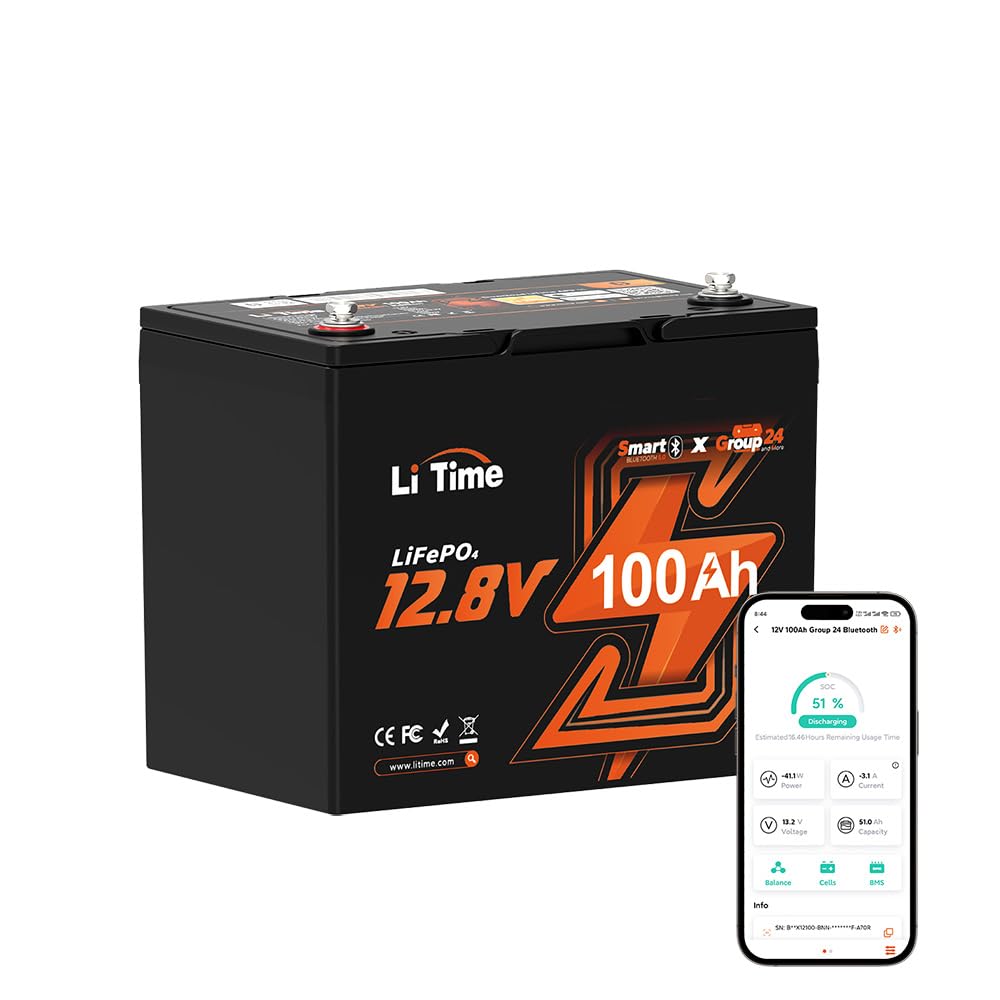
This Group 24 LiFePO4 delivers a true 100Ah of usable capacity at only 21 lbs, making it one of the most convenient drop-in replacements for lead-acid in a solar RV or backup installation. The built-in Bluetooth 5.0 module pairs with the LiTime app for real-time voltage, SOC, and temperature monitoring, so you never guess your battery status.
The 100A BMS includes low-temperature charge cut-off and IP65 water resistance, protecting the cells in unheated compartments during freezing weather. Owners report stable performance under 30A compressor loads and seamless pairing with Redarc BCDC chargers. The app can be finicky during charging cycles, but it offers essential remote disconnect capability.
At 10.24 x 6.61 x 8.3 inches, this battery fits standard Group 24 boxes without modification. The certified automotive-grade cells support 4000+ cycles, and the five-year warranty adds peace of mind for full-time solar users who demand reliable, trackable power.
Why it’s great
- Full 100Ah usable capacity at 21 lbs
- Bluetooth app with real-time SOC and temperature readouts
- IP65-rated housing for dusty or damp compartments
Good to know
- Bluetooth app may require reconnection during charging
- BMS may ship in sleep mode requiring a lithium-aware charger wake-up
2. Power Queen 12V 100Ah LiFePO4 Battery
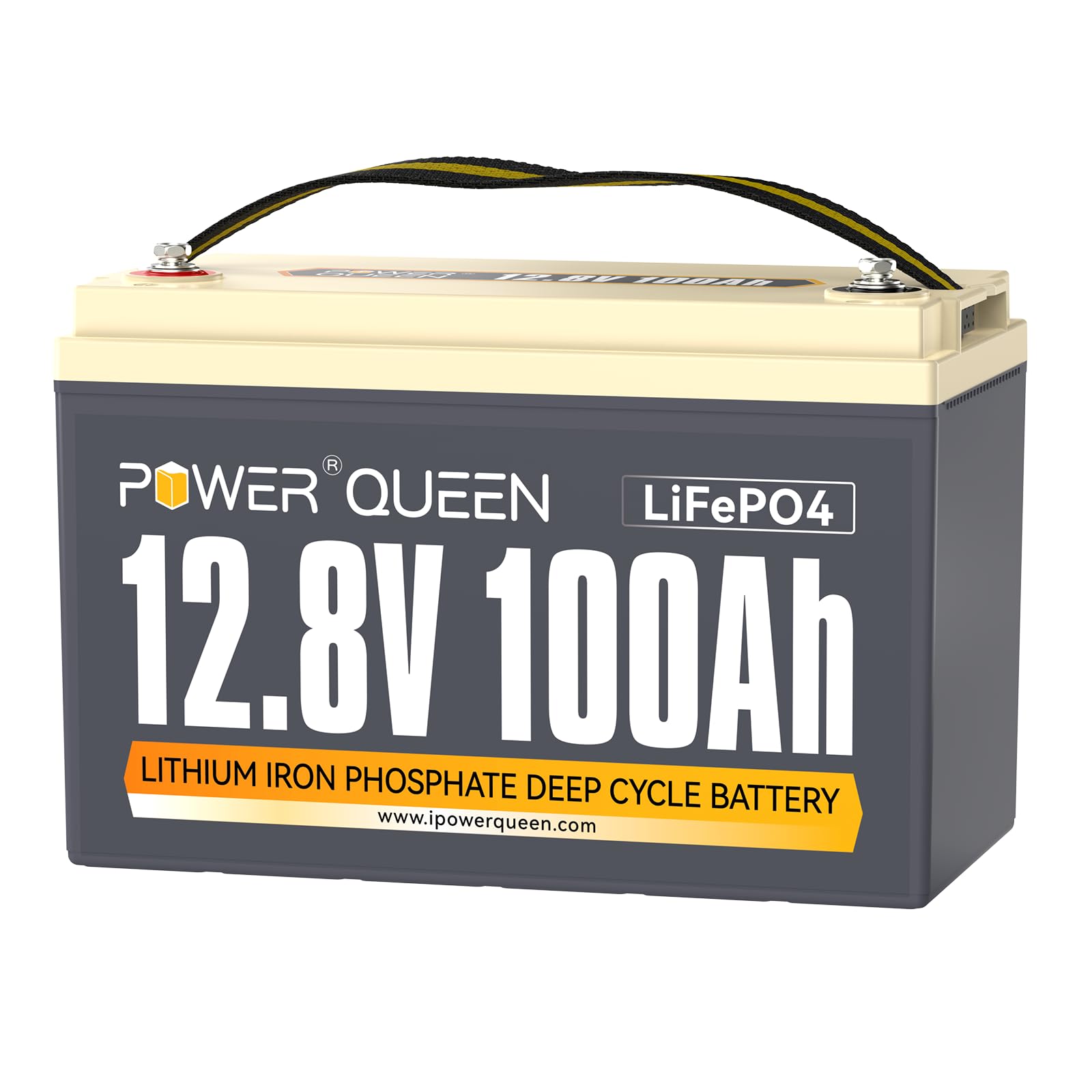
Power Queen builds one of the most robust 100Ah LiFePO4 options for solar and marine setups, using Grade-A lithium iron phosphate cells that tested at 102Ah from new. The BCI Group 31 casing weighs only 24 lbs but delivers the energy density to run a 30–70 lb thrust trolling motor for multiple days without recharge.
With an advertised 15,000 cycles to 80% capacity, this battery dramatically outpaces AGM alternatives over a five-year solar timeline. The 100A BMS covers overcharge, over-discharge, short circuits, and over-temperature protection, while the low self-discharge rate of 3% per month makes it ideal for seasonal cabins or backup panels that sit unused for weeks.
Series and parallel configurations up to 4S4P let users build a 20.48 kWh bank from four units. The straightforward design omits Bluetooth or an LED display, which reduces parasitic draw and keeps the interface simple—just solid, reliable voltage from the terminals.
Why it’s great
- Grade-A cells with verified capacity above rating
- Extremely long cycle life for heavy daily solar use
- Lightweight Group 31 format with standard terminal placement
Good to know
- No Bluetooth or display—requires external monitor for SOC
- 6mm terminal bolts may cross-thread with multiple ring lugs
3. HRBEENERGY 12.8V 100Ah LiFePO4 Battery

At 19.4 lbs and 40% lighter than equivalent lead-acid, the HRBEENERGY 100Ah LiFePO4 is among the most portable high-capacity options for mobile solar setups. The IP67-rated enclosure allows direct mounting in wet marine environments or exposed battery trays without corrosion risk.
The 100A smart BMS includes low and high-temperature cut-off, plus overcharge and short-circuit protection. Users report this battery powers a 500W heater for 2.56 hours or a 12W lamp for over 106 hours straight, matching its 1280Wh rating in real-world conditions. Parallel expansion supports up to 16 units, scaling to 20.48 kWh for larger off-grid homes.
The 10-year manufacturer warranty and universal Group 24 footprint make this a strong entry point for budget-conscious buyers who want lithium’s weight and cycle advantages without paying for extra smart features. M8 terminals accept standard solar cable lugs directly.
Why it’s great
- Fully waterproof IP67 case for outdoor and marine use
- Exceptional weight-to-capacity ratio at under 20 lbs
- 10-year warranty with responsive customer support
Good to know
- No Bluetooth or app for real-time monitoring
- Terminal thread depth may be shallow for very long bolts
4. ECO-WORTHY 12V 100Ah LiFePO4 with Bluetooth
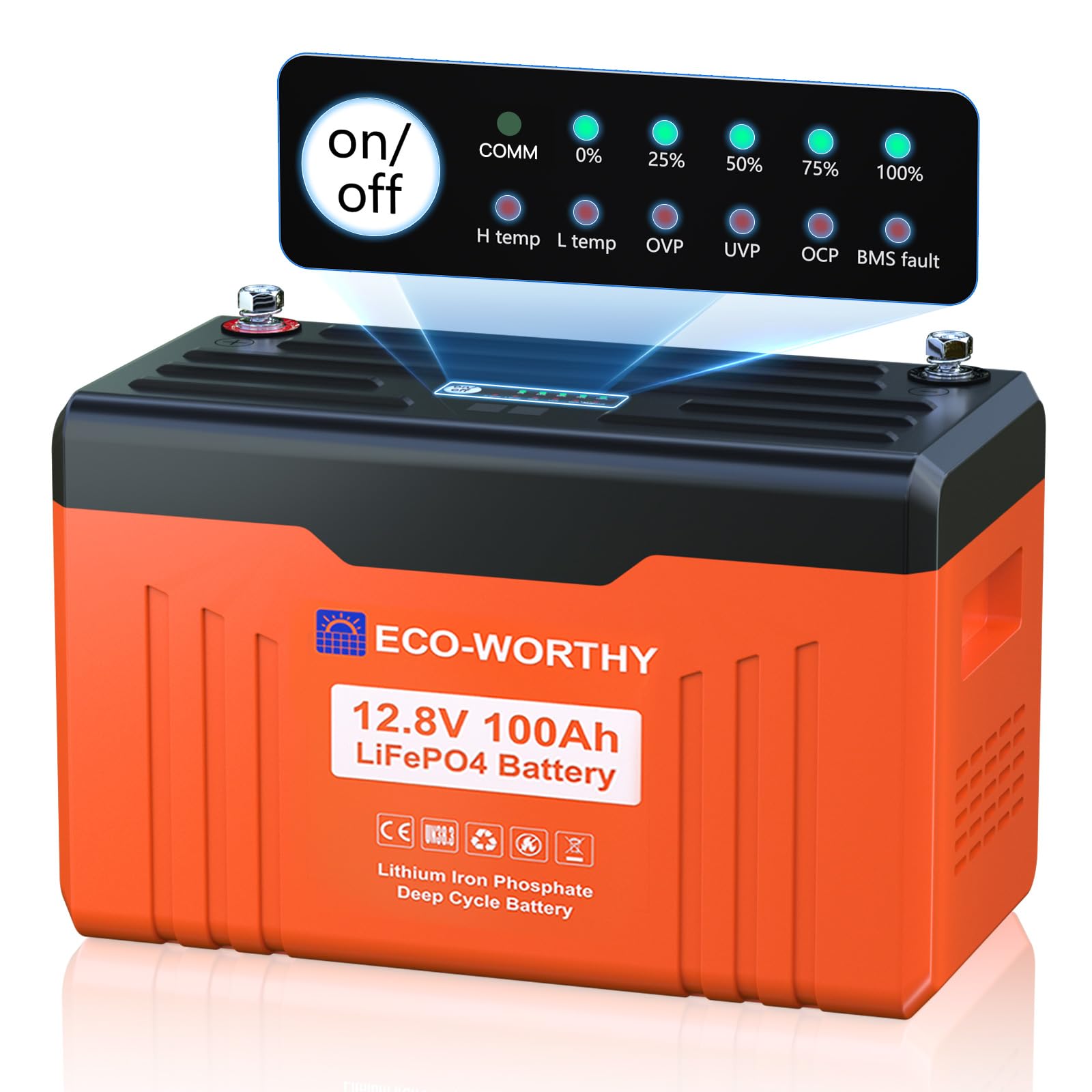
ECO-WORTHY packs two monitoring methods into one Group 27 battery: a front-facing LED display that shows SOC at a glance and a Bluetooth module for deeper diagnostics via the ECO-WORTHY app within 30 meters. The metal cell-fixture design reduces expansion risk, which is a known failure point in cheaper LiFePO4 packs.
The 100A BMS outputs 1280W continuous, enough for small appliances and trolling motors, and triggers a buzzer on fault conditions. Users noted the app’s coulomb-counting algorithm drifts under loads below 1A, so a separate shunt-type monitor is advised for accurate resting SOC. The battery supports 4P2S expansion up to 10.24 kWh, making it suitable for growing solar arrays.
At 25 lbs, this is slightly heavier than some 100Ah rivals, but the dual-display flexibility and three-year warranty compensate for the extra poundage. The physical LED display eliminates the need to pull out a phone for a quick charge check.
Why it’s great
- Built-in Bluetooth and SOC display for flexible monitoring
- Metal cell-fixture design prevents internal swelling
- Fault buzzer adds an audible safety alert
Good to know
- Bluetooth SOC accuracy drifts at loads under 1A
- Requires a Group 27 battery box (larger than standard Group 24)
5. HQST 12V 100Ah LiFePO4 Battery

HQST’s 22-lb LiFePO4 battery features a built-in LED display that cycles through real-time capacity, voltage, and current—taking the guesswork out of solar charge status without an app. The 100A BMS provides 20 layers of protection including low and high-temperature cut-off, ensuring safe operation in uninsulated sheds or RVs during winter months.
Users report losing less than 0.5V over 12 hours of heavy electronics use, confirming the full 100% DoD capability. The battery supports parallel connections up to 400Ah and series configurations for 24V, 36V, or 48V banks, making it adaptable for systems that may later expand. The 10-year product support and UL-tested cells back its construction.
One reliability note: the LED screen should be sealed with silicone or marine-grade sealant if mounted in a wet environment, as moisture intrusion has been reported. Otherwise, the battery performs consistently across solar, RV, and trolling motor applications.
Why it’s great
- Integrated LED display for instant voltage and current readout
- Low-temperature cut-off protects cells in freezing weather
- Scalable up to 400Ah in parallel configuration
Good to know
- LED screen may need waterproof sealing in marine use
- Some units arrived at low charge requiring initial activation
6. Dumfume 2-Pack 12V 150Ah LiFePO4
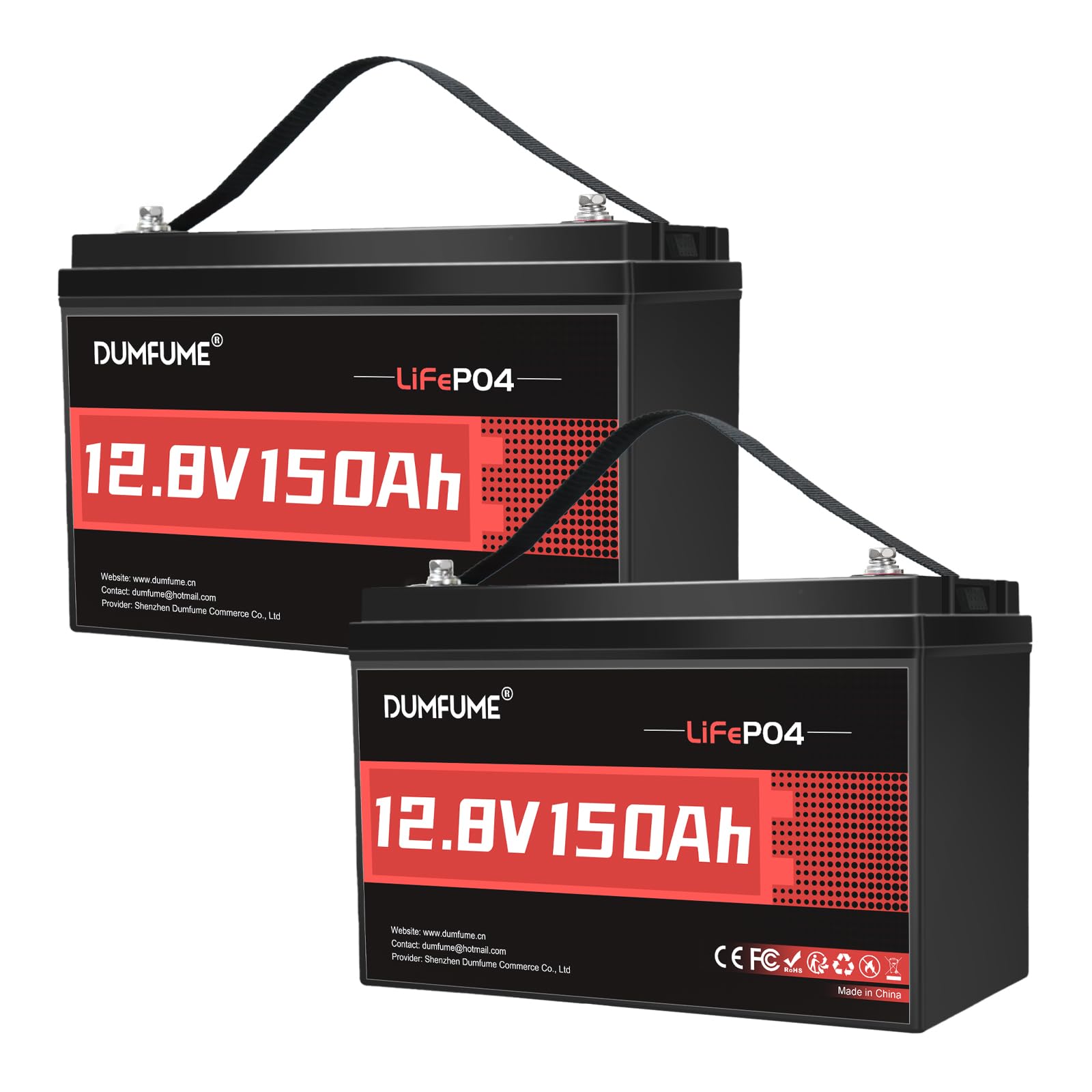
This twin-pack delivers two 150Ah LiFePO4 batteries, yielding a combined 300Ah (3840Wh) bank that can run a small off-grid cabin for several days on solar alone. Each unit weighs roughly 24.5 lbs and includes a dedicated 100A BMS, so the pair effectively doubles the protection against electrical faults in high-draw setups.
Independent testing showed each battery exceeding its 150Ah rating by about 7Ah when new, and one-year-old units in weekly cycling still surpassed the spec. The parallel configuration supports up to 4S4P, allowing this pair to integrate into larger 12V or 24V systems. Users note the 5-year warranty applies only to direct purchases, not Amazon, so check the seller’s policy before buying.
These batteries lack Bluetooth or a display, which keeps the internal electronics simple and the parasitic draw negligible. They are a solid choice for solar owners who prioritize bulk capacity and cycle life over smart monitoring features.
Why it’s great
- Factory pair delivers 300Ah at under 50 lbs total weight
- Verified capacity exceeds the 150Ah label rating
- Excellent value per amp-hour for large solar banks
Good to know
- No Bluetooth or voltage display—requires external monitor
- Warranty handling differs between Amazon and direct purchases
7. Dumfume 12V 150Ah LiFePO4 Battery
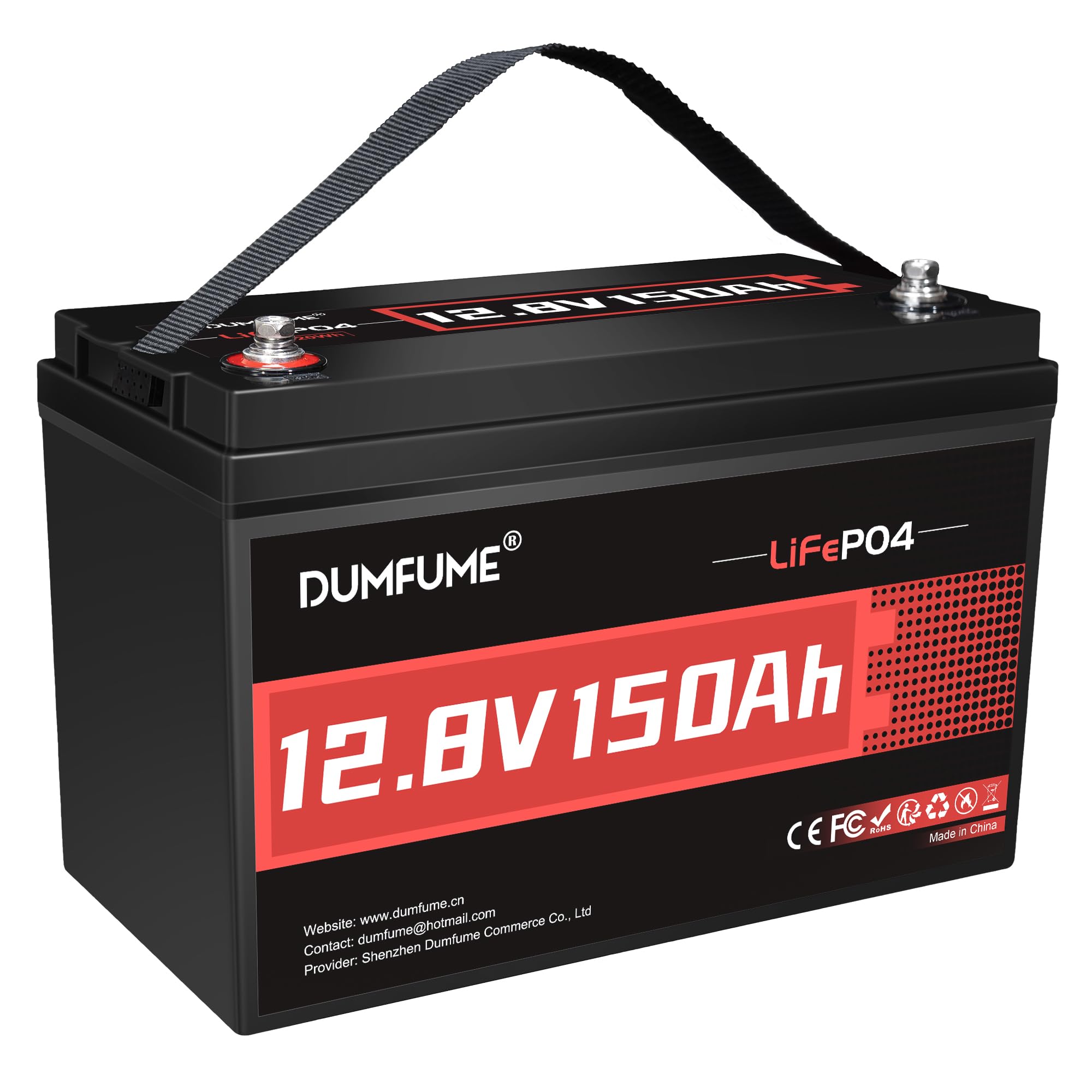
When a single battery needs to handle significant daily solar storage, the Dumfume 150Ah provides 1920Wh of usable energy at only 22 lbs—a capacity that would require two 100Ah units from most competitors. The compact Group 31 footprint (13 x 6.78 x 8.66 inches) fits standard trays and leaves room for future expansion.
The 100A BMS delivers 1280W continuous and peak handling for startup surges, while the low-temperature protection ensures safe charging down to 5°C. Owners running 50A chargers report no BMS tripping, and units tested for capacity consistently hit or exceeded 157Ah. A required full maintenance cycle every six months during storage keeps the cells balanced.
Parallel and series expansion up to 4S4P allows this single battery to anchor a system that can later grow to 600Ah. The five-year warranty covers manufacturing defects, though some users found the warranty claim process smoother through direct purchase than Amazon.
Why it’s great
- Highest single-unit capacity at 150Ah in this price segment
- Very light at 22 lbs for its output
- Handles 50A charging continuously without overheating
Good to know
- Requires temperatures above 5°C for safe charging
- No Bluetooth, LED, or battery management app
8. WEIZE 12V 100Ah Deep Cycle AGM Battery

For solar projects where budget is the primary constraint and weight is not an issue, the WEIZE 100Ah AGM delivers reliable backup at 63 lbs. The sealed lead-acid construction is maintenance-free and spill-proof, making it suitable for enclosed compartments where ventilation is limited.
With a 3% monthly self-discharge rate, this battery holds a charge well during seasonal use. The AGM chemistry tolerates continuous float charging from a solar controller without the BMS complexity or low-temperature cut-off that lithium requires. Users have successfully paralleled four units to create a 4.8 kWh backup for lights, fans, and garage door openers during outages.
The trade-off is usable capacity: AGM batteries should not be discharged below 50% DoD, so this 100Ah effectively offers 50Ah of daily cycling. It also weighs nearly three times as much as a comparable LiFePO4, which may limit portable or roof-mounted installations.
Why it’s great
- Very low upfront cost per amp-hour
- Sealed, maintenance-free, and spill-proof
- Simple series/parallel wiring without BMS interaction
Good to know
- Only 50Ah usable (50% DoD) in daily solar cycling
- Extremely heavy at 63 lbs for a single 100Ah unit
9. Newport 12V50Ah Deep Cycle AGM Battery
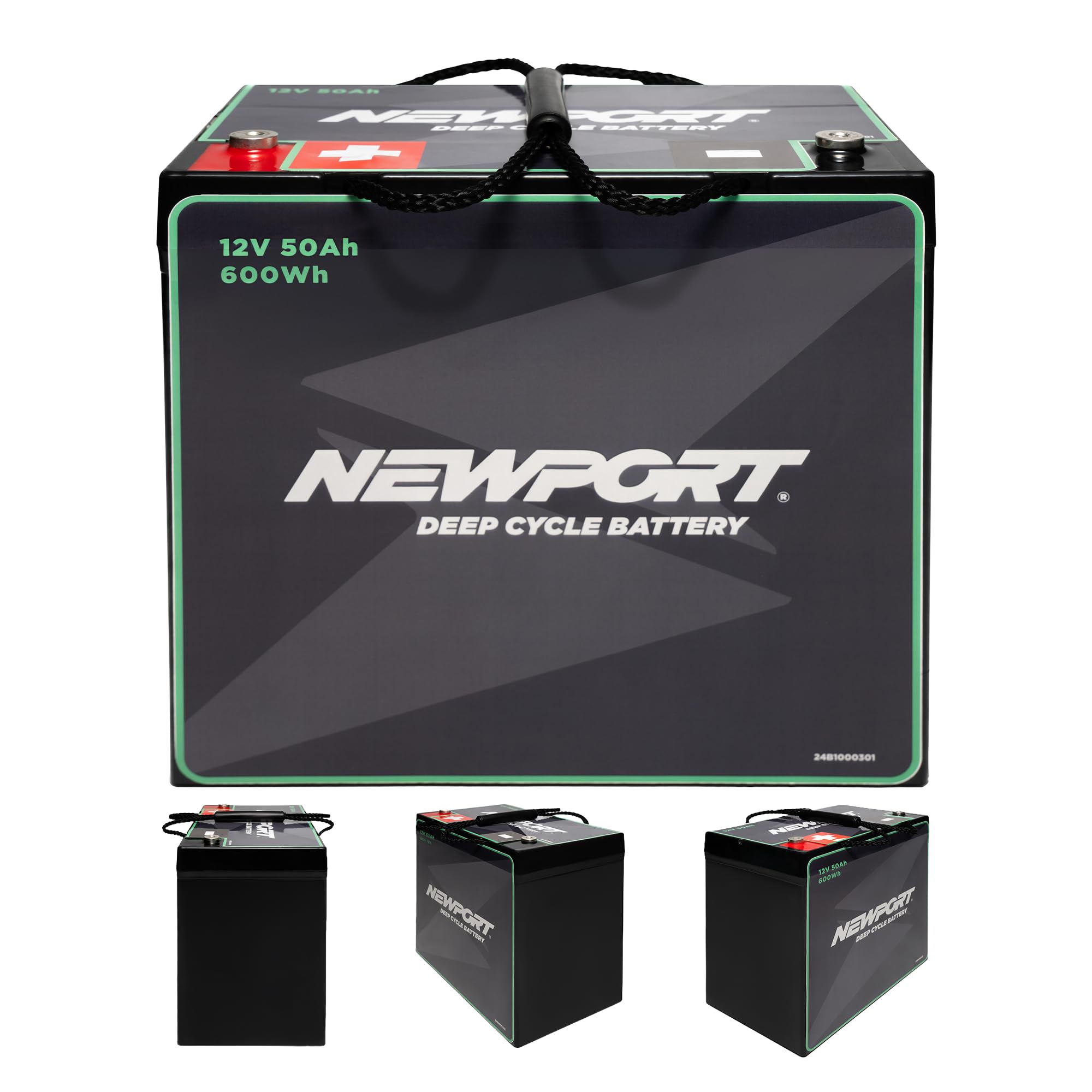
When a solar project calls for a lightweight, low-capacity battery for small appliances or a trolling motor, the Newport 50Ah AGM hits a balance between weight and cost. At 32 lbs, it is nearly half the weight of the WEIZE 100Ah while still offering a sealed, maintenance-free AGM design with marine terminals.
Users report steady voltage output for 4+ hours on a 55 lb thrust trolling motor at moderate speeds and 7 hours on a 25 lb motor at full power. The battery survived a 20 mph truck-bed tumble with only cosmetic damage—proof of its robust build. The 1-year limited warranty covers defects, though the battery lacks a built-in charge indicator, so an external voltage meter is recommended.
Its 50Ah capacity limits solar applications to very small loads—a 12W LED light could run for roughly 20 hours before hitting the 50% DoD recommended for AGM longevity. This makes it best suited for weekend camping solar setups or as a dedicated battery for a single trolling motor rather than a full home backup system.
Why it’s great
- Lightest AGM option at 32 lbs with sealed spill-proof design
- Durable construction survives rough handling and drops
- Affordable entry point for small solar or trolling motor use
Good to know
- Only 25Ah usable (50% DoD) in daily solar cycling
- No built-in charge indicator or battery management
FAQ
What is the difference between a deep-cycle battery and a starter battery for solar?
Can I use a regular lead-acid car battery with my 12V solar panel?
How many amp-hours do I need for a 100W solar panel?
Final Thoughts: The Verdict
For most users, the best battery for 12v solar panel winner is the LiTime 12V 100Ah Bluetooth LiFePO4 because it combines full 100% DoD capacity, app-based monitoring, IP65 protection, and a compact Group 24 footprint at a mid-range price point. If you need extreme cycle life for daily off-grid use, grab the Power Queen 12V 100Ah. And for small-budget or winter-temperature setups where simplicity rules, nothing beats the straightforward reliability of the WEIZE 12V 100Ah AGM.