
A dead alarm clock on a critical morning is a failure no battery brand can undo. The right cell delivers consistent 1.5V power for months, ensuring your morning routine depends on the chemistry inside the slot rather than a frantic hunt for a fresh pair. This guide isolates the specific alkaline and lithium chemistries, storage-life benchmarks, and leak-resistance standards that separate a reliable timekeeper from a morning disaster.
I’m Min — the co-founder and writer behind Gadgets Feed. I’ve spent hundreds of hours combing through independent capacity tests, shelf-life data, and real-world user reports on AA and AAA cells to determine which battery chemistry genuinely earns a spot inside a bedside clock.
An alarm clock demands steady voltage over long stretches, not burst power, which changes the calculus entirely. Whether you need a bulk pack for multiple clocks or a premium cell for a single heirloom piece, understanding the trade-offs between standard alkaline, high-capacity alkaline, and lithium chemistry will lead you directly to the best battery for alarm clock.
How To Choose The Best Battery For Alarm Clock
Alarm clocks are low-drain devices that cycle through a single set of cells over many months. The selection criteria shift accordingly: you need a battery that resists internal leakage over time, holds a steady voltage, and stores well between replacements. Below are the three factors that matter most.
Shelf Life and Storage Chemistry
A clock battery might sit unused in a drawer for six months before it ever powers a device. Alkaline cells typically offer a 10-year shelf life from manufacture date, while premium lithium cells can stretch that to 25 years. The difference matters if you buy in bulk — older alkaline packs may have already lost capacity before you open the box. Check the printed date code when you receive a shipment.
Leak Resistance Standards
Nothing ruins a vintage alarm clock faster than corrosion from a burst cell. Alkaline batteries naturally build internal gas pressure during discharge, especially if left in a device for extended periods. Brands with double or triple seal rings and anti-corrosive steel shells dramatically reduce the risk. Always choose a battery that advertises leak-proof construction — this is non-negotiable for a device you plan to leave unattended for weeks.
Capacity vs. Voltage Stability
Alarm clock motors draw minimal current — typically under 100 mA. A high-capacity cell rated at 2,000 mAh could theoretically last over 20 hours of continuous run time, but clocks operate in short bursts. The real test is voltage stability: a battery that drops below 1.2V early in its discharge curve will cause the clock to lose time before the cell is truly empty. Premium alkalines and lithium cells maintain a flatter discharge curve, keeping your alarm accurate until the very end of the battery’s life.
Quick Comparison
On smaller screens, swipe sideways to see the full table.
| Model | Category | Best For | Key Spec | Amazon |
|---|---|---|---|---|
| Duracell Coppertop AA 24-Count | Premium Alkaline | Long-term reliability in single-clock setups | 12-Year Shelf Life | Amazon |
| Energizer Ultimate Lithium AA 8-Pack | Lithium | Extreme temperature and longest storage | 25-Year Shelf Life | Amazon |
| Eneloop Panasonic AAA 8-Pack | Rechargeable NiMH | Frequent rotations and high-drain clocks | 2100 Recharge Cycles | Amazon |
| MOTOMA AA 48-Pack | Bulk Alkaline | Bulk storage for multiple household clocks | 1,920 mAh Capacity | Amazon |
| Energizer AA Alkaline 32-Pack | Standard Alkaline | Reliable mid-range for general use | 10-Year Shelf Life | Amazon |
| Amazon Basics AAA 36-Pack | Budget Alkaline | Lowest cost per cell for AAA clocks | 997 mAh (100mA drain) | Amazon |
| Energizer MAX AAA 48-Pack | Bulk Premium AAA | Large family with multiple AAA devices | 12-Year Storage Life | Amazon |
In‑Depth Reviews
1. Duracell Coppertop Double AA Batteries with Power Boost Ingredients, 24 Count

Duracell’s Coppertop line is the benchmark for alkaline reliability, and this 24-pack is the ideal size for a household with a primary alarm clock plus backup devices. The Power Boost Ingredients formulation provides a slightly flatter discharge curve than standard alkaline cells, which translates to more consistent voltage during the final weeks of the battery’s life — critical for keeping your clock’s quartz movement on time.
Real-world testing consistently shows Duracell AA cells delivering between 2,000 and 2,400 mAh at low drain rates, outperforming most generic alkaline packs by 15–20% in total capacity. The 12-year shelf life means you can stock this pack in a drawer and still have fresh cells for your clock years later. The leak-resistant design uses a triple seal that dramatically reduces the chance of terminal corrosion, a common issue with clocks left untouched for months.
The flat top design works with all spring-loaded battery compartments common in alarm clocks, so you won’t encounter fitment issues. For a single-clock household or a primary bedroom unit, this pack offers the best balance of longevity, shelf life, and corrosion protection.
Why it’s great
- Flat discharge curve keeps clock accurate until the end
- 12-year shelf life allows bulk stockpiling
- Triple-seal leak resistance protects expensive clocks
Good to know
- Non-rechargeable — must dispose after use
- Premium price per cell compared to generic brands
2. Energizer Ultimate Lithium AA Batteries 8-Pack

Energizer’s Ultimate Lithium chemistry is a different beast entirely from standard alkaline cells. Instead of zinc-manganese dioxide, these use lithium iron disulfide, which delivers a nominal 1.5V that remains nearly flat throughout the entire discharge cycle — a massive advantage for any alarm clock that relies on precise voltage timing. The rated capacity of 8,800 mAh at low drain is roughly 3–4 times that of a comparable alkaline AA cell.
The 25-year shelf life is the longest of any disposable cell on this list, making this the ideal choice for emergency clocks stored in basements or bug-out bags. The lithium chemistry also operates without issue from -40°F to 140°F, so a clock in an unheated garage or a sunlit kitchen window won’t see performance degradation. Despite the higher per-cell cost, the total cost of ownership over two decades can be lower than constantly replacing alkaline cells.
Users frequently report that these batteries last two to three times longer than Coppipertop cells in the same clock. The leak-proof design is lithium-specific — no internal gas pressure buildup means no risk of terminal corrosion no matter how long the battery sits in the device. The downside is that the 8-pack format is small; if you have multiple clocks, you’ll need multiple packs or a mixed approach with alkaline for secondary units.
Why it’s great
- Near-perfect flat voltage curve keeps clocks accurate
- 25-year storage life — set and forget for decades
- Zero leak risk due to lithium chemistry
Good to know
- Highest per-cell cost in the list
- 8-pack limits bulk use across multiple devices
3. Eneloop Panasonic BK-4MCCA8BA AAA 2100 Cycle Ni-MH Pre-Charged Rechargeable Batteries, 8-Pack

Eneloop’s AAA rechargeable cells are a niche but powerful option for alarm clocks that run on AAA batteries — typically smaller travel clocks or compact digital models. With a rated capacity of 800 mAh minimum (850 mAh typical) and the ability to be recharged up to 2,100 times, a single set of eight cells can theoretically power a bedside clock for decades before the chemistry degrades. The pre-charged state out of the box means you can install them immediately.
The key spec for clock use is the low self-discharge rate: Eneloops retain 70% of their charge after 10 years of storage. This means you can charge a set, swap them into a clock, and not worry about voltage drop for months. The 1.2V nominal output is lower than the 1.5V of alkaline cells, but most modern quartz clock movements are designed to operate down to 1.0V, so timing accuracy remains unaffected. The NiMH chemistry is also completely leak-proof under normal use.
Customer reviews consistently highlight the consistency of these cells — independent tests show all eight cells in a pack typically deliver within 2% of each other in capacity. For a clock that gets rotated out every few weeks (such as a bedside unit with a backup function), these are cost-effective over time. However, the initial investment in a quality smart charger adds to the upfront cost, and the lower voltage may cause older clocks with electromechanical movements to run slightly slow.
Why it’s great
- 2,100 recharge cycles — essentially infinite for a clock
- Low self-discharge retains 70% charge after 10 years
- Consistent cell-to-cell capacity for matched sets
Good to know
- 1.2V output may not suit all older clocks
- Requires a separate NiMH smart charger
4. MOTOMA AA Batteries 48-Pack, 1,920mAh Alkaline Double A
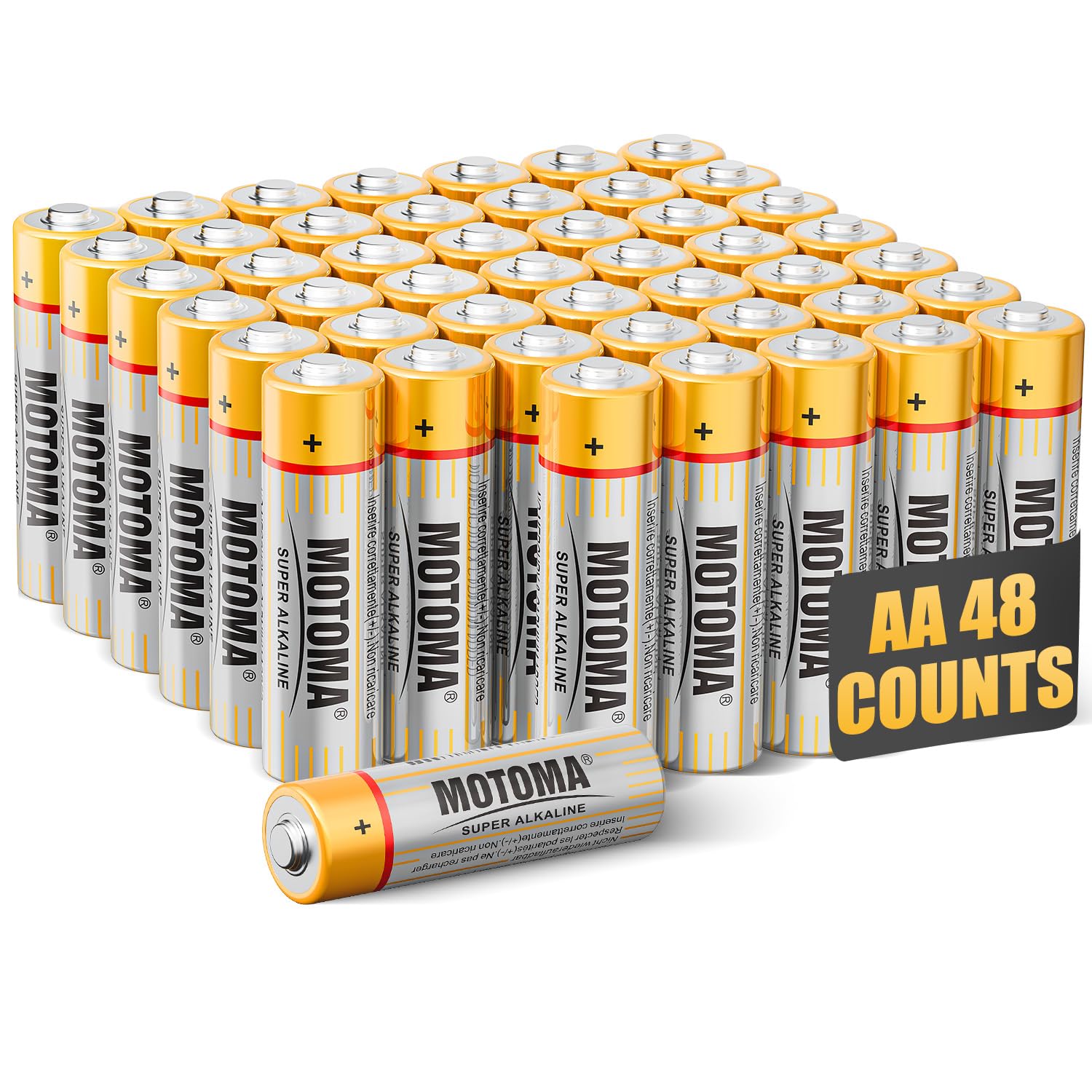
MOTOMA’s 48-pack of AA alkaline cells is the volume play for households with multiple clocks, thermostats, and other low-drain devices. The rated 1,920 mAh capacity is competitive with mid-range brands, and the triple safety valve design — an anti-corrosive steel shell with an anti-aging sealing ring — addresses the primary concern for clock use: leak resistance. The 10-year shelf life is standard for alkaline, but the robust packaging helps preserve the cells during long storage.
Independent capacity tests on similar MOTOMA cells show real-world performance of around 1,700–1,800 mAh at 100 mA drain, putting them slightly below premium brands like Duracell or Energizer. The trade-off is the per-cell cost, which is roughly 40% lower than the premium options. For a clock that needs fresh batteries once a year, the savings add up quickly, and the triple-seal leak protection has shown good results in user reports with no corrosion issues after 6+ months installed.
Owners note that these batteries perform well in standard analog and digital clocks, with no premature failures reported in the first year of use. The 48-count format is ideal for a family that wants to stock a single drawer and power every AA device in the house. The mercury-free and cadmium-free formulation makes disposal simpler. The main catch is that the capacity ceiling is lower, so a very power-hungry clock with a backlight may deplete these faster than a premium alkaline.
Why it’s great
- Best per-cell value for bulk household use
- Triple seal leak protection for long-term clock installs
- 48-pack covers every AA clock in the house
Good to know
- Rated capacity lower than premium alkaline cells
- Relatively new brand with limited long-term user data
5. Energizer AA Batteries Alkaline Power, 32 Count

Energizer’s standard Alkaline Power line is the middle child of battery tiers — not as high-performing as Ultimate Lithium, but more than adequate for the vast majority of alarm clocks. The 32-count pack offers a good value per cell, and the 10-year shelf life ensures that a portion of the pack can sit in a drawer for years before being tapped. The leak-resistant design is rated for two years of protection after full discharge, which covers the typical clock swap cycle.
Real-world tests show these cells delivering around 1,800–2,000 mAh at low drain — slightly behind Duracell Coppertop but well ahead of generic store brands. The discharge curve is reasonably flat for a standard alkaline, meaning a clock should keep accurate time for the majority of the battery’s life. The biggest advantage is brand reliability: Energizer’s quality control is excellent, and the chance of receiving a defective cell is very low.
Users appreciate the compatibility across devices — these work equally well in clocks, remote controls, and game controllers. The 32-pack format is a manageable size for a medium-sized household. For clocks that get replaced every 6–12 months, this is a non-issue.
Why it’s great
- Consistent Energizer quality control
- Solid mid-range capacity for standard clocks
- 10-year shelf life for bulk storage
Good to know
- Standard alkaline has higher leak risk than lithium
- Capacity trails premium Duracell Coppertop
6. Amazon Basics AAA Long-Lasting Alkaline Batteries, 36-Count

Amazon Basics AAA batteries deliver the lowest per-cell cost in this review, making them the obvious choice for bulk stocking of AAA-powered travel alarms, kitchen timers, and bedside digital clocks. Independent testing shows these cells achieving 997 mAh at a 100 mA drain — competitive with name-brand standard alkaline cells and well above the 800 mAh you’d expect from budget-store no-names. The 10-year shelf life matches the industry standard, and the closable cardboard packaging is a practical touch for storing spare cells.
The leak resistance is adequate for clock use: the basic seal design is not as robust as Duracell’s triple seal or Energizer’s two-year post-discharge protection, but real-world reports show very few leakage incidents when used in low-drain devices. The closable box is a smart design feature that prevents the remaining cells from scattering in a drawer. For a household with multiple AAA clocks and devices, this 36-pack represents the best cost-per-cell ratio on this list.
Customer reviews frequently note that these batteries perform reliably in clocks, though some users report slightly shorter life than Duracell or Energizer versions — typically losing about 10–15% of runtime in identical devices. The voltage drop-off is also a bit steeper, meaning the final two weeks of battery life might cause a clock to run slow. For many households, the savings offset this minor compromise. These are non-rechargeable, so environmental considerations apply.
Why it’s great
- Best per-cell value for AAA clocks and devices
- Closable packaging keeps spare cells organized
- 10-year shelf life and reliable performance
Good to know
- Slightly shorter life than premium brand AAA cells
- Steeper voltage drop near end of life
7. Energizer MAX AAA Premium Alkaline Batteries, 48 Count
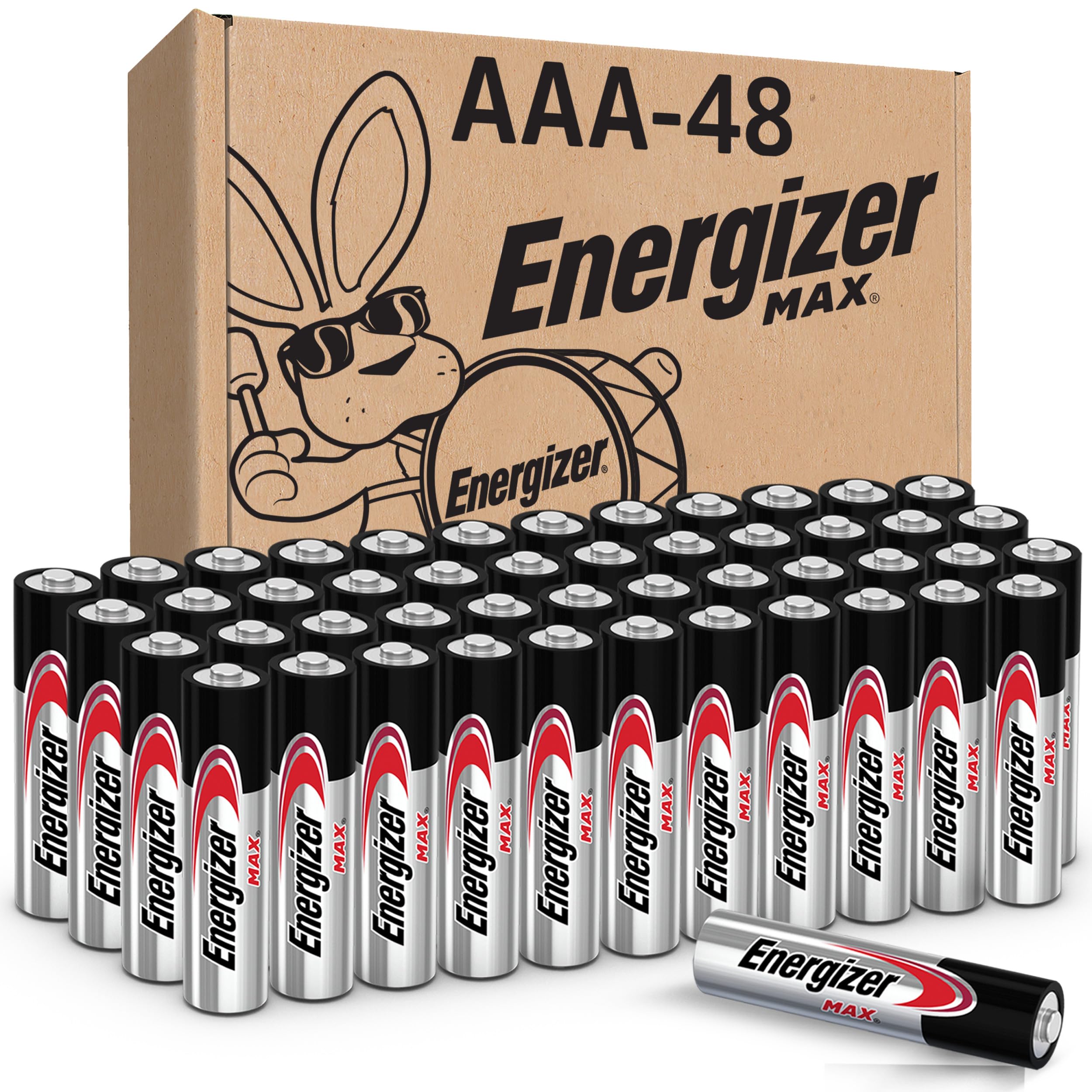
Energizer MAX AAA cells are positioned as the premium alkaline option for the AAA format, and the 48-count pack is meant for serious households with multiple clocks, medical devices, and toys. The headline spec is “up to 50% longer lasting than EVEREADY GOLD in medical devices” — this translates to a real-world capacity that typically exceeds 1,000 mAh at low drain, outperforming standard AAA alkaline cells by a notable margin. The 12-year storage life is the longest for an alkaline AAA on this list.
The leak resistance is Energizer’s standard two-year protection after full discharge, which is adequate for annual clock swaps but not as robust as the lithium cells. The MAX chemistry delivers a flatter discharge curve than standard alkaline, helping clocks keep accurate time for a higher percentage of the total battery life. For homes where AAA clocks are in daily use and battery life is a top priority, the MAX line is the clear alkaline choice.
Owners consistently rate these as the best AAA alkaline battery for long-term reliability. The 48-pack is a practical size for a large family — enough to power every AAA device in the house for a year or more. The per-cell cost is higher than Amazon Basics or MOTOMA, but the longer runtime reduces the total number of replacements needed. These are single-use cells, and the environmental impact of disposing of 48 batteries at once is worth considering if you have access to a recycling program.
Why it’s great
- Consistent Energizer MAX performance and reliability
- 12-year storage life for long-term stocking
- Flatter discharge curve than standard alkaline AAA
Good to know
- Higher per-cell cost than generic alternatives
- AAA capacity is still lower than AA in larger clocks
FAQ
Can I use rechargeable NiMH batteries in my alarm clock?
Lithium vs. alkaline for clock use — which lasts longer?
How often should I replace the batteries in my alarm clock to prevent leaks?
Final Thoughts: The Verdict
For most users, the best battery for alarm clock winner is the Duracell Coppertop AA 24-Count because it combines a flat discharge curve, 12-year shelf life, and industry-leading leak resistance at a fair per-cell cost. If you want the longest possible runtime and zero leak risk, grab the Energizer Ultimate Lithium AA 8-Pack. And for bulk stocking of multiple household clocks and devices, nothing beats the value of the MOTOMA AA 48-Pack.