
A dead battery on the water isn’t just an inconvenience — it can turn a perfect day of fishing into a long, silent drift back to the ramp. Between starting your engine, running your trolling motor, and keeping your electronics powered, your boat demands a battery that delivers reliable, consistent power without weighing you down or failing mid-trip. Choosing the wrong chemistry or capacity can leave you stranded or replacing expensive batteries far too often.
I’m Min — the co-founder and writer behind Gadgets Feed. I’ve spent countless hours analyzing electrolyte chemistry, reserve capacity ratings, BMS topologies, and cold-cranking specs to separate the marine-grade performers from the weekend warriors in this niche.
Whether you’re rigging a bass boat for tournament season or kitting out a coastal cruiser for weekend adventures, finding the right battery for boat comes down to matching your amp-hour budget and starting power to your on-water routine without overpaying for features you’ll never use.
How To Choose The Best Battery For Boat
Marine batteries face a unique set of challenges that car batteries never encounter — constant vibration, temperature swings, moisture, and deep discharge cycles that can kill a standard starting battery in a single season. Before you buy, you need to decide whether you need a starting battery (high CCA), a deep-cycle battery (high Ah), or a dual-purpose hybrid. The answer depends entirely on how you use your boat.
Chemistry: AGM vs Flooded vs LiFePO4
Flooded lead-acid batteries are the cheapest upfront but require water top-ups and venting, and they’re prone to spilling acid if your boat takes a hard wave. AGM (Absorbent Glass Mat) batteries are sealed, vibration-resistant, and maintenance-free — a solid mid-range choice for both starting and deep-cycle duty. LiFePO4 (lithium iron phosphate) batteries cost more initially but deliver 4,000+ cycles, weigh half as much as AGM, and provide consistent voltage until they’re nearly empty. For frequent boaters, lithium pays for itself in weight savings and longevity.
Capacity and CCA: Matching Power to Your Rig
Amp-hours (Ah) tell you how long the battery can run your trolling motor, fish finder, and lights without recharging. Cold Cranking Amps (CCA) measure the battery’s ability to start your outboard in cold weather. For a typical bass boat, look for at least 100Ah for trolling motor duty and 800–900 CCA for starting. If you’re running a 36V trolling motor, you’ll need three 12V batteries wired in series. Dual-purpose batteries like the OPTIMA BLUETOP offer a balanced compromise, but dedicated starting and deep-cycle batteries will always outperform a hybrid in their respective roles.
Group Size: Physical Fitment in Your Tray
Group size dictates the physical dimensions of the battery and whether it will fit in your existing tray or box. Group 24 and Group 27 are common for smaller boats and trolling motors, while Group 31 (roughly 13 x 6.8 x 9.4 inches) is the standard for high-capacity deep-cycle and dual-purpose batteries. Always measure your tray before ordering — a lithium battery in Group 31 size may be lighter but must physically fit the same footprint.
Quick Comparison
On smaller screens, swipe sideways to see the full table.
| Model | Category | Best For | Key Spec | Amazon |
|---|---|---|---|---|
| Power Queen 12V 100Ah | LiFePO4 | All-day trolling + electronics | 100Ah, 15000 cycles | Amazon |
| Litime 12V 100Ah TM | LiFePO4 | Trolling motor + ABYC compliance | 100Ah, 22.16 lbs | Amazon |
| GOLDENMATE 20Ah 2-Pack | LiFePO4 | Kayak fish finder / small loads | 20Ah each, IP67 | Amazon |
| Dumfume 12V 150Ah | LiFePO4 | High-capacity solar / house bank | 150Ah, 1920Wh | Amazon |
| Battle Born 100Ah | LiFePO4 | Premium RV / marine house bank | 100Ah, 10-year warranty | Amazon |
| OPTIMA D31M BLUETOP | AGM | Dual-purpose start + deep cycle | 900 CCA, 75Ah, 155min RC | Amazon |
| OPTIMA 34M BLUETOP | AGM | Reliable starting battery | 800 CCA, 50Ah | Amazon |
| WEIZE 12V 100Ah | AGM | Budget deep-cycle / backup power | 100Ah, 63 lbs | Amazon |
| Newport 12V50Ah AGM | AGM | Entry-level trolling motor battery | 50Ah, 32 lbs | Amazon |
In‑Depth Reviews
1. Power Queen 12V 100Ah LiFePO4 Battery
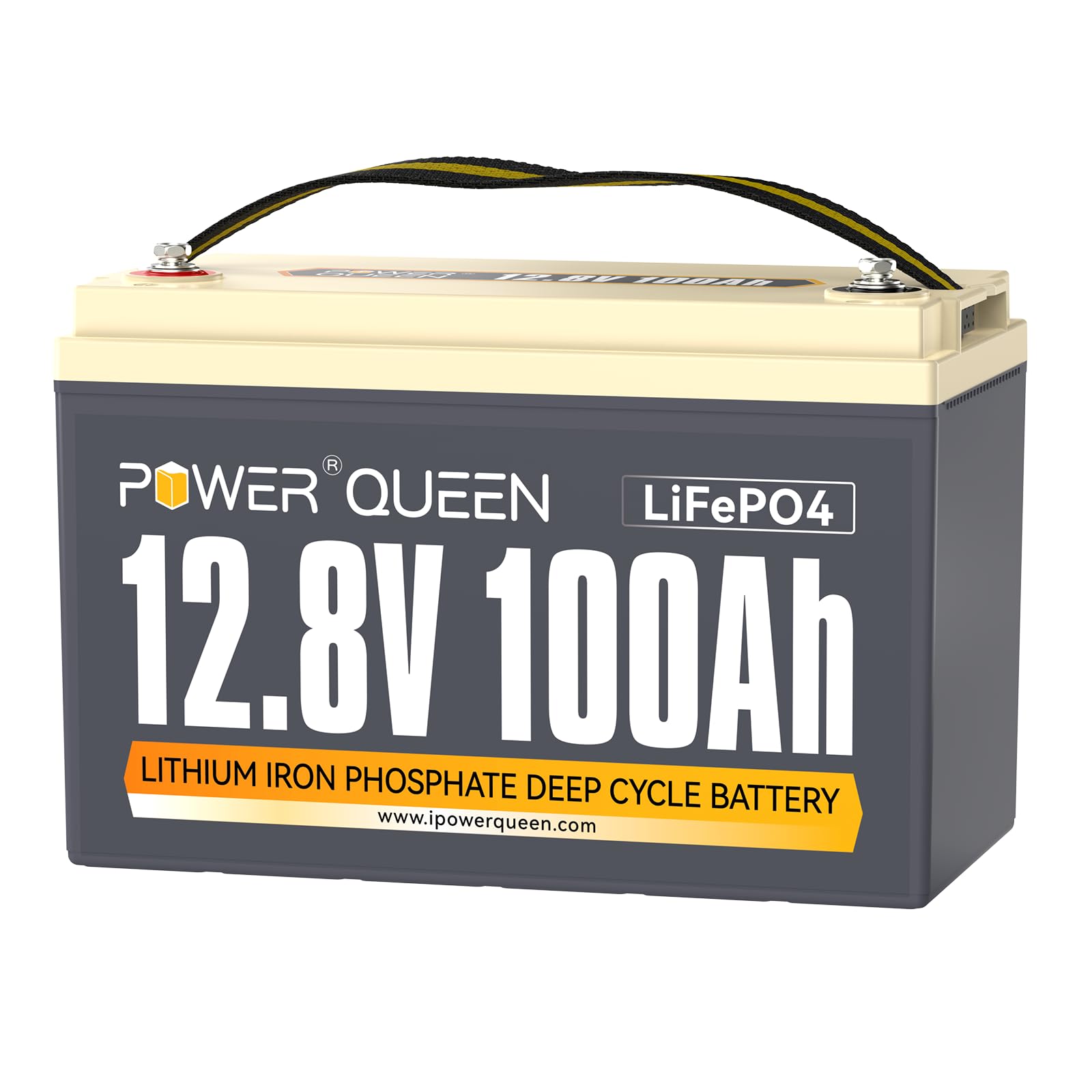
The Power Queen 12V 100Ah LiFePO4 battery hits the sweet spot for serious boaters who need all-day trolling power without the weight penalty of lead-acid. Weighing just 24 pounds — about one-third the weight of a comparable AGM — this Group 31 battery delivers 1280Wh of usable energy and can handle up to 15,000 deep cycles, which translates to over a decade of regular use before capacity degradation becomes noticeable. The built-in 100A BMS manages overcharge, over-discharge, short circuit, and thermal runaway, giving you the same safety envelope as premium brands at a lower entry point.
Real-world performance from verified buyers confirms this battery powers a 70lb-thrust trolling motor, LiveScope, and two Garmin displays from 6 AM to 6 PM with voltage dropping only from 13.2V to 13.0–13.1V at 70% speed. On a sailboat, three units in parallel ran house loads for days without issue. The flexible 4S4P expansion capability means you can build a 400Ah bank later without swapping batteries. Grade-A LiFePO4 cells ensure consistent voltage output, so your electronics stay accurate until the battery is nearly depleted.
The one real-world hitch: the 6mm terminal bolts are easy to cross-thread if you’re running multiple lugs, so take care when tightening. Also, the included bracket doesn’t fit the longer Group 31 case perfectly for all mounting trays. That said, for the combination of cycle life, weight savings, and reliable output, this is the battery most boaters should start with.
Why it’s great
- Ultra-lightweight at 24 lbs, making it easy to carry and install
- 15,000-cycle rating outlasts AGM by 10x or more
- Stable voltage output keeps fish finders and electronics accurate all day
Good to know
- Thin terminal bolts can strip if over-tightened with multiple lugs
- Mounting bracket may not align with all Group 31 trays
- Bluetooth monitoring not included; requires external shunt or meter
2. Litime 12V 100Ah Trolling Motor LiFePO4 Battery

Built specifically for the marine environment, the Litime 12V 100Ah trolling motor battery meets the ABYC E-13 standard, meaning it’s been tested for resistance to dust, water spray, and salt corrosion — real concerns when the battery sits in a wet bilge or open console. The built-in TVS (Transient Voltage Suppression) diode protects your trolling motor controller from voltage spikes that can occur in rough water, a feature you won’t find on most budget lithium batteries. At just 22.16 pounds, it’s 64% lighter than an equivalent Group 31 AGM battery, which translates to better fuel economy and easier handling on smaller boats.
Users report running a 36V trolling motor setup with only 10% battery used after five hours of fishing, and a 16-foot jonboat carrying three adults against an 8 mph headwind saw minimal discharge in four hours. The smart low-temperature protection stops charging below 32°F and stops discharging below -4°F, preventing the cold-weather damage that kills unprotected LiFePO4 cells. The BMS also handles the high inrush current of brushed trolling motors without nuisance tripping.
The main criticism is that the battery arrives in sleep mode from shipping, and the instructions don’t clearly explain the wake-up procedure — you need to apply a charging voltage briefly to activate the BMS. Litime’s customer service responds within 1-2 days, but the initial confusion is a common complaint. Also, the wiring diagram for parallel connections is incorrect; use busbars instead of daisy-chaining terminals to avoid uneven load distribution.
Why it’s great
- ABYC E-13 certified for marine-grade dust and salt spray resistance
- TVS protection prevents voltage spikes from damaging trolling motors
- Low-temp cutoff protects cells in cold weather storage
Good to know
- Battery arrives in sleep mode; requires brief charge to wake BMS
- Parallel wiring diagram in manual is incorrect — use busbars only
- No Bluetooth monitoring; capacity level is inferred from voltage
3. GOLDENMATE 12V 20Ah LiFePO4 Battery (2-Pack)
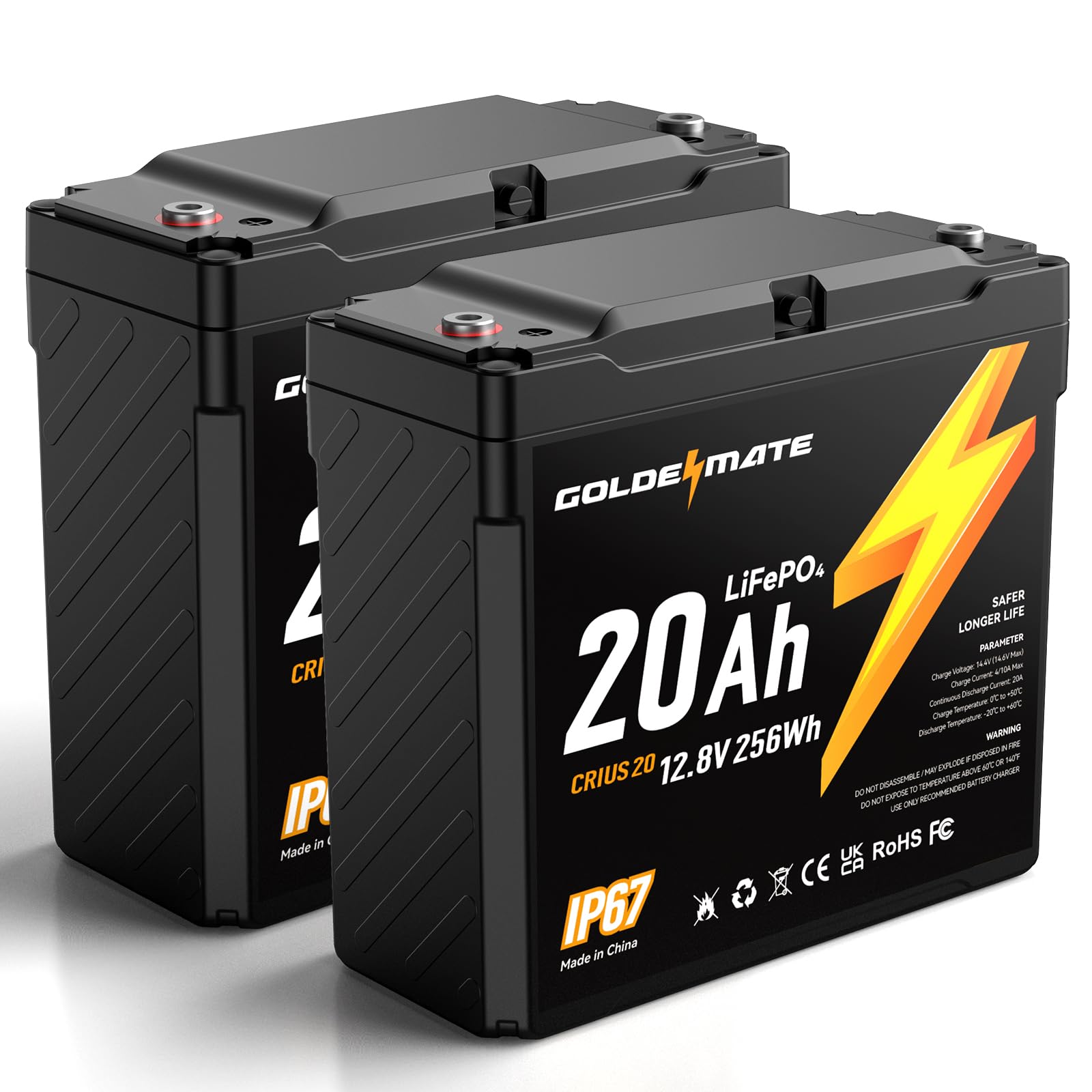
The GOLDENMATE 20Ah LiFePO4 twin-pack is purpose-built for kayak anglers, dinghy sailors, and anyone needing compact portable power for fish finders, LiveScope systems, or LED lighting. Each battery weighs just 5.95 pounds and measures about 7 x 6.6 x 3 inches, making it easy to stow in a dry bag or small hatch. The IP67 waterproof rating means it can survive accidental submersion in up to 1 meter of water for 30 minutes — a critical safety margin when paddling. The built-in 20A BMS handles overcharge, over-discharge, and short circuit protection, and the low self-discharge rate allows storage for up to a year without recharging.
Users running these in parallel for a kayak fish finder report powering LiveScope all day without voltage sag, and the compact design means you can fit two in the space of a single Group 24 battery. The LiFePO4 chemistry delivers 5,000+ cycles, far outlasting any AGM or SLA battery of similar size. For solar-powered setups (webcams, trail cameras, small LED arrays), a 200W panel charges these batteries fully within hours.
The M8 threaded terminals are smaller than standard marine posts, so you may need adapters for larger ring terminals. And the charger included in some kits is a basic unit that charges slowly; users recommend upgrading to a 10A LiFePO4 charger for faster turnaround between trips.
Why it’s great
- IP67 waterproof rating allows submersion for kayak and small boat use
- Ultra-compact at 5.95 lbs each; fits in tight storage spaces
- 5000+ cycle life outlasts AGM batteries by a wide margin
Good to know
- 40Ah total (2-pack) limits trolling motor runtime to 1-2 hours
- Small M8 terminals may require adapters for standard marine connectors
- Basic charger is slow; a 10A LiFePO4 charger is recommended
4. Dumfume 12V 150Ah LiFePO4 Battery
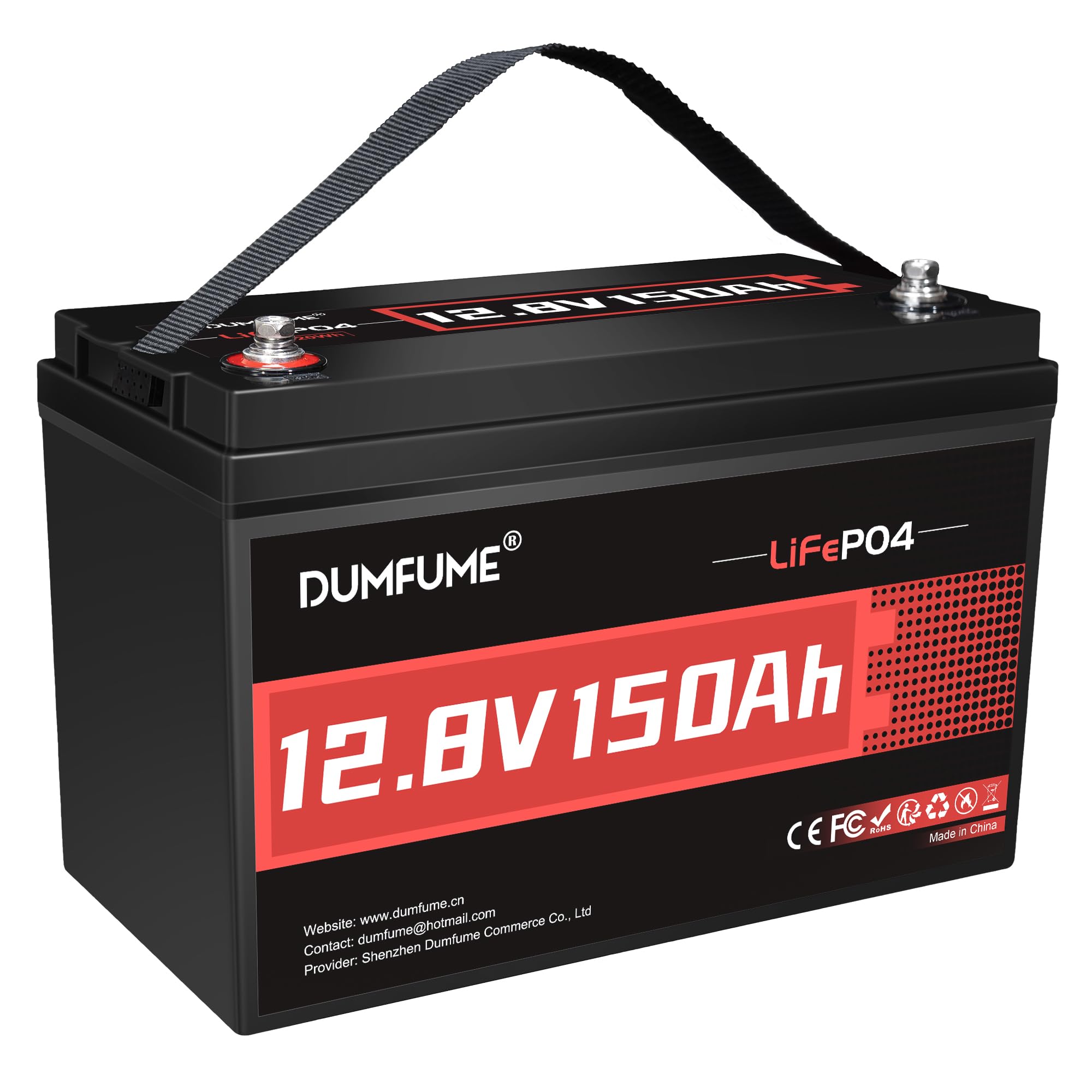
The Dumfume 12V 150Ah LiFePO4 battery offers the highest usable energy density among the mid-range options, packing 1920Wh into a Group 31 footprint that weighs just 22.05 pounds. That’s roughly one-third the weight of a 150Ah AGM battery of similar capacity. The 100A BMS protects against the usual faults plus low-temperature charging cutoffs, making this battery suitable for year-round use in colder climates if you don’t charge below 41°F. With 4,000+ cycles to 80% depth of discharge, the cost per cycle is exceptionally low for boaters who run heavy house loads or solar charging systems.
Verification from owners shows these batteries typically exceed their rated capacity by about 7Ah in testing, and four units in parallel powered a 2,000W inverter setup reliably. Golf cart users found they work well in 36V and 48V configurations after a brief initial BMS wake-up cycle. The 5-year warranty provides peace of mind, though note that warranty claims purchased through Amazon must be handled through the seller, not directly with Dumfume.
The biggest complaint centers on inconsistent state-of-charge upon arrival — about half the units in one buyer’s experience shipped at 12.2–12.4V (low for LiFePO4) and required a parallel jump charge to wake the BMS. Also, a small number of users reported complete failure after one year, with the BMS refusing to accept a charge. While not common, this failure pattern suggests component variance in the BMS. For the price, the value is hard to beat, but it carries slightly more risk than premium brands.
Why it’s great
- 1920Wh capacity in a lightweight 22.05 lb package
- Exceeds rated capacity by ~7Ah in independent tests
- 5-year warranty at a competitive price point
Good to know
- Some units arrive at low voltage needing a parallel jump to wake
- Reported BMS failures after 1 year in rare cases
- No Bluetooth; requires external monitoring to track state of charge
5. Battle Born 100Ah LiFePO4 Battery
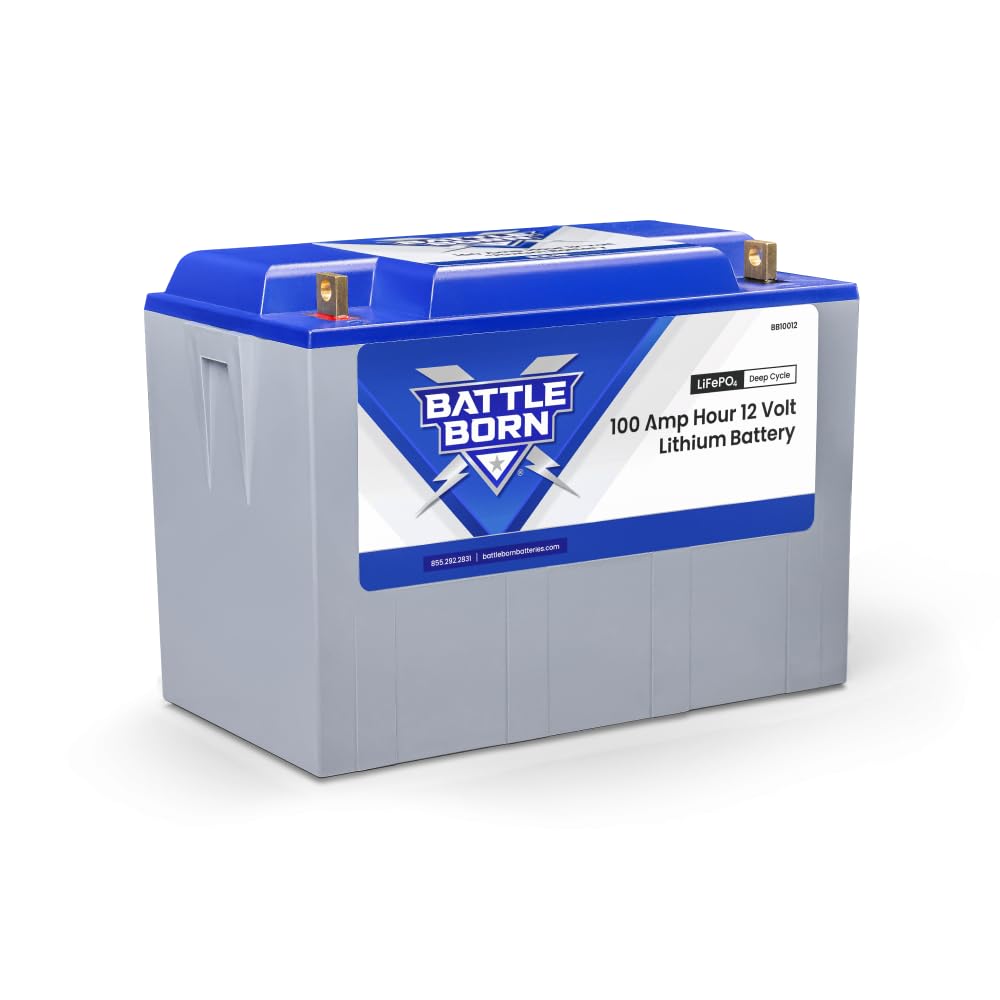
Battle Born Batteries are the gold standard for marine and RV house banks, built around LiFePO4 cells assembled in the USA with a 10-year warranty that truly covers defects. Each 100Ah battery weighs 31 pounds — heavier than the budget lithium options but still 60% lighter than an equivalent AGM — and features a robust internal BMS with low-temperature protection, high/low voltage cutoff, and short circuit protection. The drop-in design fits standard Group 27 and 31 trays, with side posts that match conventional battery connections without adapters. The ability to wire in series or parallel and mount in any orientation gives you maximum flexibility for tight engine compartments.
Owners consistently report that a single 100Ah Battle Born powers an RV fridge, lights, water pump, and devices for over 28 hours on a single charge — more than triple the runtime of the lead-acid battery it replaced. With a 300W solar panel, the battery recharges quickly, and a 450W space heater ran for 1.5 hours, raising the interior temperature by 12°F. The 10-year warranty comes with responsive US-based customer support; one owner had a BMS issue at the one-year mark and received a free replacement within days.
The price premium is substantial — roughly three times the cost of an equivalent no-name LiFePO4 battery. You also need to ensure your solar controller and alternator are configured for lithium charging; a compatible controller upgrade can cost around . And while the battery is versatile, it’s not recommended for starting applications due to the BMS’s lower peak current output. For boaters who demand the longest service life and the strongest warranty, the Battle Born is the benchmark.
Why it’s great
- 10-year warranty with responsive US-based support
- Drop-in fit for Group 27 and 31 trays with standard side posts
- Triple the runtime of lead-acid in real-world house battery use
Good to know
- Significantly higher price than comparable Chinese LiFePO4 brands
- May require alternator and solar controller upgrades for lithium charging
- Not designed for engine starting; use a separate AGM for CCA duty
6. OPTIMA D31M BLUETOP AGM Battery

The OPTIMA D31M BLUETOP is the definitive dual-purpose AGM battery for boaters who need both reliable starting power and moderate deep-cycle capacity in a single unit. With 900 Cold Cranking Amps and a 155-minute reserve capacity (C20 rating of 75Ah), this battery can fire up a large outboard or inboard engine and still run your electronics for hours. The SpiralCell technology wraps 99.99% pure lead plates into cylindrical cells that are 15 times more vibration-resistant than flooded batteries, making it an ideal choice for rough-water boats and twin-engine rigs. The dual SAE and 5/16-inch stainless steel stud terminals give you flexible connection options for both starting and accessory wiring.
Owners routinely report 9 to 14 years of service from these batteries in marine starting applications, with some units lasting over a decade before needing replacement. Two D31M units in parallel handled a 1500W load at 137.5 amps for 27 minutes during a test, demonstrating real deep-cycle capability. The sealed, maintenance-free design means no water refills, no terminal corrosion, and no venting requirements, so you can mount it in any orientation (except inverted). For a single-battery boat that needs to start the engine and power trolling gear, this is the most proven AGM option on the market.
The downsides are worth noting at this price. The battery weighs 59.8 pounds — heavy compared to lithium options. The 75Ah capacity, while adequate for dual-purpose use, is below dedicated deep-cycle batteries. Amazon shipping has been criticized for inadequate packaging, with multiple buyers receiving batteries with cracked plastic at the cell bottoms from drops. Always inspect the case carefully on arrival and check the manufacturing date to avoid old stock that has been sitting on a shelf for months.
Why it’s great
- 900 CCA delivers reliable starting power for large marine engines
- SpiralCell construction provides exceptional vibration resistance
- Proven 10+ year lifespan in real-world boat applications
Good to know
- Heavy at 59.8 lbs compared to lithium alternatives
- Amazon packaging may result in cracked cases during shipping
- 75Ah capacity is lower than dedicated deep-cycle batteries
7. OPTIMA 34M BLUETOP AGM Battery

The OPTIMA 34M BLUETOP is the smaller sibling of the D31M, optimized for boaters whose primary need is reliable engine starting with occasional deep-cycle use for lights and pumps. The 800 CCA rating is enough for most outboards up to 250 horsepower, and the 100-minute reserve capacity ensures your bilge pump and electronics stay powered even if the alternator fails. The dual SAE and 5/16-inch stainless steel stud terminals accommodate both standard battery clamps and ring terminals for accessory wiring. SpiralCell technology delivers the same 15x vibration resistance as the D31M, making this battery a long-term choice for small to mid-size boats and even personal watercraft.
One verified owner reported this battery lasted 10 years as a starting battery on their boat, running bilge pumps and electronics reliably until it was replaced preemptively — not because it failed. Another user running a 580 Case backhoe confirmed the battery held up to extreme off-road vibration that kills standard flooded batteries in weeks. The leak-proof, maintenance-free construction means you can install it in tight compartments without worrying about acid spills or corrosion spreading to nearby wiring.
The biggest risk with the 34M is receiving old stock. Several buyers reported ordering a new battery only to receive one with a manufacturing date from 2017, resulting in a dead-on-arrival unit that load-tested at just 98 CCA instead of the rated 800 CCA. Always check the date code sticker on the case before installation. The 50Ah C20 capacity is fine for starting and light house loads but won’t sustain a trolling motor for a full day of fishing. For pure starting duty, this is one of the most durable batteries money can buy, but it’s not a deep-cycle replacement.
Why it’s great
- 800 CCA provides reliable starting for most marine engines
- SpiralCell technology offers 15x vibration resistance vs flooded
- Sealed, leak-proof design for flexible mounting in tight spaces
Good to know
- Old stock with expired manufacturing dates is a known Amazon issue
- 50Ah capacity is insufficient for all-day trolling motor use
- Weighs 38.4 lbs; heavier than lithium alternatives
8. WEIZE 12V 100Ah Deep Cycle AGM Battery

The WEIZE 12V 100Ah AGM battery is the go-to choice for boaters on a budget who need a true deep-cycle battery for house loads, trolling motors, or backup power without the upfront cost of lithium. As a sealed AGM, it’s maintenance-free and spill-proof, and it delivers the full 100Ah capacity at the 20-hour rate. The 1150A max discharge current means it can handle high-draw applications like inverters and power tools, though it’s not designed for engine starting. Four of these in parallel powered a 2,000W inverter for a 4.8kWh backup system, running 120V outlets, fans, and garage door openers for hours.
Owners using these in RV and off-grid solar setups report two years of trouble-free service with 300W solar panels, running a 700W inverter for a crock pot and TV. The AGM chemistry holds a charge well and outperforms standard flooded lead-acid batteries with a slower self-discharge rate of about 3% per month. For boaters who keep their battery in seasonal storage, this is a reliable, no-fuss option that doesn’t require a BMS or special charger.
The elephant in the room is weight: at 63 pounds, this battery is over 2.5 times heavier than an equivalent LiFePO4 battery. Moving it in and out of a boat for winter storage is a two-person job. It also has no built-in charge indicator, so you’ll need a voltmeter or battery monitor to track state of charge. And while it’s rated as a deep-cycle battery, discharging below 50% state of charge will shorten its lifespan significantly — real usable capacity is closer to 50Ah if you want the battery to last multiple seasons.
Why it’s great
- True 100Ah capacity at a low cost per amp-hour
- Sealed AGM design is maintenance-free and spill-proof
- High 1150A max discharge for inverter and tool loads
Good to know
- Very heavy at 63 lbs — hard to move and carry
- Usable capacity limited to ~50Ah to avoid premature wear
- No built-in charge indicator; requires external monitoring
9. Newport 12V50Ah Deep Cycle AGM Battery
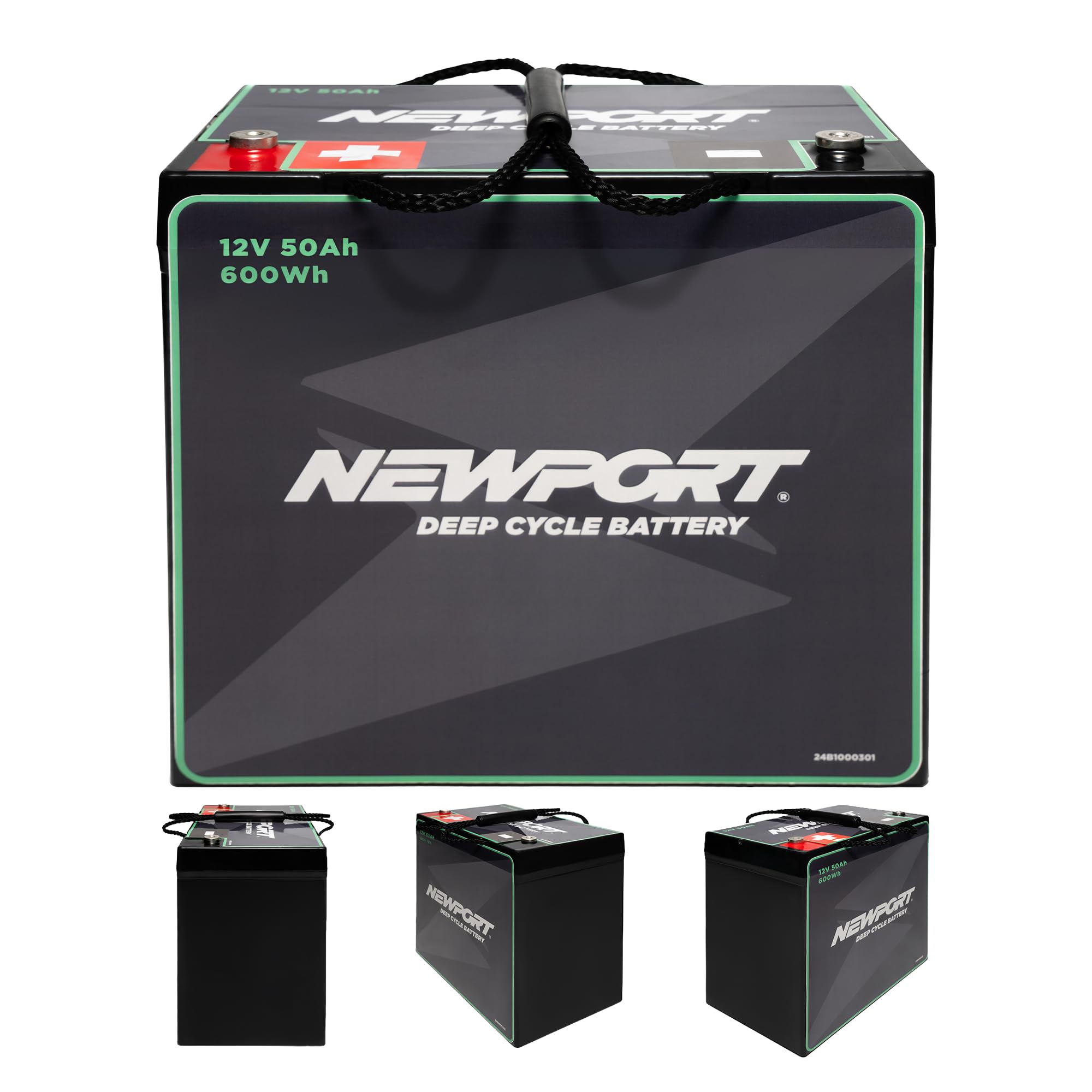
The Newport 12V50Ah AGM battery is the most affordable entry point for boaters who need a dedicated deep-cycle battery for a small trolling motor or as a secondary house battery. At 32 pounds, it’s light enough for one-hand carry, making it accessible for kayak anglers and small jonboat owners who don’t want to wrestle with heavy lead-acid batteries. The sealed AGM construction makes it leak-proof and maintenance-free, and the standard marine terminals fit most trolling motor connectors without adapters. The 50Ah capacity at the 20-hour rate is appropriate for a 25–40lb thrust trolling motor used at moderate speeds for a few hours.
Owners using this battery on a 2-person kayak with a 55lb-thrust trolling motor report steady power for four hours at moderate speeds with no voltage sag. One user ran a 25lb-thrust trolling motor on a kayak for about seven hours going up and down a river at full power, though they felt the battery could have lasted longer if fully topped off at the start. The battery also survived a 20 mph tumble from a truck bed onto asphalt with only minor cosmetic damage — a testament to its robust case construction.
The clear limitation is capacity: 50Ah is sufficient for a half-day of moderate trolling but won’t run a full day of fishing at higher speeds or support heavy electronics like LiveScope. Some users reported that the battery didn’t ship fully charged, which cut into real-world runtime. There’s no built-in charge indicator, so you’ll need a voltmeter to know when it’s time to recharge. For the price, it’s a capable starter battery, but heavy users will quickly outgrow it and wish for at least 100Ah.
Why it’s great
- Lightweight at 32 lbs for easy transport and installation
- Sealed AGM design with robust case survives drops and vibration
- Affordable entry point for small trolling motors and kayak setups
Good to know
- 50Ah capacity limits runtime on higher-thrust trolling motors
- May ship below full charge; expect reduced initial runtime
- No built-in charge indicator; requires external voltmeter
FAQ
Can I use a regular car battery in my boat?
How many amp-hours do I need for my trolling motor?
Should I buy a lithium or AGM battery for my boat?
What does group size mean for a marine battery?
Can I charge a marine lithium battery with my existing alternator or outboard?
Final Thoughts: The Verdict
For most boaters who fish regularly and need dependable all-day power, the battery for boat winner is the Power Queen 12V 100Ah LiFePO4 because it delivers the best balance of cycle life, weight savings, and price for the average angler. If you want ABYC-certified marine construction and needs voltage spike protection for a trolling motor, grab the Litime 12V 100Ah TM. And for the premium house bank that must last a decade with zero maintenance, nothing beats the Battle Born 100Ah.