
Our readers keep the lights on and my morning glass full of iced black tea. As an Amazon Associate, I earn from qualifying purchases.
Your headlights dim every time the bass hits. That flickering tells you your alternator cannot keep up with your amplifier’s demand. A car audio battery sized for deep cycling (giving steady power over long periods) fixes this by holding your voltage steady so your amps get clean power and your lights stay bright.
I’m Min — the co-founder and writer behind Gadgets Feed. This guide is built by comparing the manufacturers’ published specifications and the patterns across verified customer reviews, so you get each pick’s real strengths and trade-offs instead of marketing spin.
These six picks range from a compact battery for car audio that stops light dimming to a premium lithium powerhouse that lasts up to 20 times longer than lead-acid, according to the manufacturer’s cycle-life claims.
How To Choose The Best Battery For Car Audio
Picking a car audio battery is not like choosing a starter battery for your daily driver. You need a battery that handles repeated deep discharges (when your amp drains it low and the alternator refills it) without failing early. Here are the three numbers that matter most.
Amp-Hours (Ah) — Your Real Run-Time
Amp-hours tells you how much energy the battery holds. For car audio, aim for at least 20 Ah for a secondary battery powering a moderate subwoofer system (around 800–1000 watts). If you push 2000+ watts, look for 50 Ah or more. This number directly determines how long your system plays before voltage starts sagging.
Chemistry: AGM vs. Lithium
AGM (absorbent glass mat) batteries are sealed, spill-proof, and affordable. They handle vibration well and mount in any position. Lithium (LiFePO4) batteries cost more upfront but weigh about one-third as much as AGM, recharge twice as fast, and according to the manufacturer, last up to 20 times longer in cycle life. For a daily driver with moderate power, AGM delivers the best value. For competition-level systems or long-term ownership, lithium pays off.
Internal Resistance — Voltage Sag
A battery with low internal resistance (measured in milliohms) delivers current faster when your amplifier demands it. That means less voltage drop during bass hits — the dimming headlights you see every time a kick drum hits. Premium AGM and lithium batteries advertise ultra-low internal resistance as a key spec.
Quick Comparison
On smaller screens, swipe sideways to see the full table.
| Model | Category | Best For | Key Spec | Amazon |
|---|---|---|---|---|
| Reikken PR2400 | AGM Power Cell | High-power subs (2000+ watts) | 50 Ah capacity | Amazon |
| Kinetik HC800 BLU | AGM Power Cell | 800W systems & secondary battery | 800W maximum power | $114.99Amazon |
| Mighty Max VP-1200 | AGM Power Cell | Fixing light dimming on a budget | 50 Ah capacity | $122.49Amazon |
| XS Power XP750 | Compact AGM | Small secondary battery | 22 Ah capacity | $89.99$119.99Amazon |
| XS Power D680 | Slim AGM | Tight-space installations | 20 Ah capacity | $159.99Amazon |
| NOCO Lithium NLX27 | LiFePO4 Lithium | Maximum lifespan & extreme power | 100 Ah capacity | $651.88Amazon |
In‑Depth Reviews
1. Reikken PR2400 Energie 2400 Watt 12 Volt Power Cell

The Reikken PR2400 earns the top spot because its 50 amp-hour capacity gives you enough reserve to push a 2400-watt amplifier without your voltage collapsing. That is exactly the scenario a serious car audio build demands. You need this battery if you run 2000+ watts RMS and want a single secondary cell that actually keeps up.
At 32 pounds, it is 8.2 times heavier than the compact XS Power XP750 (3.9 pounds), but that weight translates directly into lead plates that deliver sustained current. Buyers report it keeps voltage above 14 volts even on hard bass passages, with one reviewer noting only “slight dimming at high volume” while pushing four 12-inch subwoofers. The 9.5 x 7.5 x 9-inch footprint is 46% larger than the Kinetik HC800, so measure your trunk space first.
The honest catch: a handful of buyers received units damaged in shipping, so inspect the terminal posts and case before installation. For the price, you get 2.5 times the capacity of the XS Power D680 (20 Ah) at a fraction of the lithium cost — making this the value champion for high-power builds.
Why it’s great
- 50 Ah capacity handles 2400W amplifiers without voltage sag
- Weighs 32 pounds — dense lead construction for steady power delivery
- Buyers verify voltage stays above 14V under heavy load
Good to know
- Shipped reports of damaged units — inspect on arrival
- Large footprint (9.5×7.5×9 inches) requires trunk floor space
2. NOCO Lithium NLX27
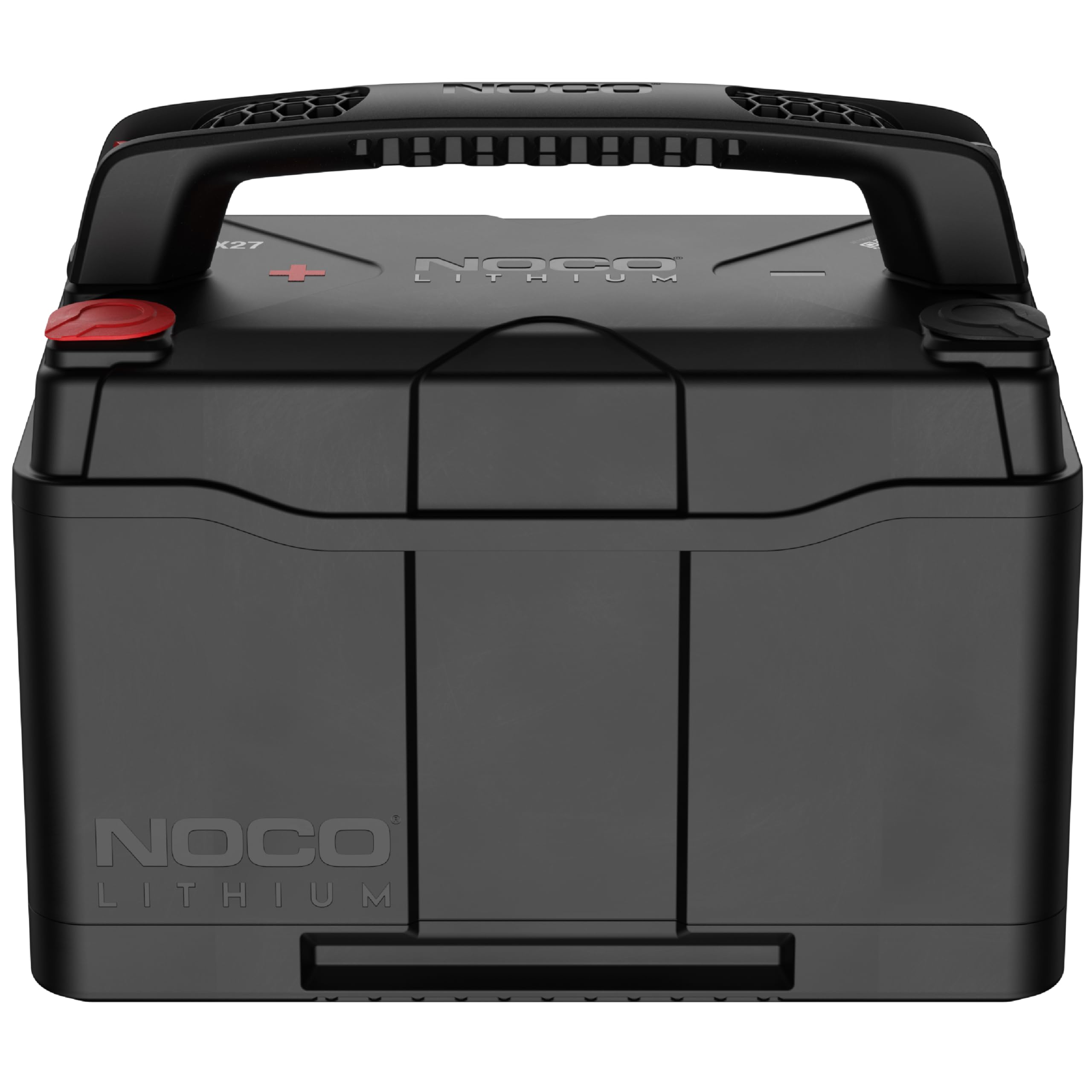
The NOCO NLX27 leaves the entire field behind on lifespan and usable capacity — it delivers 100 amp-hours and 1,400 peak amps, beating the Reikken PR2400 by 2x on capacity. According to the manufacturer, it offers up to 6,000 cycles at 50% depth-of-discharge (the percentage of the battery’s charge you use before recharging) versus a typical AGM’s 300 cycles. This battery is for the owner who plans to keep their build for years and wants to replace batteries once, not every season.
Its LiFePO4 (lithium iron phosphate) chemistry charges fully in just 2 hours with a 50A charger — twice as fast as any AGM on this list — and weighs about the same as the Reikken (33.2 lbs) while holding double the usable energy. Reviewers praise its performance as a primary battery in marine applications and high-end audio systems, noting it “maintains strong restart after hours of electronics use.” The built-in BMS (battery management system that prevents overcharge, overdischarge, and short circuits) is UL-listed, a safety certification none of the AGM batteries carry.
Pick this over the Reikken if you stop worrying about battery replacement for the next five to ten years and you have the budget for premium lithium. The investment pays back in weight savings (none of the AGM batteries match its energy density) and recharge speed that keeps your system ready faster after a long parking-lot session.
Where it shines
- 100 Ah capacity — 2x the usable energy of the Reikken PR2400
- 1,400 peak amps for effortless starting and deep-cycle power
- Up to 6,000 cycles at 50% depth-of-discharge — manufacturer claims 20x longer than lead-acid
Worth noting
- Significantly higher upfront cost than any AGM option
- Does not fit every vehicle — one reviewer noted it was 1/4 inch too tall for a Lexus LX570
3. Kinetik HC800 BLU

If you run a moderate 800-watt system and want a dedicated secondary battery that stops headlight dimming while staying affordable, the Kinetik HC800 BLU fits the job. One reviewer confirmed it “stopped my voltage from dipping below 12 volts and even stopped my headlights from dimming” — exactly the outcome you want from a secondary cell.
At 20.9 pounds and 6.5 x 8 x 5.5 inches, it is compact enough to fit in most trunks or under seats — a 46% smaller footprint than the Reikken PR2400. A buyer reported the battery “held full charge after 1 year on shelf,” which reflects the sealed AGM design’s low self-discharge rate. Its 800W maximum power rating matches cleanly with a single moderate subwoofer amplifier.
The standout here is the 1-year manufacturer warranty — three times longer than the 30-day coverage on the XS Power batteries.
What stands out
- 800W maximum power matches a single moderate amplifier perfectly
- Compact 6.5x8x5.5-inch size fits tight spaces
- 1-year warranty beats the 30-day coverage on XS Power models
The trade-offs
- 20.9 lbs is heavier than the XS Power XP750 (3.9 lbs) for similar capacity
- Only 800W max — not suitable for 1500W+ systems
4. Mighty Max Battery VP-1200

One number tells you everything: 50 amp-hours. That matches the Reikken PR2400’s capacity at a lower price point, making the Mighty Max VP-1200 the cheapest way to get serious run-time for a 1000+ watt system. A buyer who bought it to “help with a little system that was causing a little light dimming” reported it did the job, which is exactly the practical fix this battery is built for.
The catch is size: at 7.76 x 6.52 x 6.87 inches, it is shorter than the Reikken but still 2.6 times taller than the slim XS Power D680. It weighs 27 pounds, so you feel the weight when mounting it. The 50 Ah capacity matches deep-cycle performance, but the scooter-compatibility listing hints that this is a general-purpose AGM repurposed for car audio — it works, but it lacks the vibration-specific testing of XS Power’s line.
For price-to-performance, the VP-1200 delivers 50 Ah in a sealed AGM package for less than most 20–35 Ah competitor units. If you need maximum capacity per dollar and can deal with the bulk, this is your pick.
The upsides
- 50 Ah capacity at a budget-friendly price — best capacity per dollar
- Sealed AGM design mounts in any position without leaks
- Buyers confirm it stops light dimming on moderate systems
Keep in mind
- 27 pounds is heavy for its size — plan for secure mounting
- Listed as scooter-compatible, not specifically car-audio rated
5. XS Power XP750
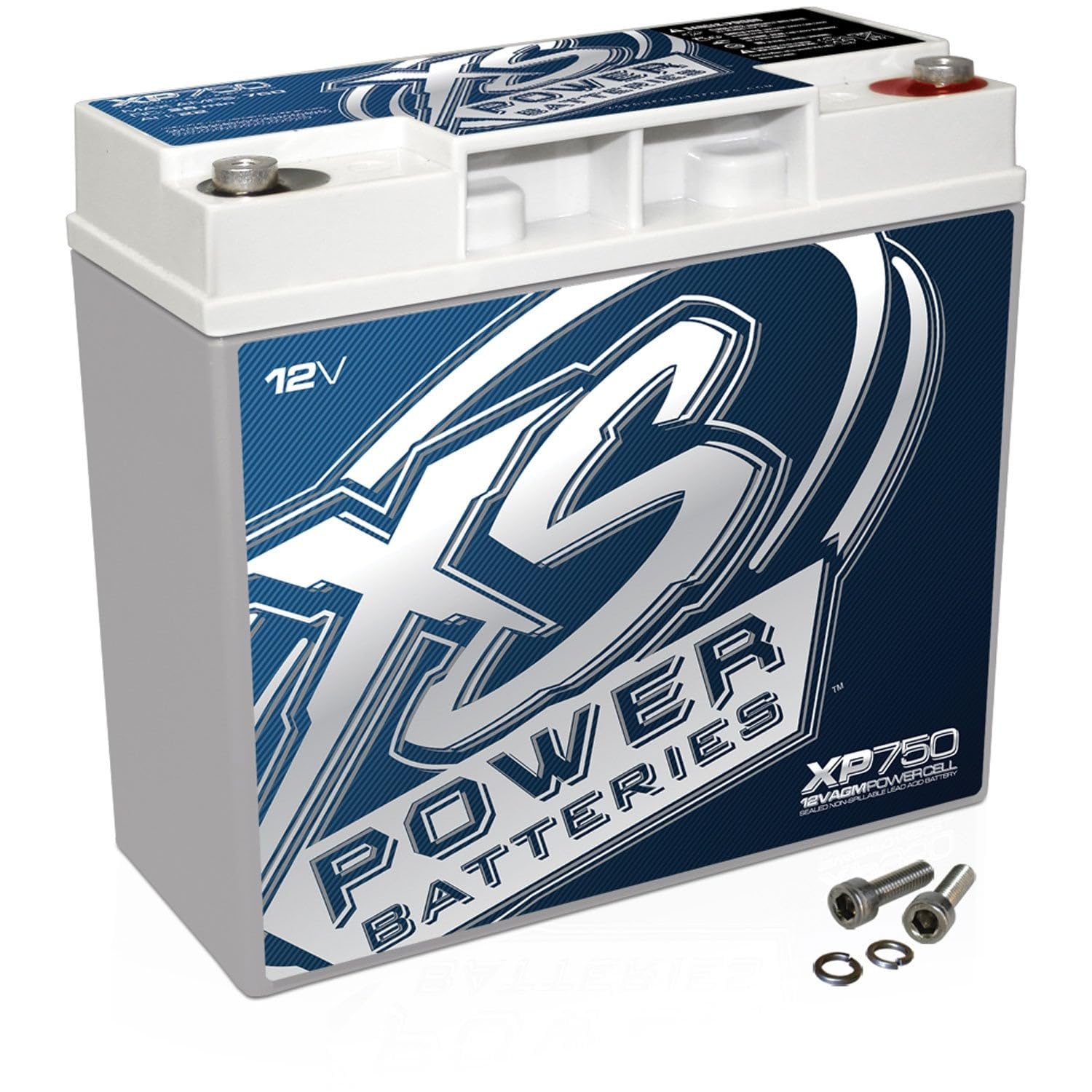
The XS Power XP750 is the lightest option on this list at just 3.9 pounds — 8.2 times lighter than the Reikken PR2400. Its compact 10 x 10 x 5-inch profile fits into tight trunk corners or under seats. This battery is for adding a small secondary cell to a modest system without adding noticeable weight or taking up space.
Its 22 amp-hour capacity and 28-minute reserve capacity (how long it can deliver 25 amps before dropping below 10.5V) is enough for a single 500–800W subwoofer amp. One buyer confirmed it “does the job well as an 2nd battery and no voltage drops to amp or lights dimming.” The ultra-low internal resistance — a key AGM advantage — helps it respond instantly when your amp demands current.
The downside: at just 22 Ah, this battery lacks the reserve for extended high-volume listening. If you compete or listen at full tilt for more than 10–15 minutes, step up to the Kinetik HC800 or the Reikken PR2400 (50 Ah). For daily driving with occasional bass, it is perfectly matched.
Why we’d pick it
- 3.9 pounds — incredibly light for a sealed AGM battery
- Ultra-low internal resistance for instant current delivery
- Owners mention no voltage drops or light dimming on moderate systems
A few caveats
- 22 Ah capacity is low — only suitable for moderate listening sessions
- 30-day warranty is shorter than competitors’ coverage
6. XS Power D680
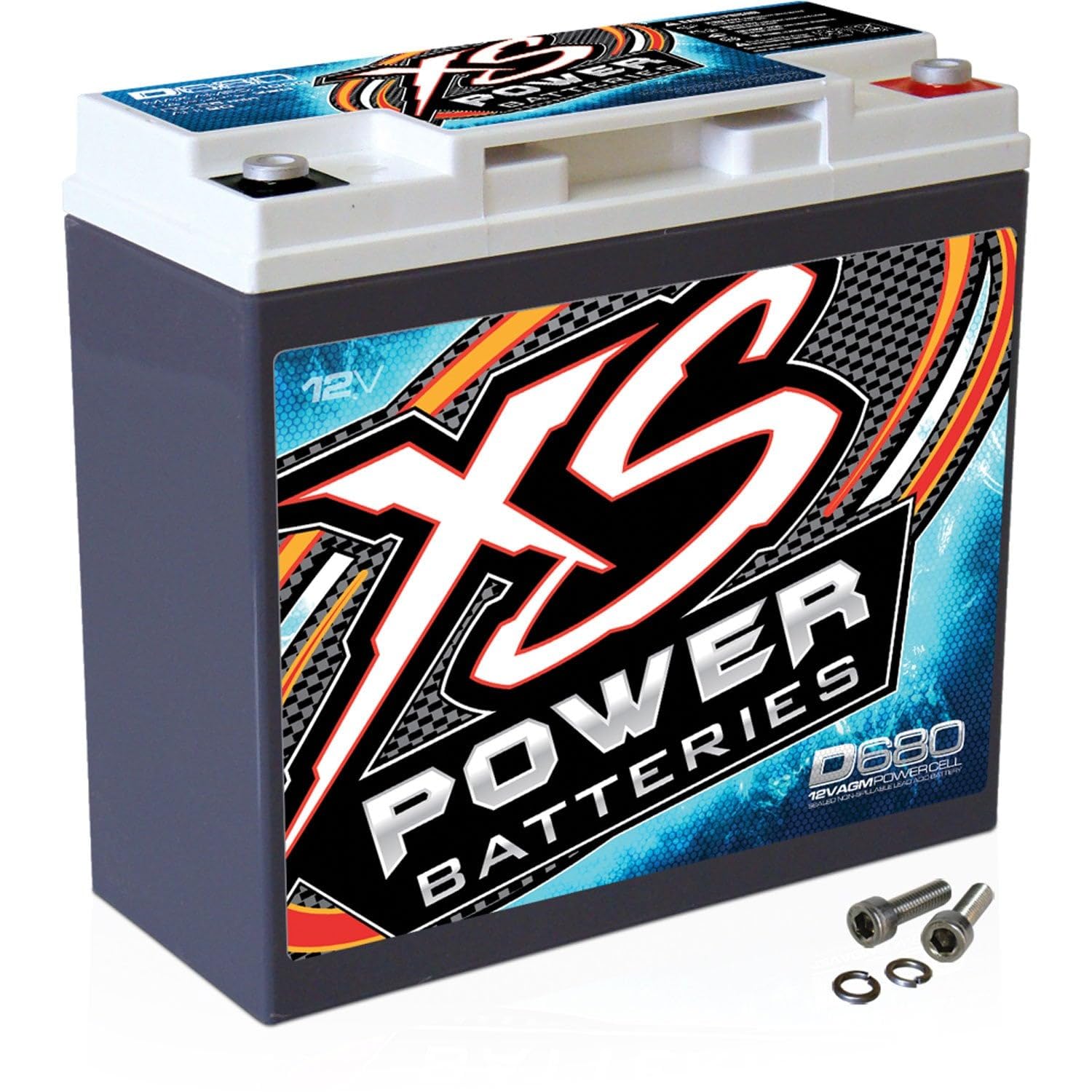
Perfect for the car audio enthusiast who needs a secondary battery that slips into a cramped under-seat or behind-the-seat cavity where depth is measured in single digits, the XS Power D680 is the obvious choice for tight installations. At just 3 inches deep and 9 inches wide, it is 2.6 times slimmer than the Mighty Max VP-1200, and its 10-pound weight is manageable for mounting on a custom bracket.
The 20 amp-hour capacity and 320 cranking amps are lower than the XP750 despite a similar footprint, so this battery is designed as a secondary power cell for modest car audio systems, not a primary starter replacement. One buyer mentioned it “works great for giving me extra power for my sound system.” However, multiple reviews report leak issues, which is unusual for a sealed AGM — inspect the terminals and case carefully.
For the tightest spaces in a car audio build where every inch of depth counts, the D680 fits where no other battery here will. Just pair it with a low-power amplifier (under 800W) and check it for leaks during the first week of installation.
Strong points
- Only 3 inches deep — slimmest battery for tight installations
- 10 pounds is light and easy to mount on custom brackets
- Buyers confirm it provides extra voltage for moderate sound systems
Before you buy
- Multiple reviews report leak issues — inspect carefully
- 20 Ah capacity is best for low-power systems under 800W
Understanding the Specs
Amp-Hours (Ah) — The Run-Time Number
Amp-hours measures how much energy a battery stores. A 50 Ah battery can theoretically deliver 50 amps for one hour, or 25 amps for two hours. For car audio, higher Ah means your system plays longer at full volume before voltage drops. A secondary battery for a 1500W system should be at least 20–30 Ah. Competition builds often use 50–100 Ah cells.
AGM vs. Lithium — The Chemistry Choice
AGM (absorbent glass mat) batteries suspend the electrolyte in fiberglass mats, making them spill-proof and vibration-resistant. They are the affordable standard for car audio. Lithium (LiFePO4) batteries are lighter, charge faster, and last thousands of cycles, but cost 4–10 times more upfront. AGM is best for most daily drivers. Lithium pays off in competition builds or long-term ownership.
FAQ
Do I need a separate battery for car audio or can I upgrade the alternator?
Can a car audio battery be used as my main starter battery?
How do I wire a secondary car audio battery?
Final Thoughts: The Verdict
For most buyers, the winner is the Reikken PR2400 because it delivers 50 amp-hours of deep-cycle capacity at a price that undercuts competitors with similar specs. If you want the longest lifespan and fastest recharge, grab the NOCO Lithium NLX27. And for a compact secondary battery that stops headlight dimming on a modest system without eating trunk space, the Kinetik HC800 BLU is the one to buy.
Product prices and availability are accurate as of the date/time indicated and are subject to change. Any price and availability information displayed on Amazon at the time of purchase will apply to the purchase of this product. As an Amazon Associate I earn from qualifying purchases.
CERTAIN CONTENT THAT APPEARS ON THIS SITE COMES FROM AMAZON. THIS CONTENT IS PROVIDED "AS IS" AND IS SUBJECT TO CHANGE OR REMOVAL AT ANY TIME.
Amazon and the Amazon logo are trademarks of Amazon.com, Inc. or its affiliates.