
Our readers keep the lights on and my morning glass full of iced black tea. As an Amazon Associate, I earn from qualifying purchases.
Specs are compiled from manufacturer listings and verified buyer reviews and can change over time — please confirm the key details on the product page before buying.
You finally got the new fish finder mounted, the wires are tidy, and you’re ready for a long day on the water — until the screen goes black two hours in because the old lead-acid battery couldn’t keep up. That sinking feeling is exactly what a proper lithium upgrade eliminates. The best battery for depth finder is the one that matches your run time without anchoring your kayak with dead weight, and today we are sorting out which chemistry, which amp-hour rating, and which terminals actually make the difference between a full day of fishing and cutting the trip short.
I’m Min — the founder and writer behind Gadgets Feed. This guide is built by comparing the manufacturers’ published specifications and the patterns across verified customer reviews, so you get each pick’s real strengths and trade-offs instead of marketing spin.
Whether you are powering a Garmin Striker on a kayak or a 10-inch chartplotter on a bass boat, the battery for depth finder you choose determines how long you stay on the water and how much dead weight you haul around.
Our Picks at a Glance


How To Choose The Best Battery For Depth Finder
Picking a depth finder battery is simpler than most anglers think. You are balancing four things: the battery chemistry, the capacity measured in amp-hours (Ah), the physical size so it fits your mounting tray, and the terminal type so the wires connect without hassle. Here is what each decision means for a real day on the water.
Chemistry: LiFePO4 vs. Sealed Lead-Acid (SLA)
LiFePO4 (lithium iron phosphate) is the clear winner for fish finders. It weighs 2.1 pounds, while an equivalent SLA battery weighs 5.85 pounds. It delivers over 5,000 deep cycles compared to 300-500 cycles for a typical lead-acid. You also get a built-in BMS (Battery Management System) that prevents overcharging, over-discharging, and short circuits automatically. The trade-off is a higher upfront cost, but the longer lifespan and weight savings make it the better value for anyone who carries a battery to the water.
Capacity: Matching Amp-Hours (Ah) to Your Run Time
Amp-hours tell you how many amps the battery can deliver for one hour. A small kayak fish finder pulls roughly 0.5 to 1 amp, so a 7Ah battery gives you 7 to 14 hours of run time. A larger 10-inch chartplotter might draw 2 to 3 amps, meaning a 10Ah battery lasts about 3 to 5 hours. If you want a full weekend without charging, step up to a 20Ah or 22Ah unit. Do not over-buy capacity for a tiny kayak — extra Ah means extra weight and bulk.
Terminal Type: F2, M5, or Pigtail Leads
Most small SLA replacement batteries use F2 terminals — the spade connectors that push onto 0.25-inch tabs. Many lithium drop-ins keep F2 terminals so you swap without cutting wires. Larger batteries (20Ah and above) often use M5 threaded screws, which require a ring terminal or a bolt. The Nocqua Pro Power kit uses a universal pigtail lead that clips onto devices directly. Check your depth finder’s power cable before buying.
Quick Comparison
| Model | Best For | Capacity (Ah) | Weight | Chemistry | Amazon |
|---|---|---|---|---|---|
| CYCLENBATT 12V 10Ah★ Best Overall | Best Overall | 10 Ah | 2.1 lbs | LiFePO4 | Amazon |
| GOLDENMATE 12V 7AhBudget Champion | Budget Compact | 7 Ah | 2.07 lbs | LiFePO4 | Amazon |
| Power-Sonic PS-1290Traditional Workhorse | Traditional SLA | 9 Ah | 5.85 lbs | Lead Acid | Amazon |
| HWE Energy 12V 9Ah | Value Lithium | 9 Ah | 2.1 lbs | LiFePO4 | Amazon |
| Enegitech 12V 10Ah | Ultra-Lightweight | 10 Ah | 1.87 lbs | LiFePO4 | Amazon |
| ZapLitho 12V 22Ah | High Capacity | 22 Ah | 5.5 lbs | LiFePO4 | Amazon |
| ECO-WORTHY 12V 20Ah | Weekend Warrior | 20 Ah | 4.85 lbs | LiFePO4 | Amazon |
| Nocqua Pro Power 12V | Kayak Kit | 4.4 Ah | 1.4 lbs | Lithium Ion | Amazon |
In‑Depth Reviews
1. CYCLENBATT 12V 10Ah LiFePO4 Lithium Battery
Our pick — over 4.5★ from 450+ verified ratings; the strongest balance of quality and price.
The featherweight 10Ah that runs two large depth finders for roughly two days straight.
This is the pick that owners come back to for the simple reason that it works exactly as advertised without drama. The CYCLENBATT delivers a continuous 10A and peaks at 20A for short bursts (5-second bursts), so even a power-hungry 10-inch chartplotter gets stable juice. At 2.1 pounds, it is lighter than the traditional lead-acid weight of 5.85 pounds, and the 5.95 x 2.56 x 3.7-inch dimensions are identical to a standard 12V 7Ah SLA — meaning it drops right into your existing battery tray without any bracket modification.
The crowd favorite here is the 10-year service life and the 5,000+ deep cycles from the Grade A cells. Buyers report that the Bluetooth-enabled app (found on the larger 100Ah sibling) captures real-time voltage and cell balance, but even the non-Bluetooth 10Ah unit includes a built-in 10A BMS that handles overcharge, over-discharge, and short circuits automatically. The IP67 waterproof rating means a splash from the livewell or a rain shower won’t kill it. One recurring detail owners mention is that it “Runs two large depth finders for ~2 days” — concrete evidence that the 10Ah rating is honest for real marine use.
The honest trade-off? This is a 10Ah battery, so if you run a high-draw unit like a Garmin Echomap UHD at full brightness all day, you will want to recharge nightly. It is a mid-range capacity that nails the balance between portability and run time.
LiFePO4 cycle champ
- Battery quality (96) and performance (84) are the two most-praised aspects — owners consistently call the build solid and the power delivery consistent.
- Weighs 2.2 lbs compared to 5.85 lbs for a comparable 9Ah SLA — you feel the difference the first time you carry it to the dock.
- IP67 waterproof rating means you don’t panic when water splashes the battery compartment.
tight fit for some
- 10Ah is fine for a single depth finder for a full day, but anglers running multiple screens or a live scope will need to step up to a 20Ah+ unit.
- Some owners wished for a Bluetooth version on the 10Ah for remote voltage checking, though the built-in BMS handles safety automatically.
long cycle life: you want a drop-in lithium replacement for your old 7Ah SLA that weighs half as much and lasts a decade.
bulky for small: you need to power a full live-scope rig for a multi-day trip — go with a 20Ah or 22Ah battery for that.
2. GOLDENMATE 12V 7Ah Lithium LiFePO4 Deep Cycle Battery
The tiny 7Ah that slips into a kayak hatch and still powers your finder all day.
If you are running a single small fish finder — think a Garmin Striker 4 or a Lowrance Hook — this 7Ah GOLDENMATE is the most cost-effective entry into lithium. It weighs just 2.07 pounds, which is dramatically lighter than the 5.85-pound lead-acid it replaces, and at 2.56 x 5.94 x 3.66 inches it tucks into tight kayak compartments. The built-in 15A Smart BMS protects against the usual overcharge and short-circuit risks, plus it has the CE, UN38.3, FCC, and UL1642 (cells) certifications that tell you the safety testing is legit.
Performance (17) and battery quality (16) are the top-rated aspects in the owner feedback. One owner reports that after six months in extreme outdoor conditions — “heat and ice” — the battery “has lasted for 6 months in the heat and ice without losing the first bit of charge.” That kind of weather resilience matters when your battery lives in an unheated garage or a truck bed between trips. The T2 terminal connectors (the same as F2 spade lugs) make swapping from an old SLA a literal plug-and-play task.
The honest caveat is that 7Ah is at the lower end of capacity. For a small single screen it is plenty, but if you decide to add a second transducer or run the backlight at max, you will hit the limit quicker than with a 10Ah. At 7Ah the 7-hour run time at 1 amp is the baseline — fine for a dawn-to-lunch session.
budget deep cycle: a minimalist kayak setup where every ounce matters and you only need power for a single small depth finder.
needs monitoring: you run two screens, a live scope, or plan 10-hour marathon days — the 10Ah CYCLENBATT is a better fit.
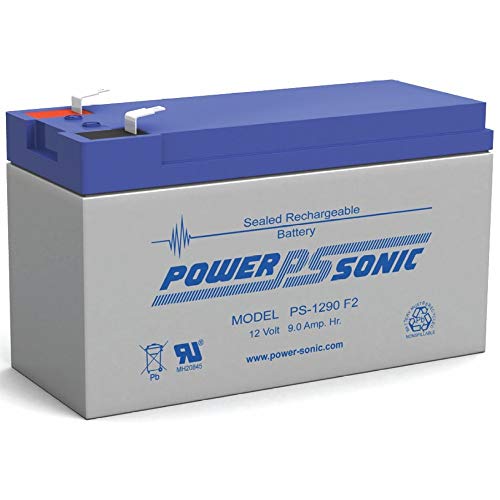
3. Power-Sonic PS-1290 12 Volt 9 Amp Hour Rechargeable SLA Battery
The old-school lead-acid that still dominates alarm systems and UPS boxes.
This is the battery your grandfather used, and it still has a place. The Power-Sonic PS-1290 is a 12-volt, 9Ah sealed lead-acid (SLA) battery with Absorbent Glass Mat (AGM) technology, meaning it is spill-proof and can be mounted in any orientation. It weighs 5.85 pounds — nearly three times the CYCLENBATT — but it costs roughly the same and has zero lithium management electronics to worry about. For anglers who already own a lead-acid charger and don’t want to switch charging habits, this is the simplest swap.
Performance (118) and battery quality (108) are the praise leaders here. Owners routinely use these as replacements for Tripp-Lite Omni systems and home UPS units, and the exact dimensions (5.94 x 2.56 x 3.86 inches) mean it slides into existing trays without shims. One owner notes a 3-4 year lifespan with proper charging via a Battery Tender Junior. The Valve Regulated, Spill Proof construction means no acid leaks if the battery tips in a boat compartment.
The honest downside is that battery life (121 mentions) carries a MIXED signal — some owners get years of reliable service, while others find that a deep discharge kills the SLA permanently in a way lithium BMS protection prevents. SLA also delivers fewer cycles (300-500 versus 4,000+ for LiFePO4), so over a five-year span you will replace this battery several times.
float charging: you already have a lead-acid charger, don’t mind the weight, and want the lowest upfront cost for a known brand.
lithium alternative: you care about every pound on a kayak or want a battery that handles deep discharges without permanent damage — go lithium.
4. HWE Energy 12V 9Ah LiFePO4 Lithium Battery
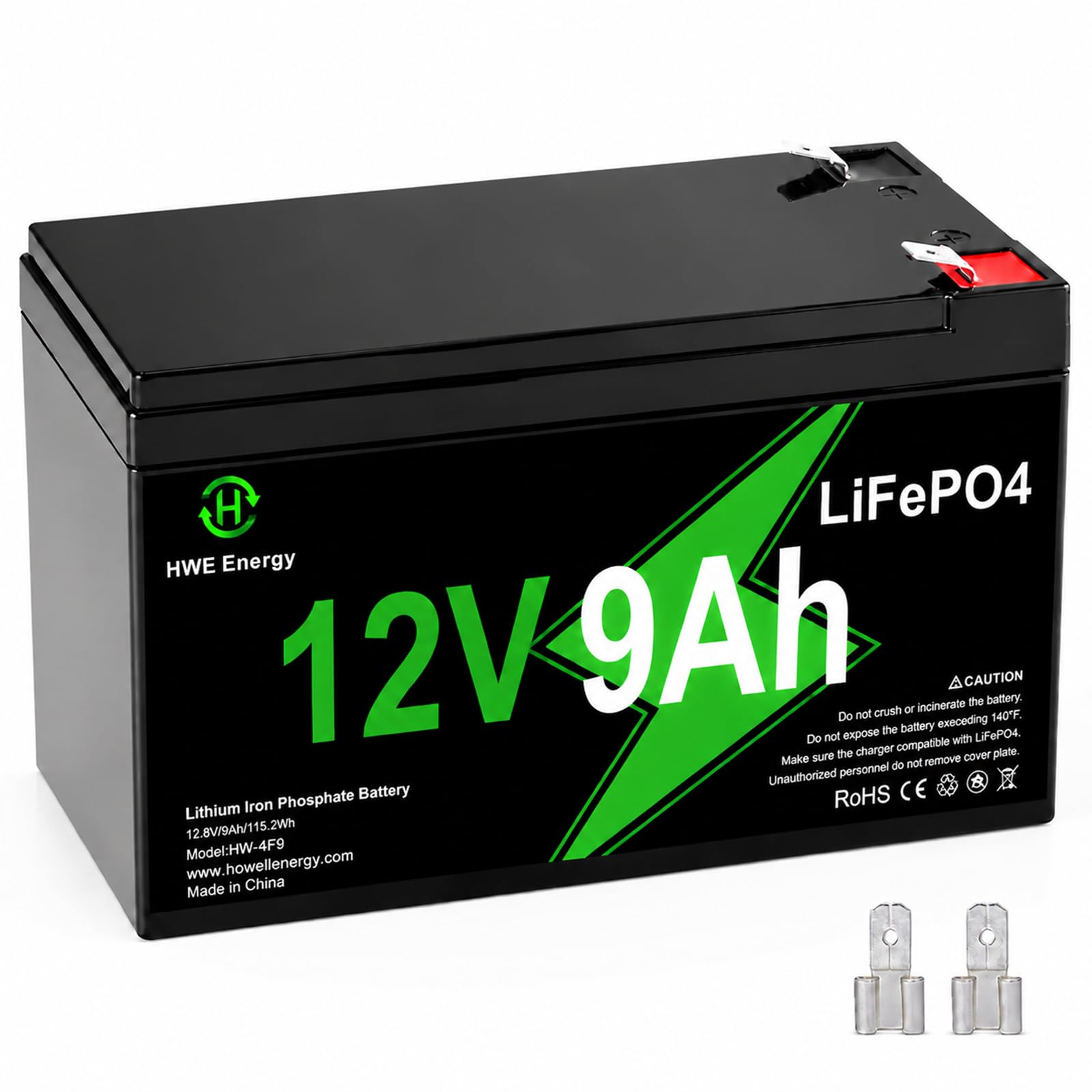
A 9Ah lithium that matches the SLA form factor but drops 3.75 pounds of dead weight.
HWE Energy takes the same approach as the CYCLENBATT — a LiFePO4 drop-in that mimics a standard 9Ah SLA footprint — and brings the price down even further. It weighs 2.1 pounds versus 5.85 for the Power-Sonic, and the built-in 15A BMS delivers the same overcharge, deep discharge, and short-circuit protection you expect from modern lithium. The included F2-to-F1 terminal adapter means it fits both common spade sizes from the start.
Performance (62) and battery quality (58) lead the owner feedback, with several buyers specifically noting it powers a Garmin 10-inch chartplotter on a boat without issue. The 9Ah capacity gives roughly 9 hours at a 1-amp draw, and the low self-discharge rate (2% per month, per the spec) means you can charge it at the start of the season and still have usable power weeks later. The 4,000+ deep cycle rating is standard for premium lithium cells.
The BMS also includes a low-temperature cutoff, which protects the cells if you accidentally leave the battery in a freezing garage. That is a feature SLA batteries simply do not offer. The 2-year warranty adds a safety net, though it is shorter than the 5-year from CYCLENBATT.
BMS protected: you want a budget-friendly lithium swap for your 9Ah SLA tray with the full BMS protection suite.
low energy density: you need a longer warranty period or want Bluetooth monitoring — this is a no-frills, reliable cell.
5. Enegitech 12V 10Ah LiFePO4 Lithium Battery
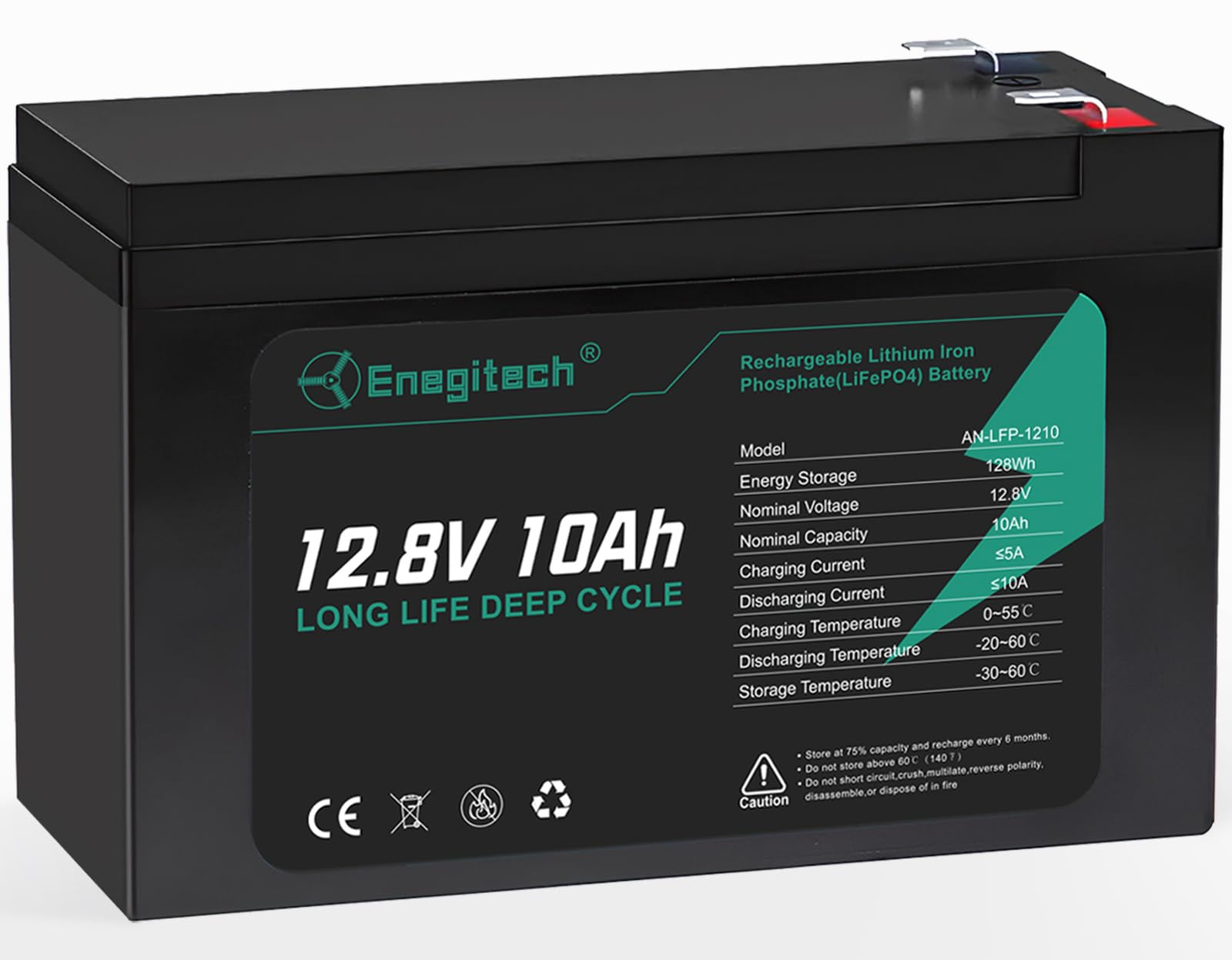
The lightest 10Ah in the lineup at 1.87 pounds — barely heavier than a water bottle.
If every ounce counts on your kayak or paddleboard, the Enegitech is the standout for pure weight savings. At 1.87 pounds and dimensions of 5.87 x 2.52 x 3.7 inches, it is roughly one-third the weight of a comparable lead-acid battery. The 10Ah capacity matches the CYCLENBATT, but the Enegitech uses A-grade cells and lists a 10-year lifespan with 2,000+ deep cycles.
The maker specifically lists compatibility with Garmin Striker 4 and Humminbird HELIX 5 fish finders, plus a range of APC UPS models, so if you are swapping a battery in a backup unit this is a direct fit. Performance (15) and battery quality (11) are the top aspects in the owner data. One buyer reports it “works perfectly for portable electronics, lighting, and outdoor projects” right from the start.
A critical fit note: the manufacturer explicitly states you cannot connect these in series or parallel, and it is not designed for kids’ ride-on toys. If you need to scale capacity later by linking batteries, skip this one. The battery life (12 mentions) is flagged as MIXED — some owners mention it holds a charge well for months, while a few had charging issues that suggest a defective unit rather than a design flaw.
space saving: an ultralight kayak or SUP build where saving ounces is more important than expanding capacity later.
unproven reliability: you plan to wire multiple batteries in parallel for extended run time — this unit prohibits series or parallel connections.
6. ZapLitho Upgraded 12V 22Ah LiFePO4 Lithium Battery
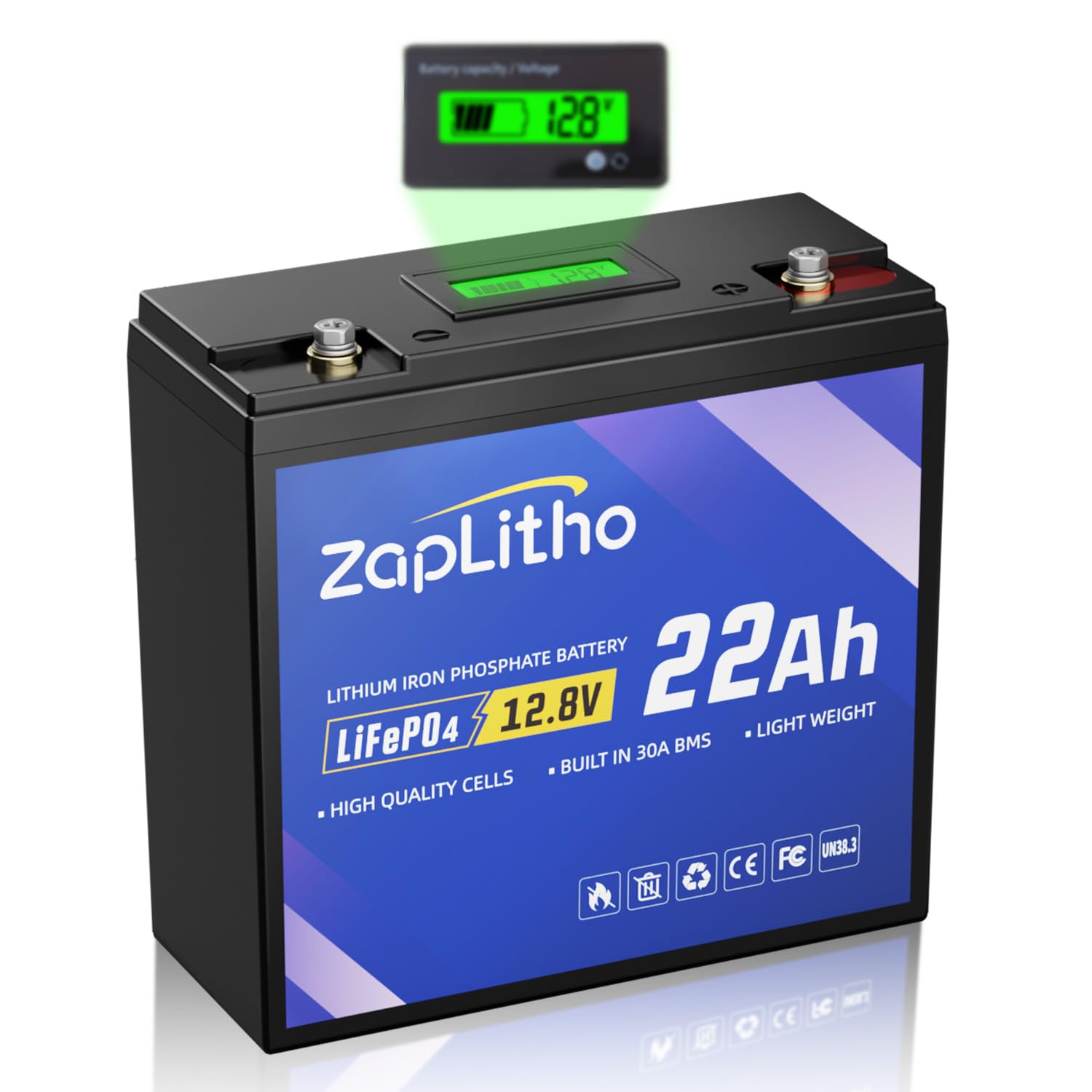
The 22Ah that powers a live scope and a fridge for a weekend without recharging.
For serious anglers running a live scope, a 10-inch chartplotter, and maybe a 12-volt cooler, the ZapLitho 22Ah is the capacity step-up that turns a day trip into a multi-day adventure. It weighs 5.5 pounds — still lighter than a 9Ah SLA — and measures 3 x 7.1 x 7 inches. The LCD voltage display on the front is a practical touch: you can glance at the remaining charge without carrying a multimeter.
Battery life (23) and lightweight (8) are the most-praised aspects. Customers note running a 12V fridge/freezer for 4.5 days on a full charge and powering a Yaesu FT-891 ham radio at 100W without voltage sag. The 30A BMS handles higher continuous draws than the 10A or 15A BMS units in smaller batteries, and the Grade A cells carry a 4,000+ deep cycle rating. The M5 terminals are standard for this capacity class, so you will need ring terminals or an adapter if your fish finder uses F2 spade connectors.
The honest trade-off is physical size. At 7 inches wide, this battery will not fit a standard 7Ah SLA tray meant for a 2.5-inch-wide battery. You need a dedicated battery box or a flat mounting surface. The water resistance is “limited to splashes” per the manufacturer, so submersion or direct rain exposure voids the warranty — treat it as indoor/cabin-protected.
extended runtime: you need all-day-plus power for a live scope, multiple screens, or off-grid camping gear in a single battery.
heavy weight: you need a compact drop-in for a small SLA tray — the 7-inch width requires a larger mounting space.
7. ECO-WORTHY 12V 20Ah LiFePO4 Lithium Battery
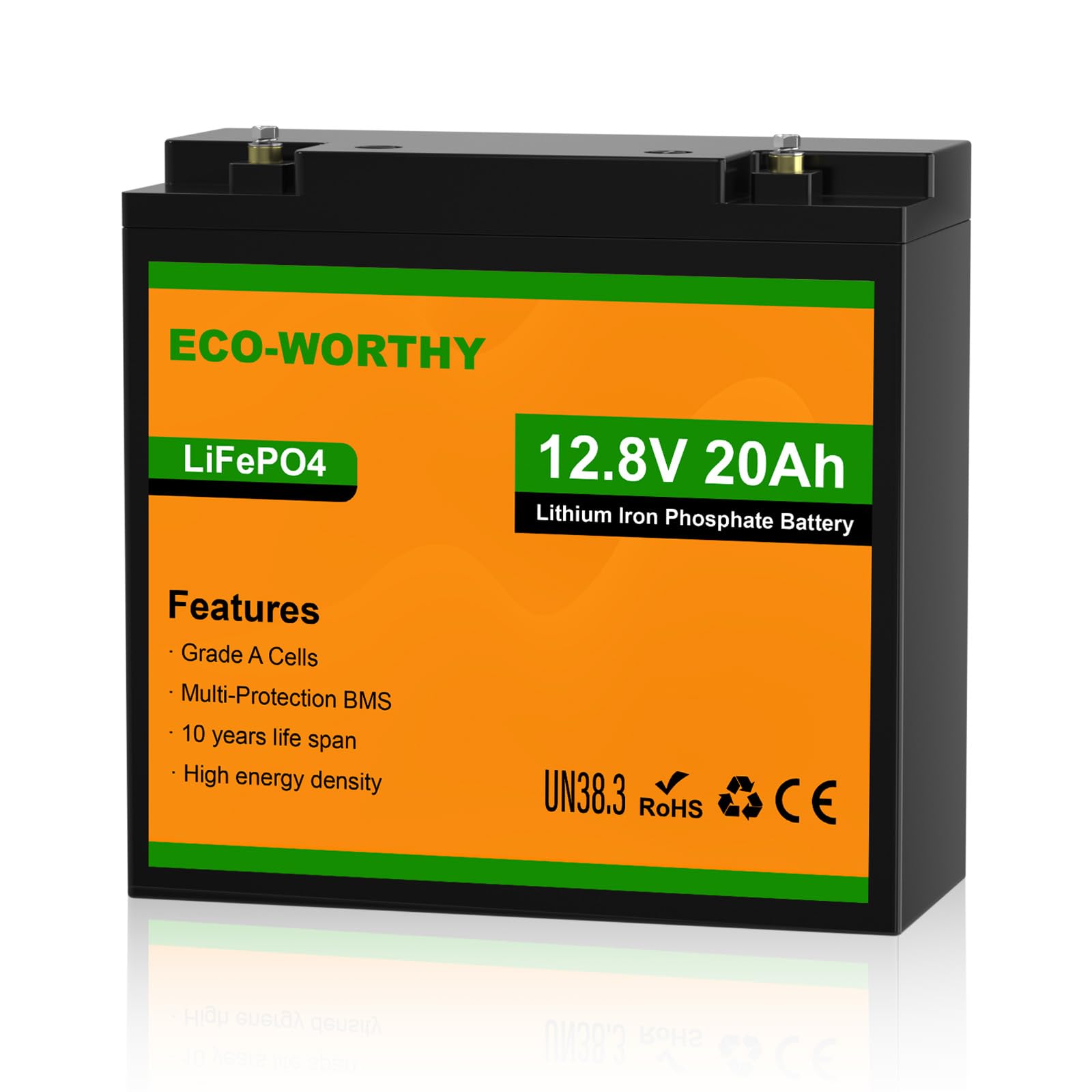
A tried-and-tested 20Ah that powers a fish finder for hours with zero voltage drop.
ECO-WORTHY is a familiar name in off-grid solar and marine batteries, and this 20Ah LiFePO4 unit is the most-reviewed high-capacity option on the list. It weighs 4.85 pounds and measures 3.03 x 7.17 x 6.69 inches, making it just slightly smaller than the ZapLitho 22Ah. The built-in BMS handles overcharge, over-discharge, and short circuits, and the M5 screw terminals provide a secure connection for medium-draw devices.
Performance (55) and portability (33) lead the owner praise. One owner tested the actual capacity and found it delivered 21.7Ah — slightly exceeding the 20Ah rating — and reported that it powers a fish finder “for hours with no voltage drop.” Amateur radio operators particularly like this one for POTA (Parks On The Air) kits because it runs a 50W radio without sagging. The company also has a strong reputation for customer support, with one owner noting a defective unit was replaced quickly.
The honest caveat is that battery life (110 mentions) carries a MIXED signal. Many reviewers point out two years of reliable service, but a subset experienced premature voltage drops. Given the volume of positive reviews overall, this inconsistency is more likely related to individual charging habits or mismatched chargers than a consistent defect. Use a dedicated LiFePO4 charger (14.6V) for best results.
large capacity: weekend warriors who want a proven 20Ah with excellent customer support and verified capacity that meets or beats its rating.
cheaper cells: you need a compact drop-in for a small tray — this battery is wider than a standard SLA and needs more space.
8. Nocqua Pro Power 12 Volt Lithium Battery & Charger Kit
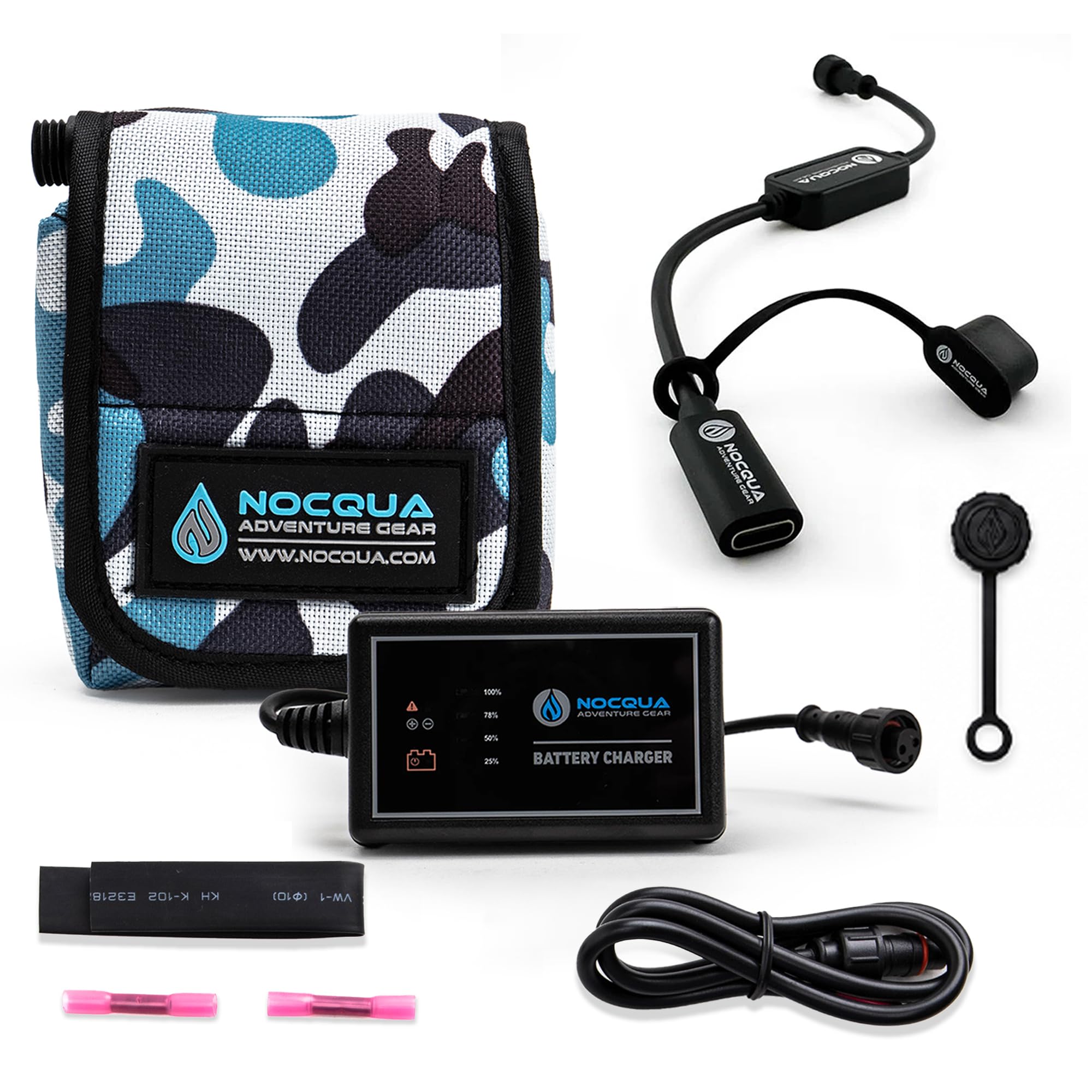
The palm-sized 4.4Ah kit that weighs 1.4 pounds and fits in a jacket pocket.
The Nocqua Pro Power is a complete system — battery, wall charger, ballistic nylon camo sleeve, and universal pigtail cable — designed specifically for kayak anglers who want the absolute smallest footprint. At 4.4Ah and 1.4 pounds, it is the lightest option here, and the silicone-sealed case is water-resistant for splashy conditions. It is compatible with Garmin, Lowrance, Humminbird, and Raymarine fish finders right from the start.
Battery life (47) and battery quality (44) are the top aspects, with owners consistently reporting that a single charge lasts a full day of fishing with a Garmin Striker 4CV. One owner specifically noted “I’ve been out 4 times this month and it still has over 50% left.” The kit includes a 110V wall charger that recharges the 4.4Ah pack in about 4 hours. The built-in short-circuit and overcharge protection means you can leave it plugged in without worry.
The honest limitation is capacity. At 4.4Ah, this battery is designed for a single small fish finder on a kayak — not for running a live scope, a fridge, or a second screen. Owners who upgrade to a larger unit later find the 4.4Ah becomes a backup or a camera battery. A few units have shipped with a defective charger, but the company replaces it readily. After about two years, one owner reports the battery voltage drops to 10.54V instead of 12V, suggesting a typical service life of around two years before noticeable degradation.
all-in-one kit: a minimalist kayak setup where everything must fit inside a small hatch and you only power a single compact depth finder.
limited compatibility: you want a battery that can grow with your gear or run a full live scope — the 4.4Ah is purpose-built for small units only.
Understanding the Specs
Amp-Hours (Ah) — The Real Run Time Number
Amp-hours tell you how many amps a battery can deliver for one hour before it drops below its usable voltage. A depth finder typically draws between 0.5 and 3 amps depending on screen size and backlight brightness. A 10Ah battery running a 1-amp fish finder gives you roughly 10 hours of run time. If you are running a live scope that pulls 2.5 amps, that same 10Ah drops to about 4 hours. Always match the Ah to your gear’s actual draw — a small kayak finder does not need a 22Ah brick, but a bass boat with two screens and a live scope does.
LiFePO4 (Lithium Iron Phosphate) vs. SLA
LiFePO4 is the chemistry used in modern fish finder batteries because it is lightweight, safe, and lasts thousands of cycles. It can be discharged deeper without permanent damage. The built-in BMS (Battery Management System) actively prevents overcharging, over-discharging, and short circuits — three things that can kill a lead-acid battery in one afternoon. SLA batteries are cheaper upfront but heavier, have fewer cycles (300-500), and cannot handle deep discharges as well.
BMS (Battery Management System) — The Silent Safety Guard
A BMS is a small circuit board inside every quality lithium battery that monitors voltage, current, and temperature in real time. It automatically shuts off the battery if it detects a short circuit, overcharge, over-discharge, or extreme temperature. This is why lithium batteries are considered safer than lead-acid for marine use — there is no risk of acid leaks or gas venting, and the BMS prevents the battery from dropping to a voltage that would damage your fish finder. Entry-level batteries often have a 10A BMS, while larger 20Ah+ units use a 15A or 30A BMS to handle higher current draws.
Terminal Types: F2, M5, and Pigtail Leads
F2 terminals are the most common on small 7Ah to 10Ah batteries — they look like two flat metal tabs that you push a 0.25-inch female spade connector onto. M5 terminals are threaded screw posts typically found on 20Ah and larger batteries; you need a ring terminal or a bolt to connect the wire. Pigtail leads (like the Nocqua kit includes) are prefabricated cables with a connector on one end that clips directly onto the battery terminals. Check your depth finder’s power cable before buying — if it ends in spade connectors, you want an F2 battery; if it ends in ring terminals, you want M5.
FAQ
Can I use a regular lead-acid charger on a LiFePO4 battery?
How long does a 10Ah battery power a fish finder?
What does “deep cycle” mean for a fish finder battery?
Will a lithium battery fit in my old lead-acid battery tray?
Is IP67 waterproof rating important for a marine battery?
Can I connect two lithium batteries together for more run time?
What does the BMS protect against in a fish finder battery?
How do I store a lithium fish finder battery over winter?
Final Thoughts: The Verdict
For most anglers, the battery for depth finder that gets the nod is the CYCLENBATT 12V 10Ah because it drops into any 7Ah SLA tray, weighs 2.2 pounds, and carries an IP67 waterproof rating with a 5-year warranty — the best balance of capacity, weight, and protection. If you want the absolute lightest kayak-friendly option, the Nocqua Pro Power 4.4Ah kit is a complete system that weighs just 1.4 pounds. And for weekend warriors who need live-scope power, the ZapLitho 22Ah gives you multi-day run time with a handy LCD voltage display.
How We Picked
We do not accept paid placement. Every pick is matched to a real buyer and a real use-case; we do not hands-on test units.
Sources & Methodology
Specifications: manufacturer listings and product documentation. Review insights: verified customer reviews, as of July 2026. Pricing: not shown on this page (it changes often); check the current price via the retailer link.
As an Amazon Associate, Gadgets Feed earns from qualifying purchases. This does not affect which products we feature.