
Our readers keep the lights on and my morning glass full of iced black tea. As an Amazon Associate, I earn from qualifying purchases.
Specs are compiled from manufacturer listings and verified buyer reviews and can change over time — please confirm the key details on the product page before buying.
When the grid fails, a home battery keeps your freezer, router, and phone running without a frantic scramble for candles. This guide compares real-world specs and owner feedback to find the portable power stations that truly protect your home during outages.
I’m Min — the founder and writer behind Gadgets Feed. This guide is built by comparing the manufacturers’ published specifications and the patterns across verified customer reviews, so you get each pick’s real strengths and trade-offs instead of marketing spin.
Keep the lights on, the fridge cold, and the Wi-Fi alive through any blackout with the battery for home that truly fits your household.
Our Picks at a Glance


How To Choose The Best Battery For Home
Choosing a home backup battery means matching storage and output to the appliances you refuse to lose during an outage. You need to match the battery’s storage and output to the specific appliances you refuse to live without during an outage, from your refrigerator to your phone charger.
Start with Capacity: The Watt-Hour Question
Capacity is measured in watt-hours (Wh), which tells you how much energy the battery can hold. A larger number, like 2048Wh, means you can run a standard refrigerator for a day or more. Smaller units around 640Wh are perfect for keeping your router, lights, and a laptop alive for a few hours, not for powering a full household.
Match the Inverter to Your Appliances
The inverter’s continuous wattage rating is the ceiling for what you can plug in at once. A 2600W inverter handles a refrigerator, a microwave, or a coffee maker. A smaller 600W unit will struggle with anything that has a heating element, so you need to count the wattage of your essential devices before you commit to a size.
Check the Battery Chemistry for Longevity
For a home battery that lasts years without dying, choose lithium iron phosphate (LiFePO4) chemistry. These cells are rated for thousands of charge and discharge cycles, often over a decade of daily use. They are the current standard for home backup because they are safer and last far longer than older lithium-ion types, so you can rely on them for years.
Quick Comparison
| Model | Best For | Capacity | AC Output | Weight | Amazon |
|---|---|---|---|---|---|
| BLUETTI Elite 200 V2★ Best Overall | Whole-home essentials & fast recharge | 2073.6Wh | 2600W | 53.4 lbs | Amazon |
| LIBRIDS 640WhBudget Champion | Compact entry-level backup | 640Wh | 1200W Surge | — | Amazon |
| AFERIY P210Top Performer | High power output at value | 2048Wh | 2400W | 48.5 lbs | Amazon |
| Anker SOLIX S2000 | Efficient fridge backup | 2010Wh | 1500W | 35.7 lbs | Amazon |
| EF ECOFLOW DELTA 3 Max | Powerful RV & home hybrid | 2048Wh | 2400W | — | Amazon |
| Anker SOLIX C2000 Gen 2 | Fast charging & expandability | 2048Wh | 2400W | 41.7 lbs | Amazon |
| BLUETTI Elite 300 | Compact 3kWh & RV-ready | 3014.4Wh | 2400W | 58 lbs | Amazon |
| Jackery HomePower 3000 | High-surge power station | 3072Wh | 3600W | 59.5 lbs | Amazon |
| EF ECOFLOW DELTA 3 Ultra Plus | Modular whole-home power | 3072Wh | 3600W | 74 lbs | Amazon |
| EF ECOFLOW DELTA Pro | Max expandability & heavy tools | 3600Wh | 3600W | 99 lbs | Amazon |
| Jackery HomePower 3600 Plus | High-capacity with easy mobility | 3584Wh | 3600W | 77.2 lbs | Amazon |
In‑Depth Reviews
1. BLUETTI Elite 200 V2 Portable Power Station
Our pick — over 4.5★ from 650+ verified ratings; the strongest balance of quality and price.
A 2073.6Wh station with a 2600W inverter that recharges to 80% in just 50 minutes.
When a storm knocks out power for days, this station keeps your refrigerator, microwave, and coffee maker running at once, thanks to its 2073.6Wh capacity and 2600W inverter. It also bounces back fast: a 0–80% charge lands in just 50 minutes when you plug into both AC and DC sources, so you are never left waiting for your backup to be ready again. It is the crowd favorite here, holding a 4.7-star average across 600+ owners who lean on it for everything from home outages to van life.
What wins people over is the sheer reliability — it is the most-praised trait in the reviews — along with raw power that lets it convert up to 1000 watts for heavy tools without flinching. The lithium iron phosphate cells are rated for over 6,000 cycles and a 17-year lifespan of everyday use, which makes this a buy-it-once investment for your home. Owners ran irons, hair dryers, shop vacuums, and even a portable air conditioner with headroom to spare, and the 24W idle draw keeps the battery from draining itself while it waits.
The honest trade-off is weight: at 53.4 pounds, it is not something you want to haul up stairs daily, and it lacks a 30A RV port for serious trailer hookups. For a home, that is a small price for the confidence this delivers, and the 3900W power-lifting burst handles startup surges from resistive loads like kettles with ease.
Home-Outage Heroics
- Runs high-draw kitchen appliances simultaneously
- 0–80% recharge in 50 minutes via dual AC+DC
- 17-year lifespan backed by 6000+ cycle cells
Consider the Heft
- 53.4 lbs means it is a low-maintenance unit
- No 30A RV port for trailer power
Your best bet if: you want one powerful station that runs your kitchen and recharges before the next storm, all in a compact footprint.
A fair warning: this is a heavy investment in both money and pounds, so plan a permanent home for it near your breaker panel.
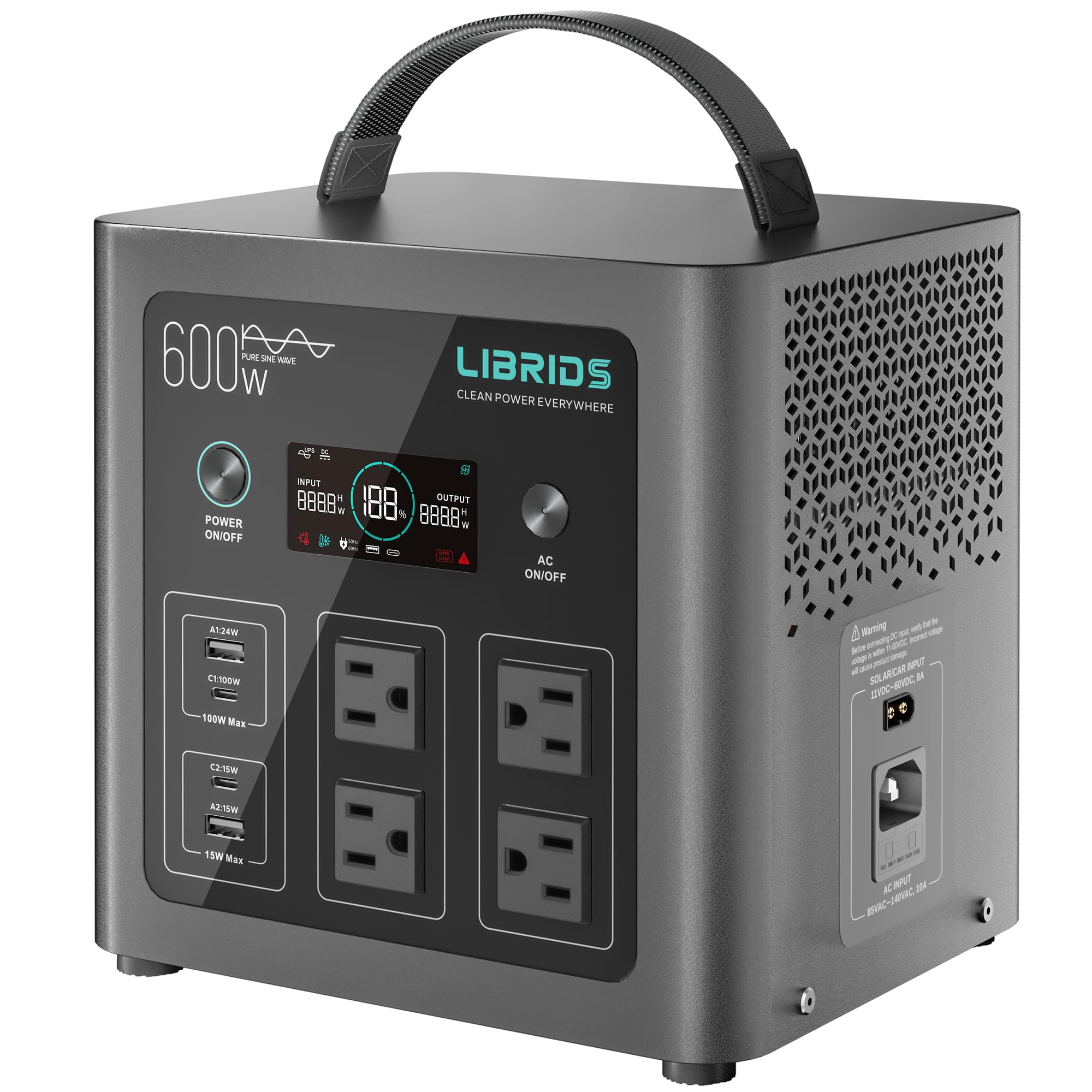
2. LIBRIDS Portable Power Station 640Wh
A 640Wh metal-frame unit with 10ms UPS that keeps your router and small fridge running on a budget.
If your outage needs are modest — keeping the Wi-Fi up, the phone charged, and the reef tank or CPAP running — this 640Wh unit delivers without the four-figure price tag of the bigger stations above. Its 600W continuous output (with a 1200W surge for startup loads) is enough for daily essentials and small appliances, and buyers report it holds a 560W load comfortably. The built-in 10ms UPS means it switches to battery instantly during an outage, so your router never blinks.
The efficiency here is the quiet win: a saltwater aquarium owner found the pure sine wave supply stable enough to keep tank pumps running as an instant backup, and the charge holds for days on standby. Buyers confirm the capacity is honest, with one measuring 610Wh against the 640Wh rating, and the metal enclosure dissipates heat well enough that overheating is a non-issue. At a fraction of the size and weight of the 2073.6Wh BLUETTI above, this is the one you grab for camping trips or tucking under a desk.
Just set expectations: a 640Wh station is a few-hours-of-essentials tool, not a multi-day household savior. It powers a 45L fridge for 6–7 hours using about half its charge, which is perfect for short outages but not for a week without power.
Entry-level excellence: This is the ideal first power station for renters or apartment dwellers who want outage insurance for their internet and devices without the bulk of a whole-home unit.
3. AFERIY P210 Solar Generator 2048Wh
A 2048Wh station with a 2400W inverter and 7-year warranty that powers a weekend of essentials or a home lab.
Reviewers consistently call the P210 an outstanding product at a fair price, and the numbers back that up: 2048Wh of capacity feeding a 2400W continuous inverter with a 4800W surge. Owners use it as a home-lab UPS, an RV workhorse, and a hurricane-season lifeline, with one reporting 6 hours of runtime on a predicted 290–320W load. That flexibility comes from its 3500+ cycle LiFePO4 battery and a <10ms server-level UPS response for protecting sensitive electronics.
What makes it stand apart is the 7-year extended warranty — two years beyond the industry standard — and the fact that it weighs 48.5 lbs. Owners praise the adjustable line charging rate that prevents breaker trips, the large clear display that holds 117VAC under load, and the whisper-quiet fans that are inaudible from 10 feet away. It is the rare budget-adjacent pick that feels premium in daily use.
The catch is some power management quirks. The default AC output auto-off after 8 hours needs an app setting change, and output is capped at 1100W while plugged in, though it delivers the full 2400W unplugged. Also, it is not for freezing temperatures, as the LiFePO4 chemistry struggles in the cold.
Raw Power Per Dollar
- 2400W inverter with 4800W surge for heavy loads
- Runs all weekend on a single 2048Wh charge
- 7-year warranty beats most competitors
Setup Quirks
- Requires app tweaks to disable AC auto-off
- Output limited to 1100W when plugged into AC
Pick this if: you want big power and a long warranty without paying flagship prices.
Think twice if: you need a set-and-forget unit — the app adjustments may frustrate non-techy users.
4. Anker SOLIX S2000 Portable Power Station
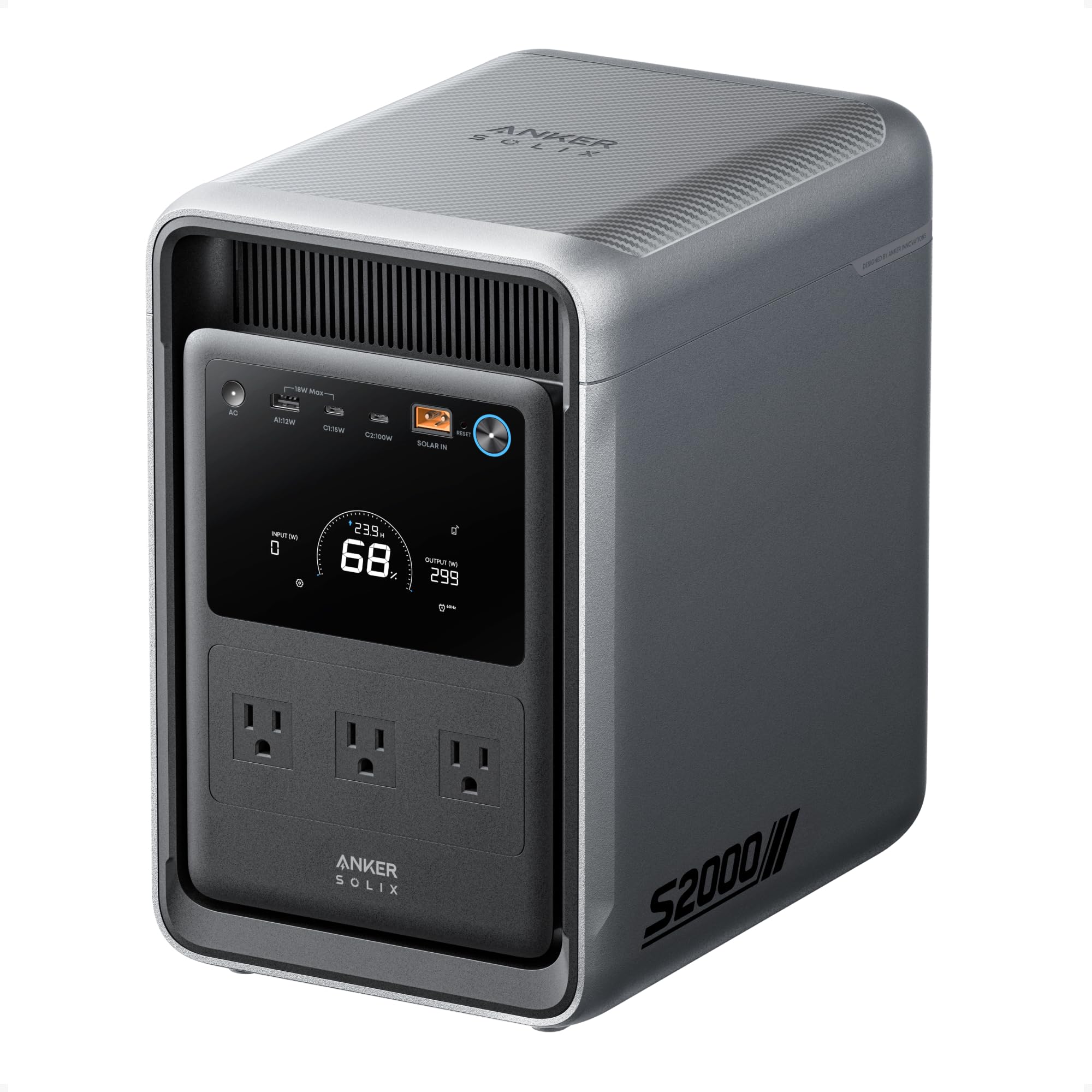
A 35.7-lb 2010Wh station that runs a fridge for up to 35 hours with a 6W idle draw.
Anker engineered the S2000 around one job: maximizing fridge runtime. With a 6W idle power draw, this 2kWh station keeps a refrigerator powered for up to 35 hours. It is also remarkably light at just 35.7 pounds — the lightest 2kWh-class unit here — making it the one you can actually move from the garage to the kitchen without a workout.
The <10ms UPS switchover is the selling point for home-office users, and owners confirm it kept their gaming setups and computers running flawlessly through outages. At 1500W continuous output with a 3000W peak, it powers 99% of home essentials, and the dual-sided outlets let you plug always-on appliances in the back and everyday devices in the front for a clean setup. Owners reported surviving a 30-hour outage while charging back from 33% to 100% in just 1.5 hours.
The trade-off is power-hungry appliances: a 1500W output won’t run a large space heater or a big window AC, so check your appliance wattage first. Also, the recessed handles are a bit shallow for easy lifting, so it is best kept in one spot.
Fridge-focused genius: If your main outage worry is spoiled food and a dead home office, this is the most efficient and portable way to solve both.
5. EF ECOFLOW DELTA 3 Max Portable Power Station
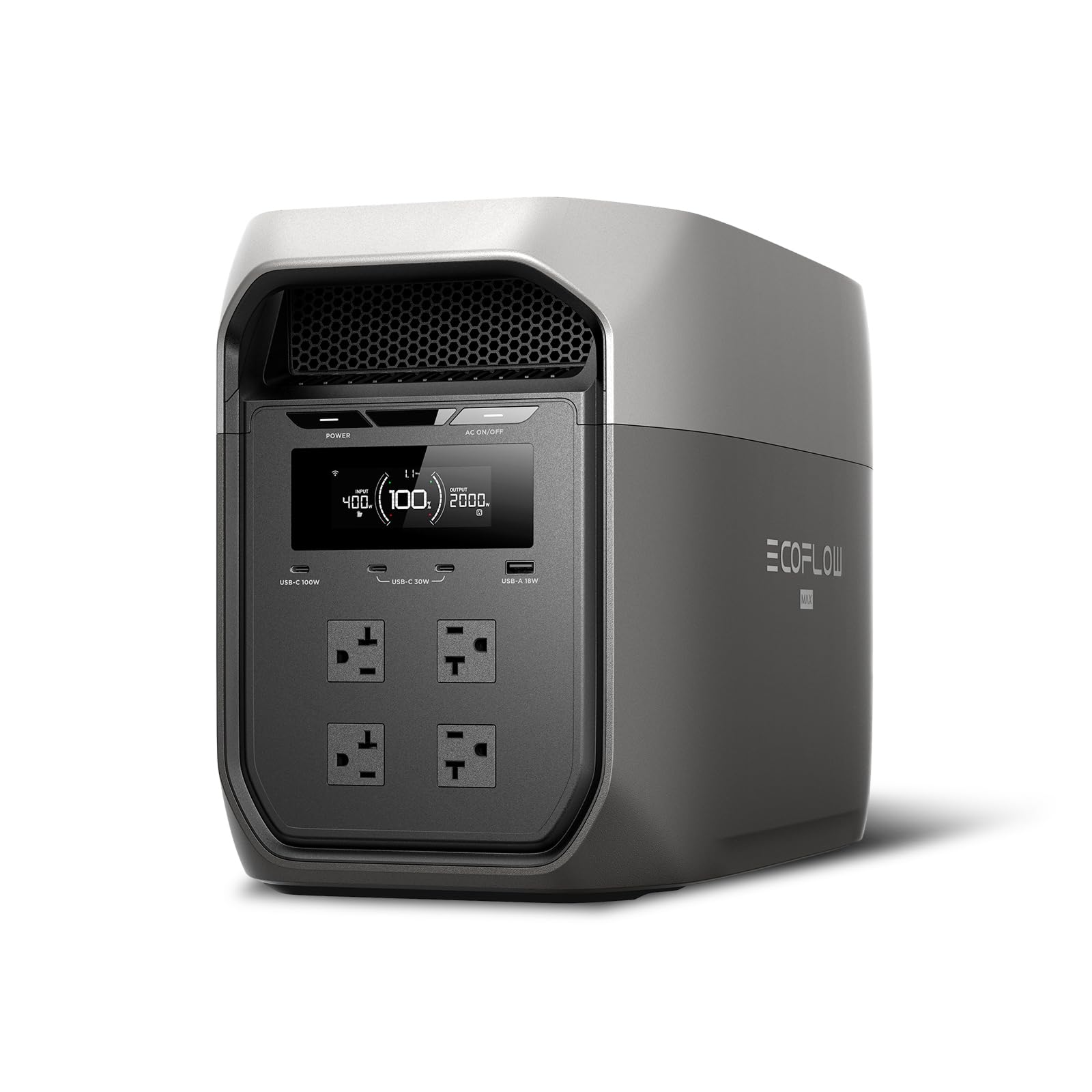
A 2048Wh station with 3400W X-Boost that powers kitchen appliances and RV gear, recharging to 80% in 1.13 hours.
EcoFlow’s DELTA 3 Max is the pick for people who want one station that does everything, from hurricane backup at home to campsite power for the trailer. Its 2048Wh battery feeds a 2400W continuous inverter with X-Boost pushing output to 3400W, which owners used to run a waffle iron and two freezers simultaneously without a hiccup. The 10ms transfer time protects your computer and medical devices smoothly, and the 4.7-star rating across 500+ owners reflects its reputation for quality.
Charging speed is the headline feature: X-Stream technology refills 0–80% in just 1.13 hours, so you can top it up quickly before a storm or between campsite moves. Owners confirm the 48-pound unit includes a hand truck, and the top, front, and rear vents give flexible placement options. The app adds a storm-guard auto-charge feature that preps the battery when severe weather is forecast, plus real-time energy monitoring and scheduling to trim costs.
The notable caveat is that fast solar and alternator charging needs an XT60i cable; a plain XT60 limits you to 12V/8A. Some owners also found the fan audible (but not loud) at 1700W loads, and the buttons are hard to see in dim light.
Fast And Flexible
- 0–80% recharge in a swift 1.13 hours
- 3400W X-Boost runs heavy appliances and tools
- Included hand truck eases the 48-lb carry
Setup Details
- Requires XT60i cable for full-speed charging
- Fan noise noticeable under heavy 1700W loads
Reach for this if: you live between home backup duty and RV adventures and want one station that masters both.
Look elsewhere if: you need the lightest possible unit — the 48-lb frame is sturdy but not featherweight.
6. Anker SOLIX C2000 Gen 2 Portable Power Station
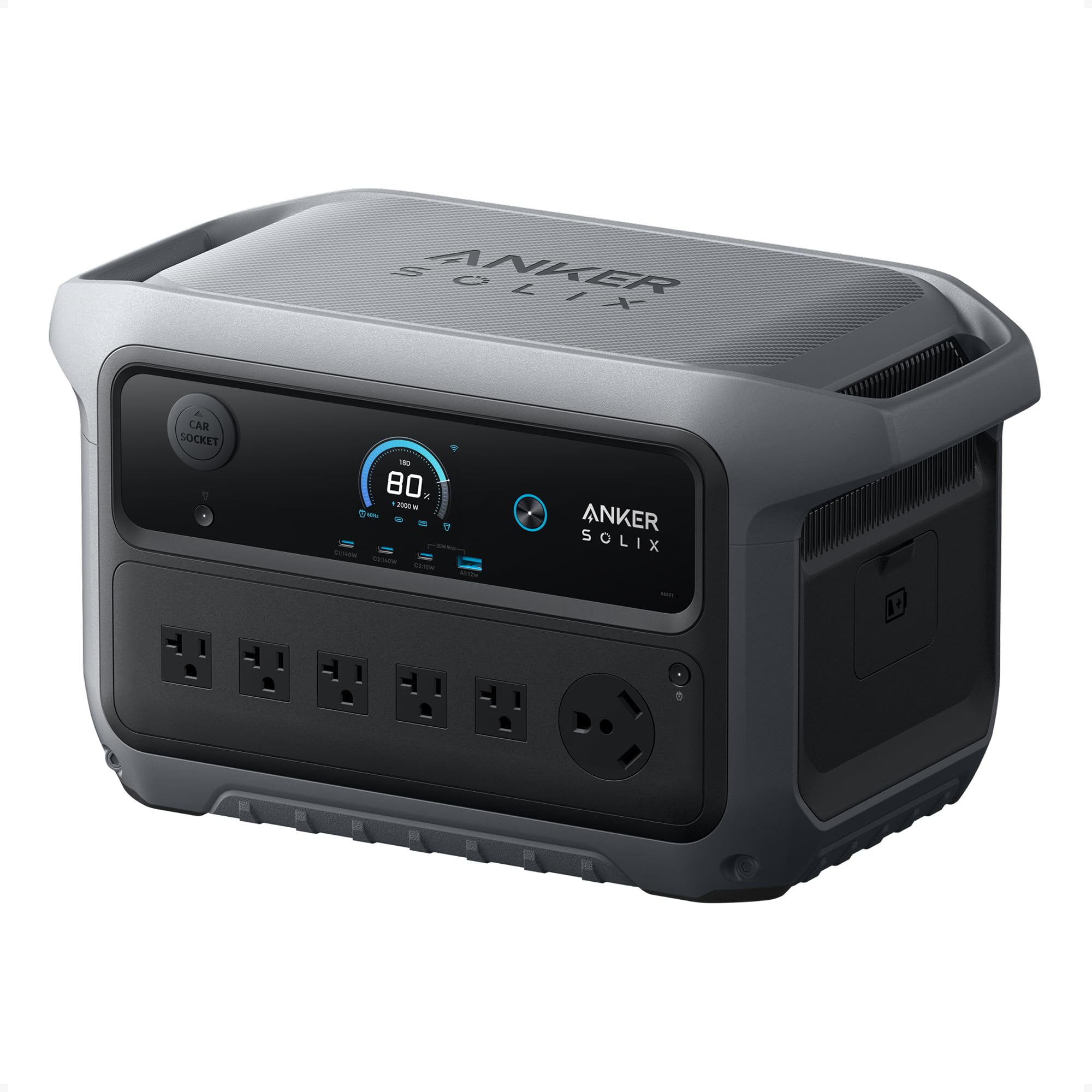
A 58-minute full charge and a 4000W peak make this the fastest house in the race.
Anker’s C2000 Gen 2 is built for the impatient: a full 0–100% charge in just 58 minutes via AC and solar, so you can literally top it up while you make breakfast before a storm hits. Its 2048Wh LiFePO4 battery delivers 2400W rated output with a 4000W peak, enough to run most window and RV air conditioners — a capability owners confirmed by running a 13,500 BTU unit for about 90 minutes. The 9W standby draw powers a dual-door fridge for up to 32 hours.
Owners rave about the power quality and reliability, with one running a camper fridge 24/7 for a seven-week trip on 5–7 days per charge. The expandable capacity is the future-proofing win: add an expansion battery to reach 4kWh and double your fridge runtime to 64 hours. At 41.7 pounds, it is one of the more manageable high-capacity options.
The one real limitation surfaced in RV use: when plugged into AC input, output is limited to 1800W, which can overload if you run the air conditioner alongside other appliances simultaneously. Also, the 41.7-pound weight still drew mixed feedback from owners, though it is lighter than most in its class.
Speed demon: If your biggest fear is a dead battery when the grid fails, no station here reboots faster than this 58-minute charge.
7. BLUETTI Elite 300 Portable Power Station
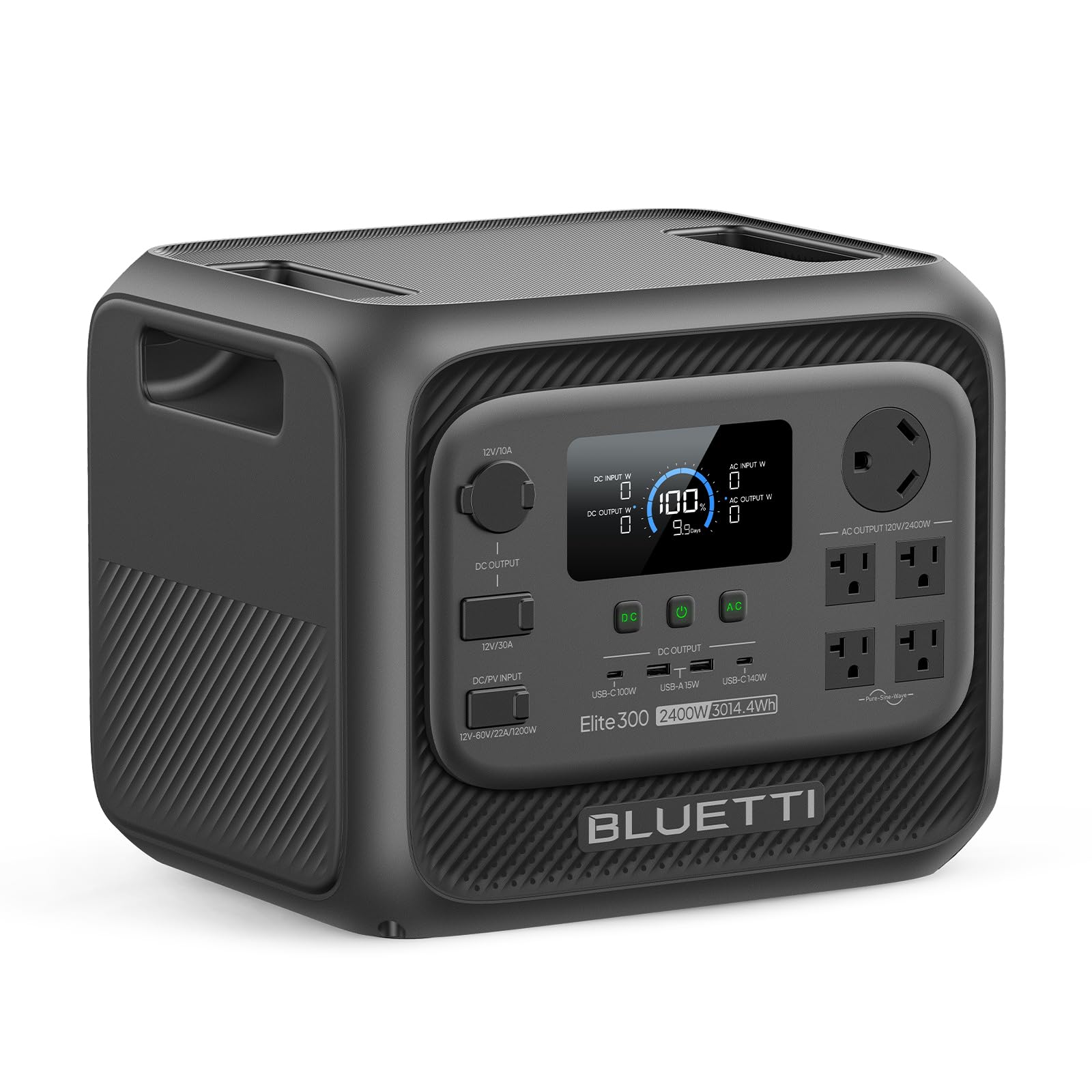
The smallest 3kWh station on the market with serious RV credentials.
BLUETTI’s Elite 300 packs a massive 3014.4Wh into a footprint that Frost & Sullivan recognized as the world’s smallest 3kWh portable power station, nearly 59% smaller than traditional units. That density matters for anyone who wants multi-day backup without dedicating a closet to it. Its 2400W inverter with a 4800W surge handles refrigerators, routers, lights, and CPAP machines, and a 10ms UPS switch keeps computers running through flickers.
The RV-ready design separates it from most of the field: the included TT-30 RV outlet and high-current 12V/30A DC output run RV appliances like 12V fridges, water pumps, and diesel heaters directly. Owners mention running a 15,000 BTU Coleman RV air conditioner for two hours on this battery, and a van-lifer called it dependable power for nomadic living. The 6000+ cycle LiFePO4 cells and a 0–100% charge in as fast as 78 minutes round out a genuinely versatile package.
The trade-off is the 58-pound weight and the fixed 3000Wh capacity — there is no expansion port, so what you buy is what you get. Solar input is also a bit limited compared to larger BLUETTI models, though owners found it workable at about 80% efficiency.
Density And RV-Ready
- World’s smallest 3kWh station per Frost & Sullivan
- TT-30 RV port plus 12V/30A DC for camper gear
- 10ms UPS protects sensitive electronics
Fixed Capacity
- 58 lbs is heavy for frequent moving
- No expansion option to grow beyond 3014Wh
Your best bet if: you need maximum power in a small space or you want to power your RV’s 12V appliances from one box.
Think twice if: you plan to expand capacity later — this station is a fixed-size commitment.
8. Jackery HomePower 3000 Portable Power Station
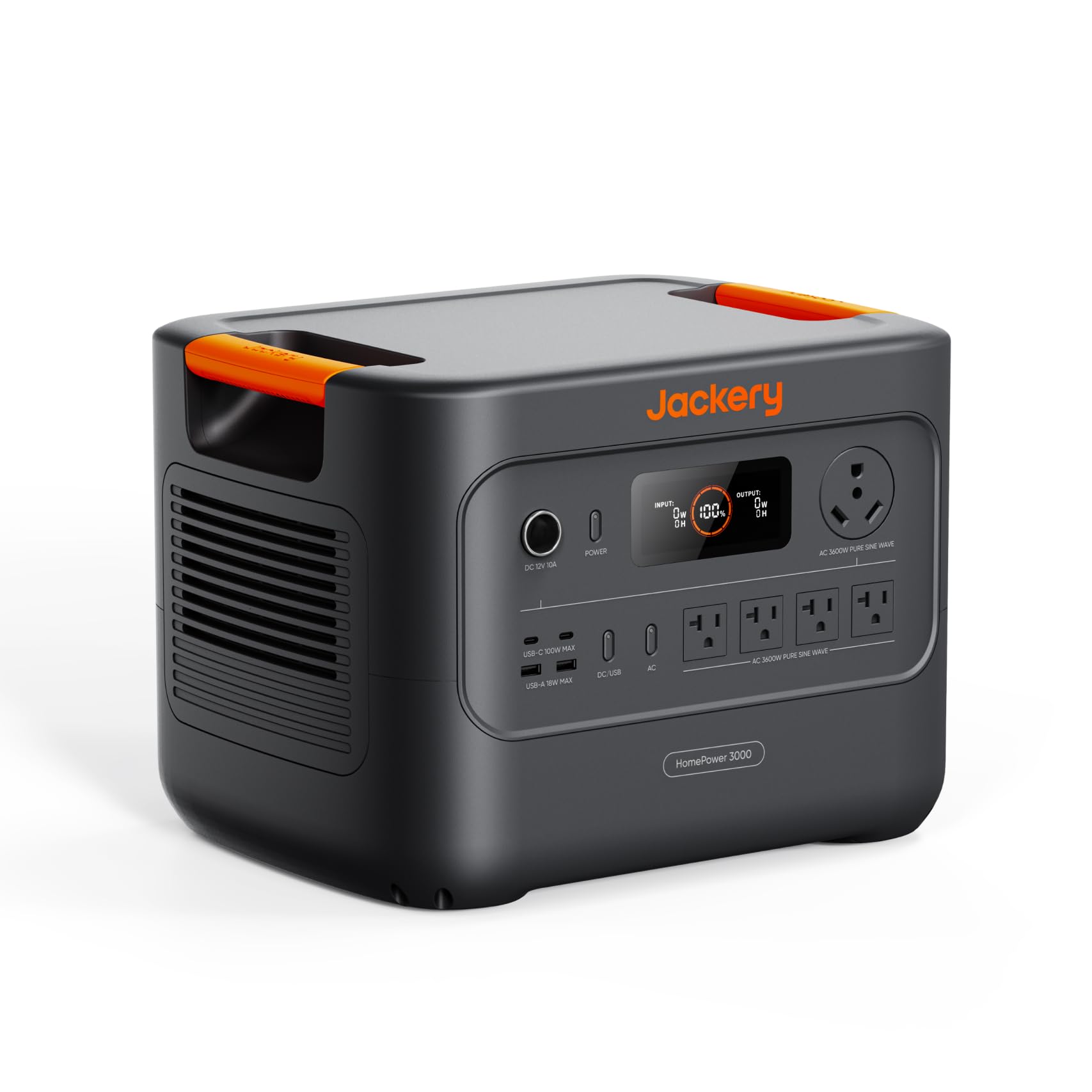
A 7200W surge that starts big motors without breaking a sweat.
The Jackery HomePower 3000 earns its place with a staggering 7200W surge capability feeding a 3600W continuous AC output, making it the station for appliances with heavy startup draws. Owners used it to run a compressor for a lemonade press continuously and powered a 30-foot travel trailer off-grid for over three days. The 3072Wh LiFePO4 battery with its UL-certified ≤20ms UPS keeps security cameras, medical refrigerators, and Zoom calls running through outages without interruption.
Reliability is the nuanced story here: Jackery is a beloved brand for many, with owners on their third or fourth unit praising the build quality and the Bluetooth solar-charging progress display. But a notable chunk of reviewers flagged the long-term dependability, so this is one to buy with realistic expectations about heavy daily use. It charges fully in 1.7 hours via hybrid AC+DC, and the dual 100W PD ports fast-charge phones, tablets, and drones.
At 59.5 pounds, the weight is the most consistent criticism, and the ChargeShield 2.0 AI is smart but not magic for battery longevity, rated at 4000 cycles retaining 70% capacity. For a home that faces frequent hurricane-season outages, this surge capacity is tough to top.
Surge muscle: If your essential appliances have big motors or compressors that need a jolt to start, this is the station with the most headroom on the list.
9. EF ECOFLOW DELTA 3 Ultra Plus
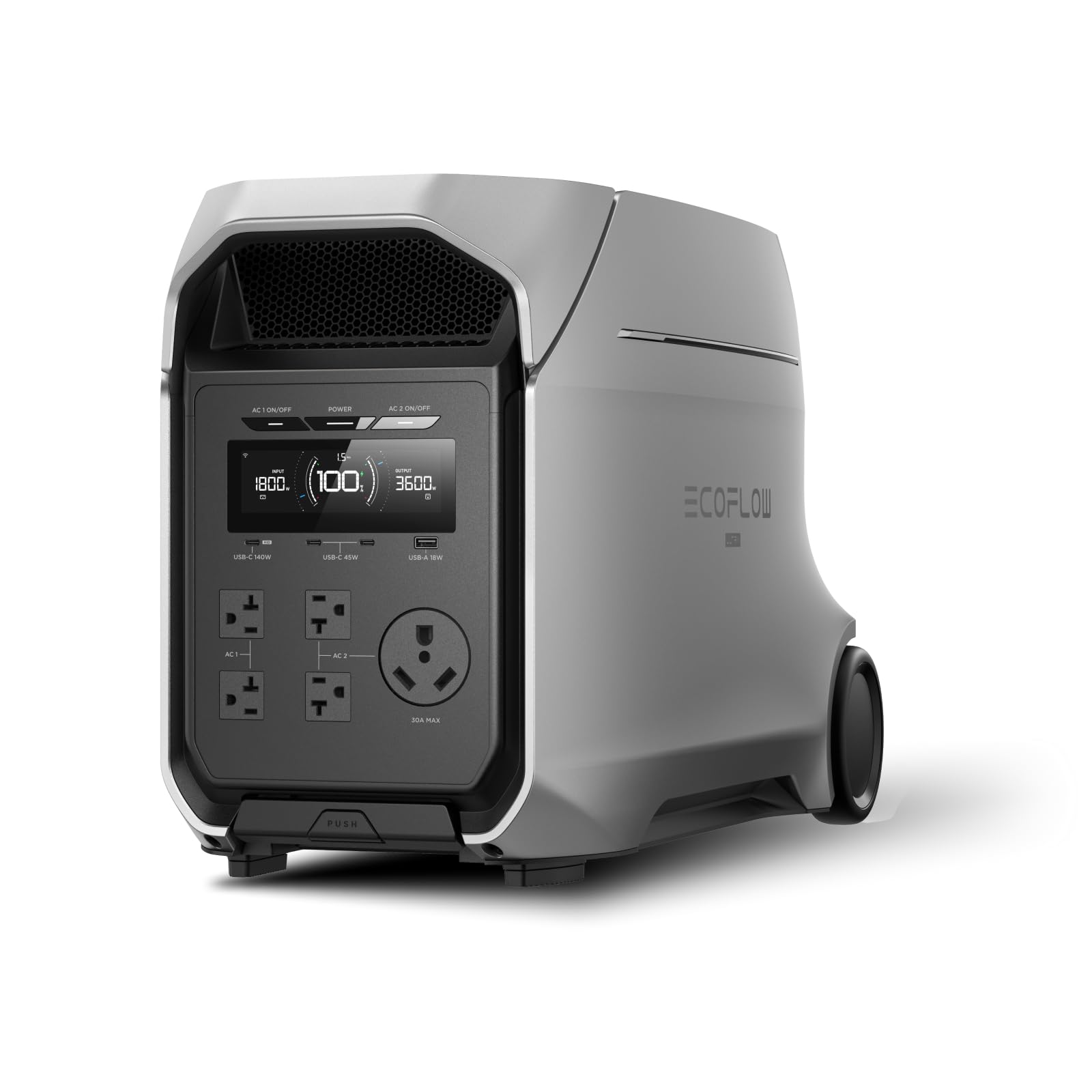
A quiet powerhouse that grows with your needs up to a full 11kWh.
EcoFlow’s DELTA 3 Ultra Plus is the future-proof answer for homeowners who might want to expand from essentials to whole-house backup down the road. Its 3072Wh base capacity is expandable up to 11kWh with extra batteries, covering multi-day blackouts or full RV living without compromise. The 3600W continuous output with a 7200W surge runs heavy-duty appliances and power tools, and owners verified the power quality with an oscilloscope, calling the output wave “basically a perfect Sinusoidal wave.”
At just 25dB even under load, this is the quietest high-capacity station here, thanks to X-Quiet 3.0 cooling, so it can run in a bedroom or RV without disturbing sleep. The <10ms UPS switches smoothly for sensitive devices, and the EcoFlow app lets you adjust charge speeds from 1600W down to 800W, set per-port priority, and enable Storm Guard to auto-charge before severe weather. Reaching 80% in under an hour with X-Stream fast charging keeps you ready for anything.
Keep in mind this is a 120V, 30-amp unit — it lacks a 220V output, so it will not run a whole-house electric water heater or central AC. At 74 pounds, the base unit is also a two-person lift, and the expansion batteries add significant cost and weight on top.
Grows With You
- Expands from 3kWh to a full 11kWh
- Ultra-quiet 25dB operation under load
- Storm Guard auto-charges before bad weather
Big And 120V Only
- 74 lbs base unit is a two-person lift
- No 220V output for high-voltage appliances
Pick this if: you want a modular system that can start small and grow to power nearly your whole home.
Look elsewhere if: you need to run 240V appliances or want a single lightweight unit.
10. EF ECOFLOW DELTA Pro 3600Wh
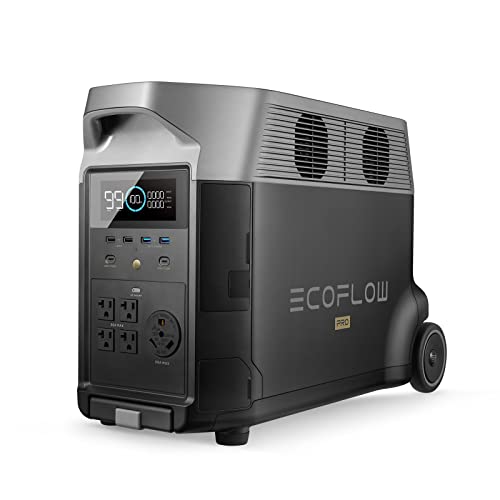
The expandable workhorse that can power an entire house or a mobile business.
The DELTA Pro is the deep-reserve champion here, starting at a vast 3600Wh and expanding up to a massive 25kWh with extra batteries and smart generators. That makes it the only station on this list that can genuinely back a whole house through multi-day outages, and owners confirm it runs a heat press flawlessly at vendor markets with no voltage drops. Its 3600W AC output expands to 4500W with X-Boost, and you can pair two units for 7200W total.
Charging flexibility is class-leading: EV station charging, solar, wall outlets, the smart outdoor generator, or a car outlet — five ways to refill the LiFePO4 battery. X-Stream charging refills in 2.7 hours via a standard 1800W wall outlet, or 1.8 hours with a 240V outlet. Owners appreciate the built-in 15 output methods, including two USB-C 100W ports and five AC outlets, and some have lasted up to 15 days on a full charge in standby.
But this is a serious commitment: at 99 pounds, it is the heaviest unit here and simply not portable in any practical sense. Some owners reported units failing after about a year of heavy use, so this is a buy for those who need the capacity and can manage the logistics.
Whole-home scale: If your goal is true long-duration backup for an entire household or a mobile business that cannot afford downtime, this is the most expandable and powerful starting point.
11. Jackery HomePower 3600 Plus

A 3584Wh station that rolls on wheels, so huge power is finally easy to move.
Jackery solved the biggest problem with high-capacity stations — moving them — by putting wheels and a telescopic handle on the HomePower 3600 Plus. Its 3584Wh capacity delivers 3600W of continuous output (7200W in parallel) and can power a 3-person household for over 2 weeks under normal use. Owners confirm the real-world math, with one reporting they powered a fridge, coffee maker, CPAP, and fan through a 26-hour outage and still had 89% left.
The safety engineering is a standout: high-temp-resistant ceramic membrane battery cells tested at 302°F prevent thermal runaway, and the system keeps working even in -4°F blizzards. It offers 6,000 cycles and a 10-year lifespan, with a full recharge in just 2 hours via hybrid AC+DC. The luggage-style design with built-in wheels makes this genuinely movable, unlike the 74–99 pound monsters elsewhere on this list.
The main considerations are the 77.2-pound overall weight (the wheels help, but stairs are still a workout) and the fact that at 3600W output, it pairs best with a critical-subpanel or heavy essentials rather than a full 240V home circuit. Jackery’s reliability track record here is strong, though some owners found the wheels add bulk that makes it less garage-shelf friendly.
easy Mobility
- Built-in wheels and telescopic handle for easy rolling
- 3584Wh powers essentials for days with headroom
- Ceramic membrane cells tested to 302°F for safety
Still Substantial
- 77.2 lbs overall, so stairs remain a challenge
- 3600W output is for essentials, not a full 240V house
Your best bet if: you want massive home-backup capacity without the back strain of lifting 75+ pounds around the house.
A fair warning: plan its permanent parking spot near the breaker panel, because moving it up stairs is still a two-person job.
Understanding the Specs
Watt-Hours (Wh) — Your Energy Reservoir
This is the total amount of energy the battery can store, like the size of a fuel tank. A 2000Wh station runs a typical fridge for roughly a day, while a 3000Wh+ unit can stretch to two or three days. Match your Wh to how long you realistically need your essentials to run.
Continuous vs. Peak Watts — What Your Appliances Draw
The continuous wattage is what the inverter delivers steadily, and your plugged-in devices must total less than this number. The peak or surge rating handles the brief startup jolt of motors and compressors — a fridge might run at 150W but spike to 600W on startup. Count your appliances’ running watts, not their surge needs.
FAQ
How much battery capacity do I really need for home backup?
What is the difference between LiFePO4 and other lithium batteries?
Can I run my refrigerator on a portable power station?
What does the UPS function do and why does it matter?
How long does a power station take to recharge?
Can I charge a power station with solar panels?
Is it safe to use a portable power station indoors?
Can I connect a power station directly to my home wiring?
What is X-Boost or Power Lifting mode?
How much does a power station weigh and can I move it easily?
Will a power station run a space heater or air conditioner?
Final Thoughts: The Verdict
Across the board, the battery for home winner is the BLUETTI Elite 200 V2 because it pairs a 2073.6Wh capacity with a 2600W inverter and a 50-minute fast recharge, making it the most complete single-unit solution for household outages. If you want a budget-friendly entry point that keeps your essentials humming without the big price, grab the LIBRIDS 640Wh. And for a mobile high-capacity option that rolls easily from room to room, the Jackery HomePower 3600 Plus is the one to reach for.
How We Picked
We do not accept paid placement. Every pick is matched to a real buyer and a real use-case; we do not hands-on test units.
Sources & Methodology
Specifications: manufacturer listings and product documentation. Review insights: verified customer reviews, as of August 2026. Pricing: not shown on this page (it changes often); check the current price via the retailer link.
As an Amazon Associate, Gadgets Feed earns from qualifying purchases. This does not affect which products we feature.