
The difference between a great day on the water and a frustrating paddle back to the launch is entirely in the chemistry sitting inside your hull. A lead-acid deep cycle battery might have the right terminals, but its usable capacity gets halved the moment you draw power, and the weight penalty punishes every inch of your kayak’s stability. Choosing the wrong power source means voltage sag, early cutoffs, and a battery that lives in your garage after three trips.
I’m Min — the co-founder and writer behind Gadgets Feed. I’ve spent hundreds of hours analyzing battery datasheets, comparing BMS topologies, and cross-referencing real-user endurance reports across lithium iron phosphate and AGM chemistries to isolate exactly what matters for a trolling motor setup on a kayak.
The goal is to filter the noise and find the best battery for kayak trolling motor based on cycle life, weight-to-capacity ratio, and real-world runtime against a 12V motor pulling a loaded hull.
How To Choose The Best Battery For Kayak Trolling Motor
Selecting a trolling motor battery for a kayak is a different puzzle than wiring up a bass boat. Kayaks lack the space, the weight capacity, and the voltage forgiveness of a larger hull. You need to match chemistry, capacity, physical size, and protection features to your specific motor thrust and typical trip duration. Ignoring any of these four variables can leave you stranded mid-lake.
Chemistry: LiFePO4 vs. AGM Lead-Acid
Lithium iron phosphate (LiFePO4) offers fully usable capacity — you can draw 100% of the rated amp-hours without damaging the cell. AGM lead-acid batteries degrade quickly if you discharge past 50%. LiFePO4 also maintains steady voltage above 12.8V under load, while lead-acid voltage sags, reducing motor speed as the battery drains. The trade-off is upfront cost, but the cycle life (4,000+ deep cycles vs. 300–500 for lead-acid) usually makes lithium cheaper per trip within the first year.
Capacity and Motor Thrust Matching
A 30–40 lb thrust motor draws roughly 25-35 amps at full speed. A 50Ah battery running at 100% usable capacity gives you roughly 1.5–2 hours at full throttle with a 30A motor. A 100Ah battery doubles that to 3–4 hours. If you fish all day or run through wind and current, the extra capacity buffer prevents early shutdown. Most kayakers find 50Ah adequate for half-day trips on smaller motors, while 100Ah is the sweet spot for full-day use on 45–55 lb thrust motors.
Weight, Size, and Kayak Fitment
Every pound matters on a kayak. A 32-lb AGM battery in the front hatch can negatively affect tracking and make the bow sit low. A 20-lb LiFePO4 unit in the same spot is manageable. Physical dimensions also limit your choices — narrow center hatches, tank wells, and battery boxes in sit-on-top kayaks often reject standard Group 31 footprints. Measure your compartment height, width, and depth before buying. Some compact 100Ah lithium batteries use a Group 24 or custom mini case that fits tight cavities.
Quick Comparison
On smaller screens, swipe sideways to see the full table.
| Model | Category | Best For | Key Spec | Amazon |
|---|---|---|---|---|
| Litime 12V 100Ah TM LiFePO4 | Premium | Full-day fishing on 45-80 lb thrust motors | 100Ah / 22.1 lbs / Group 31 | Amazon |
| CYCLENBATT 12V 100Ah Mini Bluetooth | Premium | Tight hatches with app-based battery monitoring | 100Ah / 20.8 lbs / Compact 9″ x 5.4″ | Amazon |
| DJLBERMPW 12V 100Ah LiFePO4 | Mid-Range | Large kayaks with 30-70 lb motors | 100Ah / 23 lbs / Group 31 size | Amazon |
| HumsiENK 12V 100Ah Group 24 | Mid-Range | Lightweight builds needing IP67 waterproofing | 100Ah / 19.7 lbs / Group 24 | Amazon |
| Timeusb 12V 100Ah LiFePO4 | Mid-Range | Powering motors plus fish finders all day | 100Ah / 23 lbs / Group 31 | Amazon |
| GOLDENMATE CRIUS 50 12V 50Ah | Mid-Range | Compact kayaks with IP67 splash protection | 50Ah / 14.1 lbs / Compact | Amazon |
| Power Queen 12V 50Ah LiFePO4 | Mid-Range | Ultralight kayaks / 30-40 lb thrust motors | 50Ah / 11.6 lbs / Compact | Amazon |
| OKMO 12V 50Ah LiFePO4 Mini | Budget-Friendly | Budget entry into LiFePO4 for small motors | 50Ah / 18 lbs / Compact | Amazon |
| Newport 12V 50Ah AGM | Budget-Friendly | Short trips on a tight budget | 50Ah / 32 lbs / Heavy-duty AGM | Amazon |
In‑Depth Reviews
1. Litime 12V 100Ah Trolling Motor LiFePO4 Battery

The Litime 100Ah TM is purpose-built for trolling motors and meets the ABYC E-13 standard for marine electrical safety. Its built-in TVS diode clamps voltage spikes from 12V-36V motors, which is a genuine issue when running a brushed Minn Kota on lithium where motor inductance can spike the battery bus. At 22.1 lbs, it shaves 30+ lbs off a comparable Group 31 lead-acid, and tests show full-day trips against a 45 lb thrust motor barely tickle the capacity — users report returning home with over 80% state of charge after 8 hours of intermittent use.
The low-temperature protection shuts off charging below 32°F and discharging below -4°F, which protects the cells during winter storage in an unheated garage. The built-in 100A BMS handles overcharge, over-discharge, short circuit, and high-current events cleanly.
Real-world owners confirm that eight hours of trolling on a 16′ jonboat with three adults barely drained the battery, and two users on bass boats measured a 4 mph speed increase from the weight savings over lead-acid. The only learning curve is that Litime ships the battery in sleep mode — you need to apply a charging voltage briefly to wake the BMS. This is standard practice for LiFePO4, but first-time lithium buyers should expect it.
Why it’s great
- TVS diode protects the BMS from trolling motor voltage spikes
- 22.1 lbs transforms kayak handling compared to 60+ lb lead-acid
- Low-temp protection prevents winter charging damage
Good to know
- BMS ships in sleep mode and needs a wake charger for first use
- Standard Group 31 footprint may not fit all kayak hatches
2. CYCLENBATT 12V 100Ah Mini Bluetooth LiFePO4 Battery
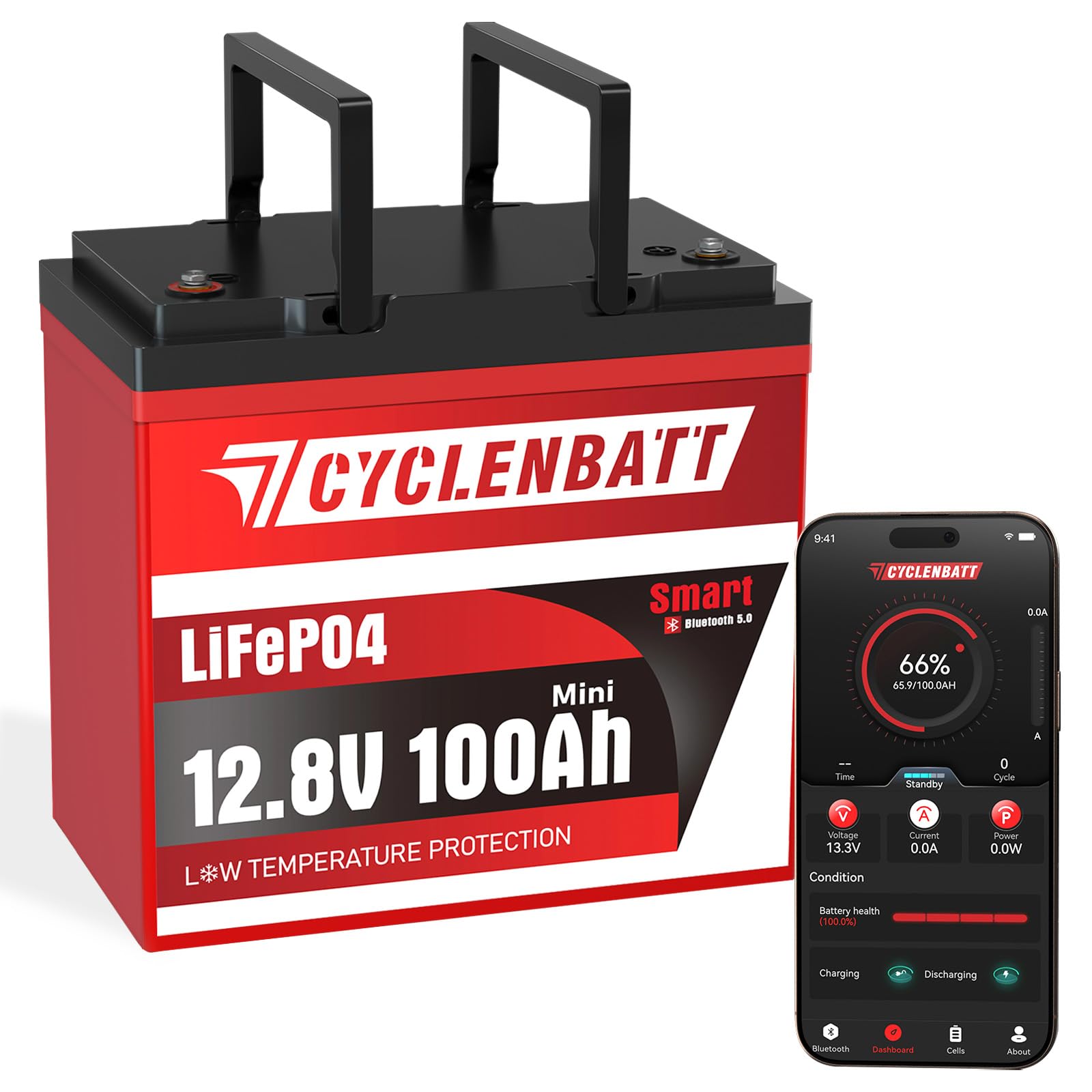
The CYCLENBATT Mini is the smallest 100Ah lithium battery on the market — 46% smaller than a standard Group 31 case at just 9.02 x 5.44 x 8.19 inches. That footprint fits inside narrow center hatches on fishing kayaks like the Hobie PA14 or the Native Slayer where a Group 31 simply won’t slide in. Despite the compact size, capacity tests from owners consistently measured 104-105 Ah, beating the sticker rating by a small margin typical of Grade A LiFePO4 cells.
The built-in Bluetooth 5.0 communicates with CYCLENBATT’s app to show real-time state of charge, individual cell voltage, temperature, current, and charge cycles. You can also toggle charge/discharge on and off through the app — useful if you want to lock the battery in storage mode or isolate a fault remotely. The BMS also includes low-temperature protection that cuts charging below 32°F and discharging below -4°F.
Owners running this battery in overlanding and marine setups confirm it powers a fridge/freezer for over 8 hours without solar input, and at least one user successfully reads the BMS data through a custom Python library over BLE, suggesting the bluetooth protocol is stable and accessible. The 100A continuous discharge handles peak surges of 330A for several seconds, which covers inrush from a 55 lb trolling motor without tripping the BMS.
Why it’s great
- Smallest 100Ah lithium footprint for tight kayak compartments
- Bluetooth app provides cell-level voltage monitoring
- Actual capacity tested around 105 Ah for extra runtime
Good to know
- Non-standard dimensions may not fit standard battery boxes
- App required to see precise state of charge
3. DJLBERMPW 12V 100Ah LiFePO4 Battery

The DJLBERMPW 100Ah uses a 100A BMS with low-temperature cutoff and UL1973-tested cells inside a Group 31 housing. The IP66 rating means it can handle spray and rain without issue, which is a practical advantage for an open kayak tank well that sees periodic splashes. Weighing 23 lbs, it sits in the standard range for a mid-tier 100Ah lithium battery and is compatible with 30-70 lb trolling motors across 12V to 48V systems if you wire multiple units in series.
Cycle life is rated at 4,000 cycles at 100% depth of discharge and up to 15,000 cycles at 60% DOD, which is in line with entry-level LiFePO4. The manufacturer recommends charging every 3-5 months if the battery is stored unused, and the BMS includes overcharge, over-discharge, over-current, overheating, and short-circuit protection. A 50A charge current enables a 5-hour full recharge from a dedicated LiFePO4 charger.
After 15 months of continuous use in a solar setup, one owner reported the battery stopped charging. The company shipped a replacement at a reduced fee, which suggests the after-sales support is functional even if the BMS lifespan in that unit fell short. Another user ran three of these in a 36V golf cart setup and reported better runtime than lead-acid with significant weight savings. For a kayaker, the IP66 and 100Ah at this price point makes it a strong mid-range contender.
Why it’s great
- IP66 rating handles spray in open kayak compartments
- UL1973-tested cells add a safety certification layer
- 50A charging allows full recharge in under 5 hours
Good to know
- BMS longevity reported as inconsistent in long-term use
- Warranty support may involve partial replacement fees after 12 months
4. HumsiENK 12V 100Ah LiFePO4 Lithium Deep Cycle, Group 24

The HumsiENK 100Ah is a lightweight Group 24 battery that weighs only 19.7 lbs — over 2 lbs less than typical Group 31 lithium units. The Group 24 footprint is 10.2 x 6.6 x 8.2 inches, which is a meaningful size reduction for kayak hatches that can’t swallow the full length of a Group 31 case. It still delivers the same 100Ah capacity, 1280Wh, and a 100A BMS with low-temperature cutoff and short circuit protection.
The IP67 rating is one of the highest in this price range, meaning the battery is fully protected against dust and can survive submersion in up to 1 meter of fresh water for 30 minutes. For a sit-on-top kayak that might flip or take a wave over the bow, that is a genuine safety margin. The case includes a nylon carry handle that makes moving the battery between garages and kayaks easier than a bare box.
Owners running this battery in 36V golf cart setups praised the significant weight reduction over lead-acid and the consistent voltage until the battery is nearly empty. One reviewer noted that the BMS shut down at ~10V and required a jump-start to wake, which is normal BMS behavior but worth knowing if you run the battery dead on the water. The Bluetooth version of this battery adds app monitoring, but the base model relies on the BMS for silent protection.
Why it’s great
- IP67 fully submersible rating for flipped-kayak protection
- Group 24 footprint fits smaller compartments than Group 31
- Nylon handle makes transport convenient
Good to know
- Base model lacks Bluetooth monitoring
- BMS may hard-cut at 10V requiring external wake-up
5. Timeusb 12V 100Ah LiFePO4 Battery

The Timeusb 100Ah uses automotive-grade LiFePO4 cells and a 100A BMS rated for 100% DOD cycling. The advertised lifespan hits 4,000 cycles at 100% DOD, 6,000 cycles at 80% DOD, and 15,000 cycles at 60% DOD — figures that, if accurate, make this battery a decade-long investment for a typical kayaker running one full charge per trip every weekend. The IP65 shell provides dust and spray resistance, and the Group 31 size (13 x 6.77 x 8.5 inches) is slightly more compact than some competing Group 31 cases.
The key differentiator here is the energy density rating of 55 Wh/lb. At 23 lbs, the battery delivers 1280Wh of total energy, which is among the highest weight efficiency in the mid-range category. An independent capacity test showed the unit meeting or slightly exceeding its 100Ah rating, and a 90A load test confirmed the BMS handles sustained high draw without thermal throttling. The battery can be expanded to 4P4S for a 20.48 kWh system, though kayakers rarely need that.
Users running two in parallel for a 2000W inverter on a marine trawler reported they outperformed the previous AGM bank by a wide margin and held stable voltage during heavy solar cycling. One negative is that earlier versions of this battery lacked low-temperature protection, but newer batches include it — always verify the manufacturing date if you store the battery in a freezing garage. The 5-year warranty and responsive customer service from Timeusb is a plus for first-time lithium buyers.
Why it’s great
- 55 Wh/lb energy density is excellent for the price tier
- 15,000 cycles at 60% DOD can last a decade of weekend use
- Scalable 4P4S expansion for future power needs
Good to know
- Older batches may lack low-temperature protection
- IP65 is splash-resistant but not submersible
6. GOLDENMATE CRIUS 50 12V 50Ah LiFePO4 Battery

The GOLDENMATE CRIUS 50 packs 50Ah into a 14.1 lb package with an IP67 waterproof rating. The compact dimensions (8.19 x 8.98 x 5.43 inches) make it one of the easier 50Ah lithium batteries to stash inside the cramped electronics pod of a kayak like the Perception Pescador or a sit-inside model where vertical clearance is tight. The built-in 50A BMS handles the continuous discharge demands of a 30-50 lb thrust motor, with short-circuit, overcharge, and over-discharge protection.
Cycle life is rated at over 5,000 deep cycles at 100% DOD, which is aggressive for a 50Ah battery at this price point. The Grade A lithium iron phosphate cells offer stable voltage performance and no memory effect, and the battery supports expansion up to 16 units for 10,240Wh total — though a single 50Ah unit is typically enough for half-day trips on a 30 lb motor. Charging is straightforward with any LiFePO4-compatible charger, and the self-discharge rate is low enough to store for up to a year without maintenance charging.
Bass anglers reviewing this battery report running a Garmin LiveScope alongside a trolling motor for a full day without voltage drop. One user specifically noted the battery provided clear imaging throughout a 4-hour trip with zero performance degradation. The 1-year warranty is shorter than the 5-year terms on premium brands, but the IP67 rating and Grade A cell quality at this price level make it a strong pick for the budget-conscious kayaker prioritizing waterproofing over warranty length.
Why it’s great
- IP67 waterproof for splash-prone kayak compartments
- Small footprint fits tight electronics pods
- Grade A LiFePO4 cells deliver stable voltage under load
Good to know
- 1-year warranty is shorter than industry average for LiFePO4
- 50Ah may limit full-day use on motors above 40 lb thrust
7. Power Queen 12V 50Ah LiFePO4 Battery
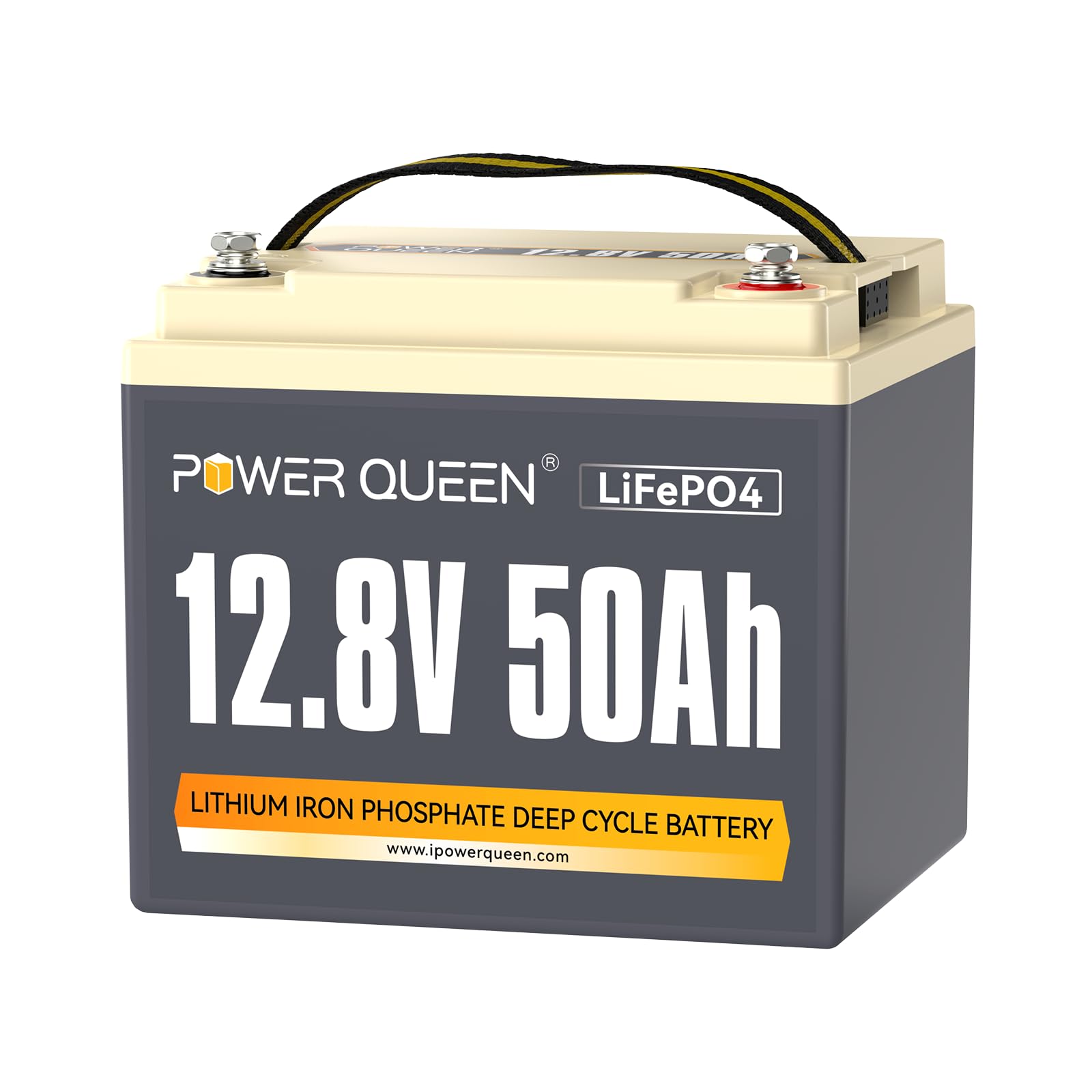
The Power Queen 50Ah is the lightest battery in this comparison at 11.6 lbs. It achieves that weight by using a compact case that measures 7.68 x 6.54 x 6.77 inches — small enough to fit under the seat of a sit-on-top kayak or inside a standard battery box intended for a 35Ah group.
Built with EV-grade LiFePO4 cells and a 50A BMS, the battery provides 4,000+ deep cycles at 100% DOD with a 10-year design life. Voltage stays above 12.8V until the battery is nearly empty, which means the trolling motor runs at full speed for longer compared to lead-acid where voltage gradually sags. The battery supports 4P4S expansion, though most kayakers use it as a standalone power source.
Owners with PA14 kayaks report that a single Power Queen 50Ah runs a Garmin 93sv and LiveScope 34 for 5 hours and only drops 0.2V — that kind of voltage stability is critical for fish finder image clarity. One user measured actual capacity at roughly 57 Ah, beating the sticker rating. The only catch is that this battery is an energy storage battery, not a starting battery, so it should never be used for engine starting applications.
Why it’s great
- 11.6 lbs is the lightest 50Ah option for ultralight kayak builds
- Actual capacity often exceeds 50 Ah in user tests
- Voltage stays above 12.8V until near full discharge
Good to know
- 50Ah may be insufficient for long days on 50+ lb thrust motors
- Not designed for high-cranking starter applications
8. OKMO 12V 50Ah LiFePO4 Battery Mini
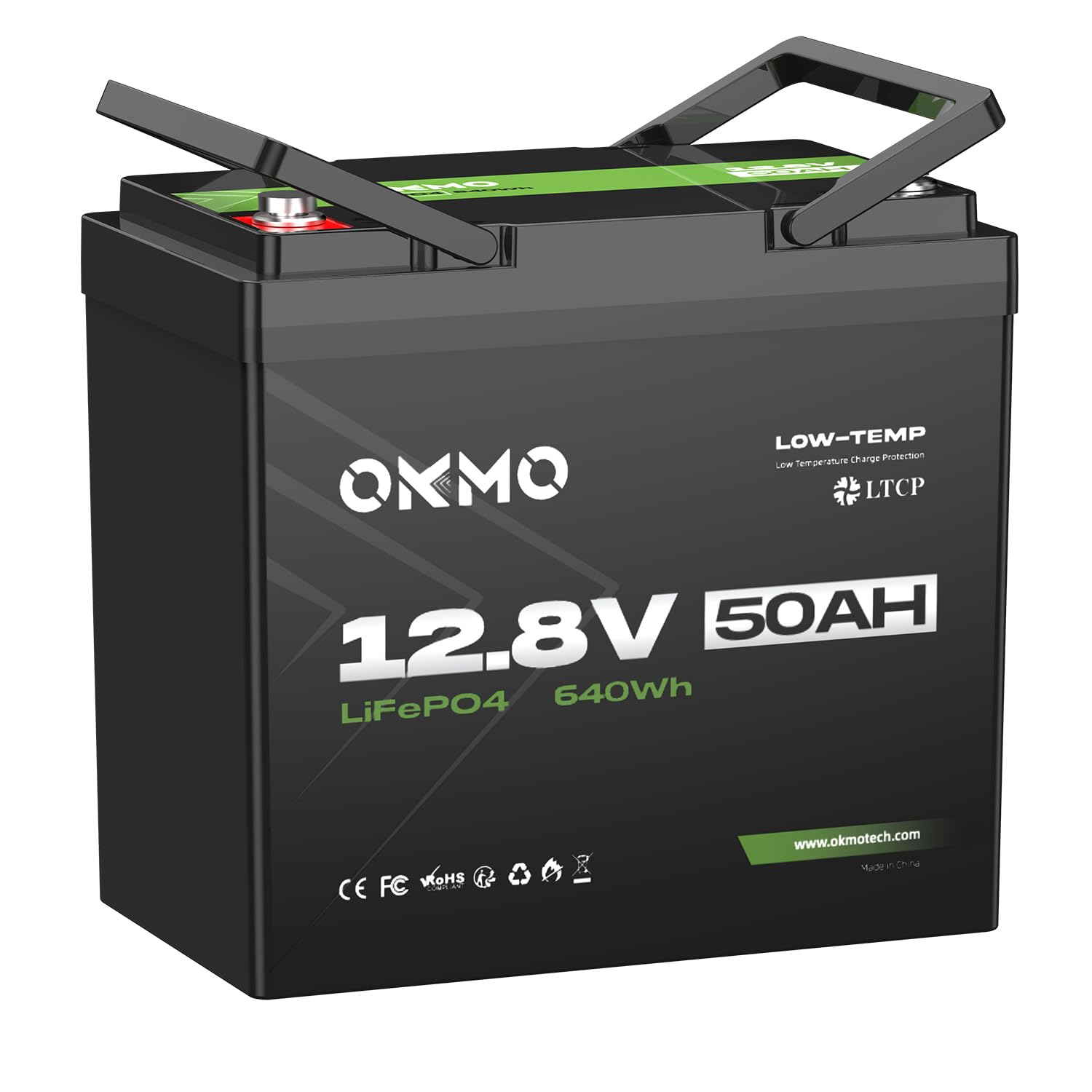
The OKMO 50Ah Mini is the lowest-cost LiFePO4 entry in this lineup, offering a 10-year design life and over 4,000 deep cycles at 100% DOD. It weighs 18 lbs, which is heavier than the GOLDENMATE and Power Queen 50Ah options but still dramatically lighter than the 32-lb Newport AGM. The BMS includes low-temperature charging protection, overcurrent protection, and short circuit protection, with a 50A continuous discharge rating that covers 30-50 lb trolling motors.
One notable feature is the capability to chain multiple units in 4P4S configurations to build a 51.2V 200Ah system, though that is overkill for a single kayak. The battery supports 2-hour fast charging with a 0.5C current (25A), but the manufacturer recommends 0.2C (10A) for regular charging to maximize cycle life. The 5-year warranty is standard for the category, but some users reported slow customer service response when dealing with a defective unit.
An owner using this battery in a kayak for lights and a Garmin UH2 sonar reported it performed flawlessly during full-day trips. A second user connecting two units in series for a 24V electric outboard found the setup functional after a replacement unit was sent for a DOA battery. Quality control on the BMS appears inconsistent based on user feedback — one DOA report in five reviews suggests buying from a seller with a solid return policy is advisable.
Why it’s great
- Lowest entry price for LiFePO4 chemistry
- 10-year / 4000-cycle design life stretches value
- Supports fast charging in 2 hours at 0.5C rate
Good to know
- Customer support response time can be slow
- 18 lbs is heavier than other 50Ah lithium options
9. Newport 12V 50Ah Deep Cycle Heavy-Duty Marine Battery
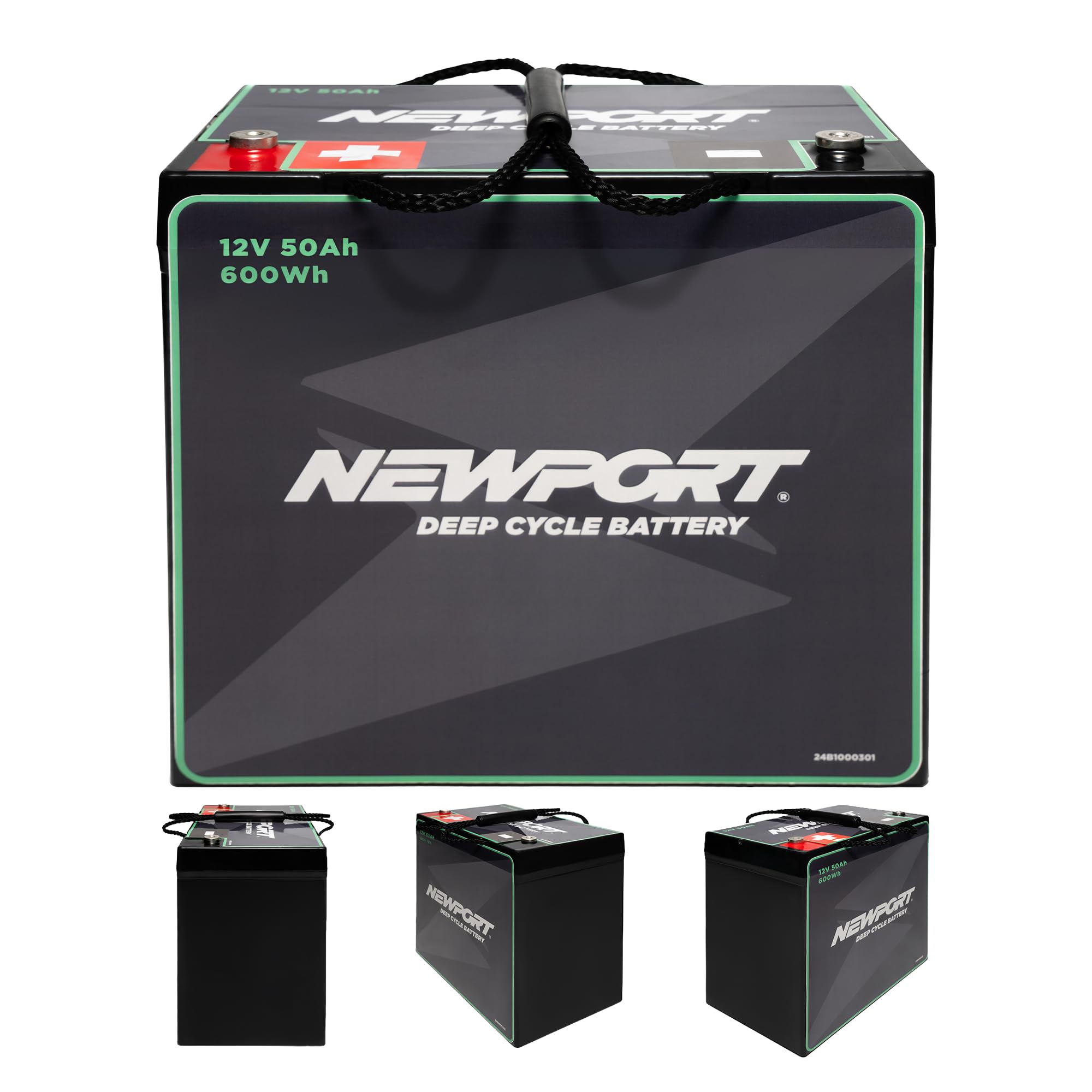
The Newport 50Ah AGM is the only lead-acid battery in this comparison, and it earns its spot as the most affordable upfront option for kayakers who want a sealed, leak-proof battery without investing in a lithium charger. At 32 lbs, it weighs nearly three times as much as the Power Queen 50Ah lithium while delivering only half the usable capacity (about 25Ah usable before voltage sag damages the plates). The sealed AGM construction is maintenance-free and resistant to vibration, which is helpful in a moving kayak.
For a kayaker running a compact 25 lb thrust motor on short afternoon trips, this battery delivers roughly 7 hours at full power based on one owner’s real-world test with a 25 lb motor. The heavy-duty build survived a 20 mph truck bed tumble with only cosmetic damage, suggesting the casing is genuinely rugged. It uses standard marine terminals that accept trolling motor connectors without adapters.
The major limitation is that the 32-lb weight makes bow-heavy kayak handling more pronounced, and the 50% usable capacity rule means you effectively have a 25Ah battery. If you run a 40 lb motor pulling 30 amps, expect roughly 50 minutes of full-throttle runtime before you risk damaging the battery by discharging past 50%. That is workable for a short putt to a fishing spot, but not for all-day motor-dependent trips. The 1-year warranty is shorter than any lithium option in this guide.
Why it’s great
- Lowest upfront cost for a new deep cycle battery
- Sealed AGM construction is leak-proof and vibration-resistant
- Standard marine terminals accept common trolling motor connectors
Good to know
- 32 lbs significantly impacts kayak tracking and stability
- Only 25Ah usable due to 50% DOD limit on lead-acid
- 1-year warranty is the shortest in this guide
FAQ
How many amp-hours do I need to run a 55 lb thrust trolling motor on a kayak for a full day?
Can I use a standard lead-acid charger on a LiFePO4 battery for my kayak trolling motor?
How do I safely mount a lithium battery inside a kayak to prevent water damage?
Is a Group 31 battery too big for a standard fishing kayak hatch?
How long does it take to fully recharge a 100Ah LiFePO4 battery used for kayak trolling?
Final Thoughts: The Verdict
For most kayakers, the best battery for kayak trolling motor is the Litime 12V 100Ah TM because it combines a purpose-built TVS-protected BMS for trolling motors, a manageable 22.1 lb weight, and a 100Ah capacity that powers a full day of fishing with juice to spare. If your kayak hatch can’t swallow a Group 31 footprint, grab the CYCLENBATT 12V 100Ah Mini Bluetooth — its 9-inch length fits tight compartments and its app gives you real-time battery data. And for budget-conscious half-day trips, the Power Queen 12V 50Ah delivers the lightest 50Ah lithium package at a price that competes with lead-acid while offering triple the usable energy.