
Our readers keep the lights on and my morning glass full of iced black tea. As an Amazon Associate, I earn from qualifying purchases.
Specs are compiled from manufacturer listings and verified buyer reviews and can change over time — please confirm the key details on the product page before buying.
You want your motorhome’s lights, fridge, and heater to keep running without you constantly checking a voltage gauge. That depends on one choice: how many amp-hours you buy and whether the battery chemistry can handle daily deep discharges. This guide covers deep-cycle 12V batteries with at least 100Ah capacity, so you can power your rig’s house systems reliably trip after trip.
I’m Min — the founder and writer behind Gadgets Feed. This guide is built by comparing the manufacturers’ published specifications and the patterns across verified customer reviews, so you get each pick’s real strengths and trade-offs instead of marketing spin.
This list matches 12V deep-cycle batteries with 100Ah or more, so a couple of options are the nearest same-type size that serves the same purpose. if you need a simple drop-in swap or a whole off-grid power bank, the right battery for motorhome balances your daily energy use against your available space and your tolerance for heavy lifting.
Our Picks at a Glance

How To Choose The Best Battery For Motorhome
Your motorhome’s house battery is the heart of your off-grid comfort. Before you pick one, you need to match its capacity to how you actually camp — a weekend boondocker has very different needs than a full-time solar user.
Capacity: Match Amp-Hours to Your Daily Appliance Use
Battery capacity is measured in amp-hours (Ah), and that number tells you how long you can draw power. A 100Ah battery can deliver 1 amp for 100 hours, or 10 amps for 10 hours. List your biggest 12V loads — a fridge, lights, a water pump — and add up their typical daily draw to find the minimum Ah you need.
Chemistry: Lead-Acid vs. Lithium (LiFePO4)
Traditional lead-acid batteries are cheaper upfront but only let you safely use about 50% of their rated capacity before recharging. Lithium iron phosphate (LiFePO4) batteries let you use nearly 100% of their capacity, charge faster, and typically last for thousands of cycles. The catch is a higher initial price, but the usable power and lifespan often win over time.
Physical Fit: Size and Weight Matter in a Motorhome
Motorhome battery compartments are tight. Most lithium batteries are built to standard BCI group sizes (like Group 24, 27, or 31) so they drop into existing trays, but they weigh far less than the lead-acid units they replace. Measure your compartment’s length, width, and height before you buy to avoid a return.
Quick Comparison
| Model | Best For | Capacity | Weight | BMS | Amazon |
|---|---|---|---|---|---|
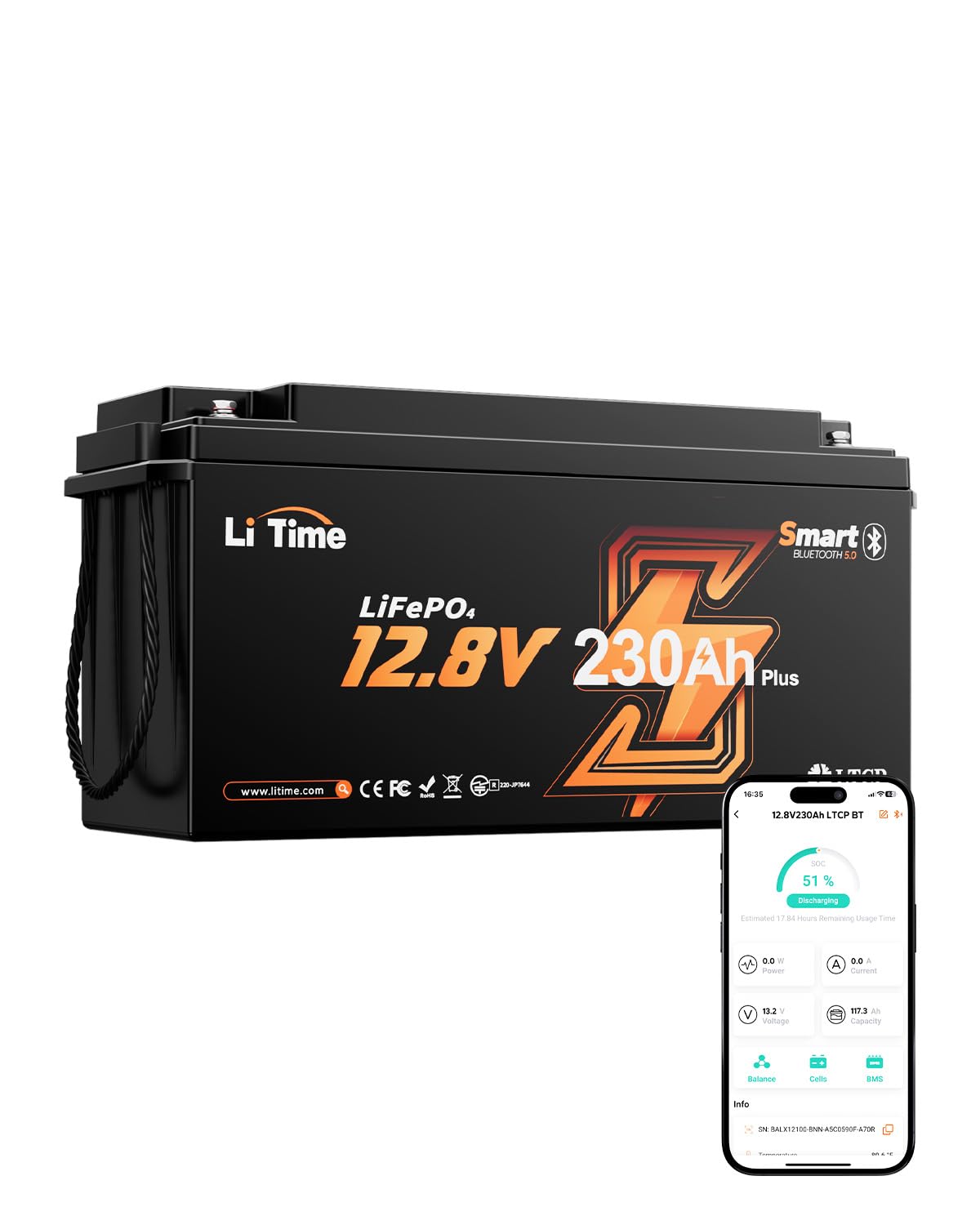
| Litime 12V 230Ah★ Best Overall | High capacity with Bluetooth | 230 Ah | 46 lbs | 200A | Amazon |
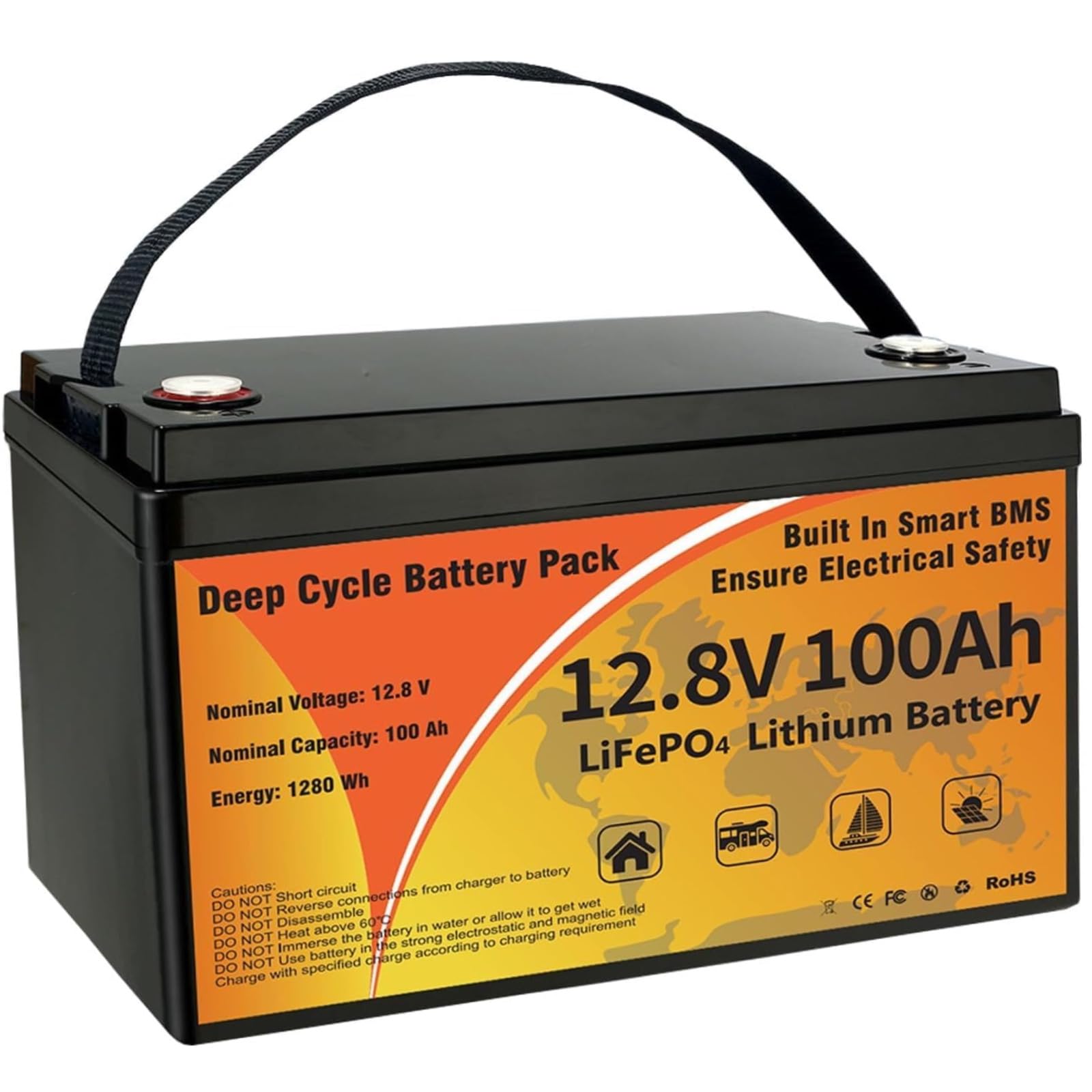
| VEMDIA 12V 100AhBest Value | Budget-friendly Group 31 | 100 Ah | 24 lbs | 100A | Amazon |
| WEIZE 12V 100AhTop Performer | Traditional sealed lead-acid | 100 Ah | 60 lbs | N/A | Amazon |
| HumsiENK 12V 100Ah | Lightweight Group 24 | 100 Ah | 19.7 lbs | 100A | Amazon |
| Power Queen 12V 150Ah | Big energy in Group 27 | 150 Ah | 33.5 lbs | — | Amazon |
| Power Queen 12V 200Ah Plus | High-load appliances | 200 Ah | 48.6 lbs | 200A | Amazon |
| ECO-WORTHY 12V 280Ah | Fire-safe metal case | 280 Ah | — | 200A | Amazon |
| DUMFUME 12V 600Ah | Massive 7.2kWh reserve | 600 Ah | 107.8 lbs | 200A | Amazon |
| Litime 12V 320Ah Mini | Self-heating for winter | 320 Ah | 57.3 lbs | 200A | Amazon |
| E-LekTech 12V 660Ah | Peak capacity for long trips | 660 Ah | 109.4 lbs | 250A | Amazon |
| VATRER POWER 12V 460Ah | 300A output for heavy loads | 460 Ah | 104.7 lbs | 300A | Amazon |
In-Depth Reviews
1. Litime 12V 230Ah LiFePO4 Lithium Battery
Our pick — over 4.5★ from 700+ verified ratings; the strongest balance of quality and price.
This battery gives you 230 amp-hours of capacity, yet weighs only 46 pounds, so you can lift it into place without a struggle.
This is the pick for motorhome owners who want true overnight independence without installing a second battery. Its 230 amp-hours of capacity is 2.3x what a standard 100Ah battery holds, so you can run a fridge and lights comfortably for days. It fits right into existing Group 4D boxes, and at 46 pounds it weighs only about a third of the lead-acid battery it replaces, which makes installation a one-person job.
The built-in Bluetooth 5.0 lets you check voltage, charge rate, and discharge rate from your phone, so you never have to open the compartment to guess your remaining power. The 200A BMS adds over 20 safeguards, including a low-temperature cutoff that pauses charging below 32°F (0°C) to protect the cells. This matters if you camp in early spring or late fall when overnight temperatures dip.
Buyers report it delivers roughly three times the usable power of traditional lead-acid units. The value for money also gets high marks, though the battery life story is a bit mixed — most owners see it hold a charge perfectly, while a few note it can drop overnight. On lifespan, the manufacturer claims a 10-year service life with 4,000+ deep cycles, backed by a 5-year warranty.
What wins people over
- Compact for its size, with lightweight handling at 46 lbs
- Bluetooth app gives live charge and discharge rates
- Expands up to 4P4S for a 48V 920Ah system at 47.1kWh
Watch out for
- A few owners mention the charge doesn’t always hold overnight
- The app can be glitchy during charging and needs reconnecting
The crowd favorite: This is the one to grab if you want a single battery that handles a full week of moderate off-grid use with phone-based monitoring.
Think twice if: You camp in freezing conditions — this version isn’t heated, so you’d want the heated model for winter.
2. VEMDIA 12V 100Ah LiFePO4 Battery (Group 31)
A featherweight 24-pound Group 31 that delivers a clean 100Ah drop-in for campers on a budget.
If you’re swapping out an aging lead-acid house battery and want lithium benefits without the premium price, this VEMDIA unit is the entry point. It holds 100 amp-hours with 1280Wh of energy, and its 100A smart battery management system (BMS) guards against overcharge, over-discharge, and short circuits. The low-temperature cutoff stops charging below 32°F (0°C), protecting the cells during cold snaps.
The weight is the headline story — this battery comes in at just 24 pounds, which makes it roughly 60% lighter than a comparable lead-acid battery and easy to maneuver into a tight compartment. It measures 12.9 x 6.69 x 8.5 inches, so it suits a BCI Group 31 battery box, and owners note it fits standard trays with room to spare. The operating range spans -4°F to 140°F, so it keeps delivering rated capacity even under heavy loads.
Customers note the quality is solid, with one arriving charged above 98% at 13.39VDC and ready to work. The solid brass terminals resist corrosion, and the rubber feet on the bottom stop it from sliding around a van floor during sharp turns. It’s also expandable up to 4P4S, so you can build out to a 20.48kWh bank later.
Why it earns the value label: You get the core lithium advantages — light weight, full usable capacity, low-temp protection — at a price that undercuts most rivals in this size class.
Who should skip it: If you need more than 100Ah in a single box, stepping up to a 150Ah or 200Ah unit will serve you better.
3. WEIZE 12V 100Ah Deep Cycle Battery (Group 31)
The old-school workhorse that powers a motorhome reliably without any fancy electronics or app pairing.
Not every motorhome owner wants to jump to lithium, and this WEIZE sealed lead-acid battery is a proven, simpler alternative to the more expensive chemistry. It’s a deep-cycle 12V battery with a full 100 amp-hours of capacity, using an AGM (absorbent glass mat) design that’s maintenance-free and spill-proof. There’s no BMS to configure and no Bluetooth to pair — you connect it and go.
Owners have put this battery through real-world tests, with one reporting it ran 18 interior LED lights and 3 vent fans for over 20 hours without recharging. Another ran it as a motorhome house battery as a factory-install replacement, and it handled the job without complaint. On power output, its maximum discharge current is 1150A, and its self-discharge rate sits at just 3%, so it holds its charge well between trips.
The trade-off is weight and usable capacity. At 60 pounds, this AGM is heavy — about 2.5x the weight of a comparable lithium battery — and, like all lead-acid, you only get safe use of roughly half its rated capacity before recharging. The physical size is 12.99 x 6.73 x 8.43 inches, so it fits standard Group 31 trays and can replace models like the UB121000.
Who this fits: If you want a rugged, no-nonsense battery that works with any standard charger and don’t mind the weight, this is a reliable pick.
The honest limit: If you’re outfitting for heavy daily solar use, lithium’s deeper usable capacity will serve you far better.
4. HumsiENK 12V 100Ah LiFePO4 Battery (Group 24)
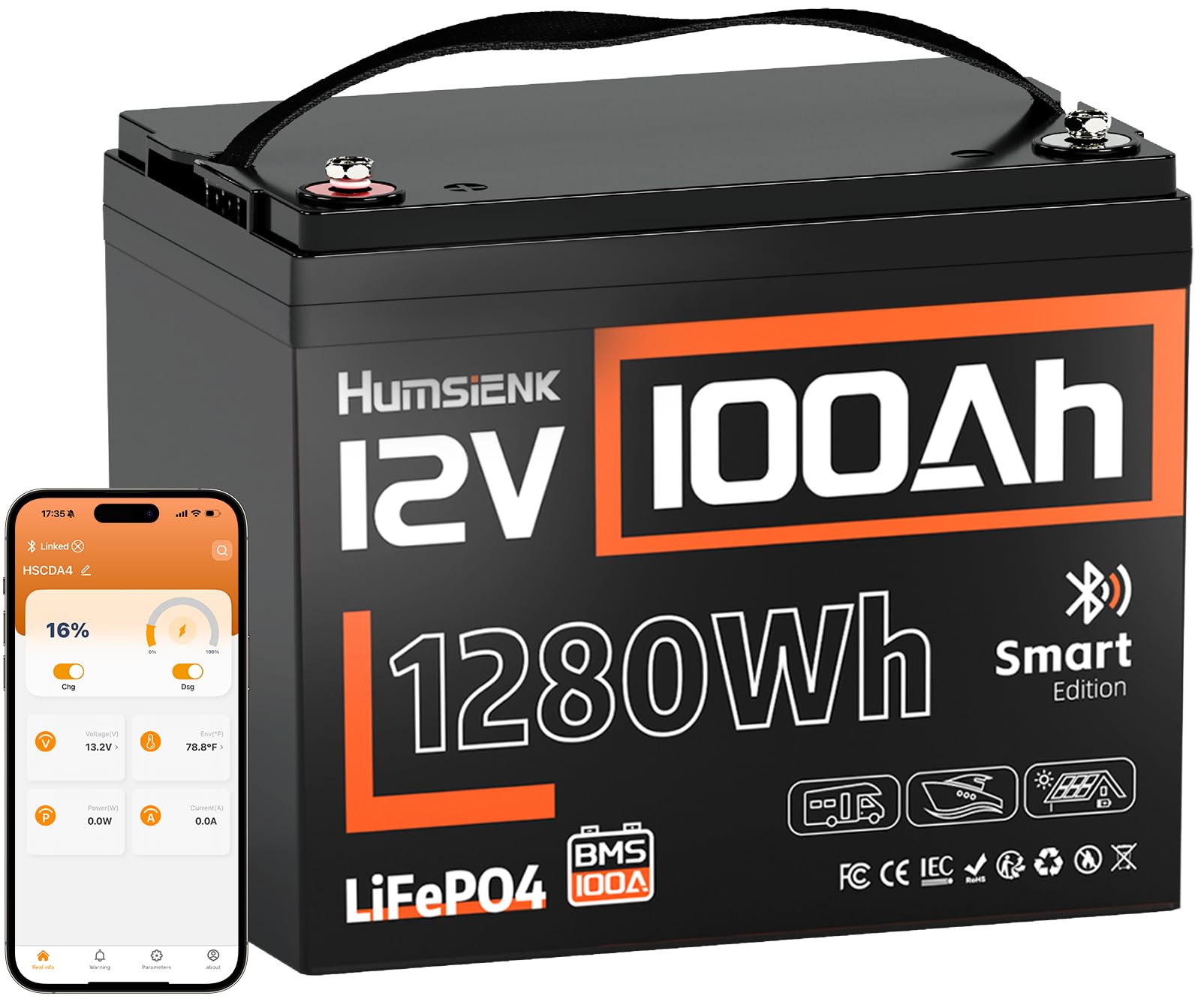
The lightest 100Ah lithium here at 19.7 pounds, ideal for small compartments and weight-conscious trailers.
This HumsiENK battery packs a full 100 amp-hours (1280Wh) into a BCI Group 24 footprint that’s globally compatible with Group 24–31 battery boxes. The big draw is its weight — just 19.7 pounds, which makes it over 60% lighter than a lead-acid equivalent and over 30% smaller. For a small trailer or a motorhome where every pound counts against your payload, that’s a meaningful difference.
The 100A smart BMS pairs with a dedicated app for real-time monitoring of voltage, temperature, and other key parameters. Owners have pushed it hard, with one running an 8000 BTU A/C on eco-mode for 11 hours down to 50% drain through a 2000W inverter. Another reported it powered major kitchen appliances without issue, describing it as a perfect drop-in replacement for RV, solar, or marine use.
On safety, it uses A+ grade LiFePO4 cells that are UL tested and certified by FCC and CE, with an IP65 waterproof rating. The low-temperature cutoff operates across a wide range from -4°F to 158°F, and it supports up to 15,000 cycles with a 5-year warranty. The app and BMS performance earn high marks, though a few owners found the Bluetooth connectivity a bit finicky to set up.
Standout feature: The sheer lightness at 19.7 lbs makes this the easiest 100Ah battery to install and the friendliest to your rig’s payload.
Gauge your fit: If your compartment is sized for a Group 24 box, this is a smooth upgrade; if you need more raw capacity, look higher up this list.
5. Power Queen 12V 150Ah Lithium Battery (Group 27)
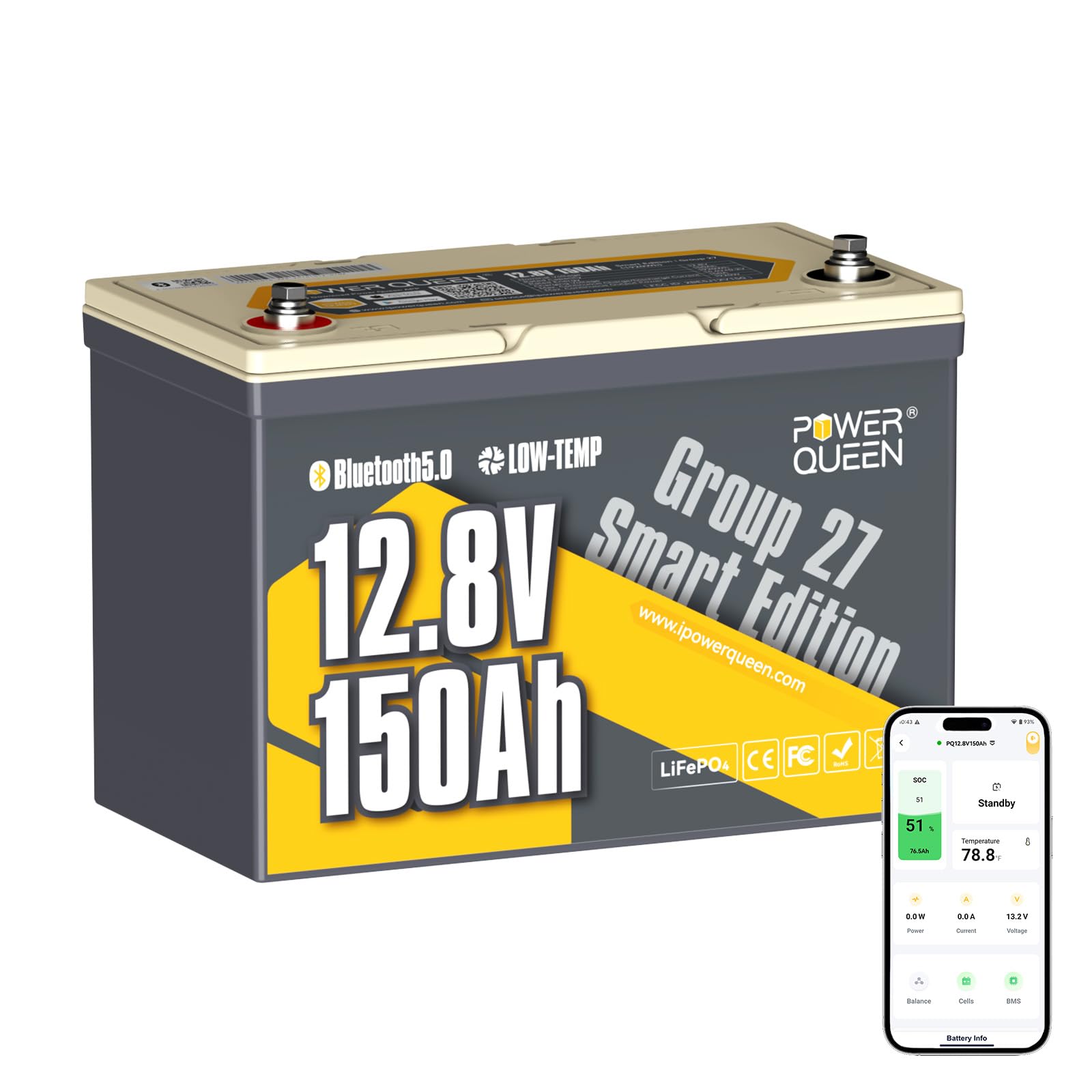
A 50% energy boost over typical 100Ah lithium, all within the same Group 27 footprint you already have.
This Power Queen battery solves a common motorhome problem: you want more runtime but your battery compartment is sized for Group 27. It delivers 150 amp-hours of capacity — 50% more usable energy than a typical 12V 100Ah lithium battery — without growing the physical footprint. At 33.5 pounds, it’s a substantial upgrade over the two standard SLA batteries it can replace, at roughly half the weight.
The numbers add up nicely for appliance-heavy users. It offers up to 1920W output power per battery, and 3840W from a two-battery setup, which is enough to run a microwave, coffee maker, air conditioner, and refrigerator. Owners confirm this in practice, with one running an induction cooktop, coffee maker, vacuum, and heater in a truck camper, keeping the battery above 90% with a 200W solar setup and 40A DC-DC charger.
Bluetooth 5.0 monitoring shows state of charge, voltage, temperature, and BMS health in real time, so you can stop guessing how much power remains. The intelligent low-temperature protection automatically prevents harmful charging in cold weather. Buyers praise the build quality and value, and the 5-year warranty adds confidence.
Why it earns the versatile label: It gives you a meaningful capacity bump over standard 100Ah units while staying physically small enough for A-frame trays and tight van compartments.
Keep in mind: The listed capacity on the box sometimes reads 190Ah in reviews, but the spec sheet says 150Ah — treat 150Ah as the honest figure.
6. Power Queen 12V 200Ah Plus LiFePO4 Battery

A 200-amp-hour powerhouse that runs big appliances like A/C units without breaking a sweat.
For motorhome owners who want to run air conditioning, a microwave, or other high-draw appliances, this Power Queen 200Ah Plus is built for the job. Its 200A BMS supports a maximum 2560W load power, which is why one owner successfully paired it with a Go Power 3000W inverter to run a 13.5K BTU A/C and a 1440W popcorn popper simultaneously. The 200 amp-hours of capacity translates to 2560Wh of stored energy.
At 48.6 pounds, it’s about a third of the weight of a comparable lead-acid battery, which would tip the scales around 130 pounds. The energy density works out to roughly 51.61Wh per pound, versus about 19.69Wh per pound for lead-acid, so you get more runtime from less mass. It supports expansion up to 4S4P for a maximum 51.2V 800Ah system with 40.96kWh of energy.
The cell quality is praised consistently, with owners noting it powers a fridge overnight and recharges well from a generator. The manufacturer claims over 4,000 cycles and a 10-year lifespan. The honest caveat is battery life — some owners reported a low state of charge or struggled to read the exact percentage, so you may want an external monitor for precise readings.
The power play: With 2560W max load and a 200A BMS, this is the unit for appliance-heavy rigs that lithium 100Ah units can’t handle.
A fair warning: This is strictly an energy storage battery — the maker advises against using it to start engines or golf carts.
7. ECO-WORTHY EnergyRock 12V 280Ah Metal Case LiFePO4
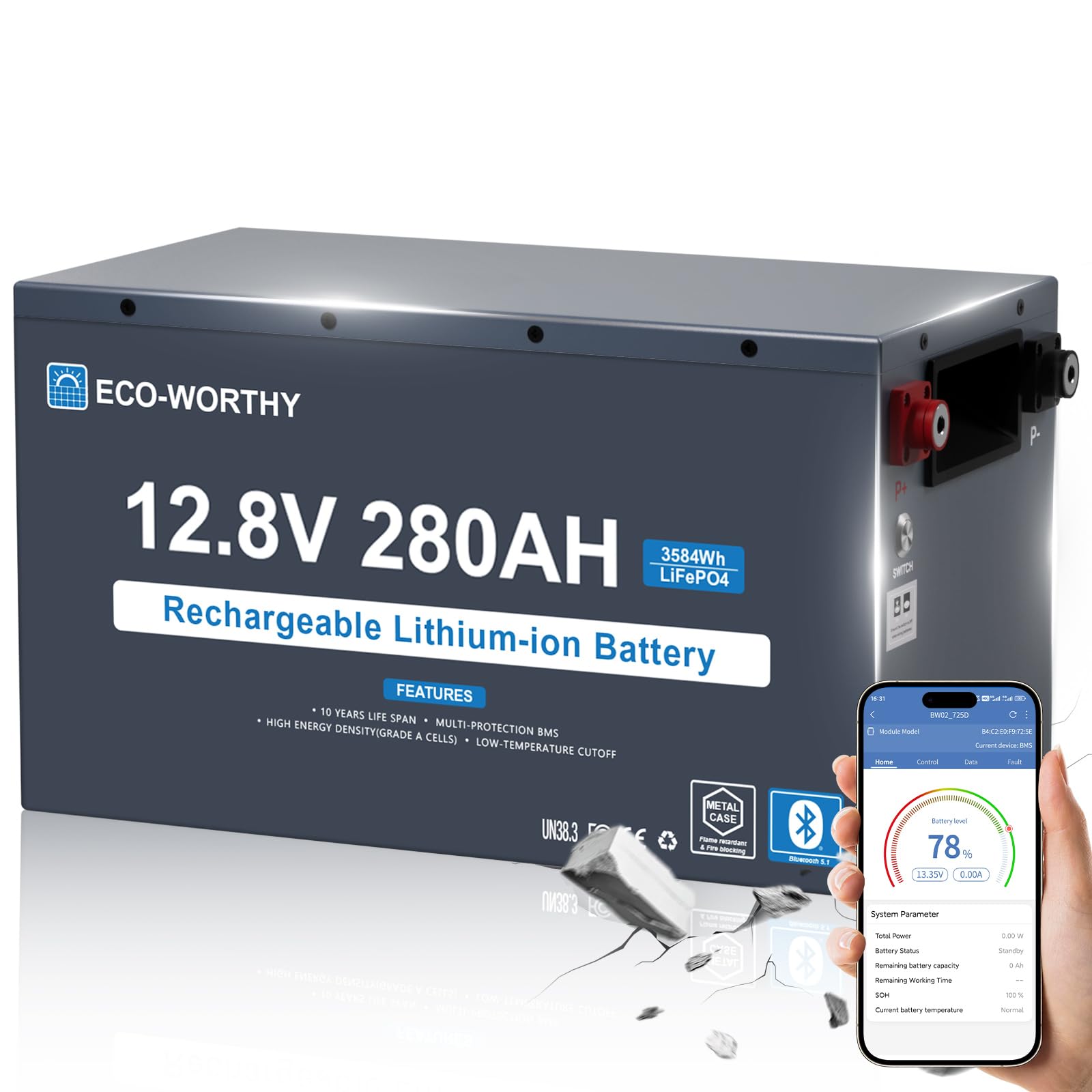
A rugged metal-clad battery from a brand with a strong owner following, ready to bolt directly into your rig.
This ECO-WORTHY EnergyRock stands out for its heavy-duty metal enclosure, which adds heat resistance and fire protection you don’t typically get from plastic-cased lithium batteries. The rugged shell means you can install it directly inside your RV or camper without a separate battery box — it comes with four mounting feet to bolt it down securely. The reinforced case and internal cell holders also resist shocks and road vibration, making it a solid choice for rough off-road travel.
With 280 amp-hours (roughly 3584Wh), owners confirm it keeps a fridge running for days — one reported powering a 12V 10 cu ft fridge for two days straight, even starting from a non-cooled state. Another owner tested it powering a 1000-watt amp without issues. The built-in 200A BMS provides multiple protections and automatically stops charging in low temperatures to protect the cells from cold damage.
The Bluetooth app lets you monitor voltage, capacity, and charge/discharge status in real time, and it works without requiring a login. A one-touch safety switch disconnects the output to prevent accidental discharge during maintenance. Build quality and installation ease are consistently praised, and the unit holds a 4.6-star average across a large owner base, cementing its reputation as a reliable upgrade.
The standout spec: The metal case with mounting feet is the defining feature — it saves space and adds a layer of physical protection most rivals lack.
Before you buy: At roughly 60-68 lbs, it’s heavy for a lithium unit, so confirm your compartment can bear the weight.
8. DUMFUME 12V 600Ah LiFePO4 Lithium Battery
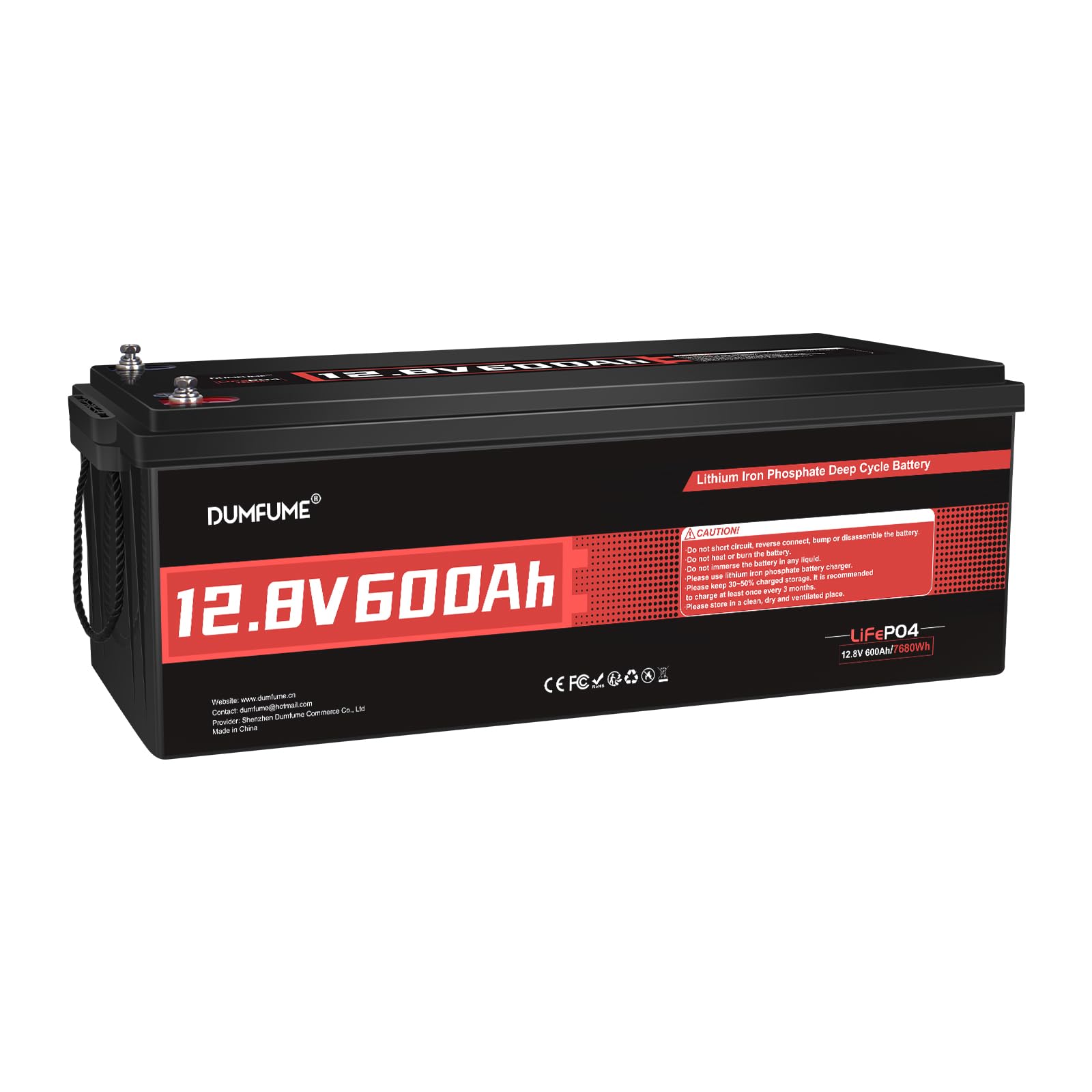
A commanding 7.2kWh reserve that can power your whole rig’s basics for a full day, if you can handle the weight.
When you want to stop worrying about running out of power mid-trip, the DUMFUME 600Ah is the capacity king of this lineup. Its 7.2kWh energy reserve is equivalent to one day’s basic power consumption for an average household — lighting, refrigerator, and small appliances. In a motorhome, that’s enough to keep your fridge cold, lights on, and devices charged without a generator.
The built-in 200A BMS provides comprehensive protection against overcharge, over-discharge, over-current, overheating, and short circuits. It also has low-temperature cutoff — disconnecting charging below 0°C and discharging below -20°C — to prevent cold-weather damage. The battery supports both parallel and series expansion, so you can reach 24V or 48V setups by adding more units, with the BMS coordinating charge and discharge automatically.
The build quality is the most-praised aspect, with owners noting excellent internal construction and solid performance even with modest 100 watts of solar. The 10-year lifespan with 4,000+ cycles at 100% DOD is the big selling point over lead-acid. The catch is weight and charging quirks — at 107.8 pounds, it’s a heavy lift, and some owners reported units that wouldn’t fully charge without a parallel jump-start. A few recommend a Victron monitor for accurate readings.
Who this fits: Full-time RVers or off-grid users who want maximum reserve and are prepared for a heavy, permanent installation.
Consider the caveat: If your setup is modest, a lighter 100-200Ah unit will be far easier to service and less punishing to install.
9. Litime 12V 320Ah Mini LiFePO4 Battery with Self-Heating
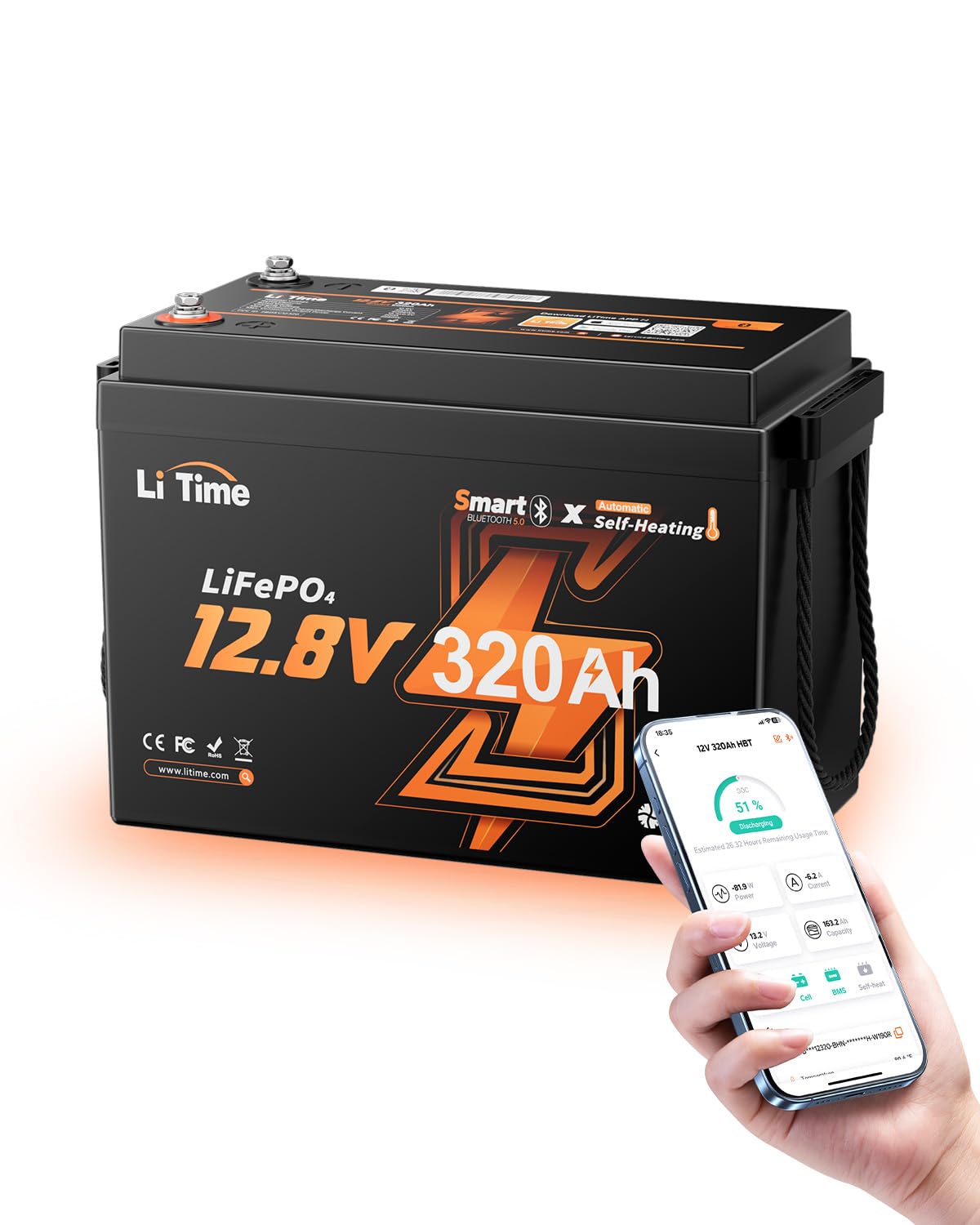
The winter camper’s ally, with self-heating that keeps the chemistry alive when temperatures plummet.
Lithium batteries are famously finicky in the cold, which is why this Litime 320Ah Mini is a standout for cold-weather campers. Its self-heating system has two modes: it activates heating below 41°F (5°C) when charging and stops at 50°F (10°C) to begin charging normally. Smart low-temperature protection also stops charging below 32°F and stops discharging below -4°F, so you can camp through frosty nights without cell damage.
The capacity is massive at 320 amp-hours, translating to 4096Wh of energy with a 2560W max continuous output. That’s enough to run RV appliances, marine tools, and off-grid setups with confidence. Reviewers point out it holds a charge extremely well, with one noting 83% capacity remaining after 90 hours of discharge. The Bluetooth app connects in seconds, letting you check charge, voltage, current, and temperature from your phone, and even control the discharge.
It’s also a space-saver, measuring 14.49 x 7.44 x 10.63 inches and weighing just 57.3 pounds — roughly 35% smaller than a standard 12V 300Ah LiFePO4 battery. That makes it a practical lead-acid replacement or a capacity upgrade when space is tight. The EV-grade LiFePO4 cells offer a 10-year lifespan with 4,000-15,000 cycles, all backed by a 5-year warranty.
Why it’s the cold-weather pick: No other battery here actively warms itself to enable charging below freezing — that’s the feature that keeps you powered in winter.
One thing to know: It needs a lithium-compatible charger to wake from sleep mode, so verify your converter before installing.
10. E-LekTech 12V 660Ah LiFePO4 Lithium Battery

This is the largest capacity in this guide, with a 250A BMS that sustains 3200W of continuous output.
This E-LekTech is for the serious off-grid RVer who treats their rig as a mobile home. With 660 amp-hours (7.68kWh), it’s the biggest single battery on this list, and its 250A intelligent BMS supports a maximum load power of 3200W. Owners confirm the real-world benefit — one runs three of them to power their 12V AC all day in an RV, and another powers an 8000 BTU A/C for 5 hours even on cloudy days.
At 109.4 pounds, it’s about a third of the weight of a lead-acid battery of the same capacity, making it easier to handle than its massive capacity suggests. It measures 24.03 x 9.66 x 8.7 inches, so it’s a substantial physical presence, but it’s designed for both indoor and outdoor use. The LiFePO4 chemistry offers over 8,000 recharge cycles with a lifespan of up to 10 years, and the 10-year warranty is the longest in this lineup.
Owners praise its value on a per-amp-hour basis and note the Bluetooth app readings match a Victron monitor accurately. The capacity holds well under load, dropping only to 13.4V with a 3.42A draw. The honest caveats are a few reports of inaccurate state-of-charge readings and a free charger that never arrived for one buyer — an external shunt is recommended for precise percentage reads.
The capacity play: For the highest single-battery capacity and a 10-year warranty, this is the one to beat.
Gauge your space: At over 109 lbs and nearly two feet long, this demands a large, load-bearing compartment — measure carefully before ordering.
11. VATRER POWER 12.8V 460Ah Self-Heating Lithium RV Battery
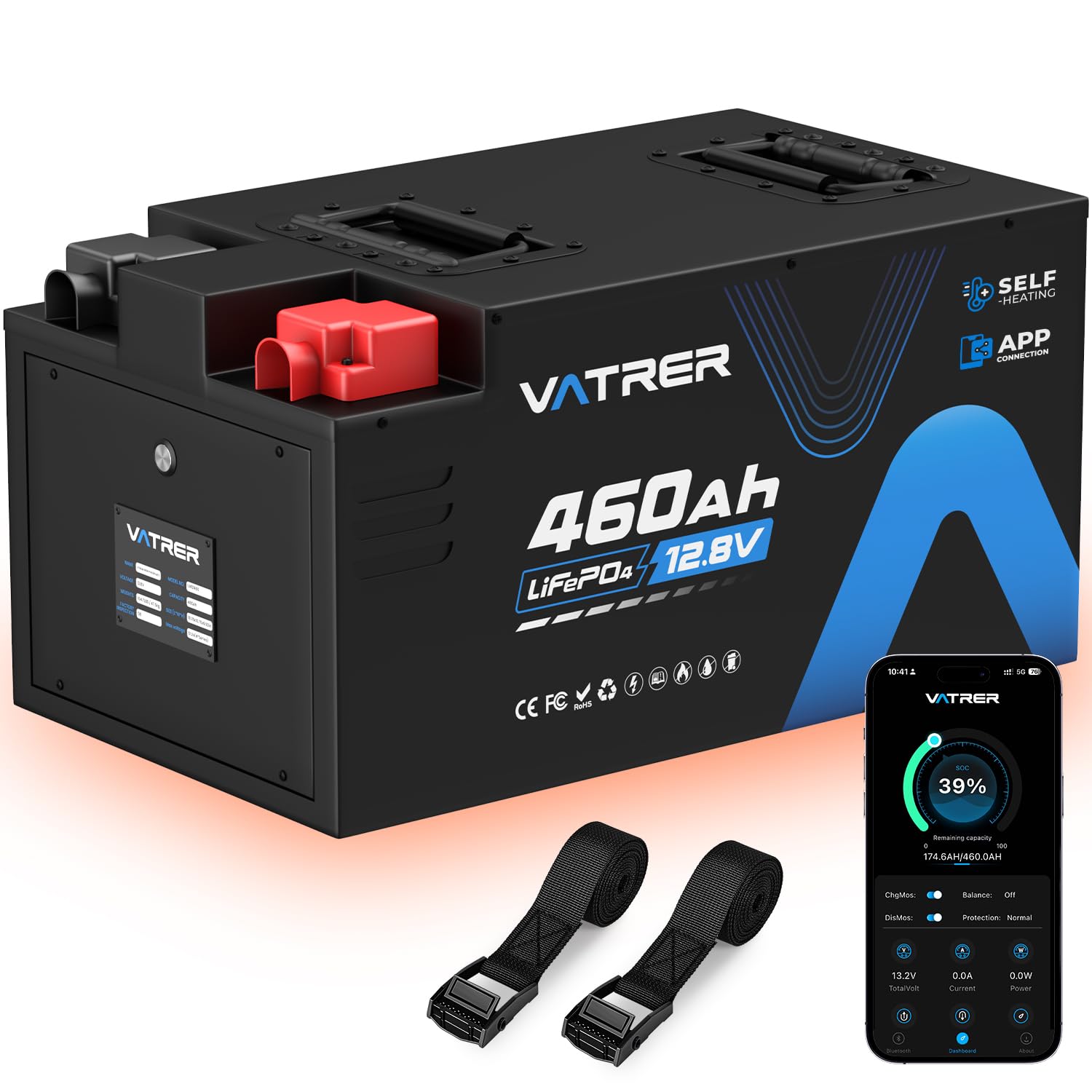
A tank of a battery — 460Ah with a 300A BMS and self-heating, built for uncompromising off-grid comfort.
This VATRER POWER battery is the premium end of the spectrum, combining a huge 460Ah capacity with a 300A continuous discharge current — the highest BMS rating in this lineup. That means it can power high-wattage appliances like air conditioners, TVs, and ovens simultaneously, giving you near-home-level comfort on the road. Owners describe it as built like a tank at 104.7 pounds, and praise its exceptional performance.
The self-heating feature is a key differentiator, allowing the battery to charge in cold temperatures where standard lithium units would shut down. It charges quickly too — one owner reported hitting 100% in about 4 hours. The all-new design uses a high-quality SPCC steel case that’s wear-resistant, and a main switch lets you control power output at the touch of a button. The built-in APP module provides real-time monitoring of current, voltage, temperature, and cycle life.
The build quality is the most-praised aspect, with owners noting it looks even better than the listing photos and feels exceptionally well-constructed. In terms of space, it measures 18.9 x 10.82 x 9.84 inches but holds the equivalent energy of five 100Ah batteries — while taking up only 1.1 cubic feet. It can expand to a max 51.2V 1840Ah system, delivering 61.44kW output and 94.2kWh of usable energy for a serious off-grid setup.
Why it earns the premium spot: The 300A BMS and self-heating functionality are class-leading in this guide, making it the most capable single-battery solution for heavy, all-season use.
The honest trade-off: Bluetooth connectivity gets mixed feedback, and at over 104 lbs, you’ll definitely want help lifting it into place.
Understanding the Specs
Amp-Hours (Ah) Explained
This is the single most important number on a deep-cycle battery. Amp-hours measure how much electrical charge the battery can deliver over time — a 100Ah battery can supply 1 amp for 100 hours or 10 amps for 10 hours. For a motorhome, estimate your daily load: a 12V fridge might draw 5-8 amps, and interior LED lights might draw 1-2 amps. Add up your usage to find the minimum capacity you need.
BMS and Protective Features
The Battery Management System (BMS) is the battery’s internal safety brain. It monitors cell voltage, temperature, and current to prevent overcharging, over-discharging, and short circuits. A higher-rated BMS (like 200A or 300A) allows more appliances to run simultaneously. Low-temperature cutoff is a critical feature that stops charging below freezing, protecting the cells from permanent damage in winter camping.
LiFePO4 vs. Lead-Acid Chemistry
Lithium iron phosphate (LiFePO4) batteries offer roughly double the usable capacity of lead-acid because you can safely drain them to nearly 100% depth of discharge, versus the 50% limit on lead-acid. They also weigh about a third as much, charge faster, and typically last 4,000+ cycles versus a few hundred. The trade-off is a higher upfront price, but for heavy or full-time use, they often win on long-term cost per cycle.
Group Size and Physical Fit
BCI group sizes (like Group 24, 27, or 31) standardize battery dimensions so you can swap between brands. Before buying, measure your motorhome’s battery compartment — length, width, and height — and compare it to the battery’s listed dimensions. Weight matters too: a 200Ah lithium battery may weigh around 50 pounds, but a comparable lead-acid unit could be 130 pounds, so check your rig’s payload limits.
FAQ
What is the difference between a deep-cycle battery and a starting battery for my motorhome?
How many amp-hours do I need for my motorhome?
Can I replace my lead-acid motorhome battery with a lithium one?
What does the low-temperature cutoff do?
How long will a LiFePO4 battery last compared to lead-acid?
What is a BMS and why does it matter?
Can I connect multiple batteries in parallel to get more capacity?
What does the Bluetooth app on a lithium battery actually show?
Is a self-heating lithium battery worth the extra cost?
How heavy is a typical deep-cycle battery for a motorhome?
Final Thoughts: The Verdict
The clear winner for most motorhome owners is the Litime 12V 230Ah because it balances massive 230Ah capacity, a manageable 46-pound weight, and app-based monitoring at a price that undercuts larger systems. If you’re budget-conscious and want a simple lithium upgrade, the VEMDIA 12V 100Ah delivers the core benefits for less. For cold-weather campers, the Litime 12V 320Ah Mini with Self-Heating is the only real choice to keep your rig powered through frosty nights.
How We Picked
We do not accept paid placement. Every pick is matched to a real buyer and a real use-case; we do not hands-on test units.
Sources & Methodology
Specifications: manufacturer listings and product documentation. Review insights: verified customer reviews, as of August 2026. Pricing: not shown on this page (it changes often); check the current price via the retailer link.
As an Amazon Associate, Gadgets Feed earns from qualifying purchases. This does not affect which products we feature.