
Our readers keep the lights on and my morning glass full of iced black tea. As an Amazon Associate, I earn from qualifying purchases.
Specs are compiled from manufacturer listings and verified buyer reviews and can change over time — please confirm the key details on the product page before buying.
When the power goes out, your priorities are keeping the fridge cold, the router on, and the lights lit. A reliable battery backup can mean the difference between a brief blackout and a spoiled freezer. We compare portable power stations to find which ones keep your home essentials running during an outage.
I’m Min — the founder and writer behind Gadgets Feed. This guide is built by comparing the manufacturers’ published specifications and the patterns across verified customer reviews, so you get each pick’s real strengths and trade-offs instead of marketing spin.
We break down the best models by capacity, output, and recharge speed to help you secure the ideal battery for power outage that matches your home’s essential needs.
Our Picks at a Glance
How To Choose The Best Battery For Power Outage
A portable power station is a long-term investment, so focus on the specs that matter for your home. You need to match three things: how much energy the battery holds, how much power it can push out at once, and how fast it can refill when the grid or the sun cooperates.
Capacity: The Total Energy Tank (Wh)
Capacity, measured in watt-hours (Wh), determines how long your devices can run. It tells you how long your devices can run. If you only need to charge phones and run a few LED lights overnight, a smaller unit in the 500Wh range works. But if a full-size refrigerator and a sump pump are non-negotiables, you want a larger tank—often 2000Wh or more—to get through a full day or two.
Output: How Much Power It Can Deliver At Once (W)
Output, measured in watts (W), is the burst of electricity the unit can supply at a single moment. This is what starts a refrigerator compressor or runs a space heater. A station can hold huge capacity but only deliver a modest output, so check this number against the appliances you plan to plug in. Also distinguish between the rated continuous output and the surge capacity that handles brief startup spikes.
Battery Chemistry and Lifespan
Battery chemistry dictates the unit’s cycle life and longevity. LiFePO4 (lithium iron phosphate) cells are safer and last longer than standard lithium-ion. These cells typically support thousands of cycles, meaning the unit can serve as daily power backup for years—not just a one-time hurricane companion. Many premium units boast a lifespan exceeding a decade with regular use.
Recharging Speed and Options
Recharge speed and options are critical for multi-day outages. Look for units that support fast wall charging—many newer models can refill in 1-2 hours. Also consider solar input if you want to recharge off-grid indefinitely, though panel wattage and sunlight will determine the actual time. Some stations also accommodate car chargers or even EV stations for flexibility.
Quick Comparison
| Model | Best For | Capacity | Continuous Output | Weight | Amazon |
|---|---|---|---|---|---|
| ECOFLOW DELTA Pro★ Best Overall | Whole-home essentials | 3600Wh | 3600W | 99 lbs | Amazon |
| GRECELL 500WBudget Champion | Entry-level budget | 519.48Wh | 500W | 14.1 lbs | Amazon |
| VTOMAN FlashSpeed 1000Fast-Refill Pick | Fast refill and heavy appliances | 828Wh | 1000W | 31.7 lbs | Amazon |
| BLUETTI Elite 100 V2 | Quiet, daily-sized backup | 1024Wh | 1800W | 25 lbs | Amazon |
| DABBSSON 2000L | High capacity with light weight | 2048Wh | 2200W | 41 lbs | Amazon |
| Anker SOLIX S2000 | Max fridge runtime | 2010Wh | 1500W | 35.7 lbs | Amazon |
| PECRON F3000LFP | 2-3 day home essentials | 3072Wh | 3600W | 63.3 lbs | Amazon |
| BLUETTI Elite 300 | Compact 3kWh and RV-ready | 3014.4Wh | 2400W | 58 lbs | Amazon |
| Jackery 2000 v2 + Solar | Off-grid solar bundle | 2042Wh | 2200W | 39.5 lbs | Amazon |
| Jackery HomePower 3000 | Whole-house fridge & more | 3072Wh | 3600W | 59.5 lbs | Amazon |
| Anker SOLIX F3800 | EV charging & 120/240V tools | 3840Wh | 6000W | 132.3 lbs | Amazon |
In‑Depth Reviews
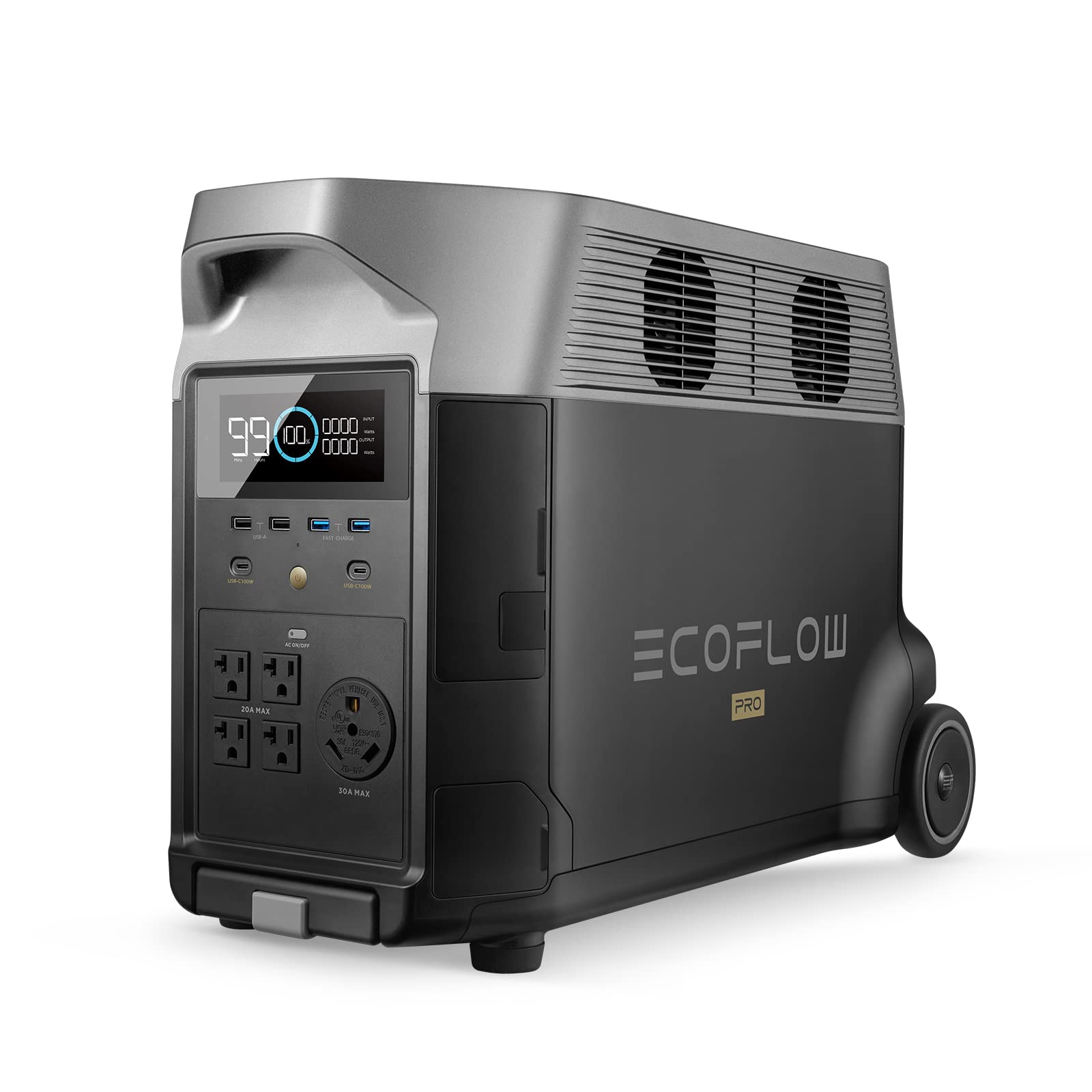
1. EF ECOFLOW Portable Power Station DELTA Pro
Our pick — over 4.5★ from 600+ verified ratings; the strongest balance of quality and price.
The heavyweight home fortress that keeps a fridge and lights running all night long.
The DELTA Pro is the benchmark for serious home backup, packing a 3600Wh LFP battery into a unit that delivers a 3600W AC output. If 99 pounds seems like a lot, remember it replaces a gas generator and the smell, noise, and fuel runs that come with it. Buyers report the unit powered a fridge and lights overnight and still had 30% left—proof that this capacity genuinely bridges multi-hour outages.
Recharging is where the DELTA Pro pulls ahead of almost everything else. Its X-Stream fast charging can refill the whole unit in 1.8 hours on a 240V outlet, or 2.7 hours on a standard 1800W wall outlet. Add four 400W solar panels and you can top it up in 2.8 hours, which means a full tank every sunny afternoon during a prolonged blackout.
Versatility is baked in. With 15 output methods—including 5 AC outlets, 2 USB-C at 100W, and car and Anderson ports—you can run several appliances at once. The EcoFlow app adds remote monitoring over Wi-Fi or Bluetooth, letting you check charge levels and tweak settings from across the house. However, the fan gets noisy under heavy load, a minor price to pay for this much power. Buyers also warn to switch off your home’s main breaker before connecting it to your house panel, both for your safety and the utility line workers’.
What wins people over
- Massive 3600Wh tank keeps essentials going overnight
- Blazing 1.8-hour wall recharge (240V) or 2.8-hour solar top-up
- Expandable from 3.6kWh up to 25kWh with extra batteries
- 15 output ports run many devices simultaneously
Where it asks a compromise
- 99-pound weight makes it a semi-permanent home fixture
- Fan noise is noticeable when under heavy load
- Units can arrive with box damage from shipping
Best suited for: Households that want a genuine gas-generator replacement for overnight and multi-hour outages, with the option to grow into a 25kWh system.
Think twice if: You need to hoist it into an RV or carry it often—at 99 pounds this one stays put.
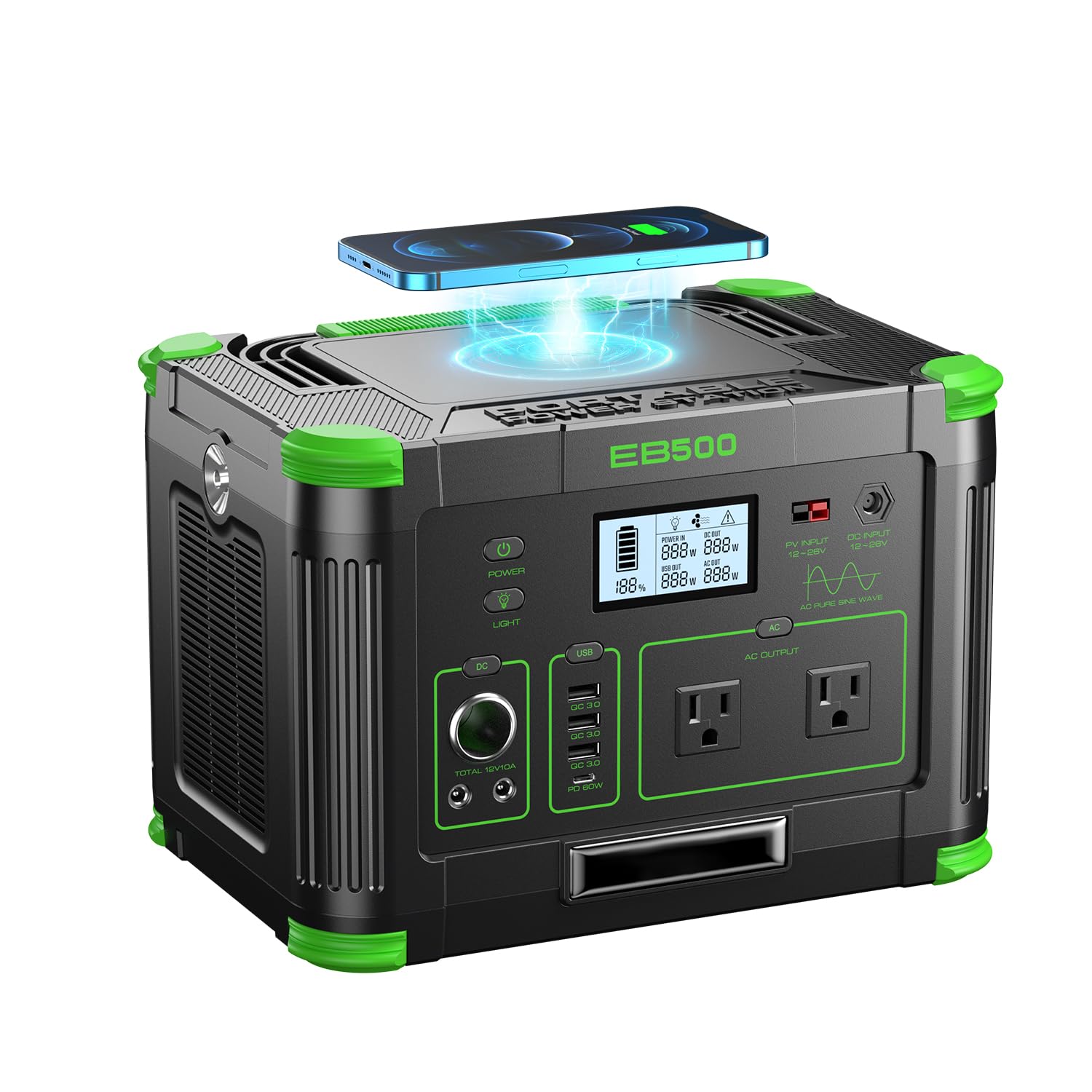
2. GRECELL Portable Power Station 500W
A featherweight 519.48Wh starter station that fits in a gym bag and runs the basics.
The GRECELL is what you reach for when the outage is more annoyance than disaster, offering a 519.48Wh battery (140400mAh) that sips power rather than gulps it. Weighing just 14.1 pounds, it is a fraction of the DELTA Pro’s bulk—which makes sense next to the DELTA Pro’s 3600Wh tank and 3600W output. This one is about portability and simplicity, not whole-home coverage.
It runs small essentials happily: phones, laptops, lights, fans, routers, a CPAP machine, even a small TV or projector, so long as they draw under 500W. Owners mention it powered a Ninja woodfire grill for about 2 hours while dropping to roughly 60% charge—a decent showing for the size. A built-in wireless charger on top adds convenience for topping up a phone without cables.
The catch is in the refill and the chemistry. Wall charging takes 6-7 hours, and a 100W solar panel stretches that to 6-9 hours, so you cannot quickly top it up mid-outage. It also uses a standard lithium battery rather than the longer-lived LiFePO4 cells found in pricier units, meaning a shorter overall lifespan. There is no shortage of value here—the aspect owners praise most is value for money—but treat it as an emergency light-and-phone companion, not a fridge power source.
Why it is a great entry point
- Only 14.1 pounds, easy to carry anywhere
- Runs lights, phones, laptops, and small appliances up to 500W
- Top wireless charging pad simplifies phone charging
- 10 output ports support simultaneous device use
What to keep in mind
- 6-7 hour wall recharge is slow for multi-day outages
- Standard lithium cells age faster than LiFePO4
- Not built for appliance-heavy loads above 500W
Reach for it if: You want an ultralight backup for powering communication and lighting during short outages.
Look elsewhere if: A refrigerator or sump pump is on your must-power list—this tank is too small.
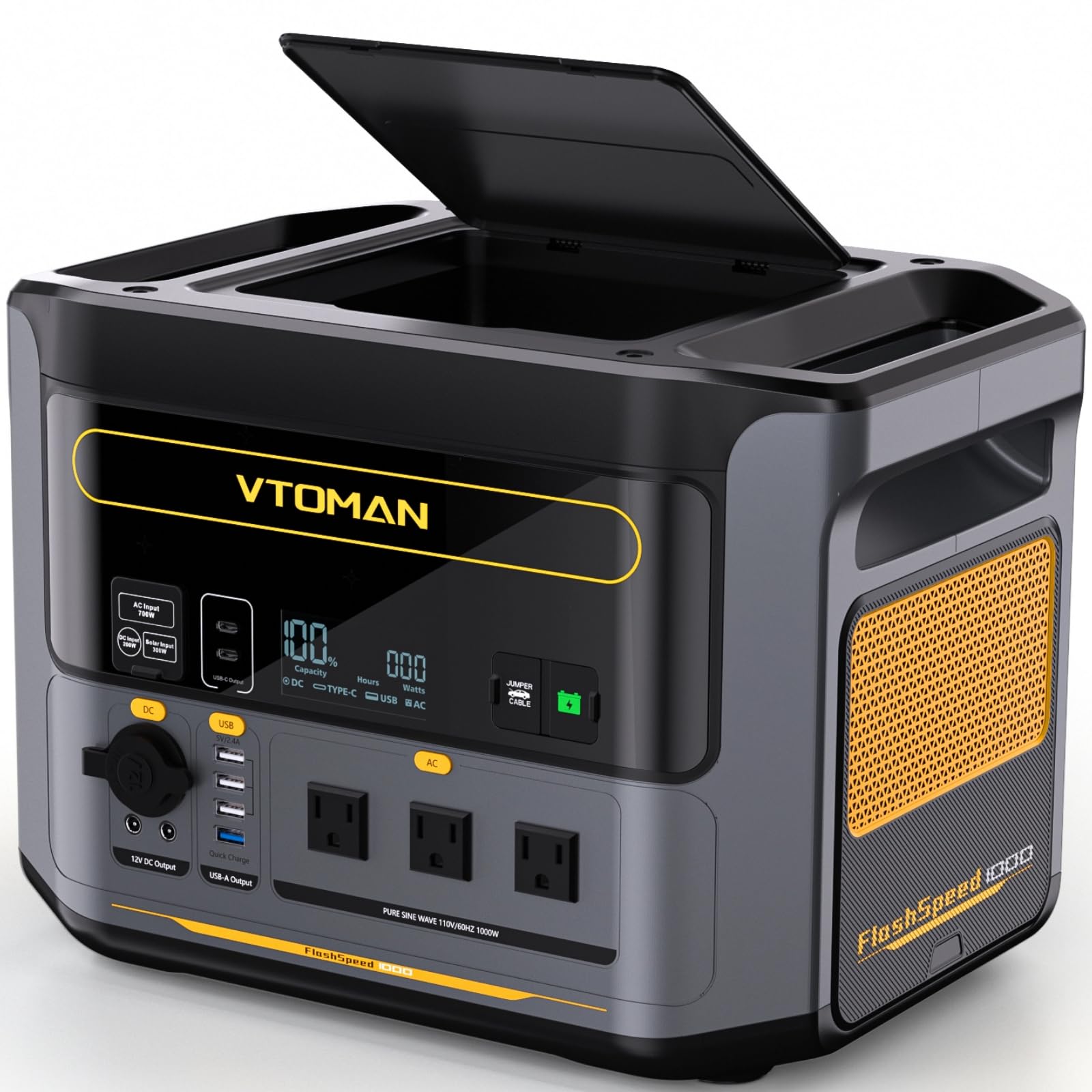
3. VTOMAN FlashSpeed 1000
Recharges to 80% in an hour and powers appliances well above its rated output.
The VTOMAN FlashSpeed 1000 earns its name with a 1000W AC input that takes it from empty to 80% in 1 hour—no separate AC adapter required. That speed is a lifesaver when the grid flickers back for short windows and you need to grab as much juice as possible. Inside sits a LiFePO4 battery rated for 3000+ cycles before hitting 80% of its original capacity, so this unit is built for the long haul.
Its “V-Beyond” technology lets the 1000W rated station power appliances above 1000W by outputting constant power rather than shutting off. That is rare flexibility for an 828Wh unit. Buyers confirm it ran a space heater and electric hotplate simultaneously, and one owner survived a month-long outage after multiple Florida hurricanes, charging it back up with 2x400W solar panels. The UPS pass-through function even auto-switches to battery during outages, protecting sensitive computing equipment.
The trade-offs are honest ones. Charging faster than expected can trip a standard outlet breaker, so plan to use a higher-amp circuit. Capacity is expandable to 2376Wh via the FlashSpeed 1500 extra battery, but that battery sells separately, and adding it doubles charging time. With 12 ports that all support pass-through charging, you can keep devices powered while the station itself refills.
Top of the class
- 0-80% recharge in just 1 hour via 1000W AC input
- Powers appliances above 1000W with constant-power output
- LiFePO4 cells rated for 3000+ cycles
- Expandable to 2376Wh with optional extra battery
Requires attention
- Fast charging may trip a standard wall breaker
- AC-active drain when idle, even unplugged
- Expansion battery adds cost and doubles charge time
Right for: Storm-prone regions where a quick refill between outages matters more than raw capacity.
Not ideal if: You need days of silent runtime without any way to recharge in between.
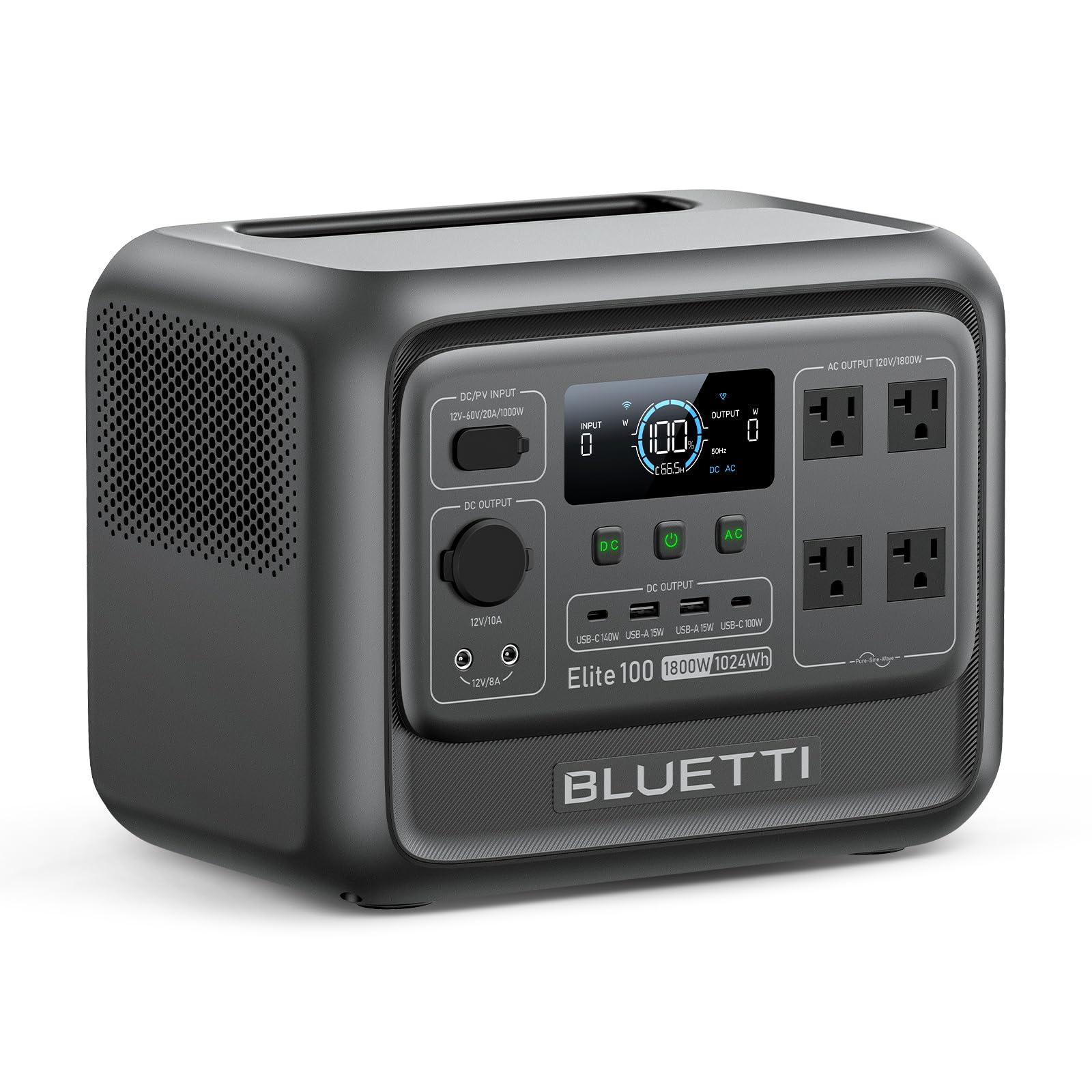
4. BLUETTI Elite 100 V2
Whisper-quiet UPS backup for routers and computers that runs nearly everything else too.
For most households, the BLUETTI Elite 100 V2 is the one worth buying because it balances a 1024Wh capacity (enough to run a fridge for hours) with a frame that weighs just 25 pounds, so you can carry it easily. Its standout feature is the built-in 10ms UPS switchover (a transfer that kicks in within 10 milliseconds), which keeps your Wi-Fi router and desktop PC running without a hiccup when the power cuts. In silent mode it operates at just 30dB (about as loud as a whisper), so it won’t disturb your sleep in a bedroom during an outage or at a campsite.
Owners consistently praise the power quality, with one astrophotographer relying on it to run a telescope mount, cameras, a mini PC, and an iPad in remote areas for 6.5-7 hours. The 1800W rated output (2700W surge) can start a microwave or a space heater, making it far more capable than its 1kWh size suggests. Recharging is equally quick: about 70 minutes to full via 1200W AC input or up to 1000W of solar.
At 35% smaller than comparable units, it tucks into a closet without dominating the room. The flip side of that compactness is that it is still dense—buyers describe it as heavy for its footprint, though the hidden handle helps. Its LiFePO4 battery supports over 4,000 cycles to 80% capacity, promising a reliable 10-year lifespan for everyday backup duty.
Standout trait: The 10ms UPS switchover makes this the go-to choice for protecting routers, PCs, and office gear through flickers and brief outages.
Practical note: Owners also report 24-48 hours of power support for essentials on a single charge—enough for most single-night outages.
Choose this if: You want a quiet, compact unit that shields your home office gear and powers small appliances.
skip it if: You expect to run a full-size fridge and freezer for days—you need a larger 2kWh+ tank.
5. DABBSSON Portable Power Station 2000L
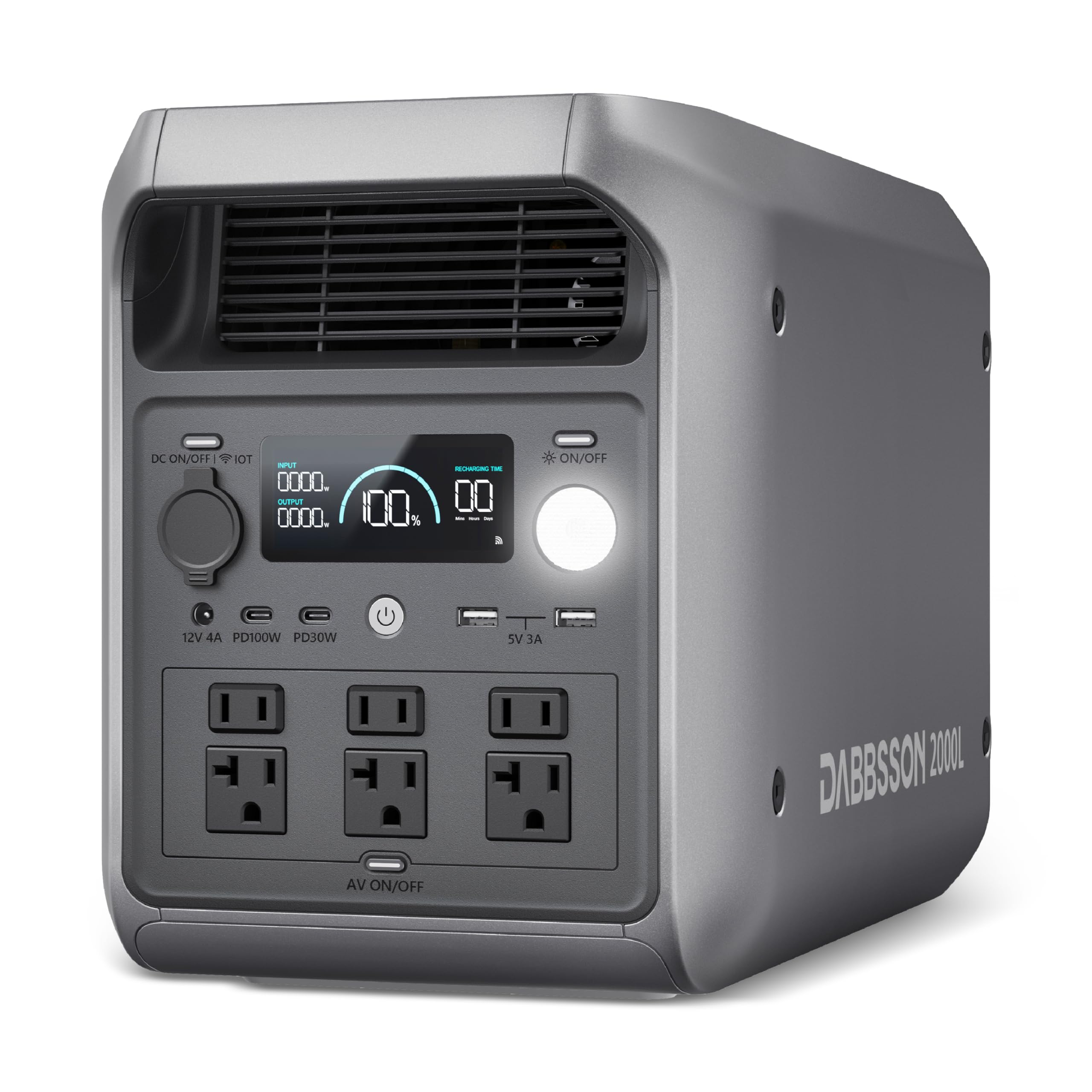
A 2048Wh tank with a 3300W surge, packed into a body that weighs just 41 pounds.
If you need to run heavy appliances like a refrigerator, heater, grill, or power tools, the DABBSSON 2000L delivers 2048Wh of capacity with a 2200W continuous output and a 3300W surge boost (a temporary power spike to start motors). what separates it in the 2kWh class is its weight: at 41 pounds, it is compact and easier to move or store than most high-capacity rivals, so you can roll it from the garage to the kitchen without a struggle. Owners call it the best price-to-performance unit in the 2kWh class, meaning you get more watt-hours per dollar than pricier alternatives.
The 2000L can refill its large tank in about 1 hour via AC input—remarkably fast for its class. It also accepts solar up to 800W MPPT, car charging, and even hybrid dual-input AC plus solar for faster off-grid refills. An EPS switch under 10ms protects computers, NAS drives, and routers from power loss, so your data and gear stay safe during an outage.
Semi-solid LiFePO4 cells push the safety and lifespan story further, rated for 4000+ deep cycles to 80% capacity and a stated 10+ year lifespan with daily use. The housing carries a UL94-V0 flame-retardant rating, an extra layer of home safety. Bear in mind the fan can get noisy under high load, and one reviewer noted the plastic feels less premium than the price suggests—build is solid, but not luxurious.
The big wins
- 1-hour AC recharge for the full 2048Wh capacity
- Reliability earns more owner praise than any other feature
- 6 AC outlets plus a full port set for many devices at once
- 5-year warranty (3 years standard + 2 extended)
What to weigh
- Fans can get loud when pushing high loads
- Some owners find the plastic housing a bit flimsy-feeling
Ideal for: Families that want near-2kWh backup capacity without committing to a 60-pound brick.
Consider another if: You need a unit that disappears into a closet—this one still commands floor space at 18.3 inches wide.
6. Anker SOLIX S2000
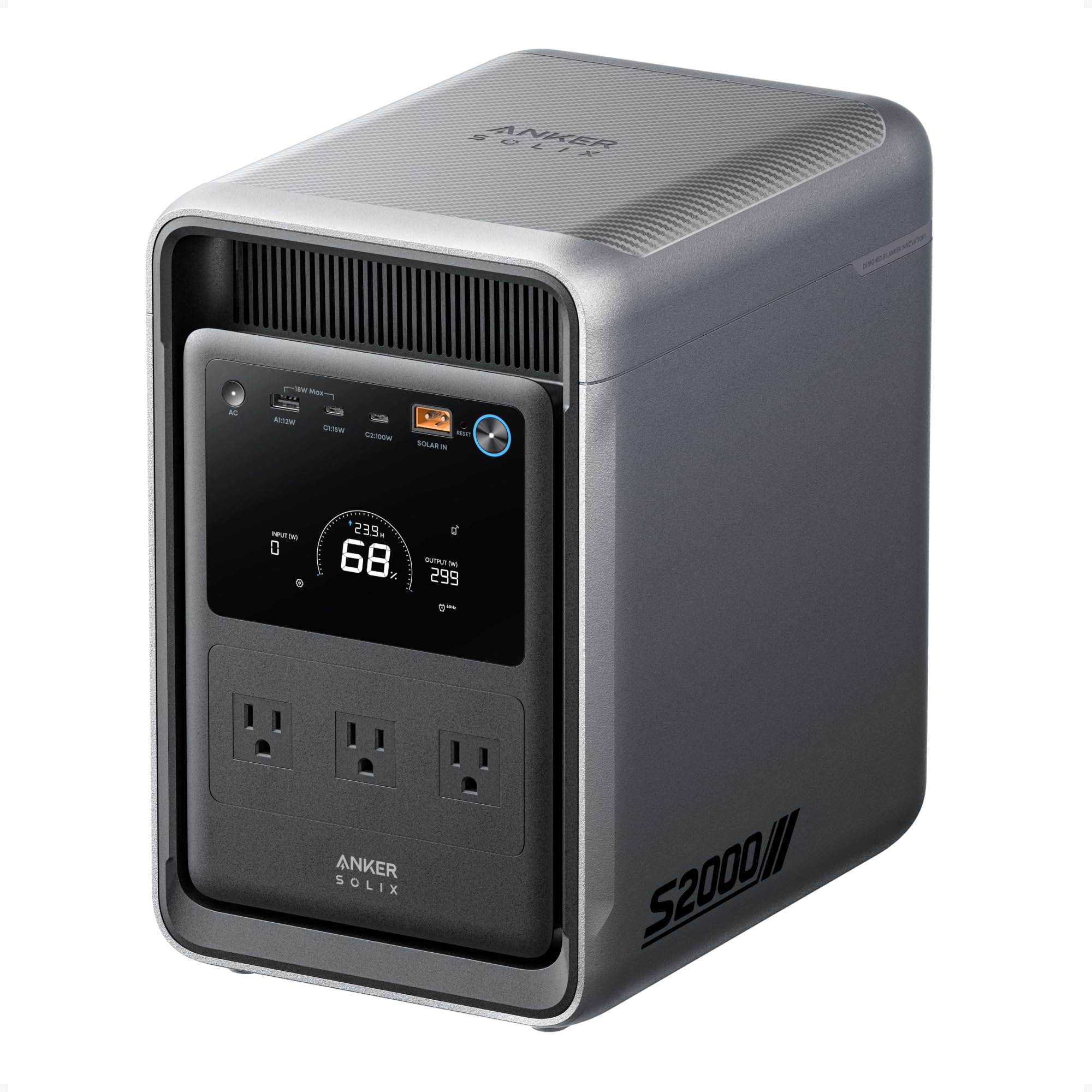
Engineered around one number that matters most: 35 hours of fridge runtime.
If your main worry is spoiled food during a long outage, the Anker SOLIX S2000 is built for that job. Its 2010Wh capacity pairs with just 6W of idle power draw (the power it uses just sitting there), so it wastes almost nothing while waiting. Anker rates it for up to 35 hours powering a refrigerator, and owners confirm that in practice: one buyer reports it ran a full-size fridge for roughly 30 hours and still had 20% battery left, so you can trust it to keep your milk cold through a multi-day blackout.
The internal 314Ah LFP cells support an eye-popping 10,000 charge cycles and a 15-year lifespan, making this as close to a set-and-forget backup as the category offers. A <10ms UPS switchover lets it guard a home office setup, and its dual-sided outlets keep always-on appliances tidy in the rear. Recharging is flexible: up to 400W of solar input plus AC, generator, alternator, or car options.
The critics’ grumbles focus on noise and smell. The fan can drone audibly during 1200W charging, and some buyers noticed a strong burning odor on the very first charge that dissipated afterward. At 35.7 pounds it is light for a 2kWh unit, though still too heavy to be called truly grab-and-go. None of these are deal-breakers for a device whose core job—keeping the fridge alive—it performs admirably.
Why it leads its class
- Up to 35 hours of refrigerator backup on a single charge
- 10,000-cycle LFP battery promises a 15-year lifespan
- Extremely low 6W idle draw preserves stored energy
- <10ms UPS keeps computers and routers running
Owner caveats
- Fan noise is noticeable during fast 1200W charging
- First charge can emit a burning smell that fades
- No 12V DC port for car-style accessories
Buy it for: Long-duration fridge protection and home-office UPS duty combined in one compact, long-lived unit.
Pass if: You regularly draw over 1500W—the continuous output tops out there.
7. PECRON Portable Power Station F3000LFP
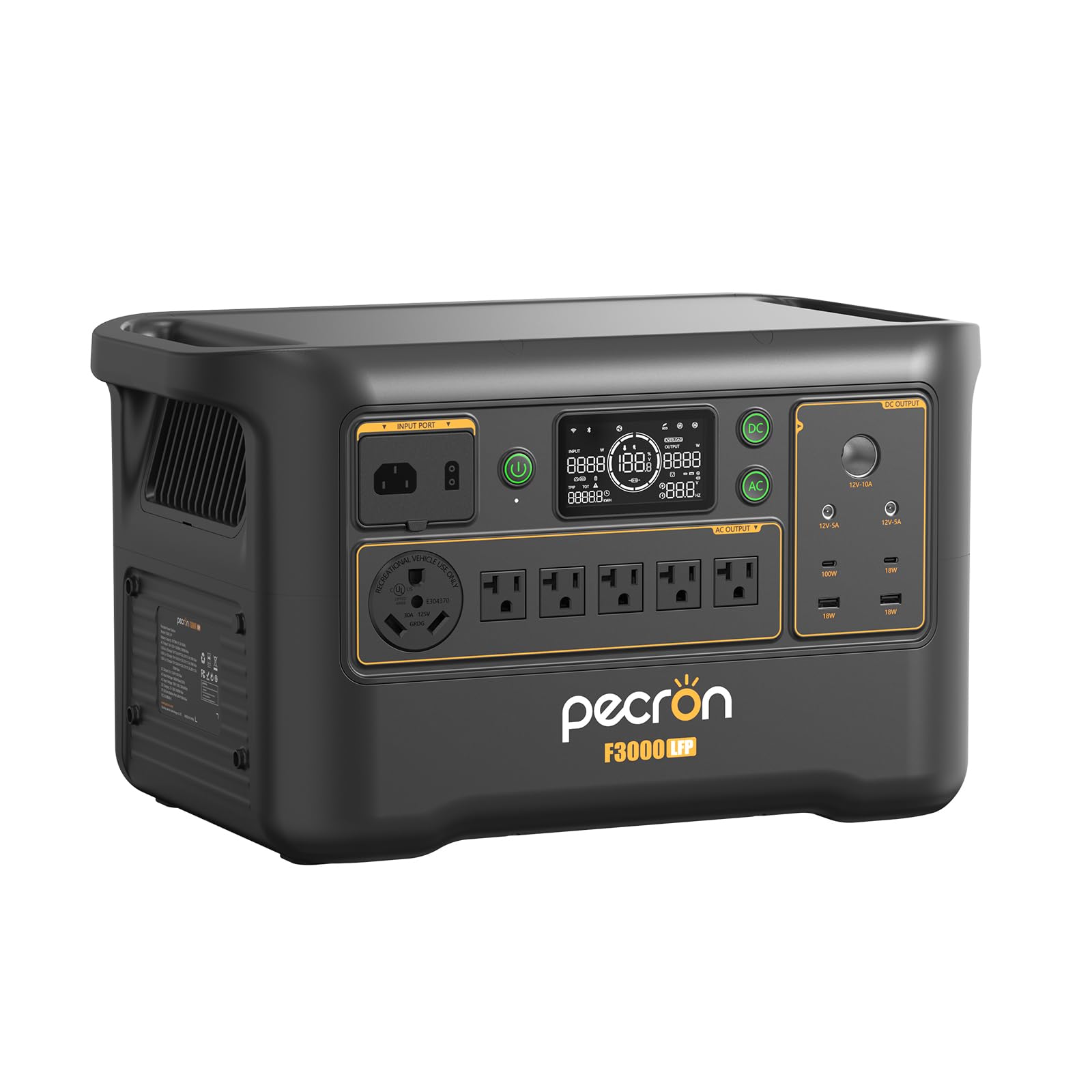
A 3072Wh powerhouse that promises 2-3 days of home essentials on one charge.
The PECRON F3000LFP targets the household that needs more than overnight coverage. Its 3072Wh LiFePO4 battery is sized to carry essential home loads—refrigerator, lights, router, CPAP—for 2-3 days, per the manufacturer. It pushes a 3600W pure sine wave output capable of running heavy-duty appliances like air conditioners and power tools, and can power 13 devices simultaneously through 6 AC outlets and a full port array.
Recharging is fast for this class: a 1800W AC input takes it from 0% to 100% in about 2 hours. It accepts up to 1600W of solar, and customers note even modest solar input around 420W per hour from a 400W panel helps stretch an outage. An 8-20ms UPS switch protects computers and medical devices, while the app allows real-time power monitoring.
The trade-off is physical. At 63.3 pounds, this is a serious piece of equipment that buyers describe as heavy but worth it. Charging performance draws mixed feedback—some report a longer charge time than advertised—and the fan is audible while charging. That said, those who have weathered 40+ outages report zero issues, and customers praise the reliability and value for money above all.
Strength in depth
- 3072Wh capacity delivers 2-3 days of essential home power
- 0-100% recharge in about 2 hours via 1800W AC input
- 13 ports power many devices at once
- Expandable up to 10752Wh with extra battery packs
Expect from real life
- 63.3-pound weight makes moving it a two-person job
- Charging time can run longer than the 2-hour claim
- Fan noise is present during charging
Best for: Homes facing multi-day outages that want one unit to carry essentials without touching a gas can.
Reconsider if: You lack floor space for a 63-pound station—this is not a countertop device.
8. BLUETTI Elite 300
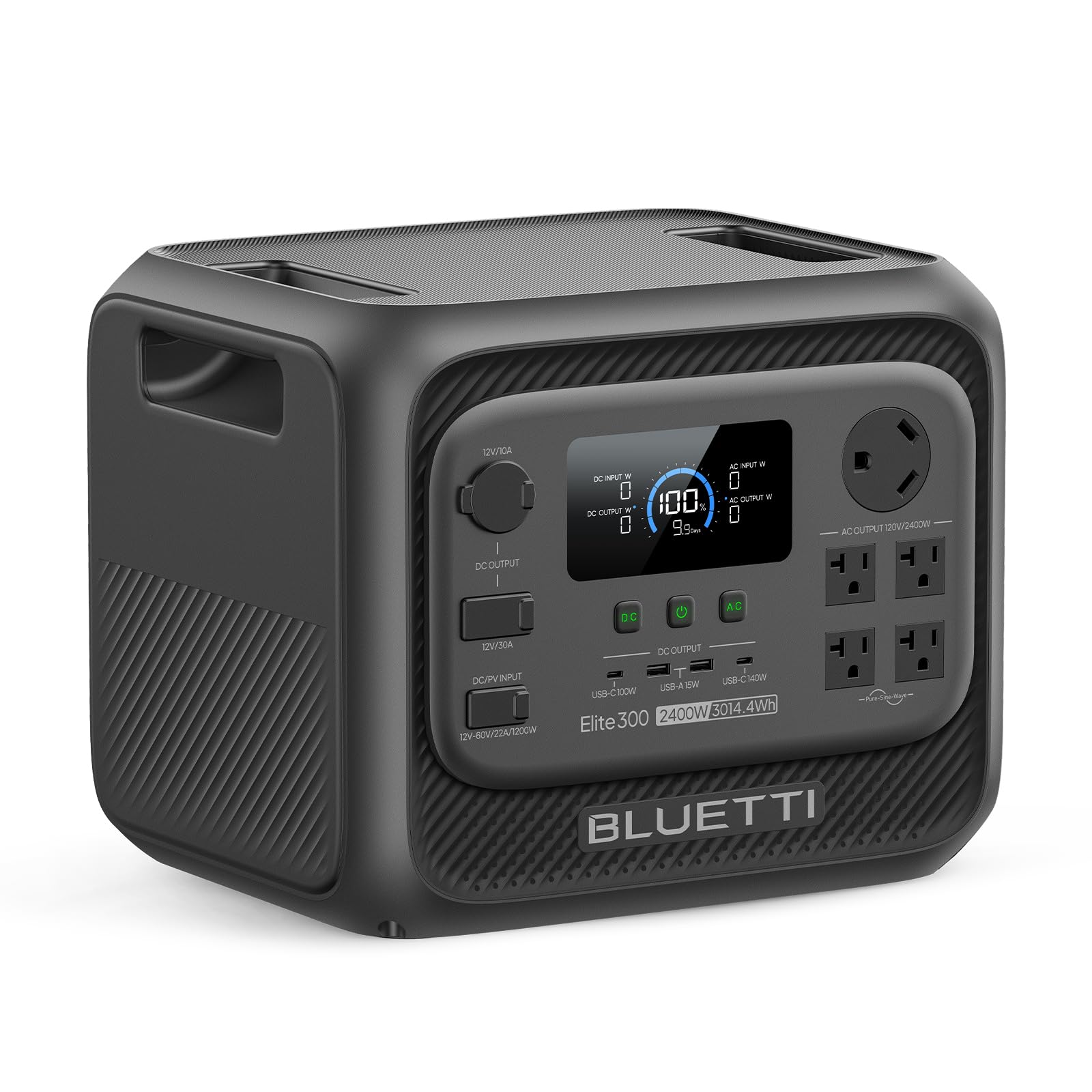
The world’s smallest 3kWh station, recognized by Frost & Sullivan, that also plugs into an RV.
The BLUETTI Elite 300 packs a full 3014.4Wh capacity into a frame recognized by Frost & Sullivan as the world’s smallest 3kWh portable power station—nearly 59% smaller than traditional units of the same capacity. That concentration of energy makes it a compelling home-backup choice that stores easily, yet buyers consistently note it feels as heavy as a truck battery at 58 pounds.
If you split time between home and a camper van, the Elite 300 is the only unit here that is RV-ready, thanks to a TT-30 outlet (the standard 30-amp plug found on RVs) and a high-current 12V/30A DC output. That lets you run 12V RV fridges, water pumps, and diesel heaters directly, so it works as both a home backup and a van-life power source. For outages, its 2400W output with a 4800W surge (a temporary boost to start appliances) handles resistive loads like kettles, and the 10ms UPS switch (a transfer that kicks in within 10 milliseconds) keeps your computer and router running without interruption.
Recharging from 0% to 80% takes as little as 78 minutes via AC. What buyers flag is the solar input ceiling of 60V/20A—some 3-panel setups exceed that voltage rating and risk damaging the MPPT controller—and the lack of battery expansion options. The app and build quality draw consistent praise, with one owner calling its power-transition handling flawless during a real outage.
The defining strengths
- Compact 3kWh design, nearly 59% smaller than rivals
- TT-30 RV port and 12V/30A DC for RV systems
- 0-80% charge in as fast as 78 minutes
- 4800W surge starts resistive loads like kettles
What to watch
- Solar input limited to 60V, ruling out some panel arrays
- No battery expansion options for growing capacity
- Display can be hard to read in direct sunlight
Grab it if: You split time between home backup and an RV and want one station that serves both.
Look past it if: You plan to scale capacity with extra batteries—this model has no expansion path.
9. Jackery Explorer 2000 v2 with 2x200W Solar Panels
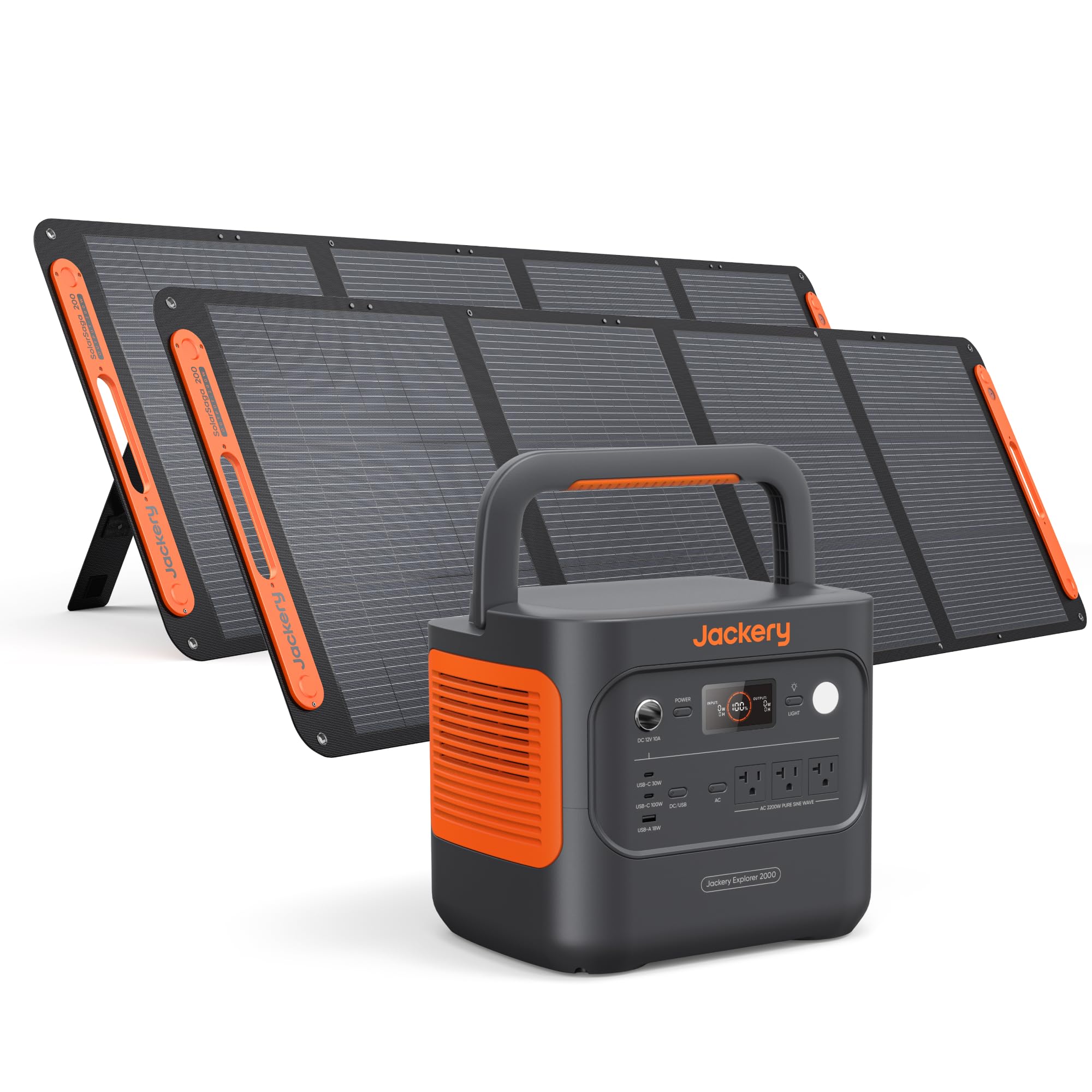
A solar-ready 2042Wh station that recharges to 80% in just 66 minutes from the wall.
The Jackery Explorer 2000 v2 stands out for being both light and fast. At 39.5 pounds, it is 41% lighter than conventional 2kWh LiFePO4 stations, thanks to CTB (Cell-to-Body) technology borrowed from electric vehicles. That weight savings makes it one of the few 2kWh units you could realistically move from garage to campsite without a dolly.
Its trick is speed. Wall charging takes it to 80% in just 66 minutes, and an app-activated Emergency Super Charging mode hits full in 102 minutes. Owners confirm this, with one buyer charging from 8% to 100% in under an hour and another reaching full from 29% in 1 hour 40 minutes. Paired with the included 2x200W solar panels, it becomes a self-sustaining off-grid power source—solar charging takes about 6 hours in full sun.
Buyers running a CPAP machine report 4-6 hours of reliable power, and the 2200W output plus a USB-C PD 100W port cover most essentials. The silent charging mode operates at 30dB, letting it refill in a bedroom overnight without disturbance. Owners note the fan stays quiet under normal use, though the unit has fewer outlets than some rivals, and the solar panels can yellow grass beneath them after a few hot hours.
Why it shines
- 80% recharge in 66 minutes from a wall outlet
- 41% lighter than typical 2kWh LiFePO4 stations at 39.5 lbs
- Includes 2x200W solar panels for off-grid refills
- 20ms UPS switching is UL1778 certified
Small trade-offs
- Fewer output ports than some 2kWh rivals
- Solar panels can discolor grass beneath them
- Proper cable connection is required for solar to work
Right for: Buyers who want a complete solar bundle that weighs little and recharges faster than anything near its capacity.
Not for: Anyone needing an RV 30A outlet—this model skips that connection.
10. Jackery HomePower 3000
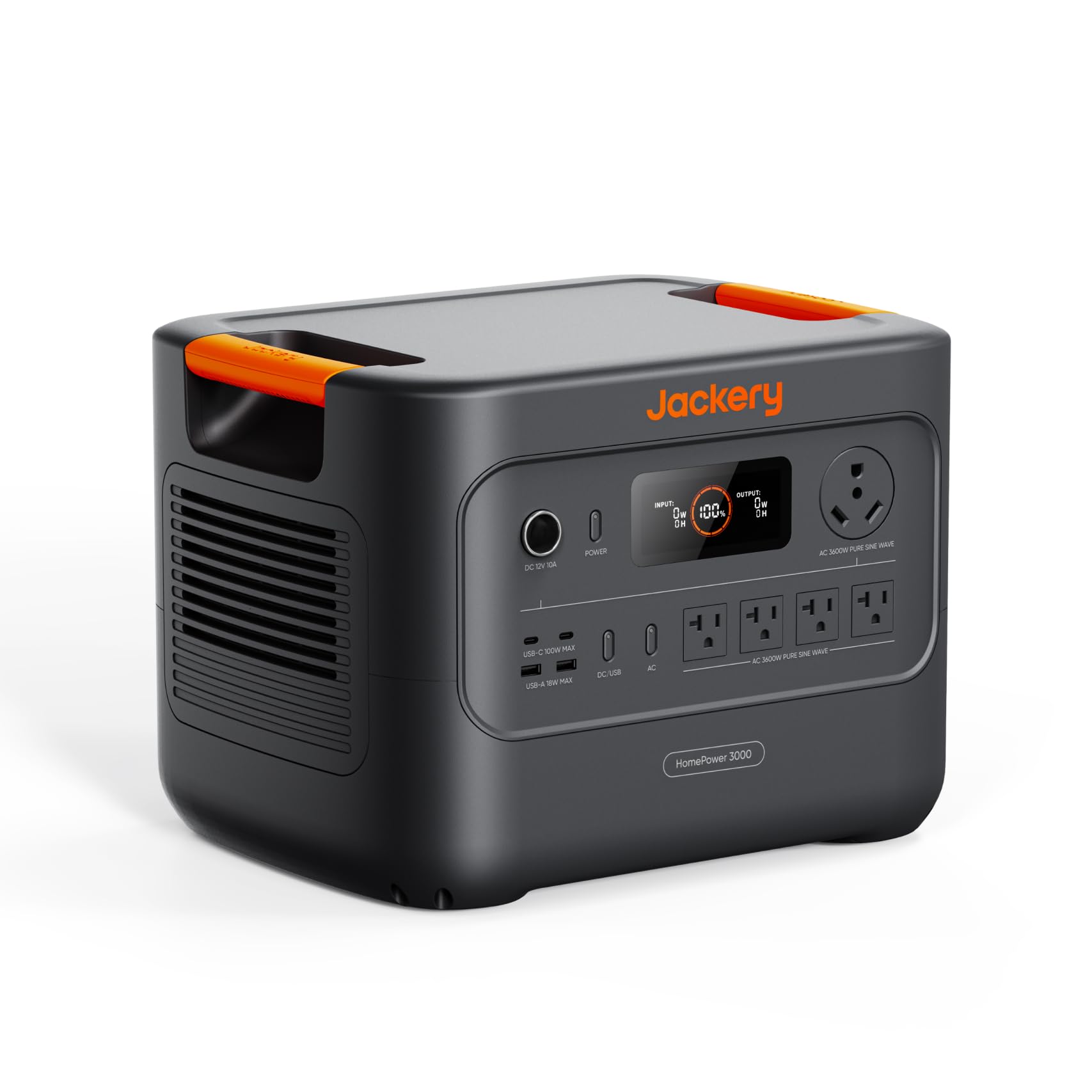
Keeps a whole household running up to 15 hours and a refrigerator going for 1-2 days.
If you want to keep your whole house running, not just one room, the Jackery HomePower 3000 is the one to pick. With a 3072Wh capacity and a 3600W output (7200W surge), it can run a fridge, fan, Wi-Fi router, and lights all at once, and Jackery rates it to power a household for up to 15 hours while keeping a refrigerator running 1-2 days. Buyers confirm the scale: one owner reports powering a Whirlpool side-by-side fridge for over 30 hours, so you can keep your food safe through a multi-day outage.
Its dual 100W USB-C PD ports fast-charge phones, tablets, and drones, while the built-in TT-30 RV port offers plug-and-play power for campers. The whole unit recharges in 1.7 hours via hybrid AC and DC, or 2.2 hours through AC alone. A UL-certified UPS switches within ≤20ms, protecting security cameras, medical refrigerators, and even Zoom calls from interruption during an outage.
Jackery claims this is the world’s first 3kWh station with CTB technology, making it 47% smaller and 43% lighter than comparable models. At 59.5 pounds, it is still a hefty lift, and owners note the fan runs at roughly 60dB whenever there is any power draw—loud enough to rule it out as a permanent bedside UPS. But for short to medium outages, buyers call it a worthy gas-generator alternative.
What earns top marks
- 3072Wh capacity powers a household up to 15 hours
- TT-30 RV port plugs campers in directly
- Full recharge in 1.7 hours via hybrid AC and DC
- ChargeShield 2.0 keeps LiFePO4 cells at 4,000 cycles
Owner reality check
- Fan noise near 60dB on any power draw limits placement
- Heavy at 59.5 pounds; two handles help but it is a lift
- Charging performance earned mixed feedback
Select this for: Whole-home coverage where one unit must run a fridge and family essentials for a day or two.
Think twice if: You want a quiet unit for a bedroom or home office—the fan will remind you it is working.
11. Anker SOLIX F3800

A 6000W dual-voltage giant that can run a dryer, charge an EV, or power a whole RV.
The Anker SOLIX F3800 is in a different league entirely, with a 3840Wh base capacity and a 6000W AC output across both 120V and 240V. That dual-voltage capability means it runs appliances most portable stations cannot touch—your electric dryer, well pump, or RV’s entire electrical system. Owners call it “ginormously powerful,” and with good reason.
This is also the only unit in this guide that can directly charge an electric vehicle. Plug your EV charging cable into its NEMA 14-50 port (the same outlet a home EV charger uses) and it delivers 6000W, with no grounding accessories required, so you can top up your car during an outage. For RVs, the NEMA 14-50 or L14-30 ports let it power all your appliances at once, and you can add a Smart Generator 5500 for auto start-stop, which extends runtime indefinitely—so you never run out of power even in a week-long blackout.
Capacity scales dramatically: add up to 6 battery packs for 26.9kWh, or pair two F3800 units with 12 packs for enough power to last two weeks. Anker backs it with a 5-year warranty and claims a 10-year lifespan via InfiniPower technology. The honest drawbacks are weight—132.3 pounds makes this a semi-permanent installation—and solar quirks, with buyers noting the 2400W solar input is hard to reach and tune for Anker’s own panels. One owner saw just 218W from a labeled 400W panel in full Texas sun.
Where nothing else matches it
- 6000W output across 120V and 240V for heavy appliances
- NEMA 14-50 port charges an EV at 6000W
- 26.9kWh with extra packs, or 53.8kWh with a second unit
- 5-year warranty with a claimed 10-year lifespan
What demands respect
- 132.3-pound weight makes it a permanent floor fixture
- Solar input rarely reaches the 2400W max with third-party panels
- BMS limits charging below 50°F to a slower rate
Invest in this if: You need whole-home coverage for heavy 240V appliances or want EV charging capability from your backup.
Avoid if: You lack sturdy floor space—at 132.3 pounds, this is not something you move around.
Understanding the Specs
Watt-Hours (Wh) Explained
This is the total energy your battery can store, like the size of a fuel tank. A higher Wh number means your devices run longer before you need to recharge. For a rough sense: a typical fridge draws about 150W per hour of compressor run time, so a 1000Wh battery might run it for several hours, while a 3000Wh+ unit can stretch toward a full day of refrigeration.
Watts (W) and Surge Output
Output wattage determines which appliances can start and run at all. Continuous output is what the unit sustains; surge is a brief burst for starting motors. Refrigerators, sump pumps, and space heaters often draw more at startup than they do while running, so make sure your station’s continuous output comfortably covers the device’s running wattage.
FAQ
How long will my refrigerator run on a 2000Wh power station?
Can these stations power a house transfer switch?
What is the difference between LiFePO4 and standard lithium batteries?
Can I recharge my power station with solar panels?
What can a 500W output station actually run?
Does leaving the power station on drain the battery?
Can I expand capacity later?
How heavy are these units really?
Can I power my RV with one of these?
What safety features should I look for?
Final Thoughts: The Verdict
The best battery for power outage for most households is the ECOFLOW DELTA Pro, a 3600Wh, 3600W powerhouse that refills in under 2 hours and can handle nearly any home essential—it is the proven crowd favorite. If you want quieter, daily-sized protection for a home office or apartment, the BLUETTI Elite 100 V2 delivers 10ms UPS protection in a light 25-pound frame. And for the buyer chasing maximum fridge runtime per dollar, the Anker SOLIX S2000 leads the 2kWh field with up to 35 hours of refrigerator backup and a 15-year lifespan. Scale your choice to the appliances you refuse to lose, and you will not be left in the dark.
How We Picked
We do not accept paid placement. Every pick is matched to a real buyer and a real use-case; we do not hands-on test units.
Sources & Methodology
Specifications: manufacturer listings and product documentation. Review insights: verified customer reviews, as of September 2026. Pricing: not shown on this page (it changes often); check the current price via the retailer link.
As an Amazon Associate, Gadgets Feed earns from qualifying purchases. This does not affect which products we feature.