
Our readers keep the lights on and my morning glass full of iced black tea. As an Amazon Associate, I earn from qualifying purchases.
Specs are compiled from manufacturer listings and verified buyer reviews and can change over time — please confirm the key details on the product page before buying.
Solar panels only make power while the sun is up. A home storage battery banks that solar energy for use after dark or during outages. This guide helps you match a solar storage battery to your inverter, capacity needs, and available space.
I’m Min — the founder and writer behind Gadgets Feed. This guide is built by comparing the manufacturers’ published specifications and the patterns across verified customer reviews, so you get each pick’s real strengths and trade-offs instead of marketing spin.
You will learn how to match voltage, capacity, and safety features to your real needs so you can confidently pick the best battery for solar power storage the first time.
Our Picks at a Glance
How To Choose The Best Battery For Solar Power Storage
Before you compare prices, you need to decide on three things: voltage, chemistry, and capacity. These three choices determine your inverter’s compatibility, runtime, and safety.
Voltage and Inverter Compatibility
Your inverter must match the battery voltage, so this is the first filter. A 12V battery (like most of the picks below) works for small off-grid cabins, RVs, and simple setups. A 48V battery (like the server rack pick) is the standard for whole-home backup because it carries more power through thinner cables.
Capacity in Amp-Hours and Watt-Hours
Capacity is measured in amp-hours (Ah), but you actually consume energy in watt-hours (Wh). To find usable energy, multiply voltage by amp-hours (e.g., 12V × 100Ah = 1200Wh). Look for LiFePO4 batteries that deliver close to 100% of that rated capacity, unlike lead-acid which only gives you about 50% before it needs recharging.
Chemistry: Why LiFePO4 Wins
Every pick in this guide uses lithium iron phosphate (LiFePO4) cells, a battery chemistry that is safe for homes because it handles thousands of deep discharge cycles, resists overheating, and contains no heavy metals. You can expect a lifespan of 4,000+ cycles, which translates to a decade of daily use.
Quick Comparison
| Model | Best For | Voltage | Capacity | Energy (Wh) | Amazon |
|---|---|---|---|---|---|
| ECO-WORTHY Cubix100★ Best Overall | Whole-home backup | 51.2V | 100Ah | 5120Wh | Amazon |
| yeagulch 2-Pack MiniBest Value | Budget-friendly trolling | 12.8V | 100Ah | 2560Wh (total) | Amazon |
| Renogy Core MiniCompact Pick | Tight-space installs | 12.8V | 100Ah | 1280Wh | Amazon |
| Litime Group 24 | RV and marine drop-in | 12.8V | 100Ah | 1280Wh | Amazon |
| Dumfume 314Ah | Large 12V capacity | 12.8V | 314Ah | 4019Wh | Amazon |
| ECO-WORTHY 280Ah | High-amperage draws | 12.8V | 280Ah | 3584Wh | Amazon |
| Redodo 2-Pack | Expandable systems | 12.8V | 200Ah (total) | 2560Wh (total) | Amazon |
| Litime 230Ah | Long trips, big loads | 12.8V | 230Ah | 2944Wh | Amazon |
In-Depth Reviews
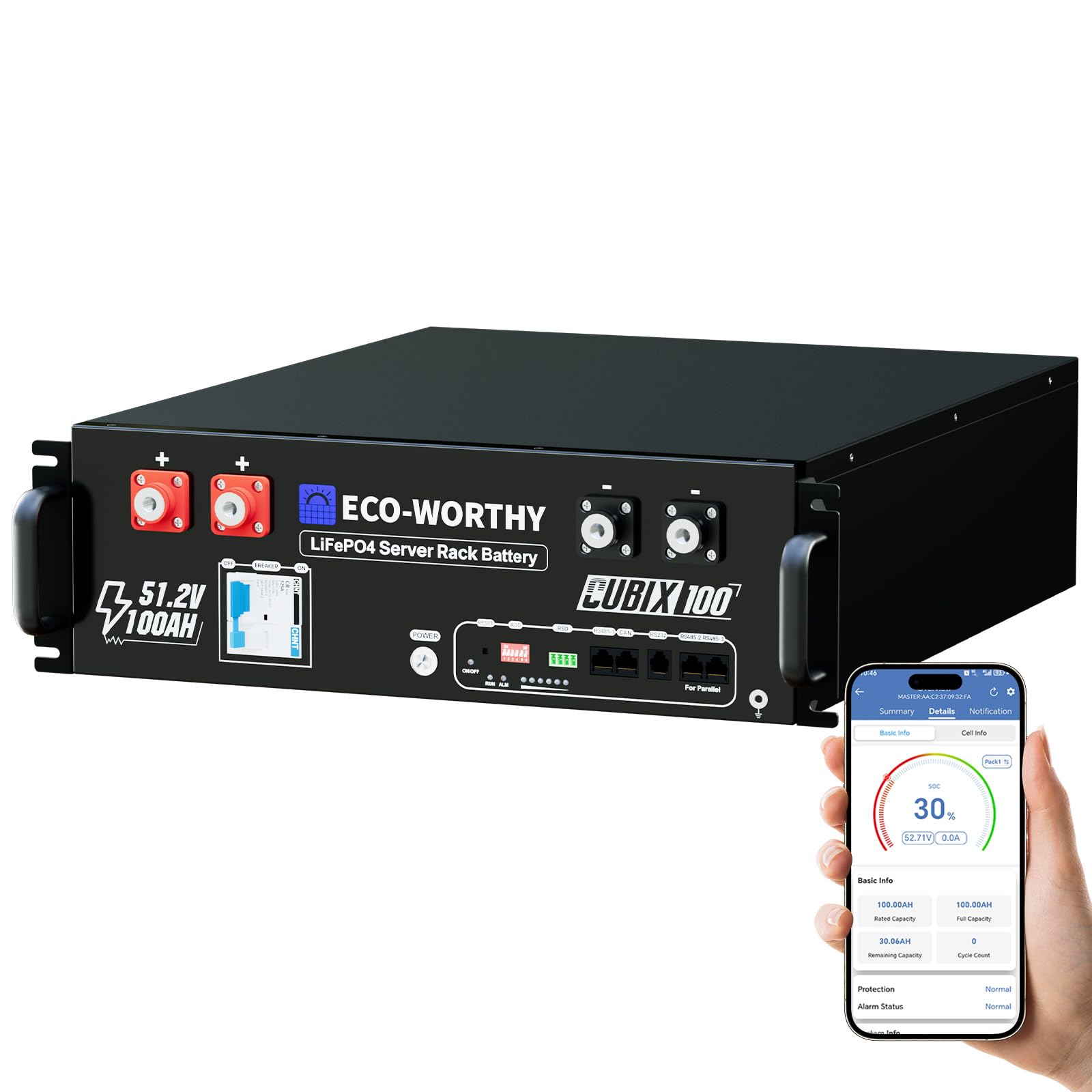
1. ECO-WORTHY Cubix100 48V 100Ah
Our pick — over 4.5★ from 300+ verified ratings; the strongest balance of quality and price.
The rack-mount powerhouse that runs a whole 2000-square-foot house.
If you are building a serious home backup system, this 48V unit is the proper foundation. It uses a nominal 51.2V chemistry to deliver 5120Wh of energy — enough that buyers report it powers their entire 2000-square-foot home. Unlike the 12V picks, this voltage lets you draw heavy loads through thinner cables, which matters for whole-home use.
Buyers most praise the solid build quality. It arrives as a complete plug-and-play kit with parallel cables, communication cables, grounding wires, and mounting screws. Owners mention it pairs easily with inverters like the EG4 6000XP, the Sungold 10kW, and the Bluetti Apex 300, and the built-in CAN/RS485 interfaces let it talk to those inverters for smarter charging. You can even scale it by paralleling up to 32 units for a maximum of 163.8kWh.
It carries the big three North American safety certifications — UL9540, UL1973, and CEC — which are the stamps of approval that matter for insurance and confidence. Customers note “Works with Sungold 10kW inverter; 1 month, zero issues.” The only recurring gripes are small: there is no on-unit screen (just LEDs), and the app is basic. The 100-pound weight means you are not carrying it upstairs, but the rack design wheels into place.
Why It Leads the List
- It packs 5120Wh of usable storage, and owners confirm it keeps an entire home running through outages.
- UL9540, UL1973, and CEC listed, so it meets strict North American safety standards.
- Bluetooth and WiFi monitoring mean you can check status from your phone via the ECO-WORTHY app.
- Supports up to 32 units in parallel to reach 163.8kWh as your needs grow.
Things to Know
- There is no display screen on the unit itself, only LEDs.
- It weighs 100 pounds, so plan for a rack or sturdy shelf.
- The early production batch had reversed terminals, though that is since fixed.
Pick it for: Home backup and off-grid systems where you need certified, expandable, whole-house power.
Think twice if: You only need to power a small cabin — a 12V unit would be simpler and lighter for that scale.
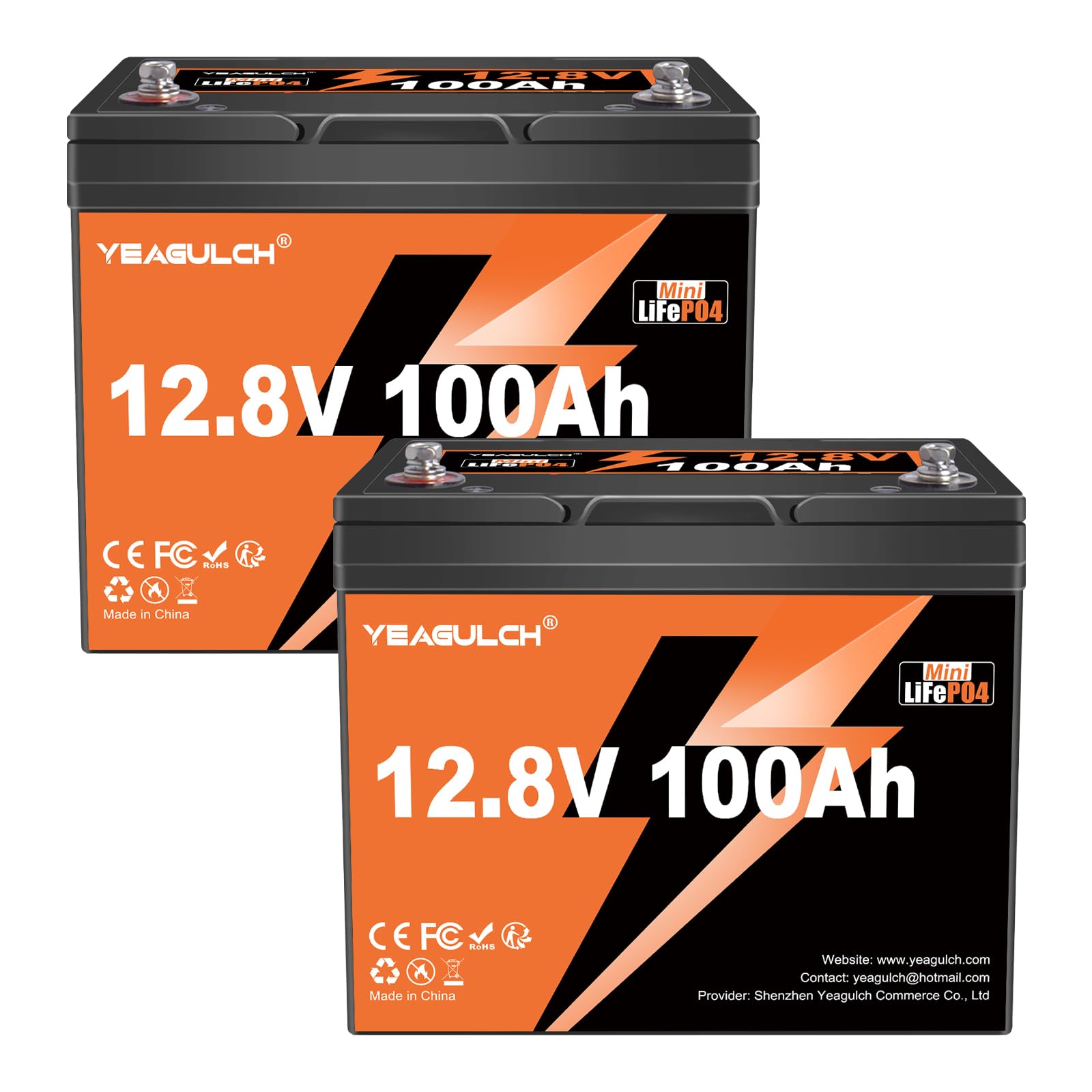
2. yeagulch 2-Pack 12.8V 100Ah Mini
The featherweight two-pack that quietly doubled a trolling boat’s range.
For the money, this two-pack is the workhorse of the list. You get two 12.8V 100Ah batteries with a combined 2560Wh for a budget-friendly price, and each one weighs just 22.04 lbs — about 2/3 lighter than the lead-acid batteries they replace. The light weight shows up in real-world use: reviewers point out an 80lb trolling motor on a 10-foot pontoon lasted at least 4 outings without a recharge.
The chemistry delivers up to 95% usable capacity, a huge jump from the 50% you get from lead-acid. That translates directly to longer runtime for the same amp-hour rating. One buyer ran a 70lb thrust trolling motor on a 3-day trip where they trolled most days and, in their words, “we didnt have to charge them yet” — a clear win for marine use.
But this is a budget pick with a real limit. The maker explicitly recommends against using it with trolling motors exceeding 700W of power. And while reliability gets the most mentions in reviews, it comes with a mixed verdict — some owners found units arrived needing a jump-start from a charged battery to work. This is a value play, not a premium one.
Solid for the price: Two batteries at 95% usable capacity each makes this the cheapest way to get a big 12V bank for solar, RVs, or fishing.
The catch: Keep motors under 700W, and be ready to troubleshoot a fresh unit if it arrives at a low voltage.
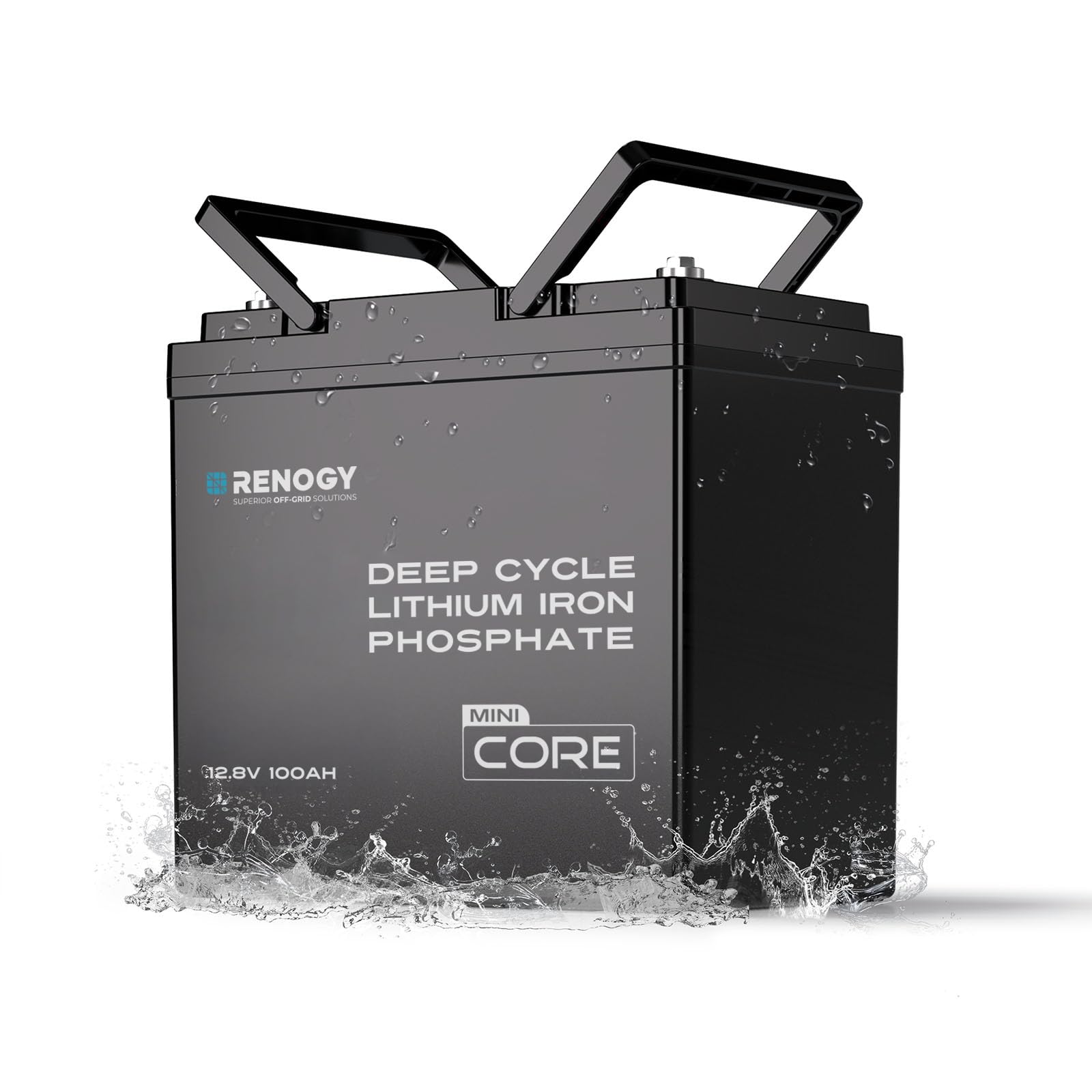
3. Renogy 12V 100Ah Core Mini
A tiny Group 22NF cell that slides into teardrop trailers and kayaks.
Renogy built this one for the tightest spaces. At 9.02 x 5.43 x 8.39 inches (Group 22NF), it is up to 50% smaller than a Group 31 battery and 13% smaller than other equivalent 12.8V 100Ah mini batteries. That footprint is the entire point — it is an excellent replacement for lead-acid in teardrop trailers or kayaks where every inch counts. Shoppers say it works perfectly for off-grid power needs where space is the primary constraint.
The safety suite is strong. A 100A BMS protects against low temperature (charging), high temperature, overvoltage, undervoltage, overcurrent, and short-circuits. The IP65-rated casing resists splashes, water, and dust, so it handles choppy waves or unpaved roads. The integrated metallic cell spacers keep the UL-listed prismatic cells locked in place, preventing damage from vibration.
It charges faster than lead-acid, and owners pair it with Renogy’s own ecosystem — the Renogy ONE monitor and a 300A Battery Shunt (sold separately) give real-time status via the DC Home app. The power capacity is the most-praised aspect. Its 22.7-pound weight keeps it portable, and it carries a 5-year warranty.
Best in tight spots: The smallest full-capacity 100Ah unit in this lineup, with splash-proof IP65 sealing and a 100A BMS for safety.
Note: The optional shunt is sold separately if you want remote monitoring, and at 12.8V it won’t run whole-home loads.
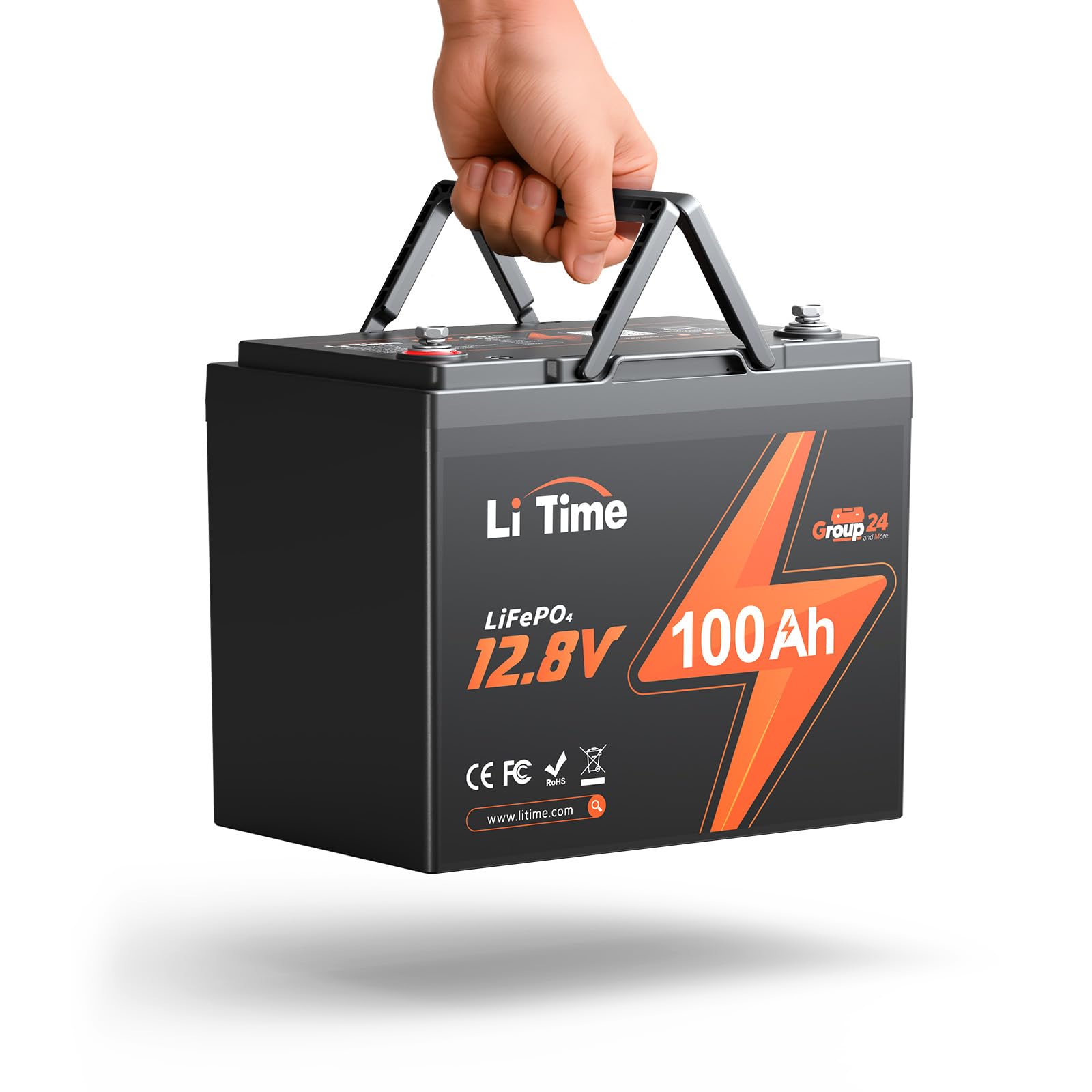
4. Litime 12V 100Ah Group 24
The true drop-in Group 24 replacement that holds charge for months.
Swapping out an old AGM battery is supposed to be simple, and this one makes it so. It is a BCI Group 24 universal fit, installing smoothly into RVs, boats, vans, and solar setups with no extra wiring. It weighs just 22.2 pounds — about 1/3 lighter than a Group 24 AGM — and provides 1280Wh of 100% usable energy compared to a 70Ah AGM’s 504Wh at 60% depth of discharge.
Its real-world longevity impresses owners. Buyers report losing only 8% of charge over 5 months of winter storage, which is excellent for seasonal use. In fishing kayaks, buyers power all their electronics all day long. For a 12V emergency backup setup, it is a favorite because it maintains over 50% charge even after heavy use.
It is built with Grade-A LiFePO4 cells and a 100A BMS that protects against overcharge, discharge, short circuit, and overheating. It is expandable up to 4P4S configuration for a 51.2V 400Ah system (20.48kWh) if your needs grow. Battery quality is the top-praised feature, backed by a 5-year warranty.
Reliable all-rounder: Excellent for RVs and trolling motors, with true 100A charge/discharge capabilities and minimal self-discharge.
The trade-off: At 12.8V, it is not for high-voltage home systems — it shines in mobile and 12V backup roles.
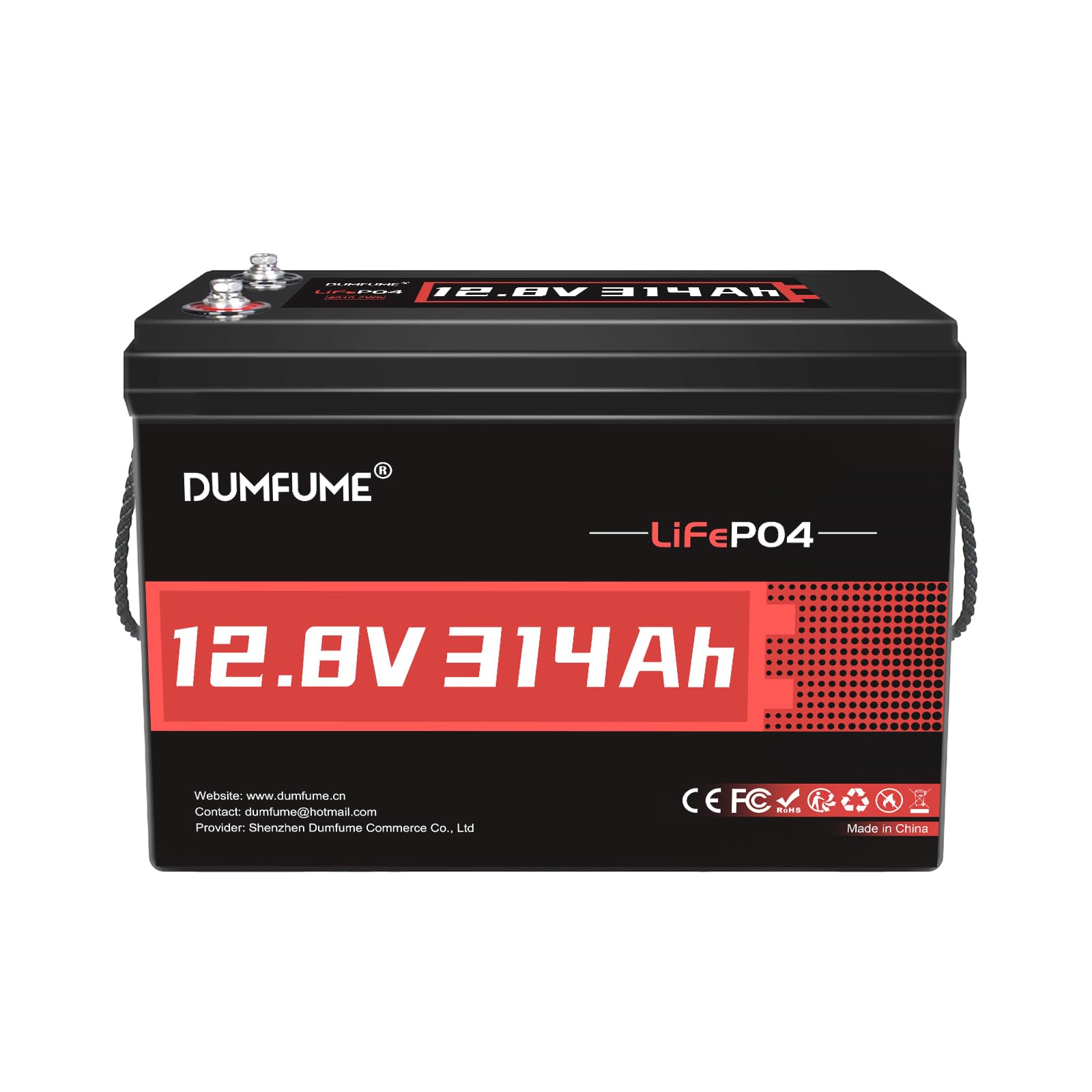
5. Dumfume 12V 314Ah
A single-cell 314Ah monster that replaces an entire lead-acid bank.
For a 12V system, this is the capacity king. A single Dumfume 314Ah unit delivers 4019.2Wh of energy — nearly double the energy density of an equivalent lead-acid battery — while weighing only 57 lbs, about 1/3 the weight of the lead-acid setup it replaces. Owners running small home solar projects say it works great, and RV owners find two of these handle an 800W solar array with ease.
The cycle life is the headline spec: it supports 4,000 cycles at 100% depth of discharge and up to 15,000 cycles at 60% DOD. That is a lifespan of up to 10 years compared to the 200-500 cycles of traditional lead-acid. The built-in 200A BMS provides overcharge, overdischarge, overcurrent, overheat, and short-circuit protection, plus high/low temperature automatic cut-off.
However, this pick has more mixed feedback than others. Performance and battery quality get the most praise, but charging capacity, battery life, and power output all carry mixed verdicts from owners — some units arrive at low voltage and need a parallel jump from a charged battery to start. It also lacks Bluetooth, so expect no app. The ABS casing resists heat and flame, and it carries a 5-year manufacturer warranty.
Best for big 12V loads: One unit holds 4019Wh and powers fridges, inverters, and campers without parallel wiring.
Watch for: No monitoring app, and some owners needed to jump-start fresh units — check voltage on arrival.
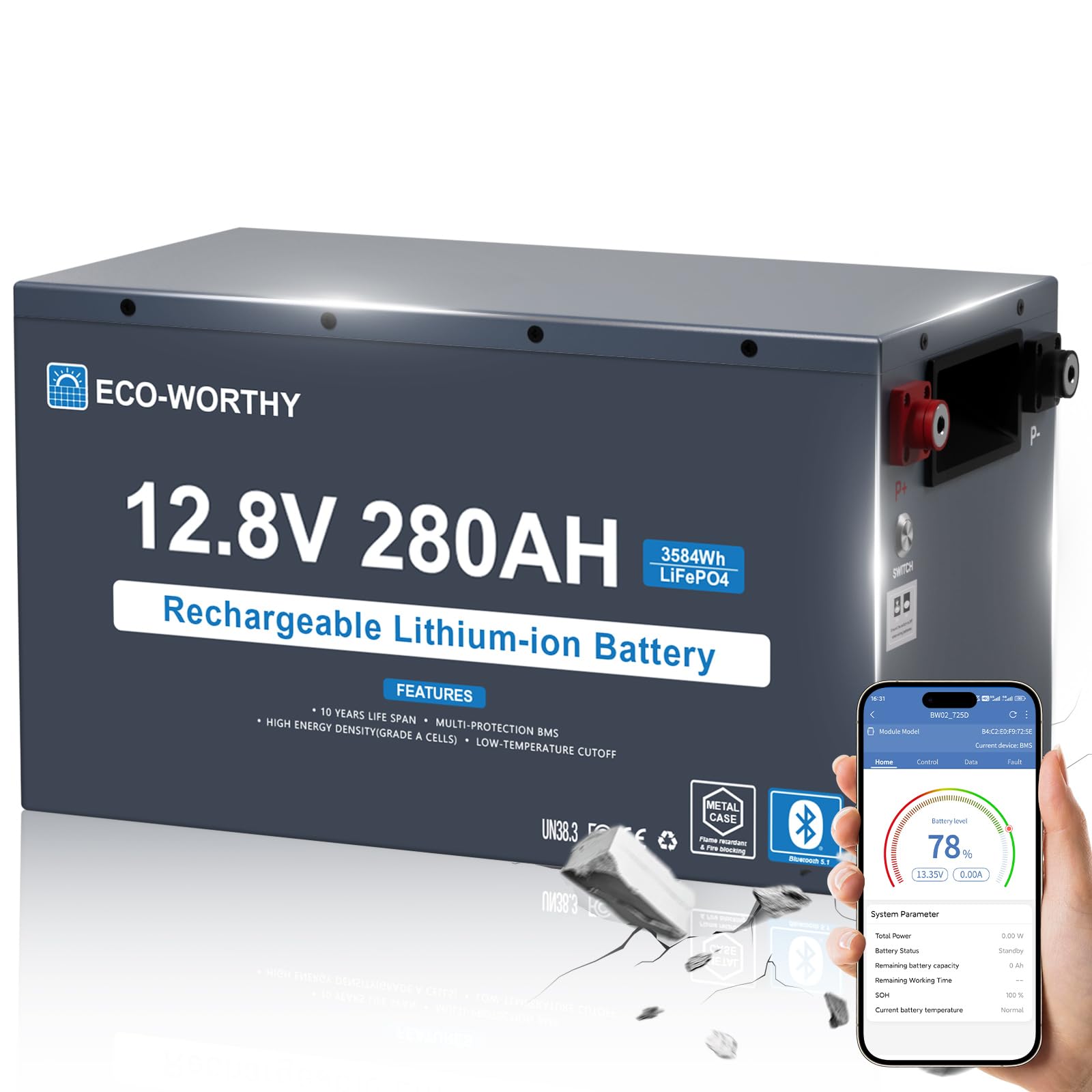
6. ECO-WORTHY 12V 280Ah Metal Case
The steel-armored 280Ah bank that shrugs off road vibration and winter cold.
This 280Ah battery wraps its Grade-A LiFePO4 cells in a heavy-duty metal enclosure, giving it superior heat resistance and fire protection over plastic-cased rivals. The reinforced shell, combined with internal cell holders, keeps the battery stable during driving — ideal for RVs, vans, and off-road use. It weighs 68.5 lbs, similar to an AGM, but holds 2.5x the capacity.
The 200A BMS is the real workhorse here. It offers over-charge, over-discharge, over-current, short-circuit, and temperature protection. Critically, it includes a low-temperature cut-off at 20°F (-7°C) so charging pauses automatically in the cold to protect cells — owners confirmed it works during snowy trips. A weak-current power switch on the case lets you one-touch cut battery output for safer installation and maintenance, and it prevents sparks when connecting.
Bluetooth monitoring is built in, showing voltage, capacity, and charge/discharge status in a phone app. Owners mention it powers a 1000-watt amp, keeps fridges running for days, and even runs a 1/2 HP sump pump for 12+ hours on an intermittent cycle. The on/off switch is a genuinely useful feature for safety. It is expandable in series or parallel, and comes with a 3-year warranty.
Built for harsh use: The metal case and low-temp protection make it the most rugged 12V option for RVs and outdoor setups.
Keep in mind: At 68.5 lbs it is not the lightest, and the app lacks some detail — but it ships about 25% charged.
7. Redodo 2-Pack 12V 100Ah

A two-pack that builds a 24V tram or a 48V power wall in minutes.
This two-pack is the most flexible configuration in the lineup. Each 100Ah battery packs a punch, and together they form a 2560Wh system — either as a 12.8V 200Ah bank or a 24V 100Ah bank. If you rewire them further, they support max 4P4S expansion to a 51.2V 400Ah system. That flexibility makes it a favorite for setups that may grow over time.
Its performance wins over users. Owners use two in parallel (200Ah) in a van and powered 2-4kW inverter appliances on a 3-week Baja trip, using less than 30% of capacity over a week without charging. The batteries charge quickly — a full charge in about 5 hours with a 14.6V 20A LiFePO4 charger, cutting charging time by 50% compared to lead-acid’s typical 10 hours. Each battery weighs just 22.04 lbs, about 1/3 the weight of a lead-acid equivalent.
The 100A BMS protects against over-charge, over-discharge, over-current, short-circuit, and high-temperature. The energy density is 58Wh/lb, far beyond an AGM’s 20Wh/lb. It carries a 5-year warranty. Customers note some newer units lack connecting cables, so check the box. For a 24V trolling motor, owners say the meter never drops below full during a full day of fishing.
Most adaptable: Run them in parallel for more capacity, or in series for 24V — the choice is yours.
Small gripe: A few recent units ship without the connecting cables, so verify before you install.
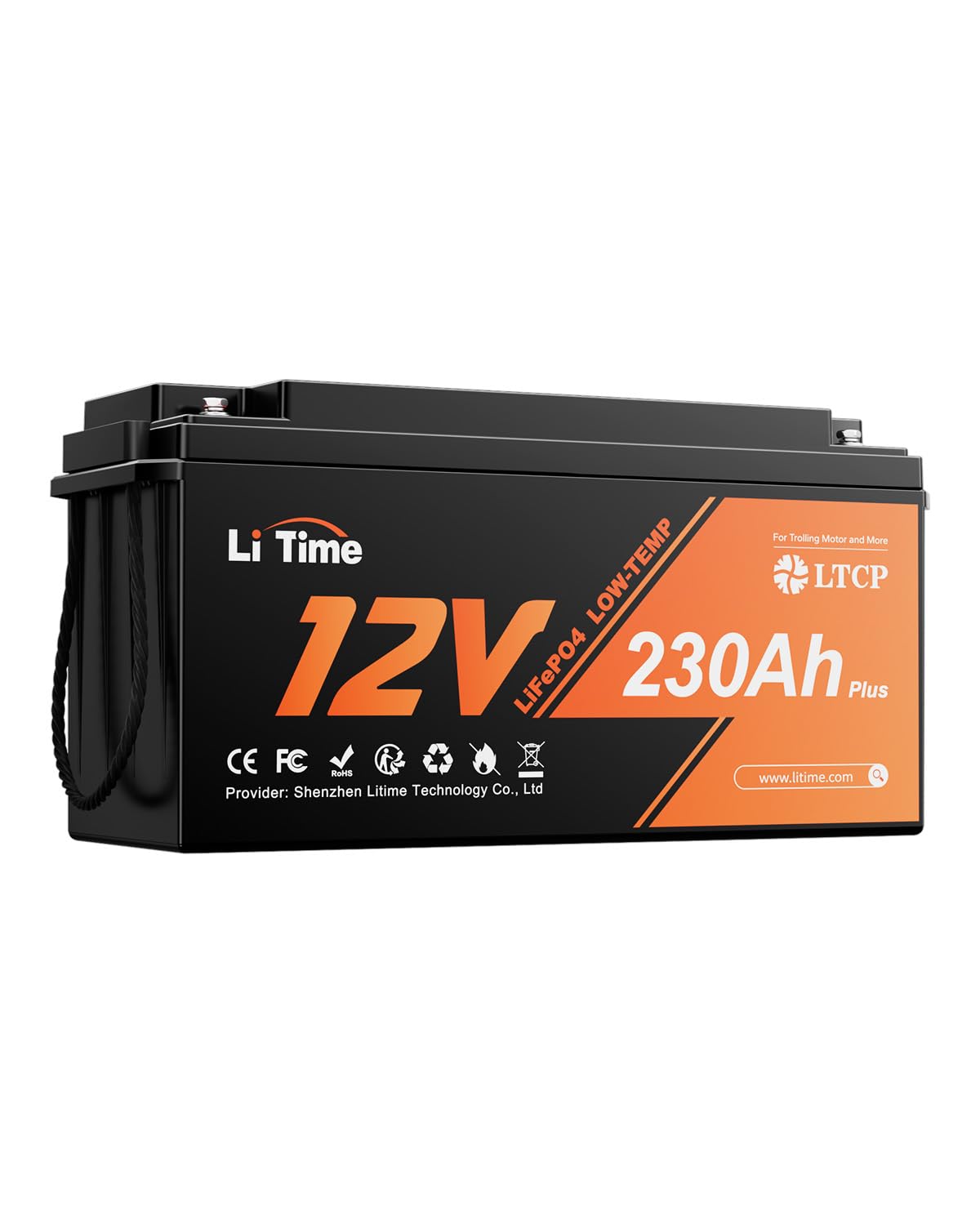
8. Litime 12V 230Ah Group 4D
The 230Ah giant that keeps a fridge running for six months of the year.
For travel trailers and campers that live off-grid for long stretches, this 230Ah unit is the endurance pick. It delivers 2944Wh of usable energy in a package that weighs just 45.98 lbs — about 1/3 the weight of the lead-acid Group 4D it replaces. Reviewers point out it powers their fridge for 6-7 months out of the year, which is the real-world proof of its staying power.
It is built with a 200A BMS offering 20+ safeguards, including advanced low-temperature protection that pauses charging below 0°C (32°F) to protect the cells. The battery supports up to 16 units in a 4P4S configuration for a 48V 920Ah system with a 47.1kWh max output — enough to cover whole-home backup and solar needs. It carries a 10-year lifetime rating (4,000+ cycles at 100% DOD) and a 5-year service warranty.
Reviews most praise the battery’s quality and reliability. Owners running it in travel trailers note its compact size for the 230Ah capacity and that it charges to 99% with a stock RV charger. The Bluetooth app is a mixed bag — some find it useful for monitoring charge and discharge rates, while others report connectivity that requires reconnecting. If you are converting an RV from lead-acid, note the trailer charger may need upgrading for lithium compatibility.
Best for long trips: One unit holds 2944Wh, and owners confirm a full week off-grid on a single charge.
Plan for: Older RV chargers may not be lithium-ready, and the Bluetooth app can be finicky.
Understanding the Specs
Voltage and System Design
Voltage is the backbone of your system. A 12.8V battery is the standard for RVs, boats, and small cabins — it pairs with cheap, common 12V inverters and charges from most solar controllers. A 48V system (like the 51.2V server rack pick) is for bigger home loads; it moves the same power with less current, meaning thinner cables and less loss. Check your inverter’s input voltage before choosing.
Amp-Hours and Watt-Hours
Capacity is listed in amp-hours (Ah), but you drain energy in watt-hours (Wh). Multiply voltage by amp-hours to get the real number: a 12.8V 100Ah battery holds about 1280Wh. LiFePO4 cells deliver nearly 100% of that rated capacity, whereas lead-acid only gives you about 50% before it is damaged. That one chemistry difference is why a 100Ah lithium can outlast a 200Ah lead-acid.
FAQ
Why is my solar battery voltage 51.2V instead of 48V?
Can I replace my lead-acid battery with a LiFePO4 directly?
How many cycles will a solar storage battery last?
What does the BMS do on a solar battery?
Will a 100Ah battery run my whole house?
What is the difference between 12V and 48V solar batteries?
Do I need Bluetooth monitoring on my solar battery?
Can I connect multiple solar batteries together?
How does cold weather affect a solar battery?
Final Thoughts: The Verdict
For most users building a serious solar storage system, the winner is the ECO-WORTHY Cubix100 because it packs 5120Wh of certified, whole-home energy with Bluetooth monitoring and room to scale to 163.8kWh. If you need a lighter, mobile 12V bank, grab the yeagulch 2-Pack for its unbeatable value per watt-hour. And for RVs that live off-grid for weeks, the Litime 230Ah is the endurance pick that owners trust to keep the fridge cold through the season.
How We Picked
We do not accept paid placement. Every pick is matched to a real buyer and a real use-case; we do not hands-on test units.
Sources & Methodology
Specifications: manufacturer listings and product documentation. Review insights: verified customer reviews, as of August 2026. Pricing: not shown on this page (it changes often); check the current price via the retailer link.
As an Amazon Associate, Gadgets Feed earns from qualifying purchases. This does not affect which products we feature.