
Our readers keep the lights on and my morning glass full of iced black tea. As an Amazon Associate, I earn from qualifying purchases.
Specs are compiled from manufacturer listings and verified buyer reviews and can change over time — please confirm the key details on the product page before buying.
When you turn the key on a 20°F morning, the only thing standing between you and a warm cab is the little lead box under the hood. Most tractor owners pick a battery by brand loyalty or price, then find out it dies after one winter or doesn’t fit the tray. This guide cuts through the chemistry to focus on what actually matters: cold cranking amps (the burst of power to start a cold engine), group size (the physical dimensions that must match your tray), and if you want lead-acid or lithium longevity. These five picks come from comparing the manufacturers’ published specs against verified customer reviews, so you get real strengths and trade-offs instead of marketing spin.
I’m Min — the founder and writer behind Gadgets Feed. This guide is built by comparing the manufacturers’ published specifications and the patterns across verified customer reviews, so you get each pick’s real strengths and trade-offs instead of marketing spin.
Our Picks at a Glance


How To Choose The Best Battery For Tractor
Choosing a tractor battery depends on three questions: does it fit, can it start your engine, and how long will it last? Start by measuring your battery compartment and then check the old battery’s group size, which is a standard set of dimensions and terminal locations. Next, look at the cold cranking amp (CCA) rating, which tells you how much starting power the battery delivers in cold weather. Finally, decide between a traditional lead-acid or AGM (Absorbent Glass Mat) battery and a newer, pricier lithium option.
Fit First: Group Size and Terminal Polarity
The most common mistake is buying on specs before checking if the battery physically fits. Tractors and lawn mowers use specific group sizes, like the compact U1 or the larger Group 24. You must also match the terminal polarity (which side is positive) to your cables. A battery that is too tall, too wide, or has reversed terminals will not install properly, no matter how many cold cranking amps it offers. Measure your tray before ordering anything.
Starting Power: The Role of Cold Cranking Amps
Cold cranking amps (CCA) measure a battery’s ability to start an engine in cold temperatures, and it is the single most important number for a tractor. A higher CCA means stronger, faster cranking, especially on a cold morning when oil is thick. A small lawn mower engine might need around 200-300 CCA, while a larger diesel tractor or a marine-style engine needs far more. Buying a battery with a CCA rating at or above what your engine requires ensures reliable starts.
Chemistry Choice: AGM vs. Lithium
The main chemistry choice is between AGM (Absorbent Glass Mat) lead-acid batteries and lithium batteries. AGM batteries are sealed, hold their charge well in storage, and are highly resistant to vibration, making them a dependable and affordable standard for most tractors. Lithium batteries, like LiFePO4, are dramatically lighter and offer more starting power and lifespans, but they cost significantly more and may require a specific charger. Your choice depends on your budget and how much weight and longevity matter to you.
Quick Comparison
| Model | Best For | CCA | Capacity | Weight | Amazon |
|---|---|---|---|---|---|
| Cub Cadet 725P17335★ Best Overall | Exact OEM Replacement | 210 CCA | 11 Ah | 8.8 lbs | Amazon |
| TYKOOL U1 LithiumLightest Pick | Lighter Weight Swap | 400 CCA | 8 Ah | 4 lbs | Amazon |
| UPLUS Group 24M AGM | Heavy-Duty Starting | 550 CCA | 79 Ah | 50.7 lbs | Amazon |
| Marxon Group 24M | Dual-Purpose Marine Use | 550 CCA | 79 Ah | Heavy | Amazon |
| Lipower Group 24 Solid-State | Long-Life Upgrade | 1200A | 60 Ah | 17.6 lbs | Amazon |
In‑Depth Reviews
1. Cub Cadet 725P17335 Battery
Our pick — over 4★ from 400+ verified ratings; the strongest balance of quality and price.
The drop-in factory replacement that fits your Cub Cadet like the original part.
This battery removes all guesswork from your next swap. It is a genuine factory part with OEM number 490-280-F017, replacing the 725P17335 and 725-17335, so it drops into a huge list of recent Cub Cadet zero-turns, including the XT1-LT42 KH and the ZTX6-60 KW FAB 2023 ULTIMA ZTX6. That exact fit protects you from the most common battery mistake — buying the wrong size. It is a 12-volt AGM (Absorbent Glass Mat) battery with 210 CCA, a chemistry that holds its charge longer in storage and shrugs off the vibration of mowing rough ground. Because it’s sealed, it won’t spill acid even when your tractor bounces over a stump.
The crowd favorite here is the sheer quality of the battery itself — over eighty owners highlight it as a great, reliable replacement. They report that it matches the exact size and specs of the original, and it cranks the engine immediately. Since it is an AGM battery, it is also a good choice if you store your mower over the winter; this chemistry tends to keep its charge better than older flooded designs. The trade-offs are worth knowing: feedback on long-term battery life is mixed, and it does not come with the mounting hardware, brackets, or nuts you might need for installation. It weighs 8.8 pounds, a manageable load for a quick swap in the shed.
A recurring concern is that a small number of units have failed to hold a charge within a few months. Buyers report that “Battery fails to hold charge; needs charging before every mower start after 3 months, even immediate restart fails.” This seems to be the exception rather than the rule, given the strong positive response overall, but it is a risk with any budget-tier lead battery. Think of this as the dependable, factory-spec starting point — the safe choice if you value a perfect fit and a simple install above all else.
Why it’s the default pick
- Exact OEM fit for a huge range of Cub Cadet zero-turns and lawn tractors
- AGM design holds charge well in storage and resists vibration
- Light at 8.8 lbs, so it’s easy to lift and swap yourself
Know before you buy
- Lifespan gets mixed reviews — some units fail to hold a charge quickly
- No mounting hardware included; source your own bolts and brackets
- 210 CCA is plenty for small mowers but not for larger diesel tractors
The safe factory swap: This is for the Cub Cadet owner who wants a guaranteed, no-research-needed fit and trusts the OEM brand over aftermarket options.
Check your expectations: If you need serious cold-cranking power for a big rig, or you’re wary about long-term charge retention, look at the higher-CCA options here.
2. TYKOOL U1 LiFePO4 Lithium Battery
The featherweight that swaps out your heavy lead-acid and spins the starter faster.
You buy this battery for the weight loss. At just 4 pounds, it is dramatically lighter than the 50.7-pound marine batteries you’ll see further down this list — a 12.7x gap that makes installation and removal genuinely easy. This is a 12.8-volt LiFePO4 (Lithium Iron Phosphate) battery with a beefy 400 CCA rating, which is more than enough to spin a 21hp Briggs & Stratton engine to life instantly. The manufacturer claims over 3,000 charging cycles and 400 amps of starting power, a significant boost over a standard lead-acid unit. The group U1 size makes it a direct upgrade for a wide range of ride-on mowers and garden tractors, including many Cub Cadet, John Deere, Troy-Bilt, and Craftsman models.
What wins people over is the instant, vigorous cranking and the surprising weight savings. Owners describe how their mower “jumped to life” with “no slow cranking — spins very fast” the moment they hit the starter. The built-in Battery Management System (BMS) is the smart brain here; it protects the battery from over-charging, over-discharging, over-current, and short circuits, which is essential for a lithium unit. Another nice touch is the built-in digital voltage meter between the terminals, so you can check the battery’s state at a glance without a multimeter. The included kit has M6 terminal bolts and nuts, protective caps, and a user manual, so you have everything you need for the swap.
There is a caution flag here, though. A significant complaint is a unit that failed to last 4 months, with the buyer unable to revive it even with a Noco lithium charger. Owners mention this battery “didn’t make it 4 months” and, despite showing a full charge on the charger, it would not turn over a John Deere Gator Diesel. This is a real durability question mark. While the lighter weight and higher CCA are excellent on paper, the reliability record is not yet proven, which is a gamble at this price point.
The upgrade appeal
- Ultra-light at 4 lbs, making install and handling a breeze
- 400 CCA delivers fast, strong cranking even with a small footprint
- Built-in BMS protects against overcharge, discharge, and shorts
The durability doubt
- Some units have failed within months and resist charging
- Lithium batteries often need a specific charger type
- Higher upfront cost than a standard lead-acid replacement
Reach for this if: You want the biggest weight reduction and fastest cranking for your lawn tractor and are willing to try newer tech.
Look elsewhere if: Reliability over years is your top concern; the proven AGM options might be a safer bet.
3. UPLUS Group 24M AGM Marine Battery
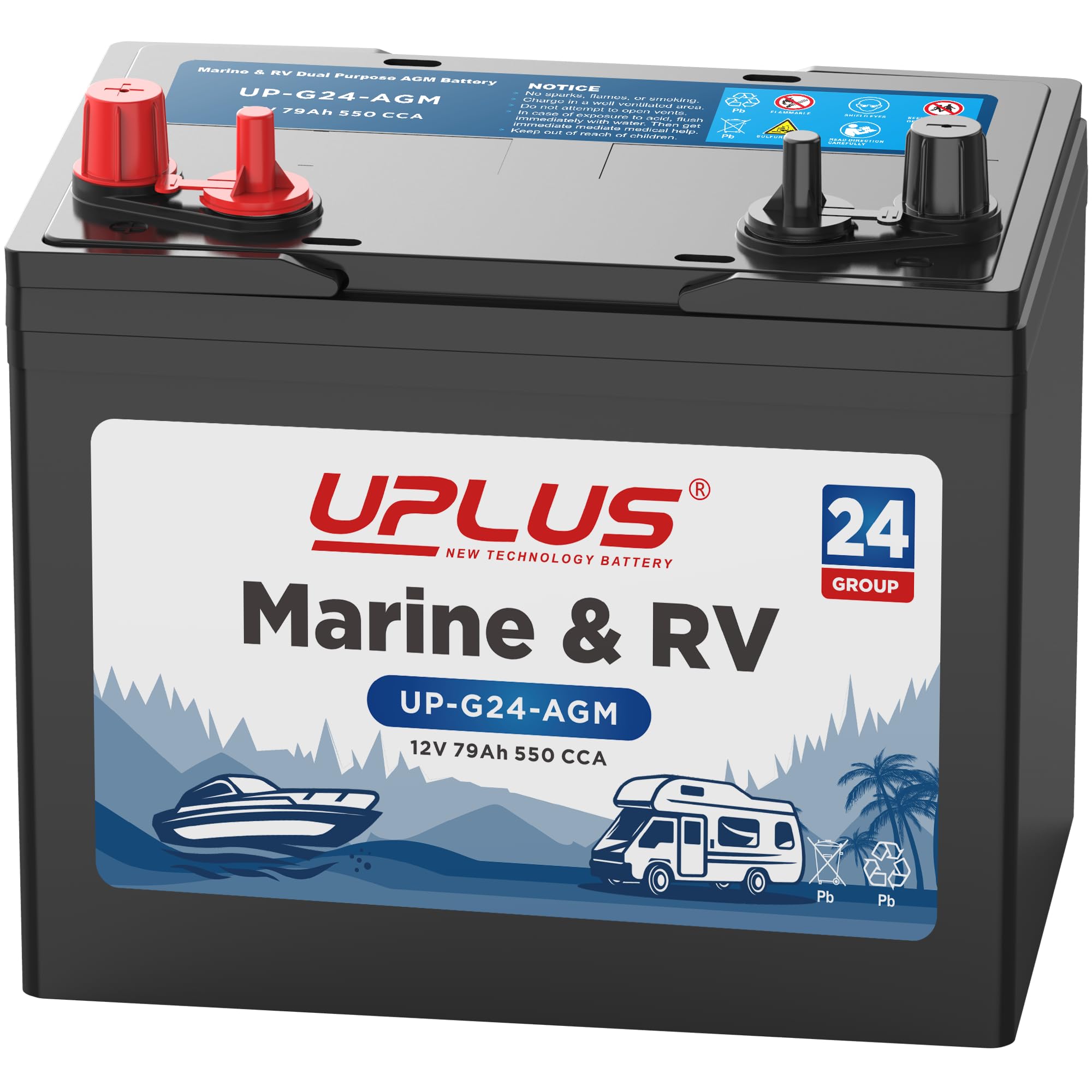
The powerhouse that starts engines up to 350HP and outlasts the average tractor battery.
This is for the owner who needs serious, no-nonsense starting power, whether it’s for a big tractor, a bus, an RV, or a boat. The UPLUS is a 12V 79 amp-hour (Ah) AGM marine battery with 550 cold cranking amps (CCA), giving it the muscle to start engines from 70 up to 350 horsepower. It is a dual-purpose design, meaning it combines the role of a starter battery and a deep-cycle battery into one unit, so you can run electronics without a second battery. The AGM construction is sealed and built with thicker, full-frame cast plates for superior strength and vibration resistance, which is critical if your tractor bounces across a rough field. At 50.7 pounds, this is a heavy, solid piece of equipment, but the 24-month warranty and responsive after-sales support add confidence.
Owners who need raw power are pleased with its performance, with one describing it as working great for a “60hp motor on the pontoon boat.” The dual-purpose nature is a standout feature because it frees up space and simplifies the electrical system by eliminating the need for a separate deep-cycle battery. The 79 Ah capacity (maintained at a 20-hour rate) is what gives it the staying power for trolling motors or auxiliary electronics, not just starting. The UPLUS also claims a space-saving design, which is a benefit if your tractor’s battery compartment is tight but still fits the standard Group 24M size (10.24″x6.61″x9.17″).
There are two things to keep in mind. First, this is a large and heavy unit, so you must confirm it fits your vehicle’s battery compartment before ordering, as the dimensions are significant. Second, while it is a great battery, it requires compatibility with your charging system — some owners note that an AGM battery may need a smart charger to charge optimally, unlike a basic lead-acid unit. Its 550 CCA is a 2.6x gap over the 210 CCA of the Cub Cadet above, so it offers far more starting punch for heavier engines, but it’s overkill for a small lawn mower.
Serious starting muscle
- 550 CCA and 79 Ah to start engines up to 350HP
- Dual-purpose design handles both starting and deep-cycle loads
- Built to resist extreme vibration with thicker plates
Know its limits
- Heavy at 50.7 lbs — make sure your tray fits it
- May require a smart charger to maintain optimally
- More power and size than a small lawn mower needs
The big-engine specialist: This is the go-to for a heavy tractor or multi-use vehicle that needs reliable starting plus auxiliary power.
If you skip it: For a compact riding mower, this is heavy and more powerful than necessary — a smaller AGM is a better fit.
4. Marxon Group 24M Marine Battery

A versatile 550 CCA workhorse that powers your tractor and your trolling motor.
You need one battery to start your tractor and still run a fish finder, radio, or running lights — that’s the exact split personality this Marxon is built for. It is a dual-purpose Group 24M battery rated at 12V, 79Ah, with 550 CCA and a 150 reserve capacity (RC), giving it the cranking power of a starter battery and the endurance of a deep-cycle. The 150 RC is the number to note here — it tells you how long the battery can run electronics if your alternator fails, which is a real safety net for equipment in the field. It uses a maintenance-free AGM design, so you never have to add acid or water.
Owner feedback highlights its pure grunt and build quality. It is described as a “great battery very heavy,” and one buyer successfully used it to power a “12,000 lb truck winch without long cables,” getting full winch power directly from the screw posts. This shows the terminal design and internal construction can handle high current draw, not just routine starting. The dual-purpose nature means it’s genuinely versatile, working for RVs, marine electronics, and as a dependable tractor battery. The manufacturer backs it with a 24-month warranty and a US-based office that promises to reply to emails within 12 hours.
The honest catch is fit and return logistics. This is a “vehicle specific fit” battery with specific dimensions (10.24*6.61*8.19 inches), and it is heavy, so you absolutely must confirm your battery compartment can hold it. One buyer ordered the wrong size and found the return process difficult, warning others to verify fit before buying to avoid a return hassle. The battery and screws are all that’s in the box, so plan your own mounting. It is also note that this is a marine battery, so while it works great, its design is tuned for the constant vibration and deep-cycling of boats, which is a bonus for rough tractor use.
Flexible and powerful
- 550 CCA for strong starting plus 150 RC for accessory runtime
- Handles heavy current draws like a truck winch without issue
- Maintenance-free sealed AGM design
The fine print
- Large and heavy — measure your tray carefully
- Wrong-size returns are difficult; verify before you order
- Only includes the battery, screws, and nuts
Who it beats: It matches the UPLUS on CCA (550 vs 550) and adds a defined 150 reserve capacity, making it the better pick if you run accessories.
Who it doesn’t: If you demand a strict factory fit for a specific vehicle, an OEM part like the Cub Cadet is less risky.
5. Lipower Group 24 Solid-State Battery

The 17.6-pound lithium that cranks with 1200A and lasts up to ten years.
This is the premium end of the battery spectrum — a modern solid-state 12V lithium battery (with 60 amp-hours of capacity and 768Wh of energy) that is engineered to outlive every lead-acid battery you’ve owned. The headline spec is the 1200A CCA adaptive starting power, which delivers lightning-fast, zero-hesitation cranking. At just 17.6 pounds, it is remarkably light, especially when compared to the 50.7-pound UPLUS above. The manufacturer claims a lifespan of up to 10 years with over 3,000 deep cycles, backed by a 5-year warranty — a stark contrast to the traditional AGM or lead-acid batteries that often fail every 2-3 years. It’s designed as a direct fit for Group 24 and 24F sizes, making it a viable upgrade for many tractors, pickups, and SUVs.
The build quality is what wins people over here, with owners consistently praising it as a “solid lithium 12v battery.” The weight loss is the first thing you notice — one owner swapped out a 53.2-pound AGM for this 17.6-pound unit, and another found it to be “13V and LIGHT!” right from the start at 13.3V. Beyond the weight, it delivers fast cranking and handles extra electrical loads with ease, which is great if your tractor or vehicle has a winch or auxiliary lighting. The smart Battery Management System (BMS) is a key safety feature, protecting against overcharge, over-discharge, and short circuits, and even helping to revive the battery if it hits a low-voltage disconnect. The dimensions (10.24″ x 6.81″ x 8.58″) match the description, and it fits various applications, including a Mazda RX8 box.
The trade-offs are about cost and setup. This is a premium investment, and it’s designed with start-stop vehicles in mind, which means some vehicles require an OBD battery registration after installation to sync the ECU — a step you should check for your specific tractor or vehicle. Buyers also note the BMS low-voltage cutoff is a feature you must understand; if the battery goes dead, you may need to slow-charge it for 30-120 minutes to revive it. Despite the higher price, the standout owner consensus is that its reserve capacity, in one case noted as 180 minutes, and CCA “beats any traditional chemistry battery” they’ve owned, making it a compelling long-term value for the serious owner.
The ultimate upgrade
- Massive 1200A CCA for instant starts in any weather
- Only 17.6 lbs — a fraction of the weight of lead-acid rivals
- Claimed 10-year lifespan with a 5-year warranty
Premium considerations
- Significantly higher cost than lead-acid or AGM batteries
- May require OBD registration or a specific charger for best results
- BMS low-voltage cutoff means you must know how to revive it
For the long-haul owner: This is a buy-once, cry-once option for anyone who wants maximum cranking power, minimal weight, and the longest possible lifespan.
Think twice if: You want a simple, cheap drop-in for a small mower; this is far more capability than you need.
Understanding the Specs
Cold Cranking Amps (CCA)
This number tells you how much starting power a battery has to crank an engine in cold temperatures (at 0°F). It’s the most important spec for a tractor because a higher CCA means stronger, more reliable starts on cold mornings. A zero-turn mower might only need around 210 CCA, while a large diesel tractor or a marine engine can need 550 CCA or more. Always match or exceed the CCA rating your engine manufacturer recommends.
Group Size and Physical Fit
The group size is a standard set of physical dimensions (length, width, height) and terminal locations that ensure a battery fits in your vehicle’s tray. Common sizes are the compact U1 for lawn mowers and the larger Group 24M for bigger tractors and marine use. Before buying, measure your battery compartment and note the terminal polarity (which side is positive). A battery with the right CCA but the wrong group size simply won’t fit.
FAQ
How do I know which battery group size fits my tractor?
What is the difference between CCA and amp hours (Ah)?
Can I replace my lead-acid battery with a lithium battery?
Will a higher CCA battery damage my tractor’s starter?
How long should a tractor battery last?
Do I need a special charger for an AGM battery?
Why is terminal polarity so important when buying a battery?
Is it worth paying more for a dual-purpose battery?
Final Thoughts: The Verdict
For most buyers, the battery for tractor winner is the Cub Cadet 725P17335 because it offers a certified exact fit and solid AGM performance at a fair price. If you want a lighter battery that spins your engine faster, grab the TYKOOL U1 Lithium. And for the serious owner who tackles heavy loads and wants maximum longevity with modern tech, the Lipower Group 24 is the one to reach for.
How We Picked
We do not accept paid placement. Every pick is matched to a real buyer and a real use-case; we do not hands-on test units.
Sources & Methodology
Specifications: manufacturer listings and product documentation. Review insights: verified customer reviews, as of August 2026. Pricing: not shown on this page (it changes often); check the current price via the retailer link.
As an Amazon Associate, Gadgets Feed earns from qualifying purchases. This does not affect which products we feature.