
The noise, the fumes, the maintenance — a gas generator solves an outage but creates a dozen new problems the moment it fires up. A battery generator for home replaces that entire cycle with silent, instant, emission-free power that sits quietly in a corner until a blackout hits. The only real question is which chemistry, capacity, and inverter rating actually cover your fridge, lights, and modem without leaving you frozen mid-outage.
I’m Min — the co-founder and writer behind Gadgets Feed. I’ve spent hundreds of hours cross-referencing LiFePO4 cycle life claims, pure sine wave inverter specs, MPPT solar controller efficiency ratings, and real-world recharge curves so this guide cuts through the wattage hype and points to the units that genuinely hold up when the grid drops.
Whether you need a lightweight unit for a weekend trip or a whole-home-capable powerhouse with a 30A RV outlet, this curated list of the best battery generator for home breaks down capacity, expandability, and fast charging to match your specific backup priorities.
How To Choose The Best Battery Generator For Home
Picking a home battery generator comes down to three interlocking specs — capacity, inverter wattage, and how fast the unit can refill when grid power disappears. A 2,000Wh unit might run a fridge for 12 hours, but if it needs eight hours to recharge, you are vulnerable during multi-day outages. Understand these variables and you will buy a generator that fits your home, not a spec sheet that looks good in a thumbnail.
Capacity (Wh) vs. Usable Energy
A 2,048Wh battery does not deliver 2,048Wh to your appliances. Inverters, cooling fans, and standby circuits consume 10–30W per hour depending on the model. That 30W parasitic draw eats 720Wh over a 24-hour period — roughly a third of a mid-range unit’s total capacity. Look for units that advertise low standby draw (under 15W) or a zero-idle mode that shuts the inverter off when no load is detected. Real-world usable capacity is always lower than the label, and the best generators minimize that gap.
Inverter Type and Surge Rating
Every battery generator ships with a pure sine wave inverter, but the continuous and surge ratings vary dramatically. A refrigerator compressor can draw 3–5x its running wattage for the first second. If your generator’s surge rating is too low, the compressor hums, clicks, and never starts. Look for a surge peak at least 50% above the continuous rating — a 2,400W continuous unit with 3,600W surge can handle most residential fridges and sump pumps. Pure sine wave output also protects sensitive electronics from the voltage noise that cheaper modified sine wave inverters produce.
Recharge Speed and Input Flexibility
Recharge speed determines how quickly you can cycle the generator during extended blackouts. AC charging rates range from 600W on budget units to 2,400W on premium models, dropping full recharge time from eight hours to under two. Solar input matters if you plan to recharge off-grid — look for a high MPPT voltage range (25–120V) and at least 800W input capacity so you can use the generator during the day and store energy for the night. Dual-input charging (AC + solar simultaneously) cuts recharge time further and is a feature worth paying for if you live in hurricane or wildfire zones.
Expandability and Port Options
Not all generators can grow with your needs. Some offer expansion batteries that double or triple total capacity via proprietary cables; others lock you into a fixed pack that cannot be upgraded. A TT-30 RV outlet is essential if you plan to power a camper or run a transfer switch. A 12V/30A high-current DC port supports diesel heaters, 12V fridges, and water pumps without wasting AC inversion losses. Count the AC outlets, too — four or more let you distribute power without daisy-chaining power strips.
Quick Comparison
On smaller screens, swipe sideways to see the full table.
| Model | Category | Best For | Key Spec | Amazon |
|---|---|---|---|---|
| AFERIY P210 | Mid-Range | Silent overnight backup | 2,048Wh / 2,400W / 30 dB noise | Amazon |
| DABBSSON 2000L | Mid-Range | Ultra-light 2kWh travel | 2,048Wh / 2,200W / 41 lbs | Amazon |
| BLUETTI AC200L | Mid-Range | Expandable home ecosystem | 2,048Wh / 2,400W / expandable to 8,192Wh | Amazon |
| EcoFlow DELTA 3 Max | Mid-Range | Fastest AC recharge | 2,048Wh / 2,400W / 0-80% in 1.13 hr | Amazon |
| Jackery Explorer 2000 v2 | Mid-Range | Lightest 2kWh backpackable | 2,042Wh / 2,200W / 39.5 lbs | Amazon |
| Anker SOLIX C2000 Gen 2 | Mid-Range | Ultra-low standby efficiency | 2,048Wh / 2,400W / 9W standby | Amazon |
| PECRON F3000LFP | Premium | High-capacity value | 3,072Wh / 3,600W / 1,800W charge | Amazon |
| BLUETTI Elite 300 | Premium | Smallest 3kWh footprint | 3,014Wh / 2,400W / 6,000 cycles | Amazon |
| Jackery HomePower 3000 | Premium | Whole-home integration | 3,072Wh / 3,600W / 7,200W surge | Amazon |
| ABOK Ark3600 | Premium | Wheeled expandable powerhouse | 3,840Wh / 3,600W / expandable to 11,520Wh | Amazon |
| Westinghouse 28000 | Premium | Whole-home gas backup | 28,000W peak / 20,000W run / gas | Amazon |
In‑Depth Reviews
1. AFERIY P210

The AFERIY P210 delivers 2,048Wh of LiFePO4 storage paired with a 2,400W pure sine wave inverter capable of a 4,800W surge, putting it head-to-head with units costing significantly more. At 48.5 lbs it is not the lightest in this class, but the 30 dB noise floor at full load means it will sit beside a bed without waking anyone — a real advantage over fan-heavy competitors that hit 45–50 dB under load.
Recharge speed is a standout here: the P210 accepts up to 2,400W AC input for a full charge in roughly 1.5 hours, and the built-in MPPT controller handles up to 500W solar input. The 16-port array includes two USB-C ports (20W + 100W), six AC outlets, and a 12V/25A XT60 DC port for high-current 12V loads. Owners consistently report that the unit powers a full-size refrigerator, power tools, and lighting simultaneously without breaker trips.
Real-world battery longevity benefits from the LiFePO4 chemistry rated at 3,500 cycles to 80% capacity — roughly 10 years of daily use. The AFERIY app adds remote monitoring and scheduling, though customer reviews note that the display can occasionally glitch after solar charging, requiring a manual reset. The 7-year extended warranty is among the longest in the category and signals confidence in the build quality.
Why it’s great
- Exceptionally quiet 30 dB operation even at full inverter load
- Fast 2,400W AC recharge cuts downtime between outages
- Industry-leading 7-year warranty at a mid-range price point
Good to know
- Display screen may require a manual reset after solar charging sessions
- 48.5 lb weight is manageable but not backpack-friendly
2. DABBSSON 2000L
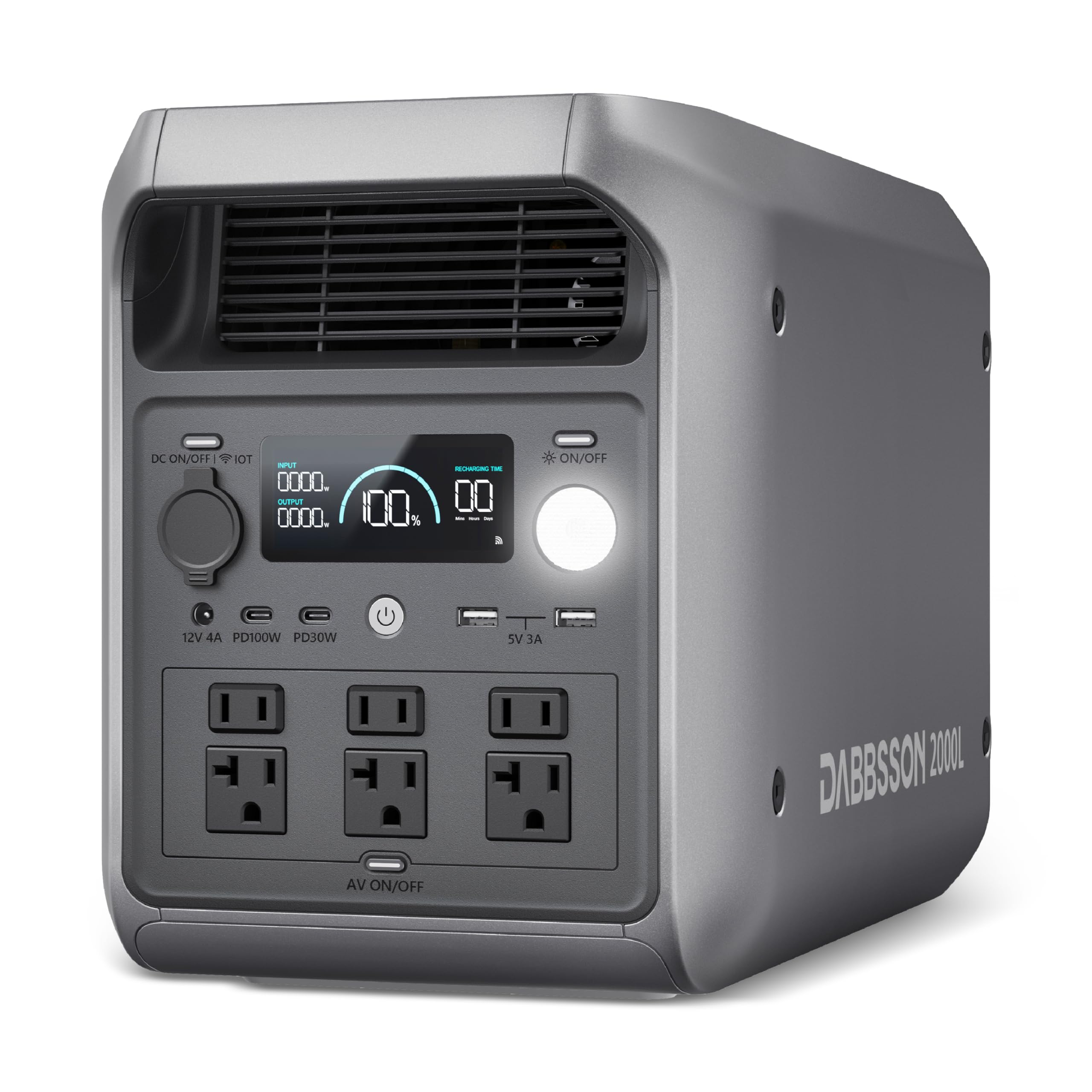
The DABBSSON 2000L uses semi-solid LiFePO4 cells — an intermediate technology between standard LFP and full solid-state — to deliver a 30% runtime improvement over conventional 2,048Wh stations while shaving the weight down to 41 lbs. That makes it one of the lightest fully-featured 2kWh generators you can buy, and the 3,300W Power Boost surge handles motor-starting loads like refrigerators and power tools without tripping.
With six AC outlets and a full port set covering USB-C, USB-A, DC5521, and a 12V car port, the 2000L can power a mini fridge, CPAP machine, and multiple phones simultaneously. The 1-hour AC recharge time (via 2,048W input) is among the fastest in its class, and the <10ms EPS switch keeps computers and network gear running seamlessly during grid dropouts. The Dabbsson app supports Wi-Fi and Bluetooth remote monitoring for charge scheduling and load tracking.
Users consistently praise the modern industrial design and compact footprint, though the fan can become audible under sustained high loads. The semi-solid chemistry is rated for 4,000 cycles to 80% capacity — roughly 11 years of daily use — and the housing carries a UL94-V0 flame-retardant rating. The 5-year warranty (3 + 2 extended) is standard for the mid-range tier, but a few reviews note unresolved software issues with the battery management system that Dabbsson support has been slow to address.
Why it’s great
- Semi-solid LiFePO4 cells deliver 30% longer runtime at the same capacity
- 41-lb weight beats competitors by 8-15 lbs in the 2kWh class
- 1-hour full recharge is class-leading for speed
Good to know
- Some units experience BMS software glitches limiting max charge/discharge
- Customer support responsiveness is inconsistent based on user reports
3. BLUETTI AC200L

The BLUETTI AC200L is the successor to the AC200MAX, bumping inverter output from 2,200W to 2,400W (3,600W Power Lifting surge) while keeping the same expansion ecosystem. You can daisy-chain up to two B300K batteries (2,764Wh each), two B210 units (2,150Wh each), or two B300 packs (3,072Wh each) for a maximum system capacity of 8,192Wh — enough to run a home refrigerator, lights, modem, and a TV for 24+ hours without solar input.
11 output ports include six AC outlets, a 30A RV port for direct camper hookup, a 48V/8A DC barrel port for efficient battery-to-battery charging, two USB-C (100W PD), and two USB-A (18W). The 45-minute 0-80% recharge via 2,400W AC input keeps downtime minimal, and the 1,200W solar input (MPPT) tops off the pack in under two hours with adequate panels. The <10ms UPS mode protects sensitive electronics from power flickers.
At 61.4 lbs the AC200L is heavier than many 2kWh units, but the expanded capacity and modular battery system make it a true home ecosystem rather than a single-use device. Users report seamless integration with 30A transfer switches for whole-room backup, and the BLUETTI app offers reliable Wi-Fi and Bluetooth monitoring. The 5-year warranty and 3,000+ cycle LiFePO4 rating support the higher entry cost if you plan to expand over time. The proprietary AC charging adapter is a minor inconvenience noted by several owners.
Why it’s great
- Four expansion battery options for customized capacity scaling
- 30A RV outlet and 48V DC port for direct camper/off-grid integration
- 45-minute 0-80% recharge keeps the unit cycling during multi-day outages
Good to know
- 61.4-lb base weight requires two people for comfortable transport
- Proprietary AC charging adapter is not a standard IEC C13 cord
4. EF ECOFLOW DELTA 3 Max
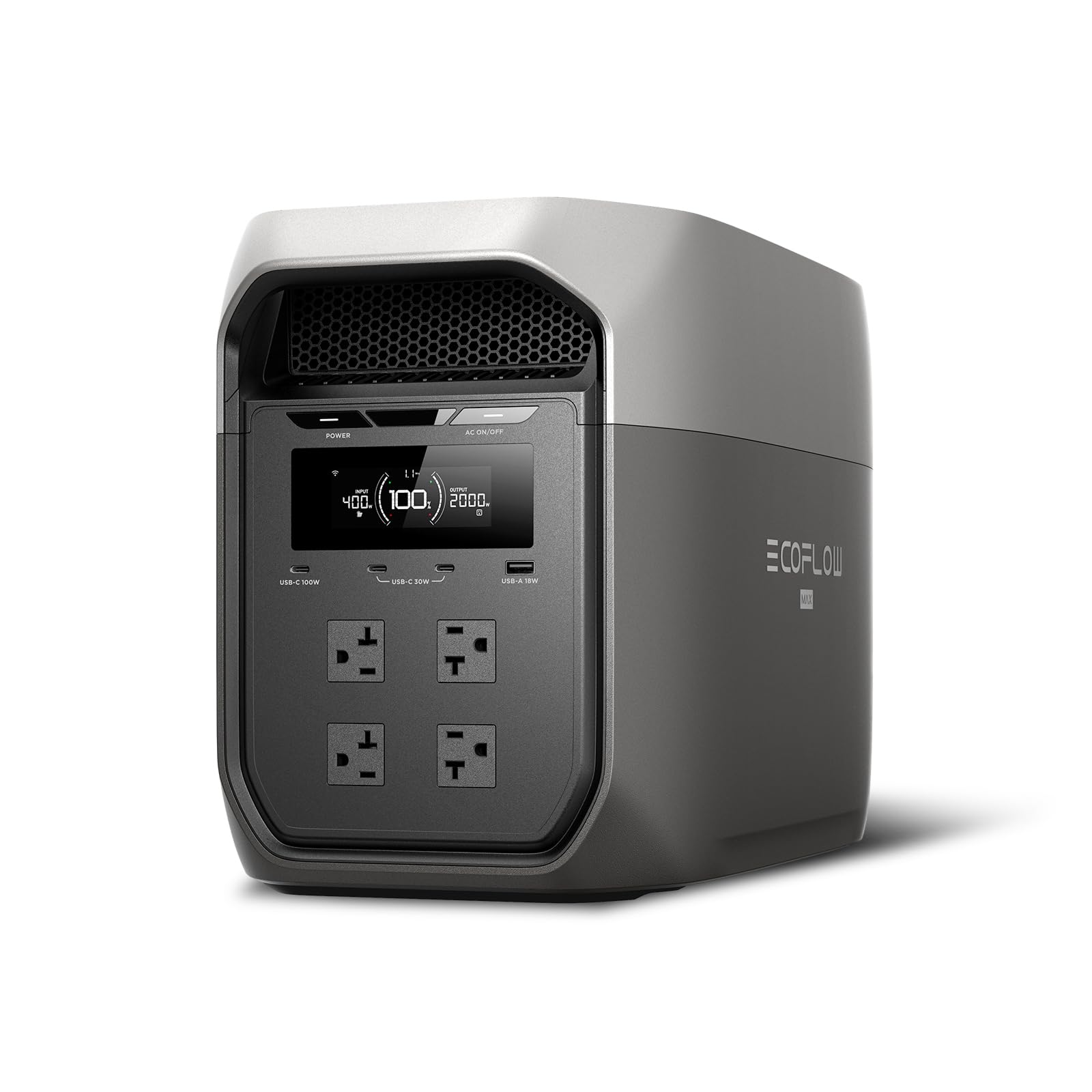
The EcoFlow DELTA 3 Max hits a 0-80% charge in just 1.13 hours using X-Stream technology, making it the fastest-recharging 2kWh generator in this lineup. The X-Boost mode pushes continuous output to 3,400W — enough to run 99% of household appliances including window AC units, microwaves, and power tools — while the <10ms UPS transfer keeps computers and network gear alive during grid flickers.
The aluminum-reinforced frame keeps the unit sturdy at 44 lbs, and the dual handle design makes transport easier than most in the 2kWh class. Port selection includes six AC outlets, two USB-C (100W PD), two USB-A, and a 12V car port. The EcoFlow app supports storm guard mode, charge scheduling, and real-time power monitoring via Wi-Fi and Bluetooth. Owners praise the quiet fan profile and the seamless pass-through charging that allows simultaneous AC input and output.
Long-term durability is backed by a 5-year warranty and a LiFePO4 battery rated for 4,000 cycles to 80% capacity. The unit’s dual handles and balanced weight distribution make it relatively easy to move between rooms or into an RV. The only compromise — and it is a minor one — is that the button labels are difficult to read in low light, which can be frustrating during a power outage when you need to locate the AC toggle quickly.
Why it’s great
- 0-80% charge in 68 minutes via X-Stream AC input
- X-Boost pushes continuous output to 3,400W for high-demand appliances
- Storm guard and app-based scheduling for automated preparedness
Good to know
- Button labeling is nearly invisible in dim environments
- Solar fast charging requires a separate XT60i cable (not included)
5. Jackery Explorer 2000 v2

Jackery’s CTB (Cell-to-Body) technology, borrowed from EV battery pack design, lets the Explorer 2000 v2 pack 2,042Wh into a 39.5-lb frame that is 41% lighter and 34% smaller than typical 2kWh LiFePO4 stations. The 2,200W pure sine wave inverter is adequate for most home essentials — fridge, modem, lights, TV — and the 20ms UPS switch meets UL1778 certification for uninterrupted power supply use.
AC fast charging hits 0-80% in 66 minutes, and a silent charging mode keeps the fan below 30 dB for overnight replenishment. The three AC outlets, two USB-C (100W PD), and one USB-A handle typical device loads, though the port count is lower than competitors offering six or more AC outlets. Users consistently report that the unit runs a full-size refrigerator for 20+ hours on a single charge, and the pass-through charging works seamlessly without any flicker during grid-to-battery transitions.
The solar input supports up to 400W panels, achieving a full charge in about 6 hours with two 200W panels. The Bluetooth app provides basic monitoring but some owners report persistent connectivity drops. The solar barrel connectors have a tendency to flex inward when cables are pushed in at an angle — a mechanical weak point noted by several buyers. Jackery backs the unit with a 5-year warranty, and the LiFePO4 chemistry is rated for 4,000 cycles to 70% capacity.
Why it’s great
- 39.5-lb weight is the lightest in the 2kWh class by a wide margin
- CTB technology improves structural rigidity and space efficiency
- Silent charging mode at 30 dB is ideal for overnight use
Good to know
- Solar barrel connectors flex inward, creating a weak mechanical point
- Bluetooth app connectivity can drop unpredictably
6. Anker SOLIX C2000 Gen 2
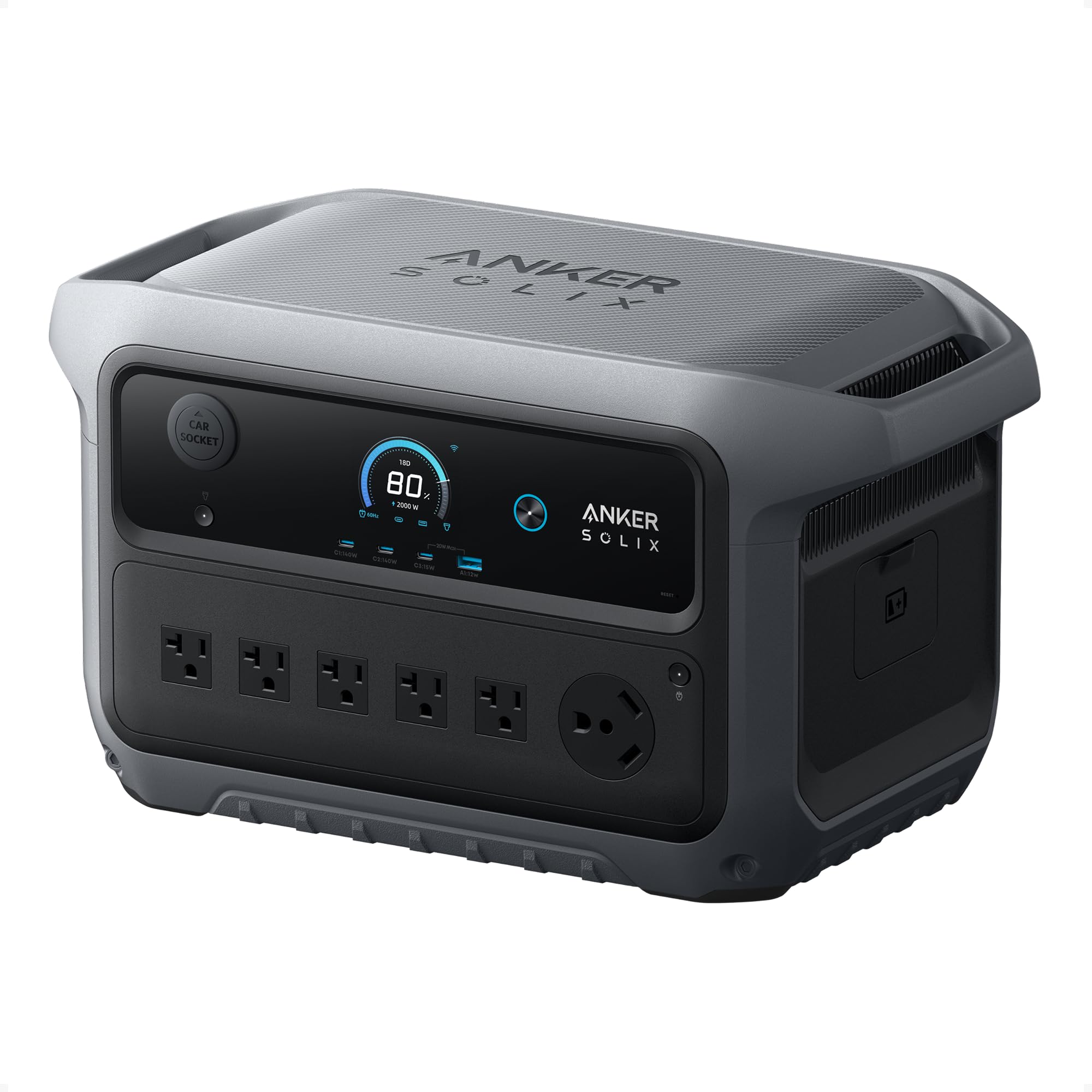
The Anker SOLIX C2000 Gen 2 stands out for its 9W standby power draw — a fraction of the 15-30W parasitic loads common in competing 2kWh units. That efficiency translates directly into longer real-world runtime: Anker claims it can run a dual-door fridge for up to 32 hours on a single charge, and adding the expansion battery (sold separately) doubles that to 64 hours. The 2,400W continuous inverter peaks at 4,000W for motor-starting loads like RV AC compressors.
Recharge speed is equally impressive — 58 minutes to 100% via AC input, with an 800W alternator charging mode that tops the battery in 3 hours from a vehicle’s 12V system (8x faster than a standard car socket). Port selection includes four AC outlets, two USB-C (100W PD), and two USB-A ports. The 41.7-lb weight and compact 18.1 x 9.8 x 10.1-inch footprint make it one of the most space-efficient 2kWh generators available.
User reviews highlight the near-silent fan operation and the intuitive companion app, though a few owners note the lack of a printed manual in the box. The LiFePO4 battery carries a 5-year warranty and is rated for 3,000 cycles to 80% capacity. The expansion battery capability pushes total capacity to 4kWh, but the additional pack adds roughly to the total investment — something to factor in if you plan to scale beyond the base unit.
Why it’s great
- 9W standby power draw is best-in-class for extended runtime during outages
- 58-minute full recharge via AC is the fastest in the 2kWh category
- 800W alternator charging enables rapid in-vehicle top-ups
Good to know
- Expansion battery adds significant cost for full 4kWh capacity
- No printed user manual is included with the unit
7. PECRON F3000LFP
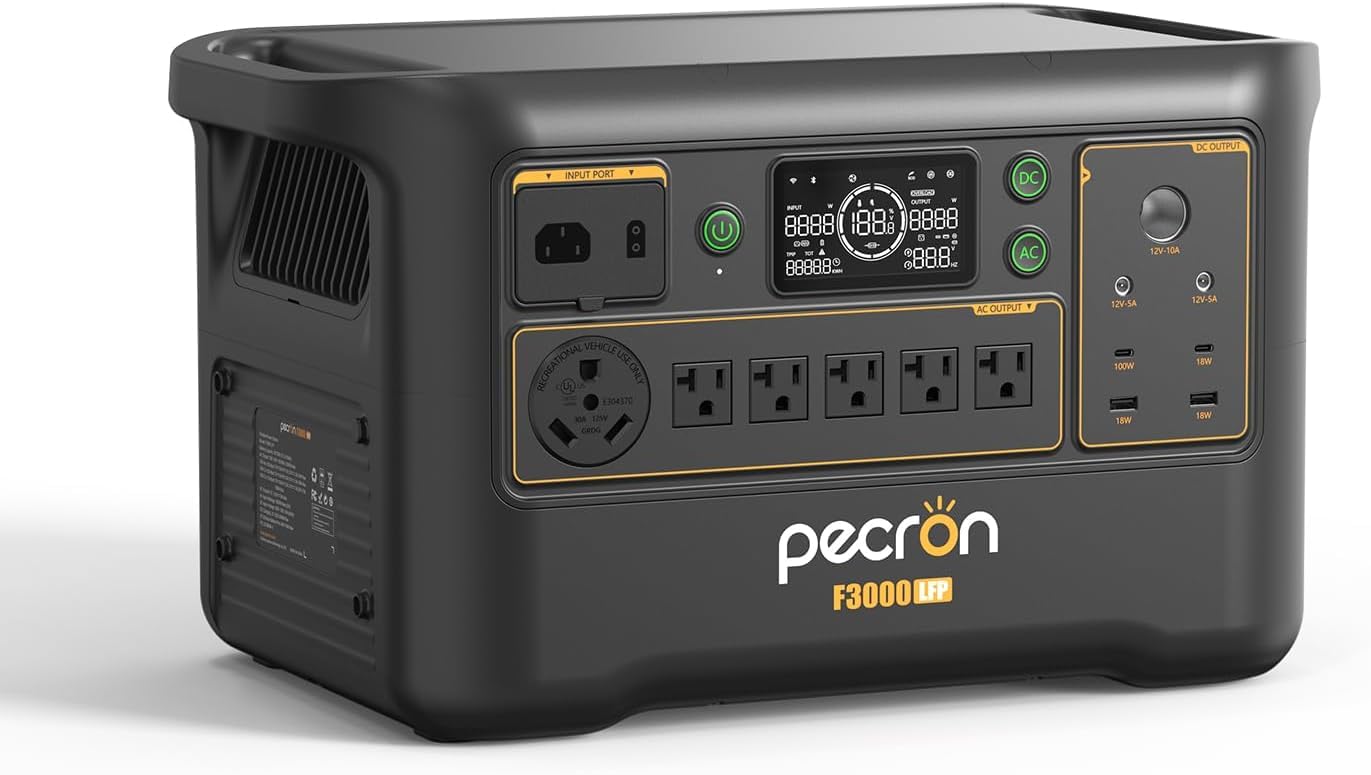
The PECRON F3000LFP delivers 3,072Wh of LiFePO4 storage paired with a 3,600W pure sine wave inverter, giving it enough headroom to run a full-size refrigerator, window AC unit, well pump, and home entertainment simultaneously. The 1,800W AC input recharges the battery from 0-100% in just 2 hours — 30% faster than many 3kWh competitors — and the 1,600W MPPT solar input can top off the pack in roughly 3 hours with adequate panel wattage.
13 output ports include six AC outlets, two USB-C (100W PD for laptops), two USB-A (18W), a 12V car port, and two DC 5525 outputs. The UPS mode switches in 8-20ms, keeping computers and medical devices running through brief grid interruptions. The F3000LFP can be expanded to 10,752Wh via a separate EP3800-48V battery pack (using a sold-separately XT120-M cascade cable), though expansion cables must be purchased separately.
Users consistently praise the value-to-capacity ratio — this unit offers 3kWh-class performance at a price that undercuts top-tier brands by several hundred dollars. The fan noise under heavy charging load is noticeable at 45-50 dB, and the Bluetooth-only connectivity (no WiFi) limits remote monitoring range. The 5-year warranty (2+3) and 24/7 customer support are competitive, though the lack of a TT-30 RV outlet means RV owners will need an adapter to connect a camper directly.
Why it’s great
- 3,072Wh capacity with 3,600W inverter at a compelling price-to-wattage ratio
- 1,800W AC recharge fully tops the battery in 2 hours flat
- Expandable to 10,752Wh for whole-home backup scenarios
Good to know
- Fan is audibly loud at 45-50 dB during high-power charging
- Bluetooth-only app lacks WiFi-based remote monitoring
8. BLUETTI Elite 300
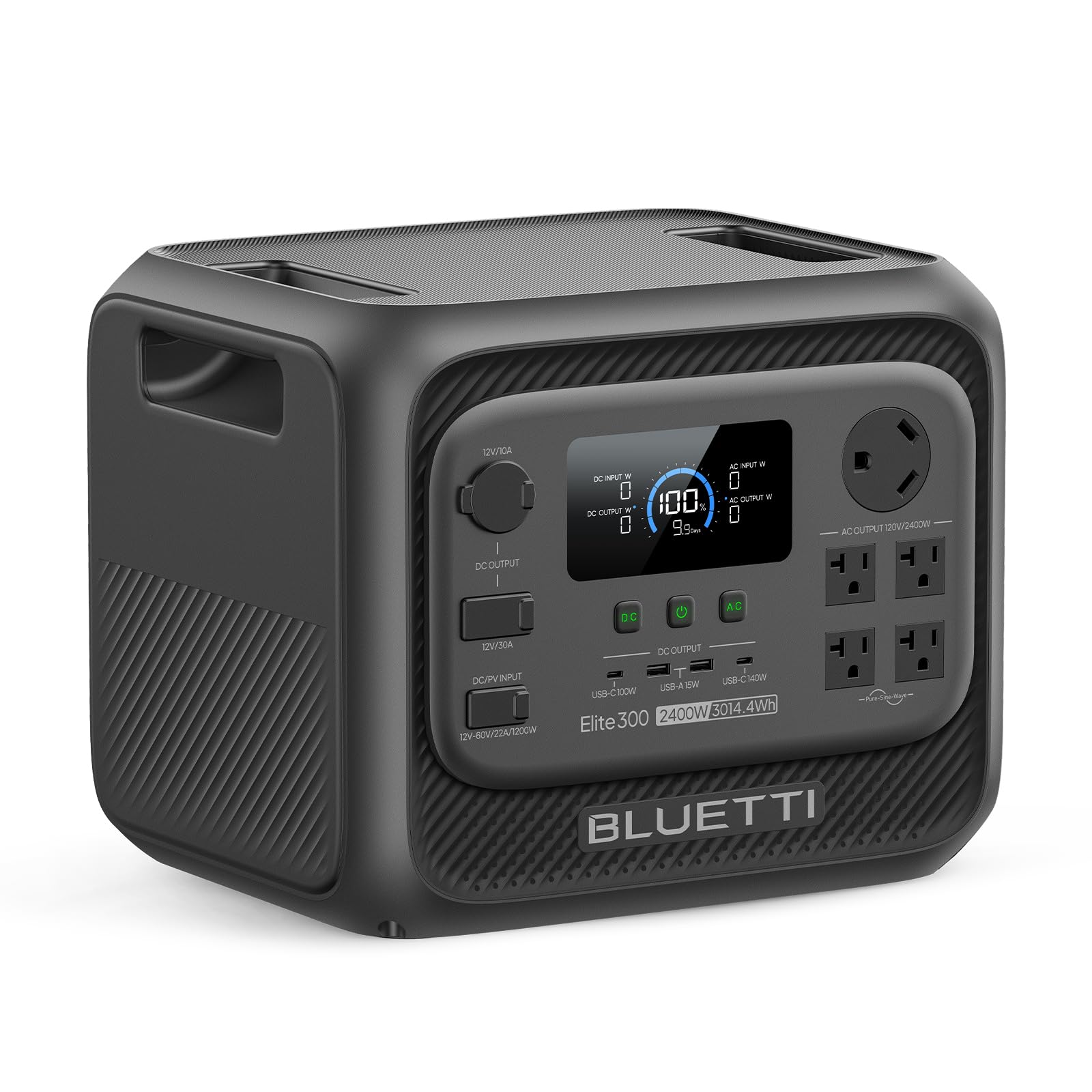
The BLUETTI Elite 300 packs 3,014Wh into a footprint 59% smaller than typical 3kWh power stations, earning a Frost & Sullivan certification as the world’s smallest 3kWh portable power station. The 2,400W continuous inverter (4,800W surge) provides enough headroom for most home appliances, and the TT-30 RV outlet plus 12V/30A high-current DC output make it a natural fit for camper vans and off-grid RVs. The 10ms UPS switch protects sensitive electronics during grid dropouts.
Recharge speed is a strong point — 0-100% in 78 minutes via AC input, and the 1,200W solar MPPT input can top off the pack in roughly 3 hours with sufficient panels. The integrated BLUETTI app supports Wi-Fi and Bluetooth monitoring, charge scheduling, and output control. The LiFePO4 battery is rated for an exceptional 6,000 cycles to 80% capacity — effectively 16+ years of daily use — making the Elite 300 a long-term investment rather than a disposable backup unit.
At 58 lbs the Elite 300 is still heavy for a single person to lift into a truck bed, but the compact dimensions (14.4 x 12 x 11.7 inches) make it easier to store in tight spaces. The primary trade-off is that the Elite 300 cannot be expanded with additional battery packs — you are locked into the 3,014Wh internal capacity. Owners also note that the display is difficult to read in bright sunlight, and the solar input maxes out at 1,200W compared to competitors offering 1,600-2,000W solar MPPT capacity.
Why it’s great
- World’s smallest 3kWh footprint saves critical storage space
- 6,000-cycle LiFePO4 rating is the highest in this lineup
- TT-30 RV outlet with 12V/30A DC for direct camper integration
Good to know
- No expansion battery option — internal capacity is fixed
- Solar input limited to 1,200W versus competitors at 1,600-2,000W
9. Jackery HomePower 3000

The Jackery HomePower 3000 pairs a 3,072Wh LiFePO4 battery with a 3,600W continuous inverter that surges to 7,200W — enough to start a well pump, a 15,000 BTU AC unit, and a refrigerator simultaneously. The ≤20ms UPS switch is UL-certified, and the built-in TT-30 RV outlet provides direct plug-and-play power for camper hookups. Jackery claims the unit can power a household for up to 15 hours or keep a refrigerator running for 1-2 days on a single charge.
Charging flexibility is robust: AC input reaches full in 2.2 hours, hybrid AC + DC cuts that to 1.7 hours, and two 200W solar panels hit 80% in 9 hours. The ChargeShield 2.0 algorithm with AI-driven charging profiles extends battery lifespan beyond the advertised 4,000 cycles (to 70% capacity). Port selection includes six AC outlets, two USB-C (100W PD), two USB-A, and a 12V car port.
At 60+ lbs the HomePower 3000 requires two handles and some effort to move, though the honeycomb bottom shell and CTB construction improve structural rigidity. The fan runs at roughly 60 dB under any load — noticeably louder than competitors and too loud for a quiet home office UPS application. A critical caveat: Jackery’s warranty policy explicitly excludes units purchased through third-party Amazon listings, so verify you are buying from the Jackery store or direct from the manufacturer to keep coverage valid.
Why it’s great
- 7,200W surge handles the highest motor-starting loads in this lineup
- ChargeShield 2.0 AI extends battery cycle life beyond 4,000 cycles
- UL-certified ≤20ms UPS keeps critical electronics safe
Good to know
- Fan runs at ~60 dB under load — too loud for quiet indoor use
- Warranty void if purchased from unauthorized Amazon sellers
10. ABOK Ark3600

The ABOK Ark3600 starts at 3,840Wh with a 3,600W continuous inverter (4,500W peak) and can expand to 11,520Wh via additional battery units — making it the highest-capacity battery generator in this roundup. The 15-port output array includes a dedicated 30A AC outlet for RV or transfer switch connections, four 20A AC outlets, three USB-C (20W + 100W PD), two USB-A (QC 3.0), two DC5521, one XT60 (12V/25A), and a 12V cigarette lighter port.
Charging is versatile: 1,500W AC input fills the base 3,840Wh pack in 3 hours, and combining AC with 2,000W solar input (via MC4/XT90) drops full recharge to just 1.29 hours. The <10ms UPS mode provides seamless backup for computers and network gear. A telescoping handle and durable wheels make the 92-lb unit surprisingly easy to roll across garages and campsites — a practical feature given the weight.
Users praise the Ark3600 for its silent, fume-free operation compared to gas generators, and the solar input performance is strong with up to 720W sustained from 800W panels during peak sun. However, several critical reviews note that defective units (charging failures or unit lockups) require the buyer to pay return shipping for the 100+ lb package — a significant cost — and that the seller only provides unpaid return labels. The 2+3 year warranty is competitive, but the return logistics are a genuine risk to consider before purchasing.
Why it’s great
- 3,840Wh base capacity expandable to 11,520Wh — highest in this roundup
- Telescoping handle and wheels make 92-lb unit garage-friendly
- AC + 2,000W solar hybrid charging reaches full in 1.29 hours
Good to know
- 92-lb weight is prohibitive for lifting despite wheeled design
- Defective unit returns may require buyer-funded + shipping
11. Westinghouse 28000

The Westinghouse 28000 produces 28,000 peak watts and 20,000 running watts from a 999cc V-twin gasoline engine with a cast iron sleeve — enough to power an entire 3,000+ sq ft home, including central AC, well pump, electric water heater, and kitchen appliances simultaneously. The 17-gallon fuel tank delivers up to 15 hours of runtime at 25% load, and the remote start key fob lets you fire the unit from inside the house during bad weather.
Output ports include four GFCI 120V 5-20R outlets, two 50A 120/240V 14-50R outlets, two 30A 120/240V L14-30R outlets, and one 30A 120V L5-30R outlet — making it transfer switch ready for both 30A and 50A home panels. The low THD (total harmonic distortion) design is safe for sensitive electronics, and the automatic CO sensor and low-oil shutdown provide critical safety features. The digital readout displays lifetime run hours, voltage, and frequency.
At 541 lbs the Westinghouse is in a completely different weight class than battery generators and requires a permanent or semi-permanent installation. The noise level is substantially higher than any battery unit — expect 70-75 dB at 25 feet — though owners consistently report it is quieter than similarly-sized gas generators. The 2-year warranty covers parts only; labor costs for warranty repairs are the buyer’s responsibility. This unit is the right choice only if you need whole-home capacity, have access to fuel storage, and can tolerate the noise and emissions that battery generators eliminate by design.
Why it’s great
- 28,000W peak and 20,000W running power covers an entire home and workshop
- 50A and 30A outlets are transfer switch ready for full-panel backup
- Remote start key fob and auto choke simplify cold-weather startup
Good to know
- 541-lb weight requires installation team or heavy-duty equipment
- Gas engine noise and emissions are inherent trade-offs vs. battery generators
FAQ
Can a battery generator run a central air conditioning unit?
What does UPS mode mean on a battery generator?
How many watts do I need to power a refrigerator during an outage?
Can I charge a battery generator with solar panels while also powering my home?
Final Thoughts: The Verdict
For most users, the best battery generator for home winner is the AFERIY P210 because it combines silent 30 dB operation, a 2,400W inverter, 2,048Wh capacity, and the longest 7-year warranty in its class at a mid-range price. If you need the smallest possible 3kWh footprint and the highest cycle life, grab the BLUETTI Elite 300. And for whole-home capacity with a 7,200W surge and solar-ready integration, nothing beats the Jackery HomePower 3000.