
Our readers keep the lights on and my morning glass full of iced black tea. As an Amazon Associate, I earn from qualifying purchases.
Specs are compiled from manufacturer listings and verified buyer reviews and can change over time — please confirm the key details on the product page before buying.
A battery generator is the difference between a storm knocking out your fridge for a day and you calmly watching it hum along. These rechargeable power stations deliver clean AC electricity without gas, oil, or exhaust fumes, so you can run them inside your home, a tent, or an RV safely. Whether you’re prepping for hurricane season, planning off-grid camping, or just want a quiet backup for your home office, the right one keeps your essentials running—and the wrong one leaves you guessing.
I’m Min — the founder and writer behind Gadgets Feed. This guide is built by comparing the manufacturers’ published specifications and the patterns across verified customer reviews, so you get each pick’s real strengths and trade-offs instead of marketing spin.
You need to understand watt-hours, surge capacity, and recharge times to pick the right one, and this breakdown of the battery generator landscape walks you through each choice with clarity.
Our Picks at a Glance


How To Choose The Best Battery Generator
Before you compare models, you need to match the machine to the real job it will do. A small station that runs your phone and a string of lights is a different purchase than a beast that keeps a fridge, freezer, and Wi-Fi going for a full day. Start by writing down the watts each device draws, then work out how long you need them to run.
Match the capacity to your outage plan
To know how long a battery generator will run your gear, check its capacity in watt-hours (Wh)—the total energy it stores. Divide that number by the watts your device draws to estimate runtime: a 1,000Wh station running a 100-watt fridge lasts about 10 hours. The crowd favorite here, the Jackery Explorer 1000 v2, holds 1,070Wh, and buyers report it powered three fridges, an ice maker, and a fan for 7–8 hours on a boat.
Check the AC output, not just the headline watts
The AC output rating tells you how much power it can push continuously, while the surge peak handles the brief burst a fridge compressor needs to start. For most homes, a station with at least 1,500W of continuous output covers a fridge, a few lights, a router, and phone charging. If you want to run a microwave, hair dryer, or power tools, you’ll need to step up to 2,000W or more.
Recharge speed matters more than you think
If the power is out for days, how fast the station refills from a wall outlet or solar panel decides how useful it is. Many premium models now hit 80% in under an hour. The Anker SOLIX C1000, for instance, reaches 80% in 43 minutes, and the DJI Power 1000 V2 manages it in 37 minutes. Faster refills mean you can cycle the same station through multiple outages in one day.
Quick Comparison
| Model | Best For | Watt-Hours | AC Output | Weight | Amazon |
|---|---|---|---|---|---|
| Jackery Explorer 1000 v2★ Best Overall | Outages & camping | 1,070Wh | 1,500W | 23.8 lbs | Amazon |
| GRECELL 500WBest Value | Budget essentials | 519.48Wh | 500W | 14.1 lbs | Amazon |
| BLUETTI AC70Fast Charger | Fast wall charging | 768Wh | 1,000W | 22.5 lbs | Amazon |
| DJI Power 1000 V2 | Speed & portability | 1,024Wh | 2,200W | — | Amazon |
| Anker SOLIX C1000 | Long-term battery health | 1,056Wh | 1,800W | 27.6 lbs | Amazon |
| DJI Power 2000 | Whole-family output | 2,048Wh | 3,000W | 47.9 lbs | Amazon |
| Jackery Explorer 2000 v2 | Light 2kWh station | 2,042Wh | 2,200W | 39.5 lbs | Amazon |
| BLUETTI Elite 200 V2 | High wattage for appliances | 2,073.6Wh | 2,600W | 53.4 lbs | Amazon |
| EcoFlow DELTA 3 Max | Balanced home backup | 2,048Wh | 2,400W | — | Amazon |
| Anker SOLIX C2000 Gen 2 | Long fridge runtime | 2,048Wh | 2,400W | 41.7 lbs | Amazon |
| EcoFlow DELTA Pro | Whole-home & heavy tools | 3,600Wh | 3,600W | 99 lbs | Amazon |
In‑Depth Reviews
1. Jackery Explorer 1000 v2 Portable Power Station
Our pick — over 4.5★ from 3,500+ verified ratings; the strongest balance of quality and price.
The 1,070Wh all-rounder that easily powers a camping trip or a storm outage
The Jackery Explorer 1000 v2 is the station that ends the “gas or electric” debate for most households. It packs 1,070Wh of capacity with a 1,500W AC output and a 3,000W surge peak, which is enough to run AC units, fridges, and electric pots. You can power multiple appliances at once through its two USB-C ports, one USB-A port, one DC car port, and three pure sine wave AC ports.
Weighing only 23.8 lbs with a foldable handle, it’s light enough to carry from your truck to a campsite without breaking a sweat. The LiFePO4 battery retains over 70% capacity after 4,000 cycles, lasting beyond a decade. Recharging is fast, too: with emergency charging activated in the Jackery App, it goes from 0% to 100% in one hour, though the default 1.7-hour mode is gentler on battery health.
Owners mention this station is a genuine lifesaver during storm outages, with one owner noting it powered three fridges, an ice maker, and a fan for 7–8 hours on a boat at anchor via a 110v-to-50amp pigtail. What wins people over is the build quality—the most-praised aspect by far—paired with dependable charging. The recurring trade-off is that it’s not expandable, so if you need a full week of off-grid power, you’ll want to look at a larger-capacity model.
Why it wins
- 1,070Wh capacity with a 1,500W output fits most home and camping needs
- Just 23.8 lbs, so it’s genuinely portable
- One-hour emergency charging cuts downtime dramatically
Keep in mind
- Only one USB-A port limits some multi-device setups
- Solar panel not included despite the name
Reach for this if: you want a single, portable station that covers outages and camping without breaking your budget.
Think twice if: you need to power a whole home for multiple days, since there’s no expansion battery option.
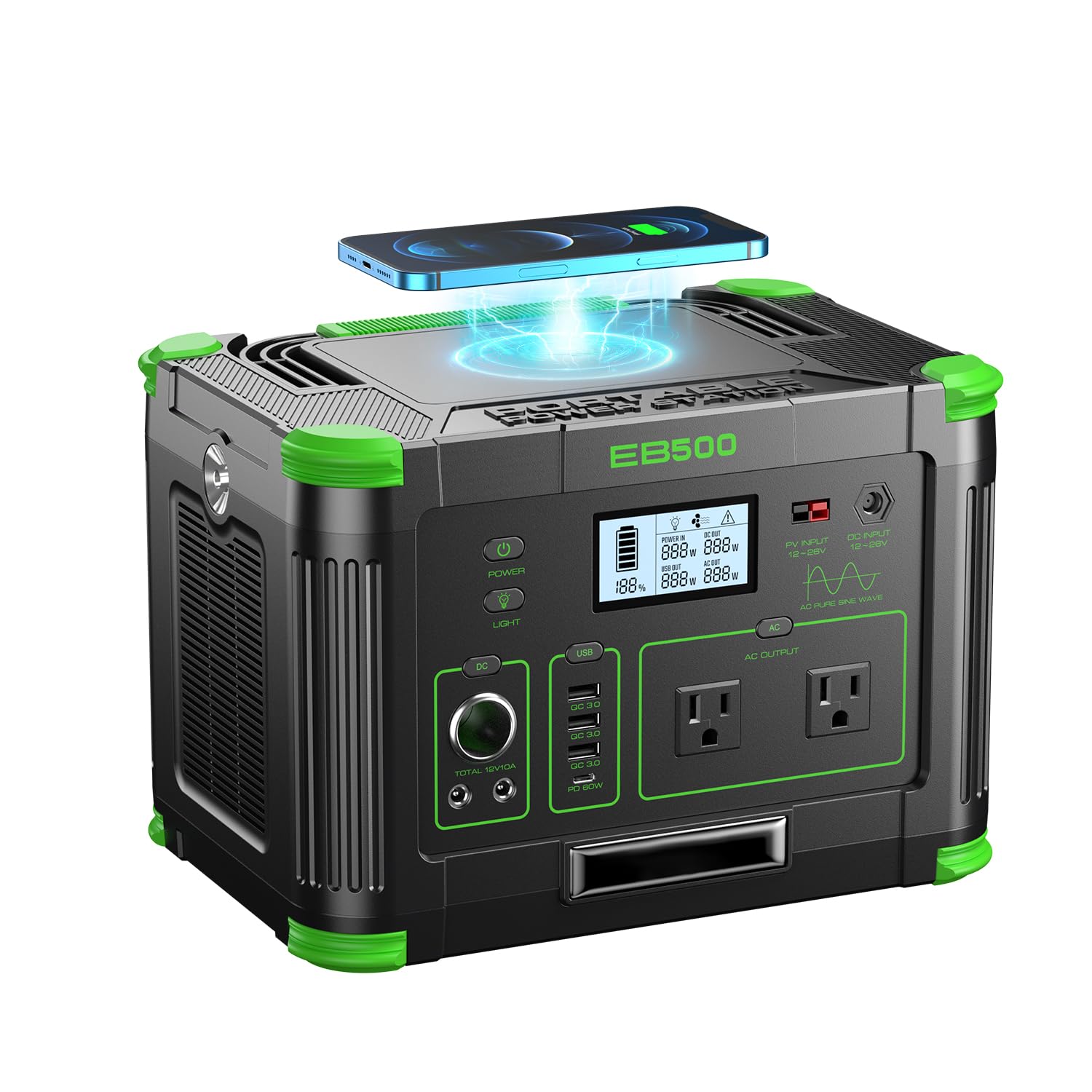
2. GRECELL Portable Power Station 500W
The lightweight entry-point that keeps the essentials humming without the premium price tag
The GRECELL 500W proves you don’t need to spend a fortune to get reliable backup power. With a 519.48Wh capacity (14,0400mAh) and pure sine wave AC outlets, it runs phones, laptops, lights, fans, routers, a TV, and even a CPAP machine as long as they draw under 500 watts. It’s an ideal starter station for home use and weekend camping trips.
At 14.1 lbs, this is the lightest station in the lineup, so you can toss it in the trunk without straining. It runs up to 10 devices at once through two pure sine wave AC ports (120V/500W), three USB-A QC3.0 ports (18W max), one USB-C PD output (60W max), two DC ports, one car port, and a 10W wireless charger. Recharge it three ways: a 100W or 200W solar panel in 6–9 hours, a car charger in 7–8 hours, or a wall outlet in 6–7 hours.
The standout feature here is value for money—buyers consistently praise getting a lot of watt-hours per dollar. One owner ran a car fridge overnight for 11 hours and the unit still showed 100% charge, while another reported it runs a mid-size fridge for 24 hours without a recharge. The recurring gripe is that 500W limits you to smaller appliances; it’s built as short-term backup, not off-grid living.
What you get
- 519.48Wh capacity is plenty for a fridge, lights, and phone
- Only 14.1 lbs, so it’s easily portable
- Charges 10 devices at once including a wireless pad
The limit
- 500W output can’t handle high-draw appliances like microwaves
- Slow wall recharge compared to premium stations
Suits you if: your priority is a dependable, budget-friendly backup for a fridge and electronics.
Look elsewhere if: you plan to run power tools or large kitchen appliances off the battery.
3. BLUETTI AC70 Portable Power Station
A mid-range station that refills in 45 minutes and runs a camping trip all day
If you camp or prep for emergencies and want fast refills without paying for a 2kWh unit, the BLUETTI AC70 fits. It stores 768Wh, runs a 1,000W inverter, and has a 2,000W power-lifting mode for brief surges. One cable refills it at up to 950W, taking you from 0% to 80% in 45 minutes and to full in 1.5 hours.
Owners say the quality is what wins them over, with fast charging as the second most-praised trait. One camper ran a 100W guitar amp with five pedals for 8 hours and only dropped to 59%, which works out to a roughly 19.6-hour runtime at that draw. The 768Wh capacity easily handles overnight CPAP use, a small fridge, or recharging phones, fans, and lights off-grid.
Its LiFePO4 battery is rated for over 3,000 charge cycles. The BLUETTI app lets you monitor status and adjust settings remotely, and it can take up to 500W of solar input for off-grid recharging. The honest downside is weight: at 22.5 lbs, it’s not the lightest for its size, and owners note it drains quicker than larger-capacity stations when pushed hard.
Why it stands out
- 45-minute 0–80% wall charge is among the quickest at this size
- 2,000W power lifting handles brief appliance surges
- Up to 500W solar input for off-grid recharging
The trade-off
- 768Wh capacity is smaller than the 1kWh+ competition
- 23.5 lbs is manageable but not featherlight
Grab this if: you want fast refills and reliable output for camping or short outages.
skip it if: you need to run a full-size fridge plus multiple appliances for days on end.
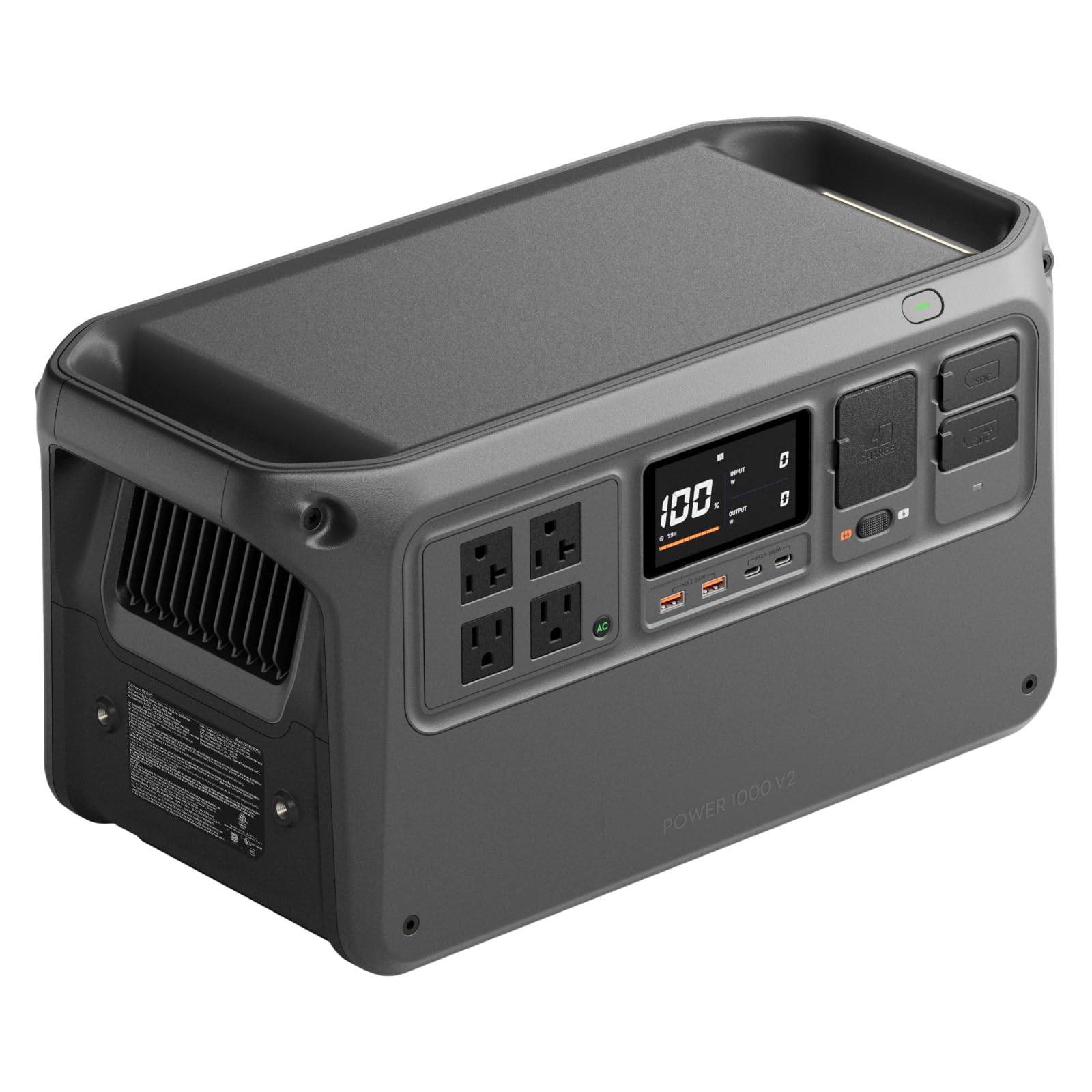
4. DJI Power 1000 V2 Portable Power Station
A 1,024Wh powerhouse that recharges to 80% faster than any other pick here
The DJI Power 1000 V2 is the station for the impatient. It recharges to 80% in a mere 37 minutes, and it delivers a 2,200W output and 1,024Wh of capacity (with an LFP battery). That’s enough surge to drive kettles, cookers, projectors, saws, and drills—about 99% of typical home appliances. For content creators, the dual 140W USB-C ports deliver 280W total, which is 40% more power than standard dual 100W USB-C setups.
You can run this inside an RV or camper van overnight because it operates as low as 26 dB—quieter than a whisper. Its UPS function (uninterruptible power supply, which kicks in during a blackout) switches in just 10ms, so your sensitive electronics stay safe. The 1024Wh battery comes with a 5-year warranty, and the flame-retardant housing plus sub-nano coating handle harsh environments.
Owners praise the power capacity and fast recharging, with one noting a fridge cooler ran for about 3 days on a charge. What people love most is the quality build, though the lack of built-in Wi-Fi/Bluetooth (a dongle is required) is a common gripe. It’s also note that MPPT and car charging modules aren’t built in—connecting a solar panel requires a separate compatible adapter.
Why it impresses
- 37-minute 80% recharge is class-leading at this capacity
- 2,200W surge powers heavy tools and appliances
- 26 dB noise level is near-silent for indoor use
What to know
- No built-in connectivity without a separate dongle
- Solar and car charging need extra adapters
Pick this if: you value lightning-fast refills and high surge power for tools and appliances.
Pass if: you want an all-in-one setup with Wi-Fi control from the start.
5. Anker SOLIX C1000 Portable Power Station

The 1,056Wh station engineered to deliver a full decade of dependable charging
The Anker SOLIX C1000’s LiFePO4 battery is rated for 3,000 cycles over a 10-year lifespan. It delivers a 1,800W continuous output with a massive 2,400W surge via SurgePad technology, which powers 99% of appliances through 11 versatile ports.
The standout feature is recharge speed. With UltraFast recharging, it hits 80% capacity in just 43 minutes and a full charge in under an hour—you just need to turn on UltraFast mode via the Anker app. It can also take up to 600W of solar input to fully recharge in 1.8 hours. At 27.6 lbs and 15% smaller than comparable 1kWh units, it’s easy to move from home to campsite.
Owners rave about the reliability, particularly its UPS mode for home offices—one user ran a garage fridge for 36 hours from 100% to 1% during an outage. The consensus is that it’s an excellent value, with quality as the most-praised aspect. The honest caveat is that solar charging can be slow if you pair it with low-wattage panels, and it can’t run a fridge all day plus a TV for hours unless you add an expansion battery.
What stands out
- 43-minute 80% recharge for minimal downtime
- 2,400W surge powers most home appliances
- 10-year lifespan with 3,000 battery cycles
Keep in perspective
- Runs a fridge about a day, not a full week
- Solar efficiency depends heavily on panel wattage
Choose this if: you want a reliable, long-lived station for short outages and RV trips.
Reposition if: you need whole-home power for multiple days without an extra battery pack.
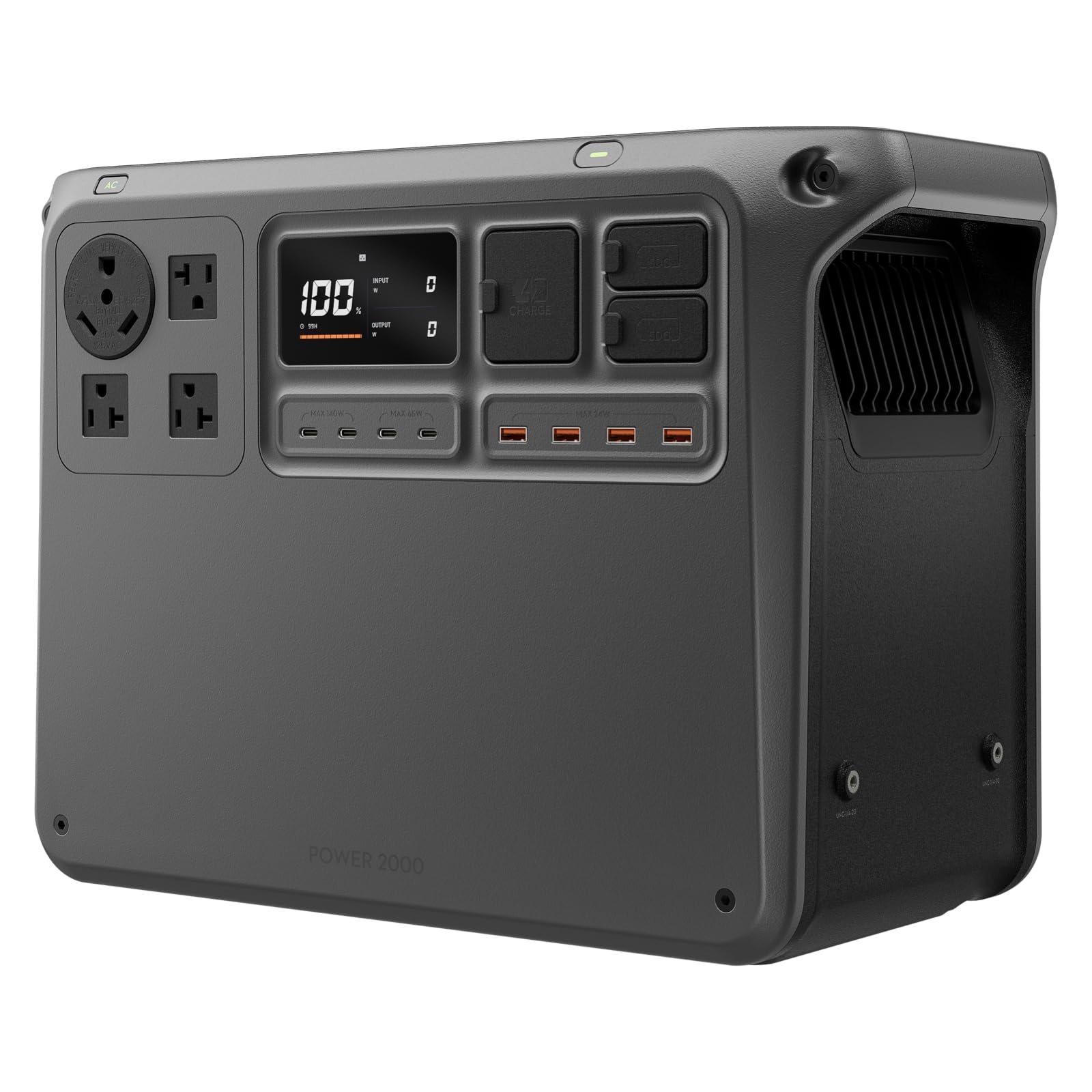
6. DJI Power 2000 Portable Power Station
A 2,048Wh beast with 3,000W of continuous power that runs 99% of appliances
The DJI Power 2000 steps up to serious home backup duty. It packs a 2,048Wh LFP battery with a 3,000W continuous output and a 4,000W surge peak, so it runs kettles, cookers, projectors, electric saws, and impact drills without breaking a sweat. It recharges to 80% in just 55 minutes, keeping downtime minimal during storms.
This station is built for groups and whole-home coverage. With 15 ports including four AC, four USB-C, four USB-A, and dual full SDC ports, it can charge 4–5 people’s phones, lights, fans, and laptops simultaneously on a camping or RV trip. It supports expansion up to 22.5kWh, which DJI says is enough to power essential home devices for 4–6 days during blackouts—though the expansion batteries are sold separately.
The 10ms UPS switch time protects computers and sensitive electronics during outages, and it runs as low as 30 dB for quiet overnight use. Buyers praise the reliability above all, noting it handles portable AC, laundry, and kitchen appliances simultaneously on old breakers. The caveat is that the app can be clunky, and the unit lacks wheels—at 21.72 kg (about 47.9 lbs), you’ll want to plan where it lives.
Why it’s a workhorse
- 3,000W continuous output runs nearly any home appliance
- 15 ports charge a whole crew at once
- Expansion up to 22.5kWh for multi-day outages
Before you buy
- No wheels, so moving the 47.9-lb unit is a two-person job
- App interface needs polish, and solar needs a separate adapter
Best if: you need whole-home or whole-crew power with room to expand later.
Consider alternatives if: you want built-in solar charging without extra adapters or a lighter footprint.
7. Jackery Explorer 2000 v2 Portable Power Station

The lightest 2kWh station here, built with EV-grade Cell-to-Body technology
The Jackery Explorer 2000 v2 delivers serious capacity without the usual bulk. At 39.5 lbs, Jackery says it’s 41% lighter and 34% smaller than typical 2kWh LiFePO4 stations, thanks to the same Cell-to-Body (CTB) technology used in electric vehicles. With a 2,042Wh capacity and three AC ports delivering 2,200W total, it covers home backup, camping, and small business needs.
Recharging is flexible and fast. AC fast charging takes it from 0% to 80% in 66 minutes, and emergency super charging through the app reaches full in 102 minutes. With 400W solar panels, you can fill it in as few as 6 hours. A Silent Charging mode delivers a full charge in 5 hours at just 30 dB, so it won’t disturb sleep or work.
Its 20ms smooth switching earns it a certified UPS rating (UL1778 tested), so it keeps power flowing during hurricanes and outages. Customers note running a medium-sized fridge, a large fan, and a dehumidifier at once on a single charge. Performance tops the praise list, with reliability close behind. The recurring complaint is Bluetooth connection drops and solar barrel ports that flex inward—so handle the frame gently.
What you’ll love
- 2,042Wh capacity in a 39.5-lb frame
- 66-minute 0–80% AC fast charge
- 20ms UPS switching keeps electronics safe
Watch out for
- Bluetooth connection can drop on some units
- Solar barrel ports feel fragile
Ideal for: anyone who wants 2kWh of backup power but can’t haul a 53-lb unit around.
Avoid doing: over-tightening the solar connectors, which some reviewers point out flexing inward.
8. BLUETTI Elite 200 V2 Portable Power Station

A 2,073.6Wh station with 2,600W of output that runs heavy appliances with headroom
The BLUETTI Elite 200 V2 is built for people who need real wattage, not just capacity. It delivers 2,600W of continuous AC power and a staggering 3,900W in power-lifting mode via HyperWatt tech, so it easily runs refrigerators, hair dryers, coffee makers, and even an air fryer. You can power up to 9 devices simultaneously, making it ideal for power outages, road trips, and off-grid setups.
The battery is engineered to last. BLUETTI claims the industry’s first CNAS-certified automotive-grade LiFePO4 battery, rated for 6,000+ cycles and a 17-year lifespan. Its 10W standby draw is 3 times lower than similar stations, reducing wasted energy. A 120V 60W diesel heater running 10 hours a day can last 3.3 days on a charge.
Charging is adjustable via three smart modes: Turbo (0–80% in 1 hour at 1,800W AC), Standard (full in 1.6 hours), and Silent (full in 3 hours at just 16–30 dB). Owners praise the power capacity and value above all, with one user saving per month through time-of-use charging. The caveat is weight—at 53.4 lbs, it’s heavy to move, though owners say the handles make it manageable.
Why it delivers
- 2,600W continuous and 3,900W peak powers big appliances
- 17-year lifespan with 6,000+ charge cycles
- Three charging modes let you balance speed and noise
Before you commit
- 53.4 lbs is a two-handed carry at best
- No expansion battery option if you outgrow it
Pick this if: you run a microwave, air fryer, or tools and want a long-lived battery.
Reposition if: you need to expand capacity later or move the unit frequently.
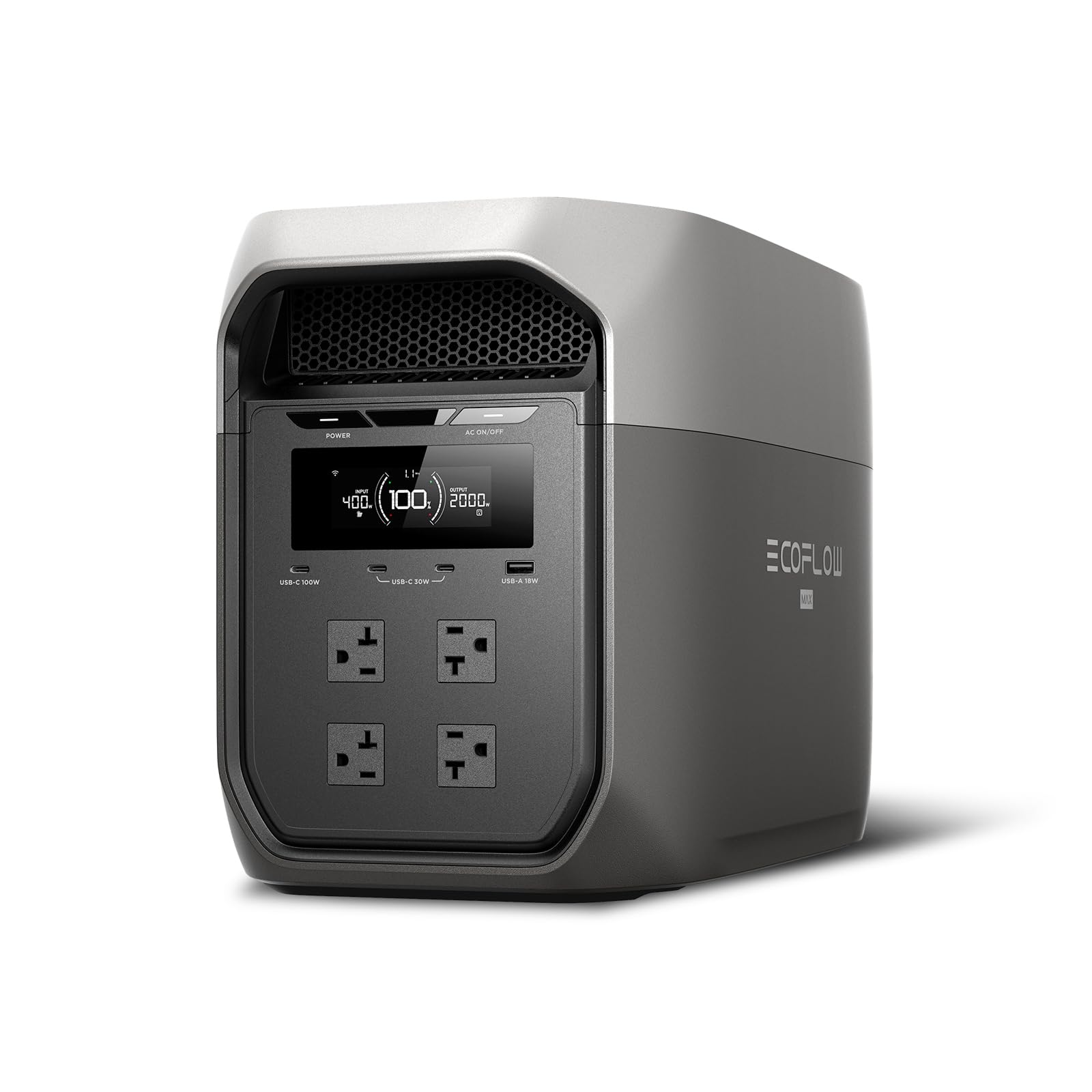
9. EF ECOFLOW DELTA 3 Max Portable Power Station
A 2,048Wh all-rounder that balances fast charging, high output, and quiet operation
The EcoFlow DELTA 3 Max is the balanced choice for home backup and RV adventures. It holds 2,048Wh of capacity with a 2,400W continuous output, expandable to a 3,400W X-Boost mode that runs fridges, microwaves, and even power tools. EcoFlow’s X-Stream technology recharges it from 0% to 80% in just 1.13 hours, so you’re rarely left waiting for power.
Its LiFePO4 battery is built for 10 years of daily use. The sub-10ms transfer time protects sensitive electronics like computers and medical devices from outages, and its ultra-quiet operation keeps nights peaceful. The EcoFlow app lets you monitor energy use in real time, set smart priorities, and manage charging and discharging schedules to cut electricity costs.
Owners consistently call it a top-quality system, praising the incredibly fast charging to full capacity and the long battery life. One buyer sent it to family in Cuba during frequent blackouts, where it kept phones, lamps, and essentials charged for hours. The most-praised aspects are performance and power, though it’s a heavy unit—so plan your setup location carefully.
Why it shines
- 1.13-hour 0–80% recharge is genuinely fast
- 3,400W X-Boost runs high-demand appliances
- 10-year LiFePO4 lifespan with a 5-year service
The reality
- Heavy build makes it a permanent fixture rather than a carry-around
- Solar panels not included for off-grid recharging
Best for: households that want a dependable, fast-charging station for outages and RV life.
Think twice if: you need to haul it regularly, since the aluminum-and-plastic frame adds weight.
10. Anker SOLIX C2000 Gen 2 Portable Power Station

A 2,048Wh station engineered to keep a dual-door fridge cold for up to 32 hours
When the power goes out, the Anker SOLIX C2000 Gen 2 keeps your food cold. It draws just 9W of standby power, so it runs a dual-door fridge for up to 32 hours on one charge. Add an expansion battery to reach 4kWh, and that extends to 64 hours—more than two and a half days of fridge protection.
With a 2,400W rated output and a massive 4,000W peak, it runs multiple appliances at once, including most window and RV air conditioners. Recharging is flexible with six ways to refill, including AC and solar to a full charge in just 58 minutes. For road trips, the 800W UltraFast alternator charging hits 100% in 3 hours—that’s 8 times faster than a standard car socket.
At 41.7 lbs and 25% lighter than similar products, it’s one of the easiest 2kWh units to move. Owners praise the performance and reliability, with one user powering a 30-quart fridge for 5–7 days per charge on a 7-week trip. The app’s runtime estimates can be inaccurate for cycling appliances, and a paper manual isn’t included—everything lives in the app—but for long fridge runtime, this is the standout.
What wins people over
- 32 hours of fridge runtime on a single charge
- 4,000W peak powers window and RV air conditioners
- 58-minute full recharge via AC and solar
Keep in mind
- App-only manuals take getting used to
- Runtime estimates for cycling appliances can be optimistic
Reach for this if: protecting your fridge and freezer during multi-day outages is your top priority.
Look elsewhere if: you prefer printed manuals and simple estimated runtimes over app-based tracking.
11. EF ECOFLOW DELTA Pro Portable Power Station
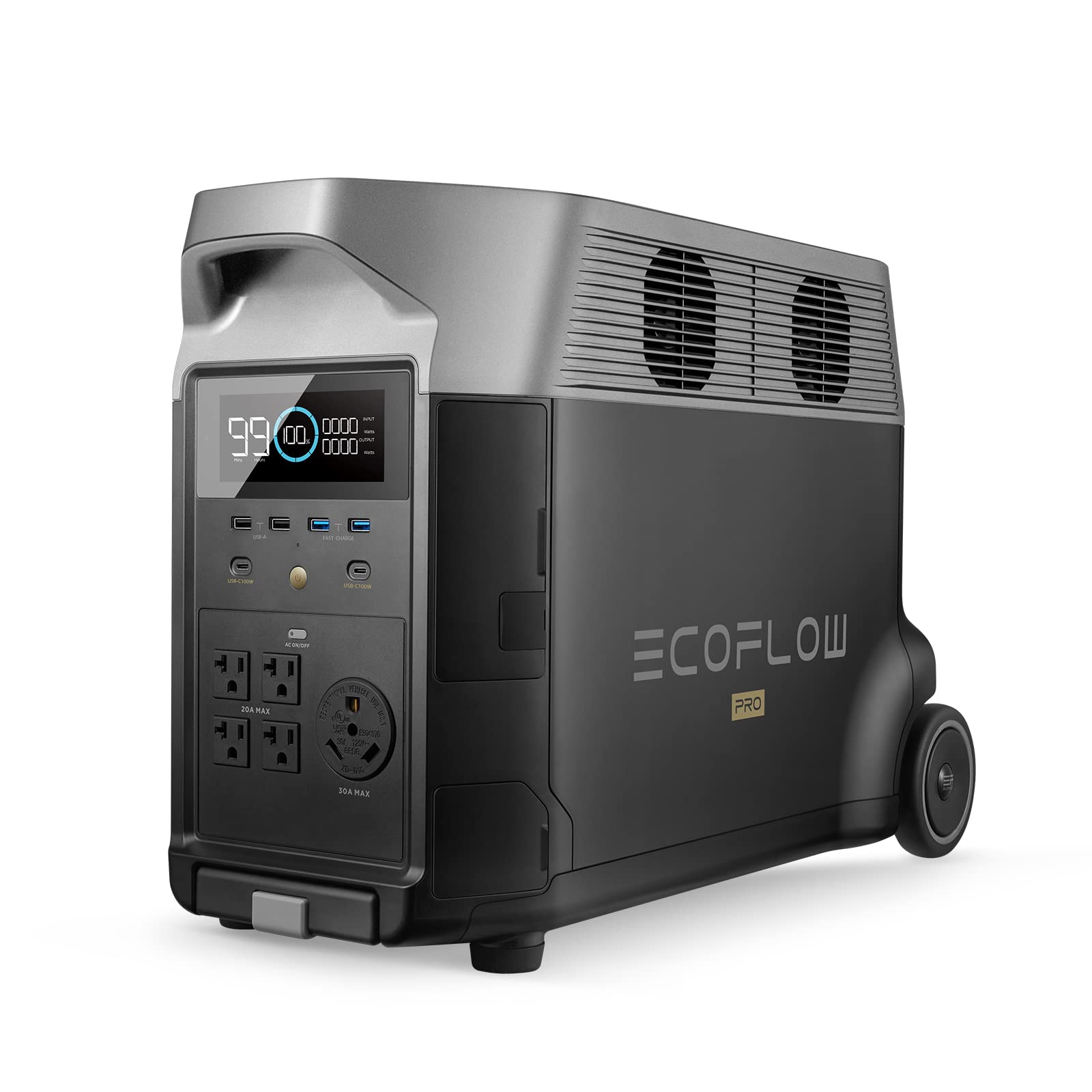
The 3,600Wh behemoth that stands in for a gas generator without ever smelling like one
The EcoFlow DELTA Pro is the flagship pick for serious home backup and mobile work. With a 3,600Wh LFP battery and 3,600W of AC output, it powers heavy-duty devices at home, outdoors, or at work. You can expand it from 3.6kWh up to 25kWh with extra batteries or Smart Generators, and even pair two units together for a combined 7,200W.
Port options are overwhelming: 15 output methods including 2 USB-A, 2 USB-A fast-charge, 2 USB-C (100W), 5 AC outlets, 2 DC outlets, one car power output, and one Anderson port. X-Stream fast charging refills the LiFePO4 battery in 1.8 hours with 2,400V outlets (3,000W), 2.7 hours with 1,800W wall outlets, or 2.8 hours via solar panels, thanks to up to 23% solar conversion efficiency.
Buyers use the DELTA Pro to run heat presses at vendor markets, power fridges and lights overnight with 30% left, and handle everything from outages to off-grid living. Performance is the most-praised aspect, with reliability close behind. The honest downside is weight: at 99 lbs, this is a permanent fixture or a heavy rolling load, and owners note the high capacity is overkill unless you truly need whole-home coverage or heavy tools.
What makes it a monster
- 3,600Wh capacity and 3,600W output run nearly any device
- Expandable to 25kWh and pairable to 7,200W
- 15 output methods charge a whole site at once
What to prepare for
- 99 lbs means it doesn’t move once set up
- Overkill for anyone not running heavy tools or whole-home loads
Choose this if: you run a mobile business, need whole-home backup, or pair it with solar for off-grid living.
pass on it if: your needs are a fridge and lights—a 1kWh station will serve you far more comfortably.
Understanding the Specs
Watt-Hours (Wh)
Watt-hours measure the total energy a battery holds, much like the size of a fuel tank. To estimate how long a device will run, divide the watt-hours by the device’s wattage. A 1,070`Wh` station (like the Jackery Explorer 1000 v2) running a 100W fridge will last roughly 10 hours. This is the single most important number to match to your actual power needs.
AC Output & Surge Peak
AC output (measured in watts) is the continuous power the inverter can deliver, while the surge peak handles the brief burst needed to start motors like a fridge compressor. For most homes, a station with at least 1,500W continuous output covers a fridge, lights, a router, and phone charging. Higher-output models like the BLUETTI Elite 200 V2 (2,600W) can run a microwave or air fryer simultaneously.
LiFePO4 Battery Chemistry
Lithium Iron Phosphate (LiFePO4) is the premium battery chemistry for power stations. It lasts dramatically longer than standard lithium-ion, with most premium models rated for 3,000 to 6,000+ charge cycles. The BLUETTI Elite 200 V2, for example, claims a 17-year lifespan, while the Anker SOLIX C1000 offers a decade of use. This chemistry also handles heat better and is safer than alternatives.
Recharge Speed & Solar Input
How fast a station refills dictates how useful it is during a multi-day outage. Premium models like the DJI Power 1000 V2 hit 80% in just 37 minutes, while the Anker SOLIX C1000 takes 43 minutes. Solar input (measured in watts) matters for off-grid use—the BLUETTI AC70 accepts up to 500W, which fully charges its 768Wh battery in 1.9–2.4 hours in full sun.
FAQ
What size battery generator do I need for a refrigerator?
Can a battery generator power a CPAP machine all night?
How long does a battery generator last before the battery wears out?
What is the difference between continuous watts and surge watts?
Can I add more batteries to a battery generator later?
How fast can a battery generator recharge from a wall outlet?
Is a battery generator safe to use indoors?
Can I use a battery generator to power a microwave or hair dryer?
Final Thoughts: The Verdict
Across the board, the best battery generator is the Jackery Explorer 1000 v2 because it balances 1,070Wh of capacity, a 1,500W output, and an easy-to-carry 23.8-lb frame at a mid-range price. If your priority is budget-friendly essentials, the GRECELL 500W delivers solid value at 519.48Wh. And for serious whole-home backup or running heavy tools, the EcoFlow DELTA Pro is the powerhouse to reach for at 3,600Wh.
How We Picked
We do not accept paid placement. Every pick is matched to a real buyer and a real use-case; we do not hands-on test units.
Sources & Methodology
Specifications: manufacturer listings and product documentation. Review insights: verified customer reviews, as of August 2026. Pricing: not shown on this page (it changes often); check the current price via the retailer link.
As an Amazon Associate, Gadgets Feed earns from qualifying purchases. This does not affect which products we feature.