
Our readers keep the lights on and my morning glass full of iced black tea. As an Amazon Associate, I earn from qualifying purchases.
Specs are compiled from manufacturer listings and verified buyer reviews and can change over time — please confirm the key details on the product page before buying.
You already own a battery platform, and you want a jigsaw that actually runs on it — one that cuts curves cleanly without dragging an extension cord across the garage floor. The trick is matching the saw to the batteries you already have, then checking the stroke, the orbital settings, and whether a battery is even in the box. That is exactly what this guide sorts out for you.
I’m Min — the founder and writer behind Gadgets Feed. This guide is built by comparing the manufacturers’ published specifications and the patterns across verified customer reviews, so you get each pick’s real strengths and trade-offs instead of marketing spin.
Battery voltage matters, but the thing that changes how a saw feels in your hand is whether you already own that brand’s batteries, because a bare tool with no pack is useless until you charge one. That single compatibility question is what makes picking the right battery jigsaw so much easier than it first looks.
Our Picks at a Glance


How To Choose The Best Battery Jigsaw
Start with the batteries you already own. A cordless jigsaw is only as useful as the pack that feeds it, and a bare tool with no matching battery means you cannot make a single cut until one arrives. Everything else — the stroke, the speed, the grip — matters, but compatibility comes first because it decides whether you can walk out and use the saw today.
Match the saw to your battery platform first
Every cordless jigsaw here runs on a specific battery family, so the first job is picking the one that matches the packs you already have. If you are on a common 18V or 20V system, a bare tool is the smart buy because you skip paying for a battery and charger you do not need. If you are starting fresh, a kit that includes a battery and charger gets you cutting the same day.
Stroke length and orbital settings decide cutting speed
Stroke length is how far the blade travels up and down on each pass, measured per minute as strokes per minute (SPM). A longer, faster stroke clears material quicker — the difference between a saw rated to 2,800 strokes per minute and one at 3,500 shows up when you are cutting a long straight line in thicker stock. Orbital settings, meanwhile, let the blade push forward as it rises for rough, fast cuts, while a lower setting keeps the blade straight for clean curves and metal.
Top-handle versus barrel grip
Top-handle saws put a trigger under your palm, which most people find familiar and easy to control on straight cuts. A barrel-grip saw moves the grip lower and closer to the work, which trades a trigger for push-button control — that position gives you tighter control in curves because your hand sits nearer the blade.
Weight and battery size you will actually notice
Battery-powered saws shed the cord, but the pack adds heft to your hand, and that weight multiplies over a long project cutting overhead or in tight spots. A saw that runs near 4.3 pounds feels light and quick; one closer to 5.3 pounds feels more planted. The bigger the amp-hour (Ah) pack you clamp on, the longer you cut between swaps — at the cost of a heavier tool in your hand.
Quick Comparison
| Model | Best For | Power System | Strokes Per Minute | Battery in Box | Amazon |
|---|---|---|---|---|---|
| Ryobi R18JS-0 ONE+★ Best Overall | Ryobi owners who want one more tool | 18V ONE+ | 3,000 rpm | No | Amazon |
| WORX WX543LBest for Beginners | Light DIY odd jobs around the house | 20V PowerShare | — | Yes, 1.5Ah | Amazon |
| SKIL JS820302 PWR COREBest Budget Kit | Cutting curves and straight lines on a budget | 20V PWR CORE | 2,800 | Yes, 2.0Ah | Amazon |
| Ryobi PBLJS01 HP Brushless | Rough cuts with more speed and runtime | 18V ONE+ | — | No | Amazon |
| Bosch GST18V-50N | Corded-level power in a compact body | 18V Bosch | 0–3,500 | No | Amazon |
| CRAFTSMAN V20 RP | Clean square cuts in plywood and cabinetry | 20V V20 | 3,200 | No | Amazon |
| Makita XVJ04Z LXT | Straight, clean cuts with quick blade swaps | 18V LXT | 0–3,000 | No | Amazon |
| Milwaukee M18 FUEL 2737-20 | Heavy cutting across wood and metal | M18 | — | No | Amazon |
| Makita XVJ01Z Barrel Grip | Precise curves and finish work | 18V LXT | 800–3,500 | No | Amazon |
In‑Depth Reviews
1. Ryobi R18JS-0 Jigsaw Battery 18V ONE+ 3000 rpm 25mm (Body Only)
Our pick — over 4.5★ from 800+ verified ratings; the strongest balance of quality and price.
A stable, easy-to-read cutter for anyone already running Ryobi 18V batteries.
You already own Ryobi 18V batteries, so this jigsaw slides straight onto them and saves you money. Ryobi rates it at 3,000 rpm (revolutions per minute, how fast the blade moves), which is enough for smooth cuts in wood. At 9.84″L x 8.74″W x 3.39″H, it is a genuinely compact body — noticeably more compact than the WORX WX543L at 4.2″L x 8.8″W x 12.6″H, so it stows easier on a shelf between jobs. It is a bare tool (no battery or charger included), so the pack that brings it to life is one you already have.
The feature that changes how the tool feels is the variable speed control that sits separate from the trigger. Instead of feathering the trigger to hold a slow, controlled cut, you dial in your ceiling and focus entirely on steering the line. There is also a trigger lock, so on long straight runs you press the side button and let the saw do the pushing without a cramping finger.
Buyers report the build quality is what wins them over — it gets talked up far more than anything else in the review pages, with performance and value right behind. As one owner puts it: “Great saw light weight great control cutting thick or thin material.” The blade-saving base is the quietly clever bit: when the teeth at the top wear dull, you drop the base to expose fresh blade and stretch more life out of every accessory. A few note the power feels mixed depending on what you cut — it is happiest slicing through thinner stock and curves rather than hogging through thick hardwood.
Where it pulls ahead
- Speed control dials separately from the trigger, so holding a slow cut is easy
- Trigger lock button lets you cut long lines without squeezing the whole time
- Runs on batteries you likely already own if you are in the Ryobi 18V camp
- Dust blower keeps the line clear, and the LED lights the cut in dim corners
Where it asks for patience
- Bare tool only — no battery or charger, so you need a pack on hand to use it
- Power feels modest on thick, dense hardwood compared with the brushless picks
Built for: the Ryobi 18V owner who wants one more compatible tool without buying another battery system.
Think twice if: you cut thick hardwood all day and want the extra speed a brushless motor brings.
2. WORX Cordless Jigsaw, 20V, WX543L
The out-of-the-box starter that hands you a charged saw with no separate battery shopping.
Not everyone owns a battery platform yet, and that is precisely the buyer this 20V WORX is built for. It arrives as a complete kit — 1 blade, a 1.5Ah 20V battery, and a charger — so there is no hunting for a pack before you can make a cut. The PowerShare system means that pack also feeds the brand’s other tools, and it swaps out cleanly if you add them later.
Light DIY is the whole point here. At 5.3 pounds it is the heaviest saw on this list, sitting above the lighter SKIL at 4.9 pounds, but that weight stays manageable in short bursts of fence repair or trim work. The dual-handle design with a variable-speed trigger and orbital function covers curved and straight cuts on common household materials without fuss.
Battery life is one of the things that earns steady praise here — the interchangeable-pack setup means you can keep a spare charged and rotate without downtime if you buy into the family. The recurring honest note is vibration: on hard materials, the saw shakes enough that you need a firm hand and a slow start to keep the blade on your line. That is a fair trade for a saw this portable and forgiving to a first-timer.
Plain-language read: if you have never owned a cordless jigsaw and want to cut a few boards without committing to a whole battery system, the included battery and charger remove the biggest hurdle. You are trading motor smoothness on hard stock for a complete, portable kit that works the day it lands.
Reach for this if: you are a first-time buyer who wants a working saw in the box, battery and charger already included.
Look elsewhere if: you cut dense materials regularly, where the vibration makes control harder than a brushless saw.
3. SKIL PWR CORE 20V 7/8 Inch Stroke Length Jigsaw (JS820302)
A full kit that cuts curves and straight lines without the cord — and includes the battery to do it.
Here is a saw that ships ready to work: a 2.0Ah PWR CORE 20 lithium battery and a 20V charger are both in the box. That 2.0Ah pack is bigger than the 1.5Ah battery in the WORX WX543L, so you get more cutting between charges out of the gate.
The numbers that matter for clean work are all here. It delivers up to 2,800 strokes per minute with a 4-stage orbital function, so you can set the aggression to match the material. The variable switch carries a brake that stops the blade cleanly for a precise finish, and both the blade clamp and the bevel adjustment are tool-free — you swap blades and set angles by hand, no wrench hunting.
A long run time is the headline — the battery’s temperature management system is designed to keep it cool so it keeps powering through a project instead of fading. It cuts up to 2,800 strokes per minute and handles both wood and metal with the included blades. The honest catch is vibration: it shakes enough that a long session can leave your arm sore, which is the trade-off for its light 4.9-pound body. Think of it as a smooth small-jobs saw rather than a lumber-mill machine.
Why it earns the price
- Battery and charger included, so it works the day it arrives
- Tool-free blade changes and bevel adjustments keep setup fast
- Brake on the switch stops the blade cleanly for a tidy cut finish
- Light at 4.9 pounds, easy to steer through curves one-handed
The honest trade-off
- Vibration can tire your arm on longer cutting sessions
- Battery life splits opinion — some get a full project, some want more runtime
Suits you best if: you want a complete cordless kit with a bigger 2.0Ah battery that tackles curves and straight cuts alike.
Skip the upgrade if: you need smooth, low-vibration cutting on long jobs where a brushless motor’s steadiness matters more.
4. RYOBI ONE+ HP 18V Brushless Cordless Jig Saw (Tool Only) PBLJS01

The step-up for Ryobi owners who want more speed and staying power in the same battery family.
You are already on the Ryobi 18V platform and cut enough that the basic model feels slow, so this is the upgrade path that stays compatible with your existing packs. The brushless motor (a motor without carbon brushes, so it runs cooler and lasts longer) is the whole story — Ryobi claims it cuts up to 36 percent faster and runs up to 78 percent longer than a brushed equivalent, so it keeps pace through 3/4″ plywood without bogging down. It runs on 18V and is noticeably light at 4.3 pounds, the lightest of the bare-tool Ryobi pair here.
The brushless design is not just a marketing badge — it is what makes this cut like a tool well above its class. As owners describe it, the HP series “really outperforms pricier rivals,” and on 3/4″ plywood the saw moves fast and never bogs down. The easy-release blade lever and tool-free bevel adjustment with a locking detent at 45 degrees left and right keep setup quick, and the on-board LED lights the cut line when the garage light will not reach.
The catch is the same as the other Ryobi here: it is a bare tool, so you need a charged 18V ONE+ pack to use it. It also runs on 18V against the WORX’s 20V, and a few owners wish it held smoother power during sustained cuts. For anyone already in the system, though, the brushless motor’s speed is worth the step up.
Why it climbs the Ryobi line: same batteries, more speed, and a lighter body than the brushed model — a straightforward upgrade if curves and occasional thick stock fill your projects.
One clear limit: no battery or charger included, so it only makes sense if you already own 18V ONE+ packs.
Perfect for: the Ryobi 18V owner chasing faster, longer cuts without leaving the battery family.
Pass it over if: you are starting from zero and need a battery in the box rather than a bare tool.
5. BOSCH GST18V-50N 18V Brushless Top-Handle Jig Saw (Bare Tool)

A compact top-handle saw that packs corded-level cutting depth into an 18V body.
Bosch built this one to deliver the kind of power buyers associate with a corded tool, and the headline figure backs it up: up to 3,500 no-load strokes per minute (blade movements per minute when not cutting), the fastest spinning saw here alongside the Makita XVJ01Z’s 3,500 top end. It also cuts up to 4.9 inches in wood, so it clears thicker stock than a compact frame suggests. At 8.46″L x 3.1″W x 8.5″H it stays small enough to stash in a drawer and land in tight spots.
Speed control is the feature buyers lean on most. There is a dial for setting the operating speed from a dead stop up to 3,500 no-load strokes per minute, plus a variable-speed trigger you can feather for fine control. The large die-cast aluminum footplate, with a no-mar plastic overshoe, adds stability on delicate surfaces, and the tool-free blade-change system means no wrench to lose.
The blade release earns its reputation as the easiest of the bunch, and owners love how eagerly the blade swaps for slow precision cuts. The big caveat is that it is a bare tool — you supply the 18V battery, so there is no cutting until a pack is charged. A handful also mention the adjustability went untested on simple hole cuts, which just means it rewards you most when you push it into heavier work.
Where the speed shows: at 3,500 no-load strokes per minute and a 4.9-inch wood capacity, this is a compact saw that cuts like a bigger one on thicker material.
What to plan around: no battery or charger in the box, so it only pays off if you already run Bosch 18V packs.
Grab it if: you want corded-class speed and depth in a small body and already own Bosch 18V batteries.
Move on if: you need a saw that arrives ready to cut with its own power source.
6. CRAFTSMAN V20 RP Cordless Jig Saw (CMCS650B)

A quieter brushless cutter that keeps its line square on plywood and cabinetry work.
If your projects are cabinets, camper interiors, and clean plywood cuts rather than demolition, this V20 saw is aimed squarely at you. It cuts up to 3,200 no-load strokes per minute with a variable-speed trigger, and the brushless motor is what lets it hold a steady, consistent pace instead of surging. At 2.02 kg it sits on the lighter end of the group, which helps when you are guiding tight curves by hand.
The cutting quality is the standout. Owners mention it makes square cuts with minimal drift, and the brushless motor stops instantly when you release the trigger — a real safety and control benefit when the blade is buried in a cabinet panel. It accepts both T and U shank blades, so you are not locked into one blade type, and 3 orbital settings let you dial in aggression for the material in front of you.
The practical details round it out: an on-board LED brightens dark workspaces, a dust blower keeps the cut line visible, and the beveling shoe lets you cut at angles up to 45 degrees. The one thing to know is that the exact runtime on a charge is not published, so plan your battery around the job rather than the other way round. It is also tool-only, so you bring your own V20 pack.
Why woodworkers like it
- Square, low-drift cuts on plywood thanks to a steady brushless motor
- Motor halts instantly on trigger release for safer, tidier stops
- Accepts both T and U shank blades for more blade options
- Runs noticeably quieter than earlier jigsaws
What to weigh up
- Bare tool only — no V20 battery or charger included
- Exact runtime per charge is not specified, so runtime planning is guesswork
Made for: the cabinet and camper builder who values a square, quiet cut over raw speed.
Look past it if: you want a complete kit with its own battery, since this one is bare tool only.
7. Makita XVJ04Z 18V LXT Lithium-Ion Brushless Cordless Jig Saw, Tool Only

A tool-less blade changer that starts slow and lands accurate, with pro-grade build throughout.
This 18V LXT saw is for the buyer who wants accuracy out of the gate. The brushless variable-speed motor delivers 0–3,000 strokes per minute, and the soft no-load mode deliberately ramps the speed up as the blade bites, which prevents the saw hopping off your line on the first contact. That starting control is the kind of detail that separates a clean cut from a ragged one.
Cutting quality is where this saw earns its keep — owners describe clean, perpendicular cuts and steady precision, with three orbital settings plus a straight-cutting mode covering a wide spread of materials. The two-finger trigger runs the length of the handle with a lock-on button, so long runs do not leave your hand cramped. As owners put it, “Way better than Ryobi. Makes concise cuts with very low vibration.”
The pros weigh it and love it: an effective LED, a blower that keeps the debris off the line, and a heft that still feels comfortable and maneuverable. That weight is exactly the trade-off — some will feel the extra mass after a long session compared with a lighter saw like the 4.3-pound Ryobi PBLJS01. There is also a lock button to press before each cut, which you get used to quickly. Give it a larger battery for heavy cutting and it rewards you with professional-grade stamina.
Its defining strength: the soft no-load start (the blade eases in instead of jerking) and low-vibration cutting make it among the most accurate saws here for anyone cutting precise lines.
The honest drawback: it has more heft than the lightest pick and a per-cut lock button that takes a little getting used to — plus no battery in the box.
Ideal if: you want clean, perpendicular cuts and a quick, no-wrench blade change, and you already own Makita 18V LXT batteries.
Better to avoid if: you want the lightest possible saw in hand or a kit that arrives with a charged battery.
8. Milwaukee M18 FUEL D-Handle 10T Metal Blade Jigsaw
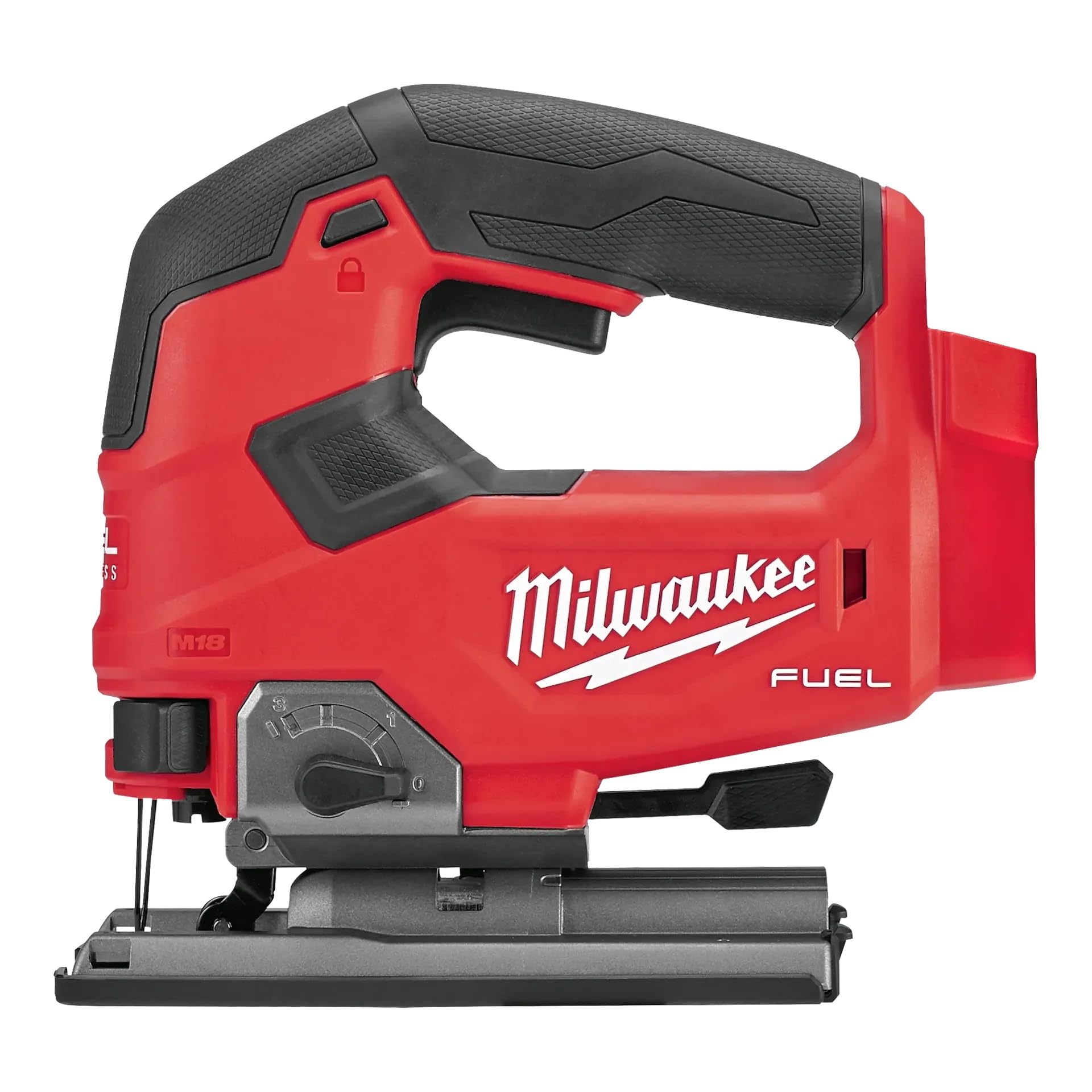
The D-handle workhorse for long, tiring cuts where grip and stamina matter most.
When the job is bigger than a weekend repair, the M18 FUEL is built for it. The brushless motor is engineered to extend runtime and hold consistent power for demanding tasks, and the D-handle grip is shaped to spread the effort across your whole hand so your arm tires more slowly on extended use. It runs on the M18 system — interchangeable with every other Milwaukee M18 battery you own.
The grip is where this saw separates from the pack. Where a top-handle jigsaw puts your palm behind the blade, the D-handle wraps your fingers around a loop for more leverage and steadier control on intricate cuts and long runs alike. That build quality is the thread through the reviews — it is the quality owners keep coming back to, and the sense that this tool is made to be used hard without giving up.
There is one honest performance note worth planning for: on heavy cutting, the wise move is to fit your largest M18 battery, because a small pack will have you swapping mid-cut for more power. It is also a bare tool, so you bring your own battery and charger. For clean, accurate cuts across wood, metal, and other materials, the durable build is the reason to choose it — and it is light and compact enough that the extra grip control does not come at the cost of maneuverability.
Why it holds up on big jobs
- D-handle grip spreads effort so your hand tires slower on long cuts
- Brushless motor keeps power consistent and extends runtime
- Cuts clean and accurate across wood, metal, and other materials
- Fully compatible with the rest of the M18 battery lineup
Plan around these
- Bare tool only — no M18 battery or charger in the box
- Heavy cutting drains a small battery fast, so a large pack is the right pairing
Choose this for: demanding, extended cutting where a firm D-handle grip and steady brushless power earn their keep.
Not the one for you if: you want a compact kit from the start, since this is a bare tool on the M18 system.
9. Makita XVJ01Z 18V LXT Brushless Barrel Grip Jig Saw

The go-to for curves and finish work, where a barrel grip puts your hand closest to the blade.
For the buyer cutting clean curves in soft wood or finishing a detail piece, the barrel grip is the reason to choose this saw. By moving your hand lower and closer to the work, it lets you steer tighter curves with less wandering than a top-handle design. The variable 6-speed control dial runs from 800 to 3,500 SPM, so you can match the pace to the material instead of muscling it.
Speed range is where this saw out-flexes the rest on this list. The 800–3,500 SPM spread gives you a slow, controlled crawl for delicate curves and a fast clip for straight runs, paired with the brushless motor and 3 orbital settings plus straight cutting. Dual LEDs illuminate the work area, and the tool-less blade change swaps blades in seconds so you are not hunting for a wrench mid-project.
The push-button on/off takes a little adjusting to if you are used to a trigger, but owners get comfortable fast and find the control worth it. Cutting smoothness is the payoff — steady, low-vibration cuts make accurate work easy, and the saw has very little vibration to fight against. That comfort and precision are why it becomes a favorite even for people who once dreaded jigsaws. The honest trade-off is more weight and the barrel-grip learning curve; if you want a familiar trigger, the top-handle Makita XVJ04Z is the swap.
The finish-work edge
- Barrel grip sits your hand close to the work for tighter curve control
- Widest speed range here at 800–3,500 SPM for slow-precision to fast cutting
- Dual LEDs and a tool-less blade change keep you cutting, not adjusting
- Smooth, near-vibration-free cutting that makes accurate lines easy
Weigh before you buy
- Push-button on/off instead of a trigger takes getting used to
- Heavier and pricier than the to-handle saws if all you need is straight cuts
Reach for it when: clean curves and precise finish cuts are the whole job, and the barrel grip suits how you like to hold a saw.
Leave it for the others if: you prefer a traditional trigger and do mostly straight, quick cuts.
Understanding the Specs
Strokes per minute (SPM)
SPM is how many times the blade travels up and down each minute — the saw’s cutting speed in plain terms. Higher numbers clear material faster on straight, rough cuts; the 3,500 SPM saws here spin noticeably quicker than the 2,800 SPM pick, which you feel on long rip cuts. Pair a high speed with a low orbital setting for curves, and let a lower speed take over when you need control on tight turns or harder material.
Orbital action
Orbital settings change how the blade moves as it cuts, letting it push forward slightly on the upstroke to claw through material faster. A high setting eats through rough, straight cuts in wood; a low setting keeps the blade traveling straight for clean curves and metal. The saws here offer up to 4 orbital settings, so you can match the aggression to the job rather than forcing one setting to do everything.
Battery voltage and amp hours
Voltage is the power platform your saw runs on — 18V or 20V here — and it decides which batteries fit. Amp hours (Ah) measure how much charge a battery stores, so a bigger Ah pack cuts longer between swaps but adds weight to your hand. Choosing a saw that matches a battery family you already own saves you from buying a whole second set of packs just to run one tool.
Bare tool versus kit
A bare tool is the saw on its own, with no battery or charger — a smart buy when you already own the matching packs. A kit bundles the battery and charger, so you can cut the day it arrives even with no existing platform. Check which one you are buying, because a bare tool cannot make a single cut until you have a charged battery in hand.
Grip style
Top-handle saws put the trigger under your palm, which most people find familiar on straight cuts. A barrel-grip saw moves your grip lower and closer to the blade, trading the trigger for push-button control — that position gives finer control in curves but takes a little adjusting to. Pick the style that matches the cuts you actually make most.
Bevel and blade change
Bevel adjustment sets the shoe to an angle so the saw cuts slopes, and the saws here adjust to 45 degrees for angled work. Tool-free blade and bevel systems let you swap and adjust by hand with no wrench to lose, which speeds up every changeover. Both features matter most when one project makes you switch blades and angles several times.
FAQ
What does battery jigsaw mean compared to a corded jigsaw?
Will the saw work with batteries I already own?
How long does a battery jigsaw run on one charge?
What stroke length and speed should a battery jigsaw have?
Can a cordless jigsaw cut through thick wood and metal?
What is the difference between a top-handle and a barrel-grip jigsaw?
Do I need a brushless motor in a battery jigsaw?
Which jigsaw blade type fits a cordless jigsaw?
Can I use a battery jigsaw for cutting curves and tight shapes?
Is a bare tool battery jigsaw cheaper than a kit?
How do I keep a battery jigsaw cutting straight and square?
Final Thoughts: The Verdict
The strongest all-round pick for most people is the Ryobi R18JS-0, because its separate speed-control dial, trigger lock, and blade-saving base make it easy to steer clean cuts through thick or thin material — and if you already run Ryobi 18V batteries, it costs you nothing extra for power. If corded-class speed in a compact body is what you are after, grab the Bosch GST18V-50N with its 3,500 no-load strokes per minute and 4.9-inch wood capacity. And for precision curves and finish work, the Makita XVJ01Z barrel grip is the one to reach for.
the Ryobi R18JS-0 and the HP both sit at 4.7 stars, so the brushed model is the smarter buy for everyday cutting. Match your saw to the batteries on your shelf first, then let the speed and grip style decide the rest.
How We Picked
We do not accept paid placement. Every pick is matched to a real buyer and a real use-case; we do not hands-on test units.
Sources & Methodology
Specifications: manufacturer listings and product documentation. Review insights: verified customer reviews, as of September 2026. Pricing: not shown on this page (it changes often); check the current price via the retailer link.
As an Amazon Associate, Gadgets Feed earns from qualifying purchases. This does not affect which products we feature.