
Our readers keep the lights on and my morning glass full of iced black tea. As an Amazon Associate, I earn from qualifying purchases.
Specs are compiled from manufacturer listings and verified buyer reviews and can change over time — please confirm the key details on the product page before buying.
A dead battery and a flat tire are the two ways a normal day turns into a two-hour wait on the shoulder. A single box that does both jobs — jump-starts your engine and airs up your tire — means you handle it yourself in minutes instead of waiting on a tow. This guide covers nine of them, ranked by how strong the jump is, how fast the pump fills, and how much battery you actually get.
I’m Min — the founder and writer behind Gadgets Feed. This guide is built by comparing the manufacturers’ published specifications and the patterns across verified customer reviews, so you get each pick’s real strengths and trade-offs instead of marketing spin.
Peak amps decide whether a half-dead engine turns over, and the compressor’s airflow rate decides how long you stand there watching a gauge. The right battery jumper and tire inflator balances peak amps and airflow against how often you actually need it.
Our Picks at a Glance


How To Choose The Best Battery Jumper And Tire Inflator
Two jobs, one box — and the specs that matter for each job are completely different.
Peak amps and engine size
Peak amps are the short surge of current the unit pushes into a dead battery to crank the engine. A small sedan engine needs far less than a big diesel truck. Buyers shopping a jump box should look for the unit’s stated engine range — “all gas engines” or a specific diesel limit — rather than assuming every box starts every vehicle. If you drive a truck or a boat, the diesel number on the listing is the one to read closely.
PSI and airflow rate
PSI (pounds per square inch) is the maximum pressure the built-in pump can push. Most car tires sit around 30 to 36 PSI, so a pump rated well above that fills a car tire comfortably. But pressure is only half the story — airflow rate, usually written in liters per minute, decides how fast the tire actually fills. A pump with a high airflow rate and a preset auto shut-off is the difference between a one-minute top-up and standing in the rain for six.
Standby time and battery chemistry
Lithium-polymer and lithium-ion packs hold their charge longer between uses than older sealed lead-acid units, which is why many modern jump boxes claim standby times measured in months. The trade-off is that lead-acid units are heavier and usually larger. If the unit lives in your trunk and only comes out twice a year, the standby spec is the one that decides whether it works when you finally reach for it.
Quick Comparison
| Model | Best For | Peak Amps | Max PSI | Battery Capacity | Amazon |
|---|---|---|---|---|---|
| HALO BOLT AIR+ 1750A★ Best Overall | Everyday cars and SUVs | 1750 A | 130 PSI | 16200 mAh | Amazon |
| ACMOUNT D18Best Value | Cold-weather backup starts | 6000 A | 150 PSI | 12000 mAh | Amazon |
| AUTOONE JWA1Second-Car Pick | Spare for a second vehicle | 6000 A | 150 PSI | 12800 mAh | Amazon |
| ANFLAG BD70 | Multiple vehicles on one charge | 7000 A | 160 PSI | 26.8 Ah | Amazon |
| Joltekon VP40 | Trunk kit with an air blower | 6000 A | 160 PSI | 10000 mAh | Amazon |
| YaberAuto AP03 | A whole roadside tool kit | 8000 A | 160 PSI | 27000 mAh | Amazon |
| DEWALT DXAEJ14 | One car, mostly home use | 1600 A | 120 PSI | Sealed Lead Acid | Amazon |
| DEWALT DXAEPS14 | Home power backup plus a jump | 2000 A | 120 PSI | Sealed Lead Acid | Amazon |
| NOCO Boost Air AX65 | Trucks and fast tire fills | 2000 A | 100 PSI | Lithium | Amazon |
In‑Depth Reviews
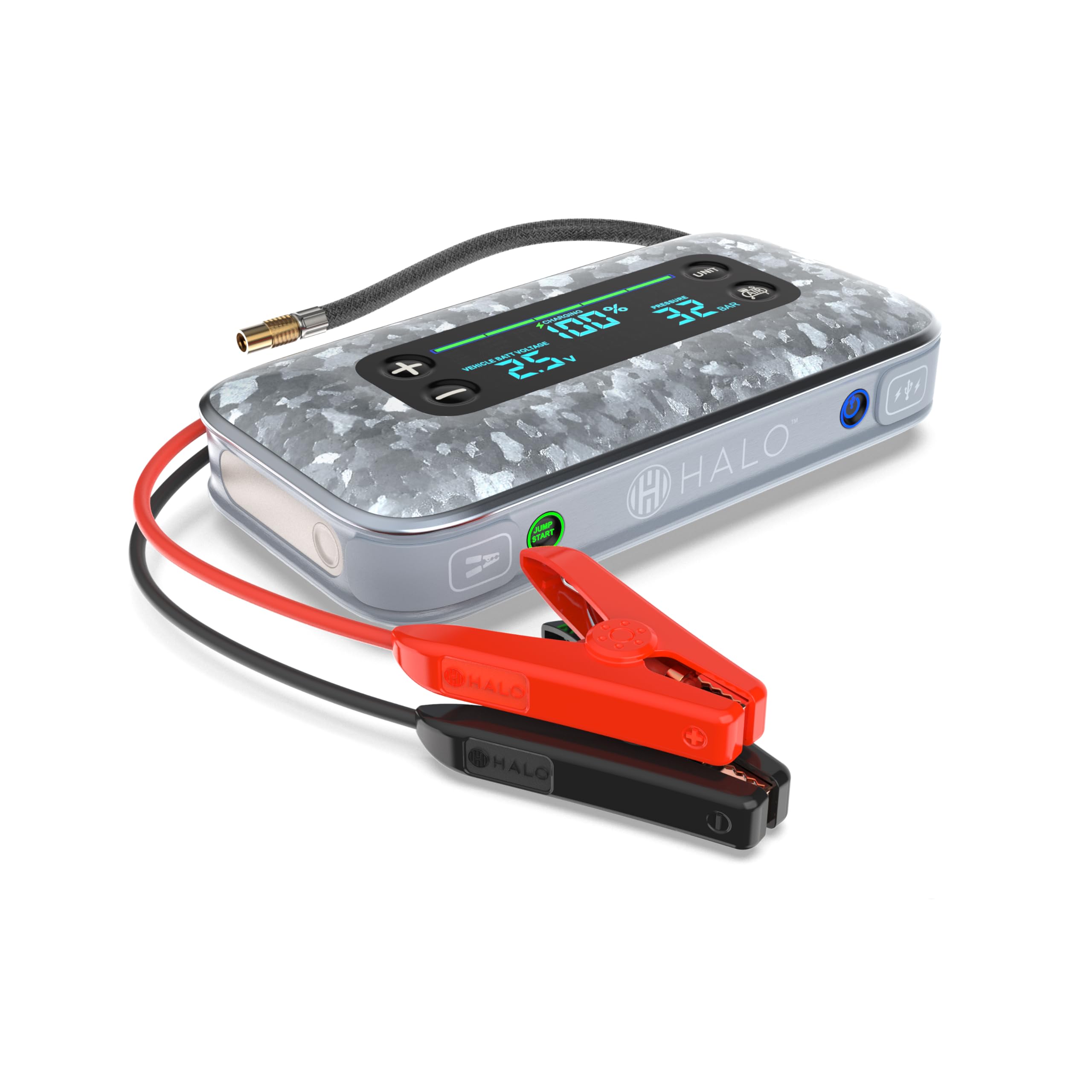
1. HALO BOLT AIR+ 1750A Jump Starter, AIR Compressor, Power Bank, Silver
Our pick — over 4.5★ from 650+ verified ratings; the strongest balance of quality and price.
The 16200 mAh pack that stays charged all winter and still starts the truck in the spring.
The HALO Bolt Air+ does not overpower anything — it outlasts it. Its 16200 mAh lithium-polymer battery (mAh, or milliamp-hours, is a measure of how much energy the pack stores) is the largest in this lineup bar one, and it is the reason owners describe pulling it out of a storage bag after weeks of sitting and finding the charge still there.
On the jump side, it pushes 600 amps of cranking current with 1750 peak amps, good for 12-volt cars, SUVs, trucks and marine batteries, and it handles engines up to 6L gas and 3L diesel. The clamps are spark-proof, and the three-step jump guide is printed directly onto the microfiber storage bag — a small thing, but it means the instructions are with you in a dark parking lot instead of in a drawer at home. The 130 PSI compressor is the lowest top-end pressure of the nine picks here, though three of these units sit within 30 PSI of each other, so for a standard car tire you will not notice the gap.
What wins people over is the sheer number of jobs it takes on. The 5-star reviews cluster around a single idea: this thing becomes the household’s shared emergency tool. As owners put it, “Last year my power went out and needed an electric outlet to plug something up and it did the job along with keeping cell phones charged.” The integrated voltmeter and floodlight ride on a color display that is 3.5x the size of earlier Bolt models, so the voltage readout is legible without squinting.
Where It Earns Its Place
- 16200 mAh lithium-polymer pack holds charge for months between uses, so it is ready when you reach for it.
- 600 amps cranking power and 1750 peak amps cover 12-volt cars, SUVs, trucks and marine batteries.
- Doubles as a power bank with a bi-directional USB-C port plus a USB-A port for phones and tablets.
- Ships with every adapter you need: a 14V wall charger, a 24-inch extension hose, two inflation needles, and long and short tapered valves.
What To Know Before You Buy
- The 130 PSI compressor is the lowest ceiling in this lineup, fine for car tires but not the fastest for a big off-road tire.
- Jumper cables are built in rather than separate, so you cannot swap in a longer set if your battery terminals sit far apart.
- The included microfiber bag protects it, but the unit itself is not a hard-shell case.
Reach for this if: you want one box that covers a daily driver, a second car, and the occasional power outage, with enough stored energy that you stop thinking about charging it.
Look elsewhere if: you drive a diesel or a lifted truck on oversized tires — the 130 PSI pump and 3L diesel ceiling put you in ANFLAG or NOCO territory instead.
2. ACMOUNT D18 6000A Jump Starter with Air Compressor 150PSI, 12V Jump Box
6000 amps of cranking power that starts a frozen V8, priced like a mid-tier tool — the value play here.
Six thousand peak amps is not a number you need for a Honda Civic. It is the number you want when the temperature drops below zero and the engine has been sitting for a week. The D18 delivers that surge for a completely dead 12V battery, and it will crank all gasoline engines and diesels up to 10L. That 6000A figure sits at a 3.4x gap over the HALO’s 1750A, and it is the whole reason this box exists as a separate pick from the HALO above.
The compressor side is where you feel the difference day to day. The claim is a flat tire from 0 to 36 PSI in under three minutes, and a top-up from 25 to 36 PSI in about a minute, with preset inflation modes and auto shut-off so you do not have to crouch beside the valve watching a dial. There are five inflation modes and three pressure units (PSI, BAR, KPA) on the LCD display. It also charges phones and tablets through dual USB ports, and the LED light cycles through flashlight, SOS, and strobe modes.
What owners talk about most is the price-to-power ratio. Buyers report jumping a car in subzero weather after it had sat, with the unit arriving roughly 80% charged and ready to work from the start. The recurring gripe is not the jump side — it is charging speed. One owner noted USB-C recharging was slower than expected, and a few others describe units that arrived and would not take a charge at all. The instructions are also written for someone who already knows what a jump terminal looks like, so a first-timer may need a video. The jump itself is straightforward, and the value is hard to argue with at this tier.
The case for it: if you drive a diesel or live somewhere cold, 6000 amps and a 150 PSI pump at this price tier is the sharpest spec-to-cost ratio in the lineup.
The honest catch: the battery is a 12000 mAh lithium-ion pack, smaller than the HALO’s, and it recharges slowly through USB-C — plug it in the night before a trip, not the morning of.
3. AUTOONE 6000A Jump Starter with Air Compressor (All Gas/10L Diesel), 150PSI Car Jumper Starter Portable
Standby power you can forget about for two years, then rely on when the battery finally dies.
The spec that sells this one is not on the box in big letters — it is the 24-month standby time. That means a fully charged unit can sit in a trunk for two years and still hold enough to crank an engine, thanks to an automatic shutoff that kicks in after 10 seconds of inactivity to stop the pack draining itself. For the second car that only gets driven on weekends, that is the number that matters more than peak amps. It carries the same 6000A peak current as the ACMOUNT above, with 12800 mAh behind it.
Under the hood it runs the same playbook as most of this class: a 150 PSI compressor with a real-time LCD that lets you set a target pressure and walk away while auto shut-off handles the rest. The listing claims a 5 PSI bump from 29 to 34 PSI in about a minute, and a car tire to 20 PSI in about two. It comes with four nozzles for cars, motorcycles, bicycles, and sports equipment. There is also a 400-lumen LED flashlight — lumens being the brightness measure — a power bank with USB and Type-C ports, and a 12,800 mAh battery that handles all of it.
What buyers actually praise is how little fuss it takes to use. The jumper cables connect without needing another car nearby, and owners use it on their own vehicles and their neighbors’. The one mistake nearly everyone makes once is forgetting there is an on switch — the directions do not mention it clearly, and one owner wrote a scathing review before discovering the button and updating it. The puffed-up “the latest 2025 smart safety chip” language on the listing is marketing dressing; the 10 protections it names — short circuit, over-voltage, spark prevention — are the real features.
What it does well: 6000A peak current, 24-month standby, and a 150 PSI compressor with real-time tire pressure on an LCD — the second-car checklist, covered.
The setup trap: find the on switch before you need the box. It is there, it is documented poorly, and it is the single most common complaint in the reviews.
Suits: a household that already has one jump box in the primary car and wants a second, smaller-package backup for a weekend vehicle.
skip it if: you want one device that does absolutely everything — it has no AC power inverter and no built-in tool kit like the YaberAuto.
4. ANFLAG BD70 7000A Jump Starter with 160PSI Air Compressor, 26800mAh Power Bank
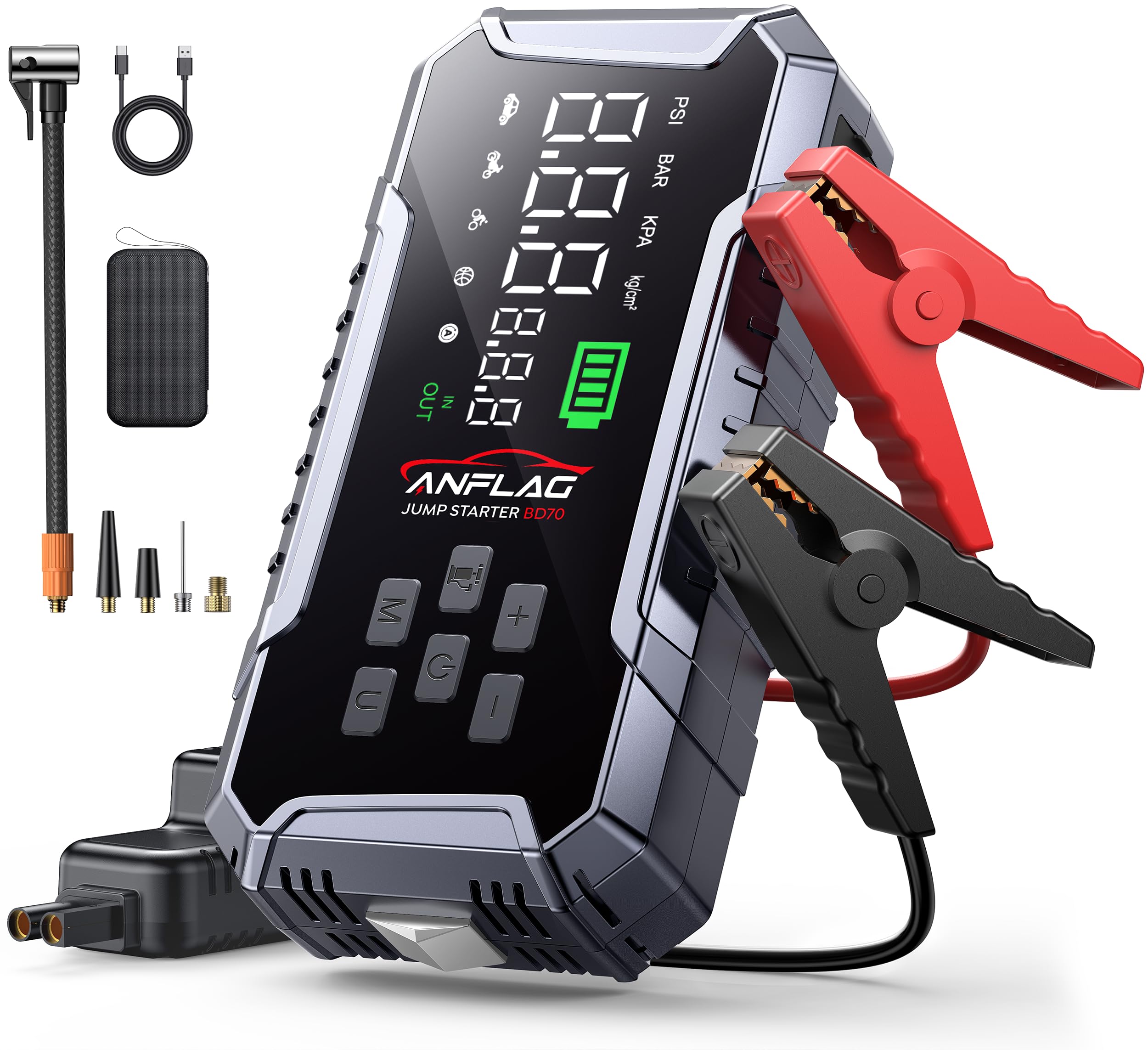
The one that carries 26800 mAh — enough for multiple jumps, several phone charges, and a full tire fill without a wall socket.
If the HALO is the long-haul trucker of this list, the ANFLAG is the mobile workshop. Its battery is a 26800 mAh lithium-ion pack — the largest of the whole lineup — rated for 1,000+ charging cycles and pushing 7000 peak amps into a dead 12V battery up to all gasoline or 12L diesel engines. That is the same 99.16Wh figure the listing prints, and it is the number to look at if you plan to leave this in a truck overnight in a parking lot and jump a street-parked car in the morning.
The jump side leans on one trick the cheaper units do not have: a one-touch FORCE START function that revives completely dead or fully drained batteries without needing a wall between uses. The compressor does 160 PSI through a 45L/min turbo pump, with a claim of 0 to 30 PSI in about two minutes. There is a 3.3-inch LCD that shows real-time pressure, five inflation modes for car, motorcycle, bicycle, ball, and custom, plus four pressure units and four nozzles. The one thing to know: this unit uses the ambient temperature spec down to -4°F, and 7000A is more than most people need — you are paying for headroom.
The ANFLAG earns its place with the working-truck crowd. The 600-lumen emergency light has three modes, one being an SOS strobe, and the whole thing sits in a rugged carry case. The IP65 rating — IP65 being the standard score for dust-tightness and spray resistance — matters on a jobsite, and the V-0 fire-resistant materials in the clamps keep the box safe to leave in a hot cab. The built-in hammer is a nice touch for breaking a window if the door will not open. Owners with fleets report using it across multiple vehicles without it going flat; the only recurring note is that the air hose wants a firm hand when you fold it back into the case.
Why It Sits High On This List
- 26800 mAh lithium-ion battery is the largest here — multiple jumps and 3–5 phone charges per fill.
- 7000A peak current covers all gasoline engines and diesels up to 12L, plus a one-touch FORCE START for fully dead batteries.
- 160 PSI compressor with 45L/min airflow, five inflation modes, and four pressure units.
- IP65-rated and built with V-0 fire-resistant materials, so it survives a hot truck cab and a dusty jobsite.
- 8-in-1 kit: jump box, tire inflator, pressure gauge, power bank, 600-lumen light, SOS strobe, and emergency hammer.
Where It Costs You
- The 3.3-inch LCD is fine in daylight but not the largest screen here.
- More capacity means more weight — this is not a glovebox unit.
- 7000A peak is more than a small car will ever use, so part of what you pay for stays idle.
Pick this if: you run a truck, a fleet, or a household where multiple vehicles depend on one box, and you want the biggest battery and the strongest jump here.
Think twice if: you only ever jump one sedan — the Joltekon or DEWALT next on the list will spare you the extra bulk.
5. Joltekon VP40 6000A 160PSI 9-in-1 Car Battery Jump Starter with Air Compressor & Air Blower
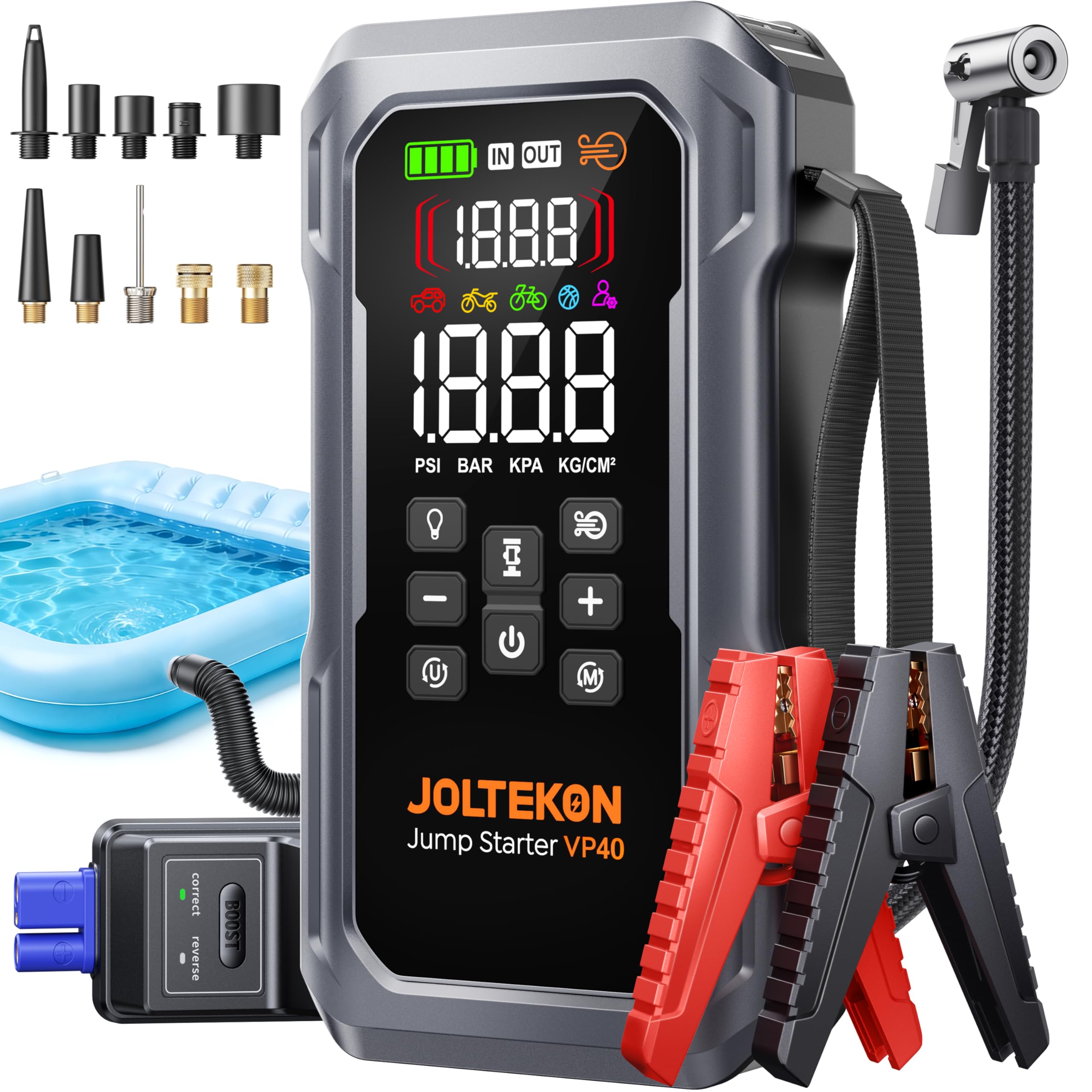
The only box on this list that also blows up the air mattress and vacuums the trunk.
Most jump starters do two jobs. This one does nine, and the extra one that jumps out is the air blower. It runs 360L/min of airflow and 5kPa of pressure through four nozzles — kPa being a metric unit of pressure, roughly a sixth of one PSI — which is enough to fill or deflate air mattresses, kayaks, swimming rings, and vacuum bags five times faster than a standard pump. The two-way ventilation design keeps the motor cool while you fill a mattress, and the whole thing folds into a 1.71 kg (about 3.8 lbs) carry case.
The jump side leans on 6000A peak current and a FORCE START function that revives low-charge batteries even after the charge has dropped, good for all gasoline or 12L diesel engines. The listing claims it handles temperatures from -20°C to 60°C — that is a wider cold-end spec than the other lithium units in this guide, which stop at -4°F. The jump is done in seconds when you connect the clamps and press the button; the cable return keeps things tidy in the case.
Where the purchase earns its keep is the tire pump and the trunk-sized footprint. The 160 PSI compressor runs off a 22-cylinder motor with five modes, five nozzles, and four inflation units, plus automatic power-off and tire pressure monitoring so it stops the instant you hit your target. Owners describe it as the thing that turns a flat tire into a five-minute job. The one honest limit: the printed peak output is 6000A while the spec sheet’s amperage field reads 7000A — buy on the 6000A figure and you will be correctly matched to the unit’s real cold-cranking performance.
Standout feature: a genuine 360L/min air blower with four nozzles — the only one on this list that turns a dead trunk into an inflated air mattress.
Who it fits: campers, road-trippers, and anyone who wants one box for the roadside and the campsite, not just the parking lot.
Good call for: trips where you want the tire filled, the phone charged, and the air mattress inflated from the same single box.
Pass on it if: you need maximum peak amps for a heavy diesel — the 6000A rating puts it below the ANFLAG and NOCO for big-engine duty.
6. YaberAuto AP03 16-in-1 Jump Starter with Air Compressor 8000A 160PSI, Tool Kits
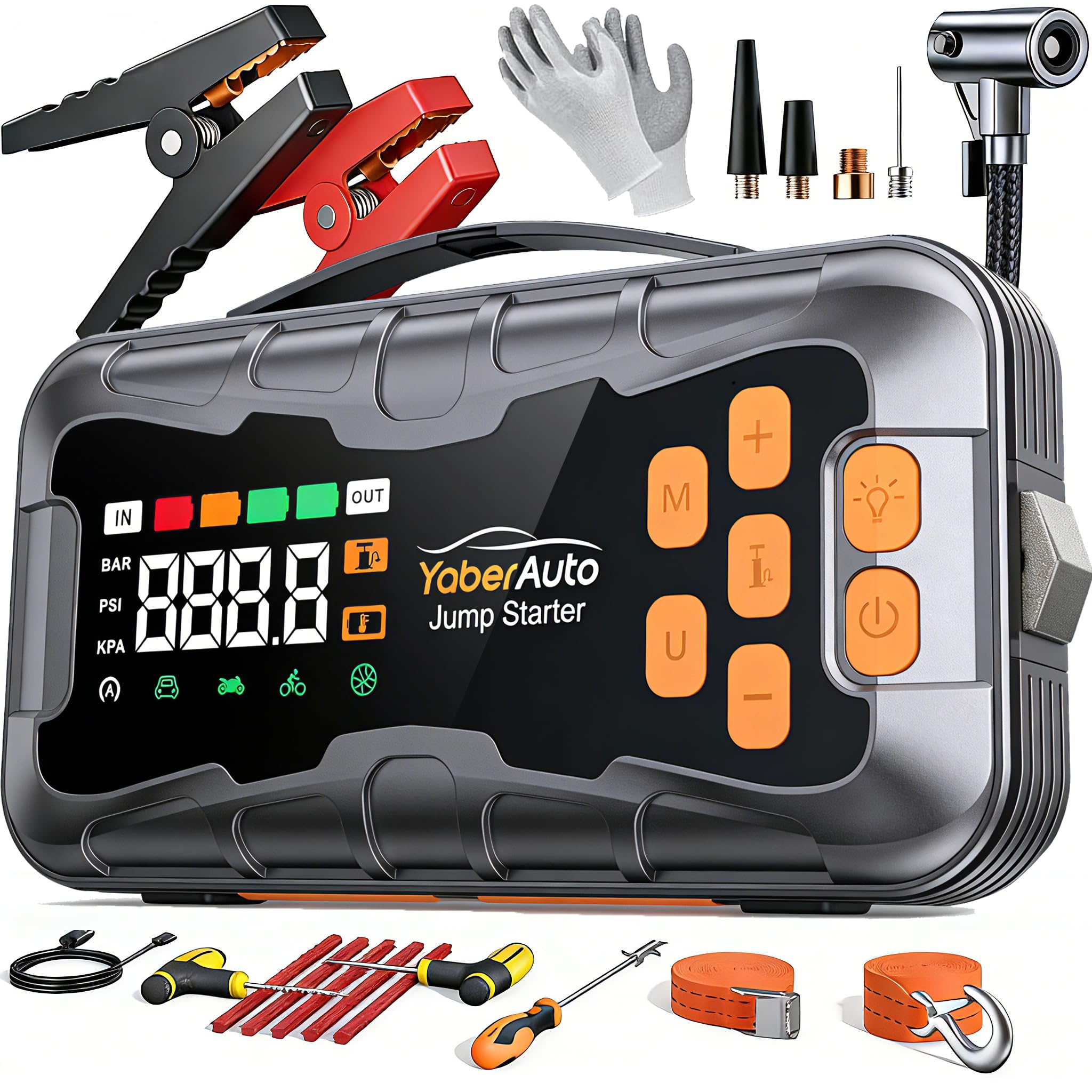
An 8000-amp jump box that also carries a tow rope, insulated gloves, and a tire repair kit.
The 8000A peak current here is the highest in this lineup, and it comes with a FORCE START function as a second safeguard for batteries that will not answer a normal jump attempt. That is enough for all gasoline engines or diesels up to 14L, the biggest diesel ceiling on this whole page. Behind it sits a 27000 mAh lithium-polymer pack rated at 99.9Wh — that is the power bank spec, enough for 3–5 full phone charges through the two 18W USB-A ports. A sturdy retractable handle makes it easy to lift out of a trunk when the whole thing tips the scales at just over a kilogram.
But the real reason a buyer picks the AP03 is the kit. The 16 functions include a 160 PSI compressor with a 3.3-inch screen visible in sunlight at ±1 PSI precision and 45L/min airflow, so a car tire reaches 30 PSI in about two minutes. There are five inflation modes, four air nozzles, three units, and a detachable air hose. Then come the extras most jump boxes skip: a tubeless tire repair kit, a 2-in-1 hook stone tool for pulling debris out of a tread, a tow rope, luggage tie-down, a car escape hammer, 400V insulated gloves for handling electrical work, and a padded emergency storage bag that organizes the lot.
Owners come back to two things: the raw jumping power and the sheer number of gadgets stuffed into one case. The user-reported pattern is that the unit starts a 3.8L V6 multiple times on one charge, and the compressor does not drain the car battery while it runs. The honest caveat is on the compressor’s speed — the counts split between buyers who find it surprisingly fast and buyers who find it slow on bigger tires, so if you have a pickup with oversized rubber, expect the NOCO’s higher airflow to feel faster. The insulation gloves and tow strap are more useful than they look, particularly if you end up helping another driver.
Its niche: 8000A of surge with a 14L diesel ceiling is the strongest jump here, paired with 27000 mAh of backup power and a full roadside tool bag.
Know this going in: the compressor is fast on car tires, but pickups with oversized tires will find the airflow less quick than the NOCO’s 67L/min.
Built for: the owner who wants to stop carrying three separate roadside kits and buy one box that handles the jump, the tire, the tow, and the tire plug in a single padded bag.
Not for: the minimalist who wants a small unit for the glovebox — the AP03 is a trunk tool with a full bag of accessories.
7. DEWALT DXAEJ14 1600 Peak Amp Jump Starter with 120 PSI Air Inflator

The sealed lead-acid unit you keep in the garage, not the truck — heavy, steady, and built to be plugged in.
This is a different animal from everything above. The DXAEJ14 uses sealed lead-acid chemistry, the older-style battery found in workshop jump packs, and carries a 1600 peak-amp jump starter alongside a 120 PSI digital air inflator. The job it does best is the one that never leaves the garage. You plug it into a wall socket with a standard extension cord between uses — the listing does not include the cord — and the integrated 25W USB-C and 15W USB-A ports will top up a phone or run a small device during a power cut. The 17.3-pound heft is the honest trade-off: this is not a glovebox unit, it is a shelf unit.
Where buyers consistently praise it is reliability, which lines up with the sealed lead-acid design. The all-metal powder-coated battery clamps feel substantial in the hand, and reverse-polarity protection warns you audibly if the clamps touch the wrong terminal. The 120 PSI inflator has a 10-minute auto shut-off timer so the motor cannot cook itself if you walk away, and a built-in LED area light lights up the roadside job. It handles most 4-, 6-, and 8-cylinder gas and diesel cars and trucks on the 1600A power alone — no donor car, no jump cables from a neighbor required.
The recurring note in the reviews is a battery-life one: some owners find it wants frequent recharging if it has been sitting for a while, and a few see it as pricey for what it does. The counterweight is that the same review pages keep showing V8 engines starting repeatedly on one charge, and the unit is still putting out 12.2 volts afterward. If you keep this plugged into a wall outlet between deployments, that battery concern largely disappears. The 120 PSI pump is also the second-lowest ceiling here, fine for car and bike tires but no speed demon on a big truck tire.
The DeWalt Difference
- Sealed lead-acid chemistry and powder-coated metal clamps — the heaviest, most workshop-grade build here.
- Reverse-polarity warning plus 10-minute auto shut-off on the inflator to protect the pump motor.
- 25W USB-C and 15W USB-A ports for phone and tablet charging during power cuts.
- 1600 peak amps covers most 4-, 6-, and 8-cylinder gas and diesel cars and trucks.
Weigh The Downsides
- 17.3 pounds — this is a garage tool, not a portable glovebox unit.
- Needs an extension cord for charging, and the cord is not included.
- 120 PSI is the second-lowest compressor ceiling in this lineup.
Anchor pick for: the garage shelf, where a wall socket is nearby and the heavy-with-metal-feel build is a feature, not a burden.
Won’t suit: a trucker who needs something that lives in the cab — the sealed lead-acid pack is genuinely too heavy to carry daily.
8. DEWALT DXAEPS14 2000 Peak Amp Jump Starter with 120 PSI Air Inflator & 500W AC Inverter

Adds a 500W AC inverter to the DeWalt package — the same lead-acid build, now a small backup power station too.
The DXAEPS14 is the DXAEJ14 with two upgrades: 2000 peak amps instead of 1600, and a 500W AC power inverter. That inverter is the non-obvious feature and the reason this pick exists on its own. A 500W AC outlet in a jump-starter body means you can run small electronics — a light, a laptop, a fan — during a blackout without dragging out a generator. Everything else here is the same sealed lead-acid reliability: the 120 PSI inflator with the 10-minute auto shut-off, the 25W USB-C and 15W USB-A ports, the reverse-polarity protection, the built-in LED area light. The unit is 17.3 pounds, so it lives wherever you put it and mostly stays there.
On the jump side, 2000A will start most 4-, 6-, and 8-cylinder gas and diesel cars and trucks, and the metal powder-coated clamps and reverse-polarity warning work exactly as they do on the DXAEJ14. The small LCD shows battery status, voltage, air pressure, reverse-connection warnings, and USB status at once, so you are not guessing about how much charge is left. The whole thing is designed for the home-emergency and jobsite role rather than the daily-driver trunk role.
The honest read on the review pages is split, and worth pricing in. Some owners treat it as an genuinely useful home backup and report the air pump, jump function, and inverter all doing their jobs across power outages. Others report the jump function failing early, or a unit that took a charge once and then would not take another, and the battery-life and reliability feedback in the reviews is mixed overall. That split is more common on lead-acid packs that sit a long time without being cycled — check it and top it up every few months, and the odds of a dead-in-the-closet surprise drop sharply.
Standout spec: a 500W AC inverter in a jump-starter package — the only pick here that can run a small appliance from the same unit that jump-starts the car.
Maintenance matters: the sealed lead-acid battery wants a top-up every few months. Skip that and some owners see the charge drop away.
Makes sense for: a household that wants a jump pack and a small emergency power source in one unit, kept on a garage shelf, checked a few times a year.
Look past it if: you want to leave the box in the car and forget it — this one wants a maintenance routine and a nearby outlet.
9. NOCO Boost Air AX65 2000A 12V Jump Starter, Air Compressor & Tire Inflator

The fastest tire filler here, with 2000 amps of jump power and a 48-minute recharge from a USB-C wall plug.
Rate this one on airflow alone and it wins. The AX65 push 67 liters per minute through its compressor — the highest airflow rate on this entire page, and well ahead of the 45L/min units that make up most of the lineup. That translates to a flat going from 0 to 40 PSI in about two minutes, or a top-off from 35 to 40 PSI in under 20 seconds. A single charge inflates up to 2.5 tires from empty, or tops off 20 low tires. If you are the person who has been stuck at a gas station air pump at 10 pm, this is the reason to own it.
The jump side is fully specked to match: 2000A peak current with ULTRASAFE 2.0 spark-proof clamps and reverse-polarity protection, designed for gasoline engines up to 8.0L and diesel engines up to 6.0L. The listing claims multiple starts per charge with maximum energy every start. It also runs as a 60W power bank through a USB-C port — 60 watts in and 60 watts out — which means the whole unit recharges from empty in about 48 minutes from any 60W USB-C adapter. That quick-recharge spec is the one to remember: most rivals take much longer to top back up. A built-in digital display sets precise pressures from 15 to 100 PSI, and dwell technology triggers auto shut-off at your chosen target.
Where this pick asks you to make a trade is in the lithium battery’s real-world endurance. The 2150 mAh capacity figure the listing prints is small for a jump pack, and the recurring complaint in buyer reports is battery life — some report units that do not hold a charge long or die quickly after sitting. A few also note the unit is heavy at around 3.7 kg, and the included microfiber bag scuffs easily. On the positive side, the reviews that use it report excellent jumping performance on big engines, including a supercharged 5.2L V8, with the tires inflated in under a minute on smaller vehicles. Rating-wise the AX65 is the lowest of this lineup, so treat it as a specialist tool for the person who wants the fastest inflator above all else.
Why You Buy A NOCO
- 67L/min airflow is the fastest inflation rate in this lineup — 0 to 40 PSI in about two minutes.
- 2000A peak starts gas engines up to 8.0L and diesel engines up to 6.0L with spark-proof clamps.
- Recharges in about 48 minutes from any 60W USB-C port — the fastest recharge here by a wide margin.
- Doubles as a 60W power bank, in and out, and includes a 3-foot inflation hose with adapters and a microfiber bag.
Where The Trade-Off Bites
- 2150 mAh lithium pack is small for a jump starter and some owners mention it does not hold a charge long.
- The unit is heavy at around 3.7 kg — not a glovebox pick.
- The microfiber bag is not a hard case, and the 100 PSI max pressure is the lowest here for topping off an off-road tire.
The personality match: the person who wants the tire done in two minutes and the jump done with pro-grade clamps, and who will plug it in via USB-C every evening they drive.
Pass it if: you want a box that lives in the car untouched for months at a time — the battery reports on this one make it a bad fit for neglect.
Understanding the Specs
Peak amps and cranking power
Peak amps are the short burst of electrical current — measured in amps — that your jump box shoves into a dead battery to spin the starter motor. Higher peak amps mean you can handle bigger engines, especially diesels, and you have more headroom in cold weather. The real-world difference is the difference between cranking a dead 8-cylinder truck on the first try and having to hold the button and hope. Match the number to the biggest engine in your driveway, not the average one.
PSI and airflow rate
PSI is the maximum pressure the built-in tire inflator can push — car tires sit around 30 to 36 PSI, so anything rated above 100 PSI will fill a standard car tire. But PSI alone does not tell you how long you wait. Airflow, expressed in liters per minute (LPM), is the spec that decides how fast the tire actually inflates. Two units rated at 150 PSI can fill the same tire five minutes apart if their LPM numbers are different. Auto shut-off at your preset pressure is the feature that lets you walk away instead of watching the gauge.
Battery chemistry: lithium vs sealed lead-acid
Lithium-ion and lithium-polymer packs are the lightest option and hold their charge longer between uses, which makes them the pick for a unit that lives in a car and comes out rarely. Sealed lead-acid packs are heavier and usually larger, but they tolerate sitting on a shelf in a garage andwant a nearby outlet, which is why the DEWALT picks here use that chemistry. The trade-off between the two depends on how often the box leaves the car: lithium for the road, lead-acid for the garage shelf.
Standby time and safety features
Standby time is how long a fully charged unit holds enough energy to still do its job — measured in months for the best units here. A pack rated for 24-month standby has an automatic shutoff that powers down after inactivity so it does not drain itself, which matters if the box lives in a trunk and only comes out twice a year. On the safety side, look for spark-proof clamps, reverse-polarity protection (which warns you if the clamps touch the wrong terminal), and 10+ internal protections against short circuit and over-voltage. These are the features that keep a mistake from becoming a repair bill.
FAQ
Will a jump starter with a built-in inflator work on my car, or do I need a separate tire pump?
How long does a jump box hold its charge if I leave it in the car?
Can a jump starter with air compressor air up a completely flat tire?
Do I need a wall outlet to charge the jump starter?
What happens if I connect the jumper clamps backwards?
Will 6000 peak amps start a diesel truck or do I need something bigger?
Is a lithium jump starter safer than a lead-acid one?
Can I use the jump starter as a power bank for my phone or laptop?
Does the air compressor need a separate power source while inflating?
What should I look for in the LED light on a jump box?
Final Thoughts: The Verdict
For most buyers, the battery jumper and tire inflator winner is the HALO BOLT AIR+ 1750A because its 16200 mAh pack holds charge through months of sitting, its 600 amps handle daily drivers up to 6L gas and 3L diesel, and the 130 PSI compressor with the oversized color display covers a normal car tire without fuss. If you drive a diesel or live somewhere genuinely cold, grab the ACMOUNT D18 — its 6000A peak and 150 PSI pump start more engine for less outlay. And for the camper who wants a tire pump, a power bank, and a proper air blower in one bag, the Joltekon VP40 is the one to reach for.
Whichever you pick, the decision depends on two questions: how big is the biggest engine you might need to crank, and how often can you top up the pack between uses.
How We Picked
We do not accept paid placement. Every pick is matched to a real buyer and a real use-case; we do not hands-on test units.
Sources & Methodology
Specifications: manufacturer listings and product documentation. Review insights: verified customer reviews, as of September 2026. Pricing: not shown on this page (it changes often); check the current price via the retailer link.
As an Amazon Associate, Gadgets Feed earns from qualifying purchases. This does not affect which products we feature.