
Our readers keep the lights on and my morning glass full of iced black tea. As an Amazon Associate, I earn from qualifying purchases.
Specs are compiled from manufacturer listings and verified buyer reviews and can change over time — please confirm the key details on the product page before buying.
If your boat, RV, jet ski, tractor, or weekend truck sits for weeks, a dead battery is the problem a battery kill switch solves. It is a simple on/off gate between your battery and the clock, alarm, stereo memory, and CO detector that quietly drain it while you are parked. Flip it off and the drain stops. That one small part is the difference between a battery that fires up first crank and one that is flat when you need it.
I’m Min — the founder and writer behind Gadgets Feed. This guide is built by comparing the manufacturers’ published specifications and the patterns across verified customer reviews, so you get each pick’s real strengths and trade-offs instead of marketing spin.
The main thing to understand is that these switches differ in how much current they can carry and whether they are manual or remote — so matching one to your amperage matters far more than brand names. The list below sorts the genuinely solid battery kill switch options by what each one actually does best.
Our Picks at a Glance

How To Choose The Best Battery Kill Switch
To pick the right kill switch, you only need to nail three numbers and one habit. Get the amperage (the current the switch can carry, measured in amps) right, decide if you want to walk to the battery or click a remote, and check that the housing survives where you plan to mount it. Everything else is detail.
Match the amperage to what you are disconnecting
Every switch has a continuous rating — the current it can carry all day without overheating — and an intermittent rating for short bursts. For a battery that just powers lights, a stereo, and an engine computer, a modest continuous rating is plenty. For a winch, a starter, or a big battery bank, you want headroom. The 275 A DC Continuous switches here, for example, also list a 455 A DC Intermittent and 1250 A DC Cranking figure — that cranking number is the short spike your starter pulls for a few seconds. Oversize rather than undersize; a switch running at half its rating stays cool.
Manual rotary versus remote control
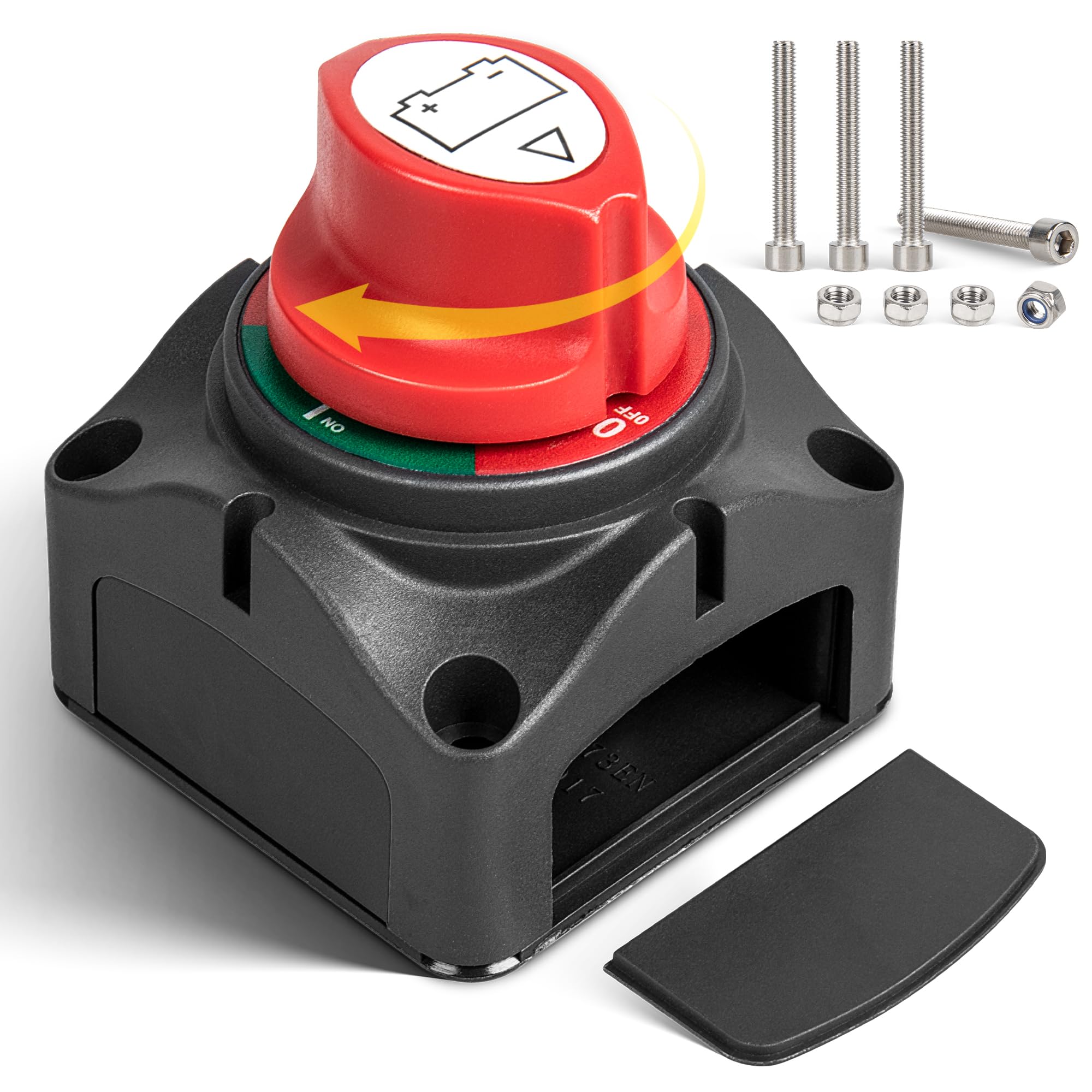
A rotary switch is a physical knob you turn by hand — clockwise to turn on, counter clockwise to turn off. It never runs out of batteries, it is instant and dead reliable, and it doubles as a theft deterrent because a thief has to find and turn a hidden knob. A remote-control switch lets you disconnect from the driver’s seat with a button, which is genuinely convenient under a hood you would rather not open in the rain. The trade is complexity — a remote unit has its own tiny electronics and a key fob that needs fresh batteries.
Housing, terminals, and where you mount it
A fully enclosed design keeps dirt, corrosion, and rain off the internal contacts — worth having on anything that lives outdoors. Tinned copper studs resist corrosion better than bare metal, and a rear cover that insulates the terminals against a short circuit is a small safety win. Check the stud size against your existing cable lugs before you buy; the wrong thread or stud diameter means a trip to the hardware store mid-install.
Quick Comparison
| Model | Best For | Continuous Rating | System Voltage | Control Type | Amazon |
|---|---|---|---|---|---|
| Battery Disconnect Switch 12V-48V Power Cut Off Switch★ Best Overall | All-around value | 275 A DC | 12V–48V | Rotary | Amazon |
| RED WOLF On-Off Battery Disconnect Switch DC 12V-48V 275APremium Pick | Small spaces, marine | 275 A | 12V–48V | Rotary | Amazon |
| Spurtar Battery Disconnect Switch 12V 24V 48V | High-current standard fit | 200 A | 12V–48V | Toggled | Amazon |
| 12-48V Master Battery Disconnect Switch 200A | Heavy truck and trailer | 200 A | 12V–48V | Rotary | Amazon |
| Remote Battery Disconnect Switch 12V 200A | Click-from-the-cab convenience | 200 A DC12V | 12V | Remote | Amazon |
| AWBLIN Upgrade Battery Disconnect Switch with Voltmeter | Voltage monitoring on the fly | 250 A at DC 12V | 5V–60V | Push button | Amazon |
| Nilight 600A On Off Battery Switch 12-48V | Big loads and starter banks | 600 A at DC 12V | 12V–48V | On/Off | Amazon |
In‑Depth Reviews
1. Battery Disconnect Switch 12V-48V Power Cut Off Switch
Our pick — over 4.5★ from 600+ verified ratings; the strongest balance of quality and price.
The best all-rounder here, and the cheapest way to stop parasitic drain on a camper, boat, or tractor.
If you own a camper, a boat, or a tractor that sits for weeks, this is the switch to start with. It also lists 455 A DC Intermittent for five-minute bursts and 1250 A DC Cranking for ten seconds, so even a starter spike is covered. The rotary knob turns clockwise to turn on and counter clockwise to turn off, and it suits anything from 12V up to 48V systems.
What wins people over is the value — it keeps coming up as an excellent deal, and the battery isolation function is the other big draw. Owners describe it as easy to turn on and off and solidly built, and the included kit is unusually complete: four mounting bolts, four 2×3/8 copper ring terminals, four heat shrink tubings, and a hex wrench. There is one thing to get right, and it is important. The wiring guidance on the instructions has been flagged as misleading — a buyer who followed the negative-and-positive setup smoked their wires. The rule from the review pages is to connect only the positive to both terminals and keep a fuse switch on the positive side, then tape the nuts to prevent shorts. Get that right and this switch simply works.
Where It Earns Its Keep
- 275 A DC Continuous rating means it stays cool even on long-running loads
- Handles 12V through 48V systems, so it fits almost any vehicle you own
- Ships with bolts, copper ring terminals, heat shrink, and a hex wrench — a full install kit
- Fully enclosed ABS housing keeps dirt, corrosion, and rain off the contacts
What To Watch
- The printed wiring directions are wrong — connect positive only to both terminals
- Machine-thread fasteners may need drilled-out screw holes in some mounting setups
Grab this one: the best all-rounder here for a camper, boat, trailer, or truck that sits between trips.
Wire it carefully: follow the positive-only rule, not the printed sheet, or you risk frying cables.
2. RED WOLF On-Off Battery Disconnect Switch DC 12V-48V 275A, Heavy Duty Marine Battery Power Cut Master Switch Disconnect Isolator Ignition Protected for Automotive RV Marine Battery Kill
Built for tight, wet corners — the jet ski and jon boat favorite.
Where this one pulls ahead is survivability in a cramped, damp space. It uses 2×3/8-inch M10 tinned copper studs and nuts, and the tinning is the point — it resists corrosion and keeps conductivity reliable when the air is salty. The ABS housing has a rear cover that insulates the terminals against short circuits, and it carries a flame retardant rating of 94VL. On raw muscle it matches the top pick at 275 A, which is well ahead of the Spurtar’s 200 A — a real gap for anyone pushing a winch or a big starter.
What buyers rave about here is how many jobs this switch handles. It turns up as the primary shutoff for battery-powered jon boat electronics, it works with solar power systems, and it handles the marine-electronics load without fuss. The size is the stealth feature: it is small enough to mount inside a jet ski so you can charge without pulling the battery, and the visible on/off indicators mean you can see the switch state at a glance. It installs on a surface, a front panel, or a rear panel, so you can tuck it wherever it fits.
The honest catch is bulk versus placement. Even a compact switch needs room for the cables and lugs (the metal connectors that clamp onto the battery posts) to bend without strain, and a few owners note the body is a touch bulky once you account for the wiring — so think through where it goes before you drill. The mounting feedback is genuinely mixed, so measure twice.
The marine edge: tinned copper studs and a 94VL flame rating are the details that matter when the switch lives near water.
Plan the fit: its compact body still needs clearance for cable bends — dry-fit it before drilling.
Reach for this if: you are mounting near water or in a tight compartment like a jet ski or small boat.
Look elsewhere if: you want a bigger knob to grab with gloves in a wide-open engine bay.
3. Spurtar Battery Disconnect Switch 12V 24V 48V Heavy Duty Battery Shut Off

A 200 A continuous workhorse for trailers, tractors, and golf carts.
This is the switch for the person who cares most about build quality and does not need the highest amp ceiling. It is rated 200 A Continuous (the current it can carry nonstop) and 1000 A Intermittent (short bursts) across 12-48V DC systems. It carries less continuous current than the RED WOLF and the top pick at 275 A, so if you are running a heavy winch you want more headroom — but for a golf cart, a trailer, or a tractor, 200 A continuous is comfortable. The toggle action gives a clear click sound with no jamming, and the on/off face plate is easy to read even panel-mounted between seats.
Durability is this one’s reputation, and it earns it. It shows up as a sturdy shutoff for a pop-up camper, better built than expected. Trailer owners who upgraded from an acid battery to lithium describe it as well-made metal with shrink wraps, terminal connectors, and bolt protection sleeves in the box. A golf cart owner running a 48V 100AH LiFePO4 battery uses it to stop a slight drain, and notes it handles twice the current of price-range competitors. Pointers on both ends mean you can install it facing either direction. The Spurtar is also the most-reviewed pick in this group — over 800 ratings — though it holds a slightly lower score than the top two.
Two fit notes worth knowing. The on/off knob flats do not always line up perfectly with the stem — a mini lock washer holds the knob on, so do not lose it. And the size draws mixed opinions: some find it perfect for their application, others find it bigger than expected for tight spaces. Neither is a defect, just a reason to check your mounting spot first.
Built to last: the sturdy metal body and included terminal sleeves are the reason it keeps coming up as a solid, long-term buy.
Check the knob: the flats do not always align — the mini lock washer is what keeps it seated, so keep track of it.
Best for: golf carts, tractors, and trailers where 200 A continuous is plenty and durability matters most.
Skip if: you are running a high-draw winch and want the extra continuous headroom of a 275 A switch.
4. 12-48V Master Battery Disconnect Switch, High Current 200A Battery Power Cutoff Isolator Killer Switch with Face Plate
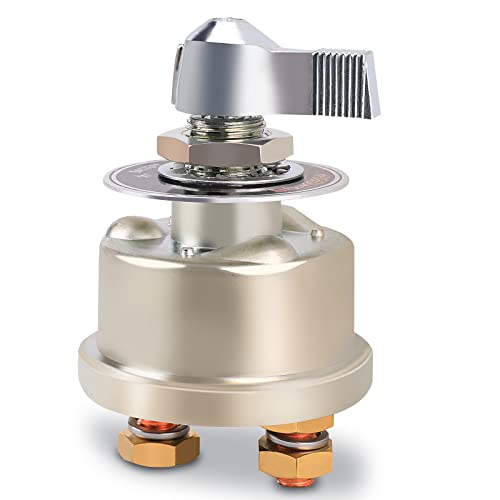
An all-aluminum housing built for harsh conditions, with a 1-year replacement warranty.
This switch skips plastic entirely. It uses a sturdy aluminum alloy heavy-duty housing built for harsh conditions, and it replaces part numbers 20701 and 062790. The rotary lever gives a definitive click when turning on and off, and it is rated 200 Amps continuous duty and 1000 Amps intermittent duty across 12-48 VDC systems. It is also the only pick here with a stated 1-Year warranty — if the switch fails during that period, the maker will replace it. Its SPST (single-pole, single-throw) circuit means it switches one path on and off, the simplest layout for a kill switch.
Easy installation is what people mention most about this one, which fits the design: no modifications required, and the included on/off indicator and face plate make orientation obvious. It gets used as a trailer winch cutoff with a positive click every time, and a golf cart owner compares it to the switches used in military vehicles — a large, heavy-duty, all-metal build. Functionality lands well for high-output disconnects and trailer batteries.
Be realistic about the trade-off. This is a large, all-metal switch, and the reliability feedback across the wider pool is genuinely mixed — some love the solid feel, others have had units stop working, so treat it as one to mount carefully and test after install. If you want a compact, plastic-bodied switch, this is not it.
Why It Stands Out
- All-aluminum housing built for harsh conditions, not a plastic shell
- Only pick here with a stated 1-Year replacement warranty
- Definitive click gives you a clear confirmation the switch engaged
- Replaces part numbers 20701 and 062790 for easy cross-reference
The Reality Check
- It is large and heavy — measure your mounting space first
- Reliability is mixed across the wider pool, so test it right after install
Pick this for: a heavy truck, trailer, or golf cart where you want an all-metal switch with a warranty behind it.
Think twice if: your mounting spot is tight — this one needs room.
5. Remote Battery Disconnect Switch 12V Battery Kill Switch for Car, 200A Upgraded Remote Control Battery Negative Cut Off Switch Anti-Theft Prevent Battery Drain Isolator for Truck, RV 360A Starting

A key-fob switch that cuts 12V power from the driver’s seat and doubles as an anti-theft disable.
If the idea of popping the hood every time you park makes you tired, this is the pick. It is an electromagnetic switch rated 200A DC12V for 12-volt battery systems, and instead of a knob you get a key fob. Press the button and the car’s power system is disconnected — which doubles as anti-theft, since a thief cannot start a car whose battery is cut. It ships with all wiring harnesses included and needs no additional accessories. The black negative wire is pre-mounted at the bottom of the switch, and installation is just red wire to the positive pole and the battery clip to the negative pole.
Installation is the clear strength — it is the single most-mentioned positive here by a wide margin. Owners describe a five-minute install and report it fixing severe parasitic drain that was killing a fresh battery fast; one noted the alternator charges at 13.7V once the drain issue is solved. The included second remote is a nice backup, and the fobs run on two stacked CR2016 lithium batteries that slide out after unscrewing the top. It is also compact enough to double as a glove-box spare.
The honest costs are worth pausing on. Quality, value, battery life, and remote control all draw genuinely mixed feedback across the wider pool, and this is the lowest-rated pick in the group — a fair sign that the electronics add complexity a simple rotary switch never has. The instructions are a known weak point; expect to work them out, and note that after a power disconnect you may need to wait about 6 seconds before pressing the vehicle start switch, and some car stereos need re-matching afterward.
Convenience winner: a fob press beats opening the hood in the rain, and the anti-theft cutoff comes free with it.
The complexity tax: it is the lowest-rated pick here, and the instructions are the weak spot — patience required.
Go remote if: you want to cut power from the cab and want an anti-theft disable built in.
Stay rotary if: you value simplicity and reliability over a fob — this one asks for more troubleshooting.
6. AWBLIN Upgrade Battery Disconnect Switch with Voltmeter On Off

A kill switch with a built-in LED voltmeter that shows your battery’s voltage in real time.
Nothing else on this list puts a readout on the switch itself. This one has an LED digital voltmeter (a small screen that shows voltage) built into the face that shows your battery’s current voltage in real time — when the switch is on, the upper button screen monitors voltage live; when it is off, the screen goes dark. The standby current is 0, and the display sips just 30ma (milliamps) while lit. It carries 250A Continuous at DC 12V and 300A for 30 minutes, and it spans DC 5-60V systems, so it covers 6V, 12V, 24V, 48V, and 60V setups — a wider range than any other pick here.
Build quality is what people praise most. It swaps the usual ABS for a nylon 66 shell with better high-temperature resistance, and the internal screw uses copper plated silver with silver contacts for greater conductivity and longer life. Owners love being able to see the voltage drop on a battery-only lake, or to check a converter’s charging without pulling terminals. The included kit is generous — four removable side plates, a rubber gasket, a rear cover, four nuts, four screws, and a terminal. There is one honest caught-in-review detail: the voltmeter reads a touch high, with a reported reading of 12.3V at an actual 12.0V. That is fine for a rough sense of charge, but do not treat it as a precision instrument.
Installation is straightforward, though the printed instructions are unclear and you may need to drill new holes. The blue LED is bright enough to be annoying at night and washed out in direct sunlight — a small mounting consideration rather than a flaw.
See your charge: the built-in voltmeter turns a plain on/off switch into a quick battery-status check every time you use the vehicle.
Accuracy caveat: the display runs slightly high — use it as a ballpark guide, not a lab reading.
This is your pick if: you run a wider voltage range or want to eyeball battery health without a multimeter in hand.
Pass it by if: you need exact voltage numbers — the readout runs slightly high.
7. Nilight 600A On Off Battery Switch 12-48V Power Cut Master Isolator

600 A continuous at DC 12V — the highest rating here, for tractors and big battery banks.
This is the muscle pick, and the numbers say so plainly. It carries 600 A continuous at DC 12V, 455 A intermittent at DC 12V, and 1250 A momentary at DC 12V — the highest continuous rating on this list, roughly double the 275 A ceiling of the top pick and the RED WOLF. The housing is ABS (a tough plastic) with a rear cover that insulates the terminals against shorts, and it fits DC 12-48V systems. It can also stand alone or be locked together with other switches, which makes it useful for a multi-battery bank setup. It ships with four bolts, two copper ring terminals, two heat shrink tubings, and a hex wrench. Gold contacts are listed for conductivity.
What people trust it for is sheer staying power under a big load. It gets used on a tractor for three years without a problem, and there is a telling pattern in the reviews — owners who burned through smaller 300-amp switches in a month or three and then moved up to this 600-amp unit report it still running a year and a half later. If your equipment demands serious current, the headroom here is the whole reason to buy it.
Now the sizing reality. This switch is large and it uses 1/2-inch studs, which will not fit most 5/16 or 3/8-inch battery terminals — some buyers end up returning it because it is simply too big for their space. The size and fit draw genuinely mixed feedback, and it is the priciest pick in the group, so measure your compartment and check your cable lugs before you commit.
Maximum Muscle
- 600 A continuous at DC 12V — the highest rating here
- Handles 1250 A momentary for big starting loads and battery banks
- Can link with other switches for multi-battery setups
- Gold contact material listed for conductivity
Size Before You Buy
- 1/2-inch studs will not fit most 5/16 or 3/8-inch terminals
- Large body may not fit tight engine compartments or battery boxes
Best for: tractors, big battery banks, and heavy loads where 600 A continuous headroom is the whole point.
skip it if: you are working with standard small terminals or a cramped mounting spot — the size will fight you.
Understanding the Specs
Continuous vs intermittent rating
The continuous rating is the current a switch can carry all day without overheating, and it is the number that matters for everyday use. The intermittent and momentary numbers cover short bursts like a starter spike. A 200 A continuous switch is a good fit for lights, a stereo, and an engine computer; a 275 A or a 600 A unit gives you headroom for winches and big battery banks. Running a switch well under its rating keeps it cool and long-lived.
Manual knob vs remote electronics
A manual rotary or push-button switch has no electronics to fail and never needs a battery — you turn it and the circuit opens or closes. A remote-control switch adds a key fob and a small internal circuit, which is convenient from the driver’s seat but introduces parts that can need troubleshooting or re-learning after a full power-down. Simpler means fewer failure points.
Stud size and terminal fit
Stud diameter decides whether the switch bolts straight onto your existing cables. Sizes like 3/8-inch M10 tinned copper studs and 1/2-inch studs are not interchangeable, and a mismatch means adapting the cable or replacing a connection. Check your lug size before buying so you are not drilling or hunting for parts mid-install.
Housing material and weather resistance
Housing material tells you where the switch can live. ABS plastic housings with a rear cover keep dirt, corrosion, and rain off the contacts; nylon 66 shells add better high-temperature resistance; aluminum alloy housings handle the harshest conditions. A rear cover that insulates the terminals against a short circuit is a safety detail worth having on anything mounted outdoors.
FAQ
Will a battery kill switch stop my car battery from draining while parked?
What is the difference between continuous and intermittent amp ratings on a disconnect switch?
Do I need a 600 A switch or is a lower rating enough for my setup?
Are remote-control battery kill switches reliable?
Can I use a manual battery disconnect switch as an anti-theft device?
How do I wire a battery disconnect switch correctly?
Which mounting stud size should I look for?
Does a battery shut-off switch work on a 24V or 48V system?
Do these switches come with the hardware I need to install them?
Can I leave a battery kill switch on all the time?
Final Thoughts: The Verdict
For most people, the winner is the Battery Disconnect Switch 12V-48V Power Cut Off Switch — it pairs a 275 A DC Continuous rating with a complete install kit and survives 12V to 48V systems, all at a value tier that makes it the smart default. If you mount near water or need the extra corrosion resistance of tinned copper studs, grab the RED WOLF 275A switch, which matches the top pick on amperage in a smaller marine-friendly body. For the biggest loads — tractors, winches, and battery banks — the Nilight 600A is the one to reach for, as long as its 1/2-inch studs and large body fit your space. Match the amperage to your real load, check your terminal size, and wire positive-only — do those three things and a kill switch will earn its keep every season you park.
How We Picked
We do not accept paid placement. Every pick is matched to a real buyer and a real use-case; we do not hands-on test units.
Sources & Methodology
Specifications: manufacturer listings and product documentation. Review insights: verified customer reviews, as of September 2026. Pricing: not shown on this page (it changes often); check the current price via the retailer link.
As an Amazon Associate, Gadgets Feed earns from qualifying purchases. This does not affect which products we feature.