
Our readers keep the lights on and my morning glass full of iced black tea. As an Amazon Associate, I earn from qualifying purchases.
Specs are compiled from manufacturer listings and verified buyer reviews and can change over time — please confirm the key details on the product page before buying.
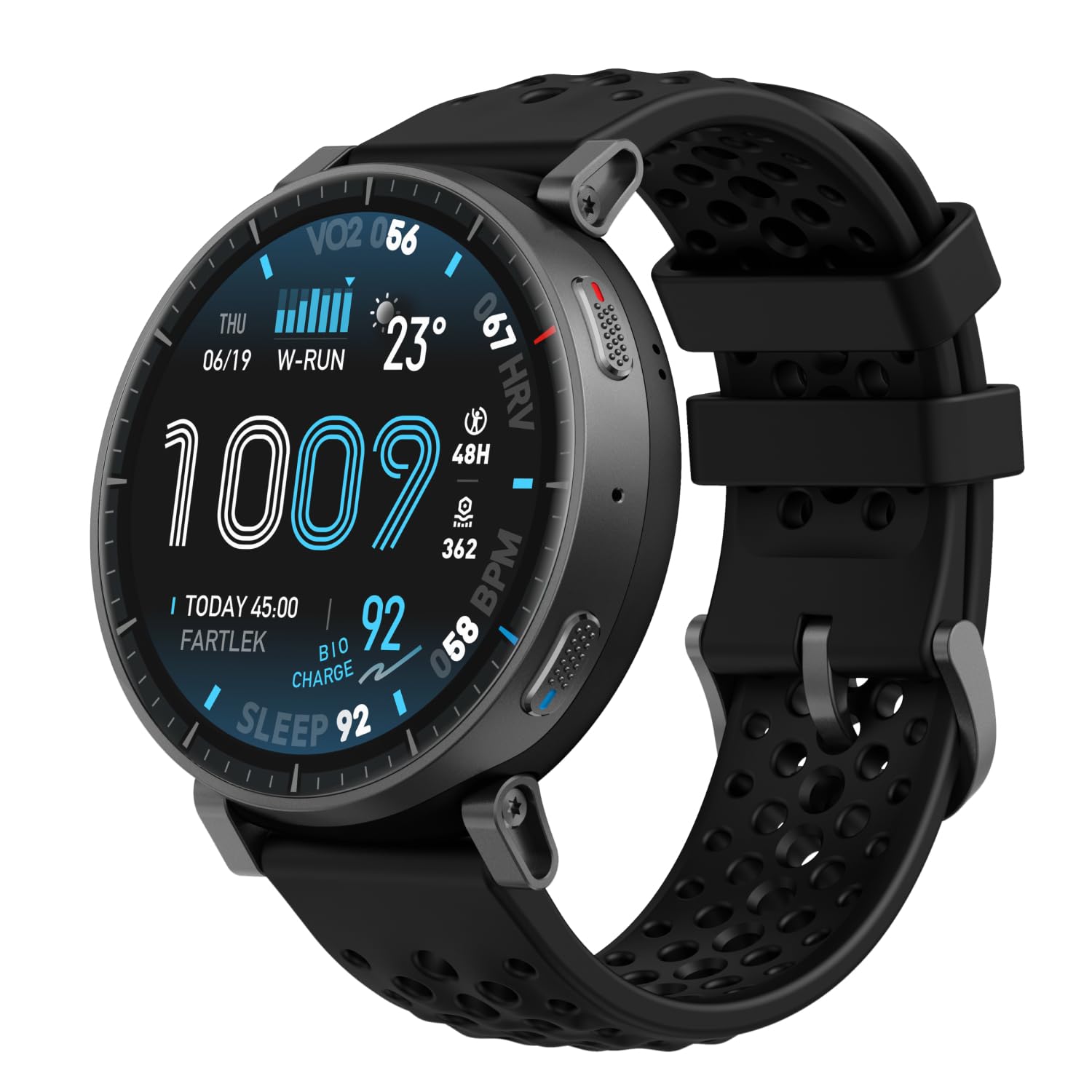
If you are tired of charging a fitness watch every single night, the real prize is a model that lasts weeks, not days. This guide sorts through the best long-lasting options, from solar-powered rugged Garmins to AMOLED Amazfits that easily clear two weeks on a charge. You will learn exactly which battery metrics matter, how solar charging actually changes the daily routine, and which pick fits your training style.
I’m Min — the founder and writer behind Gadgets Feed. This guide is built by comparing the manufacturers’ published specifications and the patterns across verified customer reviews, so you get each pick’s real strengths and trade-offs instead of marketing spin.
You want a fitness watch that won’t die on you mid-week, and the models here are the ones that truly last for weeks on end. This guide to the best battery life fitness watch skips the jargon and tells you which one fits your wrist and your routine.
Our Picks at a Glance


How To Choose The Best Battery Life Fitness Watch
Battery life determines whether you charge nightly or forget the charger for weeks. Before you pick, you need to know the three different ways makers measure battery life, because a 25-day claim and a 40-hour claim are talking about completely different usage.
Smartwatch Mode vs GPS Mode vs Training Mode
Every long-lasting watch lists at least two battery numbers. Smartwatch mode means basic notifications, heart rate, and sleep tracking with the screen off most of the time. GPS mode means the satellite receiver is actively mapping your run, which drains far faster. A watch promising 25 days in smartwatch mode might only manage 40 hours of constant GPS, so match the number to how you actually train.
Solar Charging: A Real Game Changer or a Gimmick
Solar lenses on Garmin’s rugged line convert sunlight into battery power. The catch is the conditions: most solar watches need about 3 hours of direct, bright sunlight (50,000 lux) per day to truly extend life. For hikers and firefighters who live outdoors, this means “unlimited” battery in smartwatch mode. For an office worker who never sees the sun, solar adds a day or two at most.
Display Type Controls Your Charging Habits
The display is the biggest battery drain. AMOLED displays look stunning with vivid colors and 3,000-nit brightness, but they burn power fast. Monochrome MIP displays (memory-in-pixel, a screen type that holds an image without power) look basic, yet they are the reason some watches last nearly a month. Choose between a vivid screen and a longer charge cycle.
Quick Comparison
| Model | Best For | Battery Life | Display | Case Size | Amazon |
|---|---|---|---|---|---|
| Garmin Instinct 2X Solar★ Best Overall | Ultimate outdoor endurance | Infinite (solar) | Monochrome MIP | 50 mm | Amazon |
| Amazfit Active MaxBest Value | Bright display, long battery | 25 days | 1.5″ AMOLED | 48 mm | Amazon |
| Garmin Instinct 3 SolarTop Performer | Rugged with a flashlight | 28 days | Monochrome MIP | 45 mm | Amazon |
| Garmin Instinct 2 Solar | Budget solar entry | Unlimited (solar) | Monochrome MIP | 45 mm | Amazon |
| OnePlus Watch 3 | Full Wear OS on a long charge | 120 hours | Sapphire AMOLED | 47 mm | Amazon |
| Amazfit Active 3 | Runners wanting offline maps | 12 days | 1.32″ AMOLED | 45 mm | Amazon |
| Suunto Race | Serious training with offline maps | 40 hours GPS | AMOLED | 49 mm | Amazon |
| Withings ScanWatch 2 | Classic style with ECG | 35 days | Hybrid analog | 38 mm | Amazon |
| Withings ScanWatch Nova | Luxury hybrid with 30-day charge | 30 days | Hybrid analog | — | Amazon |
In‑Depth Reviews
1. Garmin Instinct 2X Solar Tactical
Our pick — over 4.5★ from 650+ verified ratings; the strongest balance of quality and price.
The solar-powered Garmin that never needs a charger, built for the harshest conditions on Earth.
This is for outdoor enthusiasts who measure battery in weeks, not days. The solar lens extends battery life, which means you can get infinite battery life in smartwatch mode with 3 hours of direct sunlight per day. It is built to U.S. military standard 810 for thermal, shock, and water resistance, so it takes a beating that would crack a glass-faced rival.
A wildfire firefighter in Utah wears this daily and calls it durable, easy to use, and great for the job. Another owner used it during a ballistic attack in the Middle East, where the built-in LED flashlight guided people through smoke and the heart rate and breathing guidance kept a corpsman focused. The flashlight has variable intensities and strobe modes, including a red-light mode that preserves night vision.
The large 50 mm polymer case is a real trade-off for smaller wrists. Tactical features like night vision, stealth, and kill switch are built in, but the Applied Ballistics calculator requires a paid setup to open up. Multi-band GPS signal reception gives more accurate positioning than single-band devices, which matters when you are deep in a canyon. The crowd favorite — 4.7 stars across 600+ owners — leans heavily on functionality and quality as the top praise.
What wins people over
- Solar charging that extends battery to weeks, even unlimited in bright sun
- Built-in LED flashlight with strobe and SOS modes for night training
- Military-standard durability against thermal, shock, and water
- Multi-band GPS for superior positioning accuracy
Reality check
- 50 mm case is genuinely large on smaller wrists
- Applied Ballistics feature needs a paid setup
- Monochrome display, no music or calls
Reach for this if: you live outdoors, train hard, and want a watch that outlasts your trips without a charger.
Think twice if: you have a small wrist or want a color touchscreen — the 50 mm case and monochrome display are not for everyone.
2. Amazfit Active Max
A 3,000-nit AMOLED screen with 25 days of battery — the bright-screen compromise solved.
If you want a vivid color screen but refuse to charge every night, the Active Max is the answer. Its 1.5″ AMOLED display hits 3,000 nits of brightness, which stays readable under harsh direct sunlight, yet the battery runs up to 25 days on a charge. That combination of a stunning screen and multi-week battery is rare in this price range.
Buyers report real-world battery that beats the spec sheet. One buyer saw 9+ days with 27% remaining while using GPS and notifications heavily, and another got roughly 10 days with the always-on display (AOD) enabled. The 4GB of onboard storage holds music and downloaded maps with turn-by-turn directions, so you can leave your phone behind. The Zepp app syncs cleanly with iOS Health, and owners mention it rivals Garmins.
The built-in speaker and mic let you take Bluetooth calls from your wrist, and Zepp Flow replies to instant messages hands-free when paired with an Android phone. With 170+ workout modes and personalized Zepp Coach running plans from 3K to full marathon, this covers serious training too. The 48 mm case is slightly larger than the Active 3, and the pin band connector is not the slide-in style some prefer, but the scratch-resistant bezel and clear call audio win people over.
Why it stands out
- 25-day battery with a bright 3,000-nit AMOLED display
- 4GB storage for offline music and turn-by-turn maps
- Bluetooth calls and voice replies from the wrist
- 170+ workout modes with AI coaching plans
What to know
- Pin band connector instead of slide-in style
- App ecosystem smaller than Garmin or Apple
- Advanced health metrics can be less precise during intense workouts
Best for: anyone who wants a bright color screen and genuinely forgets the charger for weeks at a time.
Not for: deep app ecosystems or hyper-accurate advanced metrics — stick with Garmin if those matter most.
3. Garmin Instinct 3 Solar
A 45 mm solar Garmin that beats its predecessor with a crisper screen and a torch.
Owners who compared five different MIP watches side by side say the Instinct 3 takes the crown. Against the Instinct 2, it offers a crisper display, better solar collection, a snappier processor, and a built-in torch. One owner sold an Apple Watch Ultra 2 to wear this, praising the rugged look, bright-in-sun MIP display, and the relief of no daily charging anxiety.
You can go a full month without hunting for a charger: 28 days in smartwatch mode on a single charge, and unlimited with solar charging when you get 3 hours of direct sunlight per day. The 45 mm fiber-reinforced polymer case with a metal-reinforced bezel is lighter than it looks — one owner who hunts and fishes daily says “you really can’t feel it, it’s super light not too bulky.” The LED flashlight with variable intensities and strobe modes is a favorite for outdoor work.
Multi-band GPS with SatIQ technology delivers superior positioning while optimizing battery use, and the 10 ATM water rating plus MIL-STD-810 thermal and shock resistance means it survives rivers and drops. The recurring note is the learning curve: coming from an Apple Watch, the button interface takes time, and the solar lens extends battery rather than fully recharging it. The 300 milliamp-hour battery and 28-day rated life make this a genuine month-long companion for the active user.
Crowd verdict: quality is the most-praised aspect here, with battery life close behind — owners consistently call it the modern G-Shock with excellent battery and features.
4. Garmin Instinct 2 Solar

A smaller, lighter solar Garmin that still delivers unlimited smartwatch battery in the sun.
If the 2X feels too big, the Instinct 2 Solar gives you the same solar magic in a smaller case. You still get unlimited battery in smartwatch mode with 3 hours of direct sunlight (50,000 lux) per day, and in GPS mode, solar charging extends it to up to 48 hours in continuous direct sunlight. When you do plug in, the charge time is just 2 hours.
Real-world customers note roughly 17 to 26 days of battery depending on features. One long-term user with heart rate, texts, and weekly GPS running got about 26 days with Pulse Ox off, and noted the solar lens adds a day or two on top. The watch is lighter than a Casio, per one owner, with a comfortable silicone band that has two holders to lock down the excess strap. It pairs with bird dog collars to show direction and distance, a favorite for hunters.
The 5-button control system has a learning curve, and the monochrome screen has a dim backlight, but it is perfectly readable in sunlight. Multiple global navigation satellite systems — GPS, GLONASS, and Galileo — keep tracking accurate. The fiber-reinforced polymer case is water-rated to 100 meters, and the power manager lets you tweak settings to stretch battery further. Battery life is the single most-praised aspect among owners, tied with quality.
Bottom line: the entry point to solar Garmin ownership — same infinite-in-sun battery as the 2X, in a lighter, smaller, more affordable package.
5. OnePlus Watch 3
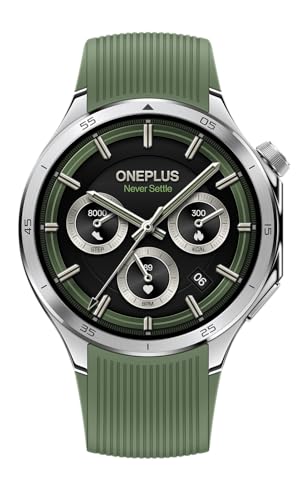
The full Google Wear OS smartwatch that finally breaks the 5-day battery ceiling.
Most full smartwatches with Google’s Wear OS die in two days, but the OnePlus Watch 3 runs up to 120 hours — that is 5 full days — on a single charge. The dual-engine architecture pairs the Snapdragon W5 with the BES2800BP chip to balance performance and power draw. Reviewers point out 3 to 5 days of normal use, and 5 to 7 days with the always-on display and GPS off. The 631 milliamp-hour battery charges in about 80 minutes.
This is a premium build: stainless steel chassis, a titanium alloy bezel, and a sapphire crystal display that one owner says is easier to see in daylight than rivals. Health tracking covers continuous heart rate, SpO2 (blood oxygen), and in-depth sleep analysis. Owners coming from a Galaxy Watch 4 found this far more user-friendly, and one called it “superior to OnePlus 2 and Ticwatch Pro” with better sensors and an amazing display.
The catch is compatibility: it is not compatible with iOS, so iPhone users are locked out. The 47 mm case has a masculine, substantial feel, and the 32GB of storage gives room for apps and music. A 6-month follow-up noted a cracked crystal, but that is a single experience among many positive ones. Battery life and quality are the two most-praised aspects by a wide margin, with health monitoring close behind.
What impresses
- 120-hour battery in a full Wear OS watch
- Titanium alloy bezel and sapphire crystal build
- Dual-engine chips for smooth, efficient operation
- 32GB storage for apps and offline music
The limits
- Not compatible with iOS devices at all
- 47 mm case is large for smaller wrists
- Reports of a cracked crystal after months of use
Pick this if: you are an Android user who wants full Google apps but refuses to charge every night.
skip it if: you use an iPhone — the iOS incompatibility is a hard stop.
6. Amazfit Active 3
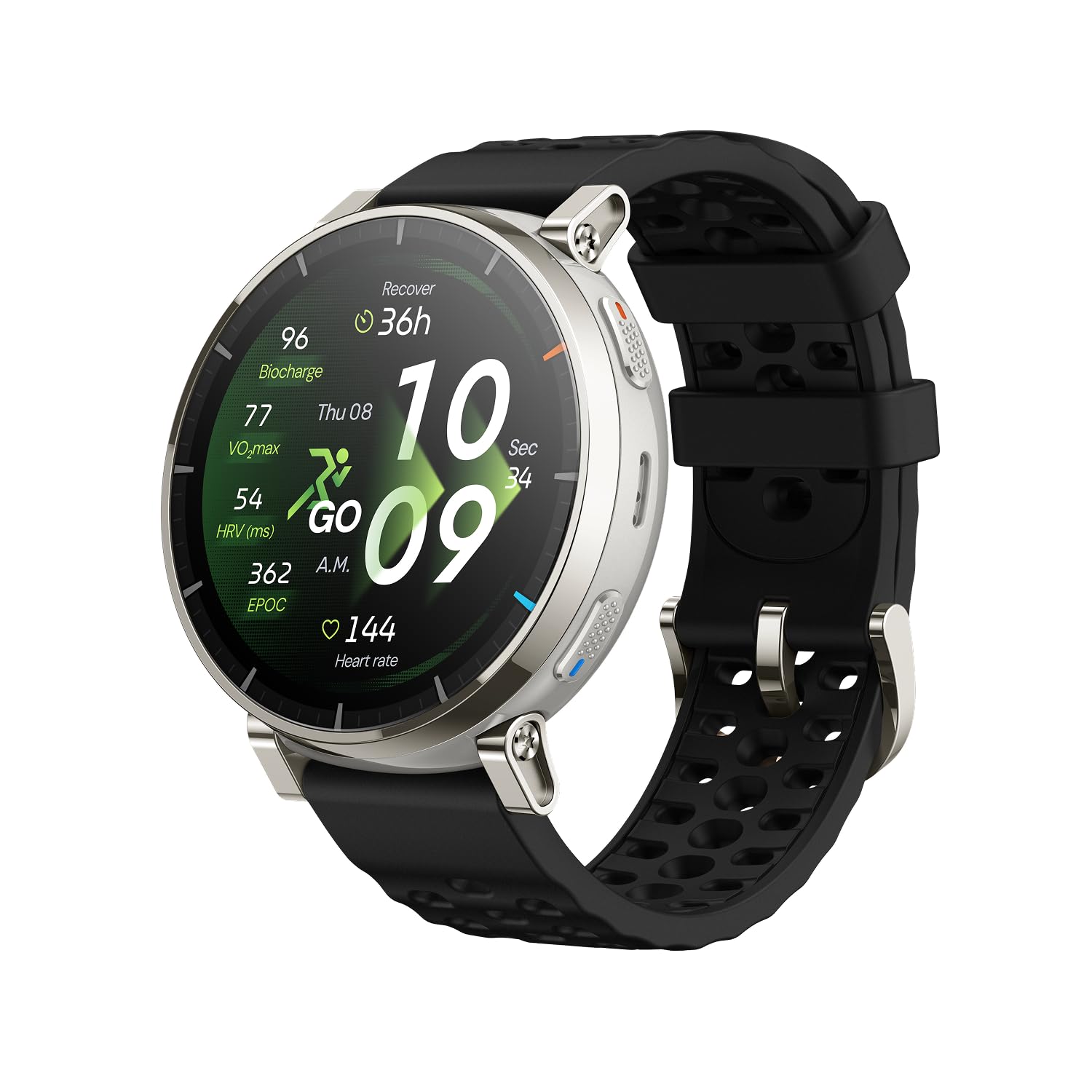
A runner-focused Amazfit with sapphire glass and 12 days of power between charges.
Built specifically for runners, the Active 3 pairs a durable stainless steel frame and sapphire glass with a 1.32″ AMOLED display that stays readable under bright sunlight. The up-to-12-day battery keeps you training through a full training block without hunting for a charger, and shoppers say roughly 12 days in real use. It is lightweight and comfortable enough for all-day wear, which matters when you track recovery days as much as workout days.
The GPS is the standout: six satellite systems lock on fast and accurately, and free offline maps with turn-by-turn directions and automatic rerouting let you explore routes without your phone. Runners can refine their form with insights on posture, running power, lactate threshold, and ground contact time The BioTracker sensor monitors heart rate, blood oxygen, stress, and sleep quality to tell you when to push or rest.
Bluetooth calls from the wrist and Zepp Flow voice commands with speech-to-text replies (on Android) keep you connected mid-run. One owner called it “way better than the price suggests,” praising the modern style, quality, and user-friendly touchscreen menus. The recurring note is that the Zepp app is less polished than rivals, but the 170 workout modes, accurate GPS, and premium feel make this a strong mid-range value.
Runner’s take: accuracy in GPS and a bright outdoor display earn the top praise, with owners calling the battery “amazing — no daily charging” and the feel genuinely premium for the price.
7. Withings ScanWatch 2

A classic analog watch hiding a 35-day battery and medical-grade ECG inside.
This is the watch for people who want fitness tracking but refuse to wear a hi-tech gadget on their wrist. The ScanWatch 2 is a hybrid: real analog hands over a stainless steel case with sapphire glass, yet it tracks heart rate, sleep stages, blood oxygen, and over 40 sports with VO2 max. The battery lasts up to 35 days per charge; one owner saw 87% remaining after 48 hours of heavy use.
The headline feature is the 30-second medical-grade ECG with AFib detection via the Withings ECG App, plus high and low heart rate notifications. Owners with heart conditions praise the detailed HR tracking, and one replaced an Apple Watch for this. The analog hands cleverly move to 10:10 to avoid blocking the digital screen. Sleep tracking earns consistent praise, along with the looks — appearance is the most-mentioned positive aspect.
Here is the honest trade-off: this is not a full smartwatch. The digital screen is tiny, there is no app store, and you will not reply to texts from your wrist. Battery life gets mixed reviews because some owners see drain faster than the 35-day claim, and the ECG accuracy draws divided feedback. This shines for health tracking and style, not smart features. Buyers who loved it called it the only watch they will wear; those who wanted a true smartwatch were disappointed.
Why it wins
- 35-day battery with continuous 24/7 tracking
- Medical-grade ECG and AFib detection
- Sapphire glass and stainless steel elegance
- Sleep stage and breathing tracking built in
Know the limits
- Tiny digital screen, no app ecosystem
- Mixed feedback on battery drain and ECG accuracy
- Crown repair can cost more than the watch after a year
Who it suits: style-conscious health trackers who want weeks of battery and ECG insights in a classic watch.
Who should look elsewhere: anyone expecting a full smartwatch experience with apps and a large touchscreen.
8. Suunto Race
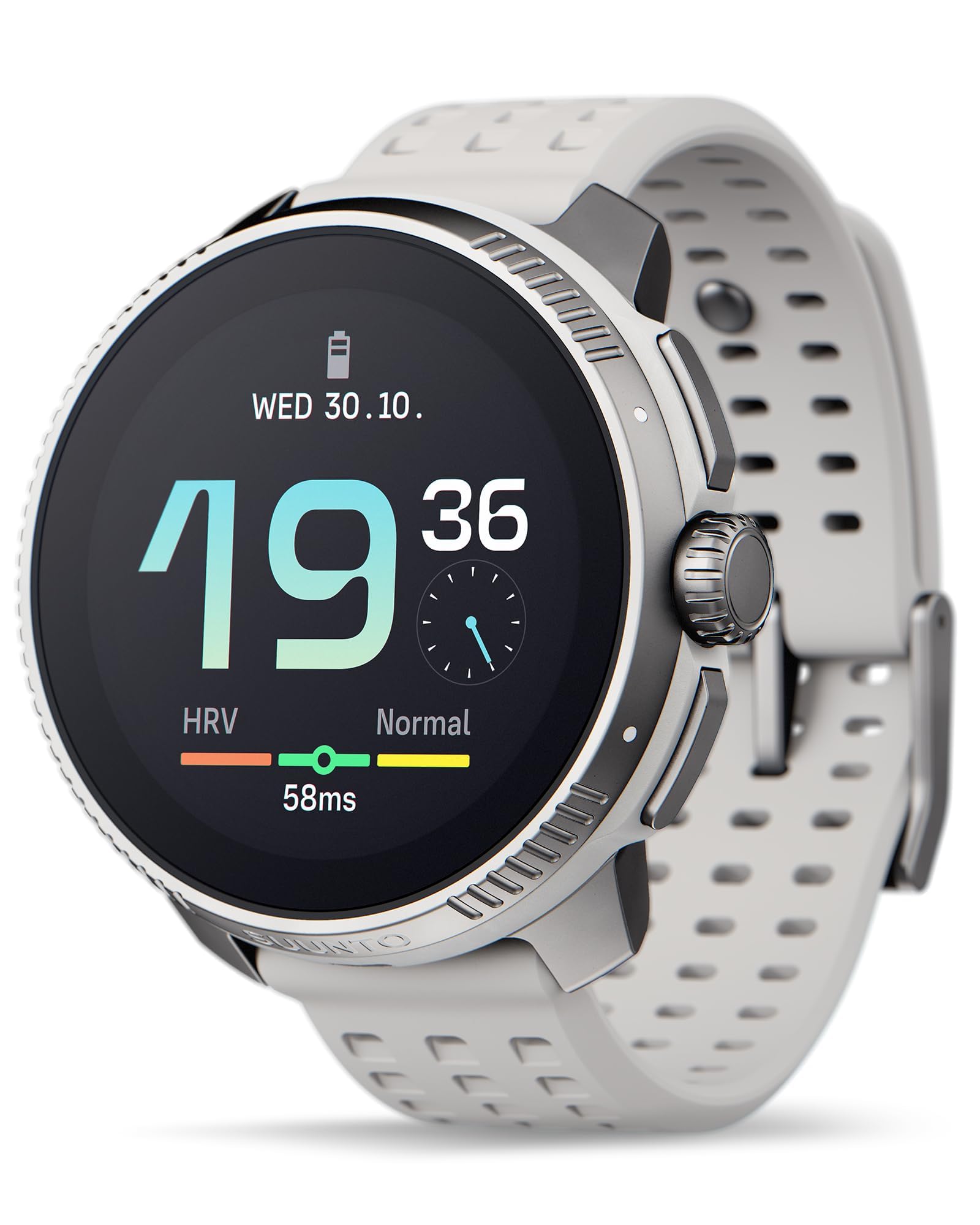
A 49 mm AMOLED training powerhouse with 40 hours of GPS and free offline maps.
Runners who want a bright AMOLED screen without the daily charge will love the Suunto Race. In the most accurate tracking mode, the battery lasts 40 hours, extending to 120 hours in tour mode. In daily mode with 24/7 heart rate tracking, it runs up to 10 days. One owner logged 500+ miles over 11 months and still had 30% battery left after roughly 2 weeks of use with 5-8 runs per day.
The 49 mm AMOLED display is large, bright, and easy to read, with a sapphire lens and a unique digital crown for fast browsing. Dual-band GNSS provides reliable accuracy in tough conditions — among cliffs, valleys, and skyscrapers. Free color global offline maps show paths, contour lines, water, and landmarks, with bread crumb trails and points of interest for navigation.
Owners praise the training metrics, sleep tracking, and 24/7 comfort, with one noting the watch is “just as good as Garmin with a much lower price.” The recurring caveat is heart rate accuracy, which draws mixed feedback — some find it very accurate, others report poor HR monitoring during intense sessions. Connectivity also gets negative marks from some. At 78 grams with a 1.93″ case, it is substantial but not heavy, and the digital crown plus buttons make it easy to use even with gloves.
For serious training: owners call it a refined running device with a great display and “great battery life that Garmin offers in its higher priced watches” — all at a lower price.
9. Withings ScanWatch Nova
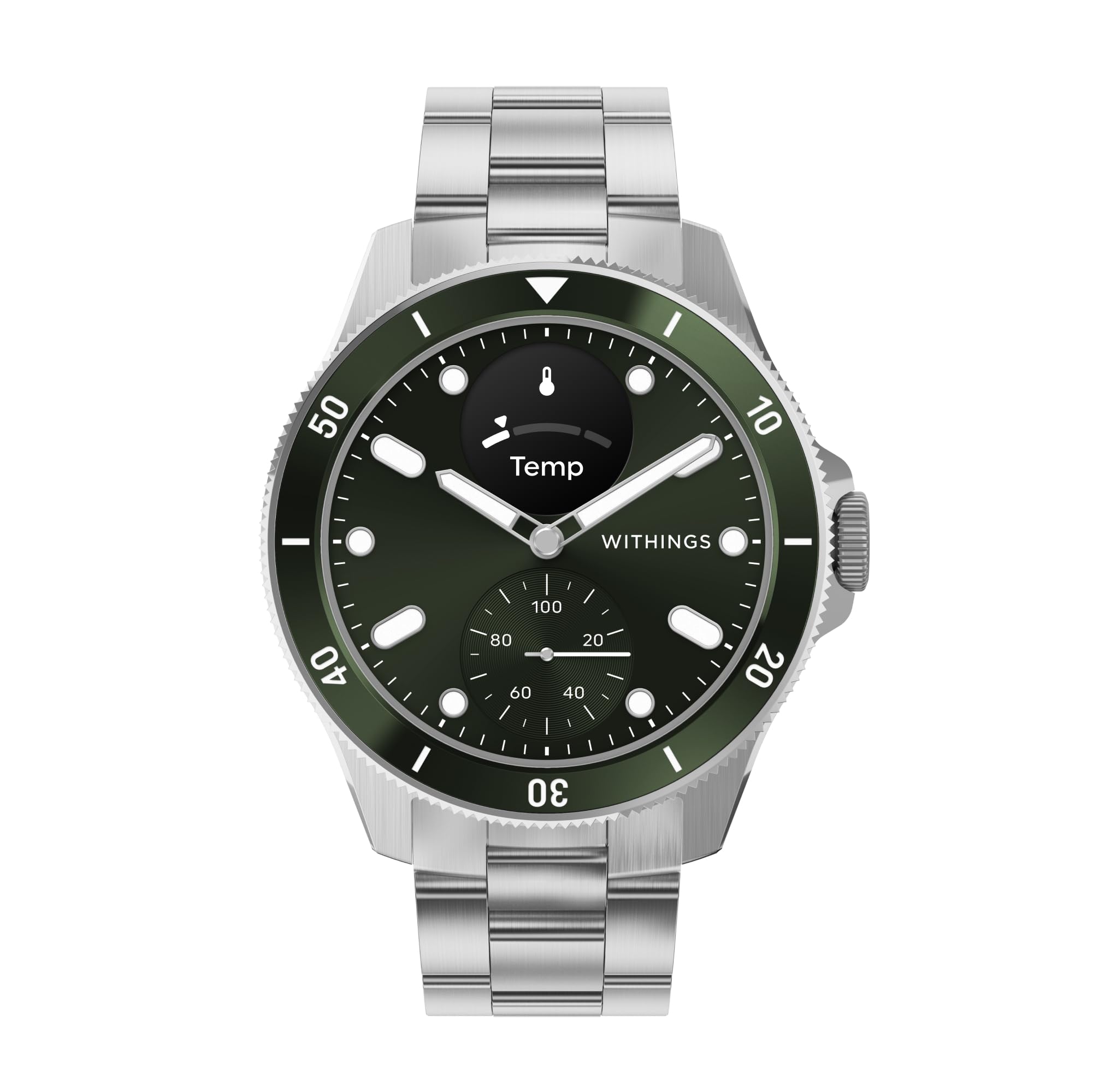
A luxury hybrid with a 30-day battery that tracks heart, sleep, and cycle in classic style.
The ScanWatch Nova takes the hybrid concept to a premium level, delivering 24/7 tracking for up to 30 days on a single charge and coming with a docking station that is USB-C compatible. It recognizes 40+ activities with heart rate zones during workouts, and the connected GPS tracker maps your outdoor sessions. One owner called it “very classy,” comparing it to a Rolex or Omega — and with the silver case and blue band, it genuinely passes as a traditional dress watch.
Health tracking is deep: heart rate monitoring 24/7 with high and low notifications, overnight heart rate variability, blood oxygen (SpO2) and temperature monitoring, respiratory tracking, and a menstrual cycle guide that logs phases, duration, flow, mood, and symptoms. Sleep tracking delivers a Sleep Quality Score with light sleep, deep sleep, duration, disturbances, and regularity. The 2-hour charge time means a quick top-up covers a full month.
The honest trade-offs are real. Battery life in practice runs closer to 20 days, or 14-15 with training, versus the 30-day claim. Sleep metrics draw mixed feedback, with one owner finding it off by 1-2 hours compared to other trackers. There is no on-watch alarm — that lives in the app — and the battery is non-replaceable. Functionality and value get mixed reviews, but appearance and quality lead the praise. The 180 milliamp-hour battery and 30-day rating make this a month-long companion for those who value style first.
What you get
- 30-day battery with USB-C docking station
- SpO2, temperature, and respiratory monitoring
- Menstrual cycle guide with logging tools
- Premium materials with a classic watch look
What to weigh
- Real-world battery near 20 days, less with training
- Sleep metrics can be off by an hour or two
- No on-watch alarm, non-replaceable battery
Choose this for: a premium, dress-watch aesthetic with serious health tracking and a month-long charge cycle.
Look elsewhere if: you need reliable sleep accuracy or an on-wrist alarm — those are genuine weak points here.
Understanding the Specs
Smartwatch Mode vs GPS Mode Battery
Every battery claim is tied to a specific usage scenario. Smartwatch mode means basic notifications, heart rate, and sleep tracking with minimal screen time — this is the “25 days” or “28 days” number. GPS mode, where the satellite receiver actively tracks your location, drains much faster, which is why Suunto quotes 40 hours and Garmin quotes 48 hours for the same kind of activity. Always match the number to how you actually train.
Solar Charging and Lux Ratings
Solar lenses convert sunlight into battery power, but the math depends on light intensity. Garmin’s “unlimited battery” claims assume roughly 3 hours per day in 50,000 lux conditions — that is bright, direct sunlight, not a cloudy day or an office window. For outdoor enthusiasts who genuinely live in the sun, this means near-infinite battery. For indoor workers, solar adds a day or two at best. The 50,000 lux figure is the real threshold for solar gains.
FAQ
How long does a fitness watch battery actually last in real-world use?
What is the difference between MIP and AMOLED displays for battery life?
Does solar charging really give unlimited battery life?
What is the difference between smartwatch mode and GPS mode battery life?
Why does a hybrid watch last 30 days when a full smartwatch lasts 5 days?
Will a battery life fitness watch work with an iPhone?
How long does it take to charge a long-battery-life watch?
Is a 10-day battery enough, or should I aim for 25-plus days?
Final Thoughts: The Verdict
For the majority of shoppers, the strongest battery life fitness watch overall is the Garmin Instinct 2X Solar because solar charging plus military-grade durability makes it the only watch that genuinely never needs a charger. If you want a bright color screen that still lasts 25 days, grab the Amazfit Active Max And for a classic analog look with 30-plus-day battery and ECG, the Withings ScanWatch 2 is the one to reach for. The crowd favorite across the board holds its 4.7-star rating with 600+ owners praising its functionality and quality above all else.
How We Picked
We do not accept paid placement. Every pick is matched to a real buyer and a real use-case; we do not hands-on test units.
Sources & Methodology
Specifications: manufacturer listings and product documentation. Review insights: verified customer reviews, as of August 2026. Pricing: not shown on this page (it changes often); check the current price via the retailer link.
As an Amazon Associate, Gadgets Feed earns from qualifying purchases. This does not affect which products we feature.