
Our readers keep the lights on and my morning glass full of iced black tea. As an Amazon Associate, I earn from qualifying purchases.
Specs are compiled from manufacturer listings and verified buyer reviews and can change over time — please confirm the key details on the product page before buying.
If your phone dies before dinner, the fix is a handset with a genuinely bigger battery, not a power bank. What you want is a phone you charge every second or third night and forget about in between. In the picks below, the honest split is that most everyday phones settle for a 5000 mAh battery (milliamp-hours — roughly a day of normal use), while the rugged crowd runs all the way up to 25500 mAh. Both live comfortably in this bracket.
I’m Min — the founder and writer behind Gadgets Feed. This guide is built by comparing the manufacturers’ published specifications and the patterns across verified customer reviews, so you get each pick’s real strengths and trade-offs instead of marketing spin.
Some of these phones will not work on Verizon or AT&T at all, and that carrier detail matters more than any spec sheet. Every entry here is an open up handset that fits the money limit, sorted by what it actually does best — so the answer to your next phone is choosing the battery life phone under $500.
Our Picks at a Glance


How To Choose The Best Battery Life Phone Under $500
A big battery number on a spec sheet is only half the story. The other half is whether the phone runs on your network, how heavy it gets in your pocket, and how fast it refills once it finally runs flat. Get those three right and the phone stops being something you have to manage.
Check the carrier bands before you check the battery
Several of these handsets are international models built for GSM networks. On US soil that often means T-Mobile and its smaller brands work fine, while Verizon and AT&T do not. One pick here, the Moto G Power, is explicitly made for US carriers, which is why it costs a little more than its battery size alone would suggest. Read the bands list on every listing before you buy — a phone that will not make calls is not a long-battery phone, it is a paperweight.
Match capacity to how you actually use the phone
If you browse, message, and take the odd photo, a 5000 mAh cell is a full day of mixed use. If you camp, work outdoors, or regularly go two days without a charger, a 10000 mAh cell or larger turns charging into a weekend chore instead of a nightly one. Going past 20000 mAh is a different commitment entirely — that is a phone you plan your pocket around, not the other way down.
Weigh the charge speed against the size of the tank
A 22000 mAh cell on a 20W charger spends hours tethered to a wall. Look at the charging wattage as well as the capacity: 25W is modest, 66W refills quickly, and reverse charging lets the phone top up another device. On the biggest cells, 66W is what makes the capacity practical.
Quick Comparison
| Model | Best For | Battery Capacity | Talk Time | Charging | Amazon |
|---|---|---|---|---|---|
| Samsung Galaxy A06★ Best Overall | Budget everyday use | 5000 mAh | — | 25W wired | Amazon |
| Samsung A16Big Screen Value | Big screen on a budget | 5000 mAh | 41 hours | — | Amazon |
| Motorola Moto G PowerWorks On Every Carrier | US carrier freedom | 5000 mAh | 24 hours | 30W TurboPower | Amazon |
| Blackview Rugged Phone | Work sites and camping | 10000 mAh | 20 hours | — | Amazon |
| FOSSIBOT F106 Plus | Outdoor night use | 12000 mAh | — | 20W | Amazon |
| TCL NXTPAPER 70 Pro | Readers and note takers | 5000 mAh | — | Fast charging | Amazon |
| Ulefone Armor 24 | Week-long off-grid trips | 22000 mAh | 168 hours | 66W | Amazon |
| Ulefone Armor 33 | Maximum capacity | 25500 mAh | — | 66W | Amazon |
In‑Depth Reviews
1. Samsung Galaxy A06 4G LTE Dual SIM 4+64GB International Black
Our pick — 4.5+★ from 450+ verified ratings; the strongest balance of quality and price.
The cheapest route to a full day of charge, with a big screen and a Samsung badge.
You get a full day of ordinary messaging, browsing, and photos before this phone needs a socket, thanks to its 5000 mAh battery (mAh means milliamp-hours — the bigger the number, the longer it runs). It refills over USB Type-C at 25W (watts — how fast power flows in), which is modest but predictable, and a 25W charger is not in the box. If you are upgrading from an aging handset, the 6.7-inch screen at 720 x 1600 pixels (262 ppi, or pixels per inch — how tightly the dots pack, so text stays legible but does not look razor sharp) keeps reading comfortable. The 50 MP main camera handles daylight shots cleanly.
What consistently wins people over is build confidence for the money — Samsung’s budget hardware feels more put together than most rivals at this tier. There is a single 50 MP wide lens plus a 2 MP depth sensor for portrait blur, so you get one good camera rather than a versatile set. Face recognition open up it, and the package includes a case, a cable, and a SIM tray ejector.
The catch is the network. This 4G model is compatible with GSM networks worldwide but, in the US, only T-Mobile and its smaller brands — Metro and Standup — will take it. Verizon, AT&T, Spectrum, Cricket, and their branded partners will not. On T-Mobile it is a bargain daily driver; on Verizon or AT&T it will not activate. The 64GB of storage is also tight once apps and photos pile up, and there is one honest watch-out: a small number of these arrive with a fault, so buy from a seller with a clean return path.
Where it earns its keep
- 5000 mAh delivers a full day of mixed use from a single charge.
- 6.7-inch screen with 262 ppi keeps everyday text and video easy on the eyes.
- 50 MP main camera holds up well in good light.
- Face open up and a bundled case make it a complete starter kit.
What to plan around
- T-Mobile only in the US — no Verizon, AT&T, or their smaller brands.
- No charger included in the box.
- 64GB of storage fills fast if you shoot a lot of video.
- No 5G on this model.
Reach for it when: you are on T-Mobile and want the least expensive path to a dependable all-day battery.
Keep walking if: your SIM comes from Verizon, AT&T, or any of their partner brands.
2. Samsung A16 4G International open up 4+128GB Gray DualSIM
A 41-hour talk time and a crisp AMOLED screen for people who take long calls.
Look at the call figure first: 41 hours of talk time off the same 5000 mAh battery the A06 carries, which is a genuine endurance edge if your phone doubles as a work line. The screen is the other draw — a 6.7-inch Super AMOLED at 1080 x 2340 pixels and 385 ppi. Compared with the A06’s 720 x 1600 at 262 ppi, that is a visibly finer panel, and the 90Hz refresh (how many times per second the screen redraws) makes scrolling feel lighter.
Storage doubles to 128GB, and you get a fingerprint reader instead of face-only open up. The 50 MP wide lens is joined by a 50 MP secondary and a 2 MP macro for close-ups, so the camera set is broader than the cheaper Samsung above. Samsung’s own listing pegs average battery life at 14.4 hours of use, which lines up with a comfortable single day rather than a multi-day stretch.
Here is the friction. Only T-Mobile and its smaller brands will activate this international 4G model in the US — the same restriction as the A06, and it is the single biggest reason a buyer returns one. The 128GB on board has no microSD slot listed, so plan your photo habit accordingly. On T-Mobile, though, the combination of that talk time, the AMOLED panel, and the 128GB is hard to argue with at this tier.
Screen you notice: the AMOLED and 385 ppi put the A16 clearly ahead of the A06 on sharpness, and 90Hz smooths out scrolling in a way budget LCDs cannot match.
Carrier caution: it is a GSM handset that works on T-Mobile and its smaller brands in the US, so check your SIM’s network before ordering.
Suits you if: you log a lot of call hours and want a sharp AMOLED screen without stretching the budget.
Think twice if: you are tied to Verizon or AT&T, or you need expandable storage.
3. Motorola Moto G Power – 2025 | open up | Made for US 8/128GB | 50MP Camera | Leaf Green
The one that simply works on Verizon and AT&T, with a 120Hz screen and 5G on top.
Almost every other phone on this list demands you check your carrier first. This one does not — it is built for the US market and compatible with all major carriers including Verizon, AT&T, and T-Mobile. For anyone on Verizon or AT&T, that compatibility alone settles the choice.
The screen is the surprise: a 6.8-inch OLED at 2388 x 1080 with a 120Hz refresh, so scrolling and video look noticeably smoother than the 90Hz Samsung above. There is a 50 MP camera with optical image stabilization (OIS — a tiny motor that steadies the lens, so low-light shots and handheld video come out cleaner). You also get 5G on the MediaTek Dimensity 6300 chipset, vegan leather on the back, Corning Gorilla Glass, and microSD expansion up to 1TB.
Owners are split on the battery — some find it excellent and some find it drains faster than the number suggests, so treat the 24-hour talk-time rating as a real-world guide rather than a promise. The other honest note is connectivity: a handful of buyers report trouble on Verizon or Total Wireless despite the US-market design, so set it up and test calls during your return window.
Why buyers gravitate here
- Made for US carriers, so Verizon, AT&T, and T-Mobile all work.
- 6.8-inch OLED at 120Hz for smooth scrolling and video.
- 50 MP camera with OIS for steadier low-light shots.
- microSD expansion up to 1TB and 5G on board.
Small print worth reading
- Battery feedback is genuinely mixed among owners.
- 30W charger sold separately, and wireless charging needs the right pad.
- A minority report Verizon and Total Wireless setup trouble.
Strongest case: you want a battery phone without carrier guesswork, and 5G plus a 120Hz screen seal it.
Less ideal: if you expect multi-day runtime from a 5000 mAh cell — this is a one-day phone.
4. Blackview Rugged Phone Android 16, 10000mAh Battery 12GB+128GB/2TB Expand Gemini AI 6.56 Inch 90Hz 4G T-Mobile Dual SIM IP69K Waterproof
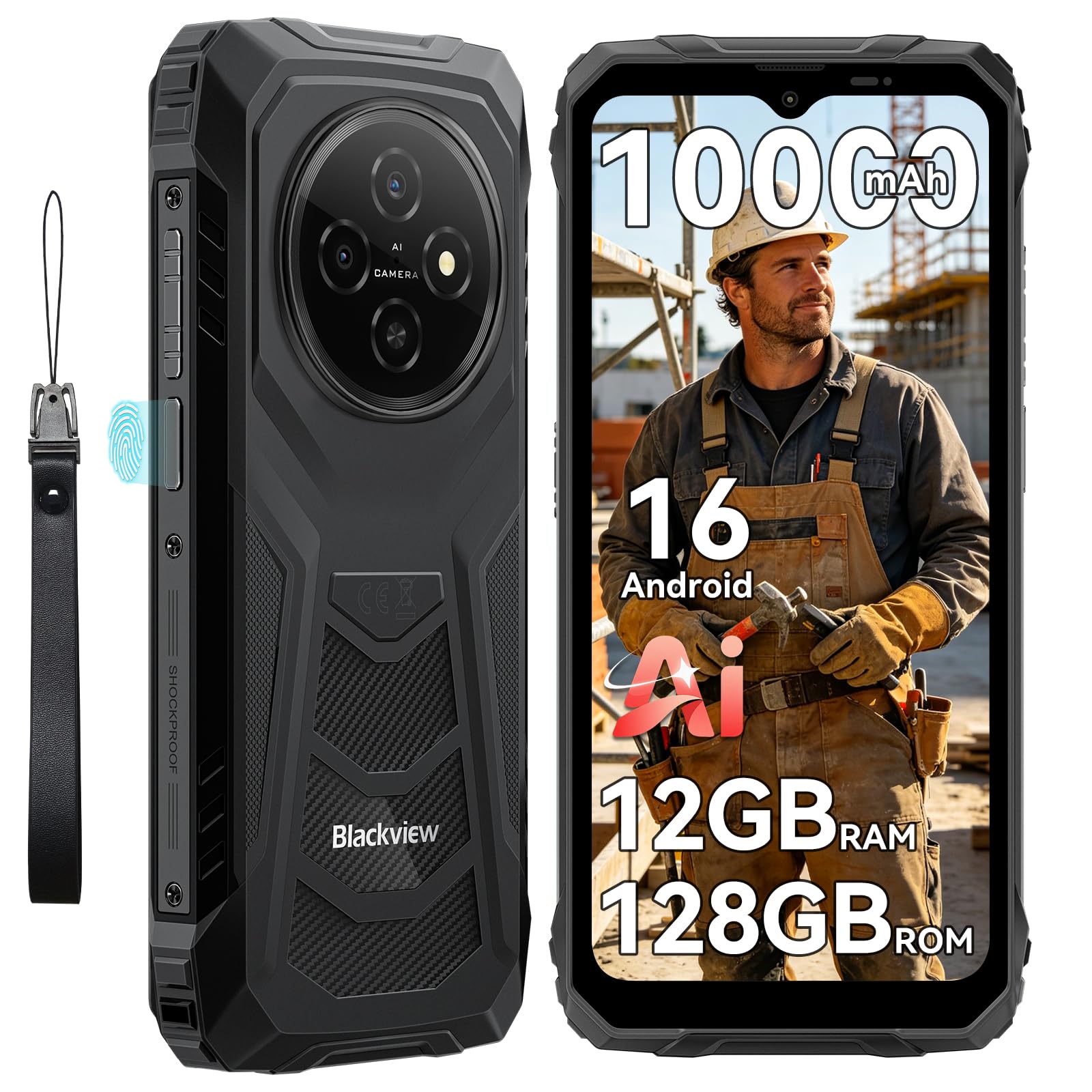
Twice the battery of the everyday phones above, wrapped in a drop-proof, waterproof shell.
This is the point where battery capacity doubles. The Blackview carries 10000 mAh — twice the Samsung Galaxy A06’s 5000 mAh — which the maker rates at up to 20 days of standby, 20 hours of talk time, and 8 hours of video playback. For anyone who works outdoors or camps regularly, that turns the nightly charge into a weekly one. The 20-hour talk time is also roughly half the Samsung A16’s 41-hour figure, which is worth knowing if long calls are your thing rather than video.
The body is the second reason to pick it: a 2-meter drop rating, 30 minutes of water protection, and full dust sealing, aimed at construction sites, warehouses, and camping trips. The 6.56-inch screen runs at 720 x 1612 with up to 450 nits (a brightness measure — how readable it stays under open sky) and a 90Hz refresh. Android 16, 12GB of RAM, 128GB of storage, and microSD expansion up to 2TB cover the software side, and OTG support lets it feed power to another USB device.
Speed is the honest weak spot — owners split between finding it quick and finding it slow, and the 16 MP camera trails the Motorola’s 50 MP by a clear margin. Carrier support is T-Mobile and its smaller brands, with dual SIM for two nano cards. One more thing worth knowing before you buy: Blackview backs it with a three-year after-sales service and round-the-clock technical support, which is a longer commitment than most budget phones offer.
Battery math that matters: 10000 mAh against the A06’s 5000 mAh is the whole story here — double the cell, and the difference between charging nightly and charging weekly.
Performance reality: owner opinion on speed is genuinely divided, so this suits patient use — calls, maps, messages, camera — more than gaming.
Best fit: trade and outdoor workers who need a phone that survives a drop and runs for days.
Look elsewhere: if you want fast app performance or a top-tier camera — this is a tool, not a camera phone.
5. FOSSIBOT F106 Plus Rugged Phone 12000mAh/20W Battery Phone

A 12000 mAh tank with a built-in lantern and a night-vision lens for after dark.
Campers and night-shift workers get something the other phones here cannot offer: a 20 MP infrared night-vision camera that photographs and records in pitch black. That is a genuinely different tool, useful for checking a campsite, spotting wildlife, or walking a dark trail. The 12000 mAh battery sits between the Blackview’s 10000 mAh and the Ulefone’s 22000 mAh, and refills at 20W — slower than the Ulefone’s 66W, so plan a longer charge when you do top it up.
Alongside the night lens is a 50 MP AI main camera and an 8 MP front camera, plus a 512-lumen camping light with lighting, SOS, and flash modes, and an exclusive red-and-blue warning mode for roadside emergencies. Dual speakers rated at 128dB push loud, clear audio for calls or music outdoors. It is a 4G dual-SIM handset, and the package includes a phone case.
Two honest limits. Sound quality gets mixed reactions — loud but not refined. And with only a small pool of buyers so far, you are trusting a newer brand more than you would with Samsung or Motorola. The pay-off is a phone that lights your tent, sees in the dark, and lasts days between charges.
Pick it for: night-time outdoor work or camping, where the infrared camera and the 512-lumen lantern earn their place.
Pass if: you want a proven big-name brand and fast charging — 20W is on the slow side for a cell this size.
6. TCL NXTPAPER 70 Pro open up Android Phone, 6.9″ 120Hz Display, 8+256GB
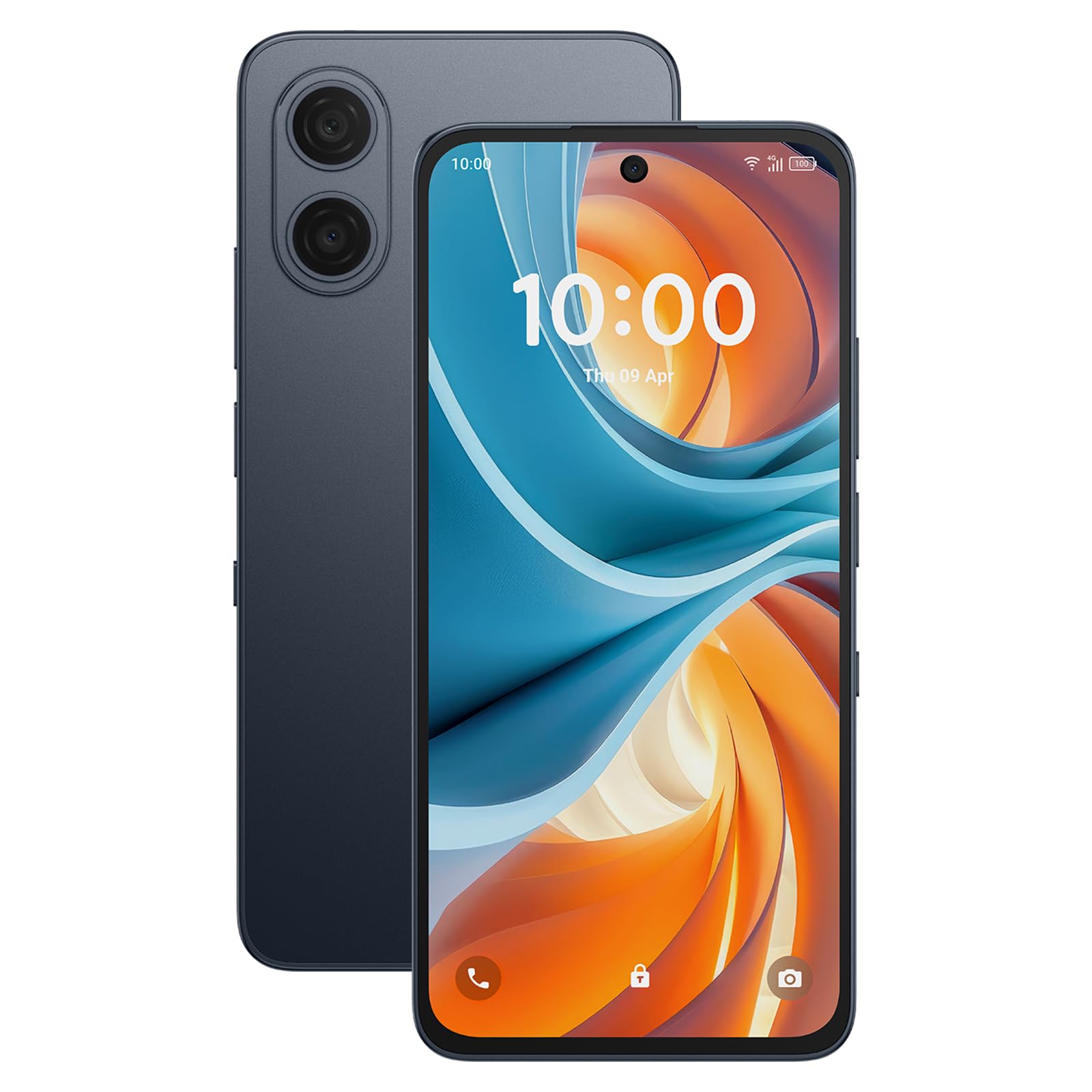
The 6.9-inch paper-feel screen that saves your eyes — with an ink mode that stretches battery.
Reading for hours is easier on the eyes here, because the 6.9-inch NXTPAPER 4.0 panel (a matte-style screen) is anti-glare and flicker-free. It runs four modes — Standard for apps, Color Paper for illustrations, Ink Paper for ebooks, and Max Ink for focused reading, which TCL says helps battery life. That Max Ink mode is the practical battery lever here, alongside a 5000 mAh cell. For students and commuters who read for hours, a battery that sips power during reading beats a giant tank that drains on a bright screen.
This is the only 5G phone in the mid-group, with WiFi 6E and IP68 water and dust resistance — a tougher seal than most non-rugged phones carry. The MediaTek Dimensity 7300 chip runs Android 16, backed by 8GB of physical RAM and up to 16GB expandable for 24GB total, plus 256GB of storage expanding to 2TB. Photography covers a 50 MP main, an 8 MP ultra-wide, and a 32 MP front camera, with OIS and a Super Night Mode for dim settings. It has hardware-level blue light reduction drawn down to 3.41%.
Battery reports are mixed — some call it fantastic, others say it drains fast, which is the honest reality of any 5000 mAh phone driving a screen this large. The anti-glare panel is the reason to choose it; if pure runtime is your goal, the rugged phones further down outlast it comfortably.
The reading advantages
- 6.9-inch anti-glare NXTPAPER display with a dedicated Ink Paper mode.
- Max Ink mode trades brightness for longer reading time.
- 5G, WiFi 6E, and IP68 on a non-rugged phone.
- 256GB storage plus 24GB total RAM for heavy multitasking.
The trade-offs to note
- Battery life draws mixed feedback from owners.
- 5000 mAh won’t outlast the rugged phones here for raw runtime.
- Its best trick — the paper screen — appeals to readers more than gamers.
Made for: readers, students, and anyone who spends evenings with a screen and wants less glare.
Not the pick for: multi-day off-grid trips — this is a one-day battery with a smarter screen.
7. Ulefone Armor 24 22000mAh Mega Battery open up Rugged Phone, Camping Light, 24GB RAM +256GB ROM, 6.78″ FHD+120Hz Screen

A 22000 mAh battery rated for 168 hours of talk time and about seven days off-grid.
If runtime is the only metric you care about, this is the number that stands out: a 22000 mAh battery that Ulefone rates at 168 hours of talk time, which is roughly four times the Motorola’s 24-hour rating. The maker describes it as about seven days of use without hunting for a charger. Better still, 66W rapid charging refills the whole tank in about 130 minutes, and OTG lets it double as a power bank for your other gadgets in an emergency.
You get real capability for the money: a 6.78-inch FHD+ screen at 120Hz (FHD+ means sharp full high-definition; 120Hz means it refreshes 120 times a second, so scrolling looks smooth). The 64 MP main camera pairs with a 64 MP night-vision camera, and there is a 16 MP front shooter. You also get up to 24GB of RAM (working memory for apps) and 256GB of storage that expands to 2TB. A 1000-lumen rear LED light (lumens measure brightness) pulls up to 6 watts and throws a beam over a good distance, useful in wet or harsh conditions. It carries IP68/IP69K water and dust ratings (sealed against dust and water jets) and MIL-STD-810H certification (a US military durability standard), and T-Mobile plus Metro PCS will activate it.
Here is what the reviews confirm in plain terms: this is a heavy phone. At 647 grams and 28 mm thick, it is roughly the weight of a small tablet in your hand and it will not sit comfortably in a slim pocket. It also will not work with AT&T, Cricket, Sprint, or Boost Mobile. Buy it knowing those two facts and it delivers endurance almost nothing else here matches.
Capacity that earns its weight: 22000 mAh against the Motorola’s 5000 mAh is the headline gap, and 168 hours of rated talk time backs it up.
Pocket cost: 647 grams and 28 mm thick — measure a pocket before you commit, because this is a two-hand phone.
Worth it for: multi-day expeditions, remote job sites, and anyone who refuses to carry a power bank.
Skip if: you want a light everyday phone or you’re on AT&T or Cricket.
8. Ulefone Armor 33 25500mAh Battery (66W) Rugged Phone, Android 15 24GB+512GB, 6.95″ FHD 120Hz Screen
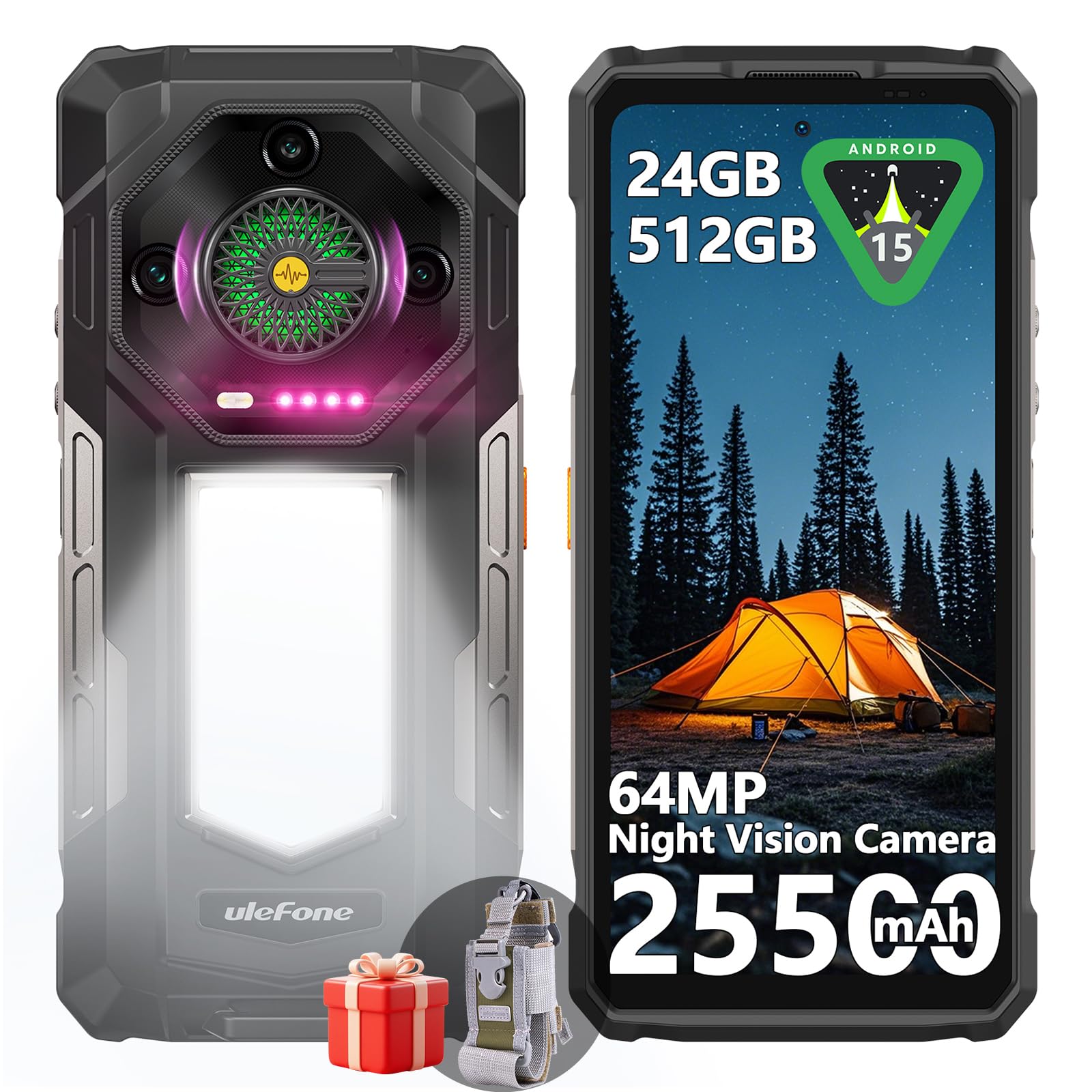
The biggest battery in the group at 25500 mAh, and it charges other devices too.
This is the ceiling of the category: a 25500 mAh cell that Ulefone rates at 10 full days of use, refilled by 66W fast charging. It can also push 10W of reverse charge into another device over a cable. That reverse-charge feature matters — with a cell this large, the phone becomes a genuine backup power source for a friend’s dead handset, a headlamp, or a pair of earbuds. On raw capacity it beats the Armor 24’s 22000 mAh, and it is the largest tank on the list.
The hardware matches the ambition. The 6.95-inch FHD+ screen at 2460 x 1080 and 120Hz hits 700 nits (a brightness measure — bright enough to read outdoors) and wears Corning Gorilla Glass 5 (a scratch-resistant cover glass). Cameras run a 50 MP main, a 50 MP ultra-wide, and a 64 MP infrared night-vision camera, plus a 32 MP selfie lens. You get 24GB of RAM with 512GB of storage expanding to 2TB. A 1100-lumen LED light with a warning-signal mode, a 118dB speaker (decibels measure loudness) with an Infinite Halo 2.0 ring light, and IP68/IP69K protection with MIL-STD-810H certification round out the package.
Before you commit, weigh what you are carrying: 765 grams and 34 mm thick is heavier and chunkier than the Armor 24, and it will not work with AT&T or Cricket. At this tier the phone is also newer to market, so there are fewer long-term owner reports to lean on. What is certain is the capacity — nothing else here lasts close to ten days.
Choose this if: maximum runtime is non-negotiable and you want reverse charging as a bonus power bank.
Then go elsewhere if: 765 grams is more phone than you want to carry, or your SIM is AT&T.
Understanding the Specs
Battery capacity in mAh
The milliamp-hour figure tells you how much charge the cell holds. A 5000 mAh battery is a solid day for most people, while a 22000 mAh or 25500 mAh battery stretches into days. Bigger numbers also mean more weight and bulk, so match the size to how often you can reach a charger. The other useful figure is talk time in hours — it shows the endurance of the radio, not just the cell.
Charging wattage and reverse charge
Wattage tells you how fast the battery refills. A 25W charger is modest, 66W is quick for a giant tank, and reverse or OTG charging lets the handset act as a power bank. Higher wattage matters most on bigger cells — a slow charger on a 22000 mAh battery turns a refill into an overnight job, while 66W can top it up in a couple of hours.
Carrier bands and compatibility
An open up phone is not automatically compatible with every network. Many imported 4G models list GSM bands that work with T-Mobile and its smaller brands but not Verizon, AT&T, or their partners. Check the band list on the listing before you buy — this is the single most common reason buyers return a phone in this category.
Rugged ratings: IP68, IP69K, MIL-STD-810H
These codes describe how well a phone survives the world. IP68 and IP69K cover water and dust, and MIL-STD-810H is a military durability standard for drops and extreme temperatures. On the rugged picks here they come with extra hardware like night-vision cameras and built-in lights, which is why those phones carry more weight than a slim everyday model.
FAQ
Will these open up phones work on Verizon or AT&T?
How many days can a 22000 mAh phone actually last?
Is a bigger battery phone always heavier?
What does 5000 mAh mean in real daily use?
Do these phones include a charger in the box?
Can a rugged phone replace a power bank?
Is a 66W fast charger worth it on a huge battery?
Will the TCL NXTPAPER’s Ink Paper mode really save battery?
Which is better for camping: the Ulefone or the Blackview?
Do these phones support microSD cards?
Final Thoughts: The Verdict
For most people, the long-battery winner is the Motorola Moto G Power — it is the only pick here built for all major US carriers, and it adds a 120Hz OLED screen and 5G on top of its 5000 mAh cell. If you are on T-Mobile and want the lowest-cost reliable starter, the Samsung Galaxy A06 does the job with a 5000 mAh battery and a big screen. And when the trip leaves the grid entirely, the Ulefone Armor 24 is the one to reach for, with its 22000 mAh cell and 168-hour talk-time rating. Whichever way you go, check your carrier bands first — that single detail decides whether any of these phones work for you.
How We Picked
We do not accept paid placement. Every pick is matched to a real buyer and a real use-case; we do not hands-on test units.
Sources & Methodology
Specifications: manufacturer listings and product documentation. Review insights: verified customer reviews, as of November 2026. Pricing: not shown on this page (it changes often); check the current price via the retailer link.
As an Amazon Associate, Gadgets Feed earns from qualifying purchases. This does not affect which products we feature.