
Our readers keep the lights on and my morning glass full of iced black tea. As an Amazon Associate, I earn from qualifying purchases.
Specs are compiled from manufacturer listings and verified buyer reviews and can change over time — please confirm the key details on the product page before buying.
That slow crank on a cold morning is your battery begging for a check-up, and a load tester is the only tool that tells you the truth without waiting for a breakdown. This guide cuts through the digital-versus-analog debate to show you which battery load tester actually deserves a spot in your garage, and which specs truly determine if it can handle your car, truck, or boat.
I’m Min — the founder and writer behind Gadgets Feed. This guide is built by comparing the manufacturers’ published specifications and the patterns across verified customer reviews, so you get each pick’s real strengths and trade-offs instead of marketing spin.
Here is the honest breakdown of the best battery load tester options, from simple analog coils to feature-packed digital analyzers, matched to how you actually use your vehicles.
Our Picks at a Glance


How To Choose The Best Battery Load Tester
Choosing the right tester boils down to if you want a simple pass/fail verdict or a full report card on your vehicle’s electrical system. Your decision mostly hinges on the voltage of your vehicles, the battery types you own, and how deep you want to diagnose starting problems.
Physical Load vs. Conductance Testing
Traditional load testers, like the OTC 3181, work by forcing a heavy current (often 100-130 amps) through a resistor coil, which puts real strain on the battery to mimic the starter motor. These tools are straightforward and brutal, but they generate serious heat and only test the battery’s ability to hold voltage under a literal load.
Digital conductance testers, meanwhile, send a small signal through the battery and algorithmically calculate its internal resistance. These are much faster, do not heat up, and give you precise numbers like State of Health and internal resistance — perfect for catching a weak cell before it leaves you stranded on a winter commute.
Matching the Tester to Your Fleet
Check the tester’s stated CCA testing capacity against the labels on your batteries. If you own a heavy-duty truck or boat with high cold cranking amps, you need equipment that reaches beyond 1,200 CCA or even up to 2,000 CCA. For basic cars with standard batteries, a simpler 6V/12V analog tester costing less might be all you need.
Quick Comparison
| Model | Best For | Testing Range | System Support | Key Output | Amazon |
|---|---|---|---|---|---|
| Clore SOLAR BA9★ Best Overall | Accurate Digital Reports | 40-1200 CCA | 12V | SOH/SOC/LCD | Amazon |
| OTC 3181Heavy-Duty Pick | Heavy-Duty Garage Use | 130 Amp Load | 6V / 12V | Analog Meter | Amazon |
| VDIAGTOOL BT500Versatile Value | Diagnosing Alternators | 5-3000 CCA | 6V / 12V / 24V | Waveform/AC Ripple | Amazon |
| Battery Tender 026-0020 | Fleet & 6V/12V Usage | 1000 Cranking Amps | 6V / 12V | Analog Load | Amazon |
| Autel BT506 | Scanner Integration | 100-2000 CCA | 6V / 12V | Smart Reports | Amazon |
| TOPDON BT600 | Printing Reports | 100-2000 CCA | 12V / 24V | Built-in Printer | Amazon |
| TOPDON BT50 | Compact Quick Checks | 100-2000 CCA | 12V | One-button Test | Amazon |
| VDIAGTOOL BT300 | Data Logging | 5-3000 CCA | 6V / 12V | Bluetooth/App | Amazon |
| KAIHENG CSY-4 | Budget-Friendly Basic Use | 100A / 50A Loads | 6V / 12V | Analog Meter | Amazon |
In‑Depth Reviews
1. Clore Automotive SOLAR Digital 12V Battery and System Tester
Our pick — over 4.5★ from 800+ verified ratings; the strongest balance of quality and price.
This pocket-sized tester delivers a full battery health report, not just a pass/fail guess.
Owners praise its accuracy: it reports actual numbers and percentage of full strength, not just voltage. It is designed around a 40-1200 CCA testing capacity for 12V systems, and it handles Flooded, AGM, Spiral, and Gel Cell batteries — which covers nearly every standard car and marine battery you will own.
Weighing just 9.6 ounces, the device is compact and handy, with a backlit screen that stays readable even in harsh sunlight. Beyond a basic load test, it functions as a system tester that checks the alternator and starter, showing resting voltage, cranking voltage, and charging system performance — all of which helps you predict a failure before it happens, like catching a battery declining in extreme heat before it leaves you stranded.
Buyers report testing 1100CA marine batteries and getting readings of 1064/1104 CA, which shows how well it tracks real-world performance against manufacturer claims. As owners put it: “Tested 1100CA marine batteries at 1064/1104 CA.” The only recurring note is that the included instructions can be unclear, so most users end up turning to video tutorials for the finer points — a minor hurdle for a tool this valuable.
Lab-grade insight: What wins people over is the depth of data — internal resistance, state of health, and state of charge all from a device that fits in a glovebox. It makes the manual BA7’s single-line LED display feel ancient by comparison.
Reach for this if: you want to know exactly how much life is left in your battery and whether your charging system is healthy, all explained in clear numbers on an LCD.
Look elsewhere if: you need 6V testing — this unit is purely a 12V tool, so classic motorcycle or vintage car owners should check the digital 6V/12V options.
2. OTC 3181 130 Amp Heavy-Duty Battery Load Tester
The analog brute that applies a real 130-amp strain to find weak cells the digital testers might miss.
This is the tool for the serious garage, applying a genuine 130-amp load for 10 seconds to see if the battery holds up under starting strain. Its extra-large display features a 0-16 volt range with zero adjust for precise calibration, and the uniquely designed clamps offer a sturdy grip on both top and side post batteries — a detail many cheaper testers overlook.
Owners mention it correctly identified a battery with a dry cell when the voltage steadily dropped over 10 seconds, while good batteries held firm — the kind of definitive verdict a pure conductance tester might hedge on. The trade-off is real physical stress: the unit gets hot during operation, and users note the resistor glows orange, so it needs time to cool between tests to protect the coil.
The recurring gripe is the heat and the occasional analog meter being slightly off — one owner noted a 1.3-volt discrepancy — but the heavy-duty coil and sturdy clamps earn it a reputation for reliability in farm and shop settings across hundreds of owners. If you are testing multiple expensive marine batteries, as one buyer did with four boat batteries worth around each, this tool pays for itself by finding only the true failures.
The Load-Test Muscle
- Genuine 130-amp load duplicates starter motor strain for 10 seconds
- Heavy-duty clamps grip both top and side post batteries
- Back brackets allow wall or toolbox mounting when not in use
The Physical Cost
- Generates intense heat and requires cool-down periods between tests
- Analog needle is less precise than a digital multimeter
Who it beats: Any digital unit when you want an undeniable, old-school stress test that physically proves a battery can deliver amperage, not just calculate resistance internally.
Who it doesn’t: Casual drivers who test once a year and prefer a lightweight tool without the need to watch cooling times to avoid burning out the coil.
3. VDIAGTOOL BT500 Car Battery Tester
A pro-level diagnostic that reads AC ripple and waveforms to catch failing alternators before you buy a new battery.
If you are tired of replacing batteries only to have the new one die because the alternator was the real problem, this is the tester that stops that cycle. It supports 6V, 12V, and 24V systems across a 5-3000 CCA range, testing regular flooded, AGM flat plate, AGM spiral, GEL, and EFB batteries — but explicitly not lithium or golf cart deep-cycle types. what separates it is its ability to measure AC ripple and show a live voltage waveform, which is how it detected an alternator outputting 14.77V in one owner’s test.
The build quality earns strong praise, with a shock-resistant ABS body with an anti-slip grip and high-quality clips that ensure a secure connection in a messy garage. One long-time mechanic with 35 years of experience validated its accuracy, noting it even survived several falls without issue — durability that suggests it can handle daily use, not just occasional weekend checks. Its 5-in-1 protection guards against reverse polarity and short circuits, so it forgives beginners’ mistakes.
Owners agree it pays for itself by preventing unnecessary battery replacements, which is cheaper than an emergency tow. The most common desire is for longer cables so a single person can test without holding the unit awkwardly in a tight engine bay, particularly on older vehicles with cramped layouts.
Why it stands out: For the money, no other unit in this roundup gives you the combination of 24V support, AC ripple detection, and a live waveform graph — features that previously required a dedicated oscilloscope or shop-grade analyzer. It even outshines the TOPDON T100 in direct comparison according to owners who tried both.
The standout spec: The waveform function that saves results to a PC via USB upload — real pro-grade data if you want to document a battery’s decline over time.
The real limitation: The clips are described as adequate rather than shop-tough, so if you are cranking through dozens of vehicles daily, this is a 10-vehicle tool, not a full-time fleet unit.
4. Autel MaxiBAS BT506
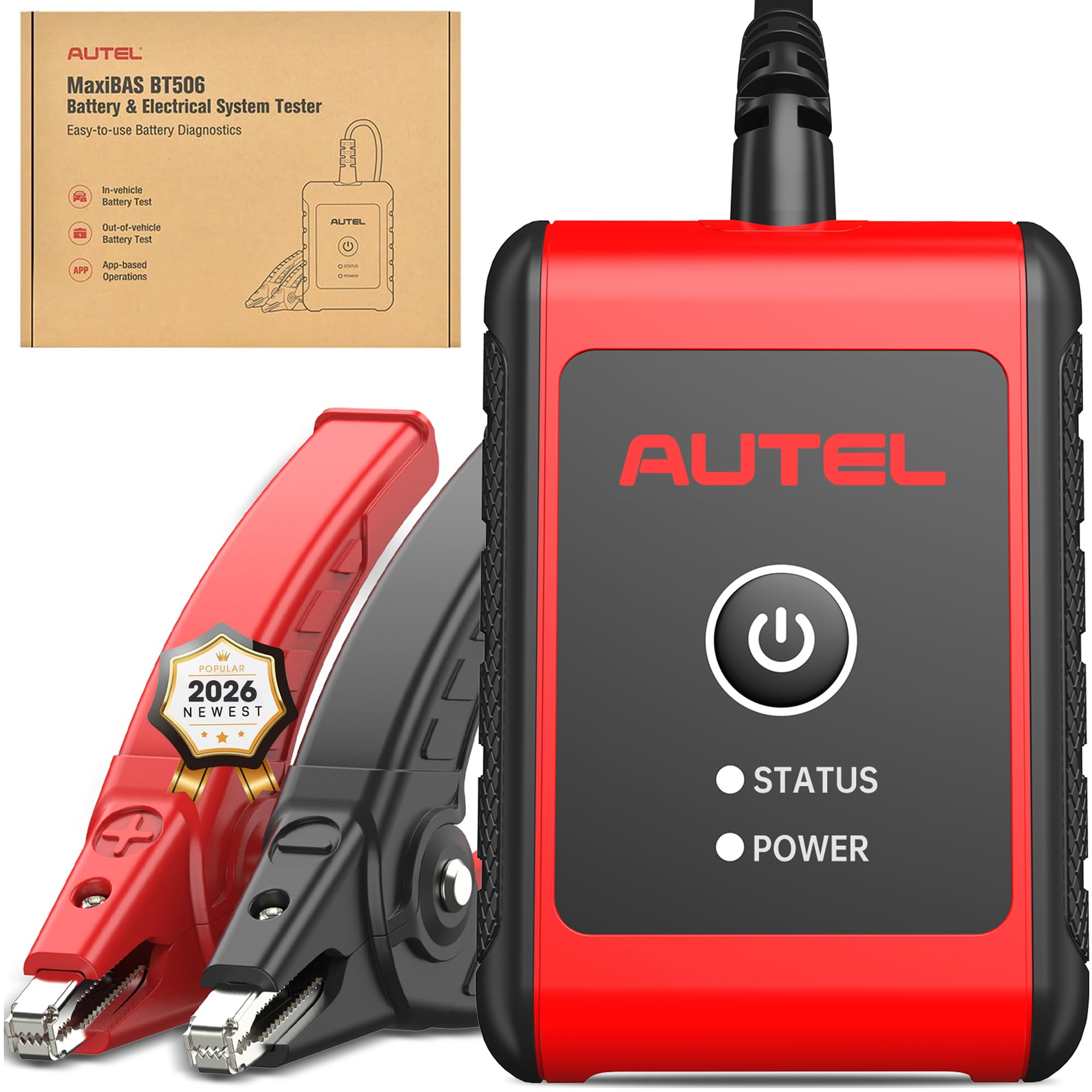
The shop-grade analyzer that slots into the Autel scanner ecosystem for smooth, documented battery verdicts.
For the DIYer who owns an Autel scanner or the professional technician building a tool collection, this is the tester that integrates rather than isolates. It tests 6V and 12V regular batteries with a 100-2000 CCA capacity across FLOODED, AGM, AGM Spiral, EFB, and GEL types, and it works with 99% of Autel wireless scanners like the MK808BT PRO and MS906TS. Advanced adaptive conductance analyzes battery health in seconds., reporting voltage, internal resistance, and overall condition on an easy-to-read screen.
Customers note it makes diagnosing batteries, starters, and alternators a breeze, with step-by-step prompts that walk you through selecting battery type and CCA. It connects to your smartphone via the MaxiAP200 app for easy viewing, sharing, and printing of reports — which one shop owner noted helps upsell battery replacements by showing customers concrete data on screen.
The defining drawback is that it is not built like a heavy-duty shop tool — one owner noted it doesn’t seem very durable for intense daily abuse, but it is excellent for a DIY person or new mechanic. The system also requires you to know your battery’s type and CCA rating before testing, and inputting model years is limited to available selections rather than exact vehicle data.
Ecosystem Advantage
- Pairs with 99% of Autel wireless scanners for a unified diagnostic workflow
- QR binding to smartphone app enables easy report sharing and printing
- Compact and lightweight for carrying around in a vehicle
Ecosystem Limits
- Cannot work with Autel wired scanners or IM Series tools
- Feels less rugged than dedicated shop-grade testers under heavy daily use
Perfect for: Anyone already invested in the Autel scanner world who wants battery diagnostics that merge directly into their existing repair workflow.
Think twice if: You just want a standalone tool and don’t want to install an app or register an account just to run a simple battery test.
5. TOPDON BT600 12V 24V Car Battery Tester

The only tester on this list that hands your customer a printed receipt proving their battery is dead.
For auto shops, battery dealers, and anyone selling used cars, this tester is a conversion machine, letting you print a report on thermal paper immediately after testing. It supports 12V and 24V Lead-Acid batteries (CCA 100 to 2000A) across regular flooded, AGM Flat, AGM Spiral, GEL, and EFB types, so it covers everything from a sedan to a heavy-duty truck. The 3.5-inch color screen is noticeably larger than most testers’ displays, making the results easy to read in dim shop lighting.
Reviewers point out that the tool is quick — completing battery, cranking, and charging tests in 5-7 seconds on multiple vehicles — and that the long cables make it easy to reach terminals even on larger trucks. The device delivers test results with up to 99.5% accuracy., and it shows CCA, health percentage, and a clear pass/fail verdict so the decision is obvious. It comes with a carry case and two extra rolls of thermal paper, so it is ready to work right from the start.
The key limitation is that it is strictly a 12V and 24V tool — it does not test 6V batteries, so owners of classic motorcycles or vintage cars will need the BT600 Plus variant for that capability. Owners also recommend a full battery charge before testing, and the printouts require manual labeling since the device does not add customer names automatically.
Reliability first: What wins people over is the consistency — it is used daily in professional settings and holds up, with the built-in printer being the feature that makes it feel “client impressive” when presenting results.
The stand-out trick: The mini-USB port allows lifetime software updates at no cost, so the device improves over time instead of going obsolete.
One honest check: Confirm you never need to test 6V systems before buying, because this unit skips that voltage entirely.
6. Battery Tender Battery Load Tester 6V/12V
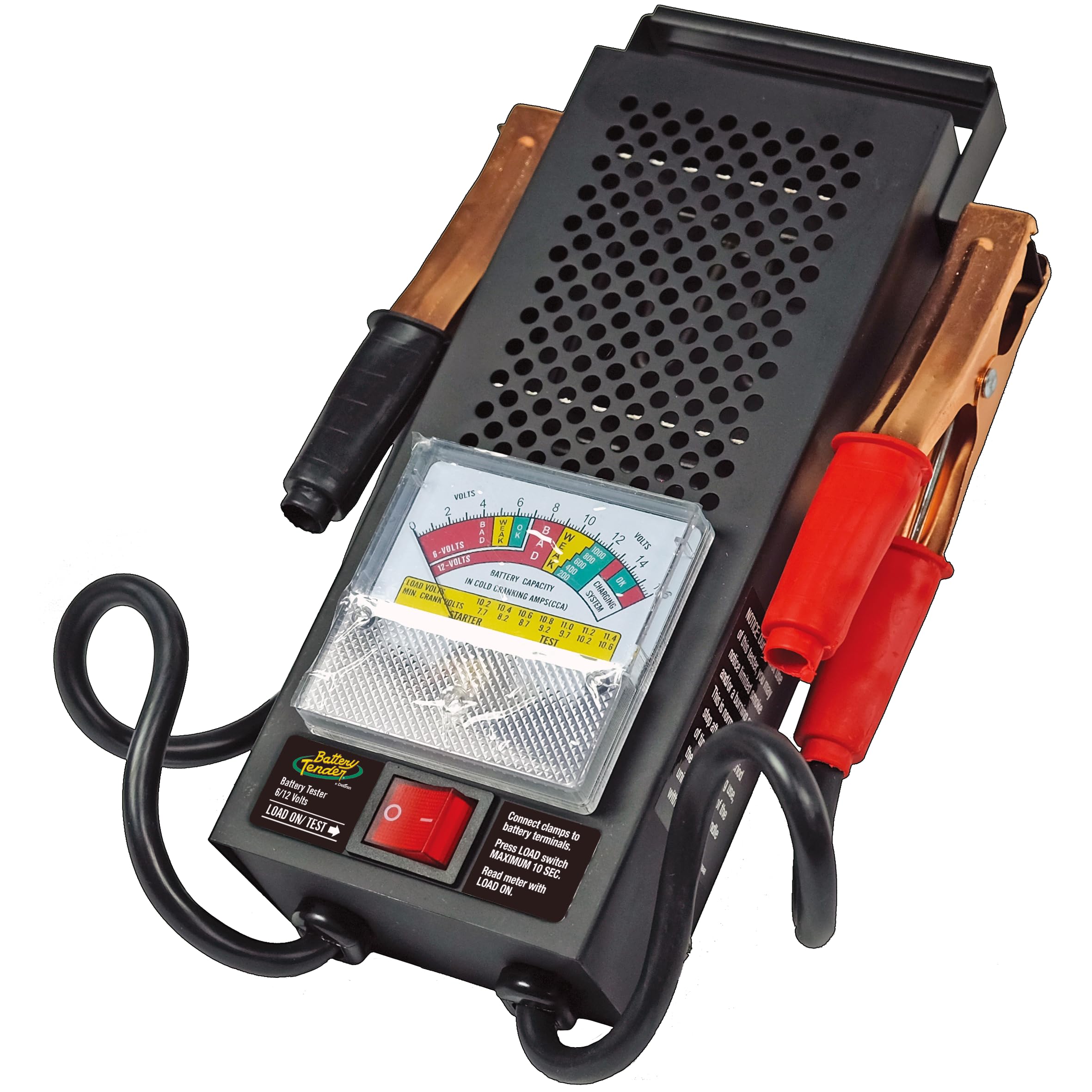
The no-frills analog worker that handles 6V and 12V batteries with the reliability the brand is known for.
When a rental company runs this tester daily on equipment with 12V batteries and reports it outlasts previous units, that is real-world endurance you can trust. It performs a 100 AMP load test for 12V batteries or a 50 AMP load test for 6V batteries, covering vehicles with up to 1,000 cranking amps, which includes most cars, pickups, SUVs, motorcycles, RVs, boats, and ATVs. The color-coded display and single toggle switch make results instantly readable, with a color-coded meter to quickly identify whether the battery passes or fails.
The analog meter is the source of both its charm and its quirks: it is a reliable, no-digital-failsafes design that demands you read the instructions about how long to run it and how long it needs to cool. Without digital protection, you can burn out the coils if you are not paying attention — the operating manual holds the exact timing that keeps the unit alive. Buyers specifically note it will get hot quickly, so the process is: clip on, load test, read the meter, then give it a break.
The rubber insulated carrying handle and color-coded heavy-duty alligator clamps offer solid safety and reliability. Owners find it simple to use with accurate voltage readings, and it helped neighbors identify needed battery upgrades instead of guessing. Its straightforward analog nature has helped it serve reliably for years, which is more than some digital units manage.
Why it works: The analog design is actually a feature for some buyers — there are no menus to navigate, no software to update, just a straightforward, simple to use load test that is easy to read and understand.
Ideal for: Owners of multiple vehicle types — cars, boats, ATVs, motorcycles — who want one simple tool that covers both 6V and 12V without learning a digital interface.
Note the risk: Treat it with respect — run it only for the time the manual states and let it cool, because without digital failsafes, user error can burn out the coil.
7. TOPDON BT50 Car Battery Tester

The slim, pocket-friendly digital tester that delivers professional-grade diagnostics for all 12V lead-acid batteries.
If you want digital accuracy without paying premium prices, this is the tester that balances capability and cost. It offers a 100-2000 CCA testing capacity for all 12V lead-acid batteries and is designed to check battery health, cranking capability, and charging system efficiency. The device uses conductivity testing technology for lab-grade accuracy in seconds, with an upgraded algorithm designed to catch issues before they strand you on a road trip.
Its defining edge for some buyers is the six-language interface — English, Spanish, French, German, Italian, and Russian — so it adapts to whichever language is most comfortable for the user. The bright LCD display and one-button operation make it a user-friendly tester for all skill levels, from the weekend DIYer to the professional. It is small enough at 4.9 x 2.6 x 0.7 inches and 215 g to disappear into a glovebox or tool bag, making it the easiest pick to always have on hand.
Owners consistently report it works well on riding mower batteries, cars, and even family vehicles, with clear results. The spark-free technology and reverse polarity protection add a layer of safety that is especially reassuring for beginners, preventing the small explosions that can occur with cheaper clips. The first test is slightly slower, but subsequent tests run quickly and the accuracy justifies the wait.
The buying math: You get the core diagnostics of testers costing far more — battery health, cranking power, charging system checks — in a package small enough to keep in any vehicle.
Own it if: You want to check multiple vehicles or batteries — cars, ATVs, trucks, boats — with a tiny tool that does not clutter your garage and gives clear digital readouts.
Pass on it if: You need 6V testing or want to work on 24V heavy-duty truck systems, both of which fall outside this unit’s scope.
8. VDIAGTOOL BT300 Car Battery Tester
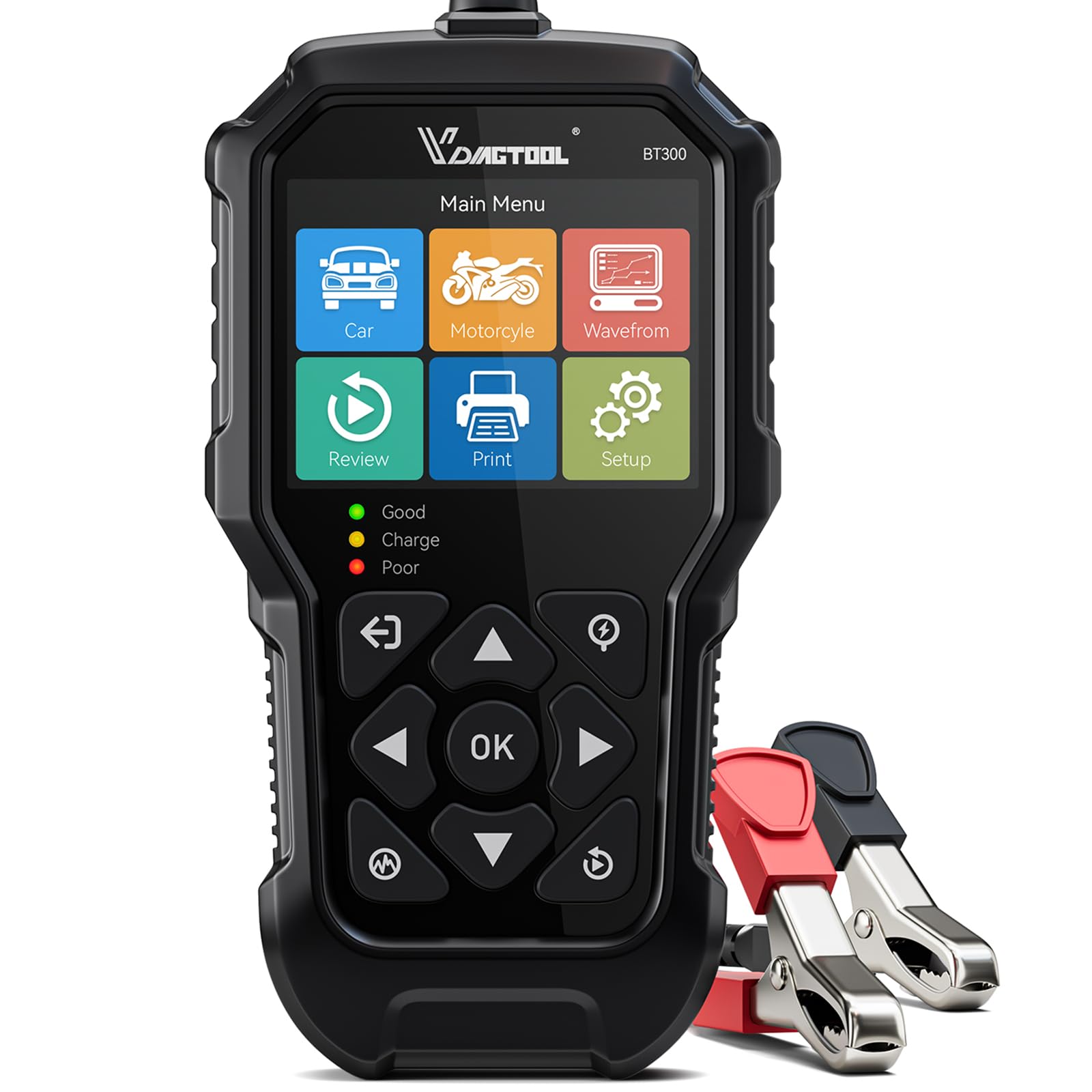
A digital diagnostic with a big 2.8-inch TFT screen and Bluetooth app that turns your phone into a battery test recorder.
This tester brings a pro-grade interface and connectivity to the home garage, pairing a 2.8-inch HD TFT display with a Bluetooth app that records your test results over time. It handles 6V and 12V systems with a 5-3000 CCA range across virtually any lead-acid battery (VRLA or SLA), AGM, GEL, and LSI types, explicitly excluding lithium and golf cart deep-cycle batteries. It checks voltage, load, internal resistance, ripple, state of charge, state of health, CCA, and cranking and charging performance — all in a single test that takes under 20 seconds.
The flexible CCA settings with ±5 or ±50 adjustments allow for ultra-accurate matching against your battery’s labeled rating. One owner verified this precision, finding the measured CCA matched the label within a few amps — and when headlights were turned on, the CCA dropped roughly 100A, confirming the tester was reading real-world load rather than a static number. It even recognized a 6-phase alternator, which is not something every tester can identify.
The one-touch testing, review, and waveform analysis modes, combined with intuitive LED health indicators — Green for Good, Yellow for Normal, Red for Poor — make it easy to interpret. The Bluetooth app capability is the defining differentiator here, letting you track a battery’s decline across multiple tests rather than relying on a single snapshot. A built-in quick test feature proves useful for unlabeled batteries where you might not know the exact CCA rating to input.
Screen & Connection
- Large backlit 2.8″ TFT display is clear and easy to read in any light
- Bluetooth app records and tracks results for battery decline monitoring
- Measures AC ripple and live voltage waveform for alternator health
Compatibility Walls
- Not compatible with lithium batteries or golf cart deep-cycle batteries
- Load testing option is not visible in the menu, possibly built-in only
Pick this for: The data-driven owner who wants to see a battery’s health trend over months, not just a single moment, using the app-connected history.
Switch away if: You only test a golf cart or lithium-powered equipment — this unit’s compatibility stops at lead-acid and AGM types.
9. KAIHENG Battery Load Tester 6V 12V

The entry-level load tester that proves you don’t need a big budget to catch a failing battery before it strands you.
This is the classic resistive load tester that keeps things simple and affordable, applying a 100 A fixed load for 12V batteries or a 50 AMP load for 6V units. It is designed to test battery condition and load, check starter motor consumption, and complete charging system diagnostics for cars, pickup trucks, SUVs, motorcycles, RVs, boats, and beach bikes. The copper clip connectors feature red positive and black negative rubber grips, making it easy to clip onto battery terminals and hold the load for up to 10 seconds to simulate starter motor draw.
Buyers describe it as a simple to use unit that gets the job done economically, correctly identifying both good batteries and ones with a shorted cell. One owner reported their golf cart sat at 12.3V and failed under load, which finally explained the sporadic starting issues they had been chasing. At 0.45 kg with an insulated carry handle, it is portable enough to move from garage to driveway without effort.
The catch is that the clamps have durability concerns, with several owners reporting breakage within 7 months of use, so it rewards gentle handling. The manual also mislabels the analog meter as an LCD Display and references nonexistent polarity LEDs — minor inaccuracies that don’t affect the tool’s function but are worth knowing. It may also smoke briefly on first use as the coil burns in, which is normal for this type of resistive tester but can be startling if you are not expecting it.
Honest assessment: For the entry-level price, this is a functional, no-nonsense load tester. It does the basic job of separating good from bad batteries clearly, saving owners the cost of unnecessary replacements.
Right for: A first-time buyer or occasional garage user who wants a basic, affordable way to test car, golf cart, and ATV batteries without learning a digital interface.
Not for: Heavy daily professional use — the clamp durability and simple analog design are better suited to light, occasional testing, not a busy shop.
Understanding the Specs
Cold Cranking Amps (CCA)
CCA is the number on your battery’s label that tells you how many amps it can deliver at 0°F for 30 seconds while keeping voltage above a minimum level. It is the single most important metric because it measures the battery’s ability to start your engine in cold weather, when oil is thick and the starter needs the most power.
Load Test vs. Conductance Test
A load test forces the battery to deliver a high current — often 100 or 130 amps — through a resistor coil for about 10 seconds, physically simulating the strain of starting your engine. Conductance testing instead sends a small signal through the battery and uses an algorithm to calculate internal resistance, which correlates with the battery’s ability to deliver current without generating heat.
State of Health and State of Charge
State of Health (SOH) is a percentage that represents the battery’s overall condition compared to when it was new, accounting for age and wear. State of Charge (SOC) is simply how full the battery is right now, similar to a fuel gauge, so you can tell whether a low reading means a dying battery or just one that needs a drive to recharge.
Alternator and Cranking Tests
A cranking test monitors the voltage dip while you turn the key to see if the starter is drawing excessive current. A charging test verifies the alternator is producing the correct voltage, typically around 14V, to recharge the battery without overcharging it.
FAQ
What is the difference between a battery load tester and a multimeter?
How do I know which CCA setting to use on my tester?
Can I test the alternator with a battery load tester?
Will a load tester work on AGM or Gel Cell batteries?
Why does my analog load tester get hot or smoke during a test?
Can I test a 6V motorcycle battery with a 12V-only tester?
What does it mean if a battery fails a load test but shows full voltage?
Is a digital conductance tester more accurate than an analog load tester?
Why does my tester show the battery is good but my car still won’t start?
Final Thoughts: The Verdict
For most buyers, the winner among battery load tester options is the Clore SOLAR BA9 because it delivers lab-grade detail — actual numbers, percentage of strength, and SOH/SOC readings — in a lightweight 9.6-ounce package that outperforms bigger, pricier units. If you want raw analog muscle and own 6V vehicles, grab the Battery Tender 026-0020. And for the professional who needs documented proof for customers, the TOPDON BT600 with its built-in printer is the one to reach for.
How We Picked
We do not accept paid placement. Every pick is matched to a real buyer and a real use-case; we do not hands-on test units.
Sources & Methodology
Specifications: manufacturer listings and product documentation. Review insights: verified customer reviews, as of September 2026. Pricing: not shown on this page (it changes often); check the current price via the retailer link.
As an Amazon Associate, Gadgets Feed earns from qualifying purchases. This does not affect which products we feature.