
Nothing drains the life out of a vehicle’s electrical system faster than a parasitic draw you didn’t notice until the engine wouldn’t turn over. A well-chosen battery master switch gives you a single point of control to physically isolate the battery, stopping phantom loads from alarms, radios, and modules the instant you park.
I’m Min — the co-founder and writer behind Gadgets Feed. I track the engineering details behind these isolators, from silver-contact conductivity and nylon-66 shell ratings to the real-world continuous amp limits that separate a reliable daily driver switch from a weekend emergency fix.
This guide breaks down the seven best candidates on the market so you can confidently choose the right battery master switch for your car, truck, boat, or RV without wasting money on something that heats up or fails when you need it most.
How To Choose The Best Battery Master Switch
Picking the wrong isolator can mean melted terminals, intermittent power loss, or a switch that physically can’t handle your system voltage. Before you click buy, lock in these three factors.
Continuous Versus Intermittent Current Rating
Every master switch lists two numbers: a continuous rating (how many amps it can carry indefinitely without overheating) and an intermittent or surge rating (a short burst, usually 5-30 minutes). For a daily-driven car with a 100-amp alternator, a 250A continuous rating offers a massive safety margin. For a trolling motor or winch setup that pulls 300A for 30-second bursts, you need a switch with at least a 500A intermittent rating to avoid voltage sag and contact welding.
Contact Material and Shell Construction
The internal contacts are the switch’s heart. Silver-plated copper gives the lowest resistance and best oxidation resistance over time, especially in high-vibration environments. Brass is cheaper but develops surface resistance that creates heat under load. The outer shell matters too — nylon 66 handles higher engine-bay temperatures than standard ABS, which can soften or warp near exhaust manifolds. Look for IP65 or similar ingress protection if the switch lives in a marine splash zone.
Mounting Style and Physical Access
Surface-mount switches are the simplest to retrofit, but rear-mount or flush-mount designs allow cleaner installation in tight dash panels. Consider whether you need a removable knob for theft deterrence or a padlock hole for lockout/tagout during maintenance. A switch that’s too hard to reach will never get used, defeating the whole purpose of isolating the battery between trips.
Quick Comparison
On smaller screens, swipe sideways to see the full table.
| Model | Category | Best For | Key Spec | Amazon |
|---|---|---|---|---|
| Perko 9601DP | Premium Marine | Saltwater and high-moisture environments | 250A continuous, brass contacts | Amazon |
| Blue Sea Systems 6006 | Premium Marine | Gasoline engine rooms, compact installs | 300A intermittent, tin-plated copper studs | Amazon |
| Ponzkoe Smart Remote Switch | Smart Isolator | Anti-theft and remote cut-off | 250A continuous, dual remote + manual | Amazon |
| FEITON 500A Lockout Switch | Heavy Duty Lockout | Industrial and fleet lockout/tagout | 500A intermittent, waterproof metal housing | Amazon |
| FASTSTORM 200A Switch | Rugged Alloy | Off-road, ATV, and vibration-heavy installs | 200A continuous, aluminum alloy housing | Amazon |
| AWBLIN Switch with Voltmeter | Mid-Range with Display | Voltage monitoring without extra tools | 250A continuous, LED voltmeter | Amazon |
| VSTM Upgrade Switch | Budget with Display | Entry-level voltage display and disconnection | 300A intermittent, nylon 66 shell | Amazon |
In‑Depth Reviews
1. Perko 9601DP Battery Disconnect Switch

Perko has built marine-grade electrical components for decades, and the 9601DP reflects that pedigree with a sealed, waterproof body that shrugs off spray and condensation. The 250-amp continuous rating is conservative by modern standards, but the real value here is the brass contact material paired with a robust mechanical lever that snaps between positions with a satisfying, audible detent. Installers who work on saltwater boats consistently report zero corrosion on the studs after a full season, which is the true test of a marine switch.
The mounting system is simple — surface mount with a removable knob, so you can pull the key and prevent accidental engagement while working on the electrical system. The shell is a dense thermoset plastic that doesn’t soften or deform under direct sunlight on a boat deck. It’s larger than many compact alternatives, which means you need clearance, but that bulk translates directly to heat dissipation capacity during long charging cycles from a shore power converter.
Where this Perko shines is in environments where water intrusion is a constant threat. It earns its premium position because the long-term reliability in wet conditions justifies the higher investment. For a travel trailer that sits outside year-round or a center console boat, this is the set-and-forget solution.
Why it’s great
- True waterproof construction tested in marine splash zones
- Removable knob adds theft deterrence and safety lockout
- Thermoset shell resists UV and heat degradation
Good to know
- Brass contacts have slightly higher resistance than silver-plated alternatives
- Larger footprint may not fit tight motorcycle or ATV battery boxes
2. Blue Sea Systems m-Series 6006 Battery Switch

Blue Sea Systems is the gold standard for marine DC power distribution, and the m-Series 6006 proves why. The defining feature is the one-piece tin-plated copper stud that accepts multiple cables without introducing extra resistance at the connection point. This matters because every additional splice or ring terminal stacked on a stud creates a potential hot spot. The 300-amp intermittent rating (at 32V max DC) gives enough headroom for starting circuits and inverter loads, while the compact 2.7-inch square footprint fits into dash panels where a Perko won’t.
The ignition protection rating lets you install this switch in a gasoline-powered engine room without violating fire safety codes. The removable knob is a clever touch — pull it off and the switch stays in whatever position you left it, preventing accidental shutdowns. Users consistently praise the smooth, positive detent action that doesn’t get sticky even after years of salt-air exposure. The Luminous label glows faintly in low light, which removes guesswork when you’re reaching around in a dark bilge compartment.
One critical note: this switch is rated for 12V and 24V systems only. At 48V (52V actual), the internal contacts can arc and heat over extended use, so stick with lower-voltage applications. For a gasoline-powered center console or a bass boat with a 24V trolling motor setup, it’s a compact workhorse that outlasts cheaper imports.
Why it’s great
- Ignition protected for safe gasoline-engine-room installation
- One-piece tin-plated copper studs minimize voltage drop at termination
- Compact surface-mount design fits tight spaces with three mounting options
Good to know
- Not suitable for 48V systems — arcing and heat buildup reported above 32V
- No voltmeter or digital display, requires external meter for voltage checks
3. Ponzkoe 250A Smart Remote Battery Disconnect Switch
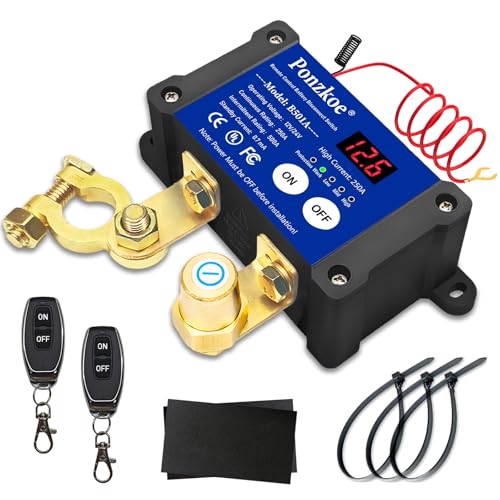
This switch breaks the manual-only mold by adding a keychain remote that can kill power from up to 50 feet away. The core module handles 250 amps continuous with copper internal contacts and includes a set of bright green confirmation LEDs that flash with every remote command. The standout spec is the standby current draw of just 0.7 milliamps — that’s orders of magnitude lower than a typical vehicle’s parasitic load and means the switch itself will never drain the battery while parked.
The Smart Voltage Guardian mode automatically disables the remote function when voltage drops below 11.4V, preventing an accidental cut-off that could strand you with a battery too weak to restart. This is a genuinely useful safety net for older vehicles with unknown ground faults. The external spring-shaped antenna extends reach through metal chassis and trailer frames, though range can drop if the battery is mounted in a trunk or under a spare tire well.
Build quality concerns show up in the user reports — a few units lost remote pairing after several months, and one reviewer noted the switch stopped responding to the key fob for reconnection while still working for disconnection. This makes it a terrific convenience feature for anti-theft and storage, but relying on it as the sole battery isolation method for critical equipment carries risk. For a weekend car or a spare vehicle, the remote convenience outweighs the reliability edge case.
Why it’s great
- Dual remote and manual control adds anti-theft deterrence without climbing under the hood
- Ultra-low 0.7mA standby current prevents self-discharge
- Smart voltage guardian prevents accidental shutdown near low-battery conditions
Good to know
- Remote pairing reliability can degrade over several months of use
- Post diameter requirement of 15-17mm tapered limits battery terminal compatibility
4. FEITON 500A High Current Battery Cut Off Switch with Lock-Out Plate
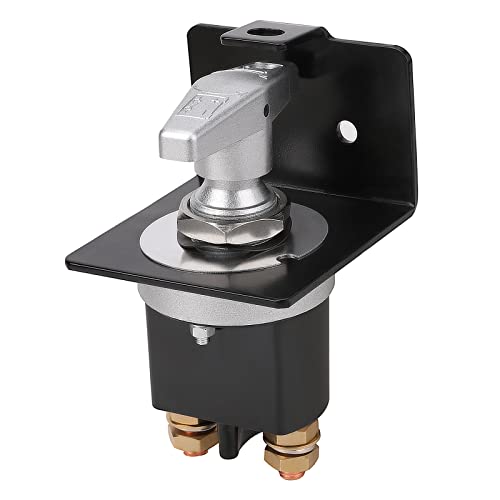
When the job demands switching loads that would melt a standard 250A isolator, the FEITON 500A steps up with metal housing and 10mm threaded copper studs. The headline number is the 5000-amp instantaneous surge capacity, which makes this viable for parallel battery banks and inverter-fed systems that see massive inrush currents. The waterproof metal shell with gasketed seals gives it an IP65-level environment rating, though FEITON doesn’t formally publish the IP code — real-world testing confirms it survives pressure-washing and rain exposure without internal corrosion.
The lockout plate is the defining feature for fleet and industrial users. A standard padlock fits through the handle hole, locking the switch in the OFF position so unauthorized personnel can’t re-energize the system while maintenance is underway. The rotary handle is large enough to operate with thick work gloves, and the mechanical feel is heavy and deliberate — no accidental bump turns this switch on or off. Installers have mounted them on Volvo trucks, dump trucks, and agricultural equipment where vibration would rattle a plastic-bodied switch apart.
The trade-off is physical size. At roughly 4 inches across with the lockout plate, this switch dominates a battery box and requires significant panel clearance. It’s overkill for a standard sedan or light truck, but for RV lithium banks, commercial fleet vehicles, and off-grid solar arrays that need a hard disconnect between charging cycles, the FEITON delivers industrial-grade reliability that cheaper alternatives can’t match.
Why it’s great
- 5000A instantaneous surge handles massive inverter and winch inrush currents
- Padlock-compatible lockout plate meets fleet lockout/tagout requirements
- Waterproof metal housing withstands pressure washing and vibration
Good to know
- Large physical footprint is difficult to fit in tight battery compartments
- No voltage display or status indicator — purely manual mechanical operation
5. FASTSTORM 200A Master Battery Disconnect Switch
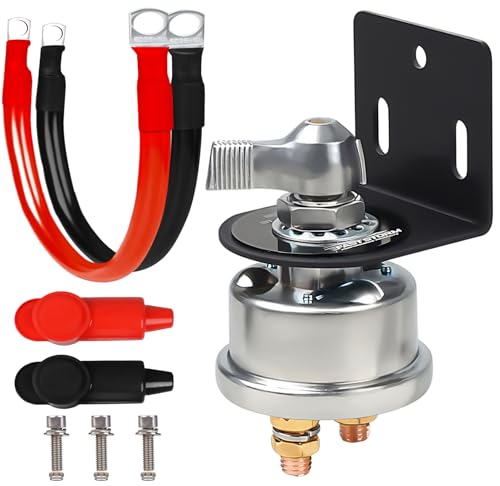
FASTSTORM built this switch specifically for off-road and heavy vehicle environments where mud, vibration, and impact are daily realities. The aluminum alloy housing provides structural rigidity that plastic shells can’t match — it won’t crack if a rock kicks up into the battery tray, and the metal body acts as a heatsink for the internal copper contacts. The 200-amp continuous rating with a 1000-amp intermittent surge covers winch pulls and high-draw accessory loads without the switch becoming a fuse.
Installation is streamlined by the pre-drilled mounting bracket that accepts standard bolt patterns, and the kit includes a dedicated cable set with ring terminals. The ON/OFF markings are laser-etched into the metal so they won’t rub off, and the audible click when engaging gives tactile confirmation even when you can’t see the switch. Users running Jeeps in mud pits and tractors on farms report zero failures after extended exposure to water crossings and pressure-wash cleanings.
The biggest limitation is the 200-amp continuous ceiling — it’s sufficient for a single 12V engine start and a moderate auxiliary load, but it will run warm under continuous 150-amp draw from a high-output inverter. For a dedicated towing setup with a 200A alternator, consider stepping up to the FEITON or a Perko-rated switch. For the weekend off-roader who needs a simple, bombproof disconnect that refuses to die, the FASTSTORM delivers rugged credibility.
Why it’s great
- Aluminum alloy housing provides impact resistance and passive heat dissipation
- Pre-drilled mounting bracket with included cables simplifies retrofit installation
- Laser-etched markings stay legible after years of abrasion and chemical exposure
Good to know
- 200A continuous rating leaves less headroom for high-output alternator systems
- No reverse-polarity protection — incorrect wiring can damage the switch
6. AWBLIN Upgrade Battery Disconnect Switch with Voltmeter

AWBLIN packs a surprising amount of functionality into a compact nylon-66 housing at a very competitive entry point. The integrated LED digital voltmeter activates when the switch is turned on, showing real-time battery voltage down to the tenth of a volt. This eliminates the need for a separate multimeter when checking battery state of charge. The display draws only 30mA when active and drops to zero draw in the OFF position, so there’s no phantom drain from the meter itself.
The internal construction uses copper-plated silver contacts — not the cheaper tin-plated copper found in similar-priced switches. Silver’s lower electrical resistance means less heat generation at the contact point, especially under sustained 100A+ loads. The nylon-66 shell handles under-hood temperatures that would soften standard ABS, and the removable side plates allow cable entry from multiple directions, simplifying installation in cramped battery boxes. Users report successful operation on 48V golf cart batteries and 54V lithium go-karts, confirming the wide voltage compatibility.
The build quality is solid for the price tier, but the voltmeter’s blue LED can be hard to read in direct sunlight. The marking on the knob uses a printed sticker that may eventually wear off with heavy use. For a budget-conscious buyer who wants voltage monitoring without buying a separate meter and needs a switch that can handle 24V and 48V systems, this is the most feature-dense option at this price point.
Why it’s great
- Integrated voltmeter provides real-time voltage monitoring without external tools
- Copper-plated silver contacts lower resistance and improve heat management
- Nylon 66 shell resists high under-hood temperatures better than ABS
Good to know
- Blue LED display washes out in bright daylight making it hard to read
- Printed knob markings may wear off with frequent gloved operation
7. VSTM Upgrade Battery Disconnect Switch with Digital Voltage Display
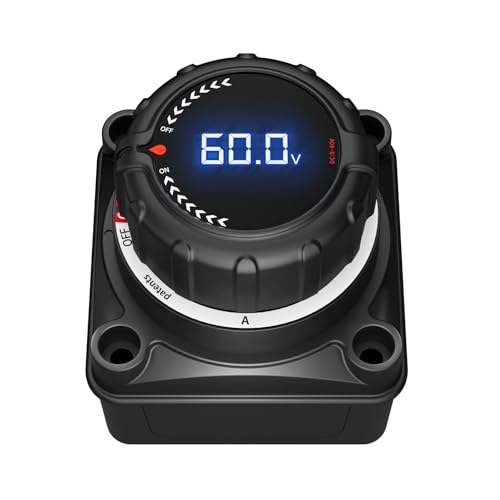
The VSTM upgrade switch mirrors the AWBLIN’s core feature set with a larger, more readable LED voltage display and a 300A intermittent rating that bumps the surge headroom slightly. The housing is also nylon 66 with copper-plated silver contacts, so the base electrical performance is comparable to the AWBLIN. The standout difference is the larger display face, which users report is noticeably easier to read from standing height in a boat or truck bed.
Included mounting hardware supports three installation methods — panel mount with the rear cover, flush mount with the gasket, or side mount with the removable side plates. The 3/8-inch ring terminal compatibility handles standard battery cable sizes without adapter lugs. Early adopters report one year of continuous use in a fish house and winch-equipped truck without any degradation in switching action or display accuracy. The knob action is smooth with a defined stop at ON and OFF, though a few users noted a slight wobble in the knob shaft that doesn’t affect electrical contact.
The main reason this sits at the bottom of the list is not functional — it’s the overlap with the AWBLIN at essentially the same price point. The VSTM offers a slightly larger display, but the AWBLIN has more positive user sentiment on long-term reliability. If the larger face matters for your mounting position, this is a perfectly capable switch. For most buyers, the very similar AWBLIN offers a slightly better track record at the same value tier.
Why it’s great
- Large LED display improves readability from standing and distance
- Three mounting methods offer versatile installation in tight or unconventional spaces
- Nylon 66 shell with copper-plated silver contacts delivers solid electrical performance
Good to know
- Minor knob wobble reported on some units, though no electrical failures linked to it
- Instruction manual is minimal — wiring diagrams in the product photos are more helpful
FAQ
Will a battery master switch drain my battery when left in the ON position?
Can I use a 12V rated battery switch on a 48V golf cart battery?
How do I wire a battery master switch to isolate the negative terminal instead of the positive?
Final Thoughts: The Verdict
For most users, the battery master switch winner is the Perko 9601DP because it delivers proven marine waterproofing and a robust mechanical lever that can survive years of salt-air exposure without corrosion. If you want the convenience of a remote key fob to kill power from outside the vehicle, grab the Ponzkoe Smart Remote Switch. And for heavy-duty winch and inverter setups that demand a padlock lockout and a metal housing that can take a beating, nothing beats the FEITON 500A Lockout Switch.