
Our readers keep the lights on and my morning glass full of iced black tea. As an Amazon Associate, I earn from qualifying purchases.
Specs are compiled from manufacturer listings and verified buyer reviews and can change over time — please confirm the key details on the product page before buying.
You’re probably staring at a job site, a garage, or a spot by the fence with no outlet in sight. That’s the real reason to go battery-powered: a miter saw that works where the cord can’t reach. Battery power also means instant setup—no extension cords or breaker trips, just grab the saw and cut. The best battery miter saw for you depends on one honest question: what are you cutting most, and how often are you hauling the saw to do it?
I’m Min — the founder and writer behind Gadgets Feed. This guide is built by comparing the manufacturers’ published specifications and the patterns across verified customer reviews, so you get each pick’s real strengths and trade-offs instead of marketing spin.
From trim work to framing lumber, the right cordless model can match a plug-in saw’s accuracy without the tether, so we’ve broken down the specs that truly matter for a battery miter saw and matched them to real-world buying decisions.
Our Picks at a Glance


How To Choose The Best Battery Miter Saw
Before you compare models, you need to match the saw to the two things that define your work: the width of the material and the angle of the cut. A cordless miter saw trades raw power for portability, so decide which matters more for your projects.
Start with the blade size
This is the single biggest physical limit on a battery miter saw. A 7-1/4-inch blade (like on many trim-focused cordless saws) is light and fast, but it can’t reach through a wide 2×10 or 2×12 in one pass. A 10-inch blade, by contrast, is the standard for framing work because it swings a longer arc and can crosscut wider stock. If you’re doing baseboards and small trim, the 7-1/4-inch class is plenty; if you’re building decks or sheds, step up to 10 inches. There’s also an 8-inch middle ground on some models that splits the difference on portability and capacity.
Understand sliding vs. fixed
A sliding saw has rails that pull the blade forward through the cut, which dramatically increases how wide a board you can slice without having to flip it. A fixed (non-sliding) saw is simpler, lighter, and often more accurate over time because there are fewer moving parts, but you’re limited to the blade’s own reach. The sliding mechanism is the feature that lets a compact 7-1/4-inch saw punch above its weight on wider lumber.
Check the bevel, not just the miter
The miter angle is the horizontal swing (for cutting something like the corner of a picture frame). The bevel is the tilt of the blade itself (for angled cuts on crown molding). A single-bevel saw tilts one way, which is fine for most DIY trim. A dual-bevel saw tilts both directions, so you don’t have to flip the workpiece over for compound cuts—this is the pro feature that saves real time on crown molding. If you only ever cut flat boards, a single bevel is a fair price saver.
Battery voltage and run-time claims
This is where cordless saws differ most from their corded cousins. A 20V saw is the standard for compact, trim-focused work, while 36V and 40V+ systems (often two 18V-20V batteries in series or one high-voltage pack) give you the torque for harder woods and longer cuts. Pay attention to the cuts-per-charge numbers. A saw that promises 585 cuts in MDF baseboard on a single charge is a different tool than one that manages a couple hundred cuts in 2×4 pine. Match that claim to your own daily workload.
Quick Comparison
| Model | Best For | Blade Size | Angle Range | Weight | Amazon |
|---|---|---|---|---|---|
| DEWALT DCS361M1★ Best Overall | Accurate trim work | 7.25 inches | 48° miter | 31.6 lbs | Amazon |
| ONEAND P553Best Value | Budget-friendly cutting | 7.25 inches | 45° miter | 19 lbs | Amazon |
| WOODSTARTER CJS65Best for Wide Cuts | Wide sliding cuts | 8 inches | 45° bevel | 26 lbs | Amazon |
| CRAFTSMAN CMCS714M1 | All-day battery life | 7.25 inches | 90° miter | 21.8 lbs | Amazon |
| RYOBI PBT01B | Ecosystem compatibility | 7.25 inches | 45° miter | 30.2 lbs | Amazon |
| SEESII THLZH2667 | Two batteries included | 8 inches | 45° bevel | 25 lbs | Amazon |
| WORX WX845L.9 | Small jobs, high RPM | 7.25 inches | 90° miter | — | Amazon |
| BOSCH GCM18V-07SN | Pro-grade portability | 7.25 inches | 45° miter | 26 lbs | Amazon |
| DEWALT DCS714B | 10-inch power | 10 inches | 22.5° bevel | 34 lbs | Amazon |
| Metabo HPT C3610DRAQA | Dual bevel, 36V power | 10 inches | 60° miter | 45.5 lbs | Amazon |
| Makita XSL06PT | Framing & fine cuts | 10 inches | 90° miter | 80.5 lbs | Amazon |
In‑Depth Reviews
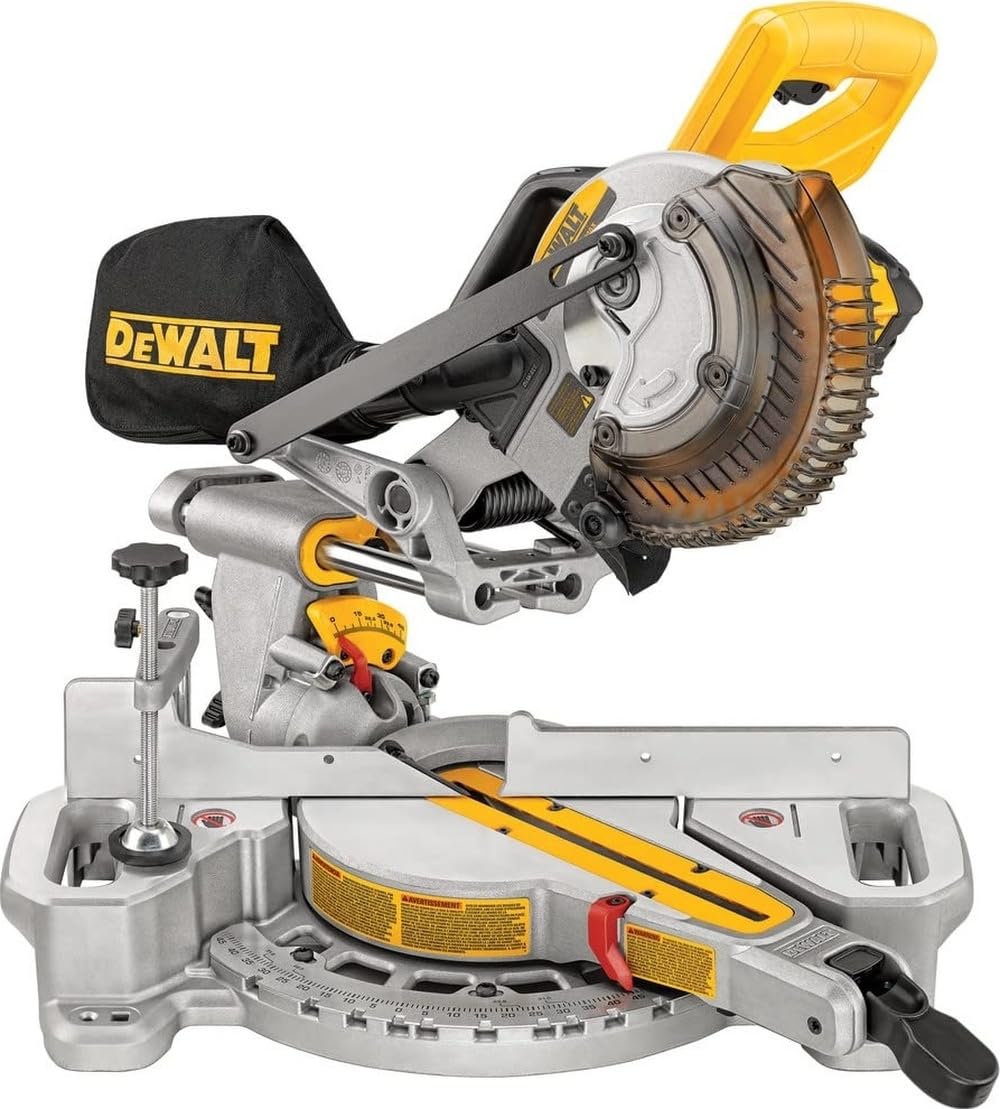
1. DEWALT 20V MAX* 7-1/4-Inch Miter Saw, Cordless (DCS361M1)
Our pick — over 4.5★ from 800+ verified ratings; the strongest balance of quality and price.
The accuracy-first cordless trim saw that wins over both pros and weekend remodelers.
Its integrated cut-line system delivers adjustment-free accuracy for trim and baseboard work. The defining feature is the integrated cut line cross-cut positioning system—a clever sightline that shows you exactly where the blade will land with zero adjustment, which beats squinting at a laser dot. It swings a 48-degree miter angle, and with 11 positive stops on a stainless steel detent plate, common angles click into place with dependable repeatability.
The power story is strong for a battery tool: it delivers on average 183 cuts of 2×4 pine or 275 cuts of 3-1/4 pine baseboard on a single 20V Max battery pack (the DCB204). That’s enough to lay a whole floor of trim on one charge, as multiple buyers report. It’s a compact design at 31.6 lbs, and the single biggest gripe is that it really only runs properly with the 4Ah batteries, so don’t expect the smaller packs to pull their weight. The material clamp gets called out as a bit flimsy, though owners say it still gets the job done.
You get everything you need in the box: the DCB204 battery, DCB112 charger, carbide blade, blade wrench, and material clamp. A few saws arrive with a 3-degree alignment quirk right from the start, but it’s an easy fix via three screws, and the stock blade is often the first thing owners swap for a finer 60-tooth Diablo.
What wins people over
- Fantastic cut-line accuracy with no adjustment needed
- Impressive battery life—hundreds of cuts per 4Ah charge
- Light and portable at 31.6 lbs for easy hauling
Heads-up before you buy
- Only works reliably with 4Ah batteries, not smaller packs
- Stock blade is rough; most owners swap it for a finer one
- Material clamp feels flimsy, though functional
Reach for this if: you want pro-level accuracy for trim, baseboards, and 2x4s without a cord, and you’re already in the DEWALT 20V system.
Think twice if: you’re only working with the small 2Ah batteries you already own—this saw wants the 4Ah packs to shine.
2. ONEAND 18V Cordless 7-1/4 in. Compound Miter Saw (P553)
The featherweight that slides into tight spaces and handles the everyday cuts without fuss.
At 19 pounds, this featherweight handles 2x4s and trim with a standard Ryobi 18V battery. At just 19 pounds, it’s one of the lightest cordless miter saws you’ll find, which makes it a genuinely portable second saw for multi-level work or a quick trip to a rental. The blade quality is the thing owners praise most, and the saw handles 2x4s and typical trim duties with a standard Ryobi 18V battery that’s interchangeable with a huge existing ecosystem.
It’s built around a 7.25-inch carbide blade with a 45-degree miter angle, and it has no laser guide—so if you rely on a light to line up cuts, this one will force you to follow the blade. It’s a fixed (non-sliding) saw, so you’ll use double cuts for wider lumber. Buyers love that it needs no outlet and stores easily, calling it versatile and light-duty rather than a shop workhorse.
The honest catch here is raw power and features. It’s a tool-only purchase, so you need a Ryobi 18V battery (or a compatible one) and charger already in hand. A few owners note the stock blade leaves rougher cuts and that the dust bag is more of a formality—many hook it straight to a shop vac instead.
Best for budget DIY: if you’re already in the Ryobi ONE+ system and need a compact, portable saw for picture frames, molding, and small trim, this is a smart, low-cost pick.
The limitation: no laser, no slider, so wider boards need double cuts and finer work takes a better blade.
3. WOODSTARTER Cordless Miter Saw, 8 Inch 40-Tooth Blade
A sliding 8-inch blade that reaches across wide boards without the bulk of a 10-inch saw.
This one earns its spot with a sliding rail system and an 8-inch blade—a middle ground that gives you a max crosscut of 12 inches and a cutting depth of 2.5 inches. That means you can slice through wide shelving or furniture stock in one pass, which a compact 7-1/4-inch fixed saw simply can’t do. It weighs just 26 lbs and ships with a 4.0Ah battery included, so it’s genuinely ready to run from the start. Multiple owners mention it handles 1×4 lumber and PVC cleanly, and one even noted it’s powerful enough for wet treated 2x8s.
You get a full package in the box: a 40-tooth carbide-tipped blade, battery, charger, two table extensions, and two clamps. The controls and slide are smooth, and the saw came square for most owners. There’s a built-in dust port for vacuum hookup, plus a bright LED and a dual-hand start with trigger lock for safety. The miter detents offer 9 preset stops (0°/15°/22.5°/30°/45°) for quick angle changes.
The trade-offs are worth knowing. Spare batteries are hard to come by (one owner called that out directly), and the stock dust bag is nearly useless—pair it with a vacuum instead. It also has a metric fence, which takes a moment to get used to if you think in inches, and a couple of owners noted the saw is top-heavy if it’s not bolted down.
Grab it for: a cordless sliding saw that cuts wide boards and doesn’t cost a fortune, with two clamps and a battery included.
Look elsewhere if: you need long battery runtime or an easy path to spare batteries down the road.
4. CRAFTSMAN V20 Cordless Sliding Miter Saw (CMCS714M1)

The sliding saw that cuts all day on one charge—a pro handyman’s favorite trailer companion.
Its 585-cuts-per-charge stamina suits pros who need all-day runtime on 2x lumber and decking. The headline number is up to 585 cuts in 3-1/4-inch MDF baseboard on a single charge with the included 20V 4.0Ah battery. Professional handymen report the battery lasts a full workday, and one even called it the “best tool in my tool trailer.” It runs a 3,800 RPM motor, cuts 2x4s, 2x6s, and deck boards with ease, and slides for an 8-inch crosscut at 90 degrees and 5-1/2 inches at 45 degrees.
It’s a single-bevel saw with a lightweight design and side carry handles at 21.8 lbs, plus an LED cut line positioning system for accurate alignment. The 9 casted miter detent stops make common angles quick to set. Owners consistently describe it as lighter than a plug-in saw, quieter than expected, and genuinely usable in a garage at midnight without waking the house. The 20V battery system means it shares power with the rest of the V20 lineup.
The recurring gripe isn’t the saw—it’s the instruction manual, which several buyers found hard to read and follow. The dust bag is also largely ineffective, so a shop vac is the better companion. A few saws need the fence checked for squareness after setup, but it’s an easy adjustment.
The everyday wins
- Outstanding battery life—up to 585 cuts per charge
- Light 21.8-lb build with carry handles for easy transport
- Quiet enough for late-evening garage work
Know before you go
- Instruction manual is genuinely hard to follow
- Dust bag is ineffective; plan for a vacuum
- Single bevel, so flip work for compound angles
Pick this if: you want a dependable, all-day battery saw for 2x lumber, decking, and trim without dragging a cord.
skip it if: your projects are mostly crown molding that needs dual-bevel cuts.
5. RYOBI ONE+ 18V Cordless 7-1/4 in. Sliding Compound Miter Saw (PBT01B)

The slider that taps into the biggest battery ecosystem in DIY—up to 800 cuts per charge.
It taps into the RYOBI ONE+ battery system, promising up to 800 cuts per charge. It promises up to 800 cuts per charge and delivers a top-tier 2×10 cross cut capacity—meaning you can slide through wide framing lumber with a battery, not a cord. It’s built around a 7.25-inch blade with a 45-degree miter angle, and the sliding rails are what let it reach across that wide stock. Customers note using it to remodel entire houses without any problem at all.
A 5.0Ah battery (or even a third-party 9Ah pack, which one owner used) runs this saw all day on a single charge, making it a favorite for finish trim work. The build quality and functionality are the twin highlights in the reviews, with owners praising how it handles everything from 5-1/4-inch baseboards to bigger stock. It’s a single-bevel saw, so flat miter cuts are its comfort zone, but it also handles crown work with the right technique.
This is a tool-only buy, so you need a RYOBI ONE+ 18V battery and charger already in your drawer. At 30.2 lbs, it’s not the lightest 7-1/4-inch saw on this list, but the power-to-portability balance still lands firmly on the portable side. The 30-day limited warranty is shorter than some rivals, so it’s worth planning around that.
Made for RYOBI owners: if you’re already collecting ONE+ tools, this sliding miter saw is the logical, cost-effective way to add serious crosscutting power to your lineup.
Who it’s not for: anyone who wants a dual-bevel head or who isn’t already invested in the RYOBI battery system.
6. SEESII 8-Inch Cordless Sliding Compound Miter Saw
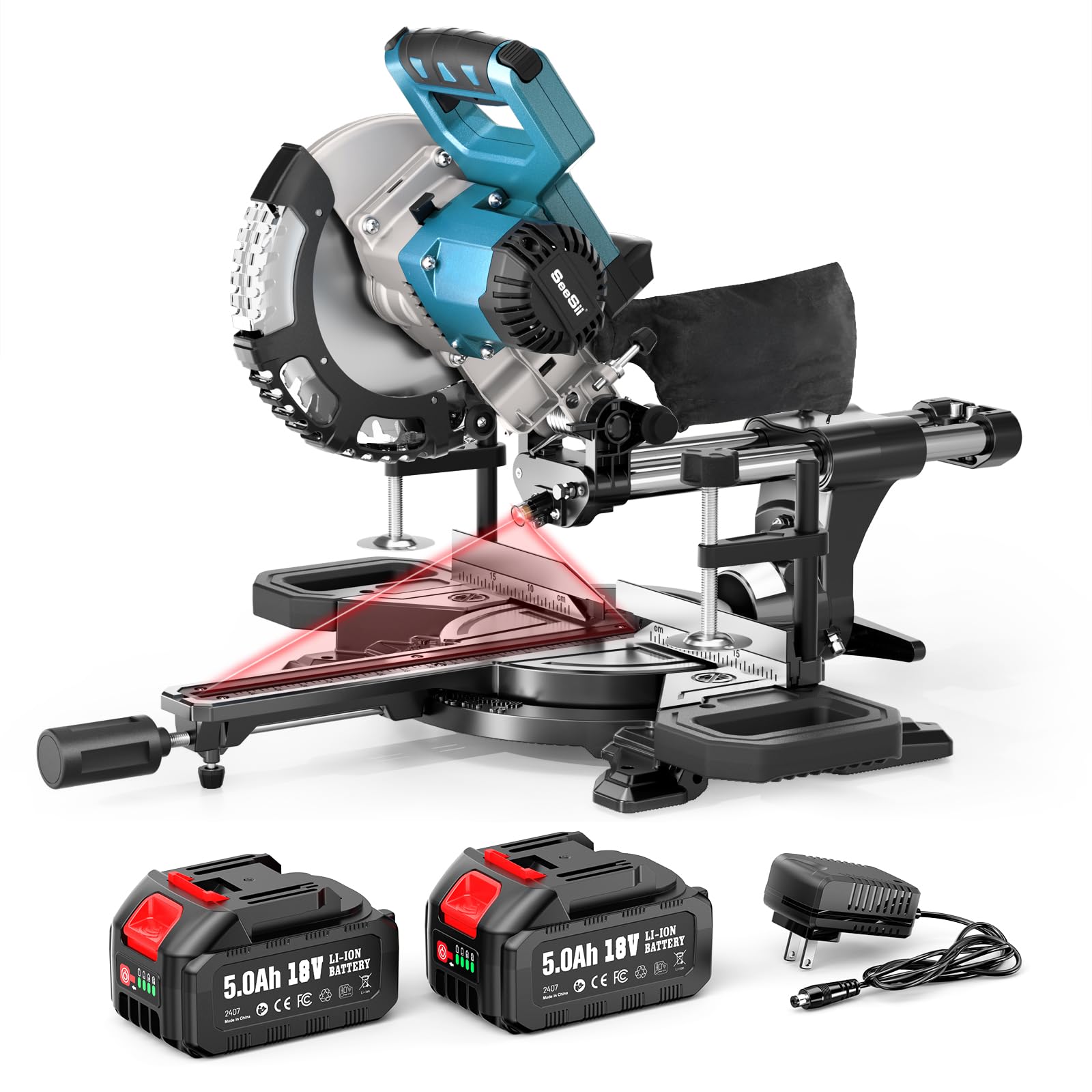
Comes with two beefy 5,000mAh batteries and a brushless motor that slices 2x4s cleanly.
It ships with two 5,000mAh batteries, so you can swap packs and keep cutting. The high-capacity dual battery system pairs with a brushless motor that spins an 8-inch TCT blade to 4,200 RPM, which owners say slices through 2x4s “like butter.” It’s a sliding compound saw with a 0-45° bevel, 45° left/right miter angles, and 9 preset stops (0°/15°/22.5°/30°/45°), covering all the common cuts for trim, shelving, and framing.
At 25 lbs for the machine only, it’s a lightweight, portable option with an ergonomic grip and side wings for supporting long boards. The laser guide and integrated LED light make low-light work easier, and the brushless motor means better battery efficiency over a long session. Reviewers point out the 5Ah batteries last a long time, and having a second one in the box means you can swap and keep cutting. It comes with two clamps, two wrenches, a dust bag, and the side wings—basically everything except the workpiece.
The honest downsides: the laser needs calibration from the start, and a few owners found the stock blade is general-purpose rather than specialized. One concerning review noted a unit that wouldn’t reach the full 45-degree bevel and no customer support response, though that’s the exception rather than the rule. The standard battery connection does allow for upgrades or compatibility with some other packs.
Choose it for: a complete cordless kit with two high-capacity batteries, a brushless motor, and sliding capacity for DIY and cottage projects.
Be aware: the laser needs calibration, and it’s a light-duty tool, not a professional framing saw.
7. WORX Cordless Sliding Compound Miter Saw (WX845L.9)

A 20V slider with a work-holding clamp and a shadow-line guide that makes small jobs easy.
Its built-in work-holding clamp secures the board on both sides of the blade for safer, easier cuts. It’s a 7.25-inch sliding compound saw with an 8-1/4-inch maximum cutting capacity, a 0-45 degree bevel, and a light-assisted shadow line that shows your cut path without a laser to calibrate. The high-RPM cuts come out clean with no tear-out, shoppers say, which is exactly what you want for trim work around windows, doors, and baseboards.
It runs on WORX Power Share 20V batteries, which you supply separately, and the company notes that Power Share PRO batteries (the 4.0Ah WA3012 or 5.0Ah WA3571) give the best run time. The extension wings support long materials, and the depth adjustment lets you cut dado slots. A handful of owners who were skeptical of a battery-powered miter saw changed their minds after building several workbenches with it, praising the long battery life and cord-like power.
The nitpicks are real but minor: the vinyl miter scale can peel over time, and there are no #8 screw holes for installing a zero-clearance fence. It’s also a bare tool, so the battery and charger are an extra purchase. For a lightweight, portable saw that’s surprisingly powerful for its class, this one over-delivers.
Why owners love it
- Built-in work-holding clamp for safer, easier cuts
- Clean, tear-out-free cuts thanks to high RPM
- Punchy performance for a 20V saw—”surprisingly powerful”
The small stuff
- Tool-only, so you need a Power Share battery to start
- Vinyl miter scale can peel over time
- No pre-drilled holes for a zero-clearance fence
Best for: homeowners who want a lightweight, capable saw for light trim, window casings, and baseboards without the cord.
Who should pass: anyone needing to crosscut wide framing lumber regularly—this is built for small jobs.
8. BOSCH GCM18V-07SN PROFACTOR 18V Slide Miter Saw

The light, accurate jobsite pro that replaces a heavy corded saw without the extension cord.
This is the compact pro saw for finish carpenters who live on ladders and in tight spaces. It weighs just 26 lbs (tool only, without the battery), has a carry handle, and delivers a pro capacity: 3-3/4-inch nested crown cutting and 8-1/4-inch crosscuts. The PROFACTOR Biturbo brushless motor is engineered to take full advantage of the extra power from Bosch 18V high-power batteries, and owners say it runs strong even on third-party 8Ah packs. The precisely centered sliding bars make the slide action feel smooth and accurate.
It’s a single-bevel saw with an easy-to-read scale and detents at common angles, plus a tall fence design that supports taller material for accurate cuts. It comes with a 7-1/4-inch 24-tooth carbide-tipped blade, material clamp, dust bag, and blade wrench. Owners who bought it as a replacement for a heavy corded miter saw call it a light, accurate upgrade, ideal for small shops, picture frames, and finish trim work. It shares blades with a Bosch circular saw, which is a nice ecosystem bonus.
The catch is the vertical cut limit: you’re restricted to a 3-1/2-inch vertical cut, which one owner flagged. There’s also no battery included—this is a bare tool, so you need a Bosch 18V battery already in your collection. Everything else, from dust extraction readiness to the quiet, precise cuts, draws praise.
The pro’s choice: if you’re a trim carpenter or finish installer already using Bosch 18V tools, this is the mobile, precise saw that carries easily and cuts accurately.
The limit: a 3-1/2-inch vertical cut ceiling and no battery in the box—this is for people already in the ecosystem.
9. DEWALT 20V MAX XR 10 in. Double Bevel Fixed Miter Saw (DCS714B)
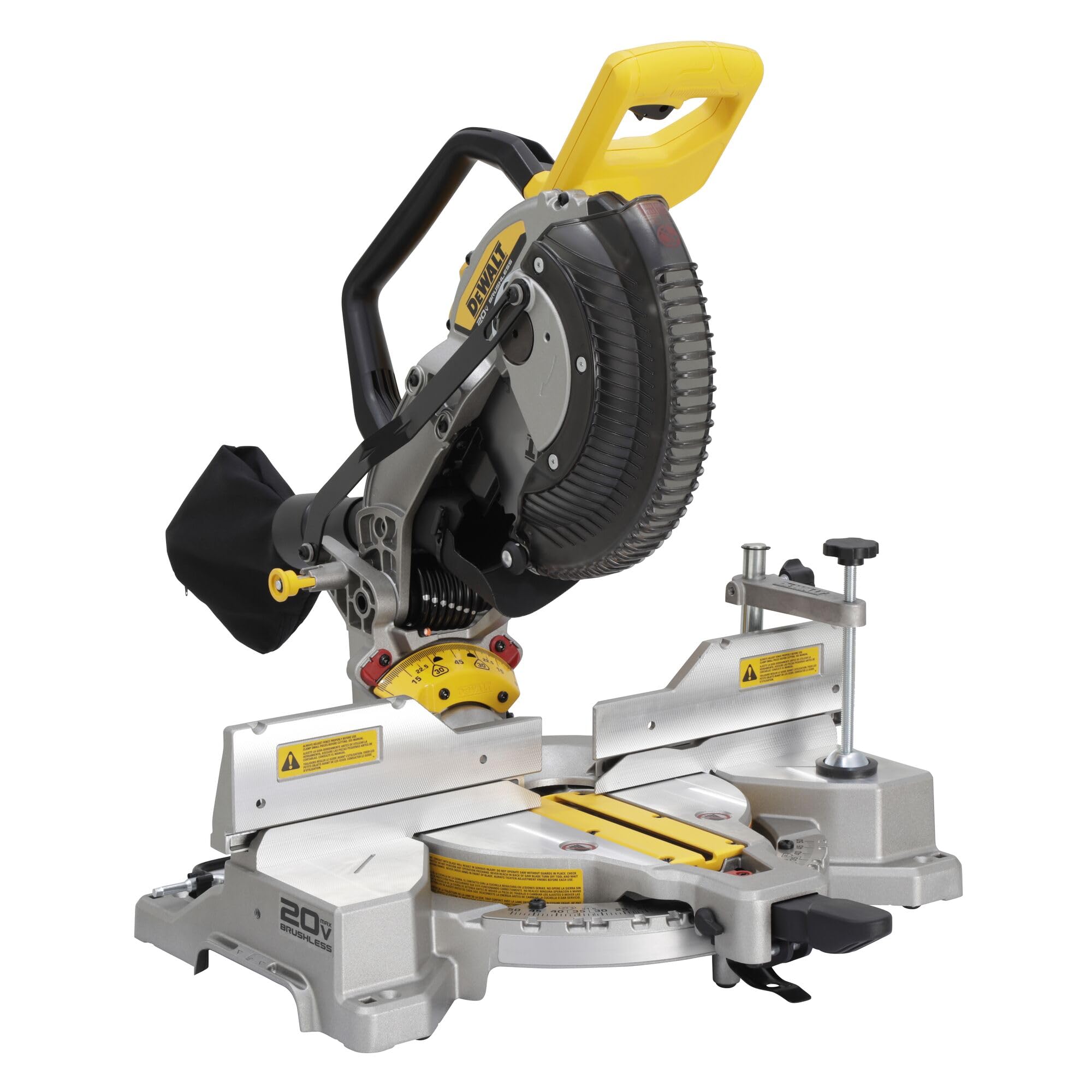
DEWALT’s most powerful compact cordless saw—a 10-inch double-bevel that captures 97% of its dust.
This is the saw that brings 10-inch capability to the 20V MAX family for the first time. It makes up to 434 cuts in 3-1/4-inch MDF base molding and up to 311 cuts in 2×4 SPF on a single charge, powered by a bevel gear transmission that boost runtime by minimizing power loss. The double-bevel head is the headline feature: you can tilt the blade both directions without flipping the workpiece, which saves real time on crown and compound cuts. A quick-snap bevel pawl sets 22.5 or 33.9 degrees fast.
Cut quality is the thing buyers single out, with owners praising clean, consistent cuts on hardwood and framing lumber, delivered quietly. The cutline blade positioning system gives adjustment-free cut line indication, and the dust collection captures up to 97% of dust during use. It’s designed for portability at 34 lbs (tool only) with a convenient carry handle, and it’s Tool Connect tag ready for asset tracking with the DEWALT site manager app. It cuts up to 6 inches horizontally and 5-1/4-inch baseboard vertically.
The honest limitation: it’s a fixed (non-sliding) saw, so you can’t crosscut wide boards like you would with a slider. One owner noted it’s “too small” for a 45-degree angle cut on a 4×2, so think of it as a compact, powerful 10-inch trim and cabinetry saw. The FLEXVOLT battery compatibility means it runs on the full range of DEWALT 20V MAX and FLEXVOLT packs, though batteries are sold separately.
The standout strengths
- 10-inch blade with double-bevel for pro-level compound cuts
- Outstanding dust collection—up to 97% captured
- Strong runtime: up to 434 cuts per charge
What to weigh
- Fixed head, so wide boards need multiple passes
- Tool only—batteries are an extra purchase
- Not the saw for heavy 45° cuts on thick framing
Choose it for: pro-level 10-inch cutting power, cleaner air, and dual-bevel convenience on trim, cabinetry, and construction projects.
Consider otherwise if: you need to crosscut wide lumber in one pass—that takes a sliding saw.
10. Metabo HPT MultiVolt 36V Sliding Miter Saw (C3610DRAQA)

A 36V dual-bevel slider that gives AC-like power and cuts through 2x10s without breaking a sweat.
This is the saw for serious builders who need the reach of a 10-inch dual-bevel slider but refuse to lose the freedom of a battery. It runs on the MultiVolt 36V system—a 36V battery (included) or a MultiVolt AC adapter (sold separately) for when you’re near an outlet. The dual bevel slides both directions, and the miter range is 0-60 degrees right and 0-55 degrees left, which is wider than most. The zero rear clearance slide rails let you cut efficiently in tight spaces or flush against a wall.
A 4Ah battery and charger come in the box, and one owner reported using it to build an entire 12×16 shed, cutting through 2x6s and 2x10s without a single problem, calling the MultiVolt battery life “2nd to none.” It weighs 45.5 lbs, which is substantial but reasonable for a 10-inch dual-bevel slider, and it includes a 10-inch blade, blade wrench, and an adjustable laser for more accurate cutting. Owners praise its accuracy straight from the start—angles spot-on with no adjustment needed.
The notable caveat comes from a handful of owners who hit quality-control issues: one reported defective 45-degree cuts that don’t sum to 90 degrees, and a replacement with a misaligned fence. It’s the kind of thing that stands out in a small review pool, so check your angles on arrival. For most, though, this is a powerful, lightweight-feeling dual-bevel saw that earned a “Best 10-Inch Miter Saw” award from Pro Tool Reviews in 2020.
Built for builders: if you’re framing sheds, decks, or doing serious trim work and want 36V power with a battery and charger included, this is a strong, capable pick.
Check on arrival: a small number of units have had angle calibration issues, so verify the fence and detents before heavy use.
11. Makita XSL06PT 18V x2 LXT (36V) Brushless 10″ Dual-Bevel Sliding Miter Saw

The 80.5-lb powerhouse that matches corded 10-inch performance and cuts walnut like butter.
This is the saw you buy when you want the absolute top of the cordless class and you’re done compromising on power. It’s an 18V x2 LXT system—two 5.0Ah batteries in series delivering 36V—that spins a 10-inch blade to 4,400 RPM via a Makita-built, electronically controlled BL brushless motor. The automatic speed change technology adjusts cutting speed and torque mid-cut for optimum performance. It delivers up to 334 cuts per charge in 2×4 SPF and up to 192 cuts in 2×12 SPF, which owners say lets the batteries last all day.
The quality and precision are the defining traits. Buyers call it “probably the best in class,” noting it matches the performance of a corded 10-inch Makita saw, cuts 3/4-inch walnut easily, and holds its calibration with a smooth, zero-deflection glide. The laser kit helps with alignment, though some owners disable the laser and use the blade itself. The forward slide rails let you place it flush against a wall, and the included kit comes with two 5.0Ah batteries, a charger, a 40T miter saw blade, a bag, and a vertical vise.
This is not a portable saw. At 80.5 lbs, it’s a full-size shop tool that stays put—owners are blunt that it’s “not very portable, but I don’t need it to be.” Dust collection is mediocre with the stock bag, so a shop vac is really required, and the standard clamp is just average. It needs four batteries if you want truly continuous operation. If your priority is a cordless saw that doesn’t give up an inch of power for the lack of a cord, this is the one.
Why it’s the flagship
- Corded-matching power: 4,400 RPM, cuts 2x12s with ease
- Top-tier accuracy and build quality, fine-tunable to zero tolerance
- Full kit: two 5.0Ah batteries, charger, laser, vertical vise
The honest trade-offs
- 80.5 lbs—this is a shop saw, not a haul-it-around tool
- Stock dust bag is weak; budget for a shop vac
- Runs best with four batteries for continuous work
This is the one if: you want a 10-inch cordless saw that genuinely replaces your corded workhorse for framing, cabinetry, and fine woodworking.
Look away if: you need to carry a saw between job sites—at 80.5 lbs, this one stays in the shop.
Understanding the Specs
Miter vs. Bevel Angles
The miter angle is the horizontalswing of the saw head, which sets how you cut a flat board at an angle—like the corner of a picture frame. The bevel is the vertical tilt of the blade, which you use for compound cuts on crown molding or angled edges. A single-bevel saw only tilts one direction, so you have to flip the workpiece for the opposite angle. A dual-bevel saw tilts both ways, which is a huge time-saver on crown work because you never flip the board.
Sliding Rails and Cutting Capacity
A sliding miter saw has rails that pull the blade forward through the cut, dramatically increasing the width of board you can handle in a single pass. That’s why the WOODSTARTER’s 8-inch blade can crosscut 12 inches, while a fixed 10-inch saw might only reach half that. If you routinely cut wide shelving, deck boards, or framing lumber, a slider is worth the extra complexity and weight. If you mostly cut trim and baseboard, a fixed head is lighter, simpler, and often more accurate over time because there are fewer moving parts to wear out.
FAQ
How many cuts can I get on a single battery charge?
What is the difference between a 7-1/4-inch and a 10-inch battery miter saw?
Do I need a sliding miter saw or a fixed one?
What does single bevel vs. dual bevel mean for my projects?
Can I use my existing batteries with these cordless miter saws?
Are battery miter saws as powerful as corded ones?
How heavy are these cordless miter saws and can I carry them?
What comes in the box with these battery miter saws?
Can I cut crown molding with a battery miter saw?
How do I connect a shop vac for dust collection?
Final Thoughts: The Verdict
If you want one dependable pick, the battery miter saw winner is the DEWALT DCS361M1 because it pairs the best accuracy system in its class with genuinely useful battery life and a portable 31.6-lb frame—it is the saw that owners consistently praise across the board. If you want a full day of cuts on a single charge and you’re cutting 2x lumber and deck boards, grab the CRAFTSMAN CMCS714M1 for its 585-cuts-per-charge stamina. And for serious builders who need 10-inch power and can live without a cord, the Makita XSL06PT is the one to reach for—it matches a corded saw’s performance and will be the last miter saw you buy.
How We Picked
We do not accept paid placement. Every pick is matched to a real buyer and a real use-case; we do not hands-on test units.
Sources & Methodology
Specifications: manufacturer listings and product documentation. Review insights: verified customer reviews, as of August 2026. Pricing: not shown on this page (it changes often); check the current price via the retailer link.
As an Amazon Associate, Gadgets Feed earns from qualifying purchases. This does not affect which products we feature.