
Our readers keep the lights on and my morning glass full of iced black tea. As an Amazon Associate, I earn from qualifying purchases.
Specs are compiled from manufacturer listings and verified buyer reviews and can change over time — please confirm the key details on the product page before buying.
Sleeping cool in your RV without hooking up to shore power or running a loud generator all night depends on one thing: the right 12-volt air conditioner. These units pull power directly from your house batteries, so you can run AC off-grid for hours. But not all of them are gentle on your battery. Some will drain your bank before sunrise, while others are built to stretch every last amp-hour.
I’m Min — the founder and writer behind Gadgets Feed. This guide is built by comparing the manufacturers’ published specifications and the patterns across verified customer reviews, so you get each pick’s real strengths and trade-offs instead of marketing spin.
This guide to the best battery operated air conditioner gives you the real-world specs and honest buyer feedback to choose the right rooftop or portable unit for your setup.
Quick Picks
- Countrymod 12V DC RV Air Conditioner 10000 BTU — Best Overall
- Treeligo 10000 BTU 12V DC Rooftop Air — Lowest Power Draw
- Outequip RV Air Conditioner, 12V — Best Value Rooftop
- EF ECOFLOW WAVE 3 Portable Air Conditioner — Portable Powerhouse
- Outequip RV Air Conditioner, 12V 10000 — All-Weather 2-in-1
- Gidrox 10000 BTU 12V DC RV Air Conditioner — Mid-Range Combo
- Cybertake S2 Pro Portable Camping Air — Tent-Ready Portable
How To Choose The Best Battery Operated Air Conditioner
The biggest mistake buyers make is looking only at cooling power (BTU) without checking how many watts or amps the unit actually pulls. A 10,000 BTU unit that draws 800 watts will run much longer on your battery than one drawing 2,930 watts—even though both claim the same BTU. Here is what actually matters for an off-grid setup.
Annual Energy Consumption (Watts) — The Real Number
Ignore the marketing BTU for a moment. Look at the “Annual Energy Consumption” spec listed in watts. This tells you how much power the unit uses when running at full load. Lower watts mean longer run time on the same battery bank. A unit rated at 800 watts will run nearly four times longer than one rated at 2,930 watts, assuming the same battery capacity.
Inverter Technology vs. Fixed Speed
An inverter compressor (also called variable frequency) is the key to efficiency. Instead of cycling on and off at full power, an inverter compressor speeds up or slows down based on the temperature. This keeps the cabin steady and uses far less power, especially at night when the temperature has already dropped. Units with an “Inverter Compressor” tag in the specs are the ones that can run all night without killing your batteries.
Form Factor: Rooftop vs. Portable
Rooftop units sit on the roof of your RV or van and require cutting a hole (typically a 14″ x 14″ vent opening). They are permanent and free up floor space. Portable units like the EcoFlow Wave 3 or Cybertake S2 Pro sit on the floor or a counter and use hoses, making them easy to move between a tent, a car, and a room. Rooftop units are generally more powerful at around 10,000 BTU, while portable units are smaller at about 5,000–6,100 BTU but far more versatile.
Item Weight and Installation
Rooftop units weigh between 40 and 54 pounds. If you install it yourself, a lighter unit (around 40 pounds) is much easier to lift onto the roof. Some units weigh 52 pounds, which is still manageable but harder to align solo. Also check the listed roof clearance—some low-profile units need only about 5.5 to 7.5 inches above the roof.
Quick Comparison
| Model | Best For | Cooling (BTU) | Power Use (Watts) | Weight | Amazon |
|---|---|---|---|---|---|
| Countrymod 12V DC RV AC | Efficiency & Run Time | 10,000 BTU | 3650 W (annual) | — | Amazon |
| Treeligo 12V DC Rooftop AC | Fast Cooling & Quiet | 10,000 BTU | 800 W | 40 lbs | Amazon |
| Gidrox 12V DC AC with Heater | All-Weather (Heat+Cool) | 10,000 BTU | 2930 W | 52 lbs | Amazon |
| Outequip RV AC (no heater) | Lightweight Rooftop | 10,000 BTU | 960 W | — | Amazon |
| EcoFlow Wave 3 Portable | Portability & Versatility | 6,100 BTU | 32 lbs | Amazon | |
| Outequip RV AC (w/heater) | Rooftop with Heat Pump | 10,000 BTU | 960 W | — | Amazon |
| Cybertake S2 Pro Portable | Tent & Small Spaces | 5,100 BTU | ~125 W (Eco+) | — | Amazon |
In‑Depth Reviews
1. Countrymod 12V DC RV Air Conditioner 10000 BTU
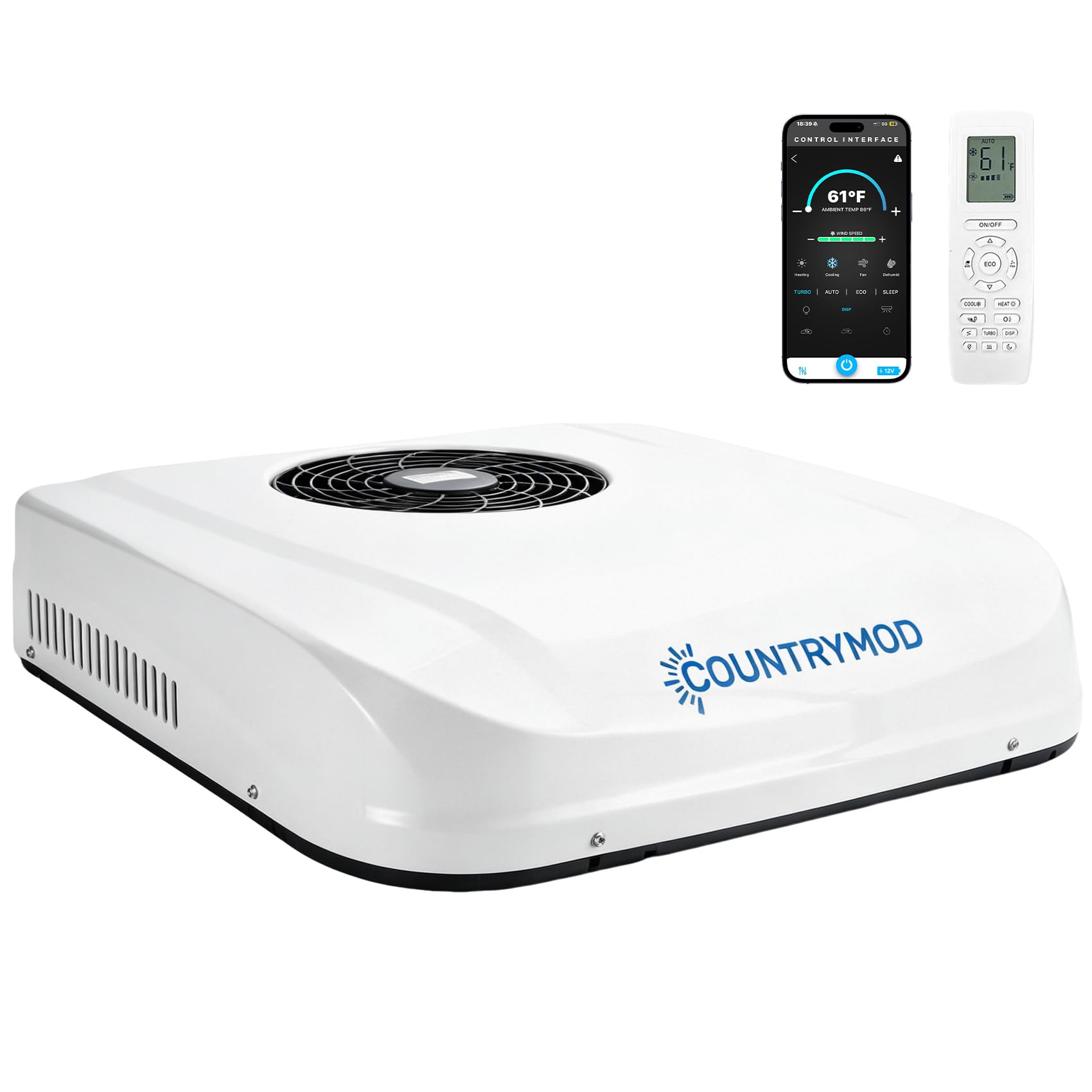
This inverter-compressor unit sips just 260W on ECO mode, letting you sleep through the night without draining your battery.
If running an AC all night on battery is your main goal, this unit is built for exactly that. It uses an inverter compressor — the variable frequency design that adjusts its speed rather than cycling on and off — and the manufacturer claims it consumes only about 0.3 kWh per hour in ECO mode. Buyers in the 113°F Nevada desert report it cooled a 100 sq ft space to 80°F during the day and 72°F at night, drawing just 260W on ECO and 590W on TURBO.
At 45-55 decibels (roughly as loud as a quiet conversation), it is hardly noticeable. One reviewer specifically called the sleep mode “absolutely low decibel” and noted that a 480Ah battery lasted all night. Unlike the Gidrox unit which draws 2,930 watts, this unit is designed to stretch your battery bank. The biggest installation gotcha: if your RV has a thick or arched roof, you will need longer 8mm all-thread rods (about 7-8 inches).
Why it wins for off-grid
- Extremely low power draw: 260W ECO, 590W TURBO according to reviewer reports
- Rated at 45-55 dB, nearly silent in sleep mode at 44 dB
- Fits standard 14″ x 14″ roof vent for easy installation
- Reviewers praise the customer service from “Tony Allen” for quick replacements
What to watch for
- Instructions are poor—most buyers rely on YouTube videos for installation
- Thick roofs require longer bolts not included in the box
- Some units arrived with a broken corner bracket at low torque
Grab this if: You want max run time from your battery bank and can handle a DIY install with some extra hardware.
Think twice if: You want a plug-and-play solution with clear instructions — this one demands a bit of tinkering.
2. Treeligo 10000 BTU 12V DC Rooftop Air Conditioner
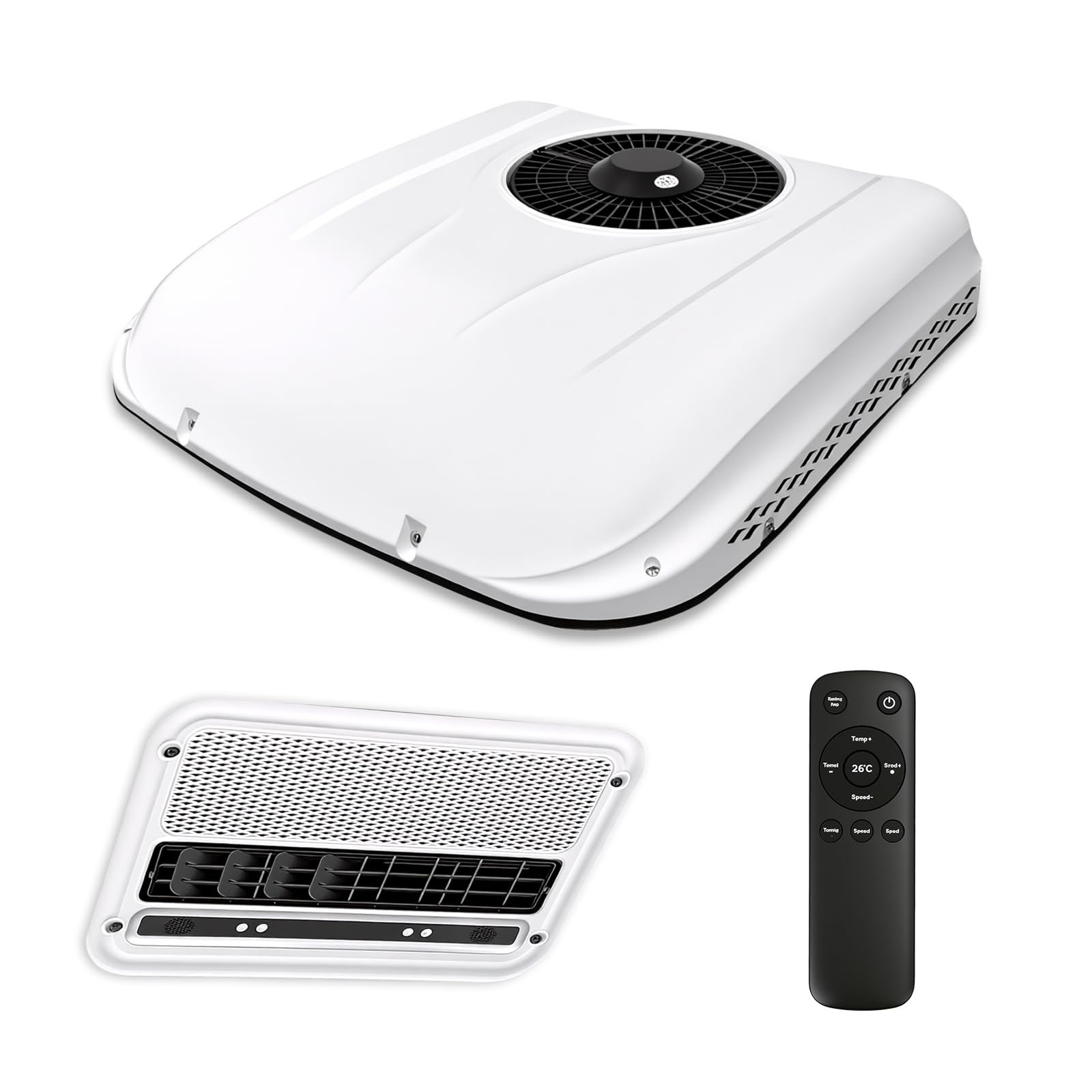
At 40 pounds and 800W annual consumption, this rooftop unit cools quickly while drawing 3.7x less power than comparable models.
The Treeligo is one of the lightest full-size rooftop units at 40 pounds, making it a realistic solo-install job. It uses an inverter compressor and is rated at only 800 watts annual energy consumption — a massive difference compared to the Gidrox unit’s 2,930 watts. That means on the same battery bank, this unit will run nearly four times longer. One buyer running a 12V 300Ah battery confirmed it “runs at 50A” which is roughly 600 watts — right in line with the spec.
It also drops the outlet temperature as low as 43°F (6.2°C) and can cool the interior within 5 minutes according to the manufacturer. The operating noise is 50 dB, which is quieter than the Outequip unit’s 54 dB but slightly louder than the Gidrox’s 40 dB Sleep mode. Buyers report it works well in 100°F weather and fits “perfectly on the roof” with the included 5-meter power cord. The catch is the “1/5” review that mentions support went unresponsive when the unit stopped working.
What stands out
- Lightest at 40 lbs, easiest roof install in this list
- 800W annual energy consumption is a full 3.7x less than the Gidrox unit’s 2,930W
- Low profile at just 5.5 inches thin, saving roof space
- Reviewers report it works well with 12V 300Ah batteries and solar
Where it stumbles
- Customer support can be unresponsive according to at least one buyer
- Installation can be tricky with bolt holes reported as misaligned
- No heating function — cooling only, unlike the Gidrox or second Outequip
Best for: Solo installers who want a lightweight, low-power rooftop unit for pure cooling — and are okay with minimal customer support.
Not for: Anyone who needs year-round heating or prefers the safety net of responsive support.
3. Outequip RV Air Conditioner, 12V 10000 BTU (no heater)
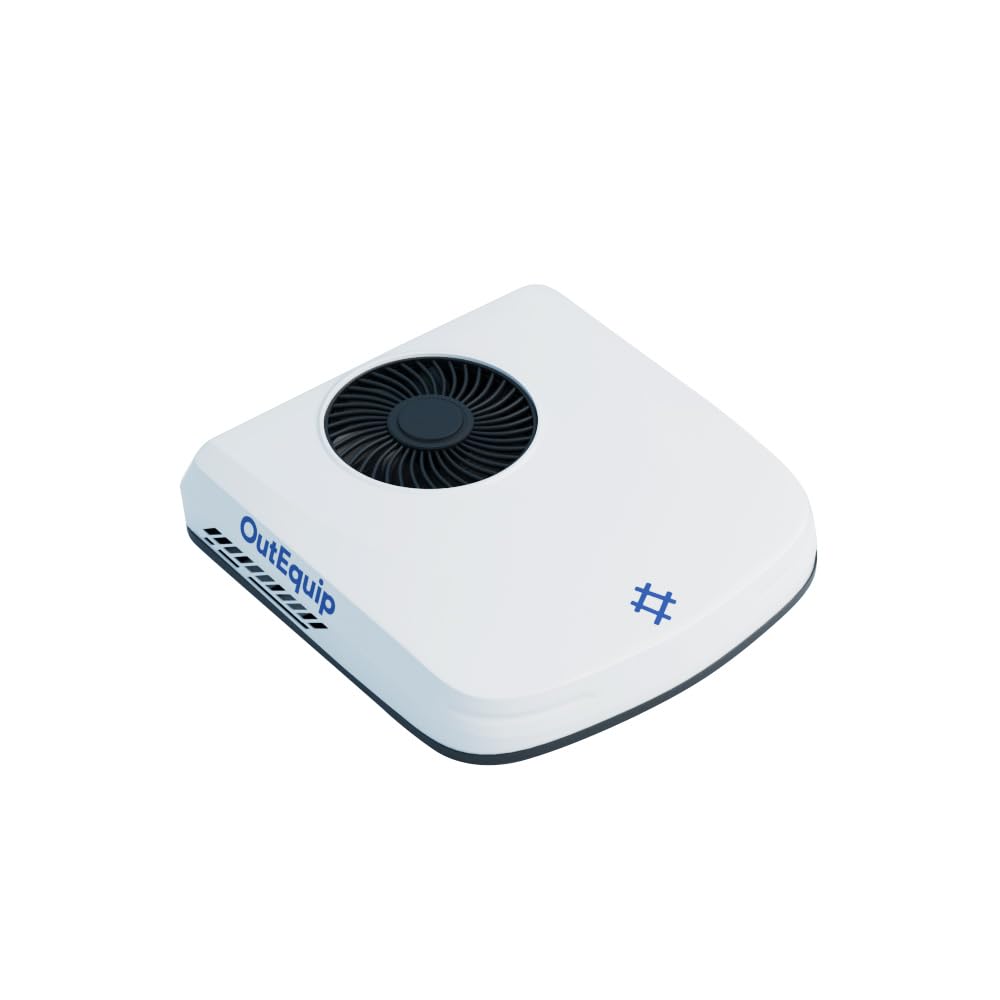
This 45-pound rooftop unit runs at 54 dB and fits low-roof Class B vans with just 7.5 inches of clearance.
The Outequip unit is among the most balanced choices for off-grid cooling. Owners mention it is very quiet at 54 dB and lightweight enough (about 43–45 lbs) for easy one-person installation. One reviewer noted: “Very quiet (54dB), light (45 lbs), easy swap.” The manufacturer claims 8 hours of cooling with a 12V 480Ah battery or 10 hours with a 600Ah battery.
Where it really shines is the low profile — at about 7.5 inches of roof clearance, it fits under the low roofs of Class B camper vans where taller units would hit the ceiling. One installer in a VW Westfalia bus confirmed it is the “ultimate AC” for a compact camper. The included remote control and Bluetooth app make it easy to adjust settings without reaching up to the unit, and the brushless copper motor fans keep it running quietly in ECO or Sleep mode.
Why it is a smart buy
- Low profile (7.5″) fits Class B RVs and low-roof vans
- 54 dB noise level — quieter than most rooftop units
- Bluetooth app + remote control for easy temperature adjustment
- 4 Star BEE rating for efficiency
The downsides
- No heating function — cooling only
- Gasket and bolt torque instructions could use more detail per some buyers
Reach for this if: You have a low-roof van or Class B RV and want a quiet, efficient cooling unit that is easy to install alone.
Pass on it if: You need a heat pump for cold mornings or have a very thick roof that needs longer bolts.
4. EF ECOFLOW WAVE 3 Portable Air Conditioner

This portable AC moves between tent, truck, and RV without any roof installation, offering 8 hours of cordless cooling on its optional battery.
The EcoFlow Wave 3 is a different breed from the rooftop units. It is a portable AC that sits on the floor and uses hoses, so no cutting into your roof. The manufacturer claims it can drop the temperature by 15°F in just 15 minutes under extreme heat.
The optional 1024Wh battery gives you up to 8 hours of cordless operation on ECO mode, and it supports 1,000W fast charging that fills it to full in about 75 minutes via AC or a car alternator. One buyer mentioned using it during a hurricane power outage in Florida and called it “great for hurricane power outages.” The Sleep mode operates at 44 dB, which is about as loud as a quiet library. The catch is that if you are outside the US, customer support is very limited — one owner reported a “non functional fan” and was told they would have to ship the unit back at their own expense.
Why it is unique
- Fully portable — no roof installation, moves between spaces
- 8 hours cordless operation with optional 1024Wh battery
- 1,000W fast charging (75 mins to full)
- R290 refrigerant reduces CO₂ emissions per the manufacturer
What limits it
- Only 6,100 BTU vs. 10,000 BTU from rooftop units — less cooling power
- No global warranty — returns ship at your cost if outside US
- No window kit included — you must DIY the seal
Choose this if: You want a portable, multi-use AC that goes from tent to RV and you already own EcoFlow power stations.
Avoid if: You are outside the US or need the maximum cooling power of a 10,000 BTU rooftop unit.
5. Outequip RV Air Conditioner, 12V 10000 BTU (with heater)
This low-profile rooftop unit adds a 4,500 BTU heat pump for mild mornings while keeping the same 960W cooling efficiency.
This is the same chassis as the Outequip unit above, but it adds a 4,500 BTU PTC heater for supplemental warmth. The specs are nearly identical — 960 watts annual energy consumption, 10,000 BTU cooling, low-profile design — but the added heater makes it a year-round solution. The heat pump is rated 4,500 BTU, which the manufacturer says is “ideal for mild temperatures and small spaces” but not enough for extreme cold or very large RVs.
Buyers love the low power draw on ECO mode, with one reviewer reporting it draws only about 16A on Eco with a 600Ah LiFePO4 battery. The unit weighs about 43 lbs (light for a rooftop AC) and sits only about 6 inches above the roof, which is 2-3 inches shorter than older units like the Dometic. Customers note the heat pump is a “standout for off grid use” and that the 12V/24V/48V compatibility gives flexibility. The main complaint is that the supplied cables may be too short for a large battery bank — one buyer needed an extra 4-gauge wire to reach their 832 Ah battery.
Why it is a two-season pick
- Heat pump adds warmth for mild cold weather (4,500 BTU)
- Ultra-low profile (about 6″) fits under solar panels or low roofs
- Runs on 12V, 24V, or 48V — very flexible electrical setup
- Lightweight at 43 lbs for solo installation
What holds it back
- Lid screws are hard to remove during installation — fragile connectors can break
- Remote requires patience to pair
- Supplied cables may be too short for large battery banks
Perfect for: Campers who face mild cold mornings and want a low-profile unit that fits under solar panels.
Not for: Arctic camping or anyone needing a primary heat source for below-freezing temperatures.
6. Gidrox 10000 BTU 12V DC RV Air Conditioner with Heater
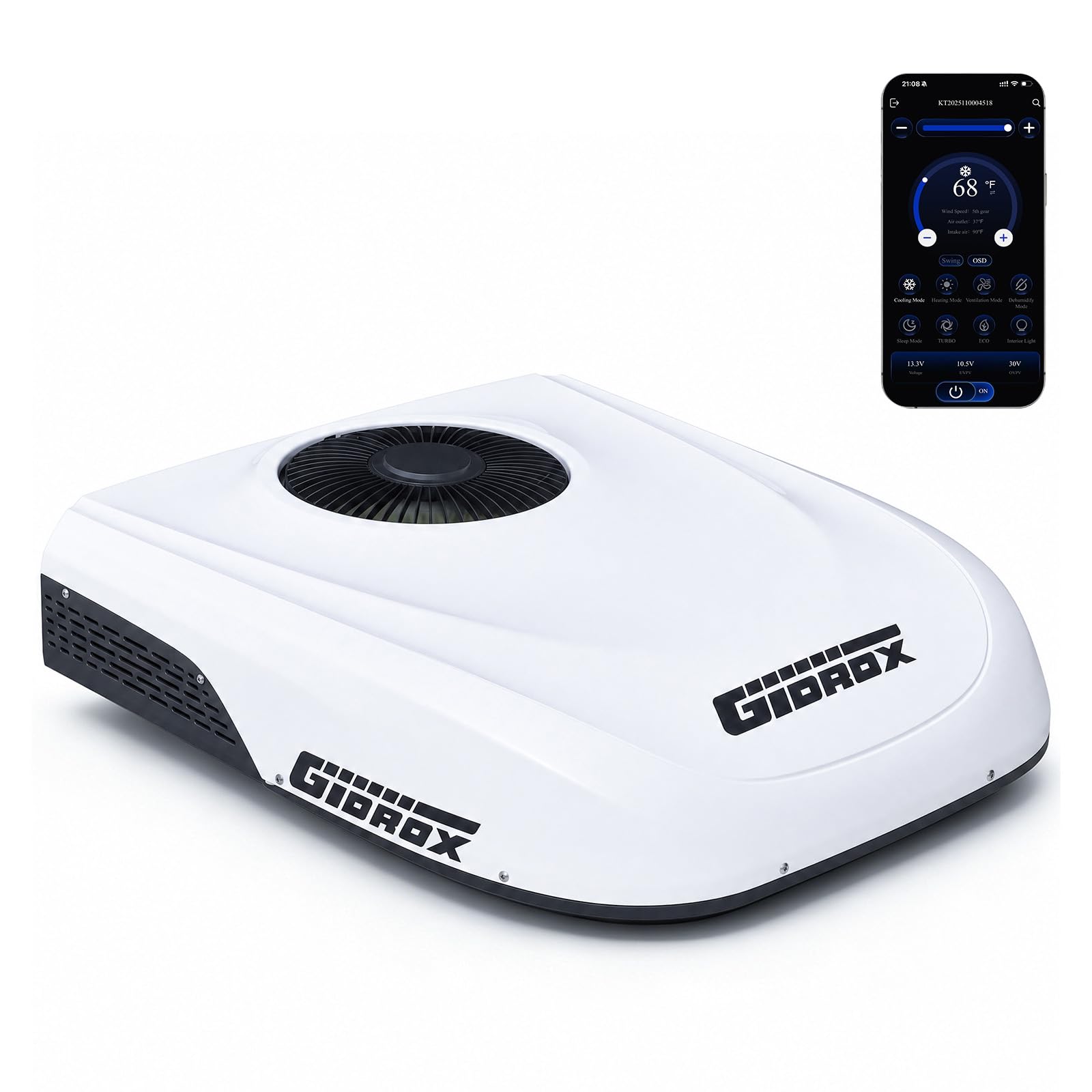
This 2-in-1 unit cools and heats with a whisper-quiet 40 dB sleep mode, but its 2,930W draw requires a large battery bank.
The Gidrox unit is the only one in this list that includes both a 10,000 BTU cooling function and a PTC heater for warmth, plus an app, remote, and touch control. The standout feature is its Sleep mode at just 40 dB — the quietest in this lineup, comparable to a library. The manufacturer says the 12V DC design runs directly off your RV battery with no inverter needed, and one satisfied buyer reported it works great overnight with an 800Ah battery bank.
The catch is the power draw: the Gidrox is rated at 2,930 watts annual energy consumption. That is a 3.7x higher power draw than the Treeligo unit’s 800 watts. This means you need a much larger battery bank for all-night use — the manufacturer recommends a 400Ah battery for “all-night” operation. The unit also weighs 52 pounds, which is 12 pounds heavier than the 40-pound Treeligo and 30% heavier in exact terms. Buyers love the “fast cooling” and the PTC heater (useful for chilly mornings), but the price is harder to swallow given the higher energy consumption.
Where it delivers
- Sleep mode at 40 dB — the quietest unit in this guide
- 3 smart control methods: app, remote, and panel
- 19.7 ft power cable included for long runs
- PTC heater works fast for mild warmth
Where it falls short
- 2,930W power draw is 3.7x higher than the Treeligo’s 800W
- Heaviest at 52 lbs, harder to install alone
- 8mm threaded rods may be too short for thick roofs
- Remote control issues reported by multiple buyers
Go with this if: You have a large battery bank (800Ah+) and want the quietest possible Sleep mode plus heating for mild mornings.
skip it if: You are trying to save battery power or have a limited budget — the energy draw and price are both high.
7. Cybertake S2 Pro Portable Camping Air Conditioner
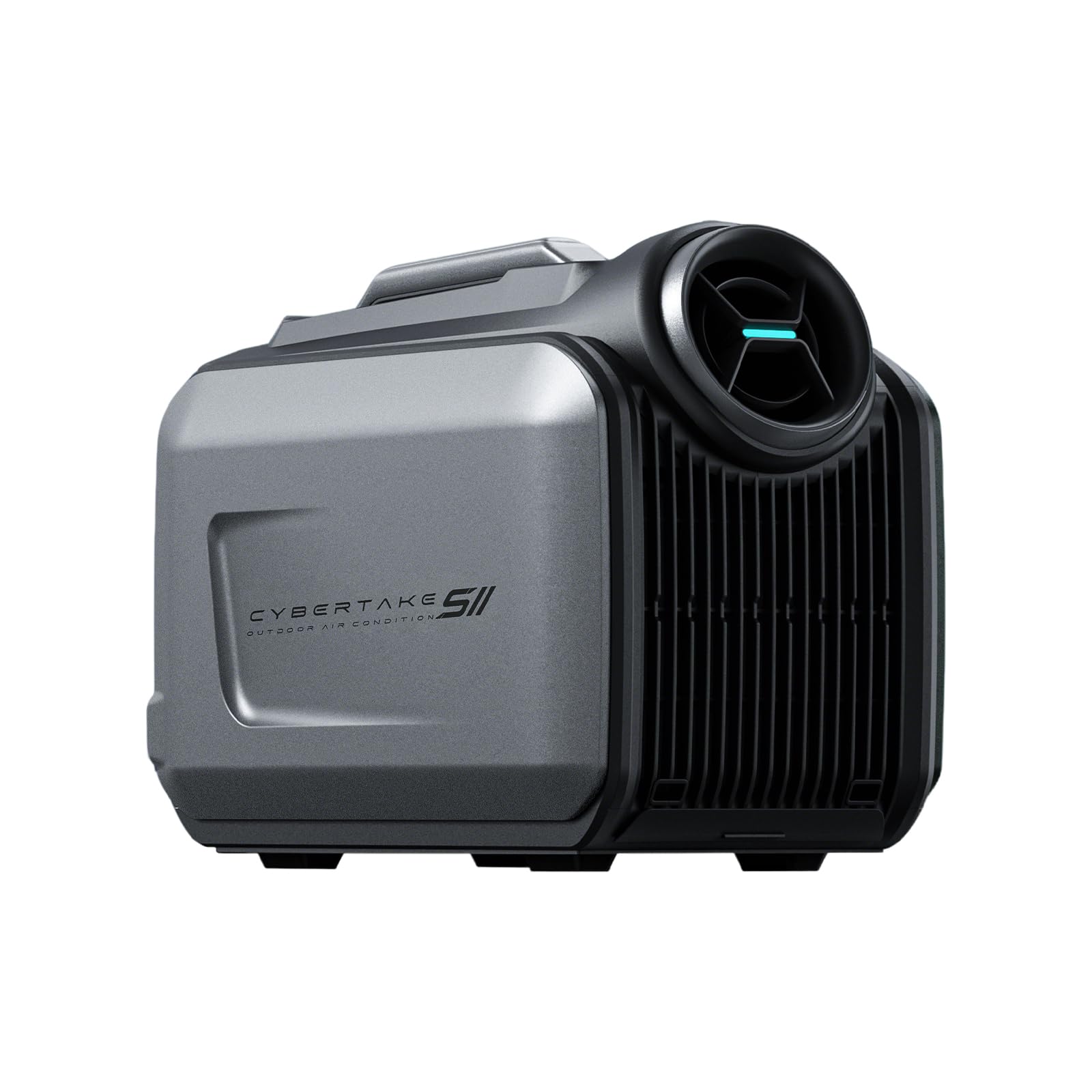
This IPX4-rated portable AC fits tents and small spaces, using just 1 kWh per 8 hours on Eco+ mode.
If you camp in a tent or teardrop trailer, a rooftop unit won’t work. The Cybertake S2 Pro is a portable AC designed for spaces up to 130 sq ft. It offers 5,100 BTU of cooling and 6,100 BTU of heating, and its standout feature is the Eco+ mode that the manufacturer claims uses as little as 1 kWh per 8 hours. That is about 125 watts per hour — dramatically lower than any rooftop unit here, though the BTU is also about half that of a 10,000 BTU rooftop.
The unit has an IPX4 water-resistant shell (it can handle splashes and rain), and it runs on multiple power sources: 100-240V AC wall outlet, 12-24V car/RV, or 48V DC from a portable power station. One buyer called it “smaller, lighter, more portable than similar units” and praised how it prevented condensation in their truck cap during camping. The noise level is 40 dB (same as the Gidrox Sleep mode), making it a good choice for a quiet campsite. The biggest complaint: the hose adapter doesn’t stay attached to the plates, with one buyer saying it “keeps blowing off the square rear and front plates.”
Why tent campers should look
- Eco+ mode uses ~1 kWh per 8 hours — extremely efficient
- IPX4 water-resistant shell for outdoor use
- 3-way power: AC wall, 12-24V vehicle, 48V DC power station
- Quiet at 40 dB and ready in 30 seconds according to the manufacturer
The frustrations
- Hose adapter doesn’t stay attached to the plates — needs a DIY fix
- Requires a separate 12V-to-48V booster for hardwiring
- Only 5,100 BTU — not powerful enough for large RVs
Best for: Tent campers, truck cap campers, and anyone who needs a portable, weather-resistant unit for small spaces.
Not for: Full-size RV owners who need the higher BTU of a 10,000 BTU rooftop unit.
Understanding the Specs
Annual Energy Consumption (Watts)
This spec tells you how much power the unit draws when running. Lower watts mean less strain on your battery. For example, the Treeligo unit uses 800 watts while the Gidrox unit uses 2,930 watts — both are 10,000 BTU rooftop units, but one will run nearly four times longer on the same battery bank. Always check this number before BTU alone.
Inverter Compressor
An inverter compressor (also called variable frequency) adjusts its speed based on the temperature, rather than cycling on and off at full power. This makes the unit more efficient and keeps the temperature steadier. All of the rooftop units in this guide use inverter technology, but portable units like the EcoFlow Wave 3 and Cybertake S2 Pro may not — check the spec tag for “Inverter Type: Has Inverter.”
FAQ
Can a battery operated air conditioner run all night on a standard RV battery?
How do I know if a rooftop unit will fit my RV?
What is the difference between a portable and a rooftop battery operated AC?
What size battery bank do I need for a 10,000 BTU 12V air conditioner?
Can I run a battery operated AC on solar power alone?
How loud are battery operated air conditioners in decibels?
Does a battery operated AC also work as a heater?
Is there a battery operated AC that works with an app?
Final Thoughts: The Verdict
For the majority of shoppers, the best battery operated air conditioner overall is the Countrymod 12V DC RV Air Conditioner because of its incredibly low power draw (260W ECO mode reported by buyers) and quiet 44 dB sleep mode. It is the unit that will let you sleep through the night without worrying about your battery dying. If you want a lightweight unit that is easier to install solo but still very efficient, grab the Treeligo 10000 BTU Rooftop AC. And for tent campers or vanlifers who need a portable unit that moves with them, the standout is the Cybertake S2 Pro Portable Camping AC with its incredibly low 1 kWh per 8 hours on Eco+ mode.
How We Picked
We do not accept paid placement. Every pick is matched to a real buyer and a real use-case; we do not hands-on test units.
Sources & Methodology
Specifications: manufacturer listings and product documentation. Review insights: verified customer reviews, as of July 2026. Pricing: not shown on this page (it changes often); check the current price via the retailer link.
As an Amazon Associate, Gadgets Feed earns from qualifying purchases. This does not affect which products we feature.