
Our readers keep the lights on and my morning glass full of iced black tea. As an Amazon Associate, I earn from qualifying purchases.
Specs are compiled from manufacturer listings and verified buyer reviews and can change over time — please confirm the key details on the product page before buying.
Carbon monoxide is the one intruder in your home that gives no warning at all — it is colorless, odorless, and tasteless, so a battery-operated CO detector is the only thing standing between your family and a gas leak you would never notice on your own. The good news: the best ones are cheap, dead simple to mount or set on a shelf, and keep working even when your power goes out. The hard part is choosing between the models that blow the alarm at everything (including burnt toast) and the ones that quietly do their job for a decade.
I’m Min — the founder and writer behind Gadgets Feed. This guide is built by comparing the manufacturers’ published specifications and the patterns across verified customer reviews, so you get each pick’s real strengths and trade-offs instead of marketing spin.
This guide breaks down what each pick actually does in real rooms and real emergencies. From electrochemical sensors to sealing ten-year batteries, every pick here earns its place as a reliable, no-fuss way to keep your air monitored without wiring, contractors, or a single wall outlet, so you can choose the best battery-operated CO detector with clear eyes.
Our Picks at a Glance


How To Choose The Best Battery-Operated CO Detector
The real question behind every battery-operated CO detector is simple: will it still be protecting your family a few winters from now, and will it beep at the right things for the right reasons? Here is what actually decides that.
Battery type is the single biggest difference between models
A sealed ten-year lithium battery means you never touch the unit again until it is time to replace the whole detector. That is the easiest life. But sealed also means you throw the alarm away when the battery finally dies — there is no fresh cell to drop in. A user-replaceable AA or 9V alarm costs less up front and lets you keep the same housing for years, but you have to remember the low-battery chirp every so often. Neither is wrong. Just know which one you are signing up for before you buy.
Electrochemical sensor is the technology doing the actual work
Every detector on this list, from the basic AA unit to the professional handheld, uses an electrochemical sensor to smell the CO in the air. It is more reliable than the old metal-oxide style and it plays nicely with battery power because it sips so little current. Over time the sensor ages and eventually needs to be replaced — that is why every reputable CO alarm has some kind of end-of-life signal built in.
Do you want a number or just a noise?
A basic alarm gives you one signal: everything is fine, or everything is not. A model with a digital LCD shows you the actual CO level in parts-per-million (PPM), which is helpful if you want to confirm a low reading or check the air after a wood stove has been running all night. A professional handheld tool takes that one step further and lets you hunt leaks across a whole building.
Quick Comparison
| Model | Best For | Power Source | Alarm Volume | Display | Amazon |
|---|---|---|---|---|---|
| Kidde Carbon Monoxide Detector KN-COB-LP2★ Best Overall | Whole-home basics, tabletop or wall | 2 AA batteries | 85 dB | LED indicators only | Amazon |
| First Alert Battery Carbon Monoxide Alarm CO400Best Value | No-frills bedroom and hallway coverage | 9V battery | 85 dB | None | Amazon |
| Kidde KN-COB-B-LP Nighthawk CO AlarmBest for Cabins | Cabin, garage, and small utility room | 3 AA batteries | — | LED indicator | Amazon |
| SITERWELL GS828A CO Detector | Multi-room coverage and travel | 2 AA alkaline (included) | 85 dB | LCD with real-time CO levels | Amazon |
| First Alert CO410A CO Alarm with Backlit Display | Workshops and work-truck garages | Battery powered | 85 dB | Backlit digital LED | Amazon |
| First Alert CO710A with Temperature Display | low-maintenance ten-year coverage | Sealed 10-year lithium | Audible | Backlit digital, CO or room temp | Amazon |
| TOPTES CT-580 Portable CO Detector | Leak hunting in RVs, cars, and job sites | Rechargeable (USB-C) | Audible + vibration | TFT color, 0–1000 PPM | Amazon |
| X-Sense SC01-W Interconnected Combo 3-Pack | Whole-home smoke plus CO coverage | Sealed 10-year lithium | 85 dB | Small LCD | Amazon |
| Sensorcon Inspector CO Monitor | HVAC, utility, and inspection pros | 1 CR123A battery | Audible + LED | Real-time ppm readout | Amazon |
In-Depth Reviews
1. Kidde Carbon Monoxide Detector, Battery Powered CO Alarm with LEDs, Test-Reset Button, Low Battery Indicator, Portable
Our pick — over 4.5★ from 36,000+ verified ratings; the strongest balance of quality and price.
The plain-vanilla pick that quietly does the one job you need done — and does it for the most people.
What you get for the money is an alarm that runs on two AA batteries (both included), so it keeps watching the air even when your power cuts out — which is exactly the scenario a lot of gas water heaters create. It works two ways: screw it to a wall with the included mounting hardware, or just stand it on a tabletop, and it runs on an electrochemical sensor to sniff out carbon monoxide in either spot. The status readout is dead simple: a green LED means power is on, a red LED plus an 85-decibel alarm means CO is present, and the 85 decibels is roughly the noise of a garbage truck a few feet away — loud enough to wake a whole floor.
A 4.7-star average across tens of thousands of ratings reflects that consistency. What wins owners over is raw functionality — the review pages are full of people who plugged it in, tested it, and forgot about it. One van-living reviewer sums up the whole category better than any spec sheet can: “we never suffocated while living in a van and it would go off if moved the wrong way or if the buttons got accidentally pushed.” It also logs the last CO detection or test run in event memory, so you can check whether anything happened while you were away. It runs on AA batteries you swap yourself, which keeps you in full control of power — you never have to throw the whole unit away when the cells die.
Where it earns the top spot
- Two AA batteries included — no extra trip on install day
- Wall-mount or tabletop placement, both from the start
- 85 dB alarm with a clear red LED when CO is detected
- Event memory logs the last detection or test run
- Backed by a 10-year limited warranty
The trade-off to weigh
- No digital PPM readout — you get a status light, not a number
- You replace the AA batteries yourself, so put a date on the calendar
- Physically, it runs 1.5 inches deep versus the First Alert CO400’s 1 inch — slightly thicker on the wall
Reach for this if: you want the safest, simplest, best-reviewed battery CO alarm on the list and you are happy to swap AAs every so often.
Look elsewhere if: you specifically want a digital PPM number on the front, in which case the SITERWELL or First Alert CO410A above is a better fit.
2. First Alert Battery Carbon Monoxide Alarm
The workhorse brand that has been guarding homes for generations keeps its reputation intact here.
First Alert’s battery-only CO alarm is the pick that buyers pass down. The review pages have a small crowd of owners who are now on their second or third unit after years of service — as one puts it: “we had this exact one for YEARS and it finally died on us. Got another one and it’s doing its job well once again.” That kind of repeat business comes from a proven combination: an electrochemical sensor, an 85-decibel alarm, and a 5-year limited warranty with an end-of-life chirp that tells you when the unit itself needs replacing.
The physical package is compact and light enough to move around. It runs 1 inch deep versus the Kidde KN-COB-LP2’s 1.5 inches, so it sits closer to the wall in a hallway or stairwell. The build quality is the top-counted thing owners single out, followed by the fact that it does its job — and that pattern runs from the factory floor of a workshop to a sleeping bag in a beater car in winter, since a 9V cell means you can drop in a fresh battery without buying a whole new unit.
What buyers rave about: the sturdy build and the loud, unambiguous alarm. People trust it as a “no wiring, no outlet needed” install that takes minutes rather than an afternoon.
The honest caveat: durability is the one soft spot on First Alert’s record here, and it is the reason the brand ships a 5-year warranty instead of a 10-year one. Buy it as a solid workhorse unit you will replace on schedule, not as a lifetime appliance.
The verdict: a strong household standard for anyone who wants a name they recognize, a no-outlet battery install, and a low current draw that keeps working in a blackout.
You will want to know: at 11.2 ounces it is noticeably heavier than the Kidde KN-COB-LP2 at 8 ounces — not a problem on a wall, but noticeable if you toss it in a car kit.
3. Kidde KN-COB-B-LP Nighthawk Carbon Monoxide Alarm, Battery Operated – 21007268
The quiet, cabin-friendly alarm that keeps working after a night of wood-stove heat.
If your CO risk lives in an uninsulated cabin, a garage with a propane heater, or a wood-stove room where the power might not be reliable, this is the alarm to reach for. It runs on three AA batteries (Duracell cells come in the box), so it keeps sampling the air through a sub-20°F night — exactly the case that motivated one buyer’s review about needing it while living with a wood stove. It carries a seven-year end-of-life warning to tell you when the sensor itself is spent, and it meets the requirements of Underwriters Laboratories, the independent safety lab that sets alarm standards.
What makes this one different from the wider Kidde lineup is how likely you are to see it on a shelf. It is designed to look like a small thermostat, not a bulky wall puck, so it slots into a utility room or lines up on a windowsill without drawing the eye. Functionality is the top thing owners count on it, followed by installation — the backplate screws on with two screws and the monitor twists on. Reviewers have flagged it as the best-looking option next to rounder rivals.
Who loves it most: the off-grid set — cabin owners, van-lifers, and anyone with a wood stove or ventless gas appliance who needs reliable monitoring without a wall outlet nearby.
One friction point worth knowing: one buyer had trouble getting the three AAs seated and noted the unit does not work with rechargeable batteries, so stick to standard alkaline cells and be patient with the battery door the first time.
The reality check: this is a no-frills alarm with no digital CO readout. That was actually celebrated by a repeat owner: “Second purchase. First one lasted many many years.” Enough said.
Bring this one home if: you have a wood stove, gas fireplace, or unheated sleeping space and want a discreet little alarm that installs in minutes.
Pick a different model if: the outlet-style puck or a big visual display is what you had in mind — this one is deliberately minimal.
4. SITERWELL Carbon Monoxide Detector 7 Year Product Life Co Detectors
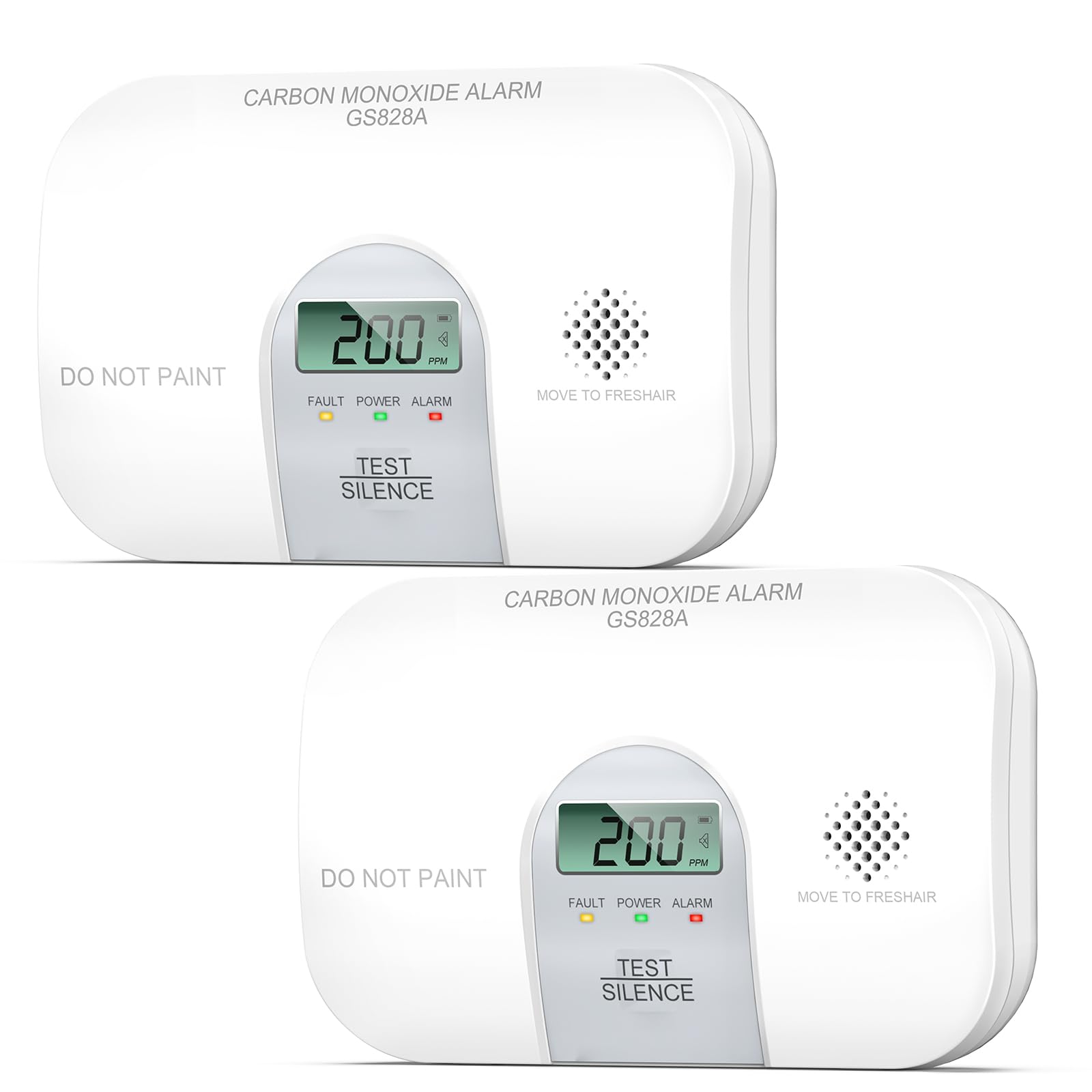
The one that puts actual numbers in front of you, not just a green light and a wish for the best.
A real-time LCD that shows CO levels in PPM is the feature you appreciate the moment your family asks “is it really safe right now?” The SITERWELL GS828A gives you exactly that, plus a three-colored LED indicator ring that flashes red for an alarm, green for power, and yellow for a fault — so a washout sensor tells you clearly instead of pretending. The 85-decibel alarm is rated to carry at least three meters, enough to be heard across a room rather than only at arm’s length. It conforms to ETL standards, meaning it meets the independent safety lab’s requirements for CO alarms.
Power comes from two AA alkalines already installed, so it wakes up as soon as you pull the battery tab — often after a 30-second air-sampling warm-up. That makes it a natural pick for hotels, RVs, and travel because there is zero setup beyond unpacking. Reliability is the aspect buyers count on most, followed by how quickly it is from the start. The sensor is built for a seven-year product life, and the manufacturer rates the unit for continued use across that window with normal battery replacement.
What makes it stand out
- Real-time LCD reads CO levels in PPM — you see the number, not just a light
- Batteries included and pre-installed — pull the tab and it is working
- Wall-mount or free-standing, so it works on a shelf or hotel nightstand
- Three-year limited warranty
Where it stumbles
- The wall-mount bracket still requires drilling, which one buyer found annoying
- A small flashing status light every 40 seconds can bother a light-sensitive sleeper in the same room
- Seven-year sensor life is shorter than the sealed ten-year batteries on the First Alert CO710A
The right call if: you want to see the actual CO number and cover more than one room — the four-pack configuration is how most buyers kit out a whole house.
Think twice if: you want a totally sealed disposable unit — this one uses replaceable AAs, which is a feature for some buyers and a chore for others.
5. 1039724 Battery Operated Carbon Monoxide Alarm with Backlit Digital Display

Runs on batteries, reads the air in real time, and turns a work bay into a monitored space.
This is the First Alert CO410A, and it is the pick that seems to end up wherever real combustion happens. In a semi-truck shop, one reviewer uses it because it “shows real-time PPM readings right on the screen” — the same trick you want when you are tuning a diesel engine or firing a propane heater in a garage. The backlit digital LED display makes those numbers readable in a dark corner. The electrochemical sensor is the same class of sensor as the simpler First Alert CO400 above, but the display turns it into a tool you can actually consult instead of a black box that only speaks up when things go wrong.
The 85-decibel alarm is loud enough to carry over shop noise, and the battery-powered design means it is not chained to a wall outlet — you can move it around to whichever bay is currently running. In a residential setting, owners are happy to buy a pair and keep one upstairs and one downstairs, since changing the batteries is simple enough to do without a ladder.
The honest trade-off: on the hardware side, the wall-mount screw pattern changed from the previous CO400 design, so if you are upgrading in place, expect to patch old holes and re-drill. A buyer described that as “a bit of a nuisance” — worth knowing before you commit to that wall spot.
The through-line: what you are really buying is First Alert’s electrochemical sensor paired with a display bright enough to read in a dark room. That combination is why it lands in shops, garages, and boiler rooms, not just living rooms.
The pick for: a home shop, work bay, or any space where you want to watch as well as be warned, on battery power and without an outlet.
Worth noting: if you have a fresh-wall install, the newer bracket pattern is easier to work with than trying to reuse the older screw holes.
6. Carbon Monoxide Detector, Temperature Display, 10-Year Battery

Ten years of coverage with zero battery swaps, plus a peek at room temperature for good measure.
The First Alert CO710A is built for people who do not want to climb a ladder. Power comes from sealed ten-year lithium batteries, so the unit monitors continuously for a full decade without you ever swapping a cell. When the coverage period runs out, the entire unit gets replaced — no fresh battery saves the sensor past its design life anyway. The multi-function backlit digital display switches between two things: the current CO level, or the ambient room temperature. There is also a peak level feature that retrieves the highest CO concentration the unit ever measured, which is what you want when you come back from a trip and want to know if anything happened while you were gone.
Because the batteries are sealed and the display is flexible, the CO710A lands in two very different spots in a home. It works on a bedside table because the temperature reading lets you double up on your clock and your air check without having two separate devices. Or it mounts to a wall in a hallway as a pure CO monitor with nothing to think about until a decade has passed.
What to know going in: the temperature display runs in Celsius, not Fahrenheit. Several buyers have flagged this as wish-list material — for most people the CO function is what matters and the temperature is a bonus, but if you specifically wanted Fahrenheit for weather peeking, this is not the unit that gives it to you.
Why it still earns a slot: nothing else on this list delivers a full decade of sealed coverage with a digital readout and a peak-level log in the same box. For pure peace-of-mind and zero battery maintenance, that combination is hard to argue with.
Ideal for: anyone who wants to mount an alarm in a tricky spot and then not think about it again for ten years.
Skip if: you absolutely need a Fahrenheit thermometer alongside the CO monitor — the display is Celsius only.
7. TOPTES CT-580 Portable Carbon Monoxide Detector, Rechargeable CO Detector with Vibration, Visual & Audible Alarms, 0-1000PPM, TFT Color Display for Home, Camping, Travel, Industrial & Professional Use

The handheld leak hunter that finds the CO your wall alarm cannot pin down to a source.
Where a normal household CO alarm tells you something is wrong, the TOPTES CT-580 tells you exactly how much and exactly where. Its high-sensitivity DDS sensor is specified to respond within 0.3 seconds across a 0 to 1000 PPM range, fast enough to catch a spike the moment a gas appliance cycles on. That range and speed is why reviewers have used it to hunt down CO sources standard alarms miss — one buyer traced a cracked PVC vent pipe on a tankless water heater by watching the reading spike to 1,800 ppm only when hot water ran — a source no basic alarm could have pinned down.
what separates it from the household units is the alarm itself. It uses three simultaneous notification modes — light, sound, and vibration — so it fires on three channels at once when the CO level crosses a threshold. The housing is ABS engineering plastic for grip, and the screen is a TFT color display with adjustable brightness, auto screen-off, and a built-in flashlight, which is the exact feature set you want when you are kneeling in an RV bay looking for a leak. It charges via USB-C and includes a protective case. The menuing is deeper than a home alarm: alarm history and both a zero and standard gas calibration are available for the professional user, and for home use it simply turns on and shows a graph.
Where it shines: as a second-layer tool. If you already have a wall-mounted CO alarm and want something you can carry into an RV, car, cabin, or garage to actually chase a leak down, this is the one that turns a vague suspicion into a confirmed number.
The catch: it is not a set-and-forget appliance. The rechargeable battery needs tending, the alarm is a manual tool you keep nearby rather than an installed monitor, and some buyers report a four-to-eight second delay on detection versus the near-instant 0.3-second spec, which is worth knowing if you plan to use it in an emergency-response setting.
Buy it if: you want a rechargeable, portable CO toolkit — for RV, boat, car, tent, or a job site — with real PPM numbers and a display you can read in low light.
Not for you if: you want something you install once and never touch again; a sealed household unit like the First Alert CO710A is the better fit.
8. X-Sense Interconnected Smoke and CO Detector Combo, SC01-W, 3-Pack
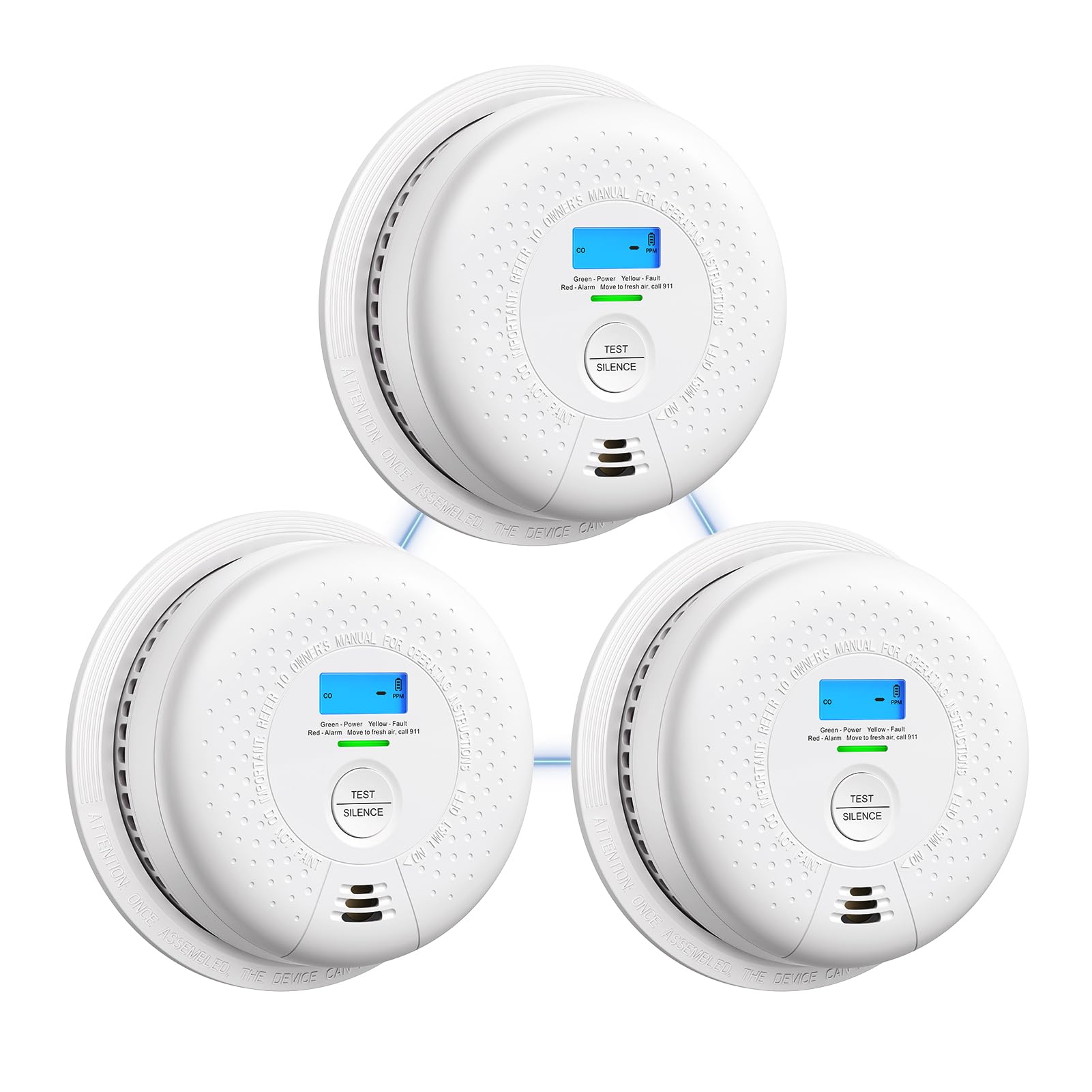
When one alarm trips, every alarm trips — and that is the whole point of this pack.
This is the pick for anyone who lives in a house big enough that a single upstairs alarm would never wake someone in the basement. The X-Sense SC01-W pairs a photoelectric smoke sensor with an electrochemical CO sensor in each unit, then wirelessly links them together — so a detection on one floor triggers the 85 dB alarm on all the others. Three units carry a sealed ten-year lithium battery, which is a full decade with no battery swaps and no ladder climbing. It meets the UL 217 and UL 2034 safety standards, the two independent lab standards covering smoke alarms and CO alarms respectively, and the enclosure uses heat-resistant PC material.
Setup is where this one really shines. Ease of installation is the feature buyers mention most, followed by the connection step — the three-pack arrives pre-synced, and one owner said plainly that linking a set of six to a set of three went smoothly. Installation takes a normal drill and screwdriver; the units come with a mounting bracket, screws, and anchors, and the pre-synced setup means you can trust the pack to work together without hunting through a manual.
The big-tent coverage case: one unit covers smoke, one covers CO, and all three cover the whole house as a mesh. For bedrooms above a basement or a kitchen near an upstairs hallway, that combined protection is exactly what a wired system would give you — without any wiring.
The honest caveat: reliability has a quiet tail of complaints — some owners mention false alarms, and one wrote in about all three units tripping within two months and then one shutting down completely. X-Sense replaced the units under its 60-day money-back and 5-year quality warranty, which is why this still earns a slot as a whole-home option rather than a single-room pick.
The pick for: a multi-floor house where you want the whole family, on every level, alerted the second any single alarm sounds.
Play it safer if: you only need CO protection in one room — a dedicated single CO alarm is simpler and there is nothing to sync.
9. Inspector CO Monitor | CE Certified Portable Gas Monitor | Industrial and Scientific | IP67 | Standard Model
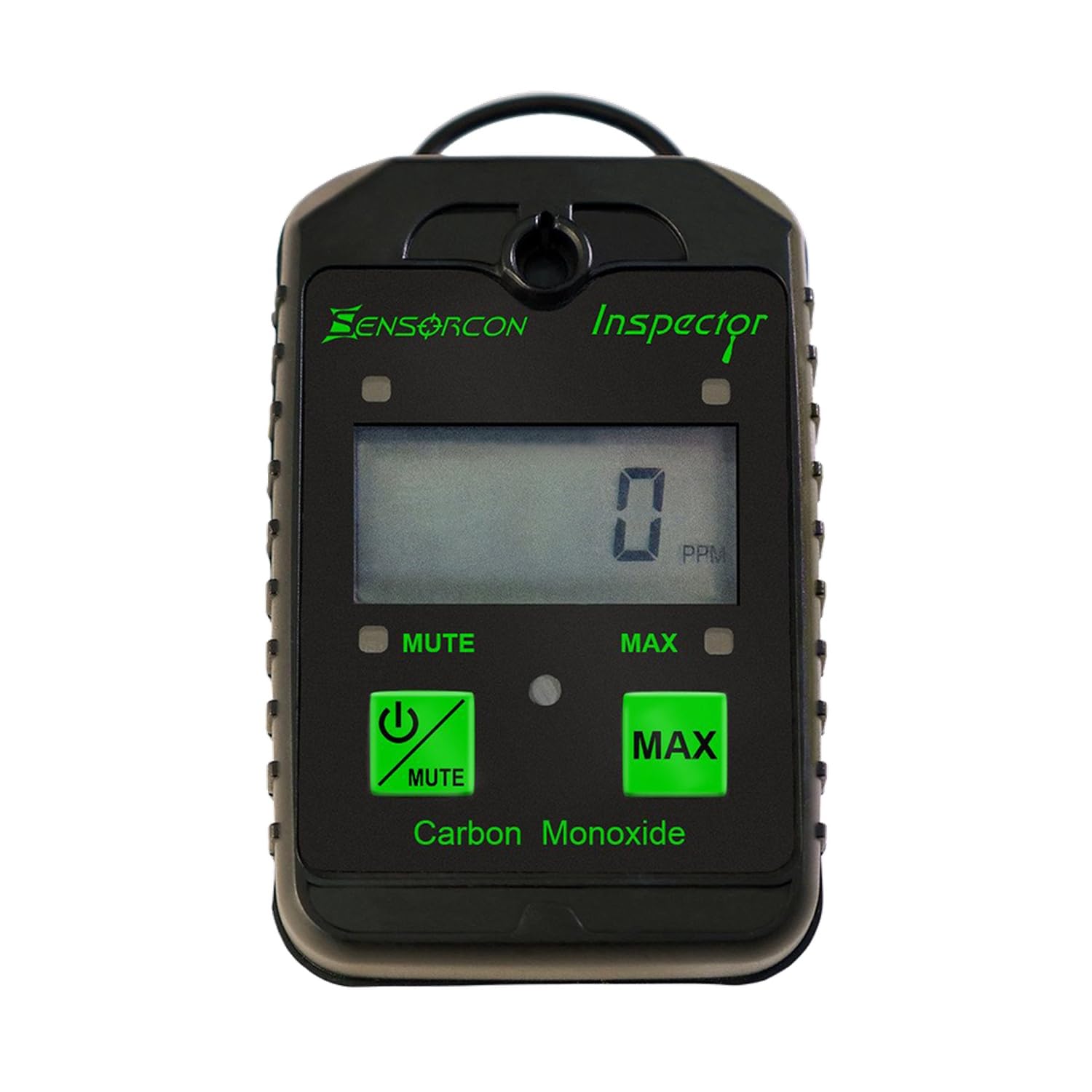
Built for the person whose job is walking into a basement and confirming the air is safe.
The Sensorcon Inspector is not really a home alarm — it is a professional CO monitor built to be carried, hung off a belt, and trusted in buildings where getting the number wrong has real consequences. It is CE certified to EN 50271, the standard for portable gas detection instruments, which is a professional-tier requirement most household alarms never touch. It reads CO in real time with a maximum-reading lock, so you can see exactly what the peak was even minutes later. The housing is IP67 waterproof and shockproof, meaning it survives being dropped in a puddle and keeps monitoring — a wearable steel belt clip and lanyard loop let you work hands-free.
The feature list that separates it from every other unit on this list is one small word: replaceable. The gas sensor can be swapped, and the power cell is a single CR123A battery, and one reviewer got almost two years and eight months of intermittent use from it. That is the design philosophy of a professional tool, not a disposable household unit — you keep the housing and service the sensor. Simultaneous visual LED and audible alerts fire together, and the monitor is used by HVAC contractors, utility workers, and building inspectors as a work tool.
The standout feature: the sensor responds fast enough to catch a puff of exhaust. Multiple reviewers describe catching a reading of 5 near a car exhaust within seconds, then watching it fall back to 0 in fresh air — exactly what you want from a work-grade instrument.
Worth knowing before you buy: the sensor requires periodic calibration and eventual replacement, both of which cost extra money and time — that is a fact of life with any electrochemical sensor used regularly, and one reason the Inspector is aimed at people who will actually use those numbers. It is battery-powered, so it still works during an outage, but the CR123A is a specific cell you will need on hand.
For the pro or serious amateur: HVAC, utility, or inspection work, or anyone who wants to walk a building with an instrument and know the CO levels room by room.
Probably not for you if: you just want to cover your home with a fixed alarm — the First Alert CO710A or Kidde KN-COB-LP2 delivers 90% of that coverage for a fraction of the cost and no calibration routine.
Understanding the Specs
Alarm Loudness (Decibels) and What It Means in Real Rooms
An 85-decibel alarm is the industry’s standard target for a CO detector, and the number matters because a kitchen or garage at night is genuinely loud. Roughly, 85 dB is about the same as a garbage truck idling outside your window or a blender at full speed on the counter. The reason it is the target and not higher is simple: louder alarms damage hearing, but quieter ones cannot cross a wall into a closed bedroom. Look for 85 dB with a clear source direction (the alarm sound itself, plus an LED that shows you which unit is triggering) rather than only checking the number.
Sensor Technology, End-of-Life, and Battery Life
Every detector here uses an electrochemical sensor, which reacts chemically with carbon monoxide and is the standard for both home alarms and professional instruments. These sensors age over time — a household unit typically has five to ten years of useful life before the sensor itself needs to be replaced, which is why budget alarms have a shorter stated lifespan and higher-end ones advertise ten years. The battery and the sensor are two separate timers. Even a unit with a sealed ten-year battery will eventually need to be replaced because the sensor is spent, so always check whether the alarm carries an end-of-life chirp that tells you when the unit itself — not just the battery — is done.
FAQ
Where should I mount a battery-operated CO detector for best coverage?
Will a battery-operated CO detector work during a power outage?
How often do I need to replace the batteries in a battery-operated CO detector?
Is a CO detector the same as a smoke detector?
What does the PPM number on a CO detector display actually mean?
How long does a CO detector last before I have to replace it?
Do I need a CO detector if my home has a natural gas furnace?
Can a battery-operated CO detector be moved from room to room?
Why does my CO alarm chirp every minute or so?
Is a professional CO monitor worth it over a basic home alarm?
What does the peak level feature on a CO detector show me?
Final Thoughts: The Verdict
For most homes, the best battery-operated co detector pick is the Kidde Carbon Monoxide Detector KN-COB-LP2 because it runs on two included AA batteries, keeps monitoring through a power outage, and gives you a wall mount or a tabletop spot with an 85-decibel alarm — the entire job, without a wall outlet. If you would rather see the actual CO levels in PPM, the SITERWELL GS828A is the pick that puts a real number on the screen, and if you want to install and forget, the First Alert CO710A seals a ten-year battery into the housing so there is no battery to swap for a decade. And for a second-layer tool you can carry into an RV, car, or job site to hunt a leak down, the TOPTES CT-580 turns a vague suspicion into an exact number.
None of these devices replaces the other layers of home safety — you still want a source of combustion kept clean, a fresh-air check, and the manufacturer’s documented maintenance routine. What a battery-powered CO alarm does is make sure a silent, odorless problem becomes a loud, unmissable one before anything worse happens. Pick the model whose power source matches the way you actually maintain things around the house, and the alarm side takes care of itself.
How We Picked
We do not accept paid placement. Every pick is matched to a real buyer and a real use-case; we do not hands-on test units.
Sources & Methodology
Specifications: manufacturer listings and product documentation. Review insights: verified customer reviews, as of September 2026. Pricing: not shown on this page (it changes often); check the current price via the retailer link.
As an Amazon Associate, Gadgets Feed earns from qualifying purchases. This does not affect which products we feature.