
Our readers keep the lights on and my morning glass full of iced black tea. As an Amazon Associate, I earn from qualifying purchases.
A door that opens without warning — whether it’s a curious toddler, a wandering senior, an intruder, or a pet — creates a gap in your security you can’t afford to ignore. Battery operated door alarms solve this with a simple, wire-free trigger that sounds the moment the magnetic contact breaks or motion is detected, giving you an audible heads-up without drilling holes or calling an electrician.
I’m Min — the co-founder and writer behind Gadgets Feed. I’ve spent countless hours digging into the technical specs, battery chemistry, decibel ratings, and real-world reliability of these devices to separate the flimsy from the fortified.
Whether you need a loud deterrent for a sliding glass door or a discreet chime for a child’s bedroom, this guide to the best battery operated door alarm options on the market will help you pick the right one for your exact situation.
How To Choose The Best Battery Operated Door Alarm
The right battery operated door alarm balances loudness, trigger type, battery longevity, and ease of installation against your specific use case — a hotel door needs different features than a pool gate. Focus on these three factors first to narrow your options instantly.
Decibel Output: Notification vs. Deterrence
Alarms below 90 dB are fine for alerting someone in the next room, but they won’t scare off an intruder or wake a deep sleeper. For active security, look for a minimum of 110 dB, with premium units reaching 120-130 dB — loud enough to be disorienting and to alert neighbors.
Sensor Type: Contact vs. Motion vs. Vibration
Magnetic contact sensors are the most reliable for doors and windows — they trigger immediately when the two halves separate beyond about half an inch. Motion detectors cover a wider area but are prone to false triggers from pets or drafts. Vibration sensors clip directly onto door handles and detect attempted entry by sensing movement of the door itself, making them ideal for travel.
Battery Considerations: Chemistry, Life, and Alerts
Units powered by AAA or AA batteries are easier to replace than those using specialty button cells (CR2032 or LR44), which may be harder to find. For high-traffic doors, choose an alarm with a low-battery indicator so you’re never caught with a dead unit. The Ring Contact Sensor, for example, markets roughly three years of battery life, which minimizes maintenance.
Quick Comparison
On smaller screens, swipe sideways to see the full table.
| Model | Category | Best For | Key Spec | Amazon |
|---|---|---|---|---|
| Ring Alarm Contact Sensor 2-Pack | Smart Home | Whole-home integration | ~3 year battery life | $29.98$39.99Amazon |
| Securityman Door Handle Alarm | Travel Security | Hotel theft deterrence | 130 dB alarm | $9.79$11.93Amazon |
| Philips Door and Window Alarm 4-Pack | Multi-Point | Covering multiple entry points | 120 dB alarm | $24.99Amazon |
| METAK Door Alarm with Remote | Remote Control | Easy arming/disarming from a distance | 600 ft remote range | $20.89$21.99PrimeAmazon |
| AMHEY Motion Sensor Door Chime | Motion | Monitoring open areas | 110 dB, 32 tunes | $22.66Amazon |
| SECRUI Wireless Door Chime | Extended Range | Receiving alerts from a long distance | 500 ft range | $20.99Amazon |
| TECKNET Door and Window Alarm 3-Pack | Budget | Economical multi-unit coverage | 3-pack, 65 dB | $16.99Amazon |
In‑Depth Reviews
1. Ring Alarm Contact Sensor 2-Pack – 2nd Gen

The Ring Contact Sensor is the premium choice if you already own a Ring Alarm Base Station and want seamless integration into a full smart security ecosystem. The second-generation sensors are noticeably slimmer than the originals, and the inclusion of a battery cover that prevents the CR2032 cells from popping out during installation is a welcome refinement that solves a common complaint.
Instant mobile alerts require a Ring Protect subscription, but even without it the sensor sounds the base station siren when a door opens. The gap tolerance is generous at about 1 inch, giving you flexibility with slightly uneven door frames, and the advertised three-year battery life means you’re not constantly replacing cells. Mounting is tool-free with either adhesive or screws, though curved moulding may trigger the tamper switch unless you create a flat surface.
For anyone building a monitored home security system rather than a standalone unit, this is the obvious pick. The downside is the dependency on a base station — this is not a self-contained alarm you can take on a trip or use for a single door without the hub.
Why it’s great
- Extremely long battery life with low-maintenance CR2032 cells
- Compact and clean aesthetic blends into any door frame
- Tamper protection prevents removal without alerting you
Good to know
- Requires Ring Alarm Base Station to function
- Subscription needed for mobile notifications
- Works best on perfectly flat surfaces
2. Securityman Door Handle Alarm 2-Pack

At 130 dB, the Securityman Door Handle Alarm is the loudest unit in this roundup, making it a formidable deterrent for hotel room doors, apartment bedrooms, or any scenario where a physical intruder attempt must be met with disorienting noise. Unlike contact sensors that require two separate pieces, this vibration-triggered alarm hangs directly on the doorknob and screams the instant the handle is moved — a huge advantage for rentals where you can’t install permanent hardware.
Two included 9V batteries power the unit, and you get both a 30-second alarm mode and a continuous mode. The sensitivity adjustment is useful, though some users report false triggers from heavy footsteps or nearby trucks if the sensitivity is maxed out. The built quality is robust enough to survive drops on tile or hardwood, which matters when you’re tossing it in a carry-on.
Mounting hardware for wall screws is included if you want a semi-permanent installation, but the real value is portability. If you travel often and want a layer of physical security that doesn’t depend on Wi-Fi or Bluetooth, this is the one to grab.
Why it’s great
- 130 dB is genuinely painful to be near — excellent deterrence
- No installation required; simply hang on the doorknob
- Durable enough to survive rough handling in luggage
Good to know
- Vibration sensor can be overly sensitive in noisy environments
- 9V batteries are less common than AAA or AA at convenience stores
- Not suitable for sliding doors or windows
3. Philips Personal Security Door and Window Alarm 4-Pack
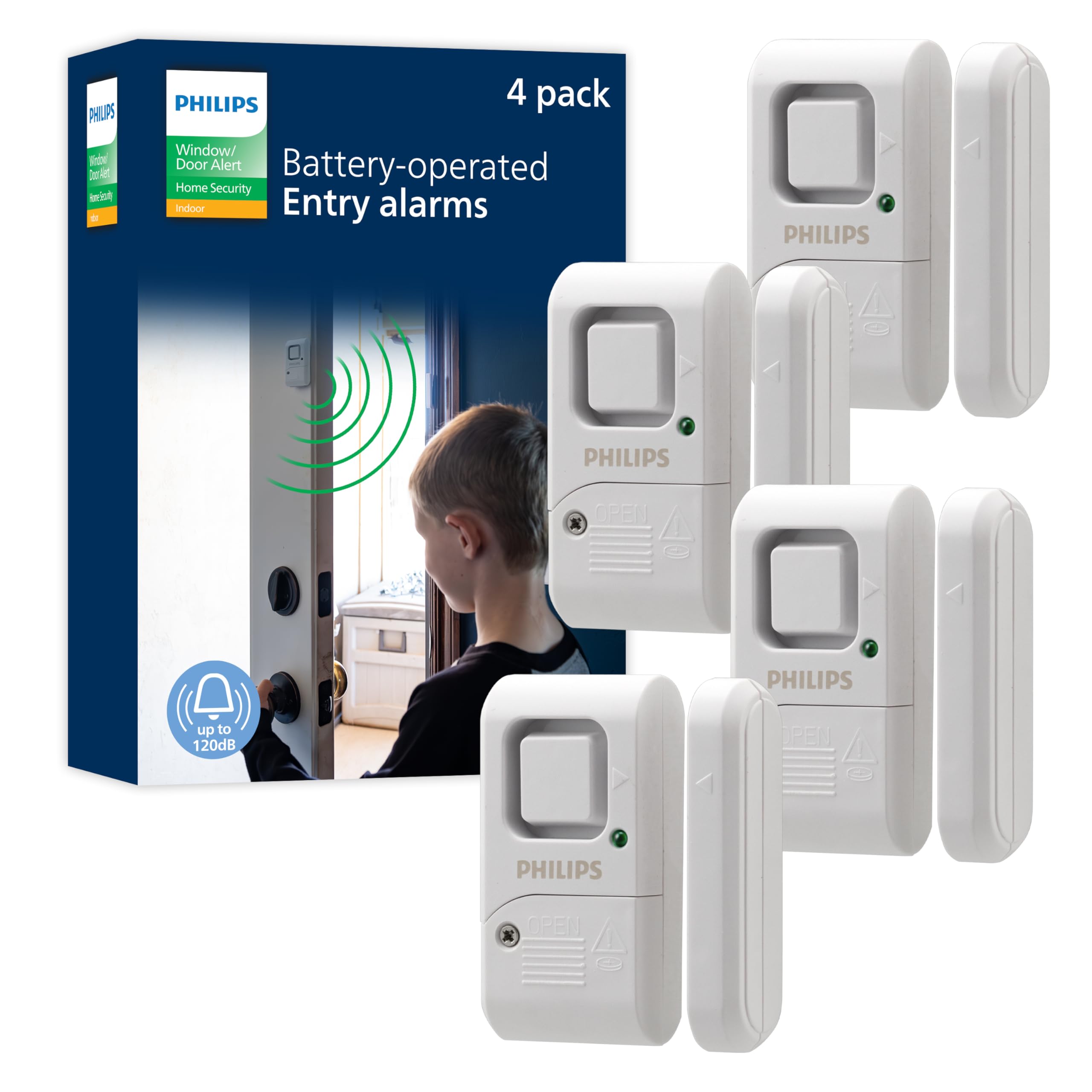
Philips brings its reputation for dependable electronics to this four-pack of magnetic contact alarms, and the headline feature here is the sheer value — four units that each push 120 dB for a price that undercuts most single-unit smart sensors. The alarm/chime/off switch on the side is intuitive to operate, and the included LR44 button batteries are pre-installed with a battery test button so you can verify power before mounting.
Installation is as simple as peeling the double-sided tape and sticking the two halves to the door and frame within 0.5 inches of each other. The alarm is switchable between a continuous siren and a polite doorbell chime, which means you can use the same units for perimeter security on doors and simple arrival alerts on windows. The low battery indicator LED is a small but crucial feature that prevents silent failure months down the line.
If you need to cover multiple entry points on a budget — front door, back door, sliding door, and a window — this pack offers the lowest per-unit cost at the highest decibel count in its class. The trade-off is that it uses CR2032-adjacent button cells rather than standard AAA batteries, so keep spares handy.
Why it’s great
- Four alarms for the price of one premium smart sensor
- Loud 120 dB siren is genuinely startling
- Battery test button gives confidence before installation
Good to know
- Uses less common LR44 button cells instead of AAA
- No remote control for disarming
- No selectable volume — it’s full blast or nothing
4. METAK Door Alarm with Remote 2-Pack

The METAK 2-pack stands out for including a dedicated remote control that works up to 600 feet away, allowing you to arm, disarm, or trigger panic mode without walking to each door. That remote range is the best in this comparison, making it practical for houses with detached garages or large yards where you want to check the door security from the driveway before entering.
This unit offers two volume levels — 90 dB for a less intrusive chime and 120 dB for full alarm mode — so you can tailor the alert to the situation. The magnetic contact sensor triggers when the gap exceeds about 0.5 inches, and the included 3M adhesive is strong enough for smooth surfaces, though sliding glass doors with wide gaps may need repositioning. The remote also doubles as a quick disarm, which is useful for those 3 AM snack runs when you don’t want to wake the whole house.
For those who want the convenience of a remote without springing for a full smart system, this hits the sweet spot. The two-pack covers two high-priority entry points, and the audible alarm is loud enough to alert everyone inside a typical home.
Why it’s great
- 600 ft remote range is the longest in this roundup
- Selectable 90 dB / 120 dB output for chime or alarm
- Two units with two remotes in the box
Good to know
- Uses AAA batteries not included
- Adhesive may struggle on textured or grooved door frames
- Occasional false alarms from strong wind on loose doors
5. SECRUI Wireless Door Chime 1-Pack

The SECRUI system is a plug-in receiver plus battery-powered contact sensor combo that excels at one specific job: alerting you from a very long distance. The advertised 500-foot open-air range means you can place the receiver in a workshop, basement, or detached garage and still hear the chime when someone opens the main door — a practical advantage for larger properties or commercial settings.
The receiver offers 32 different ringtones, from barking dogs to basic doorbell chimes, and the volume is adjustable so you can keep it subtle in a quiet office or crank it up in a noisy warehouse. At 65 dB, however, the maximum output is more of a notification than a deterrent — this is a chime system designed to alert you, not to scare off an intruder. Users report the adhesive is solid enough for permanent installation on smooth surfaces, and the same unit has been running reliably for years in some cases.
For businesses that need to know when a customer enters, or for homeowners with a long driveway, this is the most practical extended-range option. The one-sensor setup is best for a single entry point; you can expand later with additional sensors.
Why it’s great
- 500-foot range outperforms most consumer door chimes
- 32 different ringtones give you flexibility in different environments
- Receiver plugs into an outlet — no batteries to change in the chime unit
Good to know
- 65 dB is too quiet for security — it’s a notification, not a deterrent
- Includes only one sensor; additional sensors sold separately
- No smart home integration or app control
6. AMHEY Motion Sensor Door Chime 1-Pack

The AMHEY system substitutes a motion detector for a magnetic contact sensor, making it ideal for doorways without a precise contact point or for larger entryways where you want to detect anyone approaching rather than just the door opening. The sensor detects movement within a 110-degree arc up to 26 feet away, and it transmits to the plug-in receiver at up to 500 feet.
The unit offers 32 ringtones with a volume range up to 110 dB, which is loud enough to serve as a moderate alarm. A silent mode with only an LED flash is included for discreet monitoring — helpful for scenarios like keeping an eye on an elderly relative who may get up at night without startling them. The motion sensor head pivots, so you can aim it precisely to avoid triggering from passing pets when placed correctly.
This is not a replacement for a contact sensor on a specific door — motion detectors are inherently less precise. But for monitoring a hallway, a stairwell, or a wide entrance where you want early notice of anyone approaching, the AMHEY covers ground that contact sensors cannot.
Why it’s great
- 110 dB maximum volume works as a legitimate alarm
- Pivotable motion sensor head allows fine-tuned aiming
- Silent mode with visual LED alert is useful for caregivers
Good to know
- Motion detection is prone to false triggers from pets or drafts
- No on/off switch on the sensor — must remove batteries to stop
- Instructions are poorly translated and may confuse first-time users
7. TECKNET Door and Window Alarm 3-Pack

TECKNET packs three self-contained magnetic contact alarms into a single box at a price that undercuts most single-unit options, making it the best choice when you need to cover multiple zones on a tight budget. Each unit runs on AAA batteries and operates independently — no receiver, no hub, just a loud siren that sounds when the contact gap exceeds 0.78 inches.
The three-level volume control lets you dial from a subtle chime to a reasonable alert, though at 65 dB it’s nowhere near the deterrent level of the 120 dB+ units. A neat design trick is the alarm/chime mode switch: chime mode produces a single doorbell ring, while alarm mode triggers a continuous siren until the door closes. This makes them suitable for both simple arrival alerts on a cabinet and security monitoring on a front door.
Users consistently report that the adhesive holds strongly on clean, smooth surfaces, and the compact white body blends into most door frames. For a landlord, a budget-conscious parent, or anyone wanting to monitor multiple cabinets or windows without investing in smart sensors, the TECKNET 3-pack is the thriftiest way to get the job done.
Why it’s great
- Three units for a very accessible entry price
- Chime and alarm modes give dual functionality
- Compact white design blends in on most surfaces
Good to know
- 65 dB is too quiet for security — mostly a notification device
- Magnetic gap tolerance is tight at 0.78 inches
- No low-battery indicator — replace batteries on a schedule
FAQ
Can I use a battery operated door alarm on a sliding glass door?
How long do batteries typically last in a door alarm?
What’s the difference between a door chime and a door alarm?
Final Thoughts: The Verdict
For most users, the best battery operated door alarm winner is the Philips 4-Pack because it offers the best balance of loudness (120 dB), coverage (four units), and simplicity at an unbeatable per-unit cost. If you need a portable travel companion that will wake the entire floor at 130 dB, grab the Securityman Door Handle Alarm. And for a smart home integrated solution with years of battery life, nothing beats the Ring Contact Sensor if you already have the base station.
Product prices and availability are accurate as of the date/time indicated and are subject to change. Any price and availability information displayed on Amazon at the time of purchase will apply to the purchase of this product. As an Amazon Associate I earn from qualifying purchases.
CERTAIN CONTENT THAT APPEARS ON THIS SITE COMES FROM AMAZON. THIS CONTENT IS PROVIDED "AS IS" AND IS SUBJECT TO CHANGE OR REMOVAL AT ANY TIME.
Amazon and the Amazon logo are trademarks of Amazon.com, Inc. or its affiliates.