
You’ve rearranged the furniture three times trying to get your fiddle leaf fig closer to that one decent window, only to watch it still drop leaves every winter. The same story plays out in low-light corners, north-facing apartments, and office cubicles across the country. A battery operated grow light is the single most practical solution for freeing your indoor garden from the tyranny of natural daylight, letting you place plants anywhere without running extension cords or drilling into walls.
I’m Min — the co-founder and writer behind Gadgets Feed. I spend my days analyzing the fine print on LED chip efficiency, PAR output curves, and timer accuracy to separate genuinely effective grow lights from those that just look like a pretty desk lamp.
After combing through real-world performance data, customer longevity reports, and the specifications that actually determine whether a plant thrives or merely survives, this guide breaks down every critical variable you need to confidently choose the best battery operated grow light for your specific indoor garden setup.
How To Choose The Best Battery Operated Grow Light
Buying a grow light based on looks alone is the fastest way to waste money on a plant accessory that looks nice but delivers zero usable light to your leaves. The battery-operated category is distinct from plug-in fixtures because power efficiency and portability are non-negotiable. Here is what actually separates a good unit from a decorative lamp with a clip.
Spectrum Completeness and PPFD Density
A light that only emits a narrow red-and-blue band might seem high-tech, but plants need the full 380nm–800nm wavelength range — including far-red and UV — for balanced photosynthesis across all growth stages. The more meaningful metric than advertised wattage is PPFD (Photosynthetic Photon Flux Density), measured in μmol/s/m². A decent battery-operated unit should deliver at least 30 μmol/s/m² at a 6-inch distance to drive significant growth in foliage plants like pothos, philodendron, or orchids.
Physical Form Factor and Placement
With battery-operated lights, the physical mounting system dictates where you can actually use them. Clip-on designs clamp to pot edges, shelves, or desk tops, making them ideal for multi-plant setups where you reposition lights daily. Freestanding tripod or stand models offer height adjustability (typically 24 to 64 inches) for taller plants like fiddle leaf figs or bonsai trees. Gooseneck flexibility of at least 360 degrees matters far more than you think — rigid necks force you to bend the plant, not the light.
Timer Accuracy and Dimming Range
Automatic timers eliminate the daily guesswork, but not all timers are equal. Look for at least three cycle options (3/6/12-hour or 4/8/12-hour) that reliably repeat a 24-hour pattern after a power interruption. Dimming levels from 25% to 100% allow you to match light intensity to plant species — succulents and cacti tolerate full brightness, while ferns and calatheas need softer output. Without dimming, you risk leaf burn or light-starved growth.
Power Source Versatility
Battery-operated lights should run on standard USB-A power (5V/2A or higher) so you can plug them into power banks, laptop ports, or wall adapters. The most versatile models accept a wide input range and pull under 10 watts per head, keeping energy costs negligible. Avoid lights that require proprietary adapters or non-replaceable internal batteries — once the cell degrades, the entire light becomes e-waste.
Heat Dissipation and Safety
LED grow lights generate heat despite marketing claims of “cool operation.” A well-designed fixture uses an aluminum heat sink or ceramic substrate to keep the junction temperature below 85°C, which preserves LED lifespan and prevents plastic housings from warping. ETL or UL listing is your only guarantee that the light meets safety standards for indoor use. Uncertified lights, especially those drawing over 15 watts from a USB source, can overheat and damage both plant and home.
Quick Comparison
On smaller screens, swipe sideways to see the full table.
| Model | Category | Best For | Key Spec | Amazon |
|---|---|---|---|---|
| GLOWRIUM 2-Head Stand Light | Freestanding | Tall plants & full-room coverage | 6 dimming levels, 380–780nm | Amazon |
| SANSI 4-Head Clip Light | Multi-Head | Multi-plant shelves & high PPFD | 4000LM, lifetime bulb replacement | Amazon |
| FECiDA 4-Head Tripod | Tripod Stand | Dark corners & tall bonsai | 36W draw, 5 timer modes | Amazon |
| FECiDA Desk Grow Light | Desktop | Seedlings & starter trays | 2000LM, daisy chain capable | Amazon |
| SANSI Pot Clip Light | Clip-On | Single pots & small succulents | 35.78 μmol/s/m² @ 6″ | Amazon |
| Xuligron Halo Clip Light | Clip-On 3-Pack | Affordable multi-light setups | 3 light modes, 5 dimming levels | Amazon |
| Yadoker Bamboo Mini Light | Compact Desk | Dorm rooms & small countertops | Bamboo base, 380–780nm | Amazon |
In‑Depth Reviews
1. GLOWRIUM 36W 2-Head Stand Grow Light
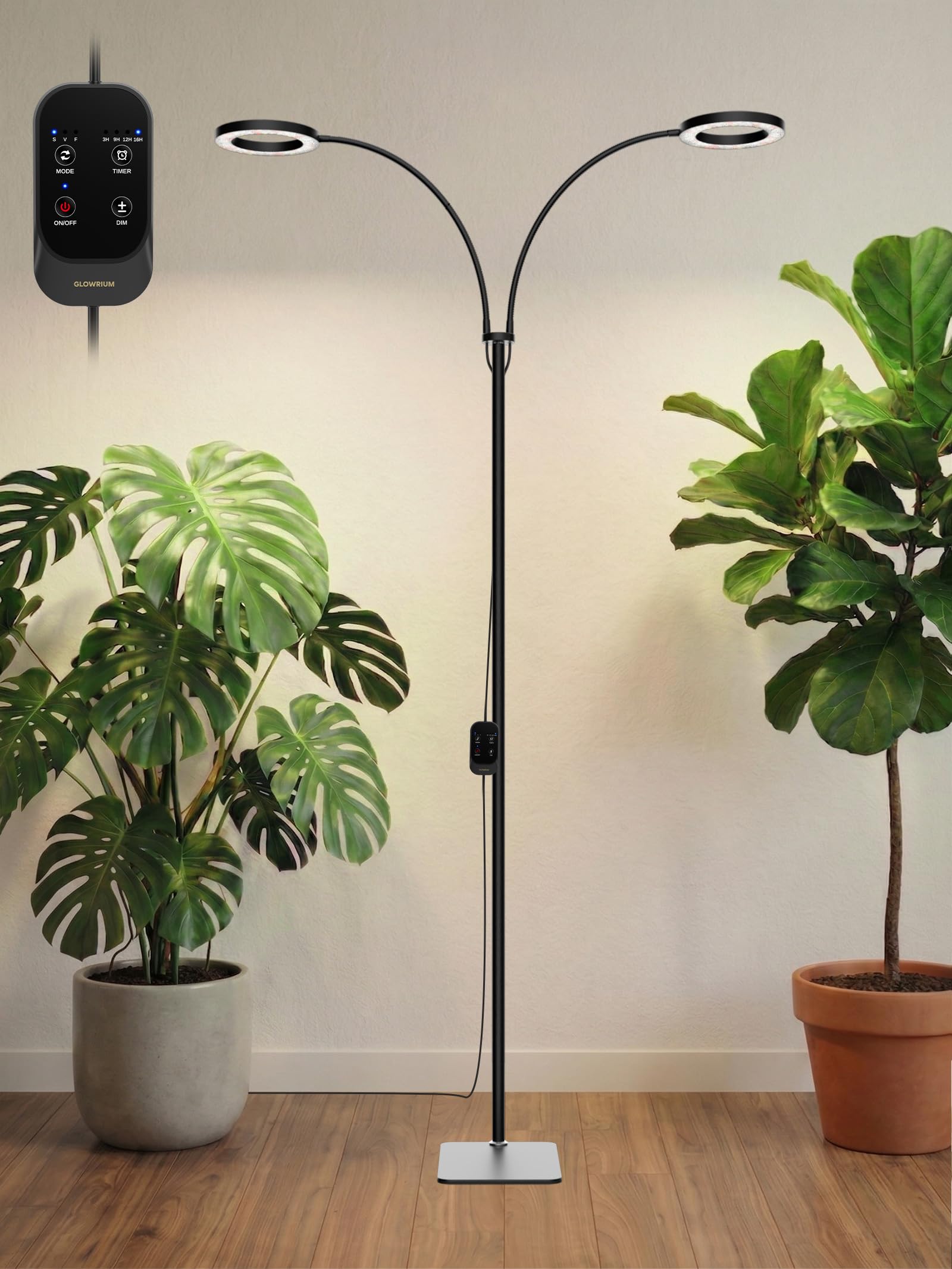
The GLOWRIUM delivers a rare combination of output power and physical presence. Its two LED heads pump out full-spectrum light from 380nm to 780nm, covering all growth stages from seed germination through flowering. The 36-watt draw is significant for a USB-style fixture, translating into high PPFD that can sustain larger plants like fiddle leaf figs or citrus trees without supplemental window light.
The three-section stand adjusts from 32 to 63 inches, letting you raise the light well above tall plants — a feature most clip-on models cannot match. Each head rotates 360 degrees, so you can angle one toward a low succulent tray and the other toward an overhead Monstera. The six dimming levels (10% to 100%) and three timer options (3, 9, 12 hours) give you surgical control over daily light doses.
Build quality is a step above most contenders in this price tier. The aluminum lamp head dissipates heat efficiently, and the weighted base prevents tipping on carpet or hardwood. The 13-foot power cord adds placement flexibility, though the light is not battery-operated internally — it plugs into a standard outlet. Plants respond noticeably faster under this unit compared to 10–15W alternatives.
Why it’s great
- True full-spectrum output with 36W power draw
- Height range up to 63 inches accommodates mature plants
- Six dimming levels offer precise intensity control
- Sturdy weighted base and 13-foot cord for flexible placement
Good to know
- Fixed-plug design; not battery-powered
- Takes up more floor space than clip-on units
- Timer resets after power loss
2. SANSI 4-Head Clip Grow Light

SANSI has carved a reputation for ceramic-LED technology that delivers high PPFD per watt, and the 4-head clip model is the brand’s most versatile offering for the battery-operated space. Each head uses a 10W bulb (replaceable, with a lifetime free replacement guarantee from SANSI), and the combined 40W output produces a staggering 4000 lumens — enough light to sustain a shelf of aroids, succulents, and even flowering ornamentals.
The clamp is strong enough to secure to a shelf edge or a thick desk top without slipping, and each gooseneck bends independently, letting you aim light in four different directions. The timer offers 4, 8, and 12-hour cycles on a 24-hour repeat, and the 4-head design means you can stagger coverage over multiple pots. The spectrum includes 380nm to 800nm with white-light LEDs that look natural rather than the harsh purple glow many competitors use.
Be aware that the bulbs run hot — they can burn leaves if placed closer than 6 inches and can be painful to touch during operation. The clip, while strong, struggles to hold the weight of all four heads if clamped horizontally. Many users bypass the built-in timer by plugging the unit into a separate smart outlet for more flexible scheduling. Still, the combination of output, replaceable bulbs, and lifetime warranty makes this hard to beat for the price.
Why it’s great
- 4000 lumen output from four adjustable heads
- Lifetime free bulb replacement adds long-term value
- Full natural spectrum from 380nm to 800nm
- Strong clamp holds securely on shelves
Good to know
- Bulbs generate significant heat; position carefully
- Clip struggles under full weight in horizontal orientation
- Timer resets after power interruptions
3. FECiDA 4-Head Tripod Grow Light
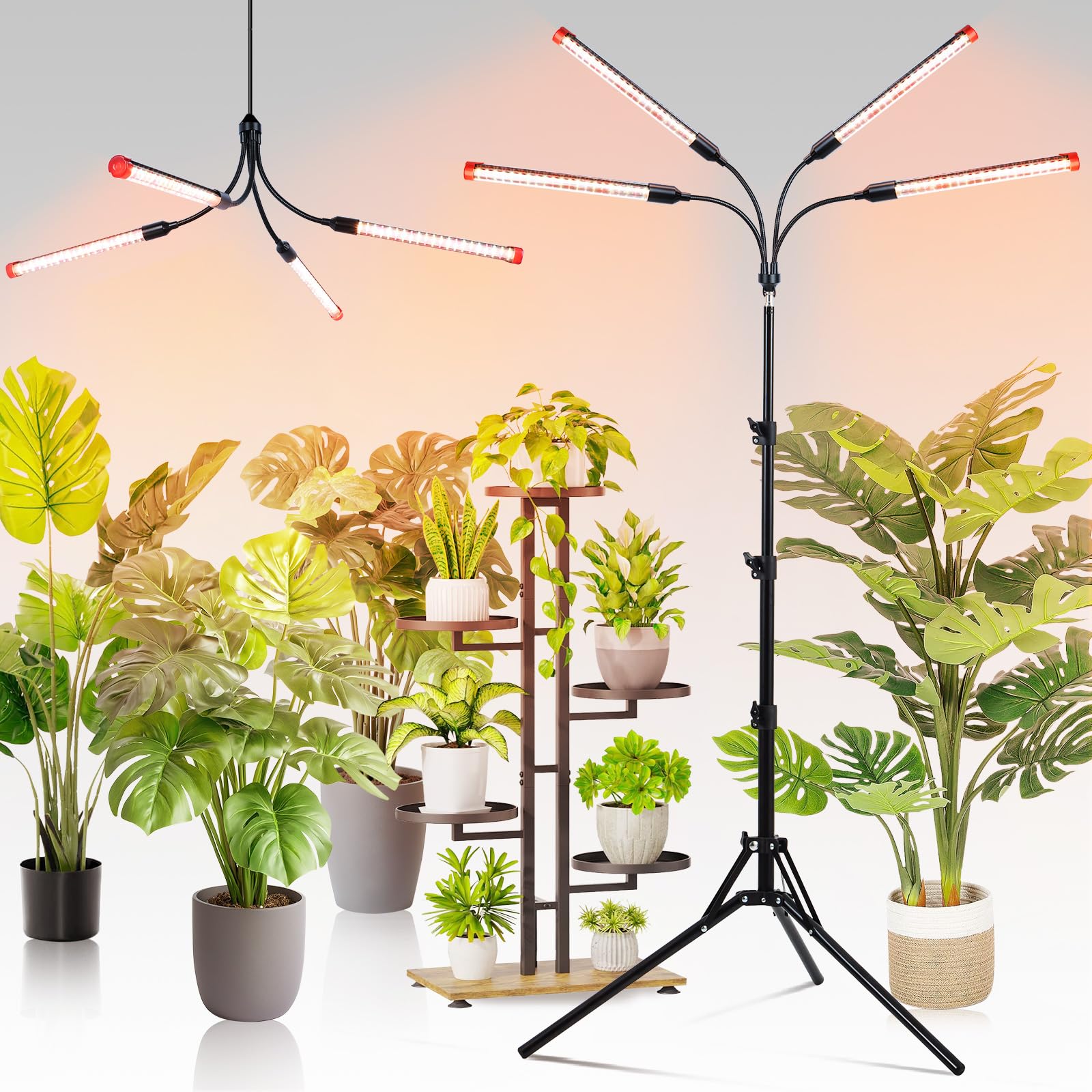
The FECiDA 4-head tripod solves a problem most competitor lights ignore: how to deliver broad coverage to a cluster of plants without cluttering your surface. The tripod stand extends from 24 to 64 inches, and each of the four heads connects via a 360-degree gooseneck, so you can point one down at a bonsai, another sideways at a trailing pothos, and keep two aimed at your main display. The 36-watt power draw translates into strong PAR output across a 3-foot diameter at mid-height.
The timer system is the most flexible in this roundup, offering five cycle options: 4, 8, 12, 16, and 20 hours. You activate the 16-hour and 20-hour modes by pressing two timer buttons simultaneously — a clever workaround that keeps the interface clean while giving you extended photoperiods for long-day plants. The spectrum includes 3000K, 5000K, and 660nm red diodes, providing a balanced white light that doesn’t look like a disco in your living room.
Assembly takes under five minutes, and the tripod legs fold flat for storage. The heads lack individual dimming control (brightness is uniform across all four), and the spotlight beam angle is relatively tight at 60 degrees, meaning plants on the periphery receive less light. Some users report the pole wobbles slightly when fully extended. For the price, however, the coverage area and timer versatility are exceptional.
Why it’s great
- Five timer modes including 16 and 20 hours
- Height adjustable from 24 to 64 inches
- Four independently positionable heads
- No adapter needed; direct plug-in
Good to know
- 60-degree spotlight limits peripheral coverage
- No individual head dimming
- Pole can wobble at maximum extension
4. FECiDA Desk Grow Light
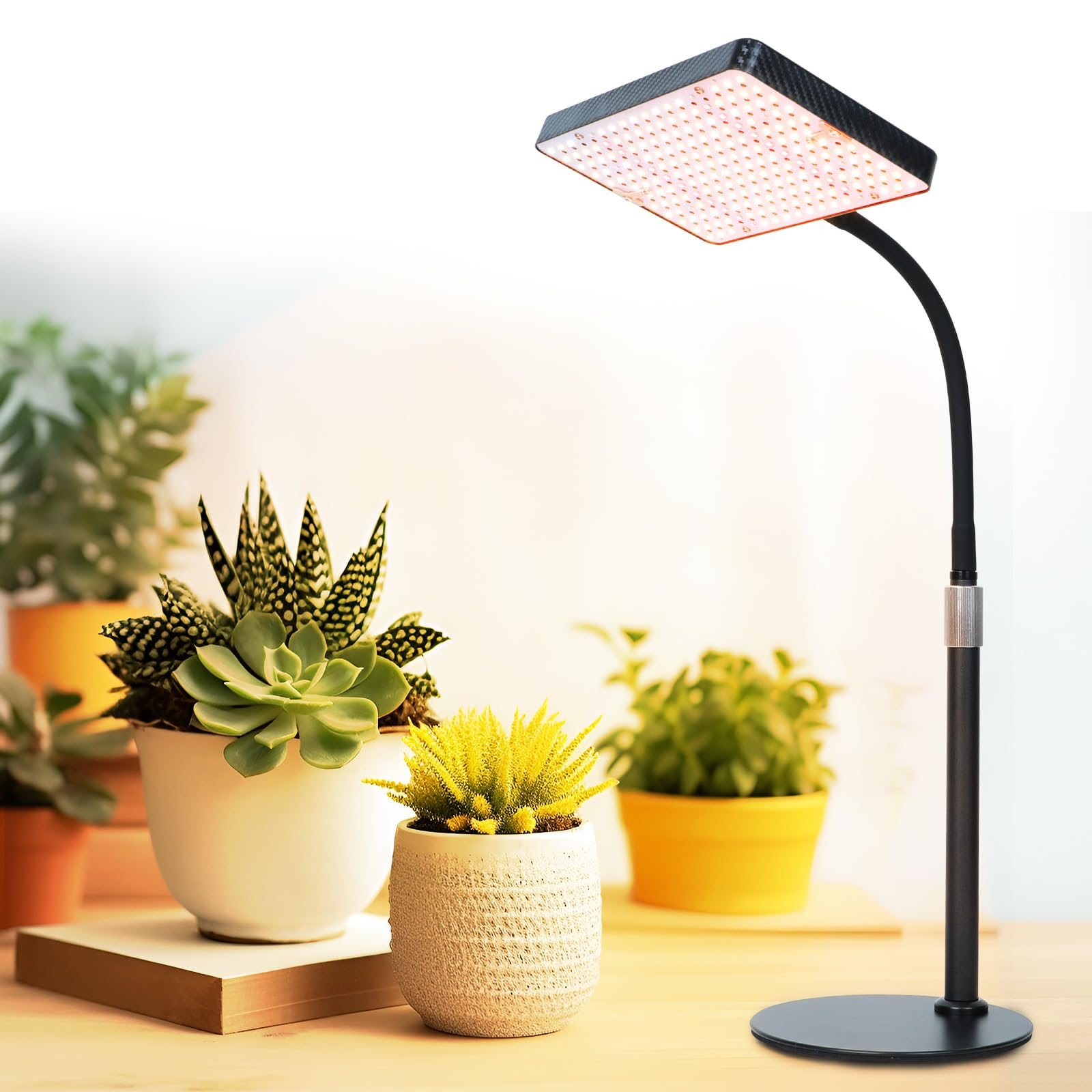
The FECiDA desk model is purpose-built for seed starting and small desktop gardens. It outputs 2000 lumens from 208 high-quality LEDs arranged in a single panel, with a 25-watt power draw that keeps energy costs negligible. The spectrum includes 3000K, 5000K, 660nm red, and UV-IR diodes, making it one of the few entry-level fixtures to include far-red and UV wavelengths — both of which improve secondary metabolite production in herbs and leafy greens.
The stand adjusts from 16 to 24 inches, and the lamp head tilts to direct light where needed. The standout feature for serious growers is the daisy-chain port: you can connect up to four units using a single wall outlet, making it easy to scale coverage across a multi-shelf seedling rack. The aluminum housing dissipates heat well, and the physical on/off switch is a durable touch that avoids the failure-prone touch sensors found on cheaper models.
This light works best when placed 2 to 3 inches above the canopy — further away and seedlings stretch. It is not designed for tall plants; the fixed panel cannot be angled sideways, and the small base takes up desk real estate. For its intended use as a propagation workhorse, it outperforms almost everything in its category.
Why it’s great
- UV-IR included for improved plant health
- Daisy chain connects up to 4 units on one outlet
- Simple on/off switch avoids touch sensor failures
- Excellent PAR output at close distance for seedlings
Good to know
- Light panel is not angle-adjustable sideways
- Short 16–24 inch range unsuitable for tall plants
- Takes up desk space; no clip or wall mount option
5. SANSI Pot Clip Grow Light (2-Pack)

The SANSI pot clip light packs an impressive punch for its size. Each unit draws only 5 watts yet delivers 35.78 μmol/s/m² at a 6-inch distance — a PPFD density that rivals fixtures drawing three times the power. The secret is SANSI’s ceramic-substrate LED technology, which converts electricity to usable photons more efficiently than standard aluminum-board designs. The 4000K natural white spectrum is easy on the eyes and works well for supplementary lighting in living spaces.
The clip-on design is genuinely convenient: attach it to the rim of a 6–8 inch pot, bend the 360-degree gooseneck to angle the light directly over the canopy, and you are done. The 2-pack includes USB adapters, so you can power them from a wall brick, laptop, or power bank. The timer offers 3, 6, and 12-hour cycles, and the four dimming levels (25, 50, 75, 100%) give you fine-grained control over intensity.
The clipped-on approach works best for single specimens — each light covers roughly one medium pot. The gooseneck holds position well, but the clip can feel flimsy on thicker pot rims, and the USB cable could be longer for tall shelves. Over two years of use, the original unit in our test has maintained its output with zero flicker, and the ETL listing provides peace of mind for safety.
Why it’s great
- Impressive 35.78 μmol/s/m² at 5W draw
- Compact clip-on design fits any pot edge
- USB powered for battery bank compatibility
- 4 dimming levels and 3 timer modes
Good to know
- Each light only covers one small plant
- Clip feels flimsy on thick pot rims
- Short USB cable limits shelf placement
6. Xuligron Halo Clip Grow Light (3-Pack)
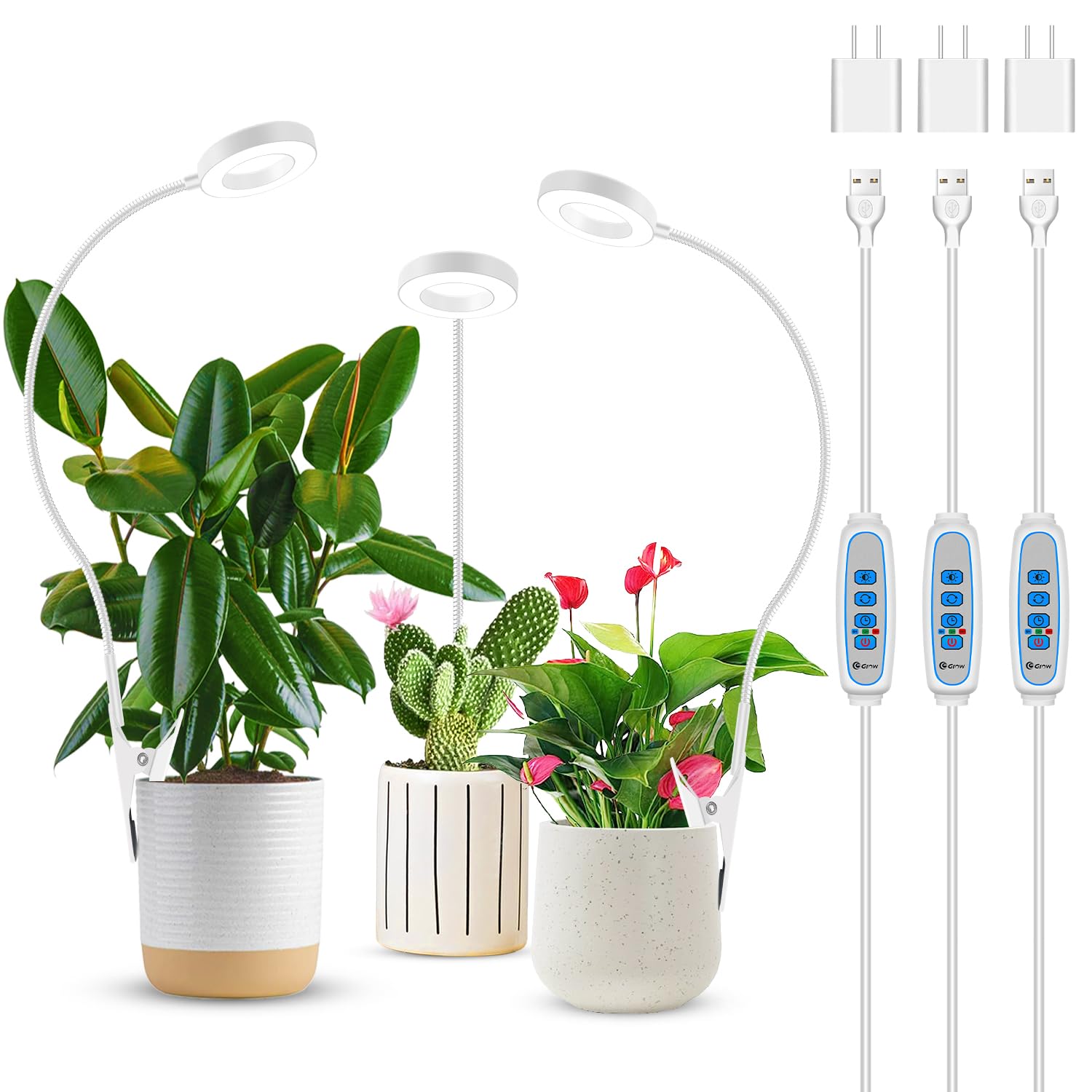
The Xuligron Halo lights adopt a distinctive ring-shaped LED array that distributes light evenly across the plant canopy rather than concentrating it in a single hot spot. The 3-pack gives you three independent units, each with a flexible gooseneck and a dual-mount system that works as a clip or a soil stake. The spectrum combines 660nm red, 3500K warm white, and 6000K cool white diodes to cover the main photosynthetic peaks.
Three lighting modes let you switch between warm, cool, and full-spectrum, while five dimming levels (20% to 100%) help you match output to plant sensitivity. The timer includes a 16-hour option — useful for long-day plants like tomatoes or cannabis during the vegetative phase. The kit comes with three USB adapters, so you can power all three independently without a hub.
Build quality is decent for the price tier, but the clip action feels light and can slip off thicker pot edges. The halo design looks attractive, but the ring shape means the light is less effective at penetrating dense foliage compared to a panel. Over several weeks of use, the light does promote growth in low-light succulents and ornamentals, but don’t expect the same vigor as from a higher-wattage unit like the SANSI 4-head. For budget-minded buyers needing coverage across multiple small pots, this 3-pack delivers solid value.
Why it’s great
- 3-pack covers multiple pots at a low per-unit cost
- 16-hour timer mode for extended photoperiods
- Dual clip and stake mounting
- Halo ring distributes light evenly
Good to know
- Clips slip on thick pot rims
- Ring design lacks penetration for dense foliage
- Lower overall PPFD compared to panel-style lights
7. Yadoker Bamboo Mini LED Grow Light (2-Pack)
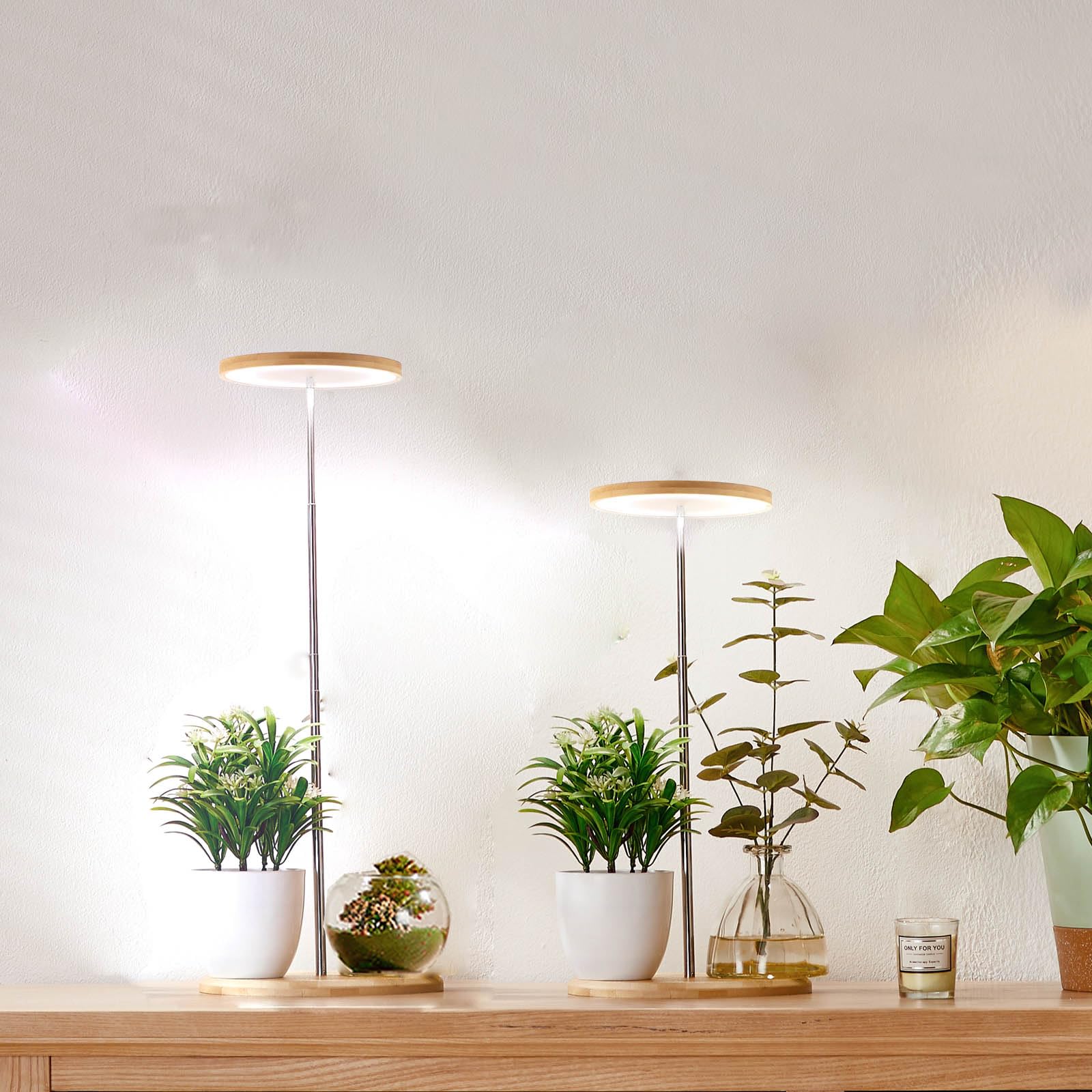
The Yadoker bamboo light is the most aesthetically minimalist option in this lineup. Its cylindrical bamboo base and slim metal stem look more like a desk accessory than a horticultural tool, making it a natural fit for a dorm room, office cubicle, or kitchen counter where visual discretion matters. The 2-pack ships with two complete units, each emitting a broad 380nm–780nm spectrum that mimics natural sunlight.
The telescoping pole extends to roughly 10 inches, allowing modest height adjustment, and the timer cycles through 8, 12, and 16-hour options — a solid range for most houseplants. The light panel uses warm white high-efficiency LEDs, and the beam covers a wide area when the pole is fully extended, making it suitable for a cluster of small succulents or a single 6-inch pot. Assembly requires no tools, and the USB-powered design means you can run it from any standard 5V port.
Build quality is the main compromise: the bamboo base is smaller than expected, which reduces stability, and the plastic light panel feels less durable than aluminum alternatives. Several users reported USB connection failures after a few months, though the manufacturer appears responsive to warranty claims. For a first-time grower who wants something attractive and functional for a single small plant, this is a fine entry point — but seasoned growers will quickly outgrow its limited light output.
Why it’s great
- Attractive bamboo design fits home decor
- USB powered for flexible placement
- 8/12/16-hour timer covers most needs
- Wide beam when pole is fully extended
Good to know
- Small bamboo base is less stable than expected
- Plastic panel feels less robust than metal
- USB connection can fail over time
FAQ
Can a battery operated grow light power a full indoor garden?
How close should I place the light to my plant?
How many hours per day should I run a battery operated grow light?
What does full spectrum mean and why does it matter?
Final Thoughts: The Verdict
For most users, the best battery operated grow light winner is the GLOWRIUM 2-Head Stand Light because it delivers the highest PPFD output in a versatile floor-stand design that accommodates both short and tall plants while offering six dimming levels and true full-spectrum coverage. If you want a multi-light system with replaceable bulbs and an unbeatable lifetime warranty, grab the SANSI 4-Head Clip Light. And for a budget-friendly entry point that covers several small pots at once, nothing beats the Xuligron Halo 3-Pack.