
Every ounce in your pack is a tax on your joints, and a cheap, bloated power bank is the dead weight you don’t need. The wrong battery pack for backpacking turns a 3-day carry into a burden—too much capacity that never gets used, or too little juice when you’re staring at a blank GPS screen ten miles from the next water source. The right one balances real-world milliamps with a form factor that doesn’t fight your hip belt.
I’m Min — the co-founder and writer behind Gadgets Feed. My buying guides are built from digging through technical datasheets and cross-referencing real field reports so you don’t have to guess which spec matters when your phone is your map, camera, and emergency beacon.
This overview of the best battery pack for backpacking isolates the core specs—capacity in mAh, weight in grams, port output in watts, and durability—to help you pick the one that actually lightens your load.
How To Choose The Best Battery Pack For Backpacking
Picking a battery pack for the trail isn’t about finding the biggest number on the shelf. It’s about matching capacity to trip length without punishing your spine. Here’s what to lock onto before you buy.
Capacity vs. Weight: The Real Trade-Off
A 10,000 mAh pack (around 200g) gives you two to three full phone charges—enough for a weekend or three days if you’re frugal with screen time. A 20,000 mAh pack (around 300-350g) stretches to five or six charges, covering a week-long trek. Beyond that, a 50,000 mAh brick (nearly 400g) is excessive unless you’re powering a camera, GPS, and lantern. Weigh your actual usage, not an inflated spec.
Output Speed: 18W Versus 22.5W Versus 30W
Standard 5V/3A (15W) charging is slow. An 18W PD port will push an iPhone 16 to 50% in about 30 minutes. A 22.5W PD port cuts that further, and a 30W PD port is ideal if you’re also charging a tablet or a Nintendo Switch. For backpacking, 18W-22.5W is the practical sweet spot—fast enough during a lunch break, without the thermal overhead of higher wattages in a sealed pack.
Durability, Ports, and Trail-Specific Features
Look for IPX5 or IP67 waterproofing if you expect rain, river crossings, or condensation inside a stuff sack. A shockproof shell (MIL-STD-810G) protects against drops on rock. Built-in cables eliminate loose cord clutter—vital when you’re digging through your pack at dusk. A digital display showing exact percentage is far more reliable than four blinking LEDs. For photographers, a 1/4-20 tripod mount turns the pack into a power source for a light or a mini-tripod base.
Quick Comparison
On smaller screens, swipe sideways to see the full table.
| Model | Category | Best For | Key Spec | Amazon |
|---|---|---|---|---|
| Nitecore NB20000 Gen 3 | Premium | Multi-day treks, ultralight | 291g / 20,000 mAh / IPX5 | Amazon |
| INIU Smallest 20000mAh | Mid-Range | Value + capacity balance | 320g / 20,000 mAh / 22.5W | Amazon |
| Anker Zolo 10K 30W | Mid-Range | Ultraportable, fast top-ups | 223g / 10,000 mAh / 30W | Amazon |
| SABANI 35000mAh | Budget | Group trips, high capacity | 335g / 35,000 mAh / 22.5W | Amazon |
| YBYP 50000mAh | Budget | Base camp, extended trips | 340g / 50,000 mAh / 22.5W | Amazon |
| ELECOM NESTOUT 10000mAh | Premium | Rugged conditions, modular gear | ~260g / 10,000 mAh / IP67 | Amazon |
| Nitecore NB Plus | Premium | Ultralight, bike packing | 155g / 10,000 mAh / IPX7 | Amazon |
In‑Depth Reviews
1. Nitecore NB20000 Gen 3
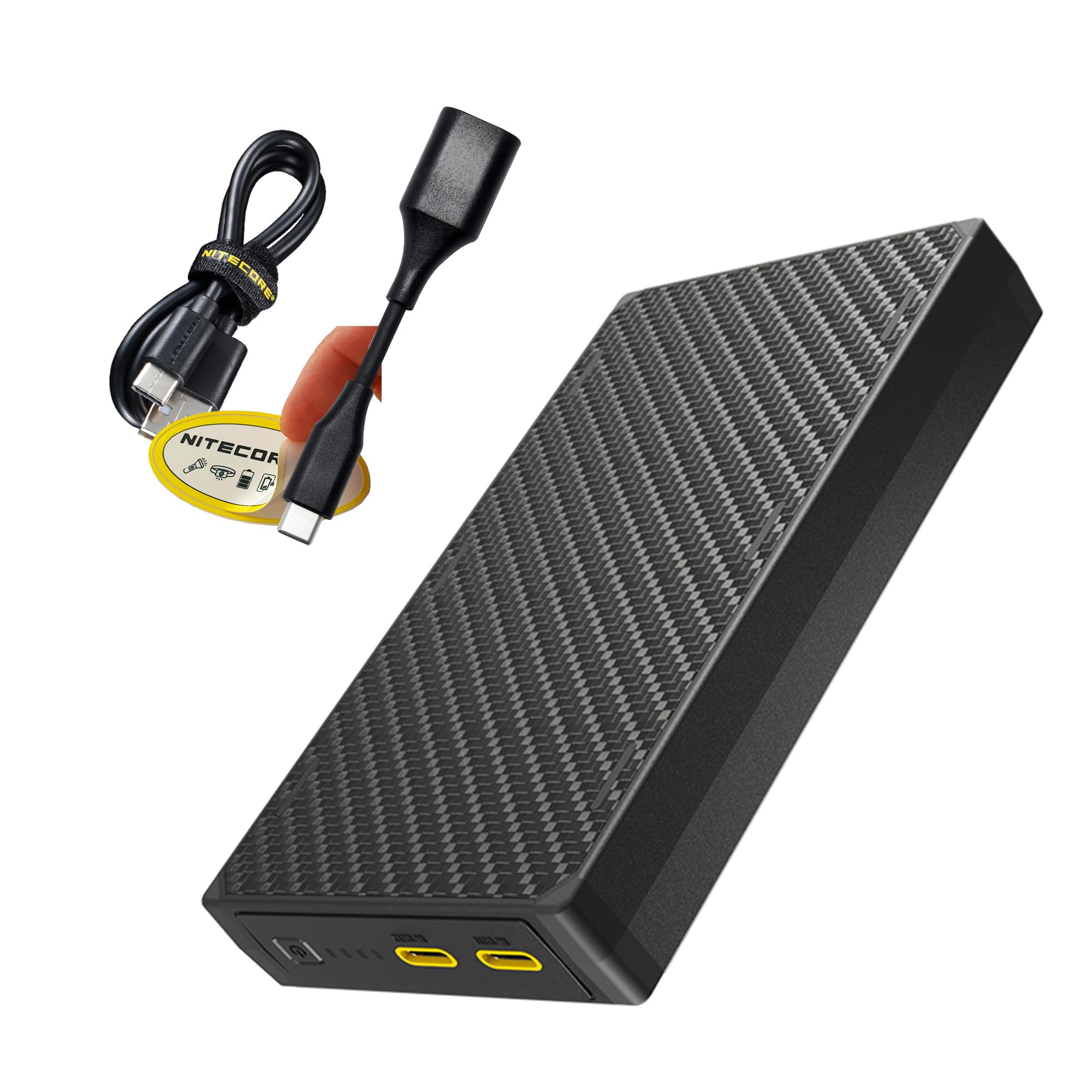
The Nitecore NB20000 Gen 3 delivers 20,000 mAh in a 10.3-ounce package—that’s 291 grams, which is lighter than most 10,000 mAh bricks from five years ago. It packs dual USB-C ports with 22.5W PD output, letting you charge your phone and your watch simultaneously without cutting speed. The IPX5 waterproof rating means it shrugs off rain and splash, and the four blue LED indicators show remaining power in roughly 25% increments.
Real-world trail tests confirm it fully charges a modern smartphone about four times with power to spare. The seamless chassis has no creases or gaps for moisture to seep into, and the included USB-C to USB-A adapter gives flexibility for older cables. It’s airline-approved for flights, so it pulls double duty from trailhead to airport lounge.
One user reported a rare battery drain issue in cold conditions on the Pacific Crest Trail, but the overwhelming majority of field reviews praise its ability to hold charge for ten days in the desert while powering a phone and a Garmin. For the weight-to-capacity ratio, nothing in this guide beats it.
Why it’s great
- 291g for 20,000 mAh is category-leading efficiency
- Dual USB-C with 22.5W PD handles simultaneous charging
- IPX5 waterproofing handles trail rain without a dry bag
Good to know
- LED indicator shows 25% increments, not an exact percentage
- No built-in cables—you must carry your own USB-C cord
2. INIU Smallest 20000mAh

The INIU “Smallest” 20,000 mAh pack squeezes four full phone charges into a dense 320-gram frame that fits in the palm of your hand. Its secret weapon is a detachable nylon lanyard that doubles as a USB-C cable—one less cord to lose when you’re rummaging through your pack at dusk. The 22.5W PD output blasts an iPhone 16 to 60% in about 25 minutes, which is genuinely fast for this capacity tier.
The smart digital display shows exact percentage down to one percent, so you never guess whether you have enough juice for another night. It’s TSA-approved, includes a built-in flashlight for camp emergencies, and comes with a 3-year replacement warranty backing the SafeCharge thermal management. The IP rating isn’t specified, so this is best kept in a dry pocket or a ziplock.
User reports consistently highlight the detachable cable as a double-edged sword: it’s convenient when attached, but easy to misplace if you pull it off and set it down. For the price, it outperforms packs that cost twice as much, making it the undisputed value pick for backpackers who want high capacity without breaking the bank.
Why it’s great
- Detachable USB-C lanyard cable eliminates loose cord clutter
- 22.5W PD delivers phone to 60% in 25 minutes
- Exact percentage digital display prevents range anxiety
Good to know
- No official IP rating—keep it dry in a stuff sack
- Detachable cord is easy to lose if not clipped back on
3. Anker Zolo 10K 30W
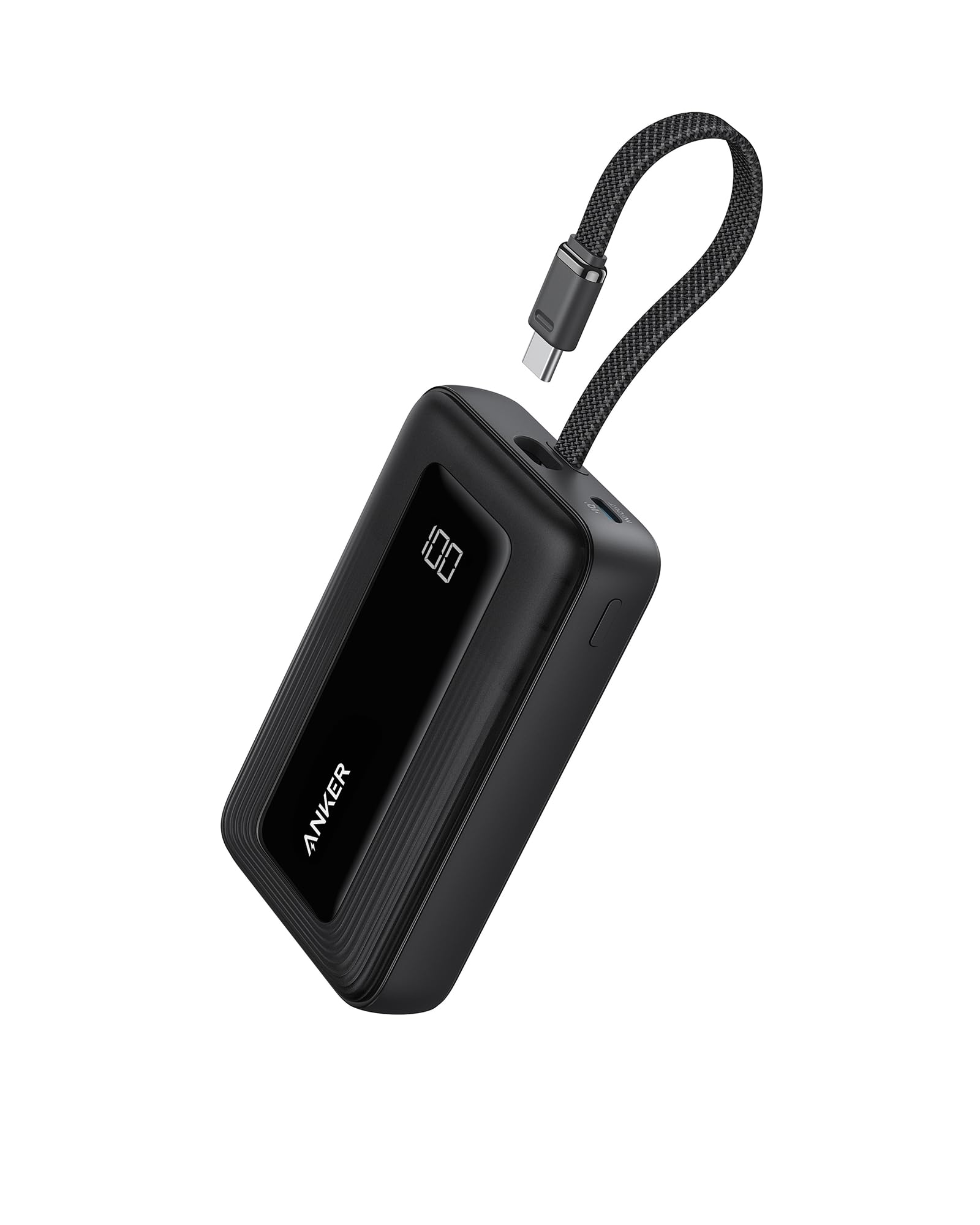
Anker’s Zolo 10K punches well above its 10,000 mAh rating by offering a full 30W PD output—enough to fast-charge an iPhone 16 Pro Max to 50% in 27 minutes. The built-in 5.4-inch USB-C cable is tested to survive 10,000 bends, so it won’t fray after a few trips of being crammed into a side pocket. At 223 grams and 4.32 x 2.58 x 0.98 inches, it’s barely bigger than a deck of cards.
The bi-directional charging handles 30W out and 20W in, meaning the pack itself refills in about 90 minutes with a 20W wall charger. The digital LED percentage display is bright and precise, and the single built-in cable covers modern Android and iPhone 15-series devices without adapters. For older iPhones, you’ll use the USB-A port with your Lightning cable.
Some users note the chassis is thicker than expected for a 10K, making it barely pocketable but perfectly fine for a hip belt pouch. The 30W output also makes it viable for topping off a Nintendo Switch or a small tablet during a zero day. If your priority is raw charging speed over total capacity, this Anker is the clear winner.
Why it’s great
- 30W PD output charges a phone twice as fast as standard 15W banks
- Built-in USB-C cable rated for 10,000 bends lasts for years
- 223g weight is ideal for ultra-light weekend carries
Good to know
- Only 10,000 mAh—won’t cover a trip longer than 2-3 days
- Thicker than some 10K rivals, feels chunky in a pants pocket
4. SABANI 35000mAh
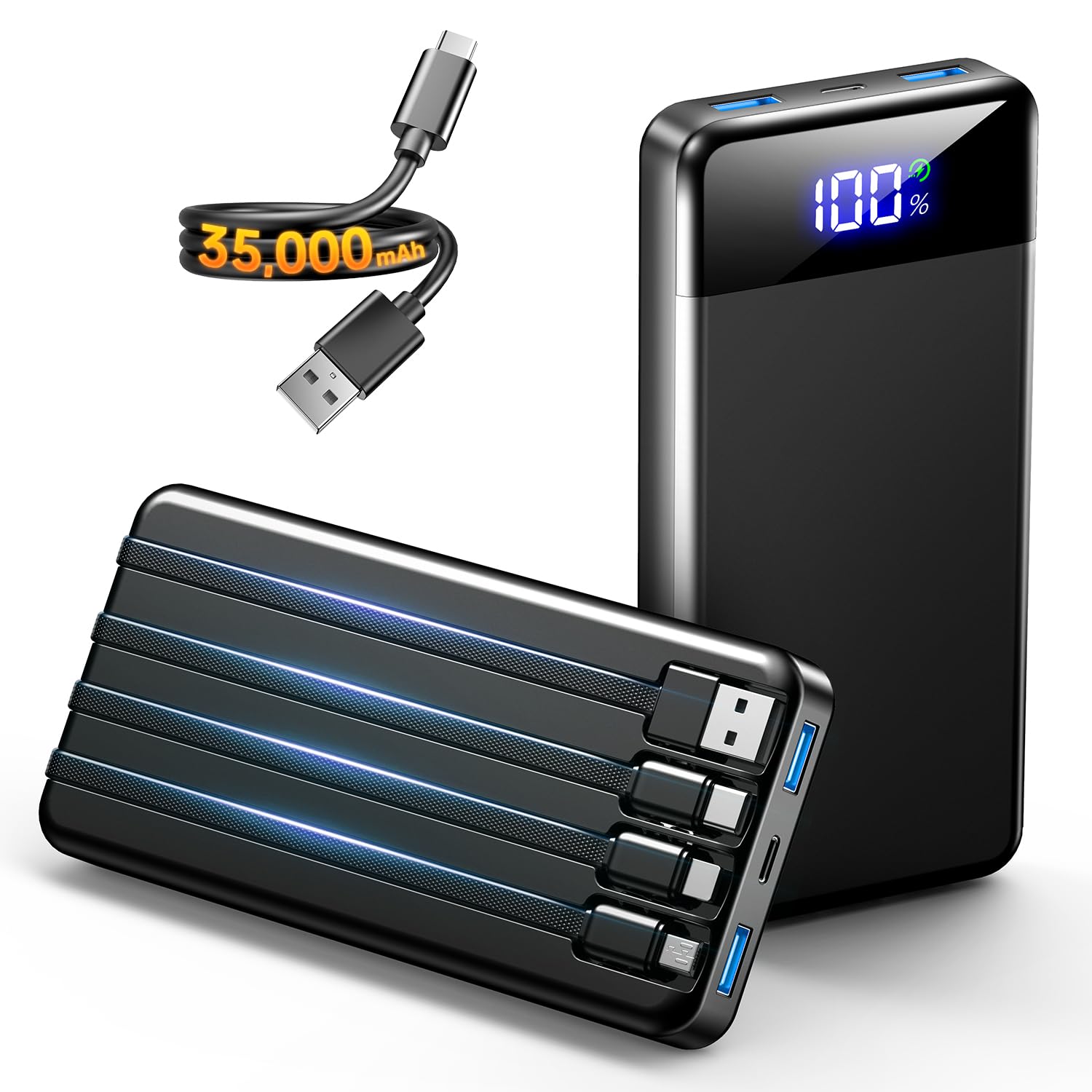
The SABANI packs a massive 35,000 mAh into a chassis that’s only 335 grams and roughly the size of an iPhone 15—5.95 x 2.87 x 0.79 inches. The headline feature is four built-in cables (iOS, USB-C, USB-A, Micro) plus three extra ports, allowing you to charge up to six devices simultaneously. For group backpacking trips or family camps, this kills the cable-sharing friction.
The 22.5W PD output pushes an iPhone 15 to 50% in about 30 minutes, and the LED display shows battery percentage down to one percent. The high-density lithium polymer cells make the slim form factor possible. Input is handled via a USB-C port or the built-in USB-A cable, and a full recharge takes around three hours with a 15W adapter.
Trail feedback is overwhelmingly positive—users describe it as “smaller and lighter than expected” for its capacity. The only consistent note is that the built-in cables are short (ideal for a pack pocket, not for holding a phone at face level), and the chassis lacks a ruggedized IP rating. Keep this one in a dry bag if rain is forecast.
Why it’s great
- Four built-in cables cover iOS, USB-C, Micro, and USB-A out of the box
- 335g for 35,000 mAh is an outlier in weight-to-capacity efficiency
- Charges six devices at once—perfect for group or family trips
Good to know
- Built-in cables are short, limiting device positioning
- No IP rating—use a dry bag in wet conditions
5. ELECOM NESTOUT 10000mAh

The ELECOM NESTOUT won an iF Design Gold Award for its vintage fuel-bottle silhouette, but the looks aren’t just for show. The IP67 rating means it survives submersion in one meter of water for 30 minutes—a true waterproof bank for river crossings and monsoon camps. The shockproof hard shell meets MIL-STD-810G drop test standards, with a silicone cushion wrapping the core cells to absorb vibration.
Capacity sits at 10,280 mAh with USB-C PD output at 20W—enough for two full phone charges. The bottom 1/4-20 tripod mount lets you attach a NESTOUT lantern or mini tripod, turning the bank into a modular camp lighting system. The smart power delivery chip auto-detects each device’s draw, allocating more power to hungry gadgets like tablets.
The trade-offs are the relatively slow 20W output and the weight—at roughly 260 grams, it’s heavier than other 10K packs. Recharging the bank itself takes about 3.5 hours. For backpackers who regularly face wet, rocky environments or want to pair it with the modular NESTOUT accessories, the durability justifies the premium.
Why it’s great
- IP67 waterproof and MIL-STD-810G shockproof—built for extreme conditions
- 1/4-20 tripod mount enables modular camp lighting setups
- Smart PD detection allocates power based on device demand
Good to know
- 20W output is slower than competitors in the same price range
- Heavier than other 10K packs—not ideal for ultralight kits
6. Nitecore NB Plus
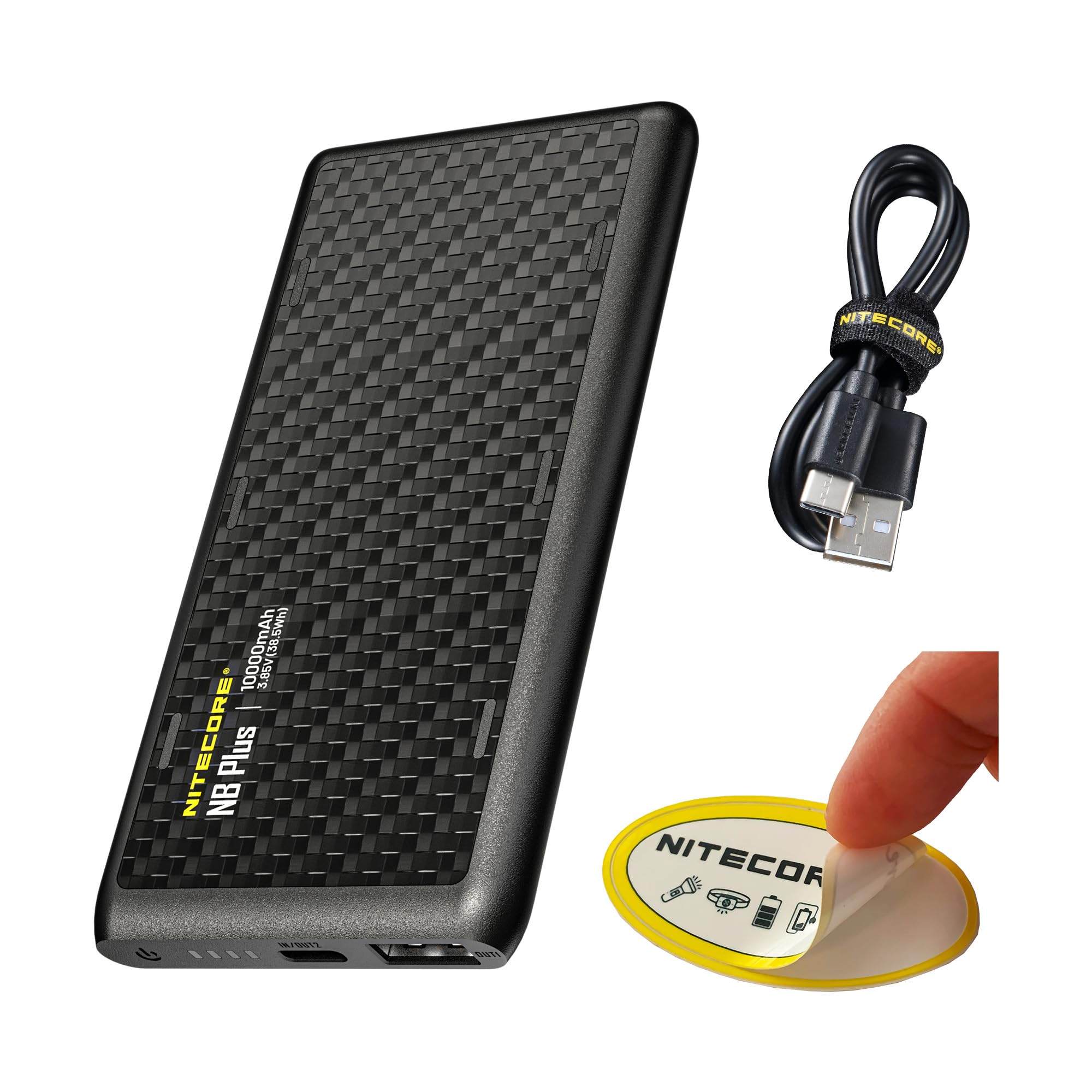
The Nitecore NB Plus tips the scale at just 155 grams (5.47 ounces), making it the lightest 10,000 mAh power bank in this guide by a wide margin. The slim profile—4.82 x 2.35 x 0.46 inches—is thinner than most smartphones, sliding into a map pocket or the sleeve of a frameless pack without adding noticeable bulk. Despite the feathery build, it carries an IPX7 waterproof rating, surviving immersion in one meter of water for 30 minutes.
Its dual ports (USB-C and USB-A) support 5V/3A charging with QC PD compatibility, delivering about two and a half full charges for an iPhone 14 mini. The rounded corners reduce impact damage and improve grip comfort when you’re pulling it out with wet hands. It’s airline-approved and includes a USB-C charging cord and a Nitecore sticker.
Field feedback from bike packers and long-distance hikers praises the pass-through charging feature—you can charge the bank itself while it’s simultaneously powering a device, useful when outlets are scarce. The trade-off is charging speed: at 5V/3A, it’s slower than the 22.5W or 30W rivals. For gram-counting thru-hikers who prioritize weight over raw speed, this is the one.
Why it’s great
- 155g is the lightest 10K pack available—critical for ultralight loads
- IPX7 waterproofing handles full submersion, not just splash
- Pass-through charging lets you charge bank and device simultaneously
Good to know
- 5V/3A output is slow compared to 22.5W+ alternatives
- No built-in cable; you must carry a separate cord
7. YBYP 50000mAh
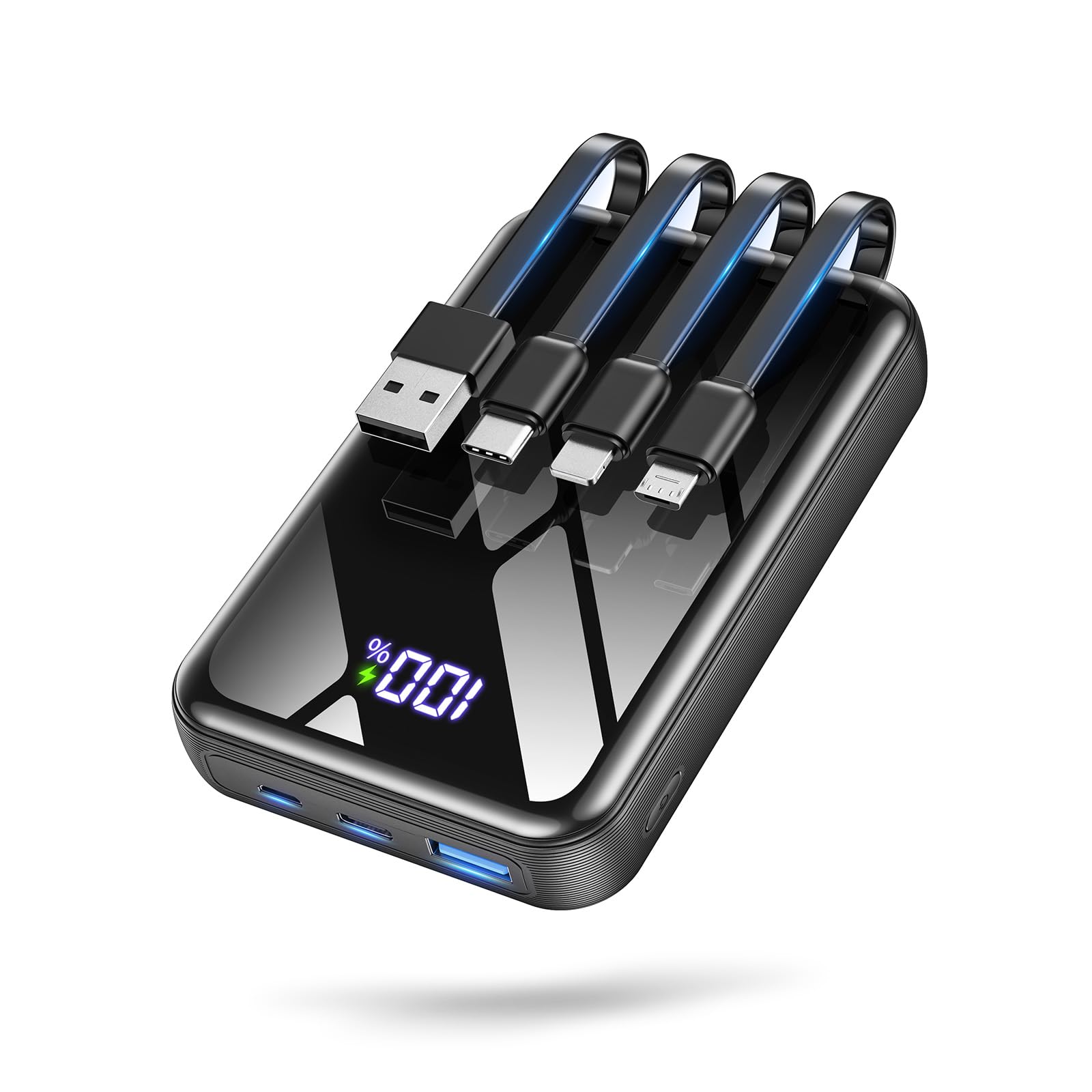
The YBYP 50,000 mAh pack is the capacity king at a claimed 0.75 pounds (340g), though the specs list it closer to 0.7 pounds—still remarkably light for a 50K brick. It claims to charge an iPhone 17 up to 9.1 times, a Galaxy S25 8.1 times, or an iPad Pro six times. The 22.5W fast charging pushes a phone to 55% in 30 minutes, and the 8-layer safety system covers overcurrent, overvoltage, and short-circuit protection.
The four built-in cables (Micro-B input, USB-A input, Type-C output, Lightning output) plus three extra ports let you charge five devices at once—a base camp hub for a group. The clear LED digital display shows exact percentage, and the kit includes an extra USB-C charging cable. It’s marketed as 30% smaller and 15% lighter than traditional 50K packs, making it feasible for car camping or extended treks where you’re resupplying power for multiple devices.
Trail reviews confirm the battery holds charge well for weeks and the fast charging is legit. The main caveat is the lack of an IP rating—this is strictly a dry-weather or dry-bag-only option. For backpackers who need a week-plus of phone, GPS, and camera power without a power source, this fills the niche no 10K can touch.
Why it’s great
- 50,000 mAh capacity at ~340g is genuinely impressive for the spec
- Four built-in cables plus three ports charge up to five devices simultaneously
- 22.5W PD fast charging delivers 55% in 30 minutes
Good to know
- No IP rating—must be kept dry in a dry bag or sealed pocket
- Claimed weight may vary; real-world weight is closer to 340g
FAQ
How many mAh do I need for a 5-day backpacking trip?
Can I charge a battery pack for backpacking with a solar panel?
Does cold weather affect battery pack performance on the trail?
Final Thoughts: The Verdict
For most backpackers, the battery pack for backpacking winner is the Nitecore NB20000 Gen 3 because it delivers 20,000 mAh at just 291 grams with dual USB-C and IPX5 waterproofing—the best balance of capacity, weight, and durability for multi-day treks. If you want to shave grams and only need weekend power, grab the Nitecore NB Plus at 155 grams. And for raw value, the INIU Smallest 20000mAh matches the Nitecore’s capacity at a fraction of the cost with a detachable cable lanyard.