
When the grid goes down, a dead phone isn’t your biggest problem—it’s the refrigerator full of food, the medical device that needs power, or the sump pump that keeps your basement dry. A dedicated power station sized for a blackout is a different beast than a simple phone charger; it needs enough capacity to run a mini-fridge for a day and enough inverter wattage to start a freezer’s compressor without tripping into overload protection.
I’m Min — the co-founder and writer behind Gadgets Feed. I’ve spent countless hours analyzing battery chemistries, inverter topologies, and real-world discharge curves across dozens of portable power stations to separate the units that genuinely deliver in an outage from those that look good on paper but stumble under a sustained load.
This guide ranks the top-tier, mid-range, and budget-friendly options based on their ability to keep essential devices running when you need them most, helping you select the absolute best battery pack for power outage.
How To Choose The Best Battery Pack For Power Outage
Choosing a power station for emergency backup isn’t the same as picking a camping battery. In an outage, you might run a refrigerator 24/7, charge laptops for remote work, and power a CPAP machine overnight—all from the same unit. Focus on these three factors to avoid buying a station that runs out of juice before the lights come back on.
Capacity (Watt-Hours) and Inverter Rating
Capacity is measured in watt-hours (Wh) and tells you how long a station can run a given load. A 2000Wh station will run a 100W refrigerator for about 20 hours—assuming no inverter losses. But the inverter’s continuous output rating in watts matters just as much. A 2000Wh station with a 300W inverter can’t start a refrigerator compressor, while a 2000Wh station with a 2200W inverter can. Look for at least 1800W continuous if you plan to run a fridge, freezer, or microwave.
Battery Chemistry and Cycle Life
The battery cells inside determine how many years the station will last. LiFePO4 (lithium iron phosphate) cells are the gold standard for emergency backup because they handle 3000 to 6000 charge cycles before degrading to 80% capacity. That translates to roughly 10 to 17 years of daily use. Older lithium-ion or NMC chemistries might save money upfront but will need replacement far sooner if you cycle them regularly during outages or testing.
Recharge Speed and UPS Functionality
After a long outage, you want the station back to full charge quickly. Units with 1800W to 2400W AC input can refill a 2000Wh battery in under an hour—critical if you have a generator or grid power for only a short window each day. Also check for a sub-20ms UPS transfer time, which lets you keep a desktop computer or networking gear running without a reboot when power blinks off and on.
Quick Comparison
On smaller screens, swipe sideways to see the full table.
| Model | Category | Best For | Key Spec | Amazon |
|---|---|---|---|---|
| EF ECOFLOW Delta 3 Classic | Mid-Range | Balanced capacity & fast recharge | 1024Wh LiFePO4 / 1800W inverter | Amazon |
| BLUETTI AC200L | Premium | Expandable home backup | 2048Wh LiFePO4 / 2400W inverter | Amazon |
| Anker SOLIX C2000 Gen 2 | Premium | Ultra-fast recharge & alternator charging | 2048Wh LiFePO4 / 2400W inverter | Amazon |
| Jackery Explorer 2000 v2 | Premium | Lightest 2kWh option for transport | 2042Wh LiFePO4 / 2200W inverter | Amazon |
| BLUETTI Elite 200 V2 | Premium | Highest cycle life (6000+ cycles) | 2074Wh LiFePO4 / 2600W inverter | Amazon |
| AFERIY P210 | Premium | High wattage & 7-year warranty | 2048Wh LiFePO4 / 2400W inverter | Amazon |
| DABBSSON 2000L | Mid-Range | Semi-solid state battery value | 2048Wh Semi-Solid / 2200W inverter | Amazon |
| DJI Power 2000 | Mid-Range | Compact build & sub-30dB noise | 2048Wh LFP / 3000W inverter | Amazon |
| Apowking 300W Power Station | Budget | Small essential device backup | 220Wh / 300W inverter | Amazon |
In‑Depth Reviews
1. EF ECOFLOW Portable Power Station Delta 3 Classic
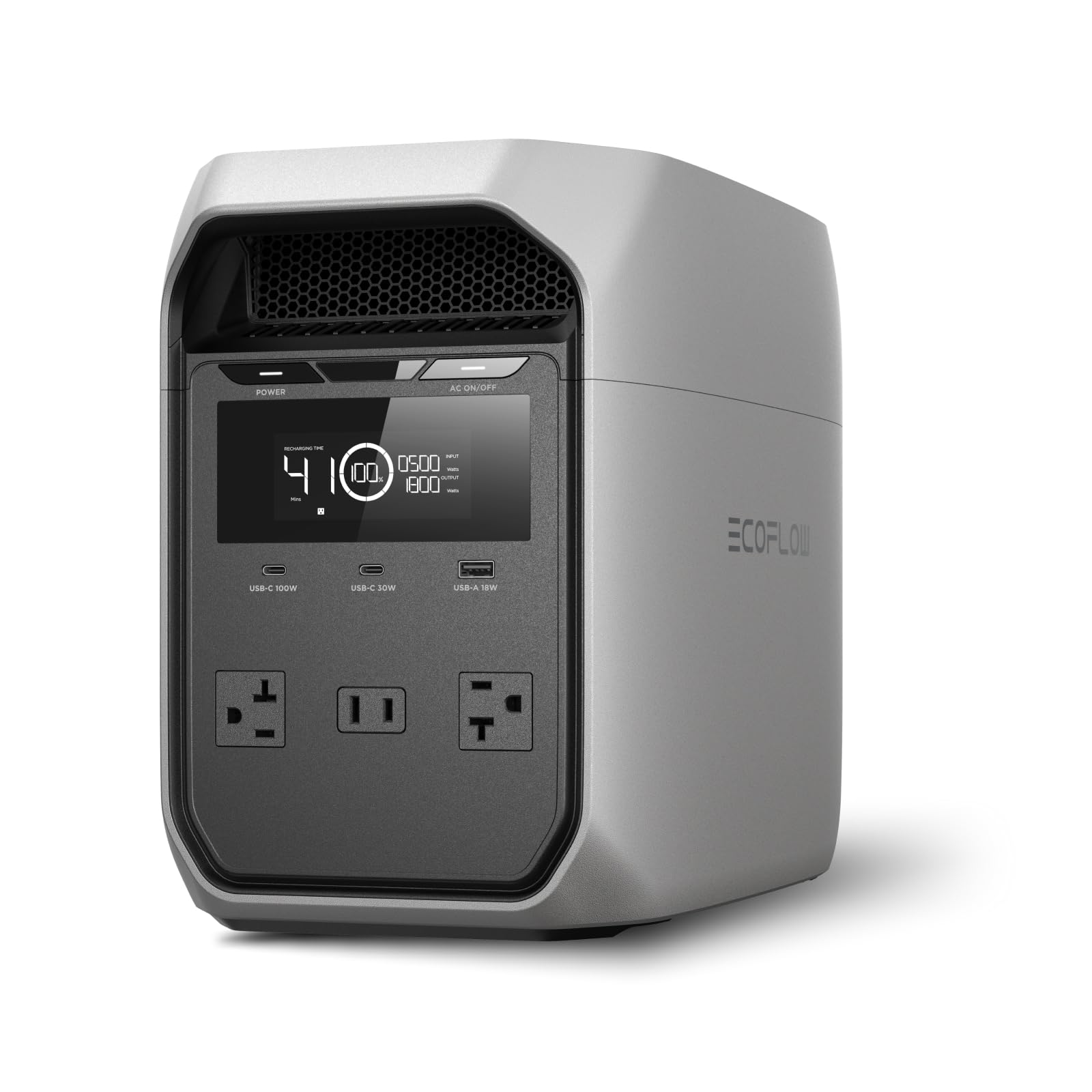
The Delta 3 Classic strikes a rare balance: 1024Wh of LiFePO4 capacity paired with a 1800W inverter (3600W surge) that can start a refrigerator compressor or a microwave without hesitation. Its X-Stream AC charging refills the battery from 0–80% in just 45 minutes, which means you can top it off during a brief generator window and be ready for another evening of backup. The sub-10ms UPS switchover keeps a desktop PC or networking gear alive through flickers, a feature usually reserved for more expensive units.
At 15 pounds, this station is genuinely portable for its class—you can carry it from the garage to the kitchen without straining. The LiFePO4 cells are rated for 10-plus years of daily cycling, so it will serve as a reliable backup long after cheaper chemistry-based units fade. Users report running a 65-inch TV for 4–5 hours, two CPAP machines for two nights, and even a tankless water heater, all without the fan noise becoming intrusive.
The EcoFlow app adds smart control via Wi-Fi and Bluetooth, allowing you to set charging schedules, monitor real-time usage, and activate Storm Alert mode when severe weather is forecast. If you need more capacity later, the station supports expansion batteries—though it uses a proprietary connector rather than a standard solar input for the expansion port. For most outage scenarios, the core capacity is sufficient to bridge a 12-hour blackout with a fridge, lights, and a laptop running simultaneously.
Why it’s great
- Fast 0-80% AC recharge in 45 minutes
- Sub-10ms UPS for sensitive electronics
- Lightweight 15-pound build for easy transport
- LiFePO4 chemistry rated for 10+ years
Good to know
- 1024Wh capacity is entry-level for running a fridge all day
- Expansion battery uses proprietary connector
- No built-in MPPT for solar panels
2. BLUETTI AC200L Portable Power Station

The AC200L is the upgraded successor to the popular AC200MAX, and the headline improvement is 2400W continuous output with 3600W Power Lifting surge. That extra 200W over the previous generation means it can handle a 1500W kettle or a 12000 BTU air conditioner more comfortably. The 2048Wh capacity provides a full day of backup for a refrigerator, a few lights, and a laptop, and if that’s not enough, you can stack expansion batteries (B300K or B300) up to a total of 8192Wh.
This unit supports up to 2400W AC input, which refills the battery from 0–80% in roughly 45 minutes. The 1200W MPPT solar input is among the fastest in its class, letting you recharge from solar panels in under two hours on a sunny day. The 30A RV port is a standout inclusion—most stations in this wattage class skip this, but the AC200L can directly charge an RV’s house battery when paired with a voltage regulator.
The 11-port layout covers every connector you’re likely to need: six AC outlets, two USB-A, two USB-C (one at 100W PD), a car outlet, and the RV port. At 61.4 pounds, it’s heavy—definitely a stationary backup rather than a camping carry-on. Bluetti includes a 5-year warranty, and real-world users report running a full-size fridge, a 64-inch TV, a modem, and security cameras for around 10 hours without draining the battery completely.
Why it’s great
- Expandable to 8192Wh for multi-day outages
- 2400W fast AC recharge in under 1 hour
- 1200W solar MPPT input for off-grid recharging
- 30A RV port for direct house battery charging
Good to know
- Very heavy at 61.4 pounds
- Proprietary expansion cable for battery packs
- No built-in wheels or telescoping handle
3. Anker SOLIX C2000 Gen 2 Portable Power Station
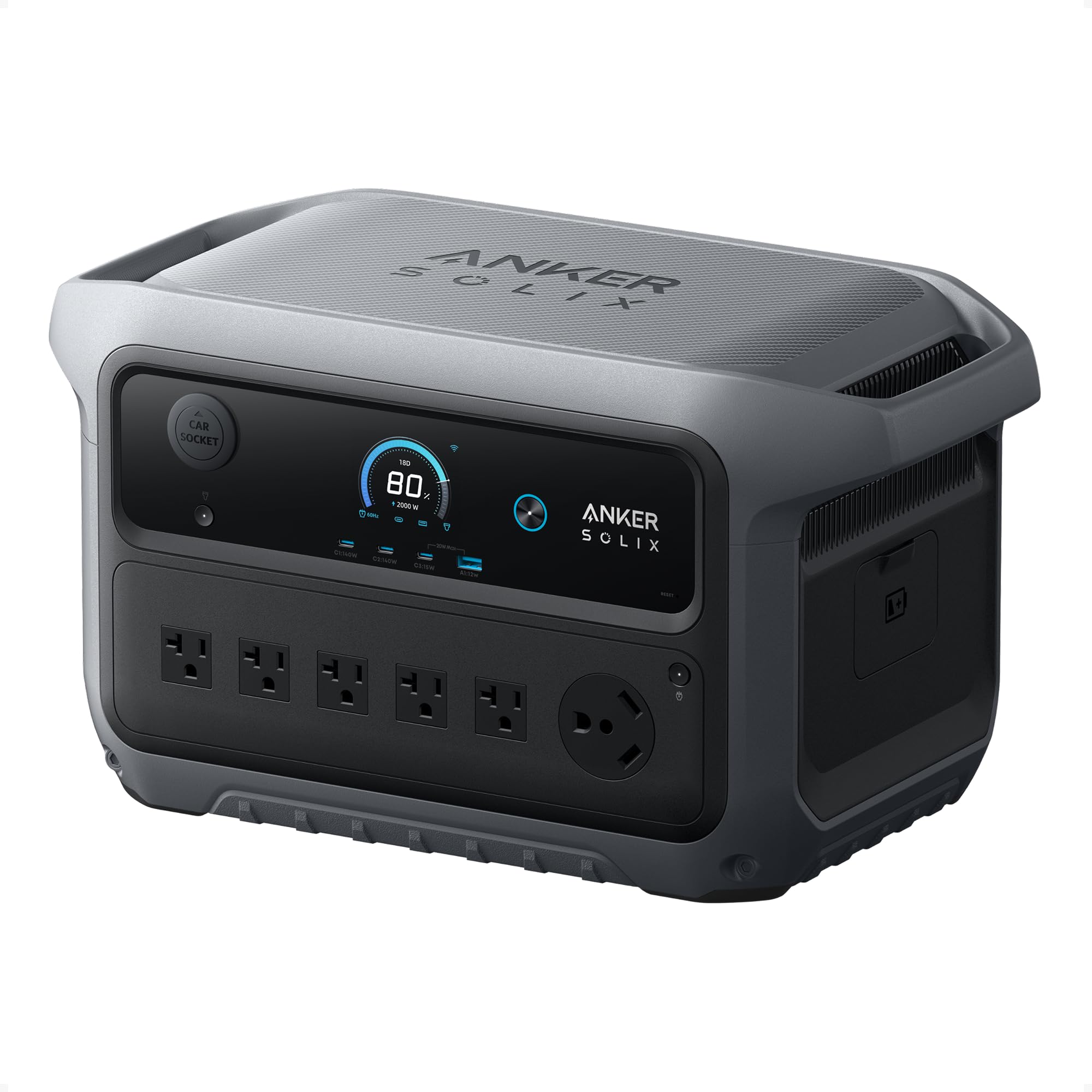
Anker’s second-generation C2000 is a direct competitor to the Bluetti AC200L, and it pulls ahead in two specific areas: standby power draw and recharge speed. The C2000 Gen 2 consumes only 9W in standby, which is roughly three times lower than many competing 2000Wh stations. That means when you leave it plugged in and waiting for a blackout, it wastes very little grid power and retains more of its charge over long idle periods.
Full AC recharge happens in 58 minutes using the included power brick, and if you have a compatible alternator charger, you can fill the 2048Wh pack from your vehicle’s 12V system in about three hours—eight times faster than a standard cigarette-lighter cable. The 4000W peak output can start most window air conditioners and RV AC units, and the unit weighs just 41.7 pounds, making it 25% lighter than comparable 2000Wh models.
The companion app provides real-time monitoring and control, and the expansion battery support takes total capacity up to 4kWh—enough to run a dual-door refrigerator for about 64 hours. Anker’s reputation for reliable power electronics carries over here; user reviews consistently praise the fast charging, the quiet operation, and the peace of mind during multi-hour outages. If you want a station that sits on standby efficiently and recharges quickly after use, this is a top contender.
Why it’s great
- Extremely low 9W standby power draw
- 58-minute full AC recharge
- 800W alternator charging for vehicle top-ups
- Lightweight 41.7-pound build
Good to know
- Expansion battery increases total cost significantly
- Peak 4000W is short-duration only
- No built-in solar charge controller in base unit
4. Jackery Explorer 2000 v2 Portable Power Station

Jackery has refined the Explorer 2000 v2 with Cell-to-Body (CTB) technology borrowed from electric vehicles, which integrates the battery cells directly into the structural frame. The result is a station that packs 2042Wh of LiFePO4 capacity into a package weighing just 39.5 pounds—making it the lightest 2kWh-class station on this list. The compact footprint (13.2 x 10.4 x 11.5 inches) slides easily under a desk or into a closet, ready for deployment.
AC fast charging takes the battery from 0–80% in 66 minutes, and a full charge is achievable in 102 minutes using the Emergency Super Charging mode via the app. The 2200W pure sine wave inverter includes a 3600W surge capacity, enough to handle a refrigerator’s compressor startup or a small microwave. The unit certified UL1778 for UPS functionality, with a 20ms switchover time that keeps networking gear alive through brief flickers.
Real-world testing shows the Explorer 2000 v2 running a standard refrigerator for 21.3 hours on a single charge, and the silent charging mode operates below 30 dB—quieter than a library. The three AC outlets, two USB-C ports (one at 100W PD), and a flashlight with SOS mode cover the essentials for home backup. The included app provides remote battery percentage monitoring and segment control, though the Bluetooth connection can be finicky if you step out of range.
Why it’s great
- Lightest 2kWh station at 39.5 pounds
- CTB technology for compact, durable build
- UL1778 certified UPS with 20ms switchover
- Runs a fridge for 21+ hours on one charge
Good to know
- Solar barrel ports feel slightly less robust than competitors
- App Bluetooth connection is not always persistent
- No expansion battery support in this model
5. BLUETTI Elite 200 V2 Portable Power Station

The Elite 200 V2 is the newest Bluetti flagship, and it pushes two specs beyond the AC200L: a 2600W continuous inverter with 3900W Power Lifting surge, and a CNAS-certified automotive-grade LiFePO4 battery rated for 6000+ cycles to 80% capacity—that’s roughly 17 years of daily use. For a buyer who wants a single station that will outlast multiple generations of replacements, this is the longevity champion.
Fast dual charging (AC plus solar) can refill the 2074Wh pack from 0–80% in about 50 minutes, and the TurboBoost mode delivers 1800W AC input directly. The Silent Charging mode drops fan noise to 16–30 dB, making it suitable for overnight use in a bedroom or RV. Bluetti’s app offers three charging profiles—Turbo, Standard, and Silent—so you can trade speed for noise depending on the situation.
At 53.4 pounds, the Elite 200 V2 is heavier than the Jackery or Anker equivalents, but dual handles make carrying it manageable. The nine-port panel includes four AC outlets, two USB-C (one at 100W), USB-A, and a car port. Users report running a microwave, a coffee maker, a hair dryer, and multiple fridges simultaneously without tripping the inverter—a testament to the 3900W surge headroom. The only missing feature is a 30A RV port, which the AC200L includes.
Why it’s great
- 6000+ cycle LiFePO4 battery (17-year lifespan)
- 2600W continuous/3900W surge output
- 50-minute 0–80% fast dual charging
- Silent charging mode below 30 dB
Good to know
- Heavy at 53.4 pounds
- No 30A RV port for direct RV charging
- Premium price compared to mid-range options
6. AFERIY 2048Wh Portable Power Station P210

The AFERIY P210 delivers 2400W continuous output (4800W peak) from a 2048Wh LiFePO4 pack, making it one of the highest-wattage stations in its capacity class. The pure sine wave inverter runs both AC input and output exclusively, meaning clean power at every point in the chain—critical for sensitive electronics like CPAP machines and home servers. The station includes 16 ports: six AC outlets, two USB-A, four USB-C (including a 100W PD port), two DC5521 ports, a car outlet, and an XT60 port rated at 300W.
Server-level UPS with a sub-10ms response time protects computers and storage arrays during power blips, and the station operates at less than 30 dB under full load—quiet enough for a bedroom. The included app provides remote monitoring via Wi-Fi and Bluetooth, allowing you to check remaining runtime and adjust charging schedules. AFERIY backs the P210 with an industry-leading 7-year extended warranty, which adds peace of mind for long-term outage preparedness.
At 54 pounds and dimensions of 15.4 x 11.0 x 12.7 inches, the P210 is a substantial unit that stays in a fixed location rather than traveling. The 1200W UPS limit is slightly lower than the 2400W continuous output when plugged into a wall, meaning some high-draw appliances may need to be disconnected before the station enters backup mode. That minor caveat aside, the P210 offers a compelling blend of capacity, silence, and warranty length for home backup use.
Why it’s great
- 4800W peak surge handles heavy appliance starts
- 16 ports including 4 USB-C ports
- Ultra-quiet operation under 30 dB
- Industry-leading 7-year warranty
Good to know
- Heavy at 54 pounds, not portable
- 1200W UPS limit when connected to grid
- Customer support responsiveness has mixed reviews
7. DABBSSON Portable Power Station 2000L
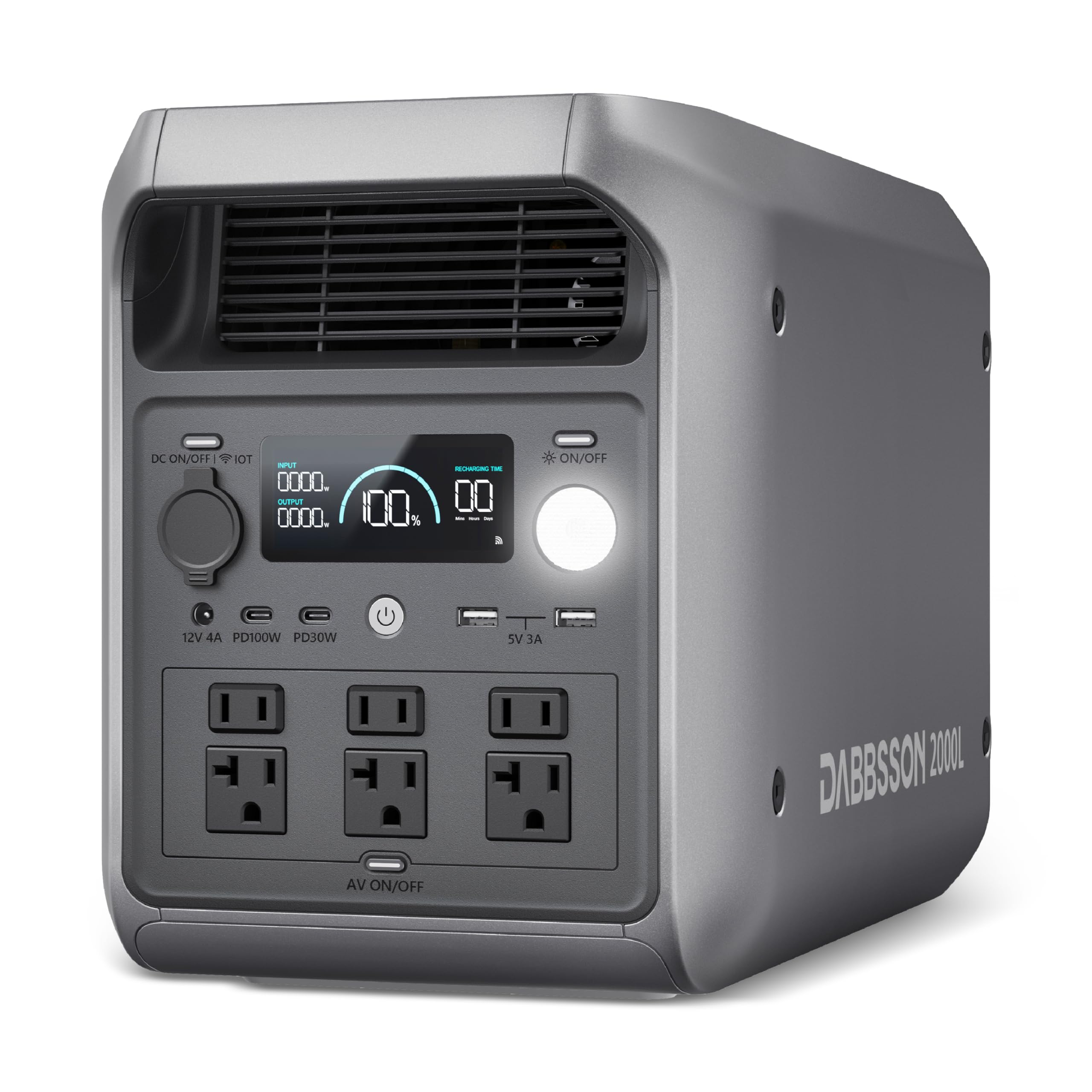
The Dabbsson 2000L uses semi-solid LiFePO4 cells, a chemistry that offers higher thermal stability and safety margins than standard LFP packs. The 2048Wh capacity supports a 2200W continuous inverter with a 3300W Power Boost surge, enough to start a refrigerator compressor or run a microwave. The station is surprisingly compact for its capacity—11.2 x 18.3 x 8.9 inches and just 41 pounds—making it one of the lightest 2kWh stations on the market.
AC fast charging refills the battery to 100% in about one hour, a competitive time for this capacity bracket. Solar input supports up to 800W via MPPT, and the hybrid dual-input mode (AC plus solar) can recharge even faster. The EPS switchover happens in under 10ms, protecting computers, NAS drives, and routers from power interruptions. Six AC outlets and a full port set—USB-A, USB-C (100W), car port, and DC5521—cover an entire household’s essential electronics.
At a price that undercuts most premium 2000Wh stations, the 2000L delivers strong value for budget-conscious buyers who still want LiFePO4 safety and fast charging. Real-world users report running a Keurig, an air fryer, two refrigerators, and two freezers simultaneously for 7.5 hours—proving the 3300W surge is genuine. The main drawback is inconsistent customer support responsiveness, with some users reporting delayed firmware updates and unreturned emails after initial contact.
Why it’s great
- Advanced semi-solid LiFePO4 cells for safety
- 1-hour full AC recharge
- Lightweight 41-pound build for 2kWh capacity
- Competitive value for the spec sheet
Good to know
- Customer support responsiveness is inconsistent
- Core software issues reported by some users
- 5-year warranty is shorter than some competitors
8. DJI Power 2000 Portable Power Station
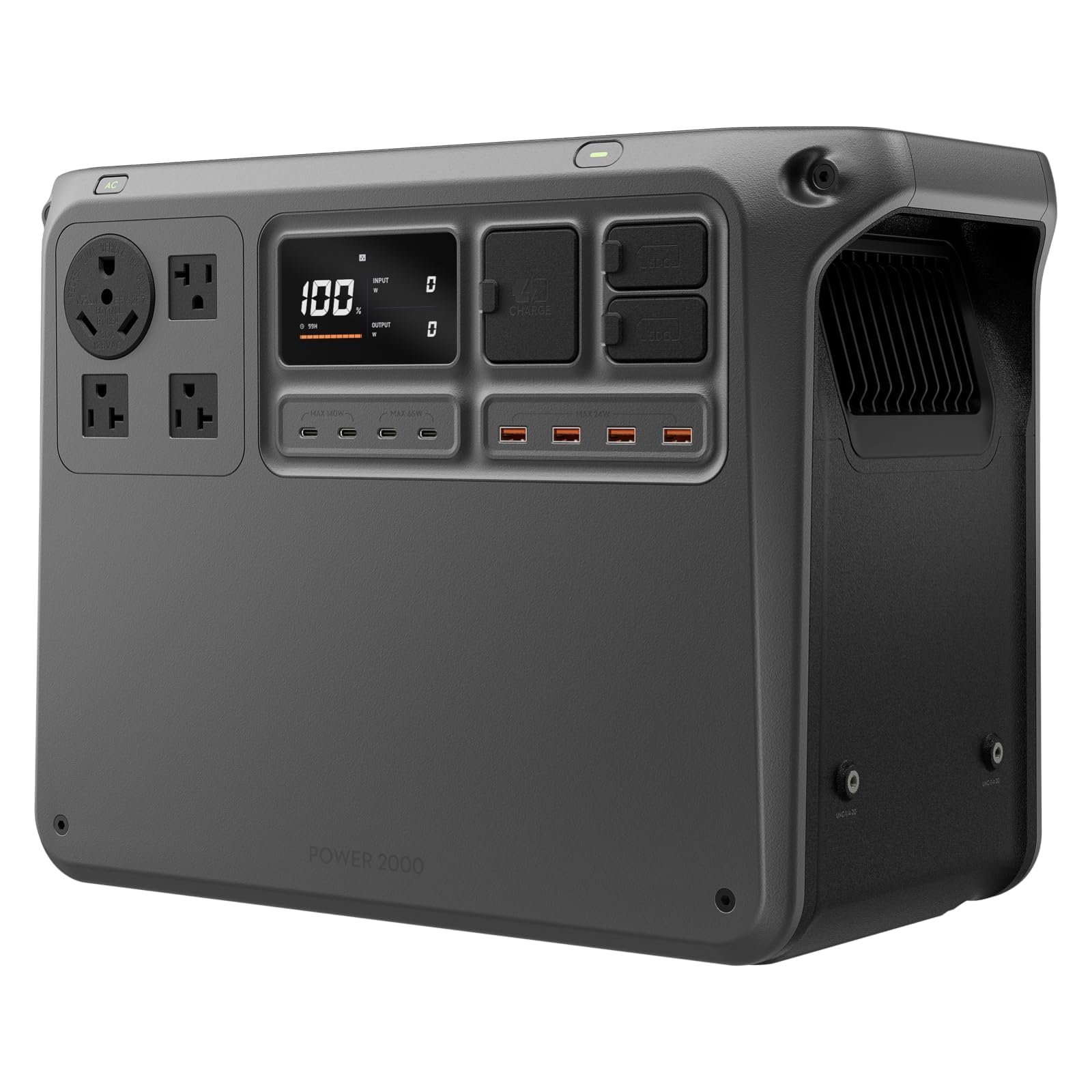
DJI’s entry into the power station category is the Power 2000, and it brings the company’s battery engineering expertise to home backup. The 2048Wh LFP pack feeds a 3000W continuous inverter (4000W peak), the highest continuous output in this roundup. AC fast charging hits 0–80% in 55 minutes and full in 90 minutes, while solar input up to 1800W can recharge the station in under two hours with adequate panel wattage.
At 17.6 x 8.9 x 12.8 inches and 47.9 pounds, the Power 2000 is compact for a 3kW-inverter station, though the lack of built-in wheels makes moving it a two-handed effort. The 15-port panel includes dual full SDC ports for DJI’s proprietary expansion batteries, allowing the system to scale up to 22.5kWh for multi-day outages. The unit operates below 30 dB, making it suitable for overnight use in an RV or bedroom without disruptive fan noise.
The DJI Home app provides remote monitoring and control, though the station requires the app for full configuration—there’s no dedicated screen for complete settings on the unit itself. Some users report that the unit heats up noticeably under load, and a few have noted a strong burning smell during initial use, though this appears to be related to the fan or inverter breaking in. The 5-year warranty provides a decent safety net, and for buyers already in the DJI ecosystem, the brand consistency is a bonus.
Why it’s great
- 3000W continuous output handles large appliances
- Fast 55-minute 0-80% AC charge
- Expandable to 22.5kWh for long outages
- Very quiet operation below 30 dB
Good to know
- Proprietary connectors for expansion and solar
- No built-in wheels or telescoping handle
- Some users report heat and odor during initial use
9. Portable Power Station 300W, Apowking Backup Battery Pack
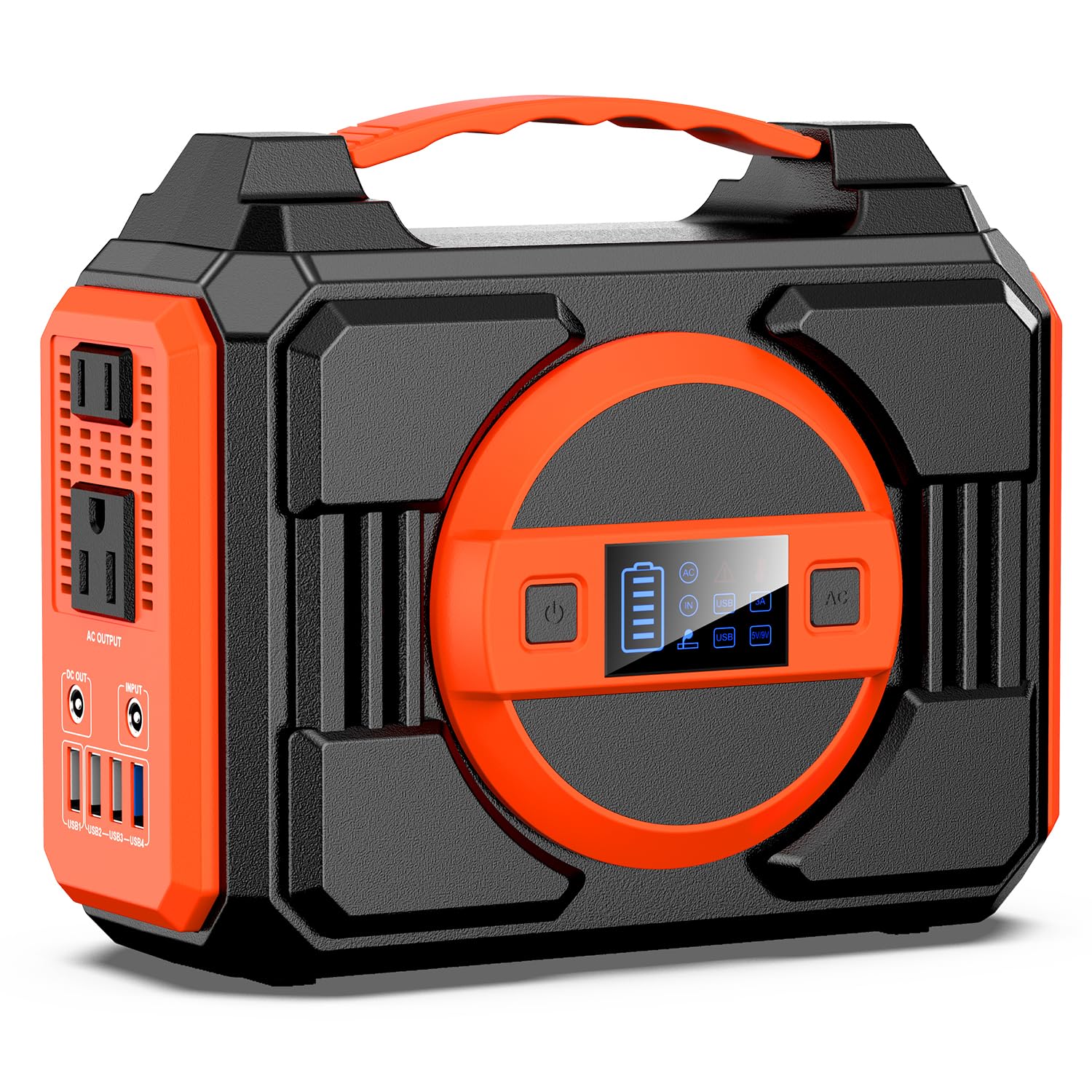
If your outage needs are limited to keeping phones, a laptop, a CPAP machine, and a few LED lights running, the Apowking 300W station is an ultra-portable entry point. The 220Wh lithium-ion battery and 300W inverter (600W peak) won’t start a refrigerator or run a microwave, but it weighs just 5 pounds and measures 8.5 x 6.7 x 4.1 inches—small enough to stash in a go-bag or a desk drawer without noticeable footprint.
Seven output ports include two 110V AC outlets (pure sine wave), three USB-A ports, one USB-C port (5V/3A, 9V/2A), and a DC vehicle port. The large back panel LED light has multiple brightness modes and an SOS flash, making it useful for power-outage navigation. Recharge options include AC wall (4+ hours for full), car 12V, and optional solar panel input via an included adapter, giving you flexible ways to replenish the battery during an extended outage.
The built-in BMS handles overcharge, over-temperature, and short-circuit protection, and the pure sine wave inverter keeps sensitive electronics safe from voltage noise. Users report charging phones, a modem, and a camping light for several hours off-grid, and the compact size makes it easy to carry between rooms or into a vehicle. For a full-house backup package, you’ll need a larger station, but as a dedicated phone-and-essentials runner that fits in a backpack, the Apowking delivers solid reliability at a fraction of the cost.
Why it’s great
- Ultra-portable 5-pound build for grab-and-go use
- Pure sine wave AC output protects sensitive devices
- Large back LED light with SOS mode
- Multiple recharge options including solar
Good to know
- 220Wh capacity is insufficient for fridge or freezer
- 300W inverter cannot start appliance motors
- Slow AC recharge (4+ hours for full)
- No USB-C PD for fast laptop charging
FAQ
How many watt-hours do I need to run a refrigerator during a power outage?
Can I charge a portable power station with a gas generator during a long outage?
What is the difference between a power station and a UPS for home backup?
How often should I recharge my backup power station when it’s not in use?
Can I power a sump pump with a portable power station?
Final Thoughts: The Verdict
For most users, the battery pack for power outage winner is the EF ECOFLOW Delta 3 Classic because it packs a fast-charging LiFePO4 battery, a robust 1800W inverter, and sub-10ms UPS protection into a remarkably portable 15-pound package at a mid-range price. If you want ultimate expandability for multi-day outages, grab the BLUETTI AC200L with its 8192Wh expansion ceiling. And for the quietest, most cycle-durable option that will serve as your daily driver for a decade-plus, nothing beats the BLUETTI Elite 200 V2 and its 6000-cycle LiFePO4 battery.