
Our readers keep the lights on and my morning glass full of iced black tea. As an Amazon Associate, I earn from qualifying purchases.
Specs are compiled from manufacturer listings and verified buyer reviews and can change over time — please confirm the key details on the product page before buying.
A battery pack with an outlet is the difference between a dying phone and a running fridge. That built-in AC socket (the same three-prong wall socket your lamp uses at home) turns a plain battery into a real power source. The picks below range from a carry-in-your-bag charger that tops up a laptop to a full home-backup tower that runs your kitchen. I ranked them by how well they actually cover an outage, not by spec-sheet bragging.
I’m Min — the founder and writer behind Gadgets Feed. This guide is built by comparing the manufacturers’ published specifications and the patterns across verified customer reviews, so you get each pick’s real strengths and trade-offs instead of marketing spin.
You will see capacity, wattage, and recharge speed side by side, so you can match a unit to your actual blackout or camping routine without overpaying. These are the strongest contenders for the best battery pack with outlet.
Our Picks at a Glance

How To Choose The Best Battery Pack With Outlet
Picking a battery pack with an outlet is mostly about matching three numbers to your real life: how much power it can push at once, how much energy it stores, and how fast it refills. Get those right and everything else is comfort.
Watts decide what you can plug in
Watts measure how much power flows at one moment. A pack rated 350W runs a laptop and a fan, while a 2,400W unit runs a fridge or a microwave. Always check whether a device’s draw sits under the rated wattage, and leave a little headroom. Peak wattage covers the brief surge when a motor or compressor kicks on.
Watt-hours decide how long it lasts
Wh (watt-hours) is the size of the tank. A bigger number means more runtime, so a 2,048Wh station keeps a fridge cold far longer than a 288Wh pack. For a rough feel, divide the Wh by your device’s watts to estimate hours. That single calculation tells you whether a unit survives a night or a whole weekend.
Battery chemistry and recharge speed
LiFePO4 (a lithium chemistry built for long life and heat tolerance) is the benchmark here, since these cells are rated for thousands of charge cycles instead of hundreds. Recharge speed matters just as much: a station that refills in about an hour is ready before the next storm, while one that needs five hours asks you to plan ahead.
Quick Comparison
| Model | Best For | Capacity (Wh) | AC Output (W) | Battery Type | Amazon |
|---|---|---|---|---|---|
| EF ECOFLOW DELTA 3 Max★ Best Overall | Whole-home and RV backup | 2048 | 2400W (3400W X-Boost) | LiFePO4 | Amazon |
| DJI Power 2000Top Performer | Quiet RV and appliance power | 2048 | 3000W | LFP | Amazon |
| BLUETTI Elite 200 V2Best for Off-Grid | Off-grid and heavy appliances | 2073.6 | 2600W (3900W lifting) | LiFePO4 | Amazon |
| Anker SOLIX C2000 Gen 2 | Fast home backup | 2048 | 2400W (4000W peak) | LiFePO4 | Amazon |
| Jackery Explorer 2000 v2 | Lightest 2kWh camping backup | 2042 | 2200W | LiFePO4 | Amazon |
| DABBSSON 2000L | Job sites and garage power | 2048 | 2200W (3300W boost) | Semi-Solid LiFePO4 | Amazon |
| EF ECOFLOW DELTA Pro | Whole-home battery bank | 3600 | 3600W (4500W X-Boost) | LFP | Amazon |
| Anker SOLIX F3800 | 240V appliances and EV charging | 3840 | 6000W | LFP | Amazon |
| BLUETTI Elite 100 V2 | One-handed camping power | 1024 | 1800W (2700W lifting) | LiFePO4 | Amazon |
| DARAN NEO300L | Compact emergency backup | 288 | 350W (600W peak) | LiFePO4 | Amazon |
| MARBERO 24000mAh | Bag-sized laptop and phone backup | 24000mAh | 120W peak | Lithium Ion | Amazon |
In‑Depth Reviews
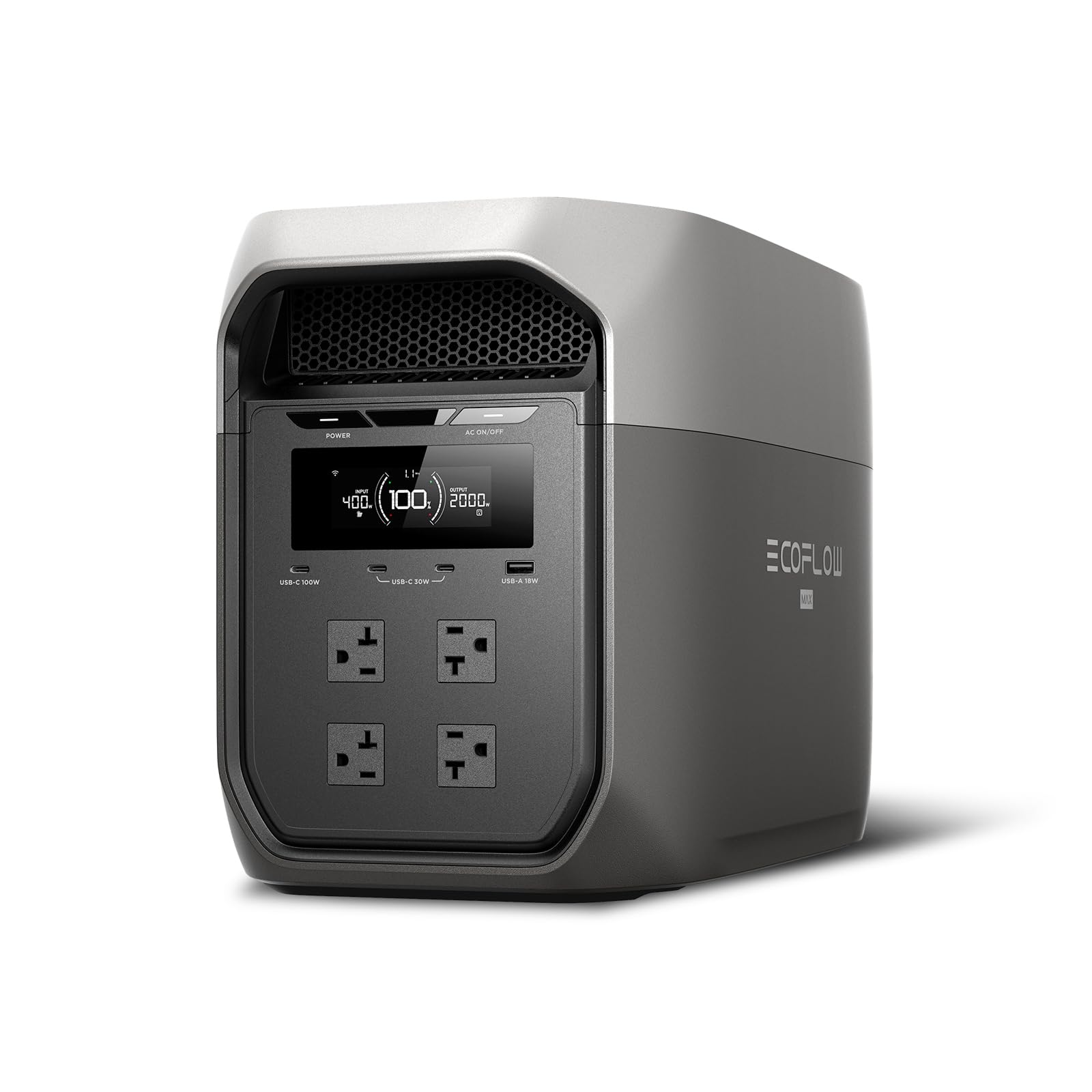
1. EF ECOFLOW DELTA 3 Max Portable Power Station, 2048Wh LFP Battery, 2400W
Our pick — over 4.5★ from 550+ verified ratings; the strongest balance of quality and price.
The big-capacity station that refills before you finish packing the car.
EcoFlow’s flagship here carries a 2048Wh LFP battery and a 2400W output, with X-Boost lifting the peak to 3400W so a fridge, a microwave, or a power tool starts without tripping. The standout number is recharge speed: X-Stream tech takes it from 0 to 80% in 1.13 hours, which is the fastest full-size refill in this group and what makes it the overall pick.
The 2048Wh LFP battery is rated for roughly 10 years of daily use, and at 1.13 hours to 80% it refills faster than any other full-size station here. App control lets you set charge and discharge windows, while the 10ms transfer time keeps a desktop or a router humming through a flicker — that ultra-quiet operation keeps a bedroom calm during a blackout. Buyers report the unit can run a TV for about 12 hours, and the value-for-money angle is what wins people over most, followed closely by the charging speed. It is heavier than a tote-bag charger, so plan on a rolling cart if you move it often.
Against the DARAN NEO300L’s 288Wh, this station packs a 7.1x larger capacity — the same jump from “run a laptop” to “run the kitchen.” The one trade-off buyers flag is that maximum solar input needs the right cable to open up full current; a plain connector caps input lower. It is a cabling detail, not a limit on the station itself.
Where it pulls ahead
- 2048Wh LFP cells rated for approximately 10 years of daily use
- 0–80% recharge in 1.13 hours, the quickest here
- 3400W X-Boost handles high-draw appliances
- App lets you schedule charging and set power priorities
What to plan around
- Substantial weight for a “portable” station
- Full solar input requires a compatible higher-current cable
- Front buttons can be faint in dim light
Reach for this if: you want one station to cover a whole-home outage or an RV trip without waiting hours to recharge.
Look elsewhere if: you need something you can sling into a backpack — that job belongs to a smaller pack.
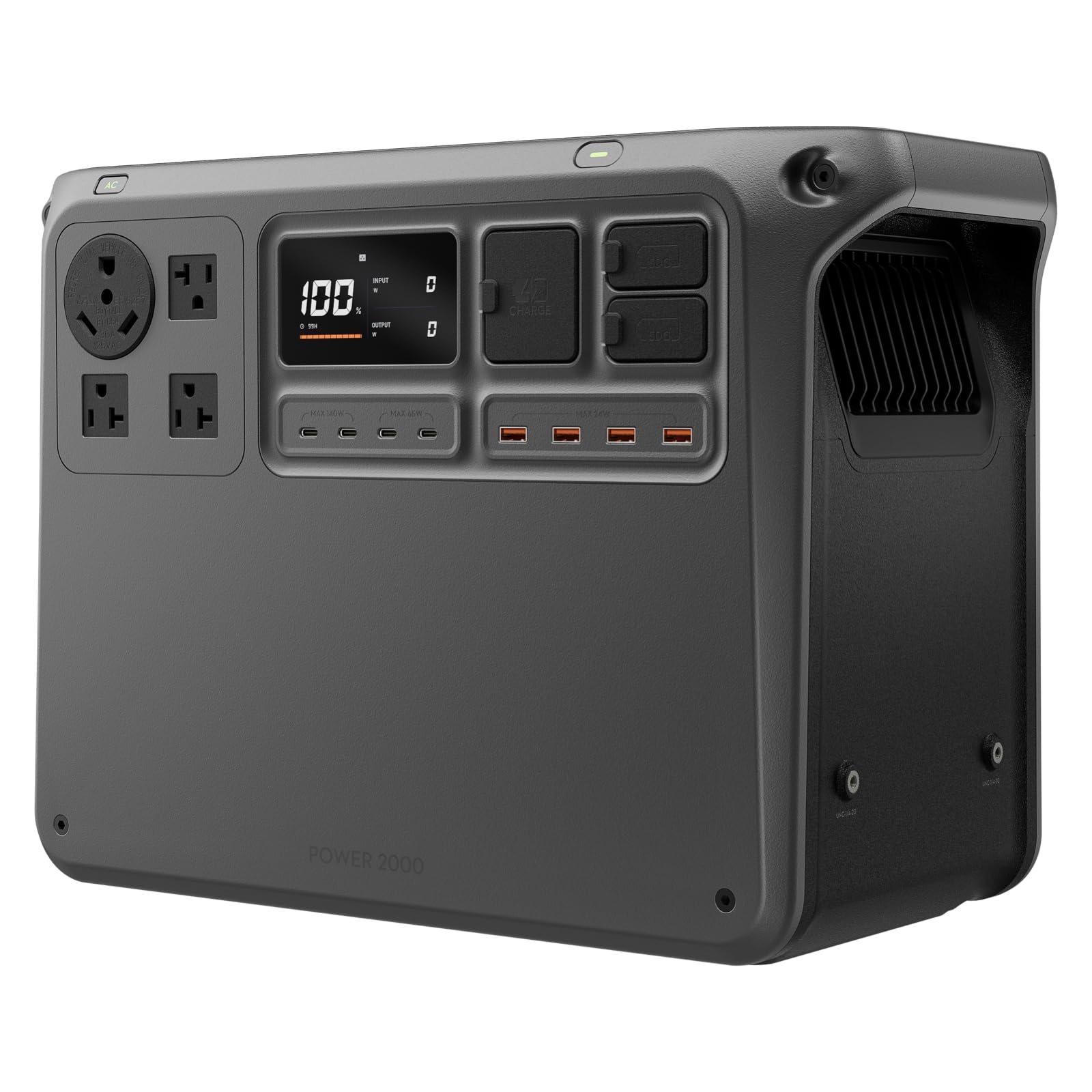
2. DJI Power 2000 Portable Power Station, 2048Wh LFP Battery
A near-silent 3000W tower built for RV nights and workshop tools.
DJI’s 2048Wh LFP station puts out a steady 3000W and runs as low as 30 dB — quiet enough to sleep beside in a van. It recharges to 80% in 55 minutes, and the 10ms UPS switchover keeps a computer or router alive through a lightning flicker. Fencing DJs and contractors show up in the reviews because it handles a full rig without complaint, and the clear capacity and build quality are what earn it the top-performer slot.
The LFP battery, sub-nano coating, and flame-retardant housing make it a fit for wet or rough outdoor conditions, and the 15 ports — including dual SDC sockets — give a crew of four or five somewhere to plug in. It runs four AC outlets, four USB-C (two at 140W), and four USB-A, so a laptop and a drone battery can top up at once. Portability is decent for the class, though this is still a two-hand lift.
The catch worth knowing: expanding into a large home system means buying DJI’s expansion batteries and adapters separately, and those accessories have been slow to restock, so a few buyers built their own solar workaround. Standalone, it’s rock solid. The premium pricing is the other honest note — worth it if you value the quiet and the output together.
The quiet is real: at 30 dB in use it barely registers in a tent or bedroom, which is where most stations lose the battle.
Expandable, with a caveat: capacity grows to 22.5kWh with add-on batteries, but those are sold separately.
Pick this when: you camp or work in an RV and want serious output without the drone of a gas generator.
Think twice if: you want a one-box home grid — plan for the accessory ecosystem upfront.
3. BLUETTI Elite 200 V2 Portable Power Station 2073.6Wh 2600W Solar Generator
A 2073.6Wh powerhouse with a 17-year-rated battery and 3900W of lifting power.
BLUETTI’s Elite 200 V2 leans on a 2073.6Wh LiFePO4 bank rated for over 6,000 cycles to 80%, with a claimed 17-year lifespan of everyday use — the longest durability figure in this lineup. The 2600W continuous output climbs to 3900W in power-lifting mode, enough to start a fridge, a hair dryer, or a coffee maker. Idle draw sits at just 10W, so it wastes less energy between uses and stretches runtime under the same load.
Owners run induction stoves, air fryers, pressure cookers, and even a dishwasher off it, and it stays compact for a 2kWh class unit. Three charging modes via the app let you pick speed versus quiet, and solar tops out at 1000W, with the panel full in about 2.4 hours. On a Yosemite trip it powered a fridge and phones all day while the car roof panels charged it on the move.
What’s honest here is the weight: at 53.4 pounds it is a two-hand carry, and the BMS (the board that manages the battery) occasionally needs full charge and discharge cycles to calibrate its percentage readout. A couple of owners hit a state-of-charge quirk that cleared after a full cycle. Neither is a fault — just calibration you should expect.
Strength to bank on
- 6000+ cycle LiFePO4 rated for 17 years of daily use
- 3900W lifting output starts heavy appliances
- 10W idle draw stretches runtime
- Three charging modes let you trade speed for quiet
Worth a heads-up
- 53.4 pounds needs two hands and a plan
- Occasional charge calibration cycles required
- Heavier than some 2kWh competitors
Suits you best if: you want a buy-once battery that outlives a decade of outages and off-grid weekends.
Heads-up: it is a lug-it station, so keep it near a cart or counter you trust.
4. Anker SOLIX C2000 Gen 2 Portable Power Station, 2,048Wh, 2,400W
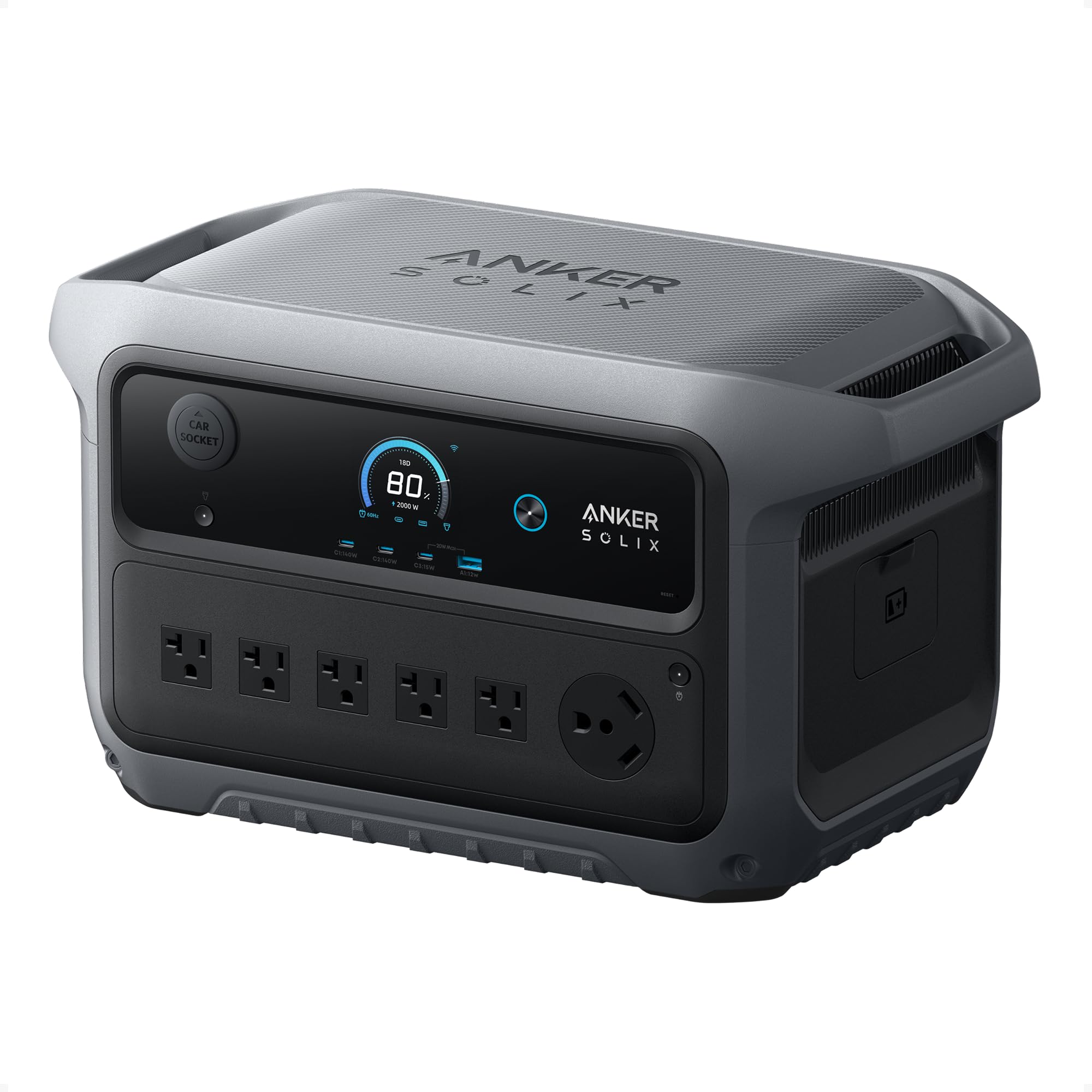
Fully charged in under an hour and slim enough to slide under a TV stand.
Anker’s 2048Wh LiFePO4 station hits 100% in 58 minutes and sips only 9W on standby, which is the figure behind a stated 32 hours on a dual-door fridge. Rated 2400W with a 4000W peak, it runs most window and RV air conditioners alongside other appliances, and the 18.1 × 9.8 × 10.1″ body slides under a counter or TV stand when it is not in use. Charging to 100% quickly and the compact footprint are what owners praise most.
Anker’s 800W UltraFast alternator charging fills it in about 3 hours from the car, which is handy for road trips without a hookup, and the app plus display let you watch usage — though a few note the runtime estimates read optimistic. The capacity jumps to 4kWh with an add-on battery, giving a stated 64 hours on that same fridge. Reviews talk about running a fridge alongside a separate freezer, a fan, a modem, and a TV at once.
The honest limit is heavy simultaneous air conditioning: a small unit draws it down fast, so this is a station for fridges and electronics rather than a whole-home AC run. Weight also lands on the “mixed” ledger — light for the class, but still a deliberate two-hand carry into position.
Fastest to ready: 58 minutes from empty to full means you can charge it while you pack and never start a storm at 20%.
The compromise: air conditioning works, but only for short bursts — treat this as a fridge-and-electronics workhorse, not an AC unit.
Great match for: households that want fast turnout on an outage and a station that hides away between events.
Skip this if: you plan to run a window AC for hours — that load outruns this class.
5. Jackery Explorer 2000 v2 Portable Power Station, 2042Wh, 2200W AC Output

The featherweight of the 2kWh field — easy to carry, easy to live with.
Jackery calls this the smallest and lightest 2kWh station, and at 39.5 pounds it undercuts the rest of the big batch. It carries a 2042Wh LiFePO4 battery with a 2200W output across three AC ports, plus a USB-C PD 100W port for fast gadget top-ups. Charging runs to 80% in 66 minutes with AC fast charge, and the silent-charging mode tops it up in 5 hours at just 30 dB.
Cell-to-Body construction, borrowed from EV packs, keeps the footprint tight and the structure secure, and the UPS switchover is 20ms to keep power through a storm. Performance and charging speed are the two most-noted strengths, and reviewers run fridges and freezers for days on a single charge. One off-grid user relies on it for remote work internet, saying it lasts days and refills in about an hour. Solar recharges in as few as 6 hours on 400W panels.
The catch on this one is a rare unit that reads short on capacity — an engineer’s single test found a heavy AC load drained it faster than the spec math predicted, though a second test landed closer to expected. Bluetooth pairing can also drop, forcing a re-pair. Neither is common, and the station is a strong pick for anyone who values liftability.
The lightest option here
- 39.5 lb — lighter than the other 2kWh stations in this set
- 0–80% in 66 minutes, full in 102 minutes via the app
- Silent mode at just 30 dB for overnight charging
- 20ms UPS switchover for storm-proof backups
Know before you commit
- Bluetooth pairing can drop and need re-pairing
- Heavy AC loads drain faster than the spec math suggests
- Solar slows after a few gray days off-grid
Best fit for: campers and remote workers who move the station often and want quiet overnight charging.
Reconsider if: you plan long AC runs — this is a fridge-and-electronics unit, not an air-conditioning rig.
6. DABBSSON Portable Power Station 2000L, 2048Wh Semi-Solid LiFePO4 Battery
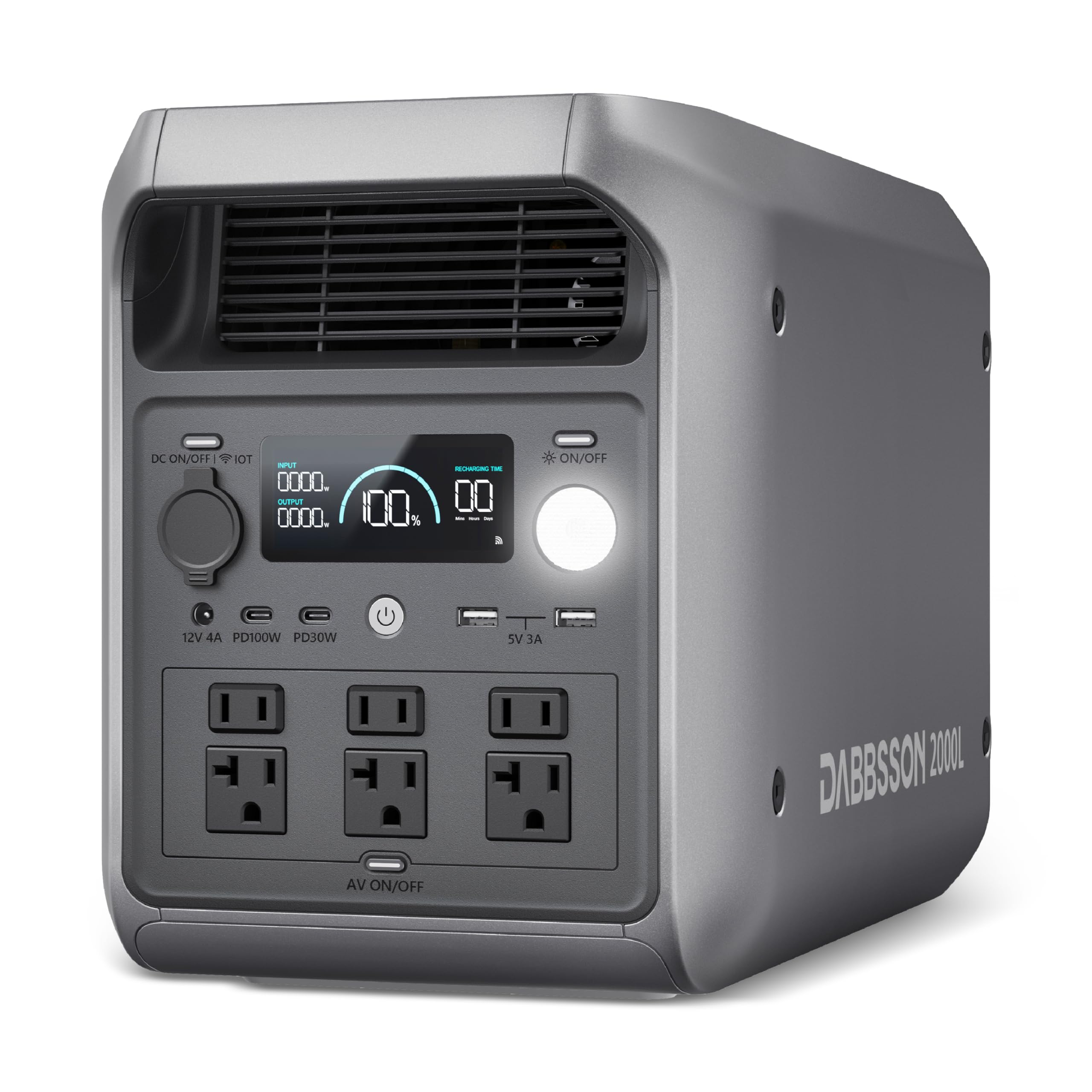
Six outlets of semi-solid LFP muscle built for garages and generators-on-a-truck.
DABBSSON’s 2048Wh station uses semi-solid LiFePO4 cells for higher stability, wrapped in a UL94-V0 flame-retardant housing, and backs it with a 5-year warranty. Output is 2200W continuous with 3300W of boost, and there are six AC outlets so a whole workbench can be plugged in at once. It recharges from AC in about an hour, and solar support reaches 800W MPPT for off-grid jobs.
The <15ms EPS switchover protects computers, NAS drives, and routers from a sudden cut, and the app handles scheduling and monitoring. Quality and value are the leading themes in the feedback, and a buyer ran a Keurig, an air fryer, a microwave, and multiple fridges off it simultaneously for hours, with one fridge lasting over 20 hours on its own. Semi-solid cells support 4000+ deep cycles to 80%, or 10+ years of daily use, backed by a 5-year warranty.
At 41 pounds it is compact for its capacity but still a lift, and under heavy load the fans can get audible — a trade-off many accept for the output. Runtime is rated 1.3x longer than comparable 2048Wh stations, so a fridge that dies overnight elsewhere keeps running here.
Built for the garage: six AC outlets and a 3300W boost mean tools, a microwave, and a fridge can share the box at once.
One quirk: the fan spins up under heavy draw — fine for a workshop, less so beside a bedroom.
Ideal for: contractors, garage tinkerers, and anyone who wants every outlet occupied during a power cut.
Skip if: you want a bedroom-silent station — high load makes noise here.
7. EF ECOFLOW Portable Power Station 3600Wh DELTA Pro, 120V 3600W AC Output
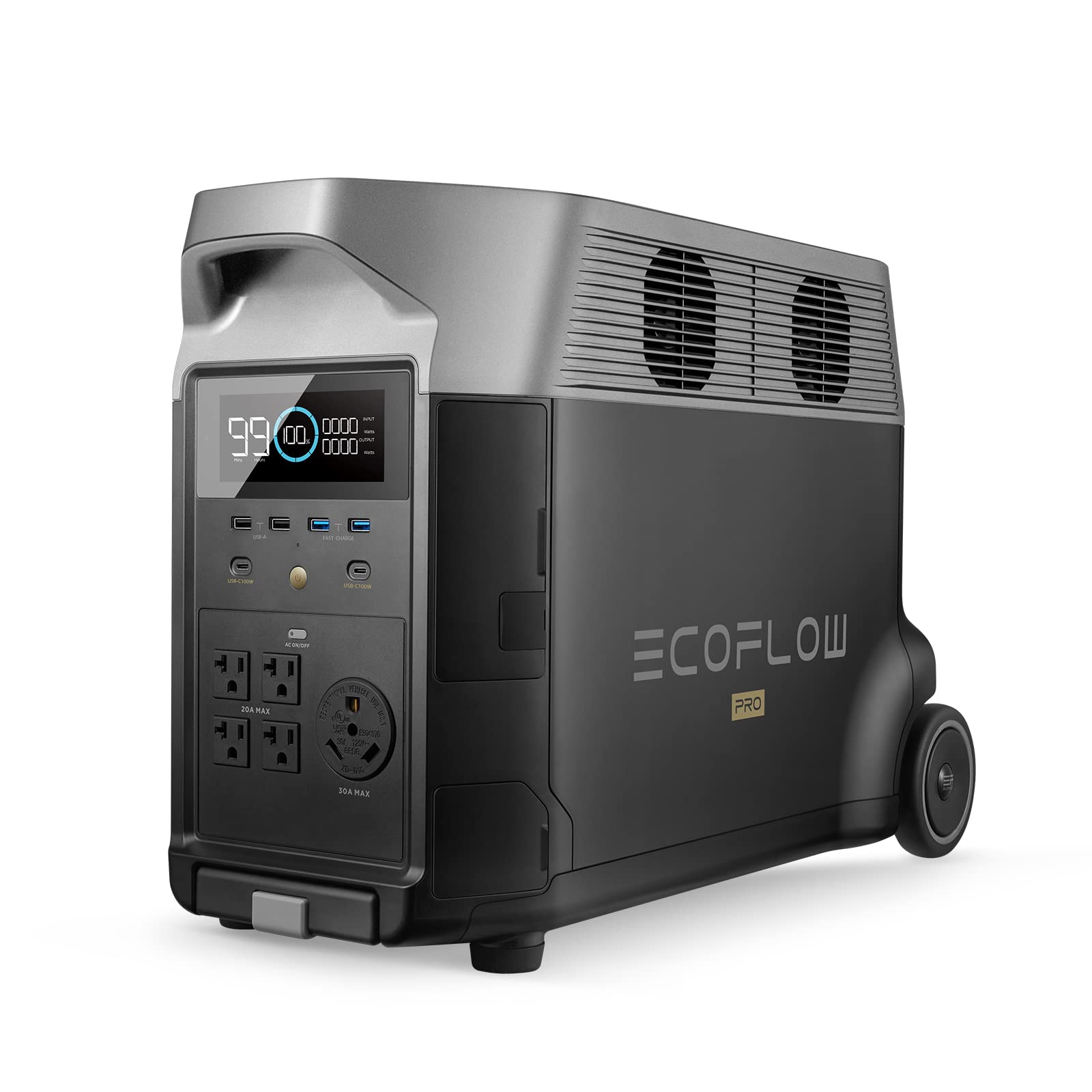
A 3600Wh home battery you can grow all the way to a whole-house grid.
EcoFlow’s DELTA Pro packs a 3600Wh LFP battery with a 3600W AC output that X-Boost lifts to 4500W, and you can pair two units for 7200W. Capacity expands from 3.6kWh up to 25kWh with add-on batteries and Smart Generators, which is what puts it in a whole-home tier. Fifteen output methods — including five AC outlets, two USB-C at 100W, and an Anderson port — mean it feeds an entire workbench or camper at once.
X-Stream charging refills it in 1.8 hours on a 240V feed, 2.7 hours on a standard wall outlet, or via solar in 2.8 hours on four 400W panels. Performance and reliability are the most-cited wins, and mobile vendors run a heat press off it at markets with no voltage sag. It also runs alongside a fridge and lights for a night and still holds charge by morning. The app handles Wi-Fi and Bluetooth monitoring and detailed settings.
The genuine knock is the 99-pound heft — this station lives where you park it, and portability is where it gives ground. A few owners also flag that solar input caps at 15A, so you need the right panel arrangement to make the most of the input. Neither dulls it as a home backup anchor.
Room to grow: start at 3.6kWh and expand toward 25kWh, so it scales with your home over the years.
The weight tax: at 99 pounds it stays put once positioned — plan its spot before delivery.
Right for you if: you want a home-backup foundation you can expand bit by bit instead of replacing down the line.
Not your pick if: you need something you carry in and out of a van each trip.
8. Anker SOLIX F3800 Portable Power Station, 3,840Wh

Dual-voltage muscle that runs a dryer and charges an EV from one box.
Anker’s F3800 is the only pick here with 120V/240V dual-voltage output and 6000W of AC power, which means it can run a clothes dryer, a well pump, or a whole home circuit panel. The 3.84kWh LFP capacity powers a family’s essentials for a day, and it expands to 26.9kWh with add-on packs — or up to 53.8kWh with a second unit and more batteries, enough for about two weeks off-grid. It also charges an EV at 6000W straight through its NEMA 14-50 port, no grounding accessories needed, which no other pick here can do.
Plugging into an RV’s power inlet is a one-cable job via the NEMA 14-50 or L14-30 ports, so popular RV models run all their appliances together. Solar recharges up to 2400W, and AC charging tops it off in under 2 hours in warm weather. Performance and reliability dominate the feedback, with owners running window AC units through cloudy Florida days and charging in around 6 hours of sun.
At 132.3 pounds this is a parked appliance, not a carry, and weight is the honest weak point. A few note that firmware must be updated for simultaneous AC-and-solar charging, and one solar test read lower than the panel label in midday sun — worth knowing before you build a solar plan around it.
A rare dual-voltage pick
- 120V/240V output runs dryers, pumps, and whole circuits
- 6000W AC output charges an EV directly
- Expands from 3.84kWh toward 53.8kWh
- One-cable RV hookup via NEMA 14-50 or L14-30
Factors to weigh
- 132.3 pounds means it stays where you place it
- Firmware update needed for simultaneous AC and solar
- Solar input can read below the panel’s label
Built for: homeowners who want to run 240V appliances and an EV without a permanent solar install.
Look past it if: portability matters — this is a stationary tower, not a rolling unit.
9. BLUETTI Elite 100 V2 Portable Power Station for Camping 1024Wh 1800W
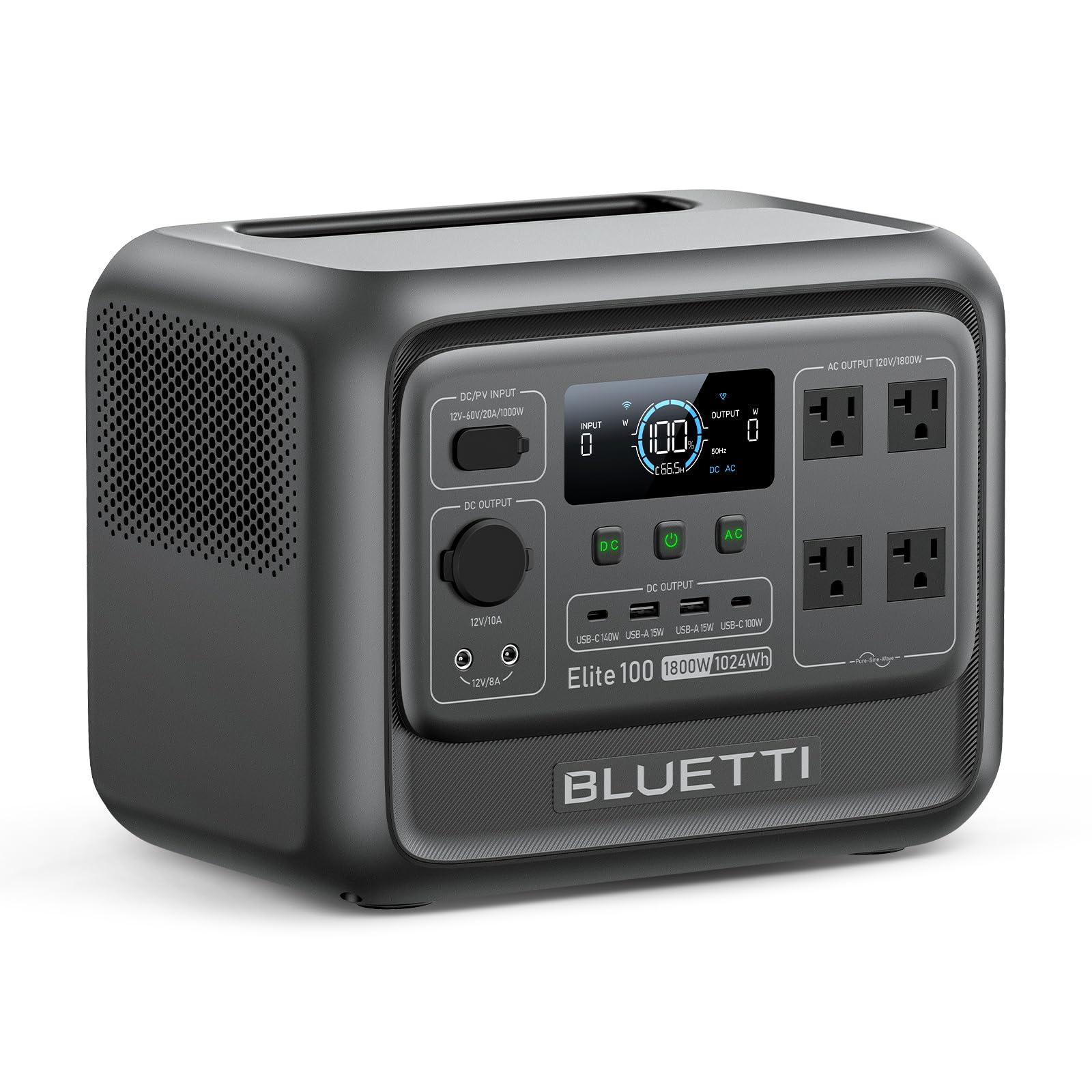
A one-handed 1024Wh grab-and-go that charges to full in about an hour.
At 25 pounds with a hidden handle, this 1024Wh LiFePO4 station is the easiest of the mid-size picks to move one-handed, yet it still puts out 1800W (2700W lifting) and runs up to 90% of everyday appliances. It recharges to full in about 70 minutes via 1200W TurboBoost AC, and solar input reaches 1000W — the fastest solar charging among 1kWh stations here. Power quality is what wins people over, followed by charging speed.
The built-in 10ms UPS keeps routers and PCs alive through a blink, and silent mode drops to 30 dB — about half the noise of typical 1kWh stations. It carries 11 ports for plugging in several devices at once, and reviewers rate it easy to carry, even for seniors, and great for camping trips. The 4000+ cycle LiFePO4 battery is rated for a 10-year lifespan, so it outlasts the lithium-ion packs in this class.
The trade-off is a heavier, pricier build than a pocket pack — this is a small station, not a phone charger, and a few buyers grumble the weight and price for the capacity. It also has less headroom than the 2kWh class, so it is not the one for a full-house outage. As a camping and emergency companion, though, it is hard to fault.
Grab it one-handed: 25 pounds and a hidden handle make it the most carry-friendly full station here.
Where it caps out: a small AC draws it down quickly, so keep it to fridges, laptops, and lights.
Made for: campers, seniors, and travelers who want real outlet power without a two-hand lift.
Not enough if: you need to ride out a multi-day blackout — step up to the 2kWh class.
10. DARAN Portable Power Station, 288Wh LiFePO4 Battery, 350W (600W Peak)
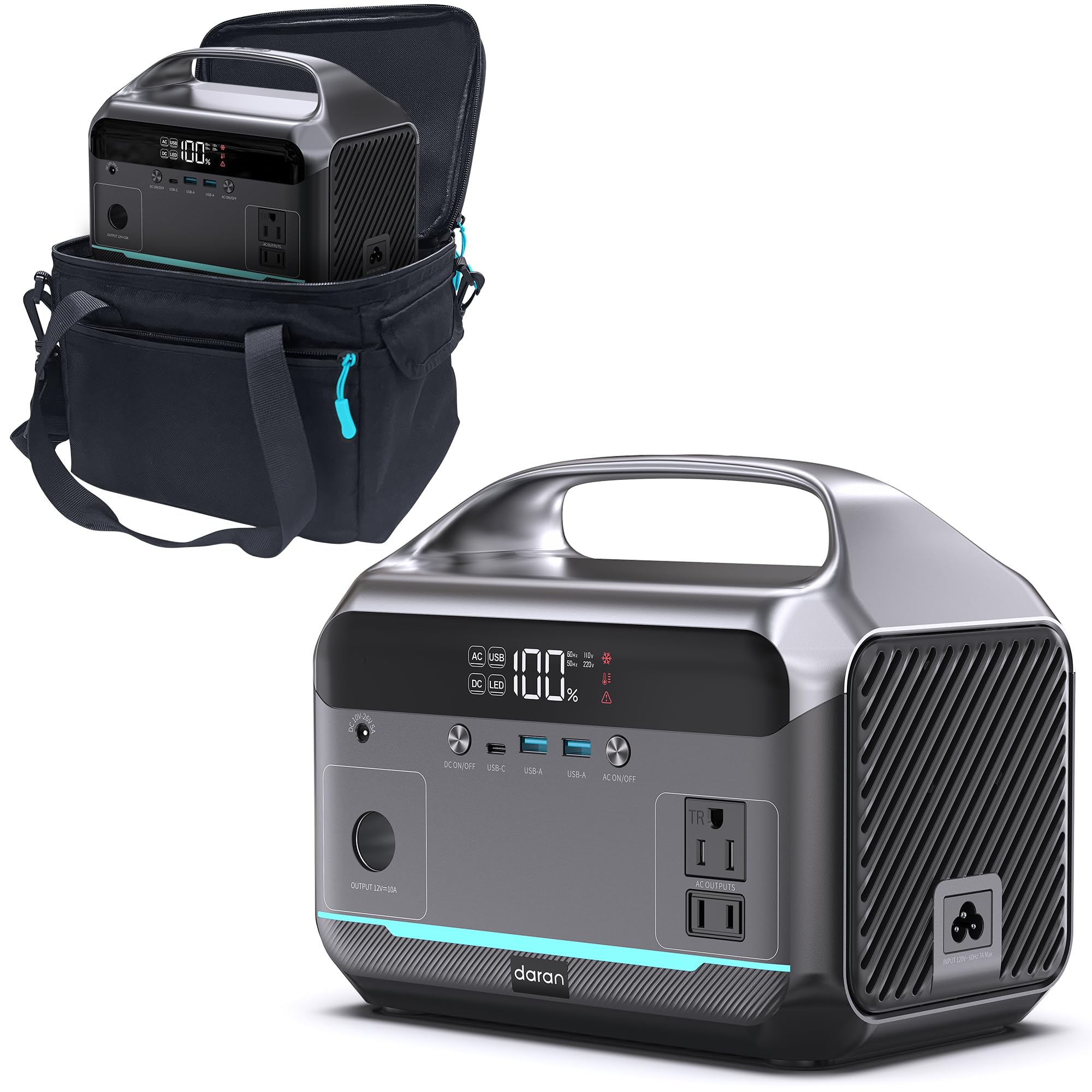
A compact catch-all for laptops, Wi-Fi, and a CPAP when the lights go out.
DARAN’s NEO300L carries a 288Wh LiFePO4 battery with a 350W rated output (600W peak), and its seven-port layout — 2 AC outlets, a 60W PD USB-C, 2 USB-A, and DC — covers phones, tablets, a mini fridge, and a projector at once. It charges from AC, a car 12V port, or solar, and refills in about 2.1 hours. At 8.2 pounds it stows in a backpack or emergency kit and is rated for up to 8.16 hours on a 30W CPAP machine.
Reliability and value are the leading themes in the feedback, and it powers a 12-volt fridge comfortably, with owners calling it easy to carry and simple to run. An LCD shows real-time power, and the rear LED runs steady, strobe, and SOS modes. Port choice stands out too — real 2-prong and 3-prong AC outlets in a small box are rarer than you would think.
Charging speed is the honest caveat: it is fine for a desk or emergency kit, but a fast-charging station will outrun it — so plan overnight top-ups rather than minutes. Its 288Wh size also means a full-size fridge is off the table; it is built for personal devices and small loads, not kitchen appliances.
Pocket-friendly backup: a seven-port 288Wh box at 8.2 pounds is the value pick if you mostly charge gadgets and small devices.
Where it stops: at 350W it cannot run a microwave or a big fridge — this covers lights, laptops, and CPAP use.
Choose it for: apartments, dorms, and weekend camping where a laptop, a fan, and a CPAP matter most.
Choose larger if: you need to run kitchen appliances or ride out multiday outages.
11. MARBERO Portable Power Bank with AC Outlet, 24000mAh, Peak 120W/110V

The bag-sized AC power bank that tops up a laptop away from any wall.
This MARBERO pack crams a 24000mAh lithium-ion battery and a built-in 110V AC outlet into a 2.4-pound, backpack-friendly body, with two USB 3.0 QC ports, two USB 5V ports, a USB-C PD port, and a DC port alongside the AC socket. The AC output runs 80W continuous with a 120W peak, which is enough for a laptop, a camera charger, or a small fan on the move. It also throws in a 3-level LED flashlight with steady, flashing, and SOS modes.
There is real-world proof in the reviews: a 45W laptop, a small fan, and a camera charger ran off the AC outlet at once, covering roughly three phone charges and one laptop charge. It also supports simultaneous USB and AC output, and owners highlight that it powers laptops and DSLR chargers that standard banks cannot. Compact size and portability are the most-praised traits. The recharge from a wall outlet takes about 5 hours, or you can top it up with an optional MARBERO solar panel.
The catch is born of physics: the AC outlet peaks at 120W, so anything wanting more power will not run, and the AC side auto-shuts off when idle to save battery. Battery life draws mixed notes — one laptop charge and a few phone fills is the realistic ceiling. If you need to run appliances rather than devices, this is not the pack. For laptop-grade portability, it is.
Travel-sized laptop power
- 24000mAh in a 2.4-pound backpack-friendly body
- Built-in 110V AC outlet runs laptops and camera chargers
- Eight ports-in-one layout covering USB, USB-C, and DC
- 3-level LED flashlight with SOS mode
Where it maxes out
- 120W AC peak rules out anything hungry
- AC outlet auto-shuts off when idle
- Battery life covers one laptop or a few phone fills
Perfect for: students, remote workers, and travelers who need one laptop charge and a phone top-up away from a wall.
Wrong pick if: you plan to run appliances — that calls for a larger station.
Understanding the Specs
Watt-hours vs watts
Watt-hours (Wh) is the fuel tank — how much energy is stored. Watts (W) is the flow rate — how much power can move at once.
A pack with more Wh runs longer, while a pack with higher W runs bigger appliances. A 2,048Wh unit and a 288Wh unit can both have outlets, but only the large one runs a fridge. Read both numbers together.
Why LiFePO4 matters
LiFePO4 is a lithium chemistry built for long life and heat tolerance. It is rated for thousands of charge cycles to 80% capacity, so a LiFePO4 pack outlasts a standard lithium-ion one that ages faster under repeated charging.
Standard lithium-ion packs cost less but age faster under repeated charging. If you plan to use the pack for years, LiFePO4 is the safer bet.
Rated vs peak watts
Rated watts is the steady power a unit delivers. Peak watts covers the split-second surge when a motor or compressor kicks on — that is why running numbers and surge numbers differ.
Never load a station past its rated watts for steady use, or it will cut out. Let the peak handle startup spikes, then let the load settle back to rated.
How many AC outlets you need
Match the outlet count to what you keep switched on during an outage. Fewer outlets means unplugging and replugging, which gets old during a long blackout.
FAQ
Will a battery pack with an outlet run my refrigerator during a blackout?
Is 288Wh enough to power a CPAP machine overnight?
Can a portable power station run a space heater?
How long does a LiFePO4 battery pack last?
Can I charge a power station and use its AC outlet at the same time?
What is the difference between rated watts and peak watts on these packs?
Can I take a battery pack with an outlet on a plane?
Will a portable power station charge my electric vehicle?
How fast can I recharge a large power station from a wall outlet?
Do I need solar panels to use a battery pack with an outlet?
Final Thoughts: The Verdict
For most households, the winner among these battery pack with outlet options is the EF ECOFLOW DELTA 3 Max, because its 2048Wh LFP bank recharges to 80% in 1.13 hours and its 3400W X-Boost handles the heavy appliances that define a real outage. If quiet matters most for RV or bedroom use, the DJI Power 2000 runs as low as 30 dB. And for 240V appliances and EV charging from one parked tower, the Anker SOLIX F3800 is the one to reach for.
Buy the capacity and wattage that match your worst-case weekend, not your best-case one — a station that hugs a fridge overnight earns its keep, while one that only charges phones will leave you unplugging the freezer. Match the output to your biggest appliance first, then let budget decide the rest.
How We Picked
We do not accept paid placement. Every pick is matched to a real buyer and a real use-case; we do not hands-on test units.
Sources & Methodology
Specifications: manufacturer listings and product documentation. Review insights: verified customer reviews, as of September 2026. Pricing: not shown on this page (it changes often); check the current price via the retailer link.
As an Amazon Associate, Gadgets Feed earns from qualifying purchases. This does not affect which products we feature.