
A battery power station bridges that gap, delivering silent, fume-free electricity that runs your mini-fridge, CPAP machine, or power tools without the noise and maintenance of a gas generator.
I’m Min — the co-founder and writer behind Gadgets Feed. I’ve spent countless hours cross-referencing inverter types, battery chemistries, and real-world discharge rates from thousands of verified buyer reports to separate the stations that actually hold their capacity from those that don’t.
Whether you’re preparing for blackout season or building an off-grid rig, this guide breaks down the top contenders for the best battery power station at every capacity tier, with hard specs that matter when the lights go out.
How To Choose The Best Battery Power Station
Choosing a power station comes down to three core decisions: capacity vs. weight, inverter power vs. your biggest appliance, and battery chemistry vs. long-term cost. The right balance depends on whether you need a weekend camp companion or a whole-home emergency backup.
Capacity (Wh) and Battery Chemistry
Watt-hours tell you how long your gear runs, but the type of cell determines how many years the station will hold that capacity. LiFePO₄ (lithium iron phosphate) batteries deliver 3,000 to 4,000+ full cycles before dropping to 80% capacity, compared to roughly 500 cycles from standard lithium-ion packs. For a station used daily or stored for emergencies, LiFePO₄ is the only chemistry worth considering.
Inverter Type and Continuous vs. Surge Watts
Pure sine wave inverters are non-negotiable for powering sensitive electronics — they replicate the clean AC waveform from your wall outlet. The continuous wattage rating tells you what the station can sustain, while the surge (peak) rating handles the momentary startup draw of motors in fridges, pumps, and power tools. A station with 2,000W continuous and 4,000W surge covers most household appliances and small power tools.
Recharge Speed and Solar Input
Fast AC charging turns a station from dead to full in around one hour — critical when you have a short window before a storm hits. Solar input matters for off-grid use: higher maximum solar wattage with MPPT (Maximum Power Point Tracking) means faster charging even under partial sun. Look for at least 200W to 500W solar input if you plan to run the station without grid power.
Quick Comparison
On smaller screens, swipe sideways to see the full table.
| Model | Category | Best For | Key Spec | Amazon |
|---|---|---|---|---|
| Segway Cube 2000 | Premium | Expandable home backup | 2048Wh, 2200W, expandable to 5kWh | Amazon |
| DABBSSON 2000L | Premium | Ultra-fast 1hr recharge | 2048Wh, 2200W cont, 3300W surge | Amazon |
| EcoFlow DELTA 3 Max | Premium | High-wattage power tools & appliances | 2048Wh, 3400W X-Boost | Amazon |
| Jackery Explorer 2000 v2 | Premium | Lightweight 2kWh for travel | 2042Wh, 2200W, 39.5 lbs | Amazon |
| Anker SOLIX C2000 Gen 2 | Mid-Range | Expandable capacity & low standby | 2048Wh, 2400W, 9W standby | Amazon |
| AFERIY P210 | Mid-Range | Quiet operation & 7yr warranty | 2048Wh, 2400W, <30dB noise | Amazon |
| BLUETTI Elite 100 V2 | Mid-Range | Ultra-compact 1kWh daily use | 1024Wh, 1800W, 30dB quiet | Amazon |
| GRECELL EB1000 | Budget | Entry-level camping & backup | 999Wh, 1000W, 17.8 lbs | Amazon |
| BLUETTI AC70 | Budget | Fast charging 768Wh portable | 768Wh, 1000W, 45min to 80% | Amazon |
In‑Depth Reviews
1. Segway Portable Power Station Cube 2000
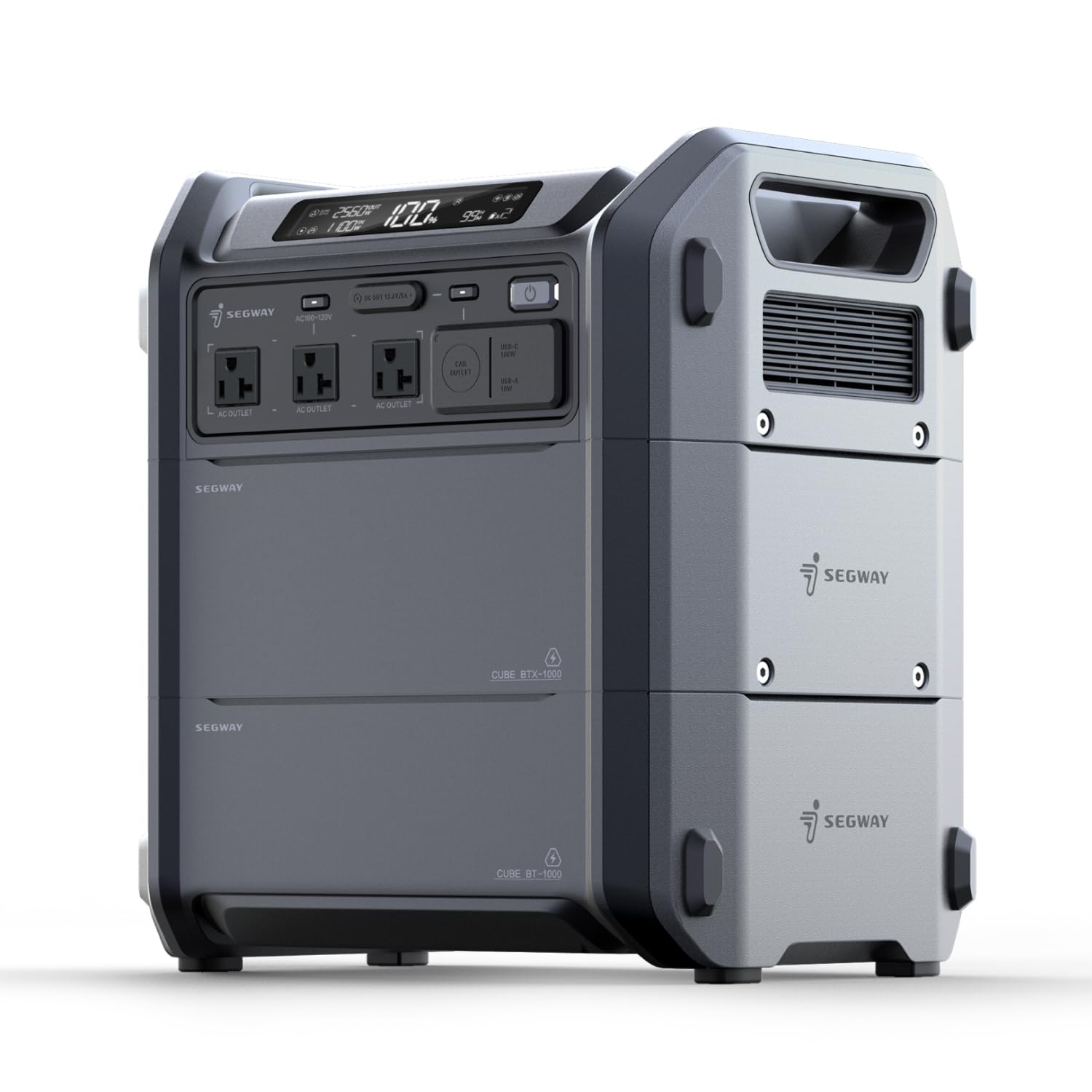
The Segway Cube 2000 delivers 2048Wh of LiFePO₄ capacity paired with a 2200W pure sine wave inverter that surges to 4400W through its R-drive function — enough to start a refrigerator compressor and a microwave simultaneously. What sets it apart is the modular expansion: you can stack up to three BTX-1000 batteries for a total of 5kWh without messy cables, turning a single station into a scalable home backup system.
Recharge speed is equally impressive: AC input fills the internal 2048Wh pack in about 1.8 hours, and the MPPT solar controller achieves up to 97% conversion efficiency for faster off-grid top-ups. The IP56 rating means it handles dust and water splashes on a campsite or in a garage, while the 4000+ cycle life on the LiFePO₄ cells gives it roughly a 10-year usable lifespan under daily use.
Real-world feedback from buyers confirms it runs a full-size refrigerator for over 11 hours and powers a pitching machine for an hour with 80% charge remaining. The app-based interface is required for initial activation, which some users found mildly inconvenient, but the five-year warranty provides peace of mind that justifies the premium positioning.
Why it’s great
- Expandable to 5kWh capacity without messy wiring.
- IP56 dust and water resistance for outdoor use.
- 97% MPPT solar conversion efficiency.
Good to know
- App required for initial activation.
- Heavy at 58 lbs.
2. DABBSSON Portable Power Station 2000L
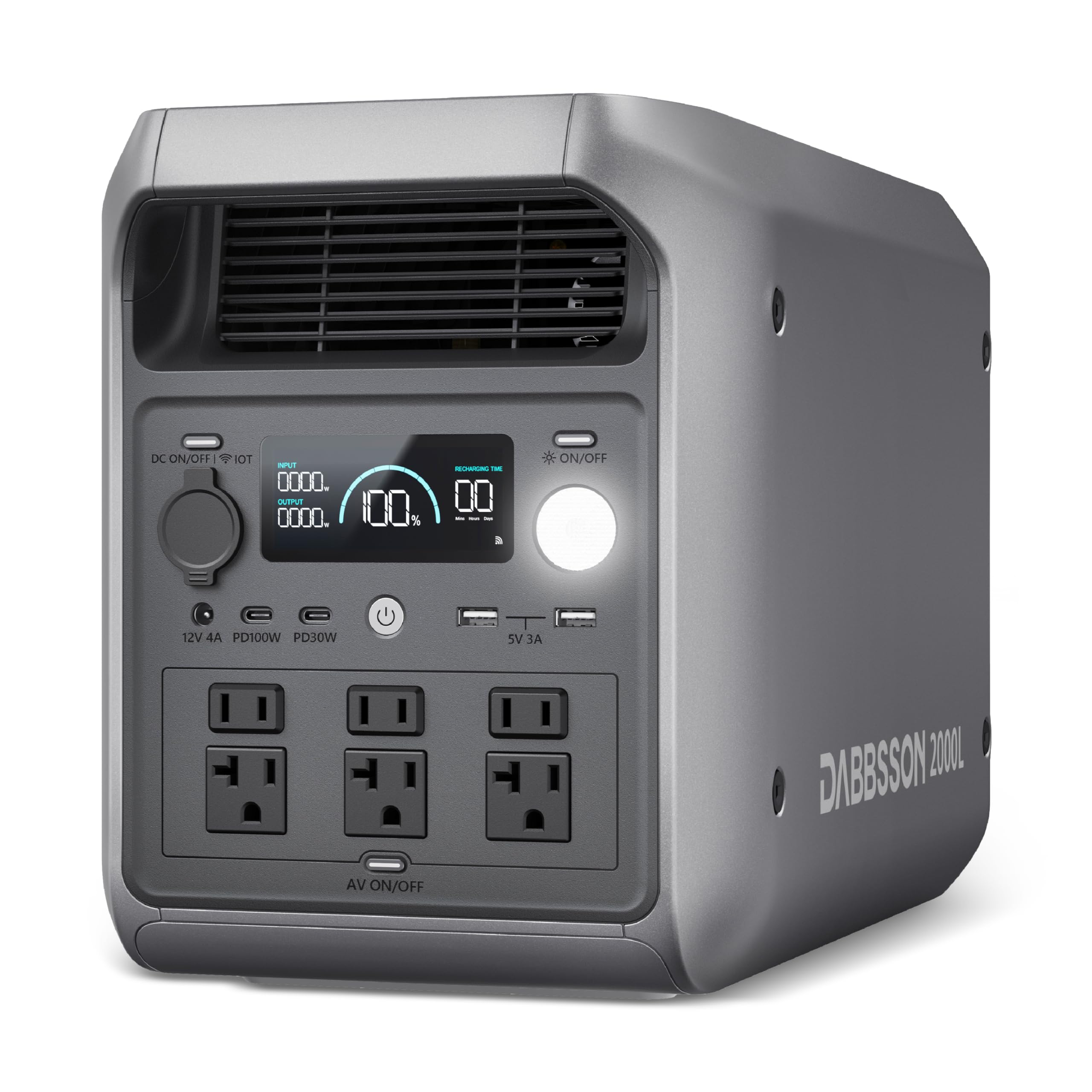
The DABBSSON 2000L uses advanced semi-solid LiFePO₄ cells rated for 4000+ cycles to 80% capacity, delivering 1.3× longer runtime per cycle than standard 2048Wh stations. At 41 pounds, it shaves off roughly 17 pounds compared to similarly rated 2kWh units, making it one of the lightest high-capacity options for RV travel or home storage.
AC recharge hits full in just one hour — class-leading speed for a 2kWh pack — and the 800W MPPT solar input provides flexible off-grid charging. The six AC outlets with a 3300W Power Boost handle heavy start-up loads from refrigerators and power tools, and the less-than-10ms EPS switchover protects connected computers and network equipment from data loss during outages.
Customer reports confirm it powers a Keurig, air fryer, and microwave along with two fridges and two freezers for over seven hours. The UL94-V0 flame-retardant housing adds a serious safety layer for indoor use. A small subset of users reported software issues preventing full charge/discharge, and Dabbsson support was slow to respond with firmware patches — a factor to weigh if you prioritize seamless software experience over raw hardware.
Why it’s great
- 1-hour full recharge time for 2048Wh pack.
- 41-pound weight is among the lightest in class.
- UL94-V0 flame-retardant housing for indoor safety.
Good to know
- Firmware support from manufacturer can be slow.
- No wireless charging pad built in.
3. EF ECOFLOW DELTA 3 Max
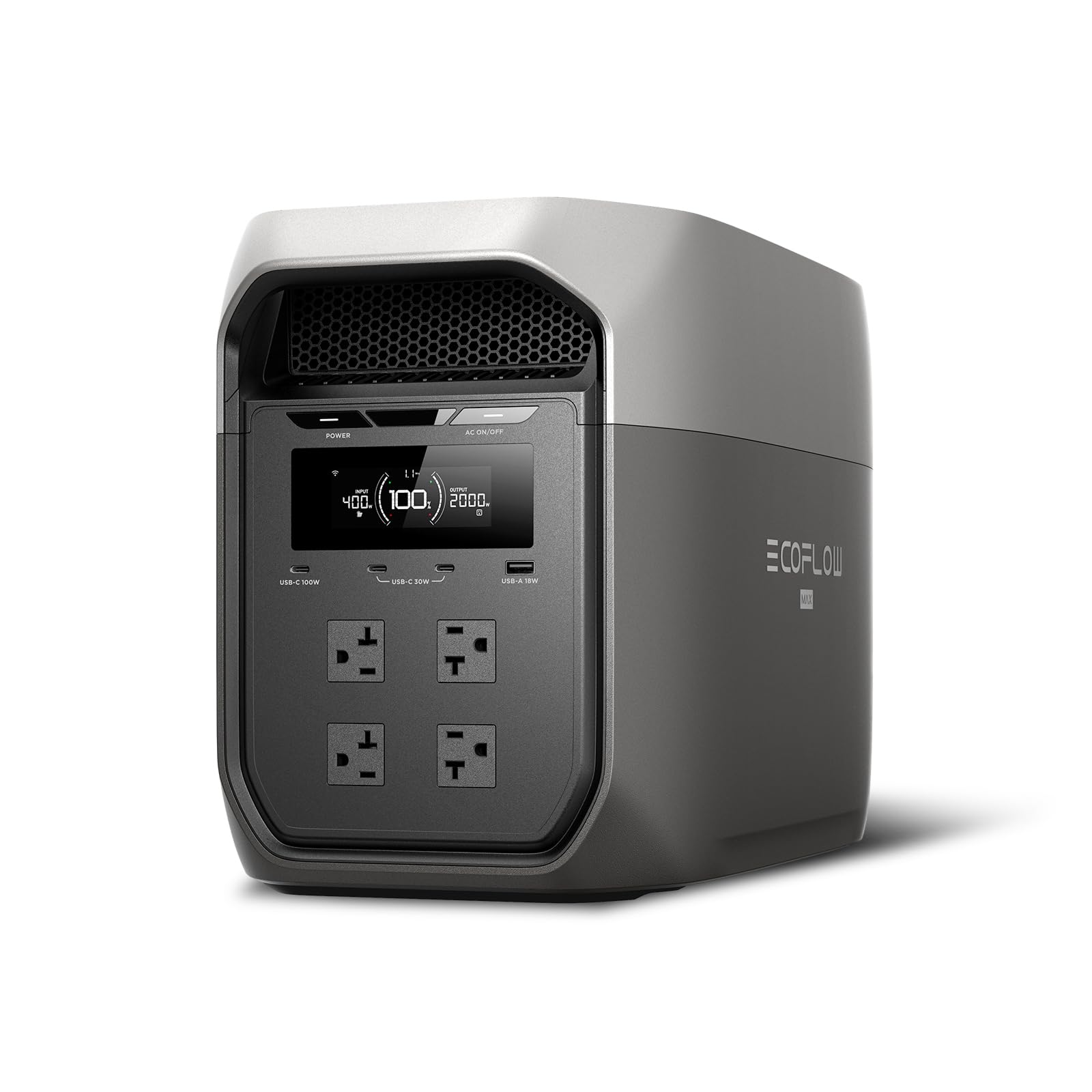
The EcoFlow DELTA 3 Max pairs a 2048Wh LiFePO₄ battery with a 3400W X-Boost inverter, meaning it can start and sustain high-draw appliances like microwaves, space heaters, and circular saws that would overload a typical 2400W station. The 10ms UPS transfer time is fast enough to keep a desktop PC and networking gear online through a blip without reboot.
X-Stream technology recharges from 0 to 80% in just 1.13 hours, and the dual-handle design at roughly 50 lbs makes it manageable for one person to haul from the garage to a campsite. The EcoFlow app provides granular control over charge/discharge schedules and real-time consumption monitoring — filmmakers and remote workers have praised its reliability for powering camera rigs and satellite internet terminals in the field.
Buyer feedback notes that the fan noise stays subdued below a 1700W load but ramps up noticeably during heavy AC charging. A few delivery complaints surfaced from carriers leaving expensive packages without a signature, so plan for a secure delivery location. Overall, the combination of X-Boost headroom and fast recharge makes this the strongest pick for users who need to power both sensitive electronics and motor-driven appliances.
Why it’s great
- 3400W X-Boost handles nearly any household appliance.
- 0-80% recharge in 1.13 hours with X-Stream.
- Granular app control for scheduling and monitoring.
Good to know
- Fan becomes audible under loads above 1700W.
- Buttons can be difficult to read in dim light.
4. Jackery Explorer 2000 v2

Jackery’s Explorer 2000 v2 uses Cell-to-Body (CTB) architecture borrowed from EV battery packs to pack 2042Wh into a 39.5-pound frame that is 41% lighter and 34% smaller than typical 2kWh stations. The 2200W pure sine wave inverter feeds three AC outlets, a USB-C PD 100W port, and a barrel-port DC section, and the 20ms UPS switchover is UL1778 certified for reliable emergency backup.
AC fast charging fills from 0 to 80% in 66 minutes, and a Silent Charging mode tops off in about five hours at under 30dB — quiet enough to sit in a bedroom without waking anyone. Solar input supports up to 400W via two parallel barrel connectors, though customers have noted the solar ports feel flimsy on the frame when plugging panels in.
Real-world tests from owners show it powers a full-size fridge for over 21 hours on a single charge, and the Bluetooth/WiFi app provides accurate battery level and runtime projections. The main trade-off for the weight savings is that the 2042Wh capacity is slightly lower than competing 2048Wh models, but for users who need to move their station between a car, an RV, and a home, the reduced size is a meaningful advantage.
Why it’s great
- 39.5 lbs — lightest 2kWh station with CTB tech.
- Silent Charging mode at under 30dB.
- UL1778 certified UPS for home backup.
Good to know
- Solar input barrel ports feel fragile.
- Bluetooth connection can be inconsistent.
5. Anker SOLIX C2000 Gen 2

The Anker SOLIX C2000 Gen 2 runs on a 2048Wh LiFePO₄ battery with a 2400W inverter that peaks at 4000W, and it adds an expansion battery port to double capacity to 4kWh — enough to sustain a dual-door fridge for up to 64 hours. Standby power draw is just 9W, which is exceptionally low for this class and matters when you leave the station plugged in for weeks between emergencies.
Recharge time is class-leading at 58 minutes for a full charge via AC, and the 800W alternator charging option fills the pack in roughly three hours while driving — 8× faster than a standard 12V car port. At 41.7 pounds with a compact footprint, it’s one of the more portable 2kWh stations, and the companion app gives clear usage predictions and remote control over outlets.
Buyer reviews consistently emphasize the reliability of the battery management system and the fast recharge cadence. Some users wished for a physical on-device manual instead of requiring the app for full setup, but the app interface itself is intuitive. For anyone planning to expand capacity over time, the C2000 Gen 2 offers the most straightforward path from a 2kWh starter to a 4kWh home backup system.
Why it’s great
- Expandable to 4kWh with add-on battery.
- 9W standby power — best in class.
- 58-minute full recharge via AC.
Good to know
- App needed for full setup — no printed manual.
- Slightly heavier than the DABBSSON at same capacity.
6. AFERIY 2048Wh Portable Power Station P210

The AFERIY P210 packs a 2048Wh LiFePO₄ battery and a 2400W pure sine wave inverter (4800W surge) into a 54-pound chassis that runs at less than 30dB under normal loads — practically silent for overnight use in a bedroom or RV. The 16-port panel includes six AC outlets, two USB-C ports (one at 100W PD), a 12V/25A XT60 DC output for high-current devices like car fridges, and standard DC barrel ports.
AC fast charging fills the pack in roughly two hours, and the less-than-10ms UPS response ensures connected equipment never blinks during a grid transition. The AFERIY app provides remote monitoring and automation settings, and the 7-year extended warranty (longer than the standard 5-year coverage from most competitors) reflects confidence in the build quality.
Customers in food trucks and off-grid worksites have praised the P210 for powering full commercial setups without faltering. A small number of users reported that the display screen can behave erratically after solar charging, requiring a reset, and that the app lacks a schedule-charging feature that would be useful for a 2048Wh battery. Those caveats aside, the combination of low noise, high surge capacity, and exceptional warranty length makes this a strong mid-range contender.
Why it’s great
- 16-port panel includes a 25A XT60 DC output.
- 7-year warranty — longer than most competitors.
- Under 30dB at normal load for quiet overnight use.
Good to know
- Display can glitch after solar charging.
- No schedule-charging mode in the app.
7. BLUETTI Elite 100 V2
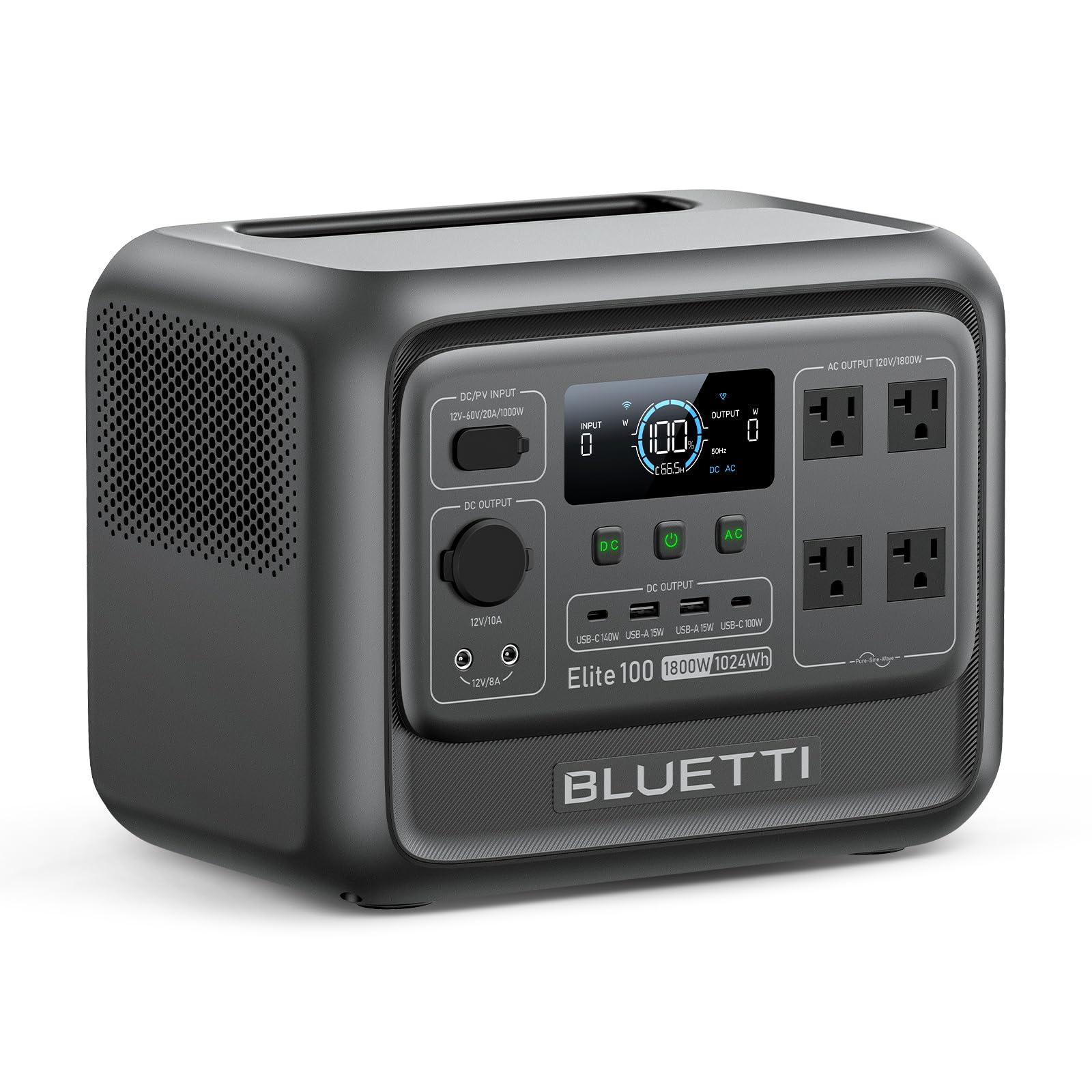
The BLUETTI Elite 100 V2 is 35% smaller and 30% lighter than its predecessor at just 25 pounds, yet delivers a full 1024Wh from its LiFePO₄ battery with a 1800W inverter that handles 90% of everyday household appliances. The 1200W TurboBoost AC input and up to 1000W solar input combine to recharge the station in roughly 70 minutes — unusually fast for a 1kWh-class station.
Four AC outlets, a 100W USB-C PD port, and a 12V car port give it enough versatility for a weekend camping trip or as a CPAP backup at home. The 10ms UPS switchover keeps Wi-Fi routers and desktop PCs running through a power flicker, and the silent mode operates at just 30dB — 50% quieter than other 1kWh stations.
Buyers who upgraded from smaller BLUETTI units like the EB3A report the Elite 100 V2 handles mini-fridges, guitar amps, and basic power tools without noise interference. The lack of a built-in LED light and wireless charging pad are minor omissions for this price tier, but the compact footprint, fast recharge, and over 4,000 cycle life make it a versatile pick for daily use and emergency readiness.
Why it’s great
- 25 lbs and 35% smaller — ultra-portable for 1kWh.
- 70-minute full recharge with 1200W AC input.
- 30dB silent mode for indoor or overnight use.
Good to know
- No built-in LED light or wireless charger.
- App control requires Bluetooth/WiFi to be active.
8. GRECELL EB1000
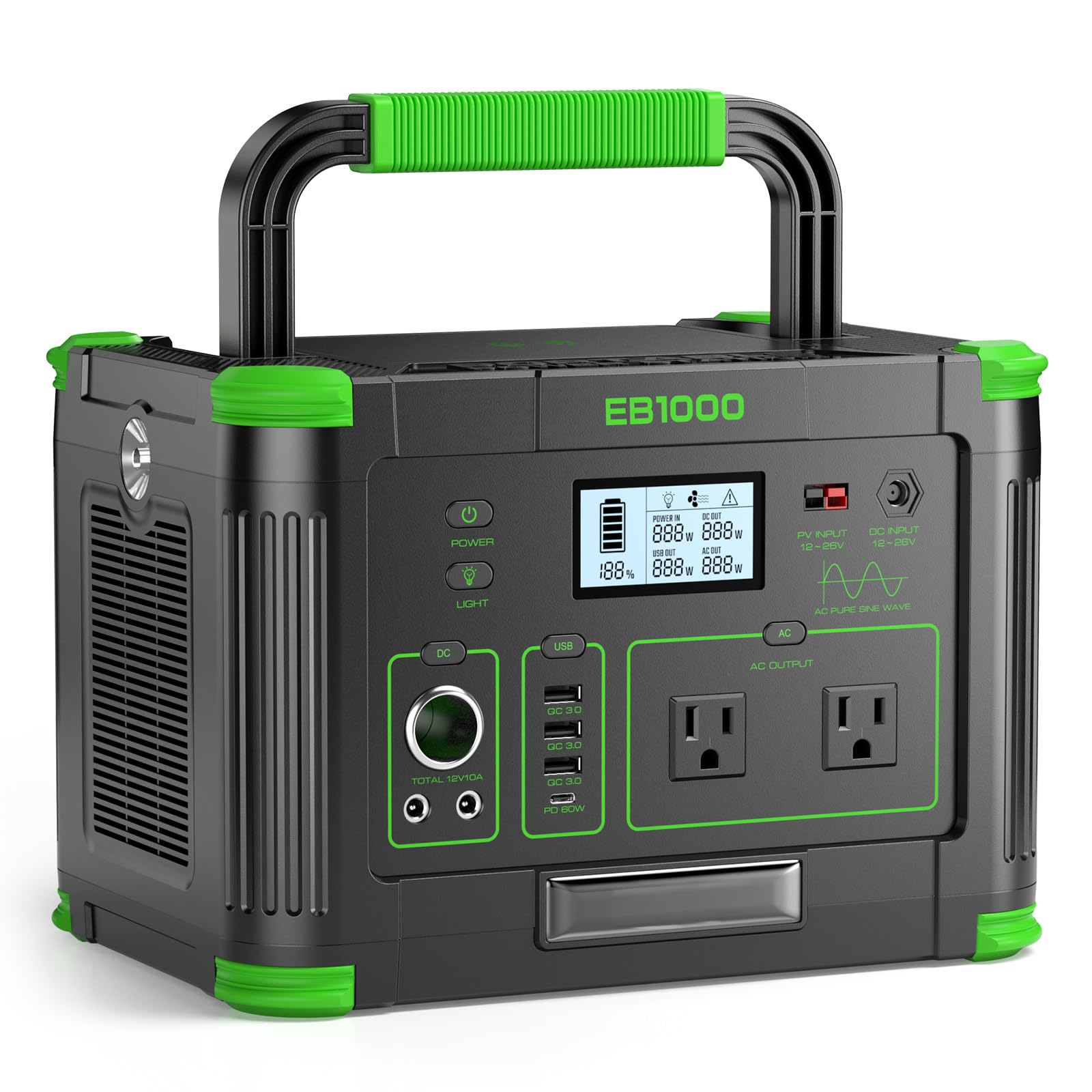
The GRECELL EB1000 packs 999Wh of capacity and a 1000W pure sine wave inverter (2000W surge) into a 17.8-pound frame — light enough to pack into a Scout camping trip or store under a desk for emergencies. The port selection is generous for the price: two AC outlets, a 60W USB-C PD port, three USB-A QC 3.0 ports, a wireless charging pad on top, a 12V car port, and two DC barrel outputs.
MPPT solar charging with the included 7909 solar cable extracts maximum power from solar panels, and the upgraded BMS provides automatic shutoff at full charge plus dual cooling fans to prevent overheating. The integrated LED light with SOS mode adds practical value for campsites or blackouts.
Customer reports confirm the EB1000 handles a 200W mini rice cooker for a full cook cycle while dropping to 50-56% battery, and powers a mini gaming PC for 4-5 hours. Some users found that the battery gauge needed a full drain and recharge cycle to calibrate properly, and the wireless charging pad may not align well with phones that have thick camera bumps. For the price, this is a reliable entry point into portable battery backup without sacrificing pure sine wave quality.
Why it’s great
- 17.8 lbs — extremely portable for 1kWh class.
- Includes wireless charging pad and LED SOS light.
- 60W USB-C PD for fast laptop charging.
Good to know
- Battery gauge may need calibration cycle.
- Wireless charging struggles with thick phone cases.
9. BLUETTI AC70

The BLUETTI AC70 delivers 768Wh of LiFePO₄ capacity and a 1000W inverter (2000W Power Lifting surge) with a recharge speed that stands out: 0 to 80% in just 45 minutes and full in 1.5 hours via the single-cable 950W AC input. That makes it one of the fastest-refueling stations in the sub-1kWh bracket, ideal for those who need quick turnarounds between power outages or day trips.
The port panel includes two AC outlets, a 100W USB-C PD port, two USB-A ports, and a 12V car outlet, plus an XT-60 solar input that accepts up to 500W of solar panels — enough to recharge the pack in 1.9 to 2.4 hours in good sun. The BLUETTI app adds remote monitoring and charge/discharge scheduling, and the 3000+ cycle life on the LiFePO₄ cells supports years of regular use.
Customers have successfully run a 100W guitar amp setup for over eight hours with the AC70, and the UPS mode (≤20ms switchover) kept desktop PCs and networking gear online during grid blips. The fan can become audible under sustained high load, but at sub-1000W draw it remains quiet. For anyone stepping up from a small 300Wh portable battery, the AC70 offers a meaningful capacity jump paired with an unusually fast recharge cycle.
Why it’s great
- 0-80% in 45 minutes — fastest in its size class.
- 100W USB-C PD for fast laptop charging.
- Robust XT-60 solar input over fragile barrel connectors.
Good to know
- Fan noise becomes noticeable under high load.
- 768Wh may not run a full-size fridge for long.
FAQ
Can a battery power station run a full-size refrigerator?
How long do LiFePO₄ batteries in a power station last?
What is the difference between MPPT and PWM solar charging?
Can I use a power station as an uninterruptible power supply (UPS) for my computer?
Final Thoughts: The Verdict
For most users, the best battery power station winner is the Segway Cube 2000 because it combines a 2048Wh LiFePO₄ core, 2200W continuous output, modular expandability to 5kWh, and IP56 weather resistance into a unified system that scales from weekend camping to serious home backup. If you want the fastest recharge in its class and a sub-42-pound frame for frequent travel, grab the DABBSSON 2000L. And for high-wattage appliance — power tools, space heaters, and full kitchen loads — nothing beats the EcoFlow DELTA 3 Max and its 3400W X-Boost inverter.