
That moment when the tent zipper goes quiet at 3 AM, but the heat and humidity inside have turned your sleeping bag into a sauna. The glow of a phone screen showing a 90°F forecast for the next three days is the real nightmare. A portable air conditioning unit that runs on a battery isn’t a luxury anymore—it’s the difference between a memorable trip and a miserable one.
I’m Min — the co-founder and writer behind Gadgets Feed. I’ve spent countless hours researching and comparing the specific specifications, real-world battery demands, and BTU output of dozens of camping AC units to separate the truly portable from the power-hungry disappointments.
From rooftop units designed for dry camping to compact spot coolers for small tents, this guide analyzes the performance metrics that actually matter when you’re miles from a shore power hookup. This is the definitive resource for choosing the best battery powered ac for camping.
How To Choose The Best Battery Powered AC For Camping
Choosing the right camping air conditioner for off-grid use means ignoring the marketing hype around BTU ratings alone. You must match the unit’s electrical draw (both running watts and starting surge) to your battery bank’s capacity and your inverter’s capability. The real measuring stick is not how cool it gets, but how long it can stay that cool on your specific power source.
Understand Your Power Architecture: 12V DC vs. 110V AC
The most efficient path for battery power is a unit that accepts 12V DC or 48V DC directly, bypassing the inverter. A 12V rooftop unit like the Outequip draws high amperage (up to 55 amps) but avoids the 10-15% conversion loss of a DC-to-AC inverter. Conversely, a 110V AC unit is compatible with any standard household-style power station but will consume more total watt-hours from your battery due to inverter inefficiency. The Cybertake S2 Pro offers a hybrid approach with direct 48V DC input, which is incredibly efficient with modern LiFePO4 power stations.
Calculate Your Realistic Runtime
You cannot trust “6 hours of cooling” claims from a single figure. That runtime depends on your battery capacity and the unit’s average load. A unit drawing 400 watts (like the OUTOHOME 5200BTU) will run for roughly 10 hours on a 4,000Wh battery. However, a unit with a higher starting current (75+ amps) may require a power station with a large surge capacity, even if its running wattage is moderate. Always compare the running wattage per BTU—a lower watts-per-BTU ratio means better efficiency.
Evaluate Portability and Form Factor
Do you need a rooftop unit for an RV, or a portable unit you can move between a tent and a truck cab? Rooftop units (Outequip 10K BTU) are permanent installations that free up floor space. Portable split-system units (UAHKPA 9000 BTU) separate the condenser from the evaporator, allowing you to place the noisy compressor outside. All-in-one portable units (BougeRV PC35) are self-contained but require a dedicated exhaust hose and airflow clearance. Weight is a major factor—a 45-pound rooftop is much easier to live with than a 34-pound portable that you need to move and vent each time.
Quick Comparison
On smaller screens, swipe sideways to see the full table.
| Model | Category | Best For | Key Spec | Amazon |
|---|---|---|---|---|
| Cybertake S2 Pro | Premium Portable | Versatile off-grid cooling | 5100 BTU, 48V DC input, 8hrs/kWh | Amazon |
| Outequip 12V 10000 BTU | Premium Rooftop | Class B/C RV permanent install | 10000 BTU, 12V DC, 55A draw | Amazon |
| BAYKUL 6800/7500 BTU | Mid-Range Portable | 400 sq ft spot cooling | 6800 BTU, 550W consumption | Amazon |
| OUTOHOME 5200BTU | Mid-Range Portable | Efficient small tent cooling | 5200 BTU, <400W power draw | Amazon |
| OUTOHOME 5100 BTU | Value All-In-One | 200 sq ft room or tent | 5100 BTU, 46 dB sleep mode | Amazon |
| BougeRV PC35 | Entry-Level Portable | Small RV or truck hotspot | 3500 BTU, App control | Amazon |
| UAHKPA 9000BTU Split | Specialty Split-System | Large van or truck cabin | 9000 BTU, 12V DC, 800W | Amazon |
In‑Depth Reviews
1. Cybertake S2 Pro Portable Camping Air Conditioner
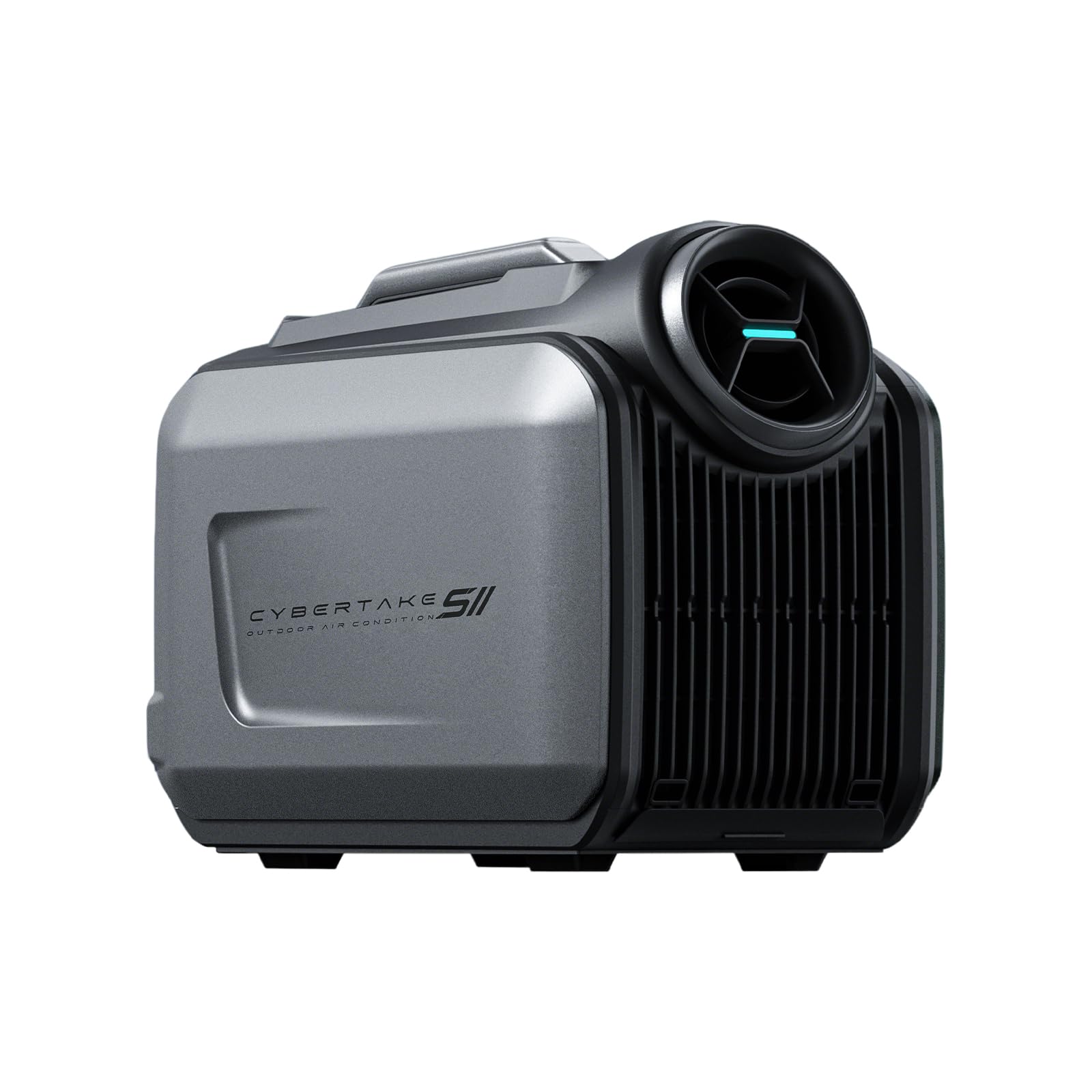
The Cybertake S2 Pro redefines what a portable camping AC can be by offering a true three-way power input: 100-240V wall, 12V/24V vehicle, and critically, 48V DC. This 48V DC option means you can connect it directly to a common LiFePO4 battery bank without an inverter, achieving an incredible 8 hours of runtime on just 1kWh of energy in Eco+ mode. The dual-duct system ensures the hot exhaust is expelled outside the tent while the cool air is circulated internally, and the IPX4 water-resistant shell means it can be safely placed outside the tent entrance without worry.
Cooling output reaches 5100 BTU, which is sufficient for spaces up to 130 square feet, and the heat pump provides 6100 BTU of heating, making this a four-season unit. The compressor uses rotary scroll technology, running at a whisper-quiet 40dB, which is quieter than a dishwasher. Build quality is rugged with silicone buttons that won’t fail after a few trips, and the included Bluetooth app control allows you to change settings without leaving your sleeping bag.
Real-world feedback from campers confirms the unit performs exceptionally well, with one user noting it cooled a freezing tent to cozy in just 15 minutes using heat mode. Another user praised the low battery consumption and very quiet operation, making it ideal for light sleepers. The primary complaint involves unclear instructions and the need for a separate boost converter for 12V vehicle operation, which the product page mentions but could be clearer. Still, for efficiency and versatility, this is the king of the hill.
Why it’s great
- Runs on 48V DC directly for best efficiency
- 8-hour runtime on a 1kWh battery in Eco+
- Heating and cooling in one unit
Good to know
- Instructions are unclear
- 12V vehicle operation requires a separate booster
2. Outequip RV Air Conditioner, 12V 10000 BTU
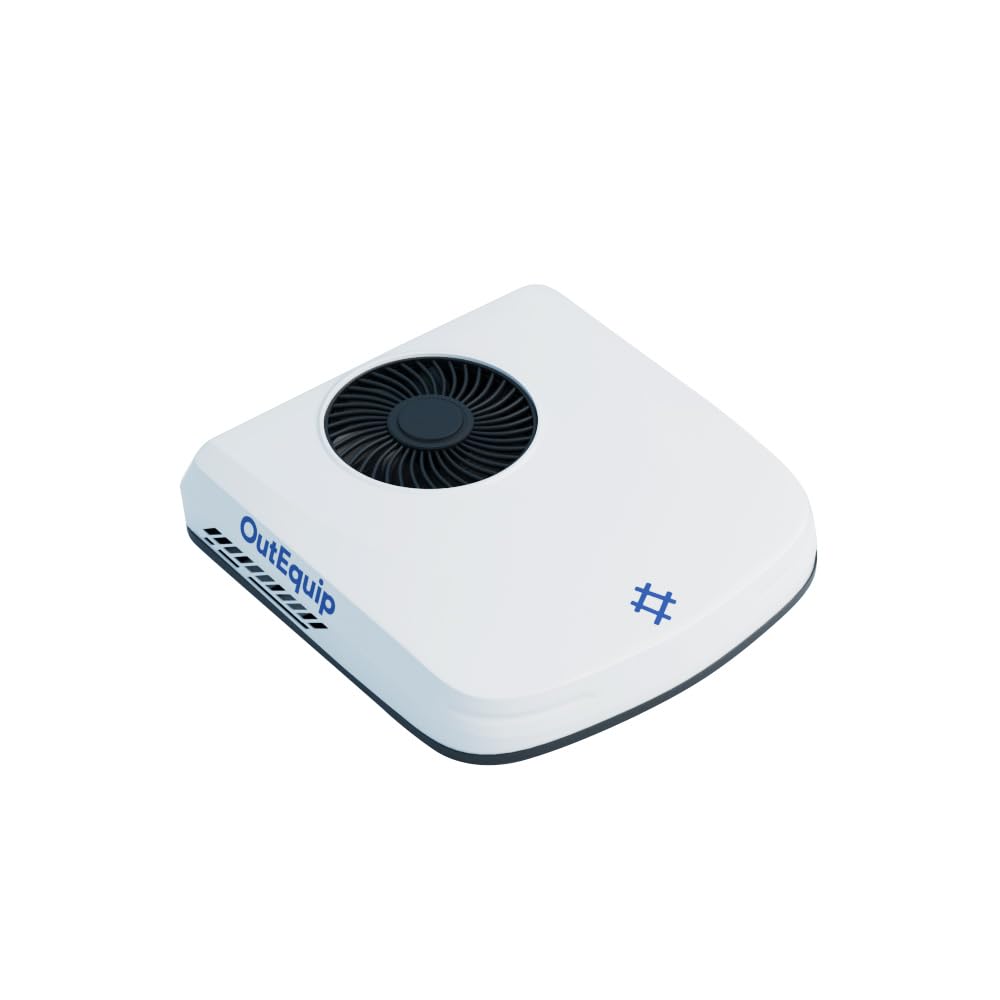
For serious RV owners who demand permanent off-grid cooling, the Outequip 12V 10000 BTU unit is a game-changer. It is a true rooftop installation with a low-profile design (fitting in 7.5-inch clearance spaces) that completely eliminates the need for an inverter. It runs directly on 12V DC from your RV’s house battery bank, delivering 10,000 BTU of cooling power, enough to cool an entire Class B or small Class C RV in under 15 minutes. The unit uses a rotary scroll compressor and brushless copper fans for quiet, reliable operation.
Power consumption is remarkably manageable for its output. On ECO mode, it draws just 20-30 amps, maintaining a comfortable 80°F inside when it’s 105°F outside. Even full turbo mode at 51-55 amps is sustainable on a well-designed 480Ah battery bank. Users report that it cools an 89°F van down to 79°F in about 25 minutes, and the sound level is only 54dB on high, which is much quieter than traditional rooftop ACs. The remote control includes eco, sleep, and turbo modes, offering flexible control.
Installation is straightforward for anyone with basic RV handiwork, but routing the power cable requires patience. One user noted that sealing the gasket properly is critical for preventing leaks. The unit weighs 45 pounds, which is lighter than many comparable units. Customer feedback is overwhelmingly positive, with one VW Bus owner calling it the “ultimate AC” for its low power draw and silence. The high BTU output combined with 12V DC efficiency makes this the gold standard for RV off-grid cooling.
Why it’s great
- 10,000 BTU on pure 12V DC—no inverter needed
- Low profile fits under standard RV clearance
- ECO mode draws only 20-30A
Good to know
- Requires careful sealing and routing during install
- High initial draw of 55A on turbo mode
3. BAYKUL Portable Camping Air Conditioner, 6800/7500 BTU
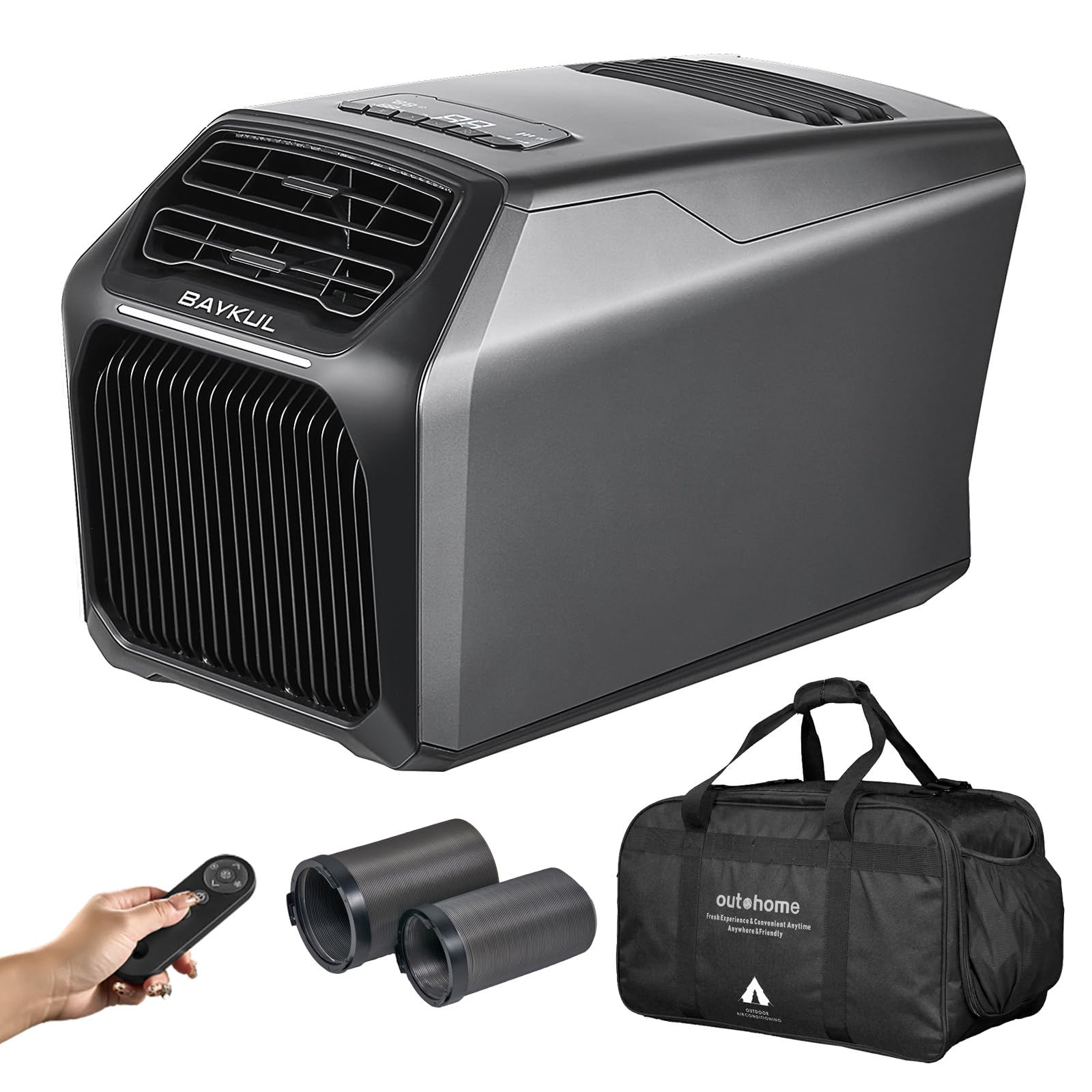
The BAYKUL 6800/7500 BTU unit delivers serious cooling power in a body that weighs just 35.7 pounds and comes with a dedicated carry bag. The 6-in-1 functionality includes cooling, heating, dehumidifier, fan, sleep mode, and a 24-hour timer. With an average power consumption of only 550 watts, it is one of the most energy-efficient high-output units on the market. The use of eco-friendly R-32 refrigerant allows it to pack 6800 BTU of cooling into a smaller footprint than R-410A units.
For tent campers, this unit feels purpose-built. A Florida camper reported that it cooled their tent quickly on a generator. The output air temperature drops by about 18°F compared to ambient, meaning a 90°F tent sees 72°F air. The RF remote control works through walls, so you can adjust settings even if the unit is placed outside your tent. The 46dB noise level is borderline whisper-quiet, suitable for undisturbed sleep.
There is a quality control caveat: one user reported a loose internal object that caused a horrible noise on startup. This seems to be an isolated incident, but it is worth noting. The unit also includes a drain port and adapters, making it viable for stationary use during hurricane season. If you want a powerful, compact unit that can heat and cool a large tent or small RV, the BAYKUL delivers outstanding value per BTU.
Why it’s great
- 550W average draw for 6800 BTU output
- Includes heating, cooling, dehumidifying
- Compact with convenient carry bag
Good to know
- Reports of loose debris inside fan assembly
- Requires generator or large power station
4. OUTOHOME 5200BTU Portable Tent Air Conditioner
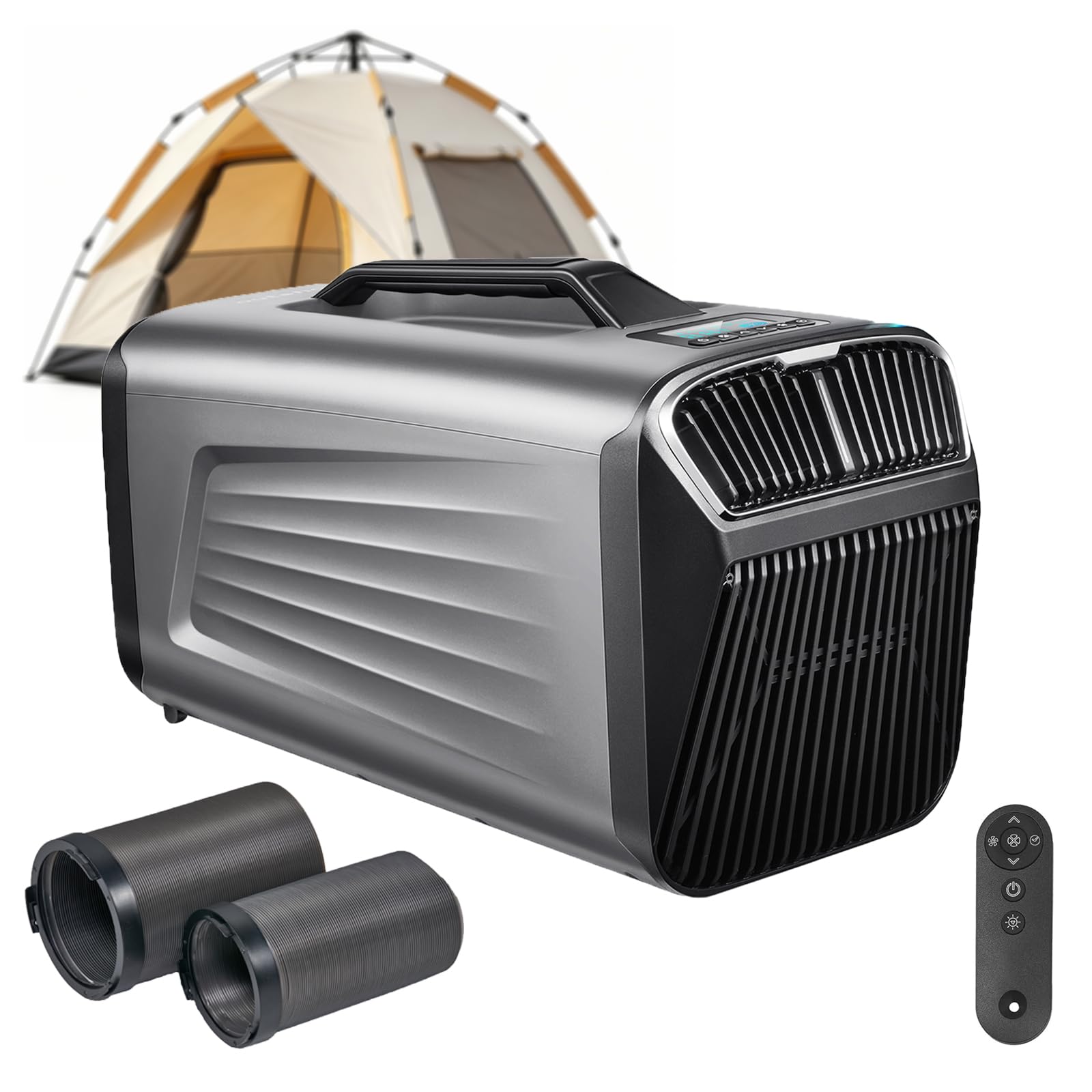
The OUTOHOME 5200BTU unit falls into the sweet spot of efficiency, consuming less than 400 watts per hour while delivering 5200 BTU of cooling. That is an exceptional watts-per-BTU ratio, meaning you can run this for 10 straight hours on a 4,000Wh power station. It uses a GMCC high-end compressor and can drop the temperature by 18°F in just 5 minutes. The unit is designed for stationary placement but is portable enough at 31.9 pounds with an ergonomic handle.
A key feature is its drainage-free operation when humidity is below 70%, which covers most dry camping conditions. If humidity is higher, a drainage pipe is included. The 4-in-1 modes (Cool, Dry, Sleep, Fan) and 24-hour timer offer flexibility, and at 46-50dB in sleep mode, it will not disturb your rest. Reviewers praise its compact, rugged build and note that the double hose design allows hot air to be ducted outside efficiently. One user measured the unit drawing just 270 watts in max cold mode, underscoring its incredible efficiency.
However, the unit runs on standard 110V AC power, so it requires a power station or generator. It defaults to Celsius, and the Fahrenheit setting resets on power off. One verified buyer expressed deep disappointment, stating the unit only cooled for one minute before blowing warm air. Setup is straightforward, but ensuring your power source can handle the inrush current is crucial. Despite isolated failures, the efficiency of the OUTOHOME 5200BTU makes it a top pick for budget-conscious campers with adequate battery capacity.
Why it’s great
- Power consumption under 400W average
- Drainage-free in low humidity
- Double hose design for efficient venting
Good to know
- 110V only—requires power station or generator
- Some units reported as defective
5. OUTOHOME 5100 BTU Portable Tent Air Conditioner
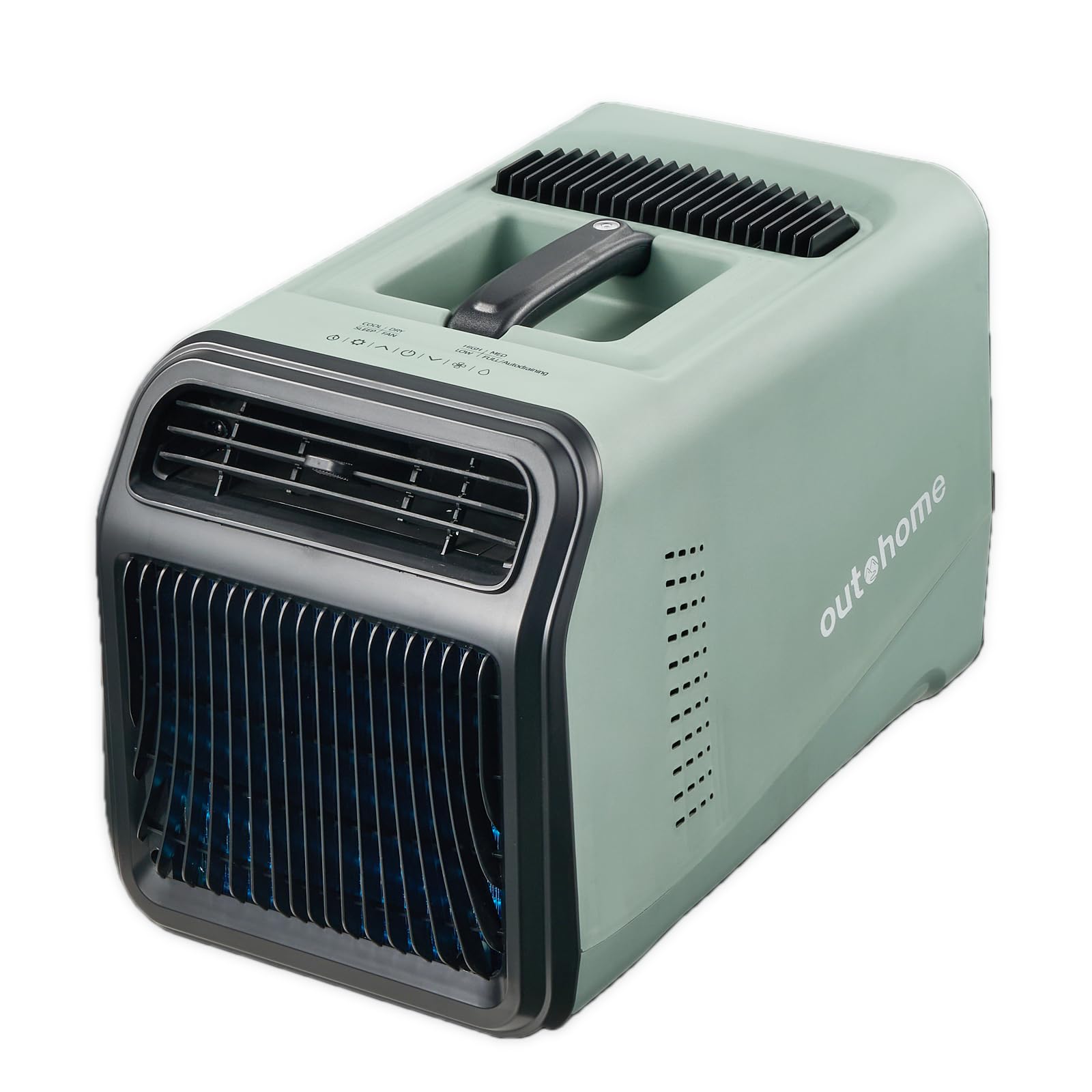
This OUTOHOME model shares the same manufacturer as the previous unit but offers a slightly different value proposition. It delivers 5100 BTU of cooling with a smart auto-evaporation system that recycles condensate water, enhancing cooling efficiency during extended operation. The unit is rated for spaces up to 200 square feet, making it more suitable for larger tents, small RVs, or a garage. At 35 pounds, it is 4 pounds heavier than its 5200BTU brother, but still manageable.
The sound level is a quiet 46 dB, quieter than a conversation, and sleep mode is genuinely restful. Users report that it can cool a truck topper sleeping area from 80°F to 65°F in under 20 minutes. The 24-hour programmable timer and precision temperature controls are intuitive. Customer support from OUTOHOME is praised, with one buyer noting that the company stands behind the product with responsive support.
The major downside is that this unit is not designed for off-grid use without a substantial power station. It requires 110V AC and a verified user noted that neither their EcoFlow nor a 2300W generator could start the compressor due to its high inrush current. Another user reported the handle falling apart during transport, making the entire unit dangerously unstable. If you have robust shore power or a high-quality generator, this is a solid performer, but its inrush current makes it a risky choice for pure battery operation.
Why it’s great
- Smart auto-evaporation system
- Good for larger spaces up to 200 sq ft
- Quiet operation at 46 dB
Good to know
- High inrush current prevents startup on many power stations
- Handle durability may be suspect
6. BougeRV PC35 Portable Air Conditioner 3500BTU
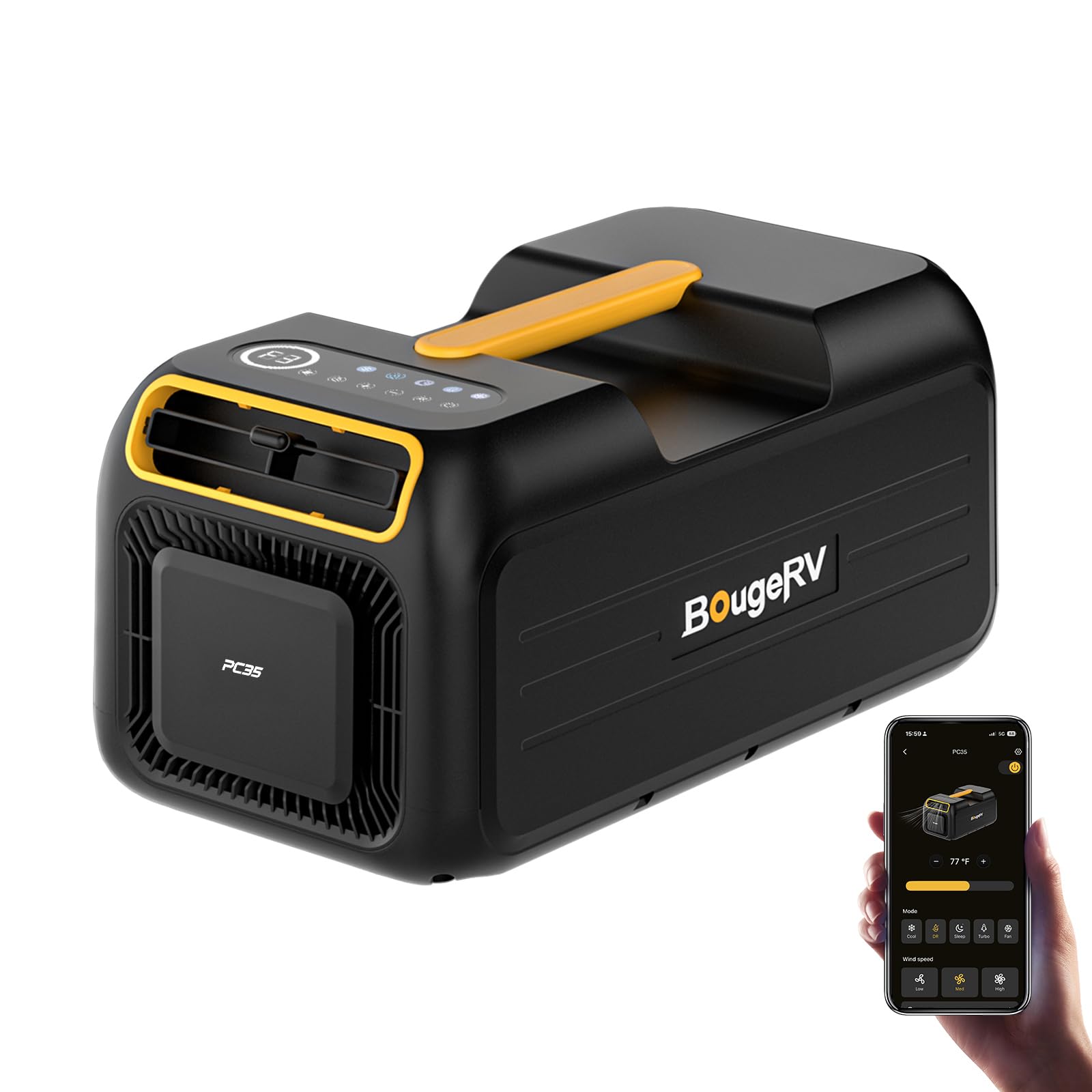
The BougeRV PC35 is a budget-friendly entry point for campers who want cooling but are not ready to invest in a high-output unit. At 3500 BTU, it is best suited for small tents, truck cabs, or personal spot cooling. It features app control via a 33-foot Bluetooth range, so you can turn it on before you even reach camp. It runs on a standard 110V AC power station, and users report pairing it successfully with a Jackery 3600 solar generator.
The unit is quiet and offers a 5-in-1 function set including cooling, dehumidifying, fan, high power, and sleep mode. The ergonomic handle makes moving it around easy, and the design is compact enough at 34.2 pounds. A verified buyer with a truck cab hotshot setup uses it with an EcoFlow Delta 2, confirming it keeps the cab comfortable. The cooling drop of 18°F in 15 minutes is effective for small, insulated spaces.
There are significant limitations. This unit cannot cool a large tent effectively, as one reviewer discovered after spending -440 on the unit plus additional investment for a power station. It struggles in extreme ambient temperatures above 100°F, with one user reporting the compressor shutting off after 3 minutes in an Arizona trip. Outside of these edge cases, it is reliable for moderate climates and small spaces. It occupies a niche: the cheapest genuine option that actually works for a small van or truck.
Why it’s great
- Affordable entry to battery camping AC
- Bluetooth app control is useful
- Quiet enough for a truck cab
Good to know
- 3550 BTU is weak for large tents
- Compressor fails in 100°F+ ambient
7. UAHKPA 12V RV Air Conditioner, Split Type 9000BTU

The UAHKPA is a 12V DC split-system air conditioner that separates the noisy condenser into an outdoor unit and the cooling evaporator into an indoor unit. This means significantly less noise inside the cabin and a cleaner installation. It produces a substantial 9000 BTU of cooling from just 800 watts of power, an excellent efficiency ratio. It is designed for a wide range of vehicles, from RVs and trucks to excavators and boats, using R134a refrigerant.
The unit includes a remote control and a digital display, allowing you to control five gear wind speeds. It is built with a thickened, rust-proof aluminum alloy core. A buyer using it with a LiFePO4 setup praised the price, cold performance, and low noise, though they noted high average power consumption of 850W. Another user in a Chinese excavator said it “works well.”
However, this unit carries the highest risk of all the products. There are reports of units failing after a month, and the return process to China is described as impossible by one disappointed buyer. The power wires supplied are undersized for the 75-amp starting current, posing a fire hazard unless you replace them with 2-gauge wire. The documentation is poor, the control panel is in Chinese, and the temperature sensor location is poor. This unit is a gamble—it can work brilliantly, or it can be a complete dud. It is only suitable for experienced DIYers who can replace wiring and troubleshoot electronic issues.
Why it’s great
- 9000 BTU from only 800W
- Split-system design for quiet indoor operation
- Works on 12V DC from vehicle battery
Good to know
- Undersized power wires are a fire hazard
- Extremely difficult returns; high failure rate
FAQ
Can I run a camping AC off a portable power station like a Jackery or EcoFlow?
How do I calculate the runtime of a 12V DC camping AC on my battery bank?
What is the difference between a rooftop RV AC and a portable tent AC for battery use?
Final Thoughts: The Verdict
For most users, the best battery powered ac for camping winner is the Cybertake S2 Pro because it offers the best balance of efficient 48V DC power, versatile 3-way input, and both cooling and heating in a portable, quiet unit. If you want a permanent, high-power installation for an RV, grab the Outequip 12V 10000 BTU for its rooftop design and massive cooling output. And for a budget-friendly entry-level pick, nothing beats the value of the OUTOHOME 5200BTU for its incredible efficiency per watt.