
A power outage, a camping trip, or a long-haul flight doesn’t have to mean a restless, unhealthy night’s sleep. The difference between waking up refreshed and struggling through the next day often comes down to one thing: having a reliable, dedicated power source for your therapy machine. You need a solution that matches your specific device’s voltage demands and your lifestyle, whether that’s a lightweight travel companion or a heavy-duty home backup that can last multiple nights.
I’m Min — the co-founder and writer behind Gadgets Feed. I’ve spent countless hours analyzing the technical specifications, battery chemistries, and real-world performance data of portable power solutions to ensure you get a recommendation that keeps your therapy uninterrupted, no matter where you are.
From lightweight, TSA-friendly options for the frequent flyer to high-capacity power stations that can run a machine with a humidifier for an entire weekend, this guide covers everything you need to confidently select the best battery powered cpap device for your specific needs and travel habits.
How To Choose The Best Battery Powered CPAP Device
Selecting the right battery for your therapy machine isn’t just about grabbing the biggest capacity you can find. The best choice depends on a balance of power requirements, portability, and chemistry. You need to match your device’s specific power draw, measured in volts and amps, with a battery that can deliver clean, stable DC power for the entire night without damaging the sensitive electronics inside your CPAP.
Battery Capacity and Runtime
The most critical spec is the battery’s capacity, measured in watt-hours (Wh). This tells you the total energy the battery can store. To estimate runtime, divide the battery’s Wh capacity by the power draw of your CPAP machine, which is typically found on the device’s label. A machine using 10 amps from a 24V source draws 240 watts. A 240Wh battery would theoretically run it for one hour, but since humidifiers and heated tubing draw significant extra power, a realistic runtime requires a much larger reserve. For a full night, look for at least 200Wh to 300Wh if you plan to use a humidifier on a low setting, or 100Wh if you travel without one.
Battery Chemistry: Li-ion vs. LiFePO4
The type of battery cell plays a huge role in the device’s lifespan and safety. Standard Lithium-ion (Li-ion) batteries are lighter and more compact for their capacity, making them ideal for travel. However, Lithium Iron Phosphate (LiFePO4) batteries are significantly more robust, offering a cycle life of 3,000 to 6,000 charges before their capacity degrades. While often heavier and bulkier, LiFePO4 batteries are also inherently more chemically stable and safer, making them the gold standard for a permanent home backup power solution that will last for years.
Portability and Connection Requirements
Your usage scenario dictates the battery’s form factor. For air travel, you are strictly limited to a battery under 100Wh (per FAA regulations for carry-on luggage), which forces you into the ultra-lightweight and compact category. For car camping or home backup, weight is less of a concern, and you can opt for a larger 300Wh+ unit. Furthermore, ensure the battery comes with the correct DC cables for your specific CPAP model—common brands like ResMed (AirSense, AirMini), Philips (DreamStation), and others often require different tip sizes and voltage settings (e.g., 12V vs. 24V).
Quick Comparison
On smaller screens, swipe sideways to see the full table.
| Model | Category | Best For | Key Spec | Amazon |
|---|---|---|---|---|
| BLUETTI X30 | Premium | Multi-Night Camping | 297Wh | 3.9 lbs | Amazon |
| EASYLONGER ES960 | Premium | High-Capacity Backup | 297.6Wh | LiFePO4 | Amazon |
| Zopec EXPLORE 8000 | Premium | Plug-and-Play Simplicity | 288Wh | 4.2 lbs | Amazon |
| EF ECOFLOW Delta 3 | Premium | Whole-Home Backup | 1024Wh | 1800W AC | Amazon |
| Anker SOLIX C2000 Gen 2 | Premium | Ultra-Fast Recharge | 2048Wh | 58 Min Charge | Amazon |
| Jackery HomePower 1000 v2 | Premium | Long-Term Reliability | 1024Wh | 6000 Cycles | Amazon |
| EASYLONGER ES720 | Mid-Range | Versatile Power Station | 266.4Wh | Multiple Ports | Amazon |
| VTOMAN Jump 600X | Mid-Range | 2-in-1 Power & Jump Start | 299Wh | LiFePO4 | Amazon |
| Medistrom Pilot-24 Lite | Budget | TSA Air Travel | 95Wh | 1.3 lbs | Amazon |
In‑Depth Reviews
1. BLUETTI CPAP Battery Backup X30

The BLUETTI X30 strikes an exceptional balance between high capacity and portability that makes it the top pick for most users. At just 3.9 pounds with a built-in handle, its 297Wh battery uses advanced lithium cells that claim over 2,000 recharge cycles, far outlasting standard power banks. This unit is specifically designed for CPAP machines, offering dedicated 12V, 15V, and 24V DC output ports so you can match your machine’s exact voltage without needing a separate adapter.
Real-world performance is where this battery shines. Users report powering a ResMed AirSense 10 for 5 to 7 hours per night over the course of a long weekend, with enough reserve for several nights of off-grid camping. The included cable set is color-coded and clearly labeled for popular models like the ResMed S9, AirSense 10 and 11, and Philips DreamStation, making setup a matter of seconds. Its ability to charge via a standard AC adapter in a few hours makes it easy to top up between uses.
The only significant caveats are its weight—at 4.1 pounds, it’s a bit heavy for ultralight backpacking—and its price point, which sits in the premium tier of dedicated CPAP batteries. While some users with specific Philips DreamStation models reported compatibility issues, the overwhelming majority of feedback for ResMed machines is outstanding, citing its compact form factor and dependable multi-night runtime as a game-changer for camping and power outages.
Why it’s great
- Ultra-compact and lightweight for its capacity, making it ideal for travel and car camping.
- Delivers impressive multi-night runtime (often 3-5 nights) without a humidifier.
- Long-lasting battery chemistry rated for over 2000 recharge cycles.
Good to know
- Heavier than some travel-specific options, and not TSA-approved for carry-on luggage.
- Some users with specific Philips models reported no-go compatibility.
2. EASYLONGER ES960 CPAP Battery Backup

The EASYLONGER ES960 is a powerhouse designed for users who need the absolute best in battery longevity. It utilizes LiFePO4 chemistry, which is rated for over 3,000 charge cycles, meaning it will likely outlast the lifespan of your CPAP machine itself. Its 297.6Wh capacity provides enough juice for two nights of solid CPAP use without a humidifier, and it includes a comprehensive set of four dedicated DC cables for ResMed, Philips, and other popular models.
One of its standout features is the robust build quality and the inclusion of a soft carrying case, which makes transporting its 6.6-pound frame much easier. The six output ports—including USB-A, USB-C (60W PD), and a 180W cigarette lighter socket—transform it into a versatile power station for camping, capable of charging laptops, phones, and even a small car fridge. Pass-through charging allows you to power your CPAP while the battery itself recharges from an AC outlet.
The primary trade-off for its durability and cycle life is its weight and size; at over six pounds, it is one of the heavier dedicated CPAP batteries on this list. Additionally, its capacity exceeds the 160Wh FAA limit, so it cannot be taken on an airplane. While some users experienced initial defects, the vast majority of recent reviews praise its performance, noting that it can power an AirSense 11 for over four hours with a heated hose and humidifier on, and for multiple nights without them.
Why it’s great
- LiFePO4 battery with an exceptional 3000+ cycle lifespan for long-term reliability.
- Versatile output ports, including a 60W USB-C, for powering other devices.
- Includes a dedicated set of cables and a soft carrying case for easy transport.
Good to know
- Heavy and bulky compared to other options, not suitable for air travel.
- Some early units had issues requiring replacement, though customer service was responsive.
3. Zopec EXPLORE 8000 CPAP Battery Backup
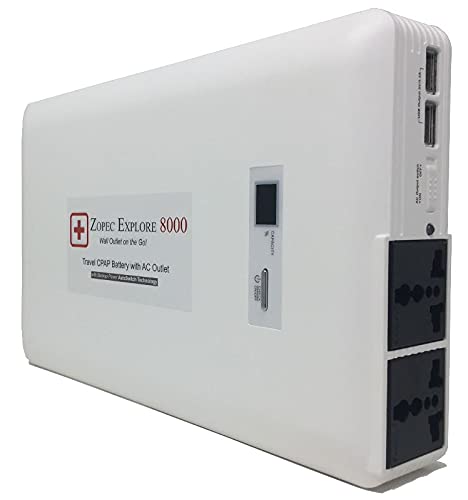
The Zopec EXPLORE 8000 is designed with simplicity in mind, functioning like a wall outlet rather than a piece of tech. You simply plug your CPAP machine’s standard AC adapter directly into the battery’s pure sine wave AC outlet. This eliminates the need for special DC cables, voltage converters, or matching tips, making it arguably the most user-friendly option for those who don’t want to fumble with connectors in the dark.
Despite its compact size—10.25 x 6.25 x 2 inches and only 4.2 pounds—it packs a 288Wh capacity using the same Panasonic cells found in some electric vehicles. Users consistently report getting 3 to 4 nights of use on a single charge when the heated humidifier and tube are turned off. Some owners have even noted that it can partially power a CPAP with a humidifier on a low setting for a full night, a feat that smaller batteries cannot achieve. An automatic power switch during an outage means you won’t wake up with a silent machine.
The main drawback is its price, which is higher than many similarly-sized competitors. Also, the large AC outlet inverter is inherently less efficient than a direct DC connection, meaning you do lose some energy in the conversion process. As some users have discovered, the manual for certain machines (like the AirSense 11) may technically prohibit using the humidifier with a battery, but the EXPLORE 8000’s robust design lets you do it anyway. It is also not FAA-compliant for air travel.
Why it’s great
- Extremely simple to use—just plug your CPAP’s own AC adapter directly into the unit.
- Provides true plug-and-play functionality, ideal for emergencies and non-tech-savvy users.
- Compact and lightweight for its high capacity, making it great for car camping.
Good to know
- Higher price point compared to dedicated DC-only batteries with similar Wh capacity.
- AC-to-DC conversion is less efficient, slightly reducing overall runtime compared to a direct DC connection.
4. EF ECOFLOW Delta 3 Classic Portable Power Station
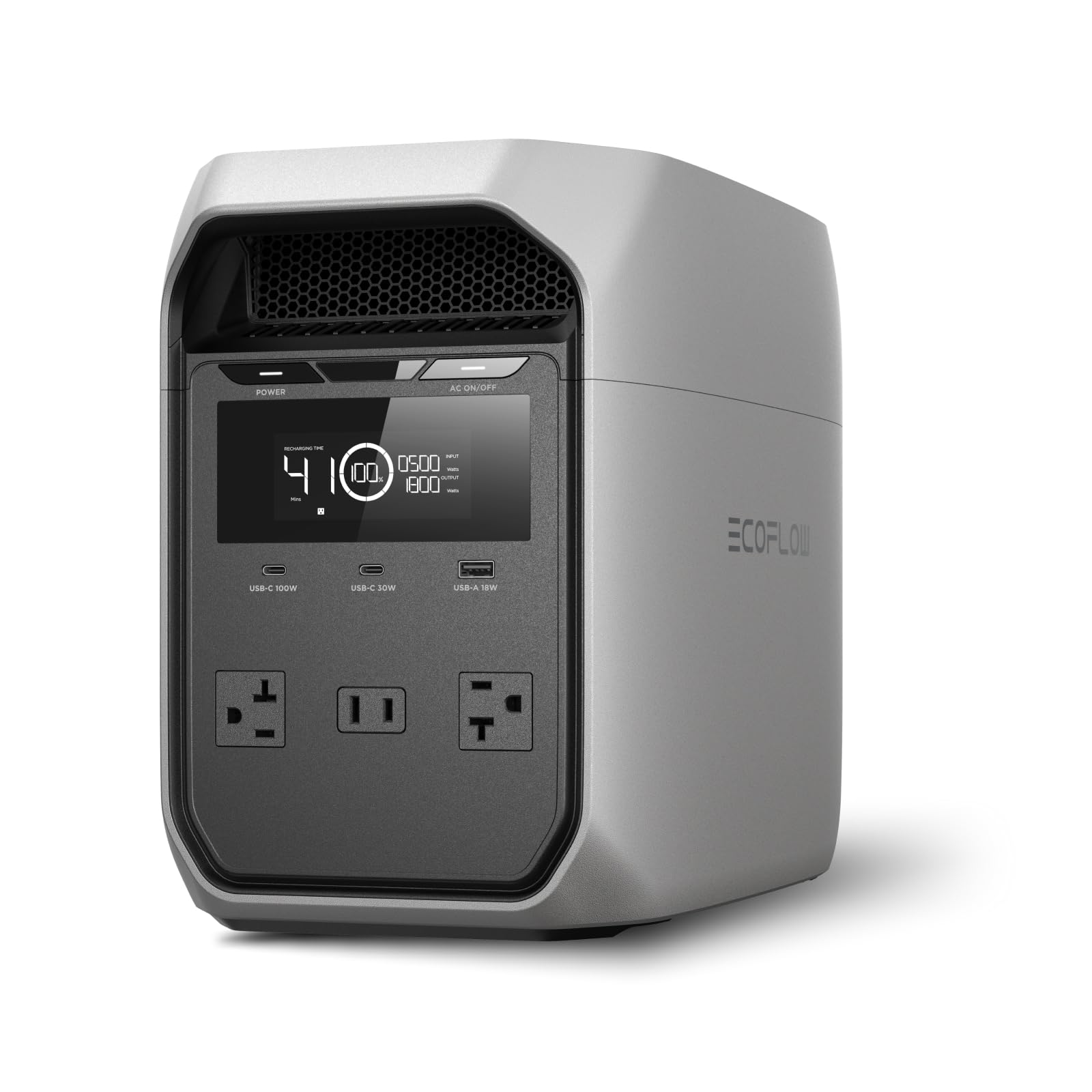
The EF ECOFLOW Delta 3 Classic represents a massive leap in capacity, designed not just for a CPAP machine but for whole-home backup. With a 1024Wh LiFePO4 battery and a 1800W (3600W surge) pure sine wave AC inverter, it can run your CPAP machine, a refrigerator, a lamp, and charge phones simultaneously for an entire day. For CPAP use specifically, this unit can provide power for a week or more, even with the humidifier running at full blast.
Its defining feature is X-Stream fast charging, which can recharge the battery from 0 to 80% in just 45 minutes. The sub-10ms UPS mode ensures your CPAP and other sensitive electronics are protected from the briefest power flickers. While it is a large and heavy unit at 15 pounds, its robust build and LiFePO4 chemistry (rated for 10+ years of daily use) make it a long-term investment in peace of mind.
The significant caveat is its price, which is in the high-end tier for portable power stations. At 15 pounds, it’s not something you’d pack in a carry-on for a weekend trip, but it’s reasonably easy to move from a closet to the living room. Some reviews note that the fan can be audible under load, and the app-based controls can be frustrating if you prefer physical buttons. However, for someone who needs a serious power station that can take on a whole house, it’s an excellent choice.
Why it’s great
- Massive 1024Wh capacity can power a CPAP for an entire week or more.
- Ultra-fast recharging from 0 to 80% in just 45 minutes.
- LiFePO4 battery is built to last over 10 years with daily use.
Good to know
- Heavy and large, designed for home use or car camping, not air travel.
- Relies heavily on a smartphone app for settings and monitoring.
5. Anker SOLIX C2000 Gen 2 Portable Power Station
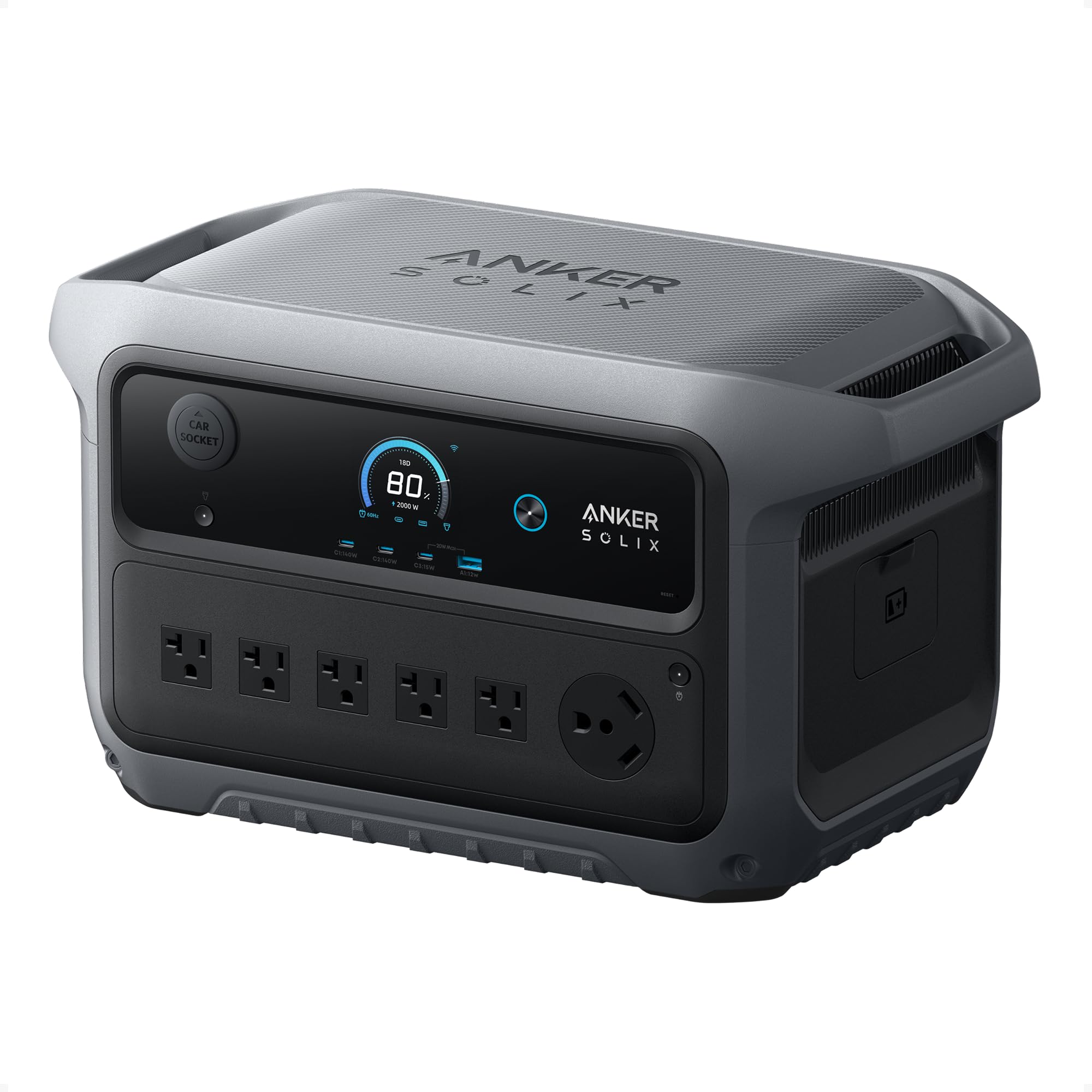
The Anker SOLIX C2000 Gen 2 is an absolute beast in the portable power station market, setting a new standard for recharging speed. With a massive 2048Wh LiFePO4 battery and a robust 2400W (4000W peak) pure sine wave AC inverter, it can run your CPAP machine alongside a microwave, window AC unit, or power tools simultaneously. For CPAP therapy, this translates to roughly 8 to 14 nights of power, even with a humidifier, before needing a recharge.
Its headline feature is the ability to recharge from 0 to 100% in just 58 minutes using a high-current AC input. This is a game-changer for emergency preparedness, as you can completely replenish its massive battery in the time it takes to eat a meal. The unit is surprisingly compact and light for its capacity, at about 41.7 pounds, and features a sophisticated app for monitoring and control.
The main barrier is its premium price tag, which places it firmly in the high-end tier. Its weight, while impressive for its capacity, is still over 40 pounds, making it more of a stationary backup than a portable travel companion. A few users have noted that the fan is quite loud under heavy load. Still, for the user who demands the ultimate in power, capacity, and recharge speed for home backup, the SOLIX C2000 Gen 2 is unmatched.
Why it’s great
- Unmatched recharge speed, going from 0 to 100% in under an hour.
- Huge 2048Wh capacity can power a CPAP for over a week, plus other appliances.
- Compact and lightweight for its class, with a very high peak power output.
Good to know
- Very high price point, making it a serious investment for home backup.
- Heavy (over 40 lbs) and not intended for regular portable use or air travel.
6. Jackery HomePower 1000 v2 Portable Power Station
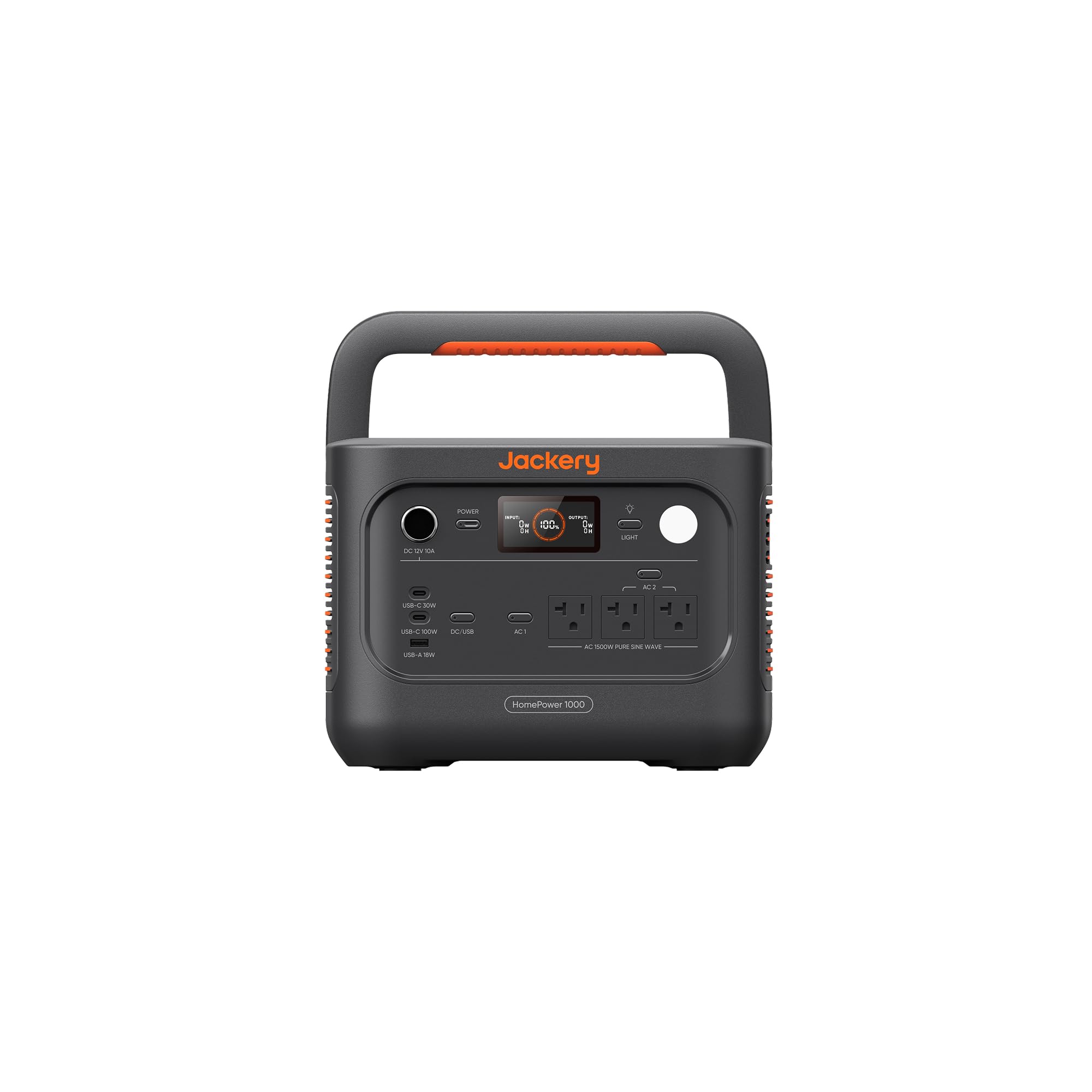
The Jackery HomePower 1000 v2 is a refined power station that prioritizes ultra-long-term reliability and fast recharging. It houses a 1024Wh LiFePO4 battery that is rated for an incredible 6,000 charge cycles while retaining over 70% of its original capacity, giving it a potential lifespan of over 16 years with daily use. Its 1500W pure sine wave inverter is more than enough to handle a CPAP machine, and its 10ms UPS switchover ensures your therapy is uninterrupted during a grid dropout.
Jackery is a trusted name in the portable power space, and this v2 model brings a significant upgrade in charging speed. It can charge from 0 to 100% in just 50 minutes via Emergency Charging mode in the app, or in a standard 1.25 hours. Weighing 23.4 pounds, it’s portable enough to move around the house or toss in the car for a camping trip, and its foldable handle makes carrying it easier than its weight suggests.
The main trade-off is its price, which is on the higher end for a 1kWh power station. While incredibly durable, its 1500W output is lower than some similarly priced competitors, though it’s still more than enough for a CPAP machine and other essentials. Some users have noted that the Bluetooth/Wi-Fi shuts off after 5 minutes of inactivity, which can be a minor annoyance. For a user who wants a reliable, long-lasting, and feature-rich home backup solution with a stellar reputation, this is a top-tier choice.
Why it’s great
- Industry-leading battery cycle life (6,000 cycles) for a 16+ year lifespan.
- Fast charging from 0 to 100% in as little as 50 minutes.
- Trusted brand with a 5-year warranty and excellent reputation for support.
Good to know
- Premium price point compared to some other 1kWh stations.
- 1500W output is lower than some competitors, though sufficient for most home backup needs.
7. EASYLONGER CPAP Battery Backup Power Supply ES720

The EASYLONGER ES720 is a dedicated CPAP battery that provides an excellent balance of capacity, features, and value. At 266.4Wh, it offers enough power for an entire night of CPAP use with a humidifier, or up to 3 to 4 nights without it. Its value proposition is strengthened by the incredible array of included accessories, including four dedicated DC cables for ResMed and Philips machines, plus an AC adapter, a handy bag, and multiple USB cables for charging other devices.
This unit is more than just a CPAP battery; it functions as a versatile mini power station. It features a 180W cigarette lighter socket, an adjustable DC output, and 4 USB ports, allowing you to power a laptop, drone, or car vacuum cleaner. The BMS safety system and pass-through charging add to its practicality for both home backup and outdoor adventures. A built-in LED light with an SOS function is a nice touch for emergencies.
Its primary downsides are its size and weight (3.31 pounds), which is heavier than the ultra-portable Pilot-24 Lite but lighter than the giant power stations. Also, reviews note that the buttons require a firm press and the LED light is a bit bright. While a few users experienced battery life that didn’t meet their personal expectations, the vast majority praise its robust performance, noting it can power an AirSense 10 for multiple nights of dry camping.
Why it’s great
- Excellent value, offering great capacity, multiple cables, and a carrying case at a mid-range price.
- Functions as a versatile power station with USB, DC, and 12V car port outputs.
- Pass-through charging and an integrated LED light add to its utility.
Good to know
- Heavier and bulkier than dedicated travel batteries, and not TSA-approved.
- Buttons and LED interface can be slightly clunky to use.
8. VTOMAN Jump 600X Portable Power Station

The VTOMAN Jump 600X is a unique and clever hybrid that combines a portable power station with a car jump starter, making it a fantastic value for road trippers and RV owners. Its 299Wh LiFePO4 battery is rated for 3,000 cycles, providing a long-lasting and safe backup for your CPAP machine. With a 600W pure sine wave AC inverter (1200W surge), it can comfortably run a CPAP with a humidifier for at least a full night.
Its versatility is its defining strength. The regulated 12V DC outputs are perfect for a CPAP, and the built-in jump starter can rescue a dead car battery, eliminating the need for a separate device. The battery is also expandable to 939Wh with an optional extra battery pack, and its pass-through charging allows you to power your CPAP and charge the unit at the same time. The included LED light with 5 modes is a handy bonus for camping.
The main trade-off is that its AC output (600W) is lower than larger power stations, though it’s perfectly adequate for CPAP use. The unit itself isn’t flyable due to capacity, and it weighs 14.6 pounds, making it a car-camping or home backup unit rather than a personal travel battery. While a few users mentioned the power drained quickly at the very end of its cycle, it is widely praised as a great budget-friendly power station for its dual functionality.
Why it’s great
- 2-in-1 design serves as both a reliable CPAP backup and a powerful car jump starter.
- Durable LiFePO4 battery with 3,000 cycles, offering long-term value.
- Expandable capacity (up to 939Wh) provides future-proofing for more demanding needs.
Good to know
- 600W AC inverter is lower than many stationary power stations.
- Slightly heavy for its base capacity, making it best suited for car camping or home use.
9. Medistrom Pilot-24 Lite CPAP Battery Backup

The Medistrom Pilot-24 Lite is the ultimate choice for the traveling CPAP user. Its defining feature is its size and weight: at just 1.3 pounds and a capacity of 95Wh, it is the only dedicated CPAP battery on this list that is both TSA-approved and FAA-compliant for carry-on luggage. This makes it an indispensable accessory for frequent flyers who rely on their therapy and cannot afford a night without power on a long-haul flight.
This unit is built for 24V CPAP machines, offering up to 16 hours of runtime on a single charge when the humidifier is off and the pressure is set low (based on manufacturer specs). Its tough aluminum case with LG industrial-grade cells ensures durability in a backpack. While it includes two specific cables (for AirMini and AirSense 10), cables for other 24V machines like the AirSense 11 or S9 are sold separately.
The clear limitation is its low capacity. You will not be running a humidifier with this unit, and its runtime may be closer to 8 hours at higher pressure settings. The included cables have been a point of contention for some users, with reports of failure. Its price, per Wh, is also significantly higher than any other battery here, making it an expensive investment for its small capacity. However, if the absolute requirement is to stay within FAA carry-on limits for a dedicated device, the Pilot-24 Lite is the only real player.
Why it’s great
- The only model on this list approved (TSA/FAA) for carry-on air travel.
- Exceptionally lightweight (1.3 lbs) and compact with a durable aluminum case.
- Provides up to 8-16 hours of runtime for travel without a humidifier.
Good to know
- Low capacity means it will not power a humidifier and has limited total runtime.
- Expensive for its small capacity, and extra cables for other CPAP models must be purchased separately.
FAQ
Can I use a heated humidifier with any CPAP battery?
What is the difference between a dedicated CPAP battery and a general power station?
Final Thoughts: The Verdict
For most users, the best battery powered cpap device winner is the BLUETTI X30 because it offers the best balance of high capacity, lightweight design, easy voltage selection, and long battery cycle life for a price that represents solid value for the dedicated CPAP user. If you need portable power that can also jump-start your car, grab the VTOMAN Jump 600X. And for the frequent flyer who absolutely must have a TSA-compliant unit, nothing beats the Medistrom Pilot-24 Lite in terms of size and carry-on compliance.