
That 3 a.m. bathroom trip by a toddler or the back door opening when you are in the basement — these moments demand an instant audible trigger before anything escalates. A battery powered door alarm solves that exact problem: it goes off the moment a magnetic contact breaks, no wiring, no monthly monitoring fee, just a piercing siren that tells you exactly what happened and where.
I’m Min — the co-founder and writer behind Gadgets Feed. I spent dozens of hours reading through verified purchase feedback and cross-referencing decibel ratings, trigger gap tolerances, battery types, and volume control ranges across seven models to isolate which units actually hold up in real homes.
The market offers everything from basic chime-only units to Wi‑Fi-connected systems with app alerts, but picking the wrong one means false alarms, silent dead zones, or batteries that die within weeks. This guide breaks down the mechanical, audible, and connectivity differences so you can choose the best battery powered door alarm for your specific door, window, or child‑safety scenario without guesswork.
How To Choose The Best Battery Powered Door Alarm
Every battery powered door alarm relies on a simple magnetic contact circuit: a reed switch in the main unit and a magnet in the smaller piece. When the gap exceeds the sensor’s tolerance, the circuit opens and the alarm sounds. Your real decision comes down to four variables: loudness, trigger reliability, battery longevity, and alert type (local siren vs. chime vs. smartphone notification).
Decibel Rating and Sound Frequency
A 120 dB rating sounds impressive, but not all 120 dB tones cut through walls equally. High‑pitched piezo sirens (common on cheap units) annoy the dog but fail to wake someone on a different floor. Mid‑range models that use a proper speaker with a lower‑frequency tone carry farther through drywall and wood framing. If you need to hear the alarm from a basement bedroom, prioritize user feedback that specifically mentions audibility through multiple rooms rather than just the spec sheet number.
Magnetic Sensor Gap Tolerance
The gap between the alarm body and the magnet determines whether the unit triggers correctly. Cheaper alarms often require the two pieces to be within 0.3 inches — a loose door hinge or a slightly warped frame will cause constant false triggers. Look for models with a tolerance of 0.5 inches or more. A wider gap tolerance also means you can mount the alarm on the door frame and the magnet on the door itself without needing millimeter‑perfect alignment.
Battery Type and Power Management
Button cell batteries (LR44, CR2032) are common in ultra‑compact alarms, but they typically last 6–12 months and are harder to replace on a whim. AAA‑powered units are bulkier but offer 12–18 months of run time and use batteries you probably already keep in a drawer. Some premium models now include low‑battery indicator LEDs or app‑based battery level reporting — a feature that saves you from discovering a dead alarm only after something actually happens.
Quick Comparison
On smaller screens, swipe sideways to see the full table.
| Model | Category | Best For | Key Spec | Amazon |
|---|---|---|---|---|
| Philips 4‑Pack (LRM3320W/27) | Premium Multi‑Pack | Whole‑home perimeter coverage | 120 dB siren, 0.5 in gap tolerance | Amazon |
| PHYSEN Smart WiFi Chime | Smart Connected | Remote push notifications | 110 dB, 500 ft range, app alerts | Amazon |
| METAK 2‑Pack with Remote | Dual‑Volume Siren | Configurable loudness + remote arming | 120 dB max, 600 ft remote range | Amazon |
| SECRUI Wireless Chime | Versatile Chime | Store / office customer entry alert | 65 dB typical, 32 ringtones | Amazon |
| AMHEY Motion Sensor Chime | Motion Detector | Hallways, driveways, dementia care | 110 dB, PIR motion + magnetic | Amazon |
| TECKNET 3‑Pack | Compact Triple Pack | Kids safety, cabinet & drawer monitoring | 65 dB, 3‑level volume, 0.78 in gap | Amazon |
| Philips 2‑Pack (LRM3420W/27) | Budget Entry Pack | Essential single‑point coverage | 120 dB siren, button cell batteries | Amazon |
In‑Depth Reviews
1. Philips 4‑Pack Window and Door Alarm (LRM3320W/27)
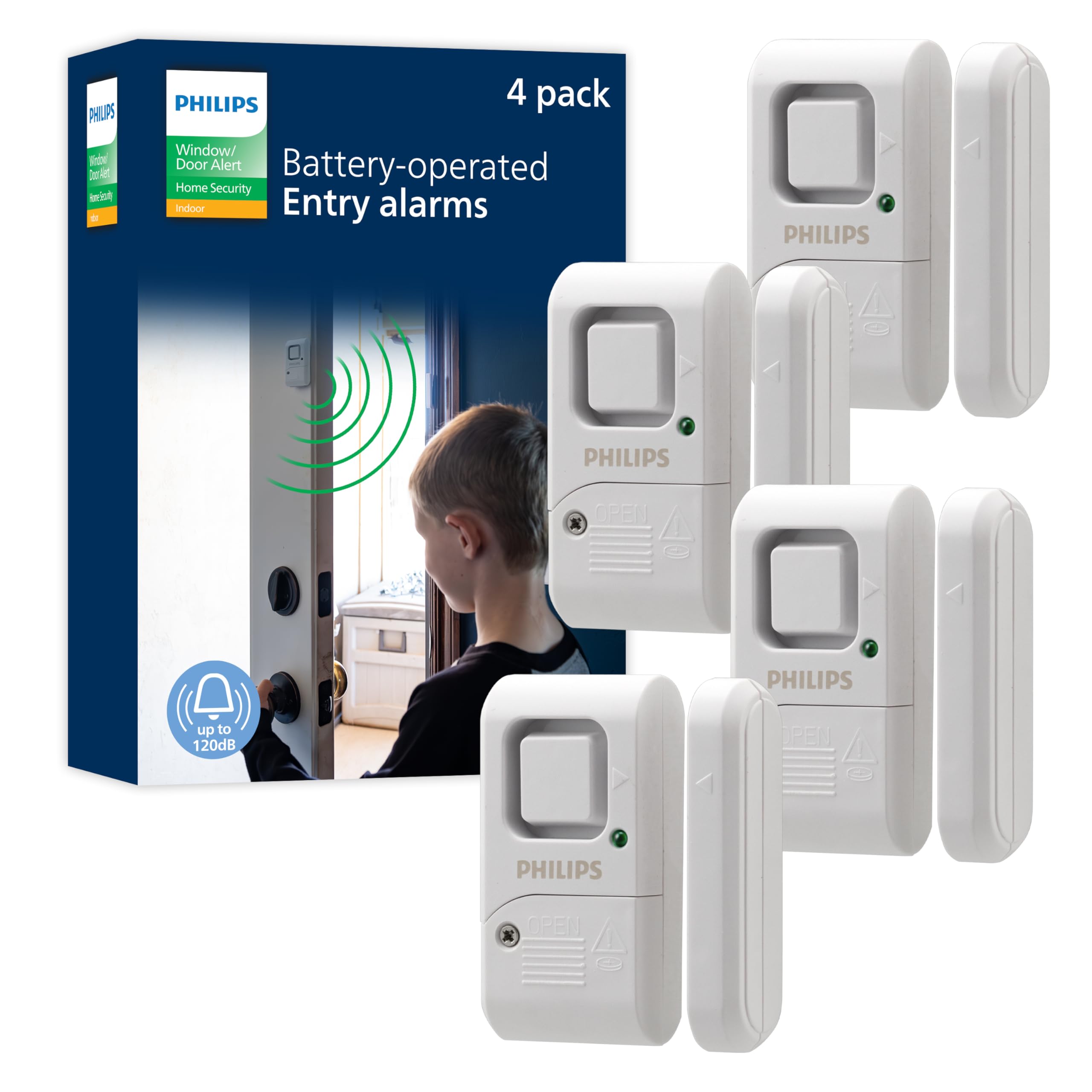
The Philips LRM3320W/27 four‑pack is the closest thing to a whole‑home perimeter solution without drilling a single hole. Each unit delivers a genuine 120 dB piezo siren triggered by a magnetic sensor with a 0.5‑inch gap tolerance — wide enough to accommodate slightly warped door frames without constant false alarms. The three‑position slide switch (Off / Chime / Alarm) lets you toggle between a friendly doorbell tone during the day and a full burglar siren at night on the same hardware.
Verified buyer reports confirm that the sound carries across entire houses, including from basement to second floor. The four included LR44 button cell batteries are pre‑installed, and a battery test button on each unit lets you check power without guessing. A low‑battery LED indicator adds another layer of reliability — you get visual warning weeks before the alarm goes silent. The adhesive pads hold firmly on clean painted wood, though some users recommend adding a drop of super glue or using 3M Command strips for textured surfaces.
For a family that needs front door, back door, sliding patio door, and a garage man‑door covered in one purchase, this pack delivers the highest siren output per dollar in the list. The trade‑off is that you cannot adjust the siren volume — it is full blast or nothing, so if you need a softer alert for naptime, you will use the Chime mode instead.
Why it’s great
- Four units cover an entire home perimeter in one box
- 120 dB siren audible through multiple floors
- Chime and alarm modes on the same switch
- Battery test button and low‑battery LED
Good to know
- No volume adjustment on alarm mode — it is always maximum
- Button cell batteries are not as easy to find as AAAs
- Adhesive may fail on rough or textured surfaces without extra glue
2. PHYSEN Smart WiFi Door Chime Sensor

The PHYSEN system breaks the local‑only limitation of traditional door alarms by integrating directly with the Tuya / Smart Life platform. When the magnetic contact breaks, you receive a push notification on your phone even if you are miles away, making this the only unit on the list that works while you are at the grocery store or on vacation. The plug‑in receiver delivers five volume levels up to 110 dB and supports assigning unique ringtones to as many as 20 individual sensors, so you know whether the front door or the garage side door triggered the alert.
Installation is genuinely wire‑free — the sensor uses double‑sided adhesive, and the receiver simply plugs into any wall outlet. The smart memory function preserves your volume and melody selections through power outages, which is more reliable than many competing smart chimes that reset to defaults. Verified users report that the 500‑foot open‑air range is conservative, with reliable transmission through drywall and typical interior construction over 100 feet.
The biggest advantage here is the app‑based family sharing: multiple caregivers can receive the same door‑open alert simultaneously, which is critical for monitoring elderly parents or children with special needs. The only catch is that the alarm sound itself comes from the plugged‑in receiver, not through the phone — so if you need the siren to scare off an intruder at 3 a.m., this still requires the receiver to be within earshot.
Why it’s great
- Real‑time push notifications without monthly fees
- Expandable to 20 sensors with unique ringtones per zone
- Five volume levels up to 110 dB via plug‑in receiver
- Power‑outage memory keeps your settings intact
Good to know
- Requires a stable 2.4 GHz Wi‑Fi network for app alerts
- Receiver needs a wall outlet — not fully portable like a battery unit
- Sensor requires AAA batteries (not included)
3. METAK 2‑Pack Window and Door Alarm with Remote

METAK solves the volume‑control problem that frustrates many 120 dB alarm owners. A physical switch on the side lets you toggle between 90 dB (loud enough for a single‑story home) and 120 dB (ear‑splitting deterrence that neighbors will hear). The included remote control operates from up to 600 feet away, letting you arm or disarm the system without walking to each sensor — a genuinely useful feature if you have alarms on multiple exterior doors.
Installation uses the standard magnetic reed switch design with a 3M adhesive backing. The gap tolerance is approximately 0.5 inches, which handles most standard residential door frames without issues. Each unit runs on two AAA batteries (not included), and the remote uses a separate coin cell that is pre‑installed. Verified owner feedback consistently highlights the clarity of the siren tone — it is less shrill than budget piezo units and carries through walls more effectively.
The two‑pack configuration covers two critical entry points (front door and back door, or a sliding patio door and a bedroom door) with a single remote. The 90 dB mode makes this usable for situations where a full 120 dB blast would be overkill — for example, alerting you that a toddler opened a bedroom door during naptime without terrifying everyone in the house. The main trade‑off is that the remote is an IR‑type line‑of‑sight unit, not RF through walls, so the 600‑foot range applies only outdoors with clear visibility.
Why it’s great
- Selectable 90 dB or 120 dB output for different scenarios
- Remote control arm/disarm from up to 600 feet away
- Two‑pack plus remote covers multiple entry points
- Less shrill siren tone carries better through walls
Good to know
- Remote is line‑of‑sight, not RF through walls
- AAA batteries not included
- Adhesive may need replacement pads for sliding doors
4. SECRUI Wireless Door Chime (1 Sensor)

The SECRUI system is built around a different philosophy: instead of a piercing intrusion siren, it provides a polite but audible chime that alerts you to entry without alarming customers, patients, or family members. The receiver offers 32 distinct ringtones — including a barking Rottweiler, a classic ding‑dong, and several electronic melodies — so you can assign a unique sound to each door. The volume is adjustable, topping out at 65 dB, which is the volume of a loud conversation.
The 500‑foot open‑air range between the magnetic sensor and the receiver means you can place the receiver at the back of a 2,000‑square‑foot office or the opposite end of a retail store and still hear it clearly. The sensor uses the standard magnetic contact closure and mounts with double‑sided tape in minutes. Verified commercial users report that the system has been running for over two years without hardware failure, making it unusually durable for this price point.
Where this unit falls short for home security is its lack of a true alarm mode — there is no 120 dB siren, no panic button, and no deterrent capability. It tells you someone opened the door, but it will not scare anyone away. For retail stores, medical offices, or any scenario where you simply want to know when a customer or patient walks in, this is the most practical and pleasant‑sounding option in the list.
Why it’s great
- 32 ringtones let you assign unique sounds per door
- 500‑foot open‑air range covers large commercial spaces
- Low 65 dB max volume is non‑threatening for customers
- Proven durability — two years of continuous use reported
Good to know
- No high‑decibel siren — purely a chime alert
- Requires outlet for receiver, not fully wireless
- Single sensor pack; additional sensors sold separately
5. AMHEY Wireless Motion Sensor Door Chime

The AMHEY door chime is a hybrid: it combines a passive infrared motion detector with a magnetic contact sensor, so you can trigger the alarm based on either body heat moving through a zone or a door opening. The motion sensor covers a 110‑degree field of view at a 26‑foot maximum range, making it suitable for monitoring hallways, driveways, or open doorways where a magnetic contact would not work. The receiver plugs into a wall outlet and offers five volume levels from silent mode up to 110 dB.
With 32 selectable ringtones and an LED flash indicator, this unit doubles as a visual alert for hearing‑impaired users. The expandable system supports pairing up to 20 motion sensors and unlimited receivers, so you can build coverage over a large area with a single receiver as the audio hub. Verified buyers have repurposed this as a cat‑entry alert, a dementia‑patient monitor, and a retail store doorbell — the adjustable sensitivity on the motion sensor is flexible enough to handle all those scenarios after some fine‑tuning.
The main caveat is that the motion sensor is strictly indoor‑rated — it is not weatherproof, so you cannot mount it outside under an eave. Additionally, there is no on‑off switch on the sensor itself; the only way to disarm it is to remove the AAA batteries, which is inconvenient if you want to temporarily disable it during parties or cleaning. For interior use where motion detection adds value beyond a simple magnetic contact, this hybrid approach is genuinely useful.
Why it’s great
- Dual PIR motion + magnetic contact for flexible triggering
- Five volume levels from silent to 110 dB
- LED flash indicator for hearing‑impaired alerts
- Expandable to 20 sensors with a single receiver
Good to know
- Motion sensor is for indoor use only — not weatherproof
- No on‑off switch on the sensor; must remove batteries
- Sensor sensitivity may cause false triggers near heating vents
6. TECKNET 3‑Pack Door Alarm for Kids Safety

TECKNET’s three‑pack is purpose‑built for parents monitoring children, particularly those with autism or elopement risks. The standout spec is the 0.78‑inch magnetic sensor gap tolerance — the widest of any unit in this roundup — meaning the alarm reliably triggers even when the door is only cracked a quarter inch, and it also resists false triggers from wind or loose hinges. Three volume levels let you choose between a quiet 40 dB chime for naptime monitoring and a louder alert for active hours.
Each unit is exceptionally compact at 4.96 x 0.79 inches, roughly the size of a thick credit card. The slim profile blends into white door frames and does not protrude enough to interfere with door closing. Installation uses the standard 3M adhesive backing, and verified users report strong adhesion on painted wood and smooth metal doors. The dual‑mode alarm offers a single “ding‑dong” chime or a continuous high‑pitched alarm — parents can choose which sound works best for their child’s sensitivity.
The trade‑off is that the maximum volume tops out at 65 dB, which is fine for alerting someone in the same house but will not scare off an intruder or be heard from the backyard. The three‑pack pricing makes this the most cost‑effective option for monitoring multiple bedroom doors, cabinets, and drawers simultaneously. The 36‑month warranty (registration required) is an added layer of confidence for a product that will see daily use.
Why it’s great
- Widest sensor gap tolerance (0.78 in) reduces false triggers
- Three‑pack covers multiple doors at a budget‑friendly cost
- Three volume levels including a quiet naptime chime
- Ultra‑compact design fits narrow door frames
Good to know
- Max 65 dB is not loud enough for intruder deterrence
- Continuous alarm tone is high‑pitched and piercing
- Sensor and alarm must be within 0.78 in of each other
7. Philips 2‑Pack Window and Door Alarm (LRM3420W/27)
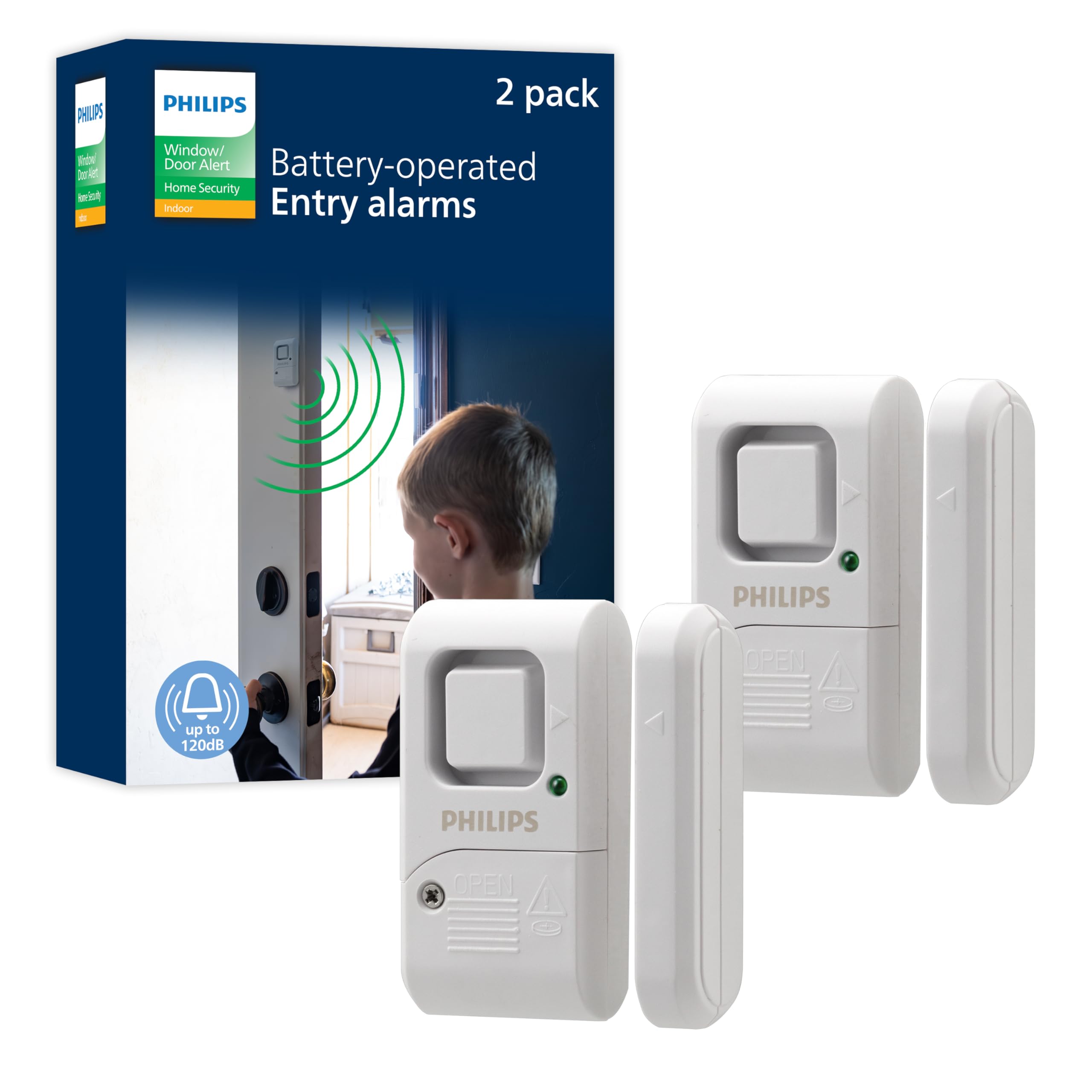
This two‑pack from Philips delivers the same core 120 dB siren and magnetic sensor design as the four‑pack flagship but in a smaller, more affordable package — perfect for a renter or apartment dweller who only needs to secure a front door and a sliding patio door. The three‑position slide switch, battery test button, and low‑battery LED are identical to the larger pack, so you are not losing any reliability features by choosing the smaller kit.
The LR44 button cell batteries are pre‑installed, which means the alarms work straight out of the box — no running to the store for AAAs. The 0.5‑inch gap tolerance is consistent across the Philips line, and verified buyers confirm that the siren is genuinely ear‑piercing at close range, carrying across the entire house even through closed interior doors. Many users have mounted one on the front door and one on the back door, creating a simple perimeter that covers both primary entry points for less than many single‑unit competitors.
The limitation, as with the four‑pack, is that there is no volume adjustment: you get full 120 dB blast every time, which may be excessive for daytime use when you just want a polite chime. You can switch to Chime mode for a less aggressive alert, but even the chime is louder than expected. For someone who wants the most affordable entry into a 120 dB security system with a trusted brand name, this two‑pack is the logical starting point.
Why it’s great
- 120 dB siren at the lowest per‑unit cost in the list
- Pre‑installed LR44 batteries — ready out of the box
- Trusted Philips build quality with 1‑year warranty
- Chime and alarm modes on a simple slide switch
Good to know
- No volume control — siren is always maximum output
- Button cell batteries are less common than AAA
- Adhesive may need extra help on textured or damp surfaces
FAQ
Will a 120 dB door alarm wake me up from a deep sleep on a different floor?
How often do I need to replace the batteries in a battery powered door alarm?
Can I use a door alarm on a sliding glass door or a French door?
What is the difference between a chime alarm and a burglar siren in these devices?
Final Thoughts: The Verdict
For most users, the best battery powered door alarm is the Philips 4‑Pack (LRM3320W/27) because it delivers consistent 120 dB siren output across four sensors, covering every primary entry point in a typical home with a trusted brand and reliable magnetic contact detection. If you need remote smartphone notifications when you are away from home, grab the PHYSEN Smart WiFi Chime — its free app alerts and expandable sensor system provide a degree of connectivity no other local‑only unit can match. And if your primary concern is monitoring a child with autism or preventing elopement, nothing beats the TECKNET 3‑Pack, whose wide 0.78‑inch gap tolerance and adjustable volume levels offer the most forgiving, parent‑friendly setup on the market.