
Our readers keep the lights on and my morning glass full of iced black tea. As an Amazon Associate, I earn from qualifying purchases.
Specs are compiled from manufacturer listings and verified buyer reviews and can change over time — please confirm the key details on the product page before buying.
A battery-powered kayak replaces paddling with a motor-driven glide. A twist-grip throttle or pedal drive moves you across the water hands-free, so your hands stay on the rod. You still steer like a standard kayak, but the motor covers more water so you arrive at your spot ready to fish.
I’m Min — the founder and writer behind Gadgets Feed. This guide is built by comparing the manufacturers’ published specifications and the patterns across verified customer reviews, so you get each pick’s real strengths and trade-offs instead of marketing spin.
Here are the two best battery-powered kayaks, judged by specs, range, and owner feedback.
Our Picks at a Glance
How To Choose The Best Battery Powered Kayak
A “battery powered kayak” is either a kayak with a built-in trolling motor or a pedal-drive model with an electric assist. You either get a kayak with a built-in trolling motor, or you get a pedal-drive kayak with an integrated electric motor that assists the propeller. Both free your hands, but they differ in weight, handling, and price.
Thrust is your real horsepower
Trolling motor power is measured in pounds of thrust, not horsepower. Higher thrust, like 45 pounds, pushes harder against wind and current, keeping you steady in choppy water. If you mainly fish calm lakes and ponds, you need far less muscle than someone battling tidal rivers.
Capacity tells you who can ride
Pay attention to two numbers. Maximum capacity is the absolute total the hull can safely carry, including you, your gear, and the motor. A kayak rated for 558 pounds can take a bigger angler plus a full cooler, while a lighter-rated hull forces you to pack lean. Always leave a safety margin rather than loading right up to the line.
The battery is usually the extra you forget
Before you buy, check whether the motor battery is included—many motorized kayaks ship without it. You will likely need to buy a deep-cycle 12-volt marine battery (a heavy-duty unit designed to power a boat motor) separately, which adds a significant first-day cost and affects how long you can stay out. Budget for it upfront so you are not stuck on the shore staring at a motor with no juice.
Quick Comparison
In‑Depth Reviews
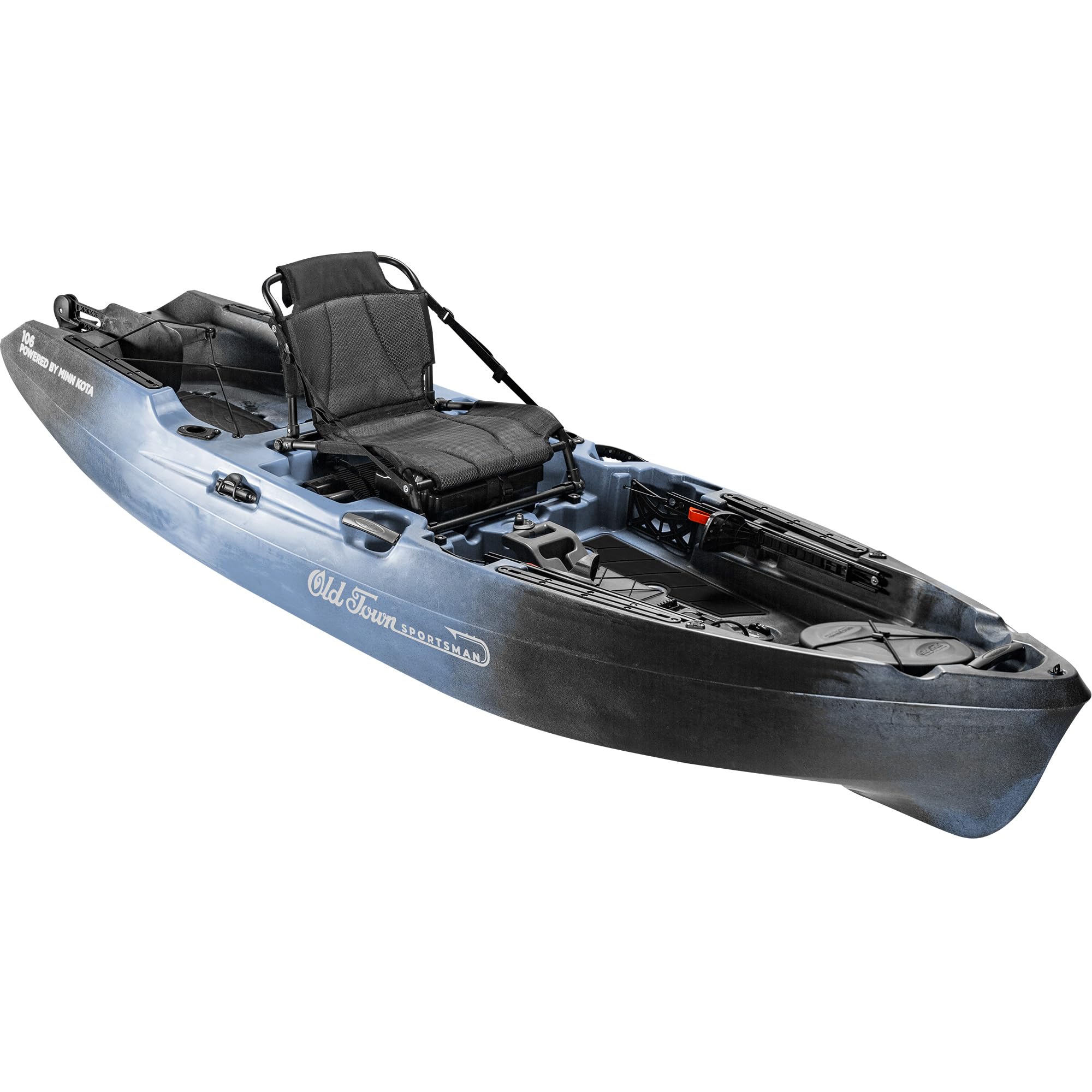
1. Old Town Sportsman 106 Powered by Minn Kota
The proven open-water performer with a factory-fitted Minn Kota motor and a rock-solid build.
This is the kayak you buy when you want a real trolling motor attached at the factory, not an aftermarket bolt-on. The Old Town Sportsman 106 ships with Minn Kota’s low-profile 12-volt motor delivering 45 pounds of thrust, and it is saltwater-ready, so estuary and coastal anglers can trust it against corrosive spray. The motor battery is not included, which is the one extra you need to plan for before launch day.
The 10-foot, 6-inch hull carries a 525-pound maximum capacity, but usable capacity for people and gear sits at 329 pounds. That gap matters: it tells you to pack deliberately and keep the heavy cooler off the bow. The kayak itself weighs 121 pounds, and the removable motor console adds 17 pounds, so this is not a roof-rack casual. Buyers report it bluntly: “Its heavy though. Don’t plan on putting this on top of your car.” A trailer or a pickup bed is the realistic home for this one.
Comfort is clearly thought through. The premium dual-layer Textilene mesh seat keeps you cool on long sessions, cushioned floor pads give both grip and relief for your feet, and the extra-large rudder gives strong boat control in forward and reverse. Three through-hull wiring kits plus a universal transducer mount let you attach a fish finder in minutes with no drilling, which removes the scariest part of outfitting a new kayak for serious anglers. The build quality earns the praise owners give it — “durability is amazing” is a common refrain, and all you need to add is a rod and a battery.
What wins people over
- Factory-installed Minn Kota motor with 45 pounds of thrust, ready for saltwater
- Drill-free fish finder mounting with included wiring kits and transducer mount
- Comfort-first cockpit: Textilene mesh seat plus cushioned floor pads for grip and relief
Where it demands compromise
- Motor battery sold separately, so factor that into your setup cost
- At 121 lb plus a 17 lb console, this is strictly a trailer or truck-bed kayak
- Usable capacity of 329 lb is well below the 525 lb maximum, so pack lean
Choose it for: the angler who wants a proven, saltwater-ready trolling motor straight from the factory and owns a trailer.
Reconsider if: you need to roof-rack your kayak alone after every trip — the 121-pound hull is a two-person lift.
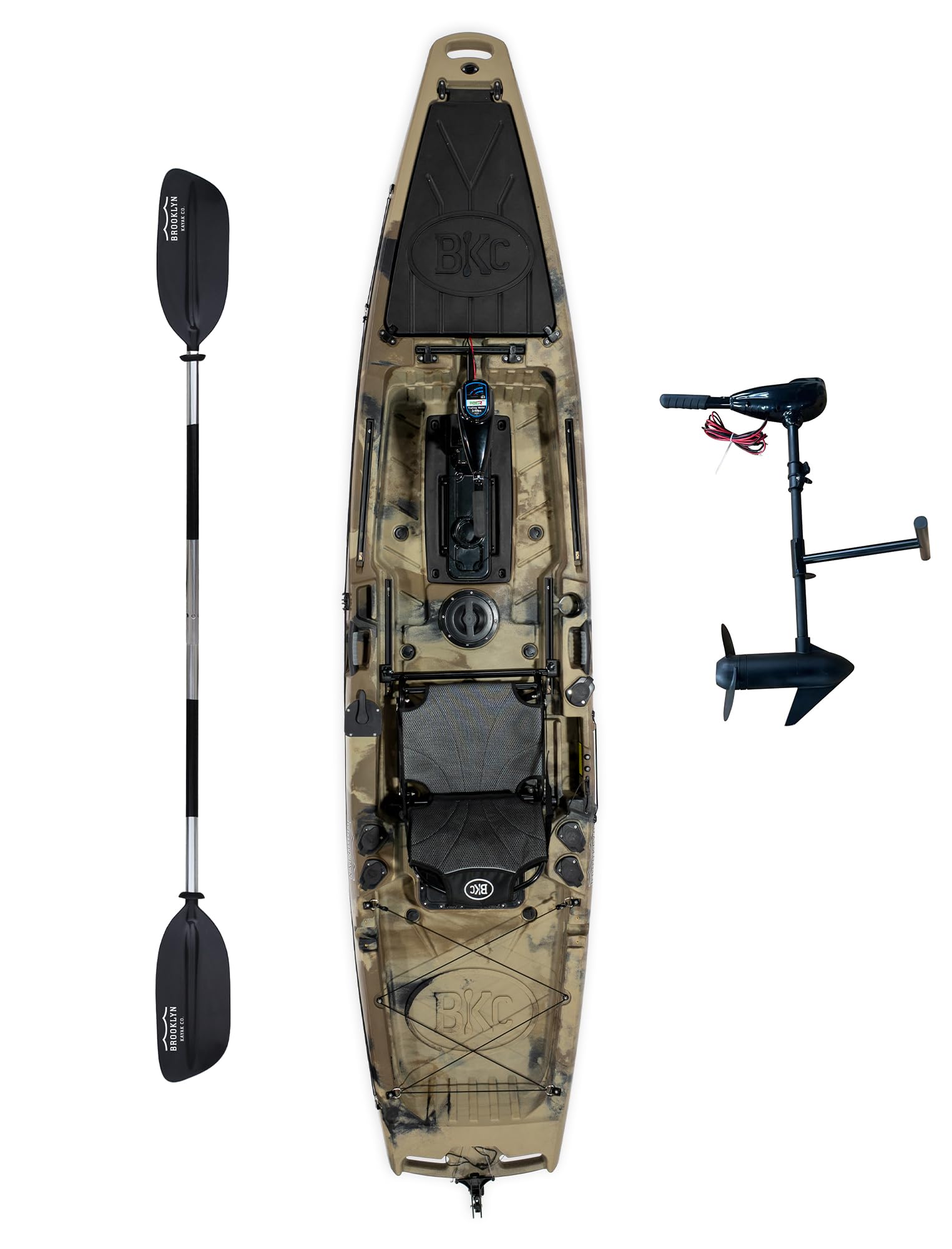
2. BKC Brooklyn 12.5 Pro Pedal Fishing Kayak
The pedal-and-motor hybrid that turns a long troll into a painless, hands-free cruise.
This BKC stands apart because it pairs an integrated trolling motor with a hands-free propeller drive, so you can cover serious water without ever lifting a paddle. The numbers back it up: owners mention pedal speeds of 3-4 mph, up to 5 mph with paddle assist, and a remarkable 27.3 miles in 6 hours of trolling. That is a full morning of fishing on one charge, the kind of range that lets you chase structure instead of hugging the shoreline.
You get a steady platform to fish from: the 12.5-foot hull is built for stability first, and owners rave about how secure it feels, describing it as “like walking on water” and noting they can stand to cast even in low waves. The extra-wide hand-operated rudder (a fin you steer with your hand) keeps you responsive at speed, and the instant reverse feature draws consistent praise for making tight repositioning feel easy in the middle of a fight.
Fishing-ready touches are everywhere: a raised adjustable seat, three flush-mounted rod holders, dual water-resistant hatches, and a large rear cargo area with bungee tie-downs for multi-day trips. The build quality draws comparisons to Hobie and Old Town from experienced owners. The honest catch is the pedal drive itself — several units arrived with the drive missing or broken in shipping, and while support resolved most issues, a few buyers waited weeks for replacements. Plan for that possibility on delivery day. And at 44.5 kg (about 98 pounds), it is noticeably lighter than the Old Town, though still not a one-hand roof job.
Range champion: 27.3 miles in 6 hours of trolling makes this the pick for covering big water, with 558 pounds of capacity to haul it all.
Shipping risk: the pedal drive has arrived missing or damaged in enough boxes that you should inspect it immediately and be ready to call support early.
Grab this if: you want pedal-assisted range plus an integrated motor, and you prioritize stability and standing room for casting.
Look elsewhere if: you demand a flawless unboxing experience — the pedal drive shipping record is the one real blemish on an otherwise excellent kayak.
Understanding the Specs
Pounds of Thrust
This is the trolling motor’s muscle rating. One pound of thrust roughly moves a foot of boat at full speed, so a 45-pound thrust motor can comfortably push a 12-foot kayak against steady wind. More thrust means better control in current, but it also tends to drain the battery faster, so match thrust to the water you actually fish.
Maximum vs. Usable Capacity
Maximum capacity is the absolute engineering limit of the hull, while usable capacity is what the maker recommends for everyday comfort and performance. Old Town lists 525 pounds max but only 329 usable for people and gear. Stay near the usable number and the kayak sits higher, paddles easier, and feels far more stable. Exceeding it turns a nimble hull into a wallowing barge.
FAQ
Do battery powered kayaks come with the battery?
How far can a battery powered kayak go on a single charge?
Can I put a battery powered kayak on top of my car?
What is the difference between a trolling motor and a pedal drive?
How much weight can a battery powered kayak carry?
Is a heavier kayak always more stable?
Can I use a battery powered kayak in saltwater?
Is it easy to mount a fish finder on these kayaks?
Final Thoughts: The Verdict
Across the board, the battery powered kayak winner is the Old Town Sportsman 106 Powered because its factory-fitted Minn Kota motor, saltwater readiness, and drill-free fish finder setup make it the most complete, proven package for serious anglers. If you want maximum range and standing stability, grab the BKC Brooklyn 12.5 Pro, which owners have pushed to 27.3 miles in 6 hours of trolling. And if hauling weight is your real concern, the BKC’s roughly 98-pound hull is the lighter, more manageable option for getting to the water.
How We Picked
We do not accept paid placement. Every pick is matched to a real buyer and a real use-case; we do not hands-on test units.
Sources & Methodology
Specifications: manufacturer listings and product documentation. Review insights: verified customer reviews, as of August 2026. Pricing: not shown on this page (it changes often); check the current price via the retailer link.
As an Amazon Associate, Gadgets Feed earns from qualifying purchases. This does not affect which products we feature.