
Our readers keep the lights on and my morning glass full of iced black tea. As an Amazon Associate, I earn from qualifying purchases.
Specs are compiled from manufacturer listings and verified buyer reviews and can change over time — please confirm the key details on the product page before buying.
If you paddle, row, or motor a small boat after dark, the single biggest safety risk is being invisible to everyone else on the water. Battery powered navigation lights solve that problem without any wiring, drilling, or a permanent 12-volt system — you clamp them on, flip the switch, and you are suddenly visible from a distance that keeps you out of trouble. The catch is that “battery powered” covers everything from a rugged, waterproof workhorse that runs for years on four AAs to a tiny clip-on that dies the first time you dunk it. This guide picks through that range to find the lights that actually hold up on the water.
I’m Min — the founder and writer behind Gadgets Feed. This guide is built by comparing the manufacturers’ published specifications and the patterns across verified customer reviews, so you get each pick’s real strengths and trade-offs instead of marketing spin.
If you need a bright, rechargeable set for a kayak or a fuss-free clamp-on kit for a small skiff, this roundup of the best battery powered navigation lights cuts through the hype to show you which ones last and which ones leave you in the dark.
Our Picks at a Glance

How To Choose The Best Battery Powered Navigation Lights
Picking the right battery-powered light is less about brightness and more about trust. A navigation light’s only job is to stay on and stay attached so other boats see your position and direction. Three factors decide whether a light does that job or leaves you invisible.
Mounting: The Make-or-Break Feature
A light that falls off your kayak at the first wave is worse than no light — it gives you false security. Suction cups are the most common mounting method, but their quality varies wildly. A strong, well-sealed cup on a smooth surface stays put for days. A weak cup pops off the moment the hull gets wet. C-clamps and strap-style mounts are more reliable on textured surfaces like kayak handles or canoe rails, though they take an extra moment to install. Look for a mount that matches your boat’s surface material and your tolerance for re-attaching mid-trip.
Battery Life and Type
You have two basic choices: disposable alkaline batteries (AA, AAA, C-cell) or built-in rechargeable lithium cells. Alkalines give you the freedom to swap fresh cells on the water — a huge advantage on multi-day trips where you cannot plug in. The trade-off is the ongoing cost of batteries. Rechargeable lights save money over time and are often more convenient for evening paddles, but a dead battery means the light is dead until you find a USB port. Check the stated runtime in hours and double it for real-world conditions; cold water and continuous use drain batteries faster than the box suggests.
Water Resistance vs. Waterproofing
An IPX5 rating (meaning it handles low-pressure water jets) means the light handles rain and splashes but will short out if fully submerged, even for a few seconds. Some lights marketed as “water-resistant” fail the first time a wave washes over the deck. A truly waterproof light — often with an O-ring seal (a rubber gasket that blocks water) or a fully potted circuit (electronics sealed in resin) — survives a dunking and keeps working. For kayakers and canoeists who regularly take water over the bow, the IPX rating is the single spec that separates a one-season light from a multi-year tool.
Quick Comparison
| Model | Best For | Mount Type | Power Source | Runtime | Amazon |
|---|---|---|---|---|---|
| Innovative Lighting Bow Light★ Best Overall | All-round durability | Suction cup | 4 AA batteries | Years on one set (owner-reported) | Amazon |
| Attwood Navigation Light KitComplete Kit | Complete clamp-on kit | C-clamp | 3 AAA batteries | 150+ hours | Amazon |
| KayaLuma 3-Pack Clip-On Lights | Ultra-compact backup set | Clip-on / Velcro | CR2032 coin cells | Up to 100 hours | Amazon |
| Pactrade Marine Suction Cup Light | Ultra-portable packable light | Suction cup | 3 AAA batteries | Long (owner-reported) | Amazon |
| Sebnux Portable Bow & Stern Light | Long runtime on C-cells | C-clamp | C-cell batteries | 200+ hours | Amazon |
| CLGMarine Adhesive Base Light | Permanent mount on inflatables | Adhesive / fixed base | 3 AA batteries | — | Amazon |
| Treela 12-Pack USB Lights | Budget-friendly multi-pack | Silicone strap | USB rechargeable | Mixed reports | Amazon |
In‑Depth Reviews
1. Innovative Lighting 560-1110 Portable LED Bow Light
Our pick — 4.5★ from 700+ verified ratings; the strongest balance of quality and price.
The one that paddlers still trust after four years of weekly abuse — because one owner reports replacing the four AA batteries exactly once in that time.
You see the real test of a navigation light in the owner reports. People who bought this for a canoe or kayak are still using the same unit, on the same set of four AA batteries, years later. One owner described replacing the batteries exactly once in four years. That kind of real-world runtime comes from a conservative LED that prioritizes visibility over raw brightness — it is not the most dazzling light on the water, but it stays lit long after flashier units have gone dark. The suction cup, which gets mixed responses overall, draws the most owner attention; the recurring advice is to clean the mounting surface and press firmly, and it holds for days.
The 120-degree beam angle and 10-watt LED throw enough light for other boats to see your position clearly. What wins people over is the build quality — the housing is genuinely waterproof, and buyers report it surviving full submersion and repeated waves. The trade-off is that the on-off switch has a raised lip that is hard to press with a paddle; you will likely need to beach the kayak to turn it on. It is also a single white bow light, so it does not give you red-green-side compliance on its own, but for informal evening paddling where the goal is simply to be seen, this is the most proven pick on the list.
The crowd’s verdict: Owners single out functionality and quality as the top strengths — every rating cluster points to a light that just works, season after season.
Reach for it if: You want a single, dead-reliable bow light that runs for years on one set of AAs and survives dunkings.
Pass it by if: You need red-green port/starboard compliance, or you want a light you can switch on and off from the cockpit without stopping.
2. Attwood Portable Navigation LED Light Kit
The ready-to-run kit that gives you bow and stern in one box — a red-green bow light, a white stern light with a telescoping pole, and two C-clamps.
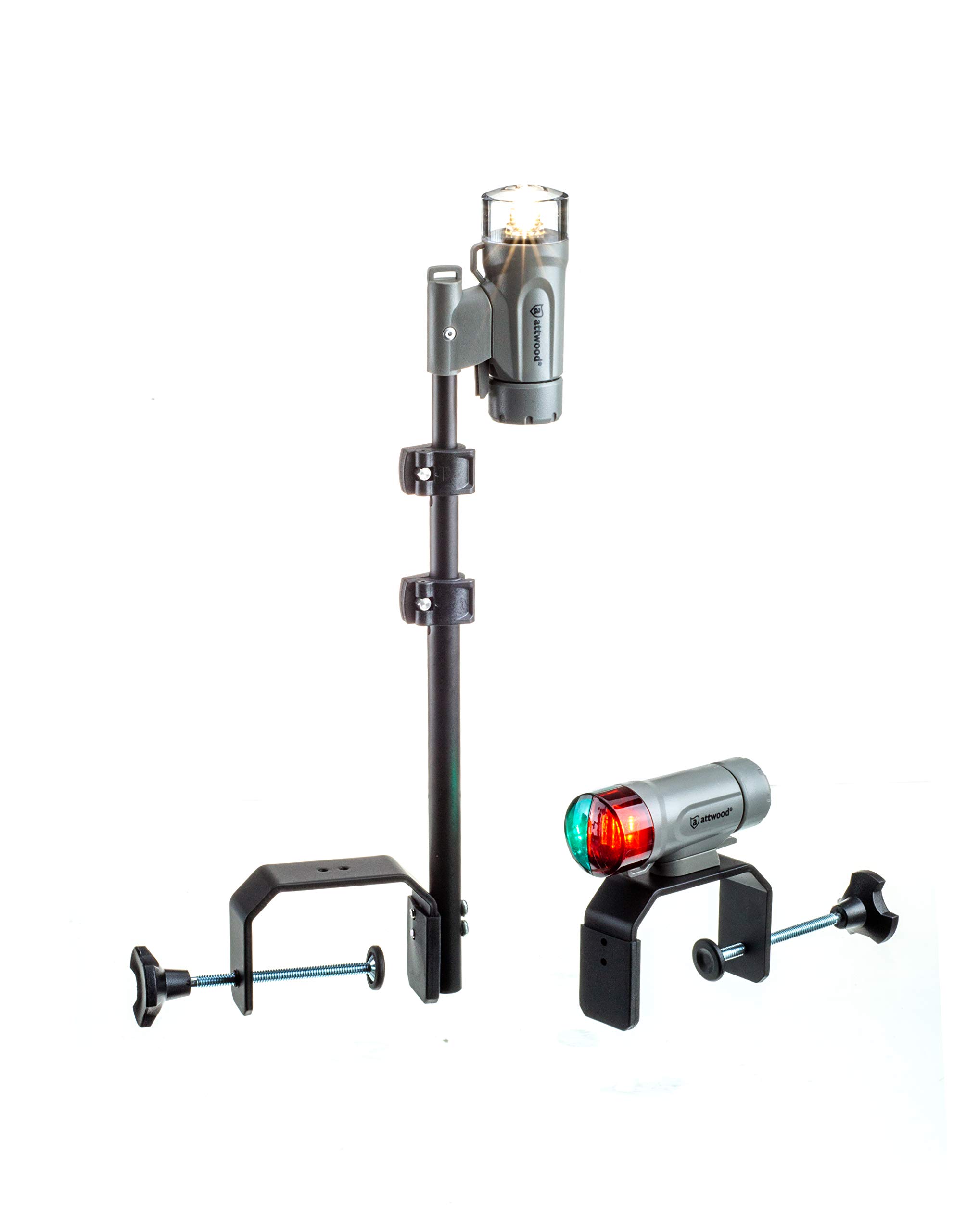
This is the most complete solution on the list: a red-green bow light, a white stern light with a telescoping pole, and two quick-release C-clamp mounts — everything you need to meet basic navigation light rules on a small boat without a single wire. The bow light clamps onto the deck, and the stern pole telescopes up to the required height. Owners consistently call it bright and easy to install, with several noting it saved them the headache of rewiring an old boat’s system. The LED array delivers over 150 hours of continuous run time on three standard AAA batteries, so a season of weekend trips is realistic before a change.
The Attwood kit shares a very similar runtime philosophy with the Sebnux — both prioritize endurance over blinding output — but the Attwood package is more complete from the start, especially with that telescoping stern pole. The mixed feedback centers on the stern light’s build: a few owners mention the pole or the clamp feeling flimsy, and a missing battery holder has been noted in isolated units. Still, for the owner who wants a single purchase that covers bow and stern requirements on a jon boat, skiff, or pontoon, this kit is the clearest path to being legal and visible at night.
The honest take: Brightness and lighting quality earn the most praise, but a small share of owners flag the stern light build as needing care — treat the clamps gently and this kit lasts.
Best for: Small boat owners (jon boat, skiff, dinghy) who want a clamp-on, no-wiring-required bow-and-stern set.
Think twice if: You need a submersible light — the Attwood is water-resistant (meaning it handles splashes), not a dive-rated unit.
3. KayaLuma LED Kayak Lights (3 Pack)

Three tiny lights that slip into a pocket — the brand claims up to 100 hours of run time on the included CR2032 coin cells.
This three-pack covers red, green, and white with three lighting modes (steady, flash, strobe) and, according to the brand, offers 1,000+ feet of visibility. The lights clip onto PFD straps (personal flotation device straps, i.e., life-jacket webbing) or kayak rigging via Velcro bands and run on CR2032 coin cells — and the kit includes six extra batteries plus a mini screwdriver, so you can refresh them on the water. Size is the defining strength here: these are small enough to stash in a dry bag as backups or to lend to a buddy, and they weigh almost nothing. Owners praise the quality and brightness most, and the compact form factor is frequently called out as a plus.
There is an important distinction to make here. The KayaLuma lights are officially IPX5-rated, which means they handle splashes and rain. That makes these a great choice for calm-water paddling and as a backup set, but a risky primary light for anyone who regularly takes waves over the deck. For the price and portability, they earn their place as the grab-and-go option, but keep them dry.
What owners say: Quality and brightness lead the praise list; the durability and water resistance get the most mixed feedback — treat them as splash-proof, not dunk-proof.
Grab these for: Calm-evening paddling, night fishing on still water, or as a lightweight backup set that fits anywhere.
Leave them for: Whitewater, surf launches, or any trip where you expect the lights to go fully underwater.
4. Sebnux Portable Battery Power Boat Navigation Light

The aluminum-bodied unit that promises over 200 hours on two C-cell batteries — far longer than the Attwood’s 150 hours on AAA cells.
This one takes a different approach to battery life: it runs on two C-cell batteries (sold separately) and a creative circuit design that delivers more than 200 hours of run time per set. The C-clamp mount secures firmly to a boat’s deck or rail, and the bright LED output gives excellent visibility even in fog, according to owners. The bow-and-stern kit (two lights) covers both ends of a small boat, pontoon, or kayak.
Brightness and ease of use are the most-praised features, with several owners noting the “excellent visibility in fog.” But the durability metrics are a recurring concern: a meaningful share of customers note the stern light switch failing after a year, and mounting issues with the screws not threading cleanly appear in multiple reviews. The seller’s customer service gets high marks for sending replacement parts, which softens the reliability concern. Compared to the Attwood kit, the Sebnux trades a telescoping pole for a simpler, sturdier design and far longer battery life — an even trade depending on your priorities.
The catch: Owners caution that the stern light attachment can be finicky and some units arrive with machining defects; the seller’s responsive support is worth noting.
Go for it if: You need a light that runs all season without battery changes and you value metal construction over plastic.
skip it if: You want a fuss-free out-of-box experience and cannot afford to troubleshoot a defective clamp or switch.
5. CLGMarine Kayak Battery Portable Navigation Light
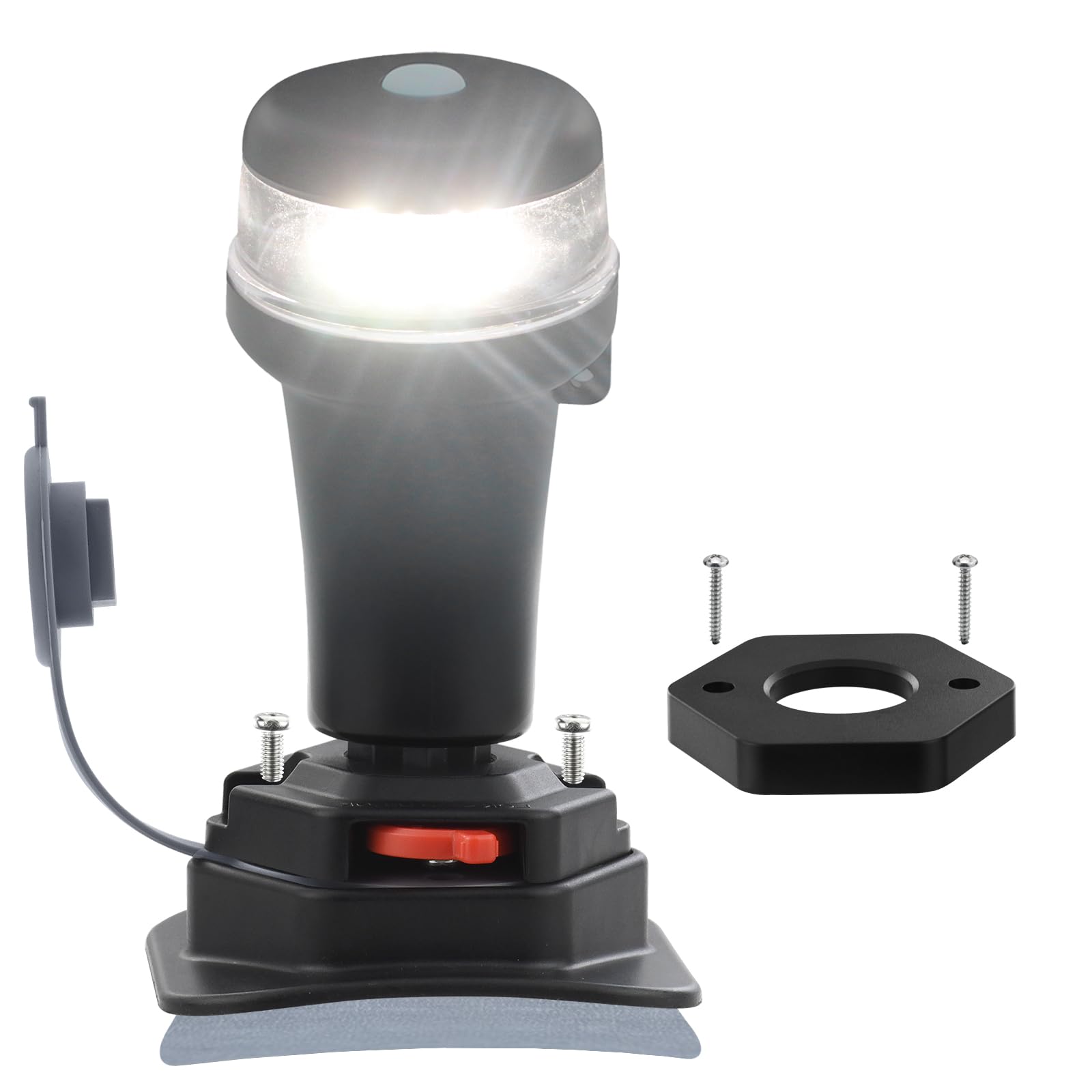
A permanent-mount solution for inflatables that hate suction cups and clamps — the adhesive base bonds directly to PVC, unlike the Innovative Lighting’s suction cup.
Inflatable kayaks and boats present a unique problem: suction cups struggle on textured PVC, and clamps can puncture the hull. The CLGMarine light solves this with a fixed adhesive base that bonds directly to the boat’s surface, paired with a detachable light body that runs on three AA batteries. The design is simple — a white LED in a transparent polycarbonate housing — and the light body separates from the base for storage, so you leave only a low-profile pad on the boat. Owners who installed it on inflatables and SUPs appreciate the secure feel that suction cups cannot deliver.
The data here is lean — only 36 ratings — but the positive mentions center on installation ease. A few reviewers point out that the light stopped working after a single day, so the reliability is a real question mark. For the kayaker who is frustrated by falling suction cups, the adhesive base is a genuinely different approach; just budget for the possibility that this may be a single-season light. At this price point, it is a niche tool for a specific problem rather than a universal recommendation.
What to know: Owners praise the installation process; the reliability is a mixed area — think of it as a targeted solution for inflatable owners willing to test it.
Ideal for: Inflatable kayak and SUP owners who cannot get suction cups or clamps to stay put.
Not for: Anyone who needs a guaranteed long-term light or prefers a well-reviewed, high-volume product.
6. Pactrade Marine Battery Navigation Light (Suction Cup)
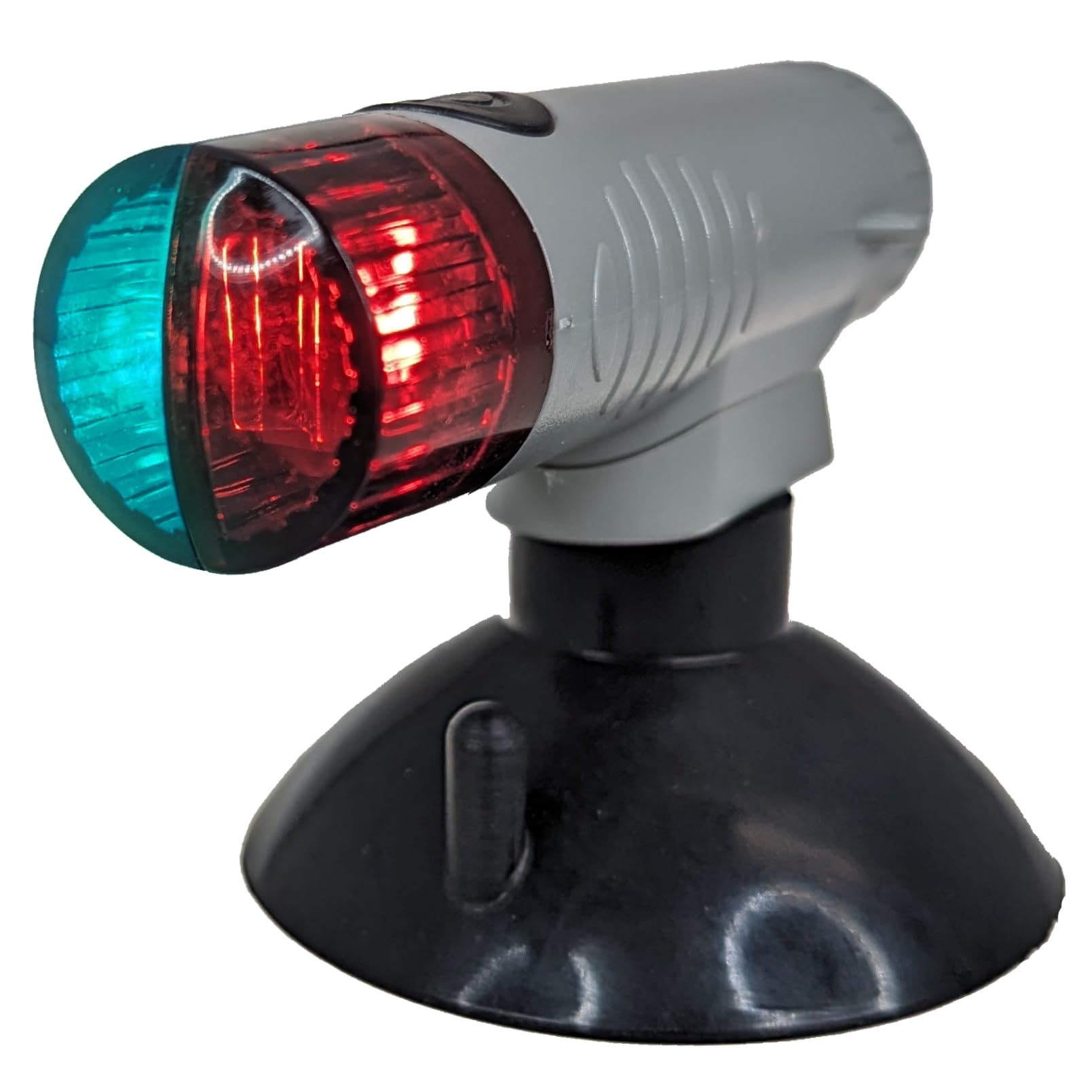
A compact red-green bow light that packs down to 4.5 x 3.2 x 3 inches and runs a long time on three AAA batteries.
This is a single red-green LED bow light with a suction cup mount and a quick-release tab that lets you detach the light body without pulling the cup off the boat. It runs on three AAA batteries, and owners consistently report “long battery life” and a compact form that stows easily in a gear bag. The light is not designed to illuminate your path — it is for being seen from a distance — and owners confirm it works well for harbor rowing and dawn patrols.
The suction cup is the recurring theme. It holds tight to smooth fiberglass but fails on varnished wood or textured surfaces. A few owners resorted to taping the light to the bow. The brightness is also modest up close; one owner summed it up by saying it is “not super bright but avoids blinding” you, and visible from a distance. For the paddler who already has a primary light and wants a compact, packable backup with red-green side indication, the Pactrade is a solid fit — just check your boat’s surface before relying on the suction cup alone.
Owner consensus: Compact design and long battery life are consistent praise points; the suction cup’s grip varies with surface smoothness — test it before you need it.
Works for: Paddlers who need an easily stashed backup red-green light for smooth-hulled kayaks or fiberglass boats.
Not ideal for: Rough-surface boats (varnished wood, textured plastic) where the suction cup cannot form a seal.
7. Treela 12-Piece Battery Boat Navigation Lights
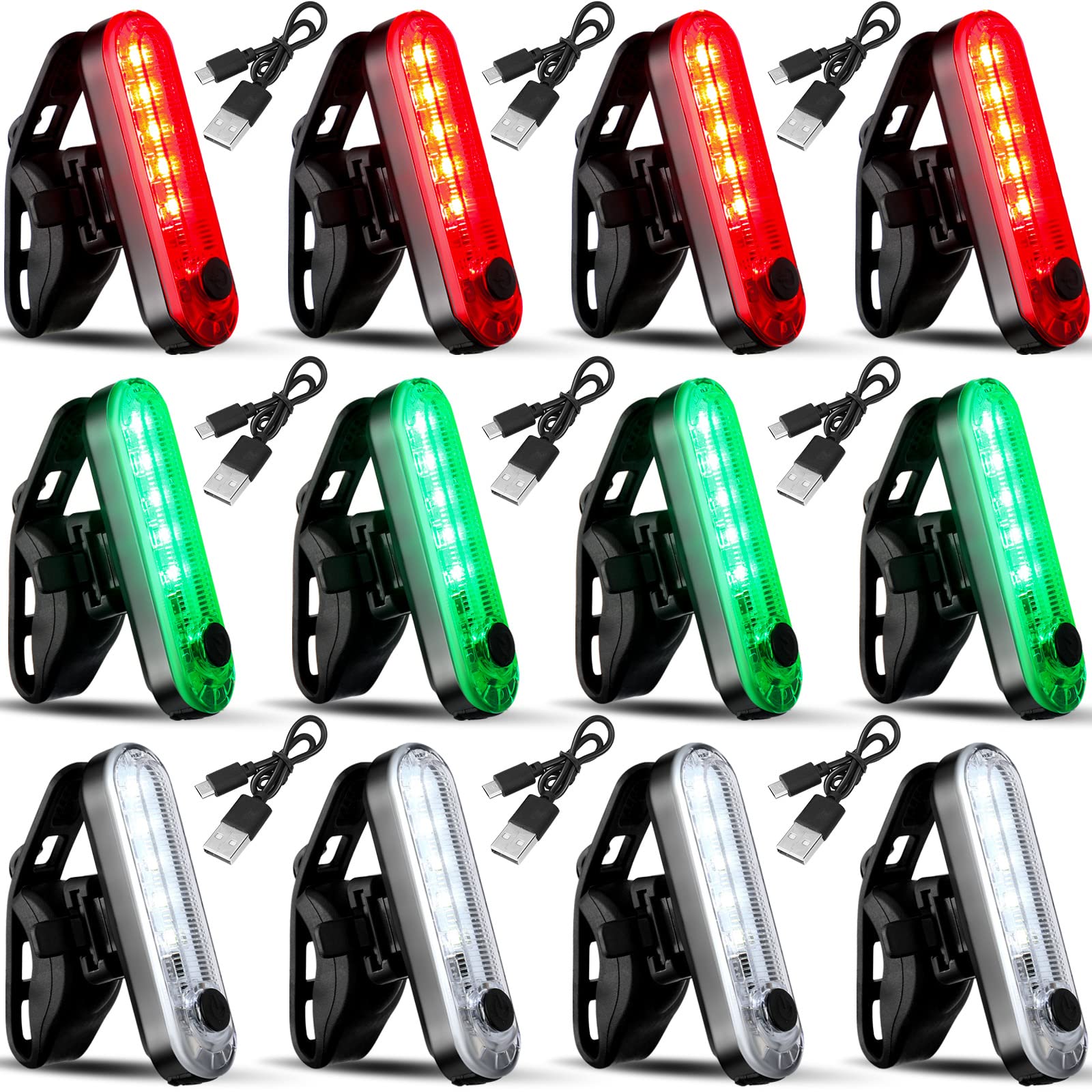
Twelve USB-rechargeable lights for the price of one premium unit — with a reliability warning: buyer reports describe units arriving dead from the start.
This is the quantity play: 12 lights (red, green, and white) with four flashing modes, USB-rechargeable lithium batteries, and flexible silicone mounting straps. Each light has its own charging cable, so you can set up a full spread — bow, stern, paddle tips, cockpit — for under thirty dollars. The brightness per light is genuinely good, with owners describing them as “bright little navigation lights.” The silicone straps wrap around kayak handles, canoe rails, and PFD webbing without requiring any permanent installation.
Reliability is the honest counterweight. A meaningful share of reports — enough to be the single most-discussed aspect — describe units arriving dead from the start, failing to charge, or shorting out after a splash of water. One owner stated that three of ten lights did not work initially, and others stopped working after moisture exposure. The water resistance is inconsistent, and the plastic cases can loosen. These are best understood as disposable or very-light-duty lights: perfect for a single trip, a loaner set, or decorating a dock, but not a primary navigation system you bet your safety on. If the idea of getting a dozen lights for the price of one appeals to you, just factor in a failure rate.
Where the value shines
- 12 lights with USB rechargeable batteries included — no buying disposables.
- Four flashing modes (steady, chase, fast chase, flashlight) add versatility.
- Silicone straps install instantly on nearly any boat or gear.
The gamble you take
- Reliability is the most common owner complaint — dead-on-arrival units are not rare.
- Water resistance is inconsistent; a strong splash can kill a light.
- Plastic build quality feels disposable rather than durable.
The best bet for: Group trips where you want a cheap light for every boat, or as a low-stakes decoration and backup set.
The honest warning: If you need a light you can trust in the dark on open water, invest in a single reliable unit instead — the Treela set is a grab-bag of individual units with varying quality.
Understanding the Specs
Mount Type
The mount decides whether your light stays put or takes a swim. Suction cups work best on smooth, clean fiberglass or plastic — they fail on textured or varnished surfaces. C-clamps give a more secure grip on rails and gunwales (the top edges of a boat’s sides), but they can be awkward to position on inflatables. Adhesive bases offer a permanent solution for inflatables, but you cannot move them without peeling the pad. Strap-style mounts (silicone or Velcro) are the fastest to install and adjust, but they are less rigid and may shift in rough water. Choose the mount that matches your boat’s surface and how often you plan to move the light.
Runtime and Battery Type
Runtime is listed in hours, but the real number depends on battery chemistry and temperature. Alkaline cells (AA, AAA, C) let you swap fresh ones on the water — critical for multi-day trips. Rechargeable lithium cells save money over time but require a USB port to top up. A rating of “150+ hours” with AAA batteries typically means continuous low-power operation; using a strobe or flash mode cuts runtime significantly. For a season of weekend trips, look for at least 100 hours of stated runtime from alkaline lights, or a rechargeable battery that lasts a full evening without needing a recharge.
FAQ
Are battery powered navigation lights legal for my boat?
How long do the batteries actually last in real use?
Can I use these lights in saltwater?
Will a suction cup light stay attached at high speeds?
What does IPX5 mean for a navigation light?
Which battery type is better: AA, AAA, or C-cell?
Can I mount a navigation light on an inflatable kayak?
How bright should battery powered navigation lights be?
What is the difference between a bow light and a stern light?
Is it safe to use rechargeable lithium batteries in a navigation light?
Final Thoughts: The Verdict
If you want one dependable pick, the battery powered navigation lights winner is the Innovative Lighting 560-1110 because it delivers proven, years-long battery life in a genuinely waterproof build — the crowd favorite that earned its top spot by surviving real paddle trips. If you want a complete bow-and-stern kit that is ready to clamp on and go, grab the Attwood Portable Navigation Kit. And for the paddler who needs a pocket-sized backup or a lightweight three-color set, the KayaLuma 3-Pack is the compact pick — just keep it out of the drink.
How We Picked
We do not accept paid placement. Every pick is matched to a real buyer and a real use-case; we do not hands-on test units.
Sources & Methodology
Specifications: manufacturer listings and product documentation. Review insights: verified customer reviews, as of July 2026. Pricing: not shown on this page (it changes often); check the current price via the retailer link.
As an Amazon Associate, Gadgets Feed earns from qualifying purchases. This does not affect which products we feature.