
Our readers keep the lights on and my morning glass full of iced black tea. As an Amazon Associate, I earn from qualifying purchases.
Specs are compiled from manufacturer listings and verified buyer reviews and can change over time — please confirm the key details on the product page before buying.
You are at a campsite, in a parked car, or stuck without power, and you need to plug something in. A battery-powered outlet — a portable power station with a standard household plug built in — stores energy inside and turns it into usable AC power, so you can charge a laptop, run a fan, or keep a CPAP machine (a breathing device for sleep apnea) going anywhere. The hard part is picking the right size: too small and your gear dies early; too big and you are carrying a brick.
This guide matches the published specs and verified customer review patterns to each pick’s real strengths and trade-offs, so you get facts instead of marketing spin.
The seven battery-powered outlet options below cover every capacity (measured in watt-hours, or Wh), wattage, and port setup worth your attention — from a 1.3-pound pocket unit to a 288Wh home backup.
Our Picks at a Glance

How To Choose The Best Battery Powered Outlet
Every battery-powered outlet is a trade-off between how much power it can push at once (wattage), how long it can keep that power flowing (capacity in watt-hours or mAh), and how heavy it is to carry. Here are the three specs that decide which one fits your life.
Start With Your Device’s Wattage
The AC outlet on these stations has a maximum wattage — typical ratings are 65W, 120W, 135W, 300W, or 350W. Check the power brick of your laptop or the label on your CPAP machine; that number must be lower than the station’s rated output. A station rated for 120W will run a 65W laptop charger safely, but plugging in a 150W appliance will trip the protection or damage the unit.
Battery Capacity Tells You How Long It Lasts
Capacity is given in watt-hours (Wh) or milliamp-hours (mAh). A 98Wh station can run a 10W phone charger for nearly 10 hours but might only run a 65W laptop for about 1.5 hours. For overnight CPAP use, look at 192Wh or higher. For topping off a phone during a day trip, 88.8Wh to 98Wh is plenty.
Check the Recharge Options
Most stations recharge via a wall adapter, a car 12V port, or a solar panel (sold separately). A unit that accepts 65W USB-C PD input (USB-C Power Delivery — a fast-charging standard that delivers up to 65 watts) refills far faster than one limited to a basic DC adapter — some hit 80% in one hour, while others need four hours for a full charge.
Quick Comparison
| Model | Best For | Rated Output (AC) | Battery Capacity | Weight | Amazon |
|---|---|---|---|---|---|
| PlantPalGear Milwaukee Inverter★ Best Overall | Milwaukee battery owners on a budget | 220W (330W peak) | — | — | Amazon |
| HOWEASY Portable Power StationAlso Great | Fast-charging laptops & 7-device campsite | 135W (270W peak) | 98Wh | 2.3 lbs | Amazon |
| DARAN 288Wh Power Station | CPAP & family camping power hub | 350W (600W peak) | 288Wh | 8.2 lbs | Amazon |
| DaranEner 192Wh Power Station | Extended-run LiFePO4 backup | 300W (600W surge) | 192Wh | 5.7 lbs | Amazon |
| Apowking 300W Power Station | Large-battery solar generator | 300W (600W peak) | 220Wh | 5 lbs | Amazon |
| ZeroKor 120W Power Station | Ultralight backpacking backup | 120W | 97.6Wh | 2.2 lbs | Amazon |
| powkey Portable Power Station | Ultra-compact everyday carry | 65W | 24000mAh / 88.8Wh | 1.3 lbs | Amazon |
In‑Depth Reviews
1. PlantPalGear 220W Inverter Compatible with Milwaukee 18V Battery
Our pick — over 4★ from 800+ verified ratings; the strongest balance of quality and price.
A bare-bones inverter that turns any Milwaukee 18V battery into a 220W outlet.
This is not a standalone battery station — it is a converter that plugs into a compatible Milwaukee 18V battery (models like 48-11-1815, 48-11-1850, 48-11-1820, battery not included) and gives you a 110V AC outlet, two 18W USB QC ports, and one 30W PD Type-C port. It outputs 220W continuous (330W peak) with a pure sine wave inverter. The 400LM LED work light has 3 adjustable brightness levels and a 90-degree adjustable angle.
Buyers love it for jobsite and camping use. One reported charging a phone all day on a 5.0 battery at a baseball game. The cooling fan is audible — a reviewer described it as “not loud annoying, but you can hear it.” A key limitation: one owner said it “won’t power outdoor patio lights more than 5 mins,” so it is best for small electronics, not continuous lighting. It lacks a built-in display and uses the battery voltage as the indicator.
The Upside
- Low entry cost if you already own Milwaukee 18V batteries
- 220W continuous (330W peak) output is competitive for small tools and electronics
- Integrated 400LM work light with strobe function
The Downside
- No battery included — you must supply your own Milwaukee 18V pack
- Not for steady outdoor lighting or high-draw loads
Reach for this if: You already own Milwaukee power tool batteries and need a cheap, portable AC outlet for charging phones or a laptop on a job site or camping.
Look elsewhere if: You want an all-in-one unit with its own battery — the powkey or ZeroKor are self-contained alternatives.
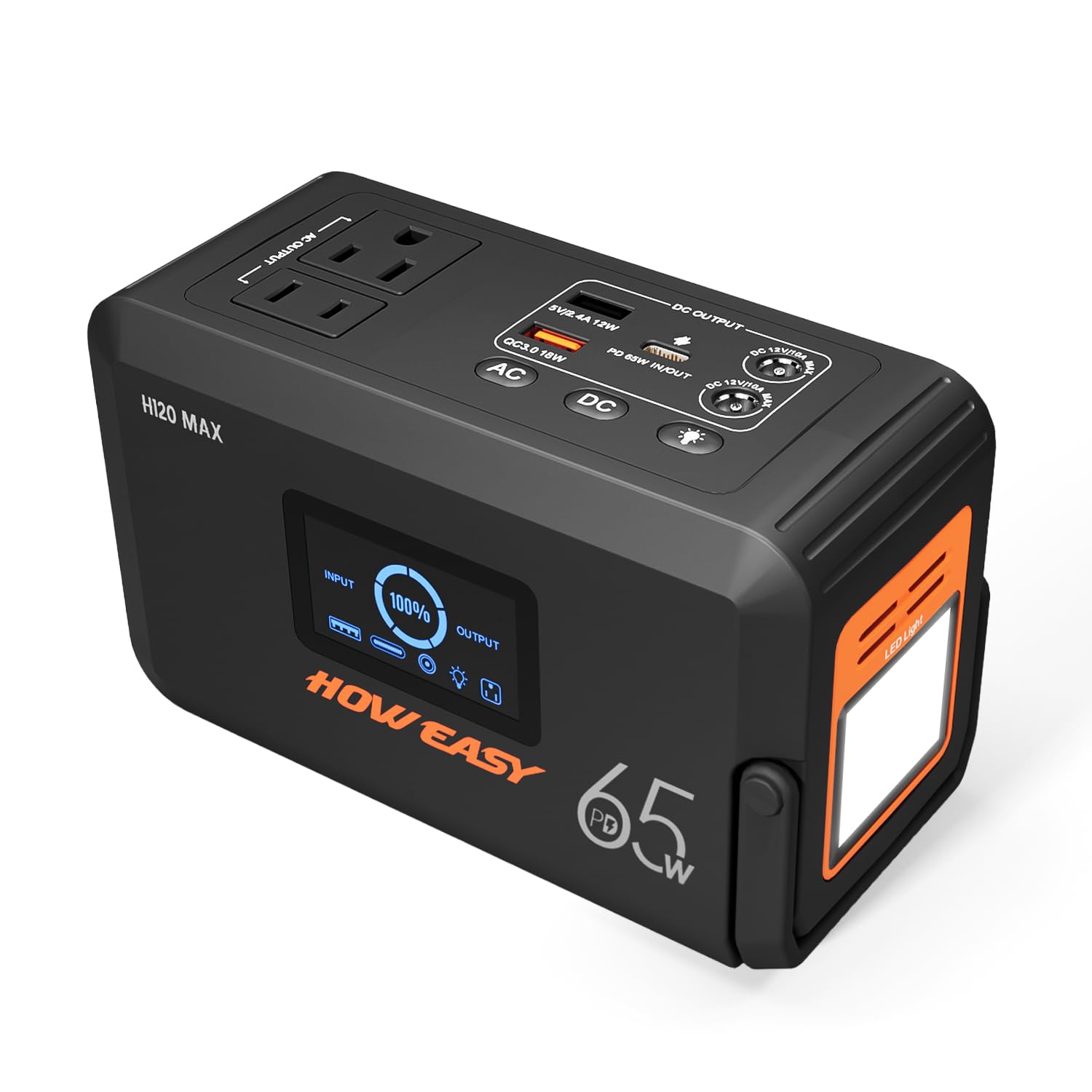
2. HOWEASY Portable Power Station 135W (270W Peak) Solar Generator
A 135W pocket power station that charges a laptop to 80% in an hour.
This unit packs the most utility into the smallest space of any pick here. It delivers 135W of continuous AC power (with a 270W peak) through two AC outlets, at 135W versus the powkey’s 65W — meaning it can comfortably run two laptops or a small fan plus a phone simultaneously. The 65W PD port (USB-C Power Delivery, a fast-charging standard) charges a laptop to 80% in 1 hour.
Buyers report it is “perfect for on the go power” for events and craft shows. One vendor mentioned using it to plug in lights at night events and a fan. The 4-mode LED flashlight (low/medium/high/SOS) is handy for emergencies. It is also airline-safe at 98Wh (under the FAA’s 100Wh limit for carry-on lithium batteries). At 2.3 lbs and 6.6 x 4 x 3 inches, it is compact enough for a backpack — though at 6.6 x 4 x 3 inches versus the powkey’s 6.9 x 3.9 x 1.9 inches, it is still very portable.
Why It Wins
- Fast 65W PD recharges itself and laptops quickly
- Two AC outlets let you power two devices at once
- FAA-compliant battery safe for air travel
The Trade-Off
- No physical on/off switch — a reviewer noted pressing the DC button is needed to stop idle drain
- 98Wh capacity is best for light-duty use, not all-night CPAP
Who this fits: The mobile worker, camper, or vendor who needs a fast-charging laptop backup that fits in a backpack and can run two small devices at once.
Who should skip: Anyone who needs to power a high-watt appliance like a hair dryer or mini fridge — those draw more than 135W.
3. DARAN NEO300L 350W Portable Power Station, 288Wh LiFePO4 Battery
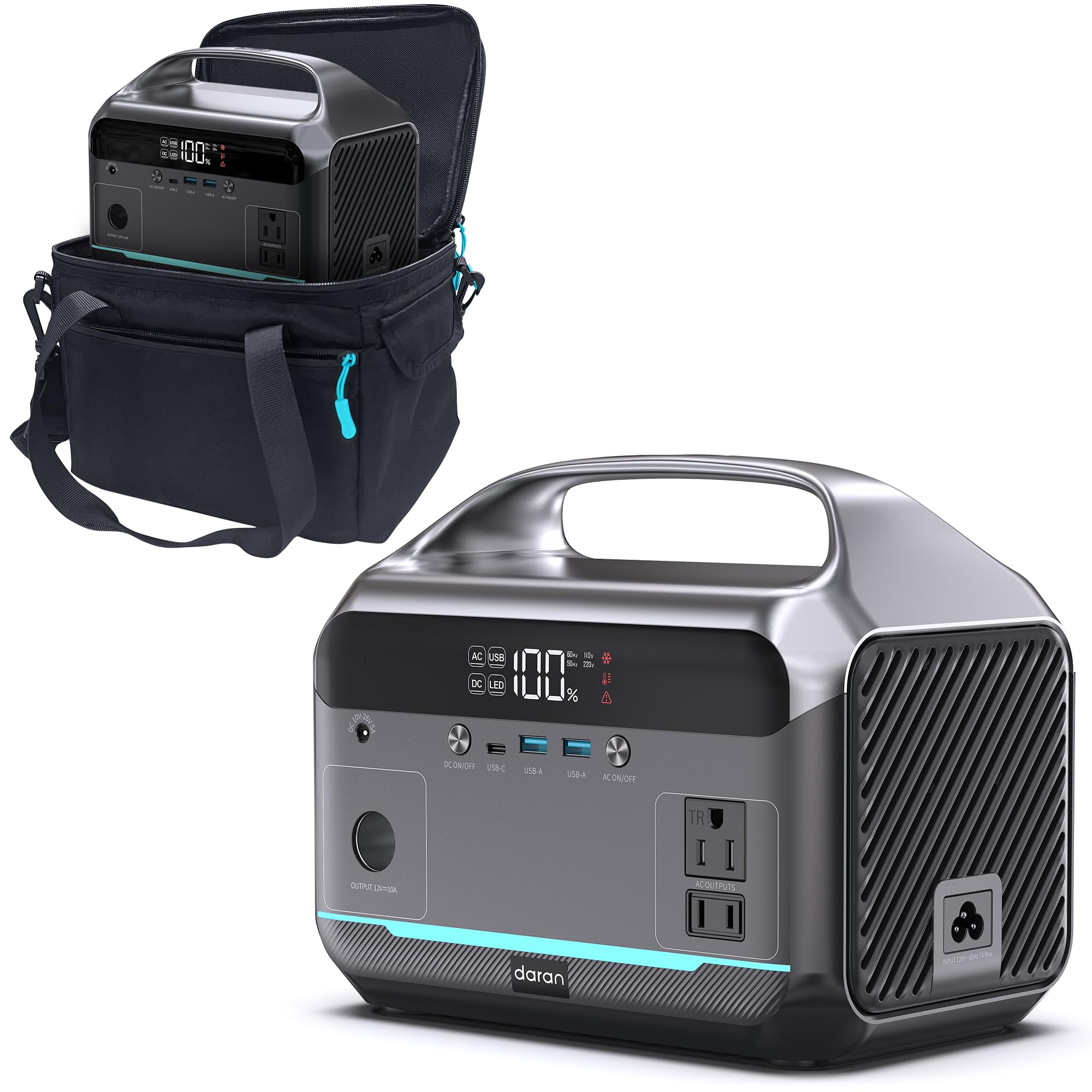
A 288Wh LiFePO4 station that runs a CPAP machine for over eight hours, per the manufacturer.
This is the heavyweight for serious home backup. With 288Wh of LiFePO4 battery capacity and 350W rated power (600W surge), The manufacturer rates it to run a 30W CPAP machine for up to 8.16 hours.. It has 7 output ports including 2 AC outlets, a 60W PD USB-C, and 2 USB-A ports — enough to charge a family’s phones, a tablet, and a mini projector during a camping trip.
The LiFePO4 chemistry (lithium iron phosphate, a type of battery that lasts many more charge cycles than standard lithium-ion) gives this unit a much longer lifespan. It recharges in about 2.1 hours via AC wall outlet. Weighing 8.2 lbs and sized at 10 x 6.6 x 8.2 inches, it is heavier than the DaranEner 192Wh model but holds 288Wh versus the DaranEner’s 192Wh. The included storage bag and rear LED with SOS mode add to its emergency-ready appeal.
What Makes It Exceptional
- Big 288Wh LiFePO4 battery lasts thousands of cycles
- 350W output runs high-draw devices like a stew pot or CPAP
- 60W PD USB-C fast-charges laptops directly
What to Know
- At 8.2 lbs, it is not a daily carry in a backpack
- Solar panels and car charging cable sold separately
Reach for this if: You need a sturdy emergency backup for home and RV trips that can run a CPAP all night and charge everything in sight.
Look elsewhere if: You only need a lightweight companion for short day hikes — the HOWEASY above weighs 2.3 lbs versus the DARAN’s 8.2 lbs.
4. DaranEner Portable Power Station, 192Wh LiFePO4 Battery, 300W (600W Surge)
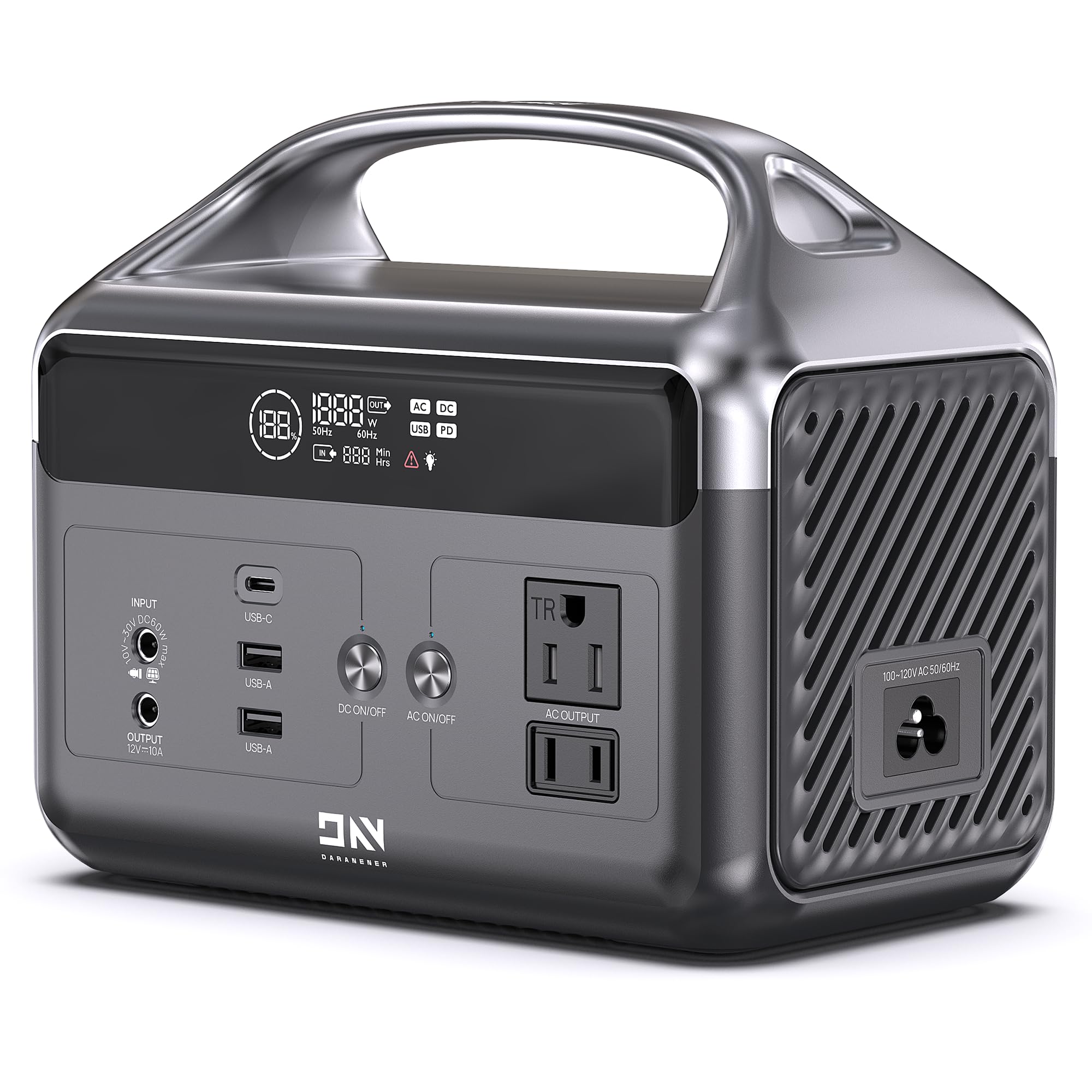
A 192Wh LiFePO4 generator that owners mention still had 40% charge after 6 hours of fan use.
This station hits a balance between capacity and portability. It delivers 300W (600W surge) of pure sine wave output through 2 AC outlets, which means clean power for sensitive electronics like laptops and CPAP machines. The 192Wh LiFePO4 battery is designed to last many more cycles than standard lithium-ion packs. One reviewer noted running a fan for 6 hours and still having 40% charge left. It is 5.7 lbs and about the size of a toaster, making it much easier to move than the 8.2-lb DARAN 288Wh model.
The station charges up to 6 devices at once. The 60W USB-C PD port can fast-charge a laptop directly. Recharge via AC wall outlet (100W max), car charger, or solar panel (60W DC input) with the built-in MPPT controller (a smart chip that pulls the maximum power from a solar panel). A reviewer who bought it specifically for a wifi router got about 9 hours of runtime. The 4-mode LED flashlight is integrated into the compact body.
Strong Points
- LiFePO4 battery lasts many more cycles than standard packs
- Pure sine wave output protects sensitive electronics
- Fair weight for the capacity at 5.7 lbs
Potential Annoyances
- Some owners noted the battery gauge can be slightly off
- The unit may ship with a very low charge — a reviewer found it completely discharged
Who this fits: The camper or emergency prepper who wants a mid-size battery that will last many years and can run a router, fan, or laptop for several hours.
Who should skip: Anyone who needs a full night of CPAP at high pressure — the 192Wh may fall short; step up to the 288Wh DARAN.
5. Apowking 300W Portable Power Station, 220Wh / 60000mAh
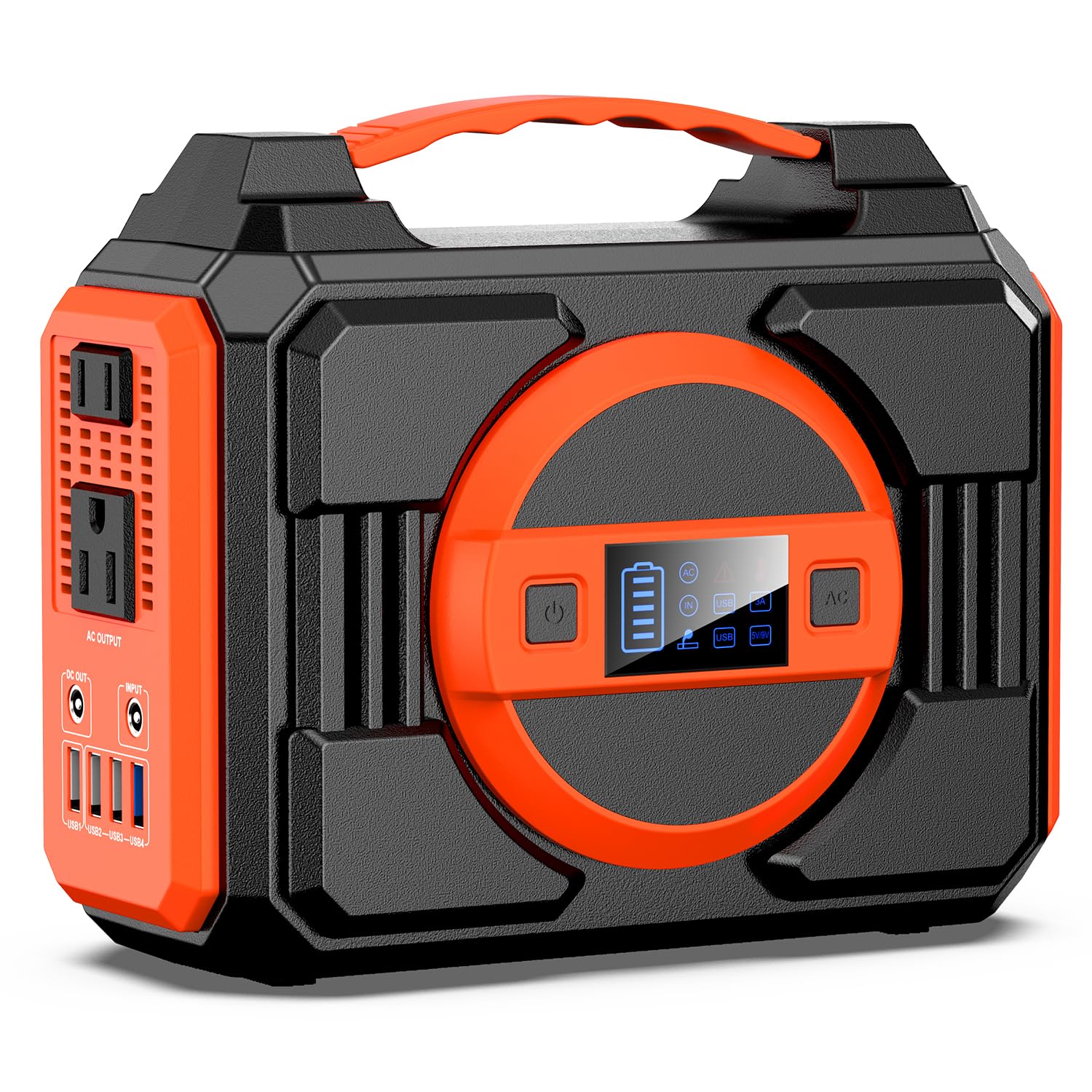
A 220Wh station with 7 ports that charges silently without a noisy fan.
This unit sacrifices a bit of output wattage (300W rated, same as the DaranEner) for a larger 220Wh lithium-ion battery capacity. It can charge up to 7 devices at once with 2 AC outlets (pure sine wave), 3 USB-A ports, a USB-A QC port, and a DC vehicle output. The bigger LED panel on the back provides area lighting, which is a welcome upgrade versus the smaller flashlight on most competitors.
It weighs 5 lbs and measures 8.5 x 6.7 x 4.1 inches — actually a bit lighter than the 5.7-lb DaranEner despite holding 220Wh versus the DaranEner’s 192Wh. The manufacturer notes that the unit operates with silent cooling vents, so no fan noise in a tent. Recharge options include a wall adapter, car 12V port, or solar panel. The real-time display shows remaining power and AC output status.
What Stands Out
- Large 220Wh battery in a 5-lb package
- Big rear LED light brightens a whole campsite
- Fanless design keeps it silent during use
What to Note
- No USB-C PD port for fast laptop charging — only standard USB-A
- Li-ion battery not as cycle-stable as the LiFePO4 in the DaranEner
Reach for this if: You want a lightweight station with a big battery for running lights and charging multiple phones at a campsite without any fan hum.
Look elsewhere if: You need a USB-C port to fast-charge a modern laptop — the HOWEASY or DaranEner have that.
6. ZeroKor 120W Portable Power Station, 97.6Wh / 26400mAh

A 2.2-lb power station that fits in a backpack and runs small electronics all day.
This is the lightest mains-capable station on the list, at only 2.2 lbs. It offers 120W rated AC output through two outlets, the same form factor as the HOWEASY but with a slightly different port arrangement. The 97.6Wh / 26400mAh lithium-ion battery pack can power a smartphone, tablet, laptop, camera, or drone without issue. The built-in LED flashlight has reading mode and SOS mode.
Three ways to recharge: solar panel (not included), USB-C wall adapter, or car USB port. The screen display shows remaining power and AC/DC status. It has 7 ports total, including a DC 12V output. The manufacturer advises that using appliances over 120W may damage the unit, and specifically calls out gear with air compressors as unsuitable.
Why It Works
- At 2.2 lbs, it is the lightest full-size AC outlet option here
- Two AC outlets for the price of a compact unit
- Multiple USB and DC ports for versatility
Its Limits
- 120W AC limit means no high-power appliances
- No customer reviews in the data to confirm real-world performance
Who this fits: The ultralight backpacker or day-tripper who just needs to keep a phone, tablet, and maybe a small laptop topped off without carrying extra weight.
Who should skip: Anyone who needs to power a power-hungry device like a hair dryer or air compressor — those exceed the 120W limit.
7. powkey Portable Power Station 65W / 110V AC, 24000mAh / 88.8Wh

A featherlight 1.3-lb station that slips into a bag and powers small gadgets via AC.
This is the lightest AC-outlet station here by a wide margin: 1.3 lbs and dimensions of 6.9 x 3.9 x 1.9 inches. Its 65W AC outlet is enough for a small laptop or charging a phone and drone, but not for running a fan or larger appliances. It has a 24000mAh (88.8Wh) lithium-ion battery, two USB outputs (including QC3.0), and a DC 9~12.6V output.
Customers note mixed real-world results. One reviewer was happy it charged their phone all weekend on a camping trip. Another found it “very compact” and loved having a wall-socket-style outlet for “a wide range of small gadgets.” But a critical one said: “The power station charged the laptop just one time; it’s impossible to use it to charge anything else.” The self-recharge time is up to 4 hours via AC wall input (15V/2A) — slower than the HOWEASY’s 65W PD input.
What We Like
- Extremely light at 1.3 lbs — easy daily carry
- Three charging methods: AC, car, and solar
- Very slim profile for storage
What’s Rough
- 65W AC output is the weakest of the list
- One buyer mentioned limited capacity — only one laptop charge
Who this fits: The minimalist who needs the smallest possible AC outlet for occasional phone and small laptop topping off — not for heavy or continuous use.
Who should skip: Anyone who expects to fully charge a laptop and then still run other gear — the 88.8Wh battery is simply not big enough.
Understanding the Specs
Watt-Hours (Wh) vs. Milliamp-Hours (mAh)
Both measure how much energy the battery holds. A watt-hour is the most useful number: it tells you how many hours the station can deliver a given load. If a device draws 50W, a 100Wh station runs it for about 2 hours. The mAh figure is typically given at a lower voltage (often 3.6V or 3.7V), so you cannot directly compare mAh numbers across products unless you do voltage math — stick to Wh for real-world comparisons.
Pure Sine Wave vs. Modified Sine Wave
Pure sine wave inverters produce an AC power waveform that is identical to the power from your home wall outlet. Sensitive electronics — laptops, CPAP machines, camera battery chargers — run cleaner and safer on pure sine wave. Most products in this guide use pure sine wave; it is a feature worth confirming if you plan to power medical or expensive gear.
FAQ
What can I power with a 65W battery powered outlet?
How long does a 98Wh battery powered outlet last?
Can a battery powered outlet run a CPAP machine?
What is the difference between LiFePO4 and standard lithium-ion batteries?
Can I charge a battery powered outlet with a solar panel?
How long does it take to recharge a portable power station?
Can I take a battery powered outlet on an airplane?
What is pure sine wave output and why does it matter?
What is the difference between mAh and Wh for these power stations?
How do I store a portable power station when not using it?
Final Thoughts: The Verdict
Across the board, the battery powered outlet winner is the HOWEASY Portable Power Station because it combines a 65W PD recharge, two AC outlets, and a 98Wh battery that is both airline-safe and fast to top off — all in a 2.3-lb package that fits everyday carry. If you want a serious emergency backup with LiFePO4 longevity and enough capacity for a full night of CPAP, grab the DARAN 288Wh Power Station. And for a bare-bones AC outlet that leverages tools you already own, the standout is the PlantPalGear Milwaukee Inverter.
How We Picked
We do not accept paid placement. Every pick is matched to a real buyer and a real use-case; we do not hands-on test units.
Sources & Methodology
Specifications: manufacturer listings and product documentation. Review insights: verified customer reviews, as of July 2026. Pricing: not shown on this page (it changes often); check the current price via the retailer link.
As an Amazon Associate, Gadgets Feed earns from qualifying purchases. This does not affect which products we feature.