
Our readers keep the lights on and my morning glass full of iced black tea. As an Amazon Associate, I earn from qualifying purchases.
Specs are compiled from manufacturer listings and verified buyer reviews and can change over time — please confirm the key details on the product page before buying.
That rotten-egg smell means a propane leak is somewhere close, but you cannot see it and the odor never tells you exactly where. A battery-powered sniffer lets you walk around your RV, grill, or furnace and find the exact joint, no outlet needed. The right one catches a tiny gas trace before it turns into real trouble.
I’m Min — the founder and writer behind Gadgets Feed. This guide is built by comparing the manufacturers’ published specifications and the patterns across verified customer reviews, so you get each pick’s real strengths and trade-offs instead of marketing spin.
Whether you are checking stove connections in a camper or inspecting a new gas line in the basement, a battery powered propane detector with a sensitive sensor, a flexible probe, and clear alerts warns you in ways a smoke alarm simply cannot.
Quick Picks
- TopTes PT-830S Rechargeable Gas Leak Detector — Top Performer
- TopTes PT520B+ Rechargeable Gas Leak Detector — Precision Reader
- TopTes PT520A+ Rechargeable Gas Leak Detector — Bendable Reach
- AEGTEST AGT-1988PRO Rechargeable Natural Gas — Best Value
- TopTes PT760 Rechargeable Natural Gas Detector — Rechargeable Workhorse
- Povlen CGD902A Natural Gas Leak Detector — Budget Gooseneck
- TopTes PT299 Gas Leak Detector — Compact Starter
How To Choose The Best Battery Powered Propane Detector
Before you buy, think about where you will use it most — inside a tight RV cabinet, next to a water heater, or out on the patio with a gas grill. A few key specs separate a tool that saves your day from one that sits in a drawer.
Probe Type and Length
The sensor tip needs to reach the leak. A flexible gooseneck (11 to 17 inches) bends around corners and stays put, while a telescopic rod extends when you need it and collapses for storage. A short, rigid tip forces you to crawl into dark spots; a long probe pulls the sensor to the pipe without your body getting in the way.
Sensitivity and Measurement Scale
Most detectors display readings in PPM (parts per million — the concentration of gas molecules in the air) or %LEL (percent of the Lower Explosive Limit — how close the air is to being flammable). A model that shows a number on a screen lets you see if a leak is getting worse or staying steady, which a simple beeping alarm cannot tell you.
Alarm and Feedback System
A loud buzzer is the minimum. Visual alerts (flashing lights or a color-changing screen) help when you are near a noisy furnace, and a vibration alert — common on the higher-end models — catches your attention if you wear ear protection or work in a loud garage. The faster the response time, the less time you spend waving the probe around.
Quick Comparison
| Model | Best For | Probe / Reach | Display Type | Power Source | Amazon |
|---|---|---|---|---|---|
| TopTes PT-830S | Professional-grade diagnostics | 14.5-inch flexible probe | TFT color screen | USB-C rechargeable | Amazon |
| TopTes PT520B+ | Reading actual PPM or %LEL | 17-inch gooseneck | Four-digit digital | USB-C rechargeable | Amazon |
| TopTes PT520A+ | Bendable reach in tight spots | 17-inch gooseneck | Audible & visual bars | USB-C rechargeable | Amazon |
| AEGTEST AGT-1988PRO | Quick checks with a color screen | 6.9-inch gooseneck | TFT color screen | USB-C rechargeable | Amazon |
| TopTes PT760 | Reaching behind appliances | 12-inch telescopic probe | Digital with %LEL | USB-C rechargeable | Amazon |
| Povlen CGD902A | Budget-friendly with a long neck | 11-inch flexible gooseneck | LCD digital screen | 2x AAA batteries | Amazon |
| TopTes PT299 | Entry-level portable sniffer | Telescopic rod (2.2 to 6.3 in) | Audible & visual | 2x AAA batteries | Amazon |
In‑Depth Reviews
1. TopTes PT-830S Rechargeable Gas Leak Detector

The PT-830S is the serious DIYer’s powerhouse — a 14.5-inch flexible probe, a TFT color screen, and three distinct alarm modes in one rugged body.
When you need to inspect a whole gas system — from the tank regulator to every stove fitting — this detector gives you a 90dB buzzer, warning lights, and a vibration alert that you can turn on or off independently. That triple-alarm setup means you catch the warning even with earplugs on or in a noisy basement workshop. The large TFT color screen displays the PPM value in real time along with the sensitivity setting and remaining battery, so you are never guessing how serious the reading is.
Buyers report it detected a leaky connection on a friend’s stove that had been causing headaches, and another owner called the leak detection “awesome for the money.” The unit is rechargeable via USB-C, giving you up to 8 hours of runtime, and its industrial-grade build with a Figaro brand catalytic sensor (a well-regarded sensor that burns gas on a heated bead for accurate readings) keeps readings consistent. One reviewer noted the fan draw is not the strongest, so moving the probe slowly is key, but that deliberate pace helps you pinpoint the exact joint rather than waving past it.
Unlike the PT520B+ which maxes out at 10000 ppm without a vibration alarm, the PT-830S adds that third tactile warning and a bigger screen for about the same footprint. It also beats the Povlen CGD902A on probe reach — 14.5 inches vs 11 inches — making it better for reaching behind a water heater without moving the unit.
Reach-for-it verdict: The go-to for homeowners and RV owners who want professional-level features — a flexible probe, color display, and vibration alert — without needing a separate technician certification.
One real trade-off: The slower air draw means you have to move the tip deliberately; if you rush, you might miss a small leak on the first pass.
This pick is for: Anyone inspecting an entire gas system — tank, lines, and every appliance connection — especially in a noisy environment where a loud buzzer might not be enough.
Look elsewhere if: You only need a quick sniff check and do not want to pay extra for vibration alerts and a color screen.
2. TopTes PT520B+ Rechargeable Gas Leak Detector
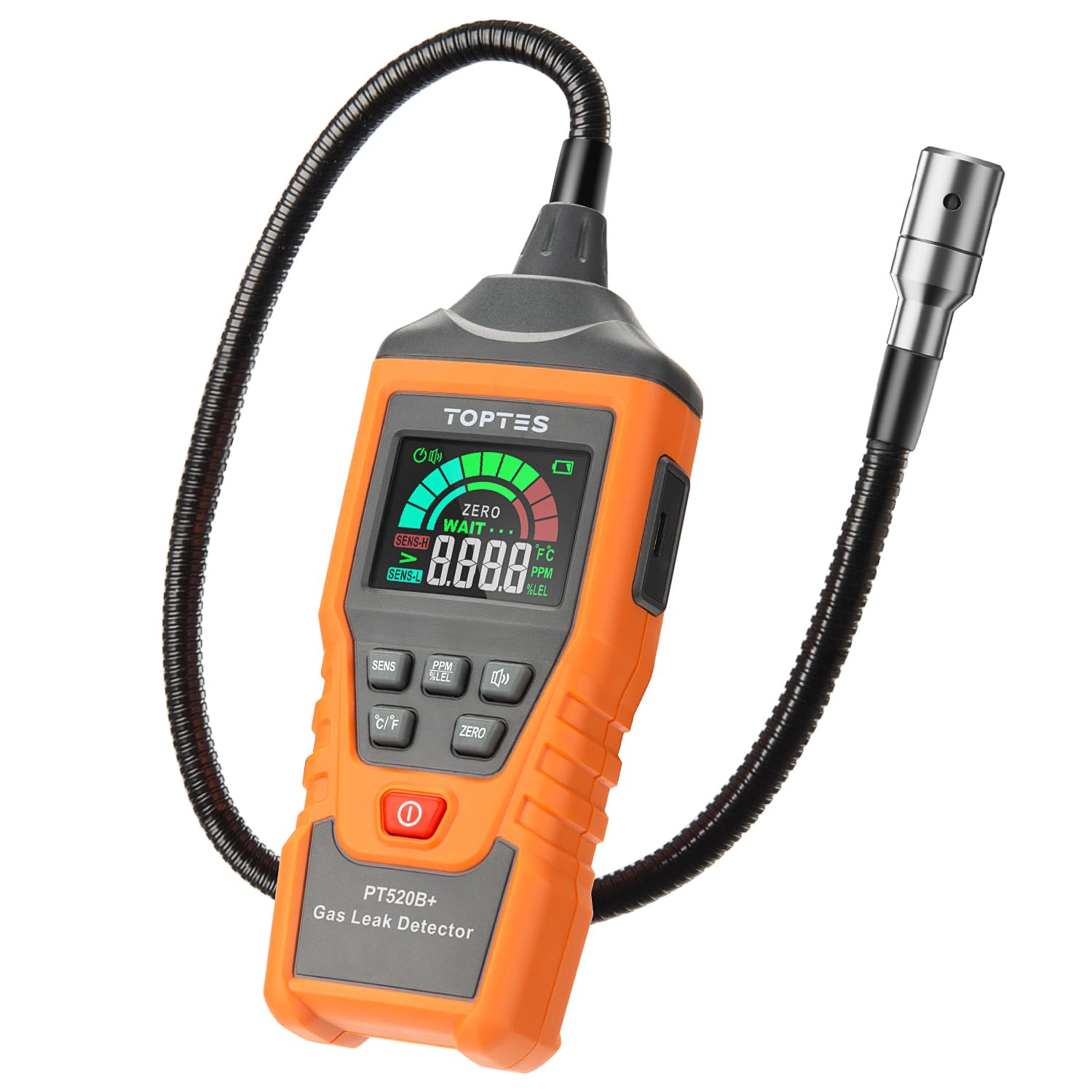
A 17-inch gooseneck that bends into tight spaces and a four-digit display that shows you the actual gas concentration in PPM (parts per million) or %LEL (percent of the Lower Explosive Limit).
The PT520B+ is built for the user who wants numbers, not just beeps. Its four-digit reading shows gas concentration from 50 to 10000 ppm, and you can switch between PPM and %LEL so you know whether you are dealing with a tiny wisp or a serious cloud. The 17-inch flexible probe reaches deep behind a gas range or down into a basement pipe chase without you having to wedge your body in there. Eleven colored bars on the display change as concentration rises, and a 75dB alarm sounds within 0.5 seconds of detection.
A buyer reports it accurately located a gas leak before the meter and saved on repair costs. The rechargeable battery can handle over 3000 cycles, and the anti-slip housing with an ergonomic grip makes one-handed operation comfortable. Another owner notes that the unit only charges with a Type-C to Type-A cable (not Type-C to Type-C), so keep the included cord handy — TopTes support helped resolve that quickly.
Compared to the PT520A+ which lacks the four-digit reading, the PT520B+ gives you that numerical feedback so you can track whether a leak is growing. Its 17-inch probe (the PT-830S has a 14.5-inch probe) provides extra reach for unusually deep or obstructed fittings.
Why it stands out
- Four-digit PPM or %LEL readout — you see the number, not just an alert
- 17-inch gooseneck probe reaches deep into cabinets and behind appliances
- Over 3000 recharge cycles from the built-in battery
What to keep in mind
- Won’t charge via standard Type-C to Type-C cable, only with the supplied Type-C to Type-A cord
- Detection range tops out at 10000 ppm — a professional unit like the PT-830S covers the same range but adds vibration alert
It fits if: You want to read the actual gas concentration level in real numbers, and you need the longest flexible probe in this lineup for hard-to-reach spots.
skip it if: You prefer a vibration alert or want universal Type-C charging with any cable — the PT-830S covers both those needs.
3. TopTes PT520A+ Rechargeable Gas Leak Detector
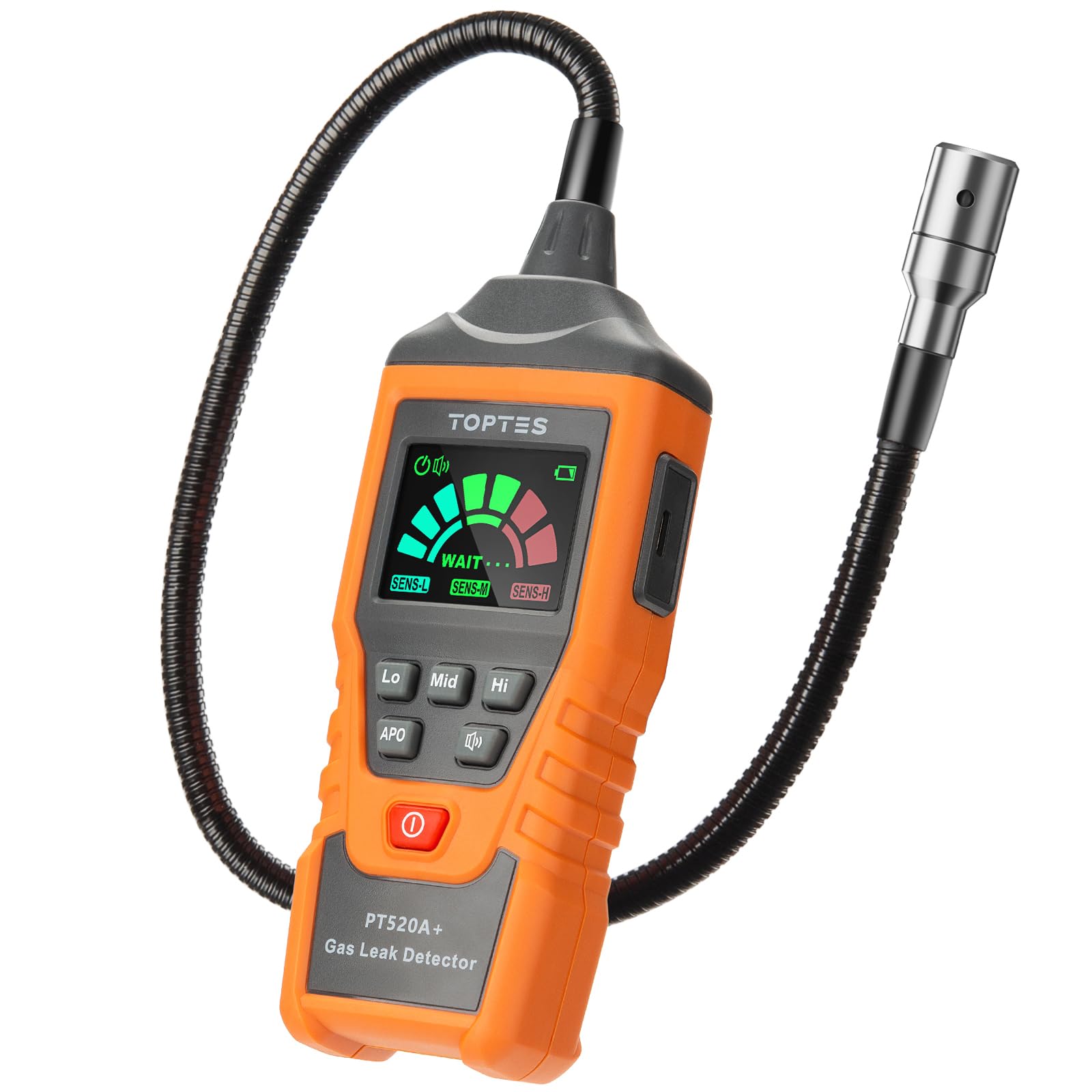
The bendable-neck specialist that snakes a 17-inch gooseneck around water heaters, dryers, and propane grills without putting you in harm’s way.
If your main concern is reaching a gas connection tucked behind a heavy appliance or inside an RV compartment, the PT520A+ makes that job straightforward. Its 17-inch gooseneck holds its shape so you can position the sensor exactly where you need it, step back, and watch the alert. The audible alarm can be muted with a button if you are working near other people and do not want the constant beeping, and the auto power-off kicks in after 10 minutes of inactivity to save the battery.
One buyer uses it weekly on propane sales and says it is very sensitive — it’ll even pick up a fart, as they put it. Another owner traced a propane leak in an RV regulator immediately after calibration. The housing has a double-sided bar-shaped groove and non-slip material, so it stays in your hand even when you are reaching at an awkward angle. The rechargeable battery supports over 3000 cycles.
Compared to the PT520B+, the PT520A+ skips the four-digit PPM display in favor of bar-graph alerts and a simpler interface, which makes it more beginner-friendly but less informative for tracking leak size. Both share the same 17-inch gooseneck, so your choice hinges on if you want actual numbers or just a clear pass/fail alarm.
Smart buy for: Anyone who primarily checks gas grills, RV hookups, and stove connections and wants a tough, long-probed detector without the complexity of reading ppm values.
The single caveat: Without a numeric display, you cannot tell whether a leak is getting bigger or staying the same — it is a go / no-go tool.
Best suited for: The casual or occasional user who needs a durable, long-reach detector for quick checks on propane appliances and doesn’t want to interpret numbers.
Not the best if: You need a precise concentration reading to document a leak for repair records — get the PT520B+ or PT-830S instead.
4. AEGTEST AGT-1988PRO Rechargeable Natural Gas Detector
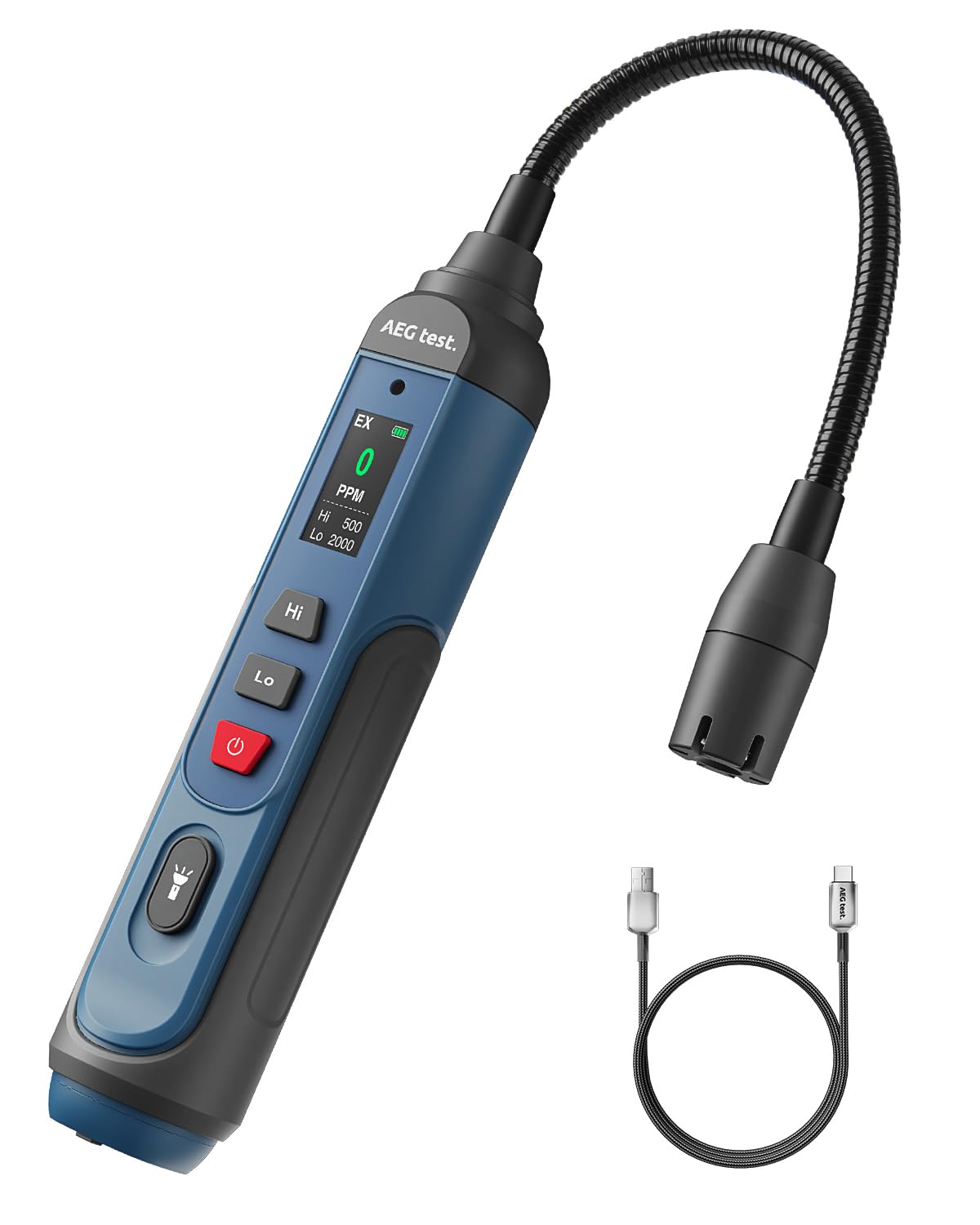
A compact, colorful detector that reads from 0 to 9999 PPM and warms up in just 15 seconds — the fastest preheat in this roundup.
The AGT-1988PRO gets you out of the waiting game. Most detectors need a 30-second warm-up, but this one is ready in 15 seconds, which matters when you are checking multiple connections in an RV park before dark. Its 6.9-inch gooseneck probe is shorter than the 17-inch models above, but it still bends to reach behind a stove or under a sink. The TFT color screen shows concentration, battery level, and alarm status with color coding — green for safe, red for danger — so a glance tells you everything.
One buyer called it “very handy” for quick checks compared to a larger professional unit, and another reviewer noted that it measures actual PPM and shows safe levels, making it a budget-friendly alternative to the pricier TopTes models. It is USB-C rechargeable, so you never buy disposable batteries. The package includes a 36-month warranty, which is the longest coverage in this list.
Where it falls short compared to the PT520B+ is probe length — 6.9 inches vs 17 inches — so you cannot reach as deep into a furnace or behind a refrigerator without repositioning the whole detector. But for the price, you get a color screen, fast warm-up, and rechargeable power that the Povlen CGD902A and TopTes PT299 do not offer.
What works well
- Fast 15-second warm-up and 0.5-second response
- TFT color display with clear concentration readout
- 36-month warranty — best coverage here
What to consider
- 6.9-inch probe is short compared to the 17-inch goosenecks on the TopTes models
- No vibration alarm, only audible and visual alerts
Reach for this if: You want a rechargeable detector with a color screen and fast start-up, and you mostly inspect accessible connections around a home or RV.
Look elsewhere if: You need a long probe to reach deep behind an appliance — the PT520A+ or PT520B+ are much better for that.
5. TopTes PT760 Rechargeable Natural Gas Detector

The PT760 packs a 12-inch stainless steel telescopic probe and a built-in flashlight into a compact, USB-C-rechargeable body that goes anywhere.
For the RV technician or homeowner who works in dim crawlspaces and narrow pipe chases, this detector solves two problems at once: the telescopic rod extends to 12 inches when you need reach and retracts for storage, and the built-in flashlight lights up the work area so you do not need a second hand for a phone light. It detects combustible gases like propane, methane, and butane, and displays the current %LEL value (1% to 20% LEL, which equals 100ppm to 10000ppm) on the screen. The alarm triggers within 0.5 seconds, and the tone frequency and screen color shift with severity.
A 40-year RV technician reported pinpointing a propane leak in less than 3 minutes with this device, and another buyer said it was way better than four other sniffers he had tried in the past five months that all stopped working. The ergonomic grip and durable construction give it a solid feel, and the auto preheat takes only 30 seconds with a countdown on the screen.
Unlike the PT520A+, which uses a bendable gooseneck, the PT760 uses a rigid telescopic stainless steel probe — it extends straight rather than bending around corners, so it is better for straight-into-a-pipe access but less versatile for wrapping around obstacles. The flashlight is a real advantage over every other model except the PT-830S, which also includes one.
Perfect for: RV owners and DIYers who work in low-light spaces and want a rechargeable detector with a sturdy extendable probe that tucks away into a protective case.
One honest limitation: The rigid telescopic rod cannot bend around corners the way a gooseneck can, so it is less suited for checking behind a tightly installed appliance.
Best for: Anyone who frequently works under sinks, in basements, or inside RV compartments where lighting is poor and the gas line runs straight.
Not ideal if: Your gas connections are behind obstacles that require a flexible neck to reach — a gooseneck model like the PT520A+ is the better choice there.
6. Povlen CGD902A Natural Gas Leak Detector
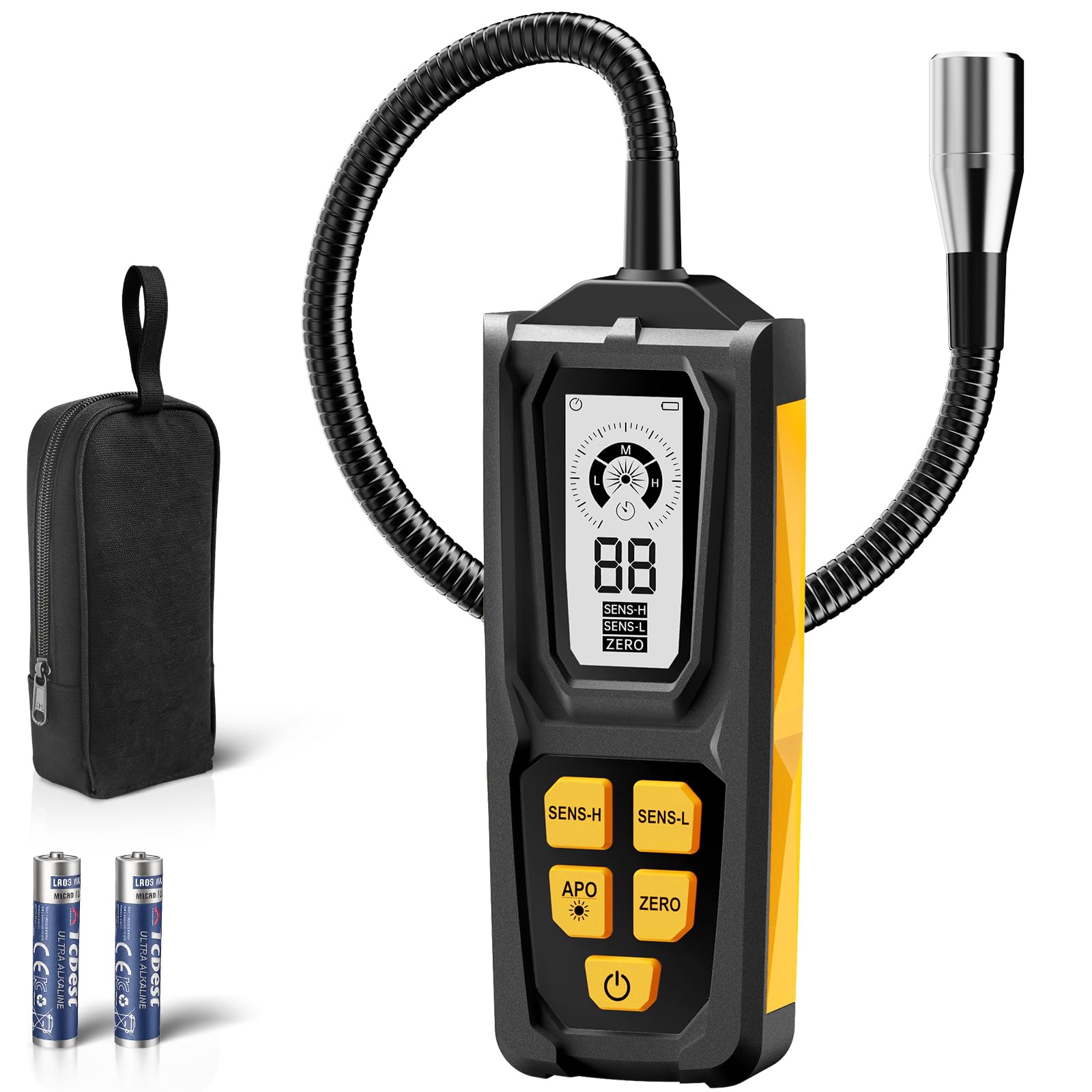
The CGD902A brings an 11-inch flexible gooseneck and a clear LCD screen to the budget tier without skipping the digital concentration readout.
If you want a long flexible probe but do not want to spend on a rechargeable model, this detector runs on two included AAA batteries and still gives you a real-time numeric display on a large LCD screen. The flexible gooseneck bends to reach behind appliances and stays in position while you read the screen, and the triple alert system — audible, visual, and screen feedback — reacts within 0.5 seconds. The detector covers methane, propane, butane, LPG, and other combustible gases, making it useful for a home stove check or a grill inspection.
One buyer mentioned finding a very small leak that they suspected but could not see bubbling because of the location, calling it “awesomeness.” Another said they were able to find the leaking spot in their gas grill hose in no time. The package includes a storage bag alongside the detector and batteries.
The catch is that at 6.4 ounces and with AAA batteries, you get a lightweight, portable tool but one you will need to replace batteries in over time — unlike the USB-C rechargeable picks above. Its 11-inch gooseneck (the PT520A+ and PT520B+ have 17-inch probes) but at this price point, it offers reach and display clarity, while the entry-level TopTes PT299 has no numeric screen and a telescopic rod (2.2 to 6.3 inches).
The strong points
- 11-inch flexible gooseneck reaches behind appliances
- Clear LCD display with real-time gas level readout
- Lifetime customer support included
The weak spots
- Runs on AAA batteries — not rechargeable, so ongoing cost adds up
- No built-in flashlight for dark areas
It fits if: You need a budget-friendly detector with a decent flexible probe and a digital display, and you do not mind replacing batteries every few months.
pass on it if: You prefer rechargeable power and a longer probe — the PT520A+ is worth the extra spend for those upgrades.
7. TopTes PT299 Gas Leak Detector with Extendable Rod

The little orange sniffer with a telescopic pole that extends from 2.2 to 6.3 inches — compact enough for a tool bag, ready for quick checks.
If your gas inspection needs are occasional — check a stove connection once a year, sniff around a new tank hookup — the PT299 is the no-fuss entry point. It uses a gas-sensitive semi-conductor sensor (a metal oxide film that changes conductivity when gas is present) and runs on two included AAA batteries. The extendable rod lets you reach a few inches further than a fixed sensor, and the 30-second warm-up is standard for this price bracket. It detects propane, methane, natural gas, LPG, and gasoline vapors.
Owners mention it took less than 2 minutes to check a pipe with multiple joints and detected the leak at both exact locations without trouble. Another reviewer found it perfect for an RV setup, calling it compact and easy to use with simple controls. The auto-off feature kicks in after 5 minutes of inactivity to save battery life, and the non-slip texture helps you keep hold of it in a tight spot.
Where it stands apart from the others: this is the only model with a telescopic rod that retracts to just 2.2 inches, making it the most pocketable option, but its maximum reach of 6.3 inches is far shorter than the 11-inch gooseneck on the Povlen CGD902A or the 17-inch probes on the premium TopTes units. It also has no numeric display — just audible and visual alarms — so you cannot gauge leak severity on a screen.
For the casual checker: If you need a detector that stays in your glovebox and comes out once or twice a year, the PT299 costs very little and works reliably when called upon.
The honest trade-off: No digital readout and a short extendable rod mean it is better for confirming a strong leak than for hunting down a tiny one in a deep space.
Pick it for: Occasional use around the home or RV where you just need a simple pass/fail tool that stows away easily.
Pass on it if: You want a numeric display, a long flexible probe, or rechargeable power — any of the other picks above will serve you better.
Understanding the Specs
PPM vs. %LEL
PPM (parts per million) tells you exactly how many gas molecules are floating in a million air molecules — a reading of 500 ppm means a noticeable but small leak. %LEL (percent of Lower Explosive Limit) tells you how close the air-gas mixture is to being flammable. At 100% LEL the gas is at its richest flammable concentration; most detectors alert well below 20% LEL so you act before things get dangerous. A model that shows both scales, like the PT520B+, gives you the best picture of leak size and risk level.
Probe Type and Why It Matters
A flexible gooseneck probe (11 to 17 inches) bends around corners and holds its shape, letting you position the sensor tip while you stay a safe distance away. A telescopic stainless steel probe (like on the PT760) extends straight into a pipe chase or behind a panel but cannot curve. A shorter probe (under 7 inches) is fine for accessible connections like a stove front or grill regulator, but anything tucked behind a water heater or furnace calls for at least an 11-inch flexible neck.
Sensor Types
The most common sensors in this category are catalytic (burns gas on a heated bead and measures resistance change) and semi-conductor (uses a metal oxide film that changes conductivity when gas is present). Catalytic sensors, like the one in the PT760, are more selective and accurate for combustible gas readings, while semi-conductor sensors (like in the PT299) are cheaper and still reliable for general pass/fail checks. The PT-830S uses a Figaro brand sensor, which is a well-regarded catalytic type known for durability.
Alarm Types
An audible alarm (measured in dB, like 75dB or 90dB) is the basic alert. A visual alarm flashes a light or changes the screen color so you see the warning even with ear protection. Vibration alert — found on the PT-830S — is a physical buzz that you feel against your hand, useful in extremely loud environments like a generator room or when you wear hearing protection. Models with multiple independent alarm modes let you choose which alerts are active, reducing nuisance when you are working near other people.
FAQ
Will a propane detector also detect natural gas and methane?
How long does it take to warm up before I can start searching?
Can I leave a battery-powered detector on all the time like a plug-in alarm?
What does the response time of 0.5 seconds actually mean in practice?
How do I know if the sensor is still working correctly after months of sitting in a drawer?
Is a flexible gooseneck better than a telescopic rod for finding leaks?
Can I use a battery-powered propane detector to check a BBQ grill’s gas line?
How many times can I recharge a detector before the battery wears out?
What should I do if my detector starts alarming but I cannot find the source?
Does a higher price always mean a better propane detector?
Final Thoughts: The Verdict
For most people, the battery powered propane detector winner is the TopTes PT-830S because it combines the longest battery life estimate (up to 8 hours), a flexible 14.5-inch probe, a clear TFT color screen, and three distinct alarm modes — audible, visual, and vibration — so you never miss a warning. If you want a longer 17-inch gooseneck and a precise PPM/LEL readout, grab the TopTes PT520B+. And for the best value with fast warm-up and a color display at a lower entry point, the AEGTEST AGT-1988PRO is a strong contender that still delivers USB-C rechargeability and a 36-month warranty.
How We Picked
We do not accept paid placement. Every pick is matched to a real buyer and a real use-case; we do not hands-on test units.
Sources & Methodology
Specifications: manufacturer listings and product documentation. Review insights: verified customer reviews, as of July 2026. Pricing: not shown on this page (it changes often); check the current price via the retailer link.
As an Amazon Associate, Gadgets Feed earns from qualifying purchases. This does not affect which products we feature.