
Our readers keep the lights on and my morning glass full of iced black tea. As an Amazon Associate, I earn from qualifying purchases.
Specs are compiled from manufacturer listings and verified buyer reviews and can change over time — please confirm the key details on the product page before buying.
If your forearm is still burning after every rivet job, the fix is not a stronger hand — it is a tool that pulls the rivet for you. A battery powered rivet gun squeezes the mandrel with a motor instead of your grip, so steel and stainless rivets that once took two hands and a grunt now pop with one trigger pull. The real question is which one to buy, and that depends on one thing above all: whether it shares a battery platform you already own.
I’m Min — the founder and writer behind Gadgets Feed. This guide is built by comparing the manufacturers’ published specifications and the patterns across verified customer reviews, so you get each pick’s real strengths and trade-offs instead of marketing spin.
Battery platform decides the real cost here, because almost every bare tool needs a pack you may already have in your garage, and the pull force and stroke decide what it will actually fasten. Read on for the honest breakdown of the best battery powered rivet gun in each class.
Our Picks at a Glance

How To Choose The Best Battery Powered Rivet Gun
The old way of setting rivets is a hand tool you squeeze until the mandrel snaps — a tool that works fine for five rivets and becomes a chore by the fiftieth. A cordless riveter replaces that squeeze with a motor, but the whole category splits sharply on one question: does it run on a battery you already own, or does it come with its own pack and charger? That single decision drives your real cost and your daily convenience, so start there before you compare pull force numbers.
Battery platform is the first filter
If you already own DeWalt 20V packs, several of the guns here convert those packs into riveting power, which means one battery ecosystem for your whole kit and no charger clutter. If you run Milwaukee, the M12 platform offers a genuinely compact option. If you have no battery system at all, a kit with a pack and charger included in the box saves you buying into two ecosystems on day one. Decide your platform first, then filter by the rest.
Pull force and stroke decide what material it will set
Pull force, measured in lbf (pounds of force — how hard the motor yanks the mandrel), is what separates a gun that handles aluminum easily from one that will not seat a stainless rivet. Stroke length is the distance the pulling jaw travels in one motion — a longer stroke lets the tool fasten a rivet in a single pull rather than grinding through it. Aluminum is forgiving; steel and stainless are the real test, so check these two figures if your work involves either.
Nose pieces and body length matter for the actual job
Rivets come in sizes, and your tool needs the matching nose piece (the interchangeable tip the rivet feeds through) to hold each one. Common sizes run 3/32″, 1/8″, 5/32″, and 3/16″, and most guns here cover some or all of them — so match the gun to the rivet size you actually buy. Body length is the other field reality: a longer body has more leverage but will not fit into a cramped corner, so if you rivet inside frames or tight panels, a more compact tool wins.
Quick Comparison
| Model | Best For | Pull Force / Speed | Rivet Sizes | Weight | Amazon |
|---|---|---|---|---|---|
| Milwaukee 2550-20 M12 Rivet Tool★ Best Overall | Milwaukee owners, compact jobs | —; few seconds per rivet | 3/32″, 1/8″, 5/32″, 3/16″ | 4.81 lb | Amazon |
| TRONYAN Cordless Brushless Rivet GunBest Value | DeWalt owners wanting low-cost entry | Up to 2 of pulls force | 1/8″, 5/32″, 3/16″ | 4.16 lb | Amazon |
| Funnywhale Cordless Rivet GunMost Powerful Value | DeWalt owners with heavy jobs | 2000 lbs pulling force | 3/16″, 5/32″, 1/8″ | 5.21 lb | Amazon |
| Sumumtor 21V Cordless Rivet Gun | Starter kit with batteries included | 1 second per rivet | 3/16″, 5/32″, 1/8″ | 7.78 lb | Amazon |
| Mayoki Cordless Rivet Gun | DeWalt users, high-volume pulling | 2248 lbf; 0.79″ stroke | — | 4.02 lb | Amazon |
| BDJHMP Cordless Brushless Rivet Gun Kit | Buyers wanting kit + Makita batteries | 2248 lbf; 2-5 sec per rivet | 3/16″, 5/32″, 1/8″ | 7.98 lb | Amazon |
| Milwaukee M12 BPRT-0 Rivet Tool | Milwaukee M12 owners | —; few seconds per rivet | — | 4.18 lb | Amazon |
| DEWALT 20V MAX XR Rivet Tool (DCF403B) | DeWalt 20V owners, pro jobsite | 2100 lbf; 800 rivets/charge | 3/32″, 1/8″, 5/32″, 3/16″ | 4.16 lb | Amazon |
| DEWALT 20V MAX XR Rivet Tool Kit (DCF403D1) | DeWalt buyers wanting everything included | 2100 lbf; 800 rivets/charge | 3/32″, 1/8″, 5/32″, 3/16″ | 6.8 lb | Amazon |
In‑Depth Reviews
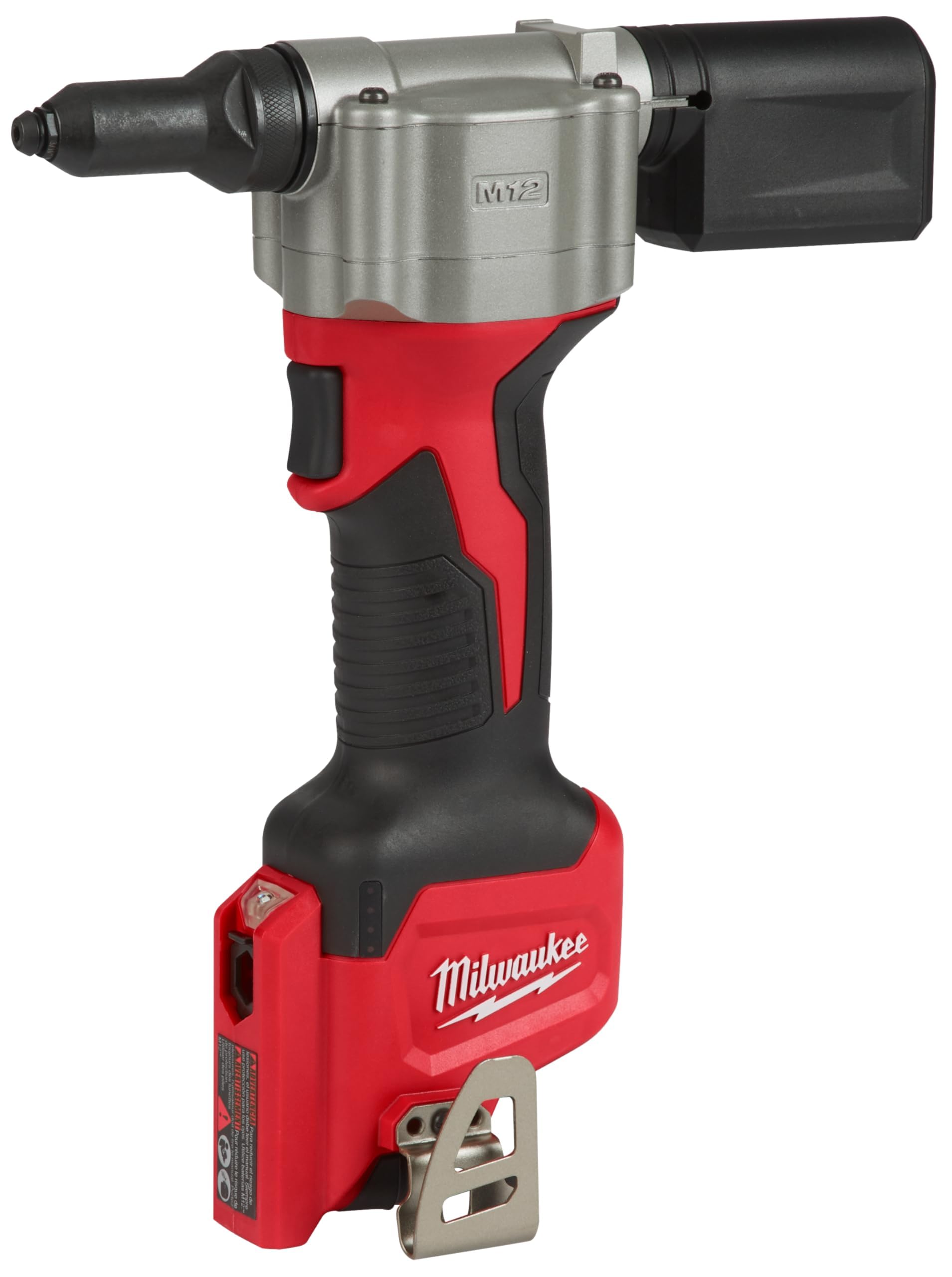
1. Milwaukee Electric Tools 2550-20 M12 Rivet Tool (Bare Tool)
Our pick — over 4.5★ from 750+ verified ratings; the strongest balance of quality and price.
The Milwaukee that sets a rivet in seconds and keeps going for 450 of them.
If you already own Milwaukee M12 batteries, this is the tool that ends the hand-squeeze forever. It pulls 3/32″, 1/8″, 5/32″, and 3/16″ rivets, and Milwaukee rates it at 450 1/8″ steel rivets per charge — meaning a single small pack lasts through a real job, not just a demo. The motor does the work while you simply hold the tool flat against the material. What buyers keep coming back to is the sheer functionality: the thing just does the job, fast, without the mandrel jams that make a manual riveter such a misery.
Where this earns the top slot is the balance of speed, portability, and battery life against that satisfyingly small body. It measures 4 x 12 x 8 inches — compact enough to get into places the bigger DeWalt-style tools struggle to reach. At 4.81 pounds it is not the lightest gun here, but the weight sits in a balanced package, and buyers report it handles stainless steel easily and performs on par with a pneumatic HUCK gun. The reviewer consensus puts functionality at the very top of what people praise, and that is exactly what a rivet gun has to get right.
The honest catch is durability: while plenty of owners describe it as extremely strong, a smaller group report units breaking within two weeks. That is a minority note against a tool most owners clearly rely on for years, but worth knowing if your work runs the motor hot all day. Also be aware this is a bare tool — no battery, no charger — so budget for the M12 platform if you are not already in it.
The case for it
- 450 1/8″ steel rivets on one charge, per Milwaukee
- Covers four rivet sizes: 3/32″, 1/8″, 5/32″, 3/16″
- Compact 4 x 12 x 8 inch body fits tighter spots
- Sets a rivet in seconds with almost no effort from the user
What to weigh first
- 4.81 pounds is heavier than the TRONYAN budget gun’s 4.16 pounds
- Bare tool — you supply the M12 battery and charger
- A minority of owners mention early durability failures
Reach for this if: you are already invested in Milwaukee’s M12 battery line and want a compact, fast riveter that handles stainless without fuss.
Think twice if: you want a battery in the box or you already committed to the DeWalt platform.
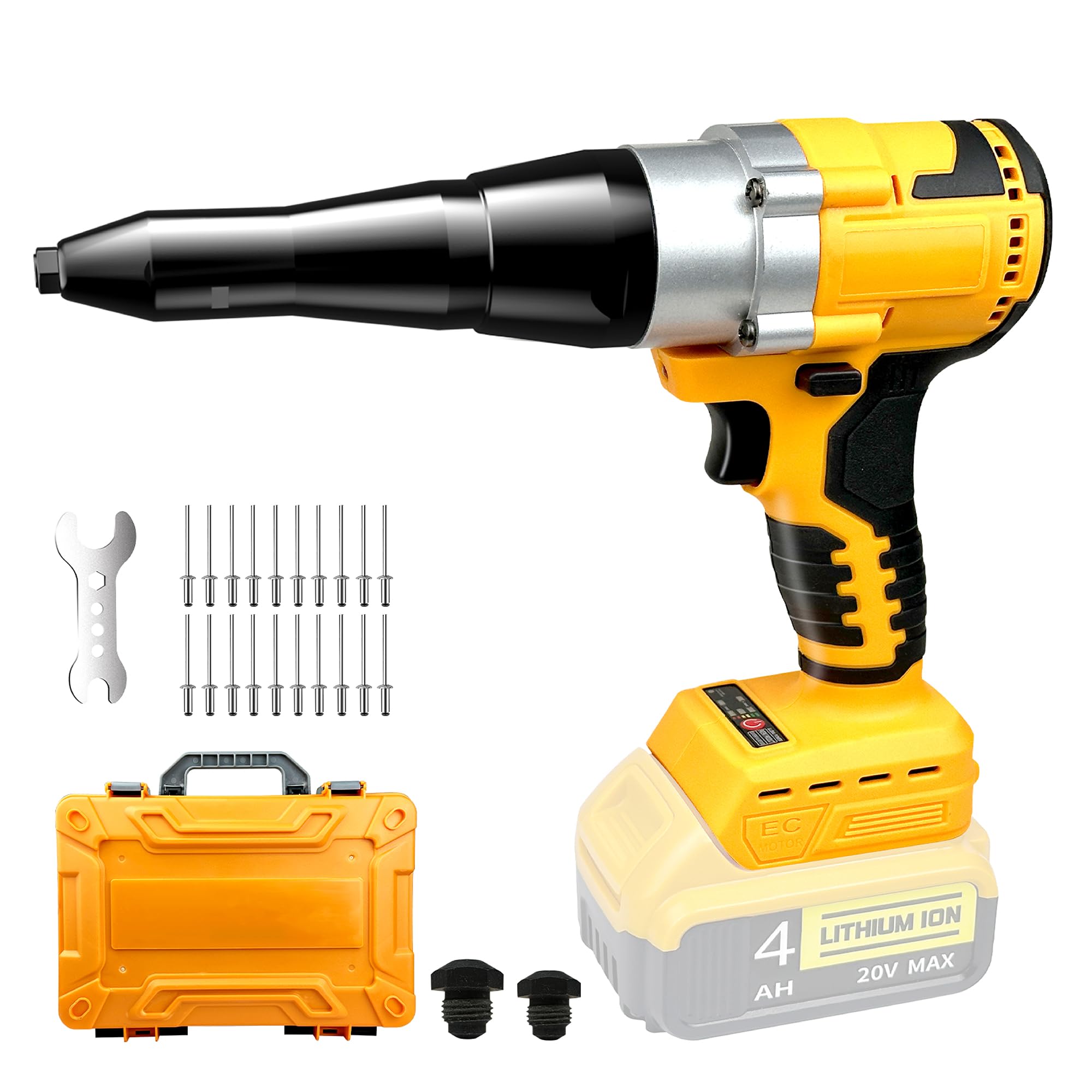
2. Electric Rivet Tool, Cordless Brushless Rivet Gun for 1/8″, 5/32″, 3/16″ Rivets, Compatible with DeWalt 20V Max Battery (Bare Tool)
The entry ticket to cordless riveting for anyone already holding DeWalt packs.
If you have a drawer full of DeWalt 20V batteries and want to stop wrecking your hands on a manual gun, this is the least you can spend to make that jump. It is compatible with DeWalt 20V Max batteries (tool only, no battery), covers 1/8″, 5/32″, and 3/16″ rivets, and fires aluminum, steel, and stainless. The brushless motor runs quieter than a brushed one and, per the manufacturer, lasts up to 10 years without replacement.
What wins people over here is reliability for the money. Owners describe it as doing the job without the hassle of air hoses, and one put roughly 200 rivets through it in the first few days without a hiccup. At 4.16 pounds it is the lightest full-size gun in this lineup — lighter than the Funnywhale at 5.21 pounds and the DeWalt DCF403B at 4.16 pounds, matching the DeWalt exactly. An integrated LED work light helps when you are riveting in a dim trailer or under a frame.
Now the honest part. The functionality feedback is genuinely mixed here, and a few owners hit a stuck mandrel early — one unit seized after just five rivets. The lesson from the field is that this is a light-to-moderate duty tool; if you are setting hundreds of rivets a week, step up. If you rivet occasionally and want to recycle the batteries you already own, it does exactly what it promises.
Straight read: this is a value-first gun for the DeWalt household — the brushless motor, 200-rivet days, and LED light make it a genuine upgrade over hand-squeezing at the lowest entry point in this list.
The trade-off: it will not seat the heaviest stainless all day like the DeWalt and Milwaukee tools above, and a small number of units fail under hard use. Treat it as a capable occasional-use tool, not a jobsite workhorse.
Buy this if: you own DeWalt 20V batteries and want cordless riveting without buying a new platform.
Step up if: you need all-day duty and stainless-heavy work — the Milwaukee or DeWalt picks absorb that punishment better.
3. Funnywhale Cordless Rivet Gun Compatible with Dewalt 20V Max Battery(No Battery) Electric Rivet Gun, Brushless Pop Rivet Gun Tool for Rivets 1/8″, 5/32″, 3/16″
DeWalt-compatible, 2000 pounds of pull, and a one-button reverse for clearing jams.
Here is the spec that matters if steel is your material: this gun delivers up to 2000 lbs of pulling force, and its brushless motor promises a longer, spark-free service life than a brushed one. It installs 3/16″, 5/32″, and 1/8″ stainless steel, steel, and aluminum rivets, so it covers the common sizes in the materials that actually fight back. The single-button forward/reverse switch is a quiet quality-of-life win — press once and it automatically pulls the rivet, breaks the nail, and withdraws the stem, so you are not manually cranking a reversing mechanism.
If you already own DeWalt batteries, this bare tool slides right in and runs without a hitch — that’s the whole point of buying tool-only. But it’s a heavy one: 5.21 pounds, heavier than the TRONYAN at 4.16 pounds and the DeWalt DCF403B at 4.16 pounds, and the package measures 14.61 x 11.85 x 4.33 inches. That bulk buys you extra pulling force, but it’s a real weight to consider if you’ll be holding it overhead. You also get an LED work light and a heat dissipation system to keep it running steady through longer sessions.
One thing to keep on your radar is the ejection. Most owners rave that rivets have never been easier, but one head into the hundreds hit a stem that would not eject — a known behavior with cordless riveters when a mandrel jams in the collector. Clear it early and it rarely recurs. Buyers also flag the length working against them in cramped spots, so measure your access before you commit.
Where it earns its keep: the 2000 lb pull force and one-button reverse make it the most capable value option for stainless and steel work, and DeWalt compatibility keeps your battery drawer unchanged.
Size up before you buy: at 5.21 pounds and a long body, it prefers open panels over tight frames.
Choose this if: you want maximum pulling force on a DeWalt platform without paying Milwaukee money, and your riveting happens in accessible areas.
Look elsewhere if: your work is mostly confined or overhead, where a lighter, shorter tool saves your wrist.
4. 21V Cordless Electric Rivet Gun with 2X 4.0Ah Battery & Charger
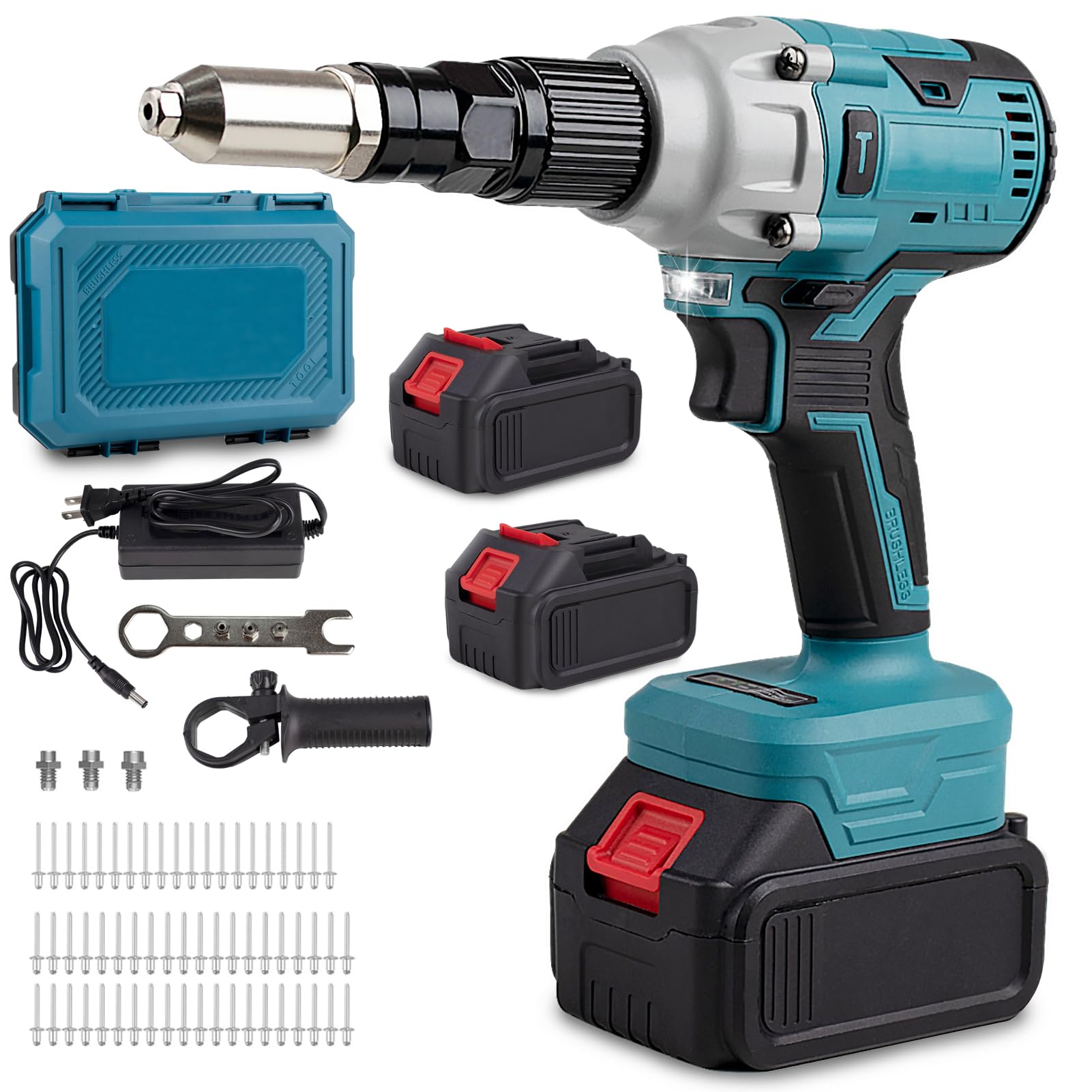
The first-timer’s kit — two batteries, a charger, and no platform to buy into.
If you own no power-tool batteries at all, this is the one that removes that hurdle entirely. It ships with two 4.0Ah 21V batteries and a charger, so you can rivet straight from the start with no separate ecosystem to fund. Its brushless motor skips carbon brush replacement and runs without sparks, and the manufacturer pitches a riveting cycle of about one second per rivet. It pulls 3/16″ (4.8mm), 5/32″ (4mm), and 1/8″ (3.2mm) aluminum blind rivets, suiting RV repairs, gutters, and general construction.
What makes this stand out is that everything comes in one box — and buyers using it on aluminum say it works flawlessly across multi-size rivets and runs fast. With two batteries, you never have to stop mid-job to charge. The single-button forward/reverse and built-in LED give you the same conveniences as pricier tools, and the radiator-style heat dissipation keeps the motor stable on longer runs. If you’re a hobbyist tackling a one-off riveting project, this kit packs a lot of capability into a single purchase.
Two specs temper the enthusiasm. First, stainless steel is where it stumbles: customers note it will not seat 3/16″ stainless steel rivets, so this is an aluminum-first tool. Second, at 7.78 pounds it is the heaviest gun in this entire list — noticeably heavier than the 4.16–5.21 pound cordless bare tools, because you are carrying that 21V battery. A few owners also hit a mid-job stop, so keep the batteries topped up on long runs.
Why it works for beginners
- Two 4.0Ah 21V batteries and a charger included — no platform to buy
- About 1 second per rivet, per the manufacturer
- Handles 3/16″, 5/32″, 1/8″ aluminum rivets
- Brushless motor, LED light, and heat dissipation in one package
The reality check
- Will not seat 3/16″ stainless steel rivets, per owners
- 7.78 pounds — the heaviest tool here with a battery mounted
- A small number of units stopped working mid-job
Start here if: you are brand-new to cordless riveting, own no tool battery system, and mostly work with aluminum.
Skip the kit if: you already run DeWalt or Milwaukee batteries and need stainless-steel capability.
5. Cordless Rivet Gun Compatible with Dewalt 20V 60V MAX Battery, Tool Only

2248 lbf of pull and 2,224 rivets on one 4.0Ah pack — a staggering spec for the money.
Here’s the number that matters: with a single 4.0Ah battery, the maker rates this gun to pull up to 2,224 rivets — that’s a full day of work without swapping packs. Its brushless motor delivers up to 2248 lbf of pulling force with a 0.79″ stroke length, so it sets a rivet cleanly in one motion instead of nibbling at it. It runs on DeWalt 20V and 60V MAX batteries (battery and charger not included), and it adds low-voltage protection to guard the pack you plug in — a smart touch when you’re using expensive batteries. It also comes with a 5-year warranty.
DeWalt users seem to love it, and quality is the thing people rave about most. Owners describe a tool that handles stainless steel rivets a manual gun cannot, pulls tight and fast, and holds up to the abuse of a real jobsite — including surviving drops. The battery longevity is the sleeper win: a 5Ah pack reportedly lasts days at this tool’s low draw. The reverse function clears broken rivet tips without a fuss, and the adjustable, switchable LED light suits both bright and dark corners.
Two things to know before ordering. First, it is a bare tool, so you need DeWalt 20V or 60V batteries already on hand. Second, the longer body and a tip-swap that needs a C-wrench mean it prefers open spaces over tight frames — the included wrench holds the base while you change a nose piece. At 4.02 pounds it is the lightest full-size gun in this group, lighter than the 4.16 pound DeWalt and TRONYAN, so overhead work is kinder than its power suggests.
Editor’s note: the 2,224-rivet rating and 2248 lbf pull put it in the same performance bracket as the DeWalt flagship, but the 5-year warranty is where it pulls ahead of most competitors in this price band.
Mind the fit: a long body that will not squeeze into tight frames, and a bare-tool format that demands you supply the battery.
Pick it if: you run DeWalt 20V or 60V batteries, want flagship-level pulling power, and value a 5-year warranty.
Consider the DeWalt XR instead if: you need maximum support and a fully first-party tool ecosystem.
6. Cordless Brushless Rivet Gun, Automatic 2248lbf Electric Riveter Kit

A complete 2248lbf kit — two batteries, a charger, and a case in one box.
This is the kit version of the 2248lbf class: the same powerful pull, but delivered with two 5.0Ah lithium-ion batteries, a charger, screws, and a carrying case, so nothing else needs buying. It runs on Makita 18V batteries as well, according to the manufacturer, which is a rare bit of cross-platform flexibility for anyone who owns that line. Its brushless motor runs spark-free and quiet, and the maker claims 50% more efficiency and longer life than a brushed motor. The automatic one-button operation takes 2–5 seconds per rivet, depending on material, and it covers 3/16″ (4.8mm), 5/32″ (4mm), and 1/8″ (3.2mm) nose sizes.
What you’ll notice first is the quiet — no air compressor hammering in the background, so it’s far more civil to run indoors or in an RV. Owners say it’s easy to use with good instructions, and people with arthritis especially love it. One put it plainly: “I am at an age where my hand strength is not what it used to be. This tool makes my project so much easier.” It’s built for aluminum nails and suits automotive and construction assembly work.
The catch is the charger. One owner reported a charger that started smoking and stopped working, leaving batteries stranded — a rare but real failure worth watching for, and you may want a backup means of charging. The kit is also the heaviest setup in this list at 7.98 pounds, so it is not the tool for reaching overhead all afternoon. If you want everything in one purchase and mostly work single-handed, it earns its place.
What makes it complete
- 2248lbf pulling force with 2–5 second one-button operation
- Two 5.0Ah batteries, charger, and carrying case included
- Runs quietly with no air compressor required
- Handles 3/16″, 5/32″, 1/8″ nose sizes
Worth knowing
- 7.98 pounds — the heaviest kit configuration here
- A rare charger failure reported by owners
- Not the tool for prolonged overhead work
Grab this if: you want a complete one-box riveting setup with serious pull force and you value quiet, spark-free operation.
Think twice if: you work overhead all day or want the charger redundancy of a name-brand platform.
7. Milwaukee M12BPRT-0 Pop Rivet Tool

The featherweight 12V Milwaukee that pulls a rivet in a few seconds.
If you already own Milwaukee M12 batteries, this tool is the natural partner for them. It runs on the 12V platform and weighs 4.18 pounds — Milwaukee describes it as lightweight with high performance for home or tradesman use. Owners say it pulls a rivet in just a few seconds, and the ease of use comes up again and again: insert the rivet, hold it flat against your material, pull the trigger, and you get a tight connection without the mandrel-jamming misery of a manual gun.
This tool shines on field repairs and one-handed work. Owners call it nice for quick fixes, and the enthusiasm is real — one said: “Love love love this riveter! Insert riveter, hold it in and up against your material, pull the trigger and BOOM. you have a clean, easy, tight connection.” The rust-proof stainless steel handle holds up, and the 12V size keeps it genuinely portable — which matters if you carry it up a ladder or into a trailer repeatedly.
Battery life opinions are mixed in the field, so if you are setting rivets in the hundreds, keep a spare charged 12V pack on hand. For light-to-moderate work, though, it is a pleasure to run.
The honest verdict: this is the most compact, most comfortable Milwaukee option, ideal for field repairs and anyone who values a small 12V footprint over raw pull force.
Check your shelf first: it arrives as a bare unit, and mixed battery-life feedback means a spare M12 pack is smart insurance.
Best for: committed Milwaukee M12 users who want a small, easy-to-run riveter for repairs and moderate jobs.
Not the one if: you need battery and charger in the box, or you are setting rivets in the hundreds daily.
8. DEWALT 20V MAX XR Cordless Rivet Tool, 3/16″, Bare Tool Only (DCF403B)

The DeWalt professional standard — 800 rivets per charge and tool-free nose changes.
If your whole tool bag is already on the 20V MAX system, this is the top-end choice: its brushless motor delivers up to 2,100 lbf of pulling force, which DeWalt rates for stainless steel rivets, and it’s designed for 800 rivets per charge to keep a job moving. It covers the full common range — 3/32″, 1/8″, 5/32″, and 3/16″ rivets — in aluminum, steel, and stainless, and its 0.98″ stroke sets a rivet in one clean motion. The tool-free nose change and on-board nose piece storage mean you’re not hunting for a wrench when you switch sizes.
What earns the praise here is quality and efficiency, and the durability matches. One owner describes it running through 100 stainless steel blind rivets easily, and the general report is of flawless performance across materials and sizes with no misfires. Its on-board mandrel collector gathers the spent stems in a rear cup, so you are not crawling around collecting scrap. The battery life is a recurring highlight too — owners say it lasts nearly forever while sipping very little power, which is the payoff of that 800-rivets-per-charge design. At 4.16 pounds it stays comfortably portable.
The one behavior to expect is stems sticking in the collection chamber. This is normal for a cordless tool rather than an air-powered one, and owners solve it by inserting the next same-size rivet to push the stuck stem into the cup — faster than disassembling. It is a bare tool, so you supply the 20V MAX battery. Compared with the TRONYAN budget gun’s three sizes, this DeWalt covers a fourth at 3/32″ and adds the tool-free nose system, which is exactly where the premium goes.
Why pros pick it
- 800 rivets per charge per DeWalt
- 2,100 lbf of pulling force for stainless steel
- Covers four sizes: 3/32″, 1/8″, 5/32″, 3/16″
- Tool-free nose change and on-board nose storage
Minor trade-offs
- Stems can stick in the collection chamber — push them through with the next rivet
- Bare tool — 20V MAX battery not included
- Premium tier, well above the value guns in this list
The pro’s call: if your riveting is regular and stainless-heavy, the 800-rivets-per-charge rating and 0.98″ one-stroke action justify stepping up to this DeWalt XR.
Stay with the value tier if: you rivet occasionally on aluminum and do not need the fourth nose size or the on-board storage.
9. DEWALT 20V MAX XR Cordless Rivet Tool, 3/16″, Battery and Charger Included (DCF403D1)

The everything-included DeWalt — the same pro riveter with a battery, charger, and bag.
This is the turnkey version of the DCF403B. It has the same power plant — a brushless motor delivering up to 2,100 lbf of pulling force for stainless steel rivets, and 800 rivets per charge — but adds a DCB203 20V MAX 2Ah battery, a DCB1102 charger, and a kit bag, plus the full nose-piece set, replacement jaw set, and belt hook. The spec that gets overlooked is the 0.98″ stroke length: it fastens a rivet in one stroke, so you’re not re-pulling to seat a stubborn mandrel. Tool-free nose change and on-board nose storage round out the convenience.
The people who love this tool are the ones who rivet for a living or take on serious restoration projects. One owner describes reskinning aluminum on a 110ft tanker and credits the tool with saving a long time and sparing their hands from cramping up. Another reports it never missing a beat where the pneumatic tools at work kept failing. The on-board mandrel collector gathers spent stems in a rear cartridge so you never chase scrap metal — and that alone wins over anyone who has done a big panel by hand.
The honest limits: it is the fully loaded, heaviest read of the DeWalt pair at 6.8 pounds with that 2Ah battery mounted, and it will not set 1/4″ rivets — one owner flags that as the only downside. It is also the top of the range in cost, so if you already own 20V MAX batteries, the bare-tool sibling above saves you the redundancy. Buy the kit when you want a single-box solution and no missing pieces on day one.
Where it fits: buy this when you want the complete DeWalt riveting system in one purchase — tool, battery, charger, bag, and every nose piece.
Weigh the redundancy: if 20V MAX batteries already fill your garage, the bare-tool DCF403B is the smarter spend, and neither will handle 1/4″ rivets.
The complete-box choice: for the buyer who owns no DeWalt batteries yet and wants pro-grade capability with nothing left to purchase.
Skip the kit if: you already run 20V MAX packs — the bare tool covers you for less.
Understanding the Specs
Pull Force (lbf)
Pull force is how hard the motor yanks the mandrel — the pin inside the rivet — to flare it into a locking head. It is measured in lbf, or pounds of force. More pull force means the tool can set harder materials: aluminum yields easily, but stainless steel resists and needs a stronger pull. The guns here span a wide range, and the makers publish figures like 2248 lbf and 2,100 lbf for their heavy-duty models. If your rivets are all aluminum, a lower-force tool is fine; if you hit stainless, buy the force.
Stroke Length
Stroke length is the distance the pulling jaw travels in a single motion. A longer stroke fastens a rivet in one pull, so the mandrel flares fully before the pin snaps, giving you a tighter, cleaner joint and less wasted motion. A shorter stroke can mean working the trigger more than once to seat a stubborn rivet. Look for stroke length stated in inches on the specification sheets, and treat it as a proxy for how fast and clean the tool seats each rivet.
Rivet Sizes and Nose Pieces
Rivets come in diameters — 3/32″, 1/8″, 5/32″, and 3/16″ are the common ones — and each size needs the matching nose piece, the interchangeable tip the rivet feeds into so the tool holds it square. A gun that covers all four sizes handles nearly every small-to-medium fastening job. A gun limited to three sizes will not accept the smallest 3/32″ rivets, which matters if you work with thin sheet metal where small rivets are the norm. Match the gun’s stated sizes to the rivets you actually buy.
Battery Platform
The battery platform — DeWalt 20V MAX, Milwaukee M12, Makita 18V — decides your real cost and convenience. A bare tool that runs on a platform you already own costs nothing extra in batteries, and you charge one set of packs for your whole kit. A tool that ships with its own battery and charger costs more up front but works from the start with no ecosystem to buy into. Neither is wrong; the choice depends on whether your garage already has a battery family.
FAQ
Will a DeWalt-compatible rivet gun work with my existing 20V batteries?
Can a battery powered rivet gun set stainless steel rivets?
What is the difference between 2000 lbf and 2248 lbf of pull force?
Do I need to buy a battery and charger if the gun is a bare tool?
How many rivets can I set on a single battery charge?
Why does the rivet stem get stuck in the tool?
Which rivet sizes should I look for in a cordless rivet gun?
Is a brushless motor worth it on a rivet gun?
Can a cordless rivet gun replace a pneumatic one?
How do I switch the nose piece to a different rivet size?
Final Thoughts: The Verdict
For most buyers, the battery powered rivet gun winner is the Milwaukee 2550-20 M12 Rivet Tool because it packs four rivet sizes and 450 1/8″ steel rivets per charge into a balanced 4.81-pound body that pulls a rivet in seconds with almost no effort — the crowd favorite at 4.7 stars across 700+ owners. If you want maximum pulling power on a DeWalt battery you already own, the Mayoki Cordless Rivet Gun delivers 2248 lbf and 2,224 rivets on a 4.0Ah pack with a 5-year warranty. And for a complete one-box setup, the DEWALT DCF403D1 Rivet Tool Kit includes the battery, charger, and every nose piece so nothing is missing on day one.
Whichever you choose, check your battery drawer first — a bare tool on a platform you already run is the smartest spend, and it’s the single biggest factor in whether a cordless riveter feels like a bargain or a surprise.
How We Picked
We do not accept paid placement. Every pick is matched to a real buyer and a real use-case; we do not hands-on test units.
Sources & Methodology
Specifications: manufacturer listings and product documentation. Review insights: verified customer reviews, as of September 2026. Pricing: not shown on this page (it changes often); check the current price via the retailer link.
As an Amazon Associate, Gadgets Feed earns from qualifying purchases. This does not affect which products we feature.