
Every sanding job eventually devolves into a fight against fatigue, dust clouds, and the constant tug of a cord that wants to pull your sander off the workpiece. Cordless sanders have solved the tether problem, but the real test is whether a battery-powered model can deliver smooth, consistent material removal without leaving swirl marks or draining its pack after ten minutes of work. The difference between a frustrating session and a productive one comes down to orbital speed range, vibration isolation, and dust management — three specs that separate toys from tools.
I’m Min — the co-founder and writer behind Gadgets Feed. I’ve spent countless hours researching brushless motor performance, battery platform ecosystems, and pad durability across the top cordless sanders to help you find the one that matches your actual workload, not just your budget.
Whether you are stripping paint off a deck or fine-sanding a cabinet door, the best battery powered sander needs to balance orbital speed with runtime and ergonomics to keep you in control from the first pass to the final grit.
How To Choose The Best Battery Powered Sander
Cordless sanders live and die by three factors: motor type, orbit speed range, and dust extraction. Ignoring any of these will lead to premature battery drain, uneven surfaces, or a cloud of fine particles that settles everywhere except the dust bag. Here’s what to prioritize.
Brushless vs. Brushed Motors
Brushless motors deliver more torque per watt and run significantly longer on a single battery charge. They also generate less heat and vibration, which translates to smoother operation and fewer burned-out pads. If you plan to sand for more than 30 minutes continuously, a brushless model is non-negotiable. Brushed motors are cheaper but lose speed under load and drain batteries faster.
OPM Range and Variable Speed
Orbits Per Minute (OPM) determines how aggressively the sander removes material. A range of 8,000 to 12,000 OPM covers most tasks: lower speeds for finishing and polishing, higher speeds for stripping paint or leveling rough wood. Models with 6-speed dials offer precise control; single-speed units force you to compromise between speed and finish quality. Always look for a sander that lets you dial down for detail work.
Dust Collection Efficiency
A sander without decent dust collection clogs your view of the workpiece and fills the air with airborne irritants. Integrated dust bags are convenient but fill fast — look for models with a 1-1/4-inch vacuum port so you can attach a shop vac for extended sessions. The dust-sealed switch is a bonus that prevents grit from killing the trigger over time.
Quick Comparison
On smaller screens, swipe sideways to see the full table.
| Model | Category | Best For | Key Spec | Amazon |
|---|---|---|---|---|
| DEWALT DCW210B | Random Orbital | Power & smoothness balance | 8,000–12,000 OPM brushless | Amazon |
| Bosch GEX18V-5B15 | Random Orbital | Pro-grade finish & ergonomics | 4.0Ah battery, soft-start | Amazon |
| Metabo HPT SV1813DAQ4 | Random Orbital | Low vibration & dust collection | 2.6 lbs, 6 speed settings | Amazon |
| SKIL SR660302 | Random Orbital (Kit) | Fast charging & portability | PWRJump 5-min charge | Amazon |
| WORX WX820L.9 | Multi-Sander | Versatility (5-in-1 shapes) | Tool-less pad change | Amazon |
| CRAFTSMAN CMCW221B | Detail Sander | Lightweight detail sanding | 9,000–12,000 OPM variable | Amazon |
| BLACK+DECKER BDCMS20B | Mouse Sander | Compact & tight corners | Finger attachment included | Amazon |
In‑Depth Reviews
1. DEWALT 20V MAX Orbital Sander (DCW210B)

The DEWALT DCW210B is the benchmark for cordless random orbital sanders, combining a brushless motor that maintains consistent torque under load with a variable-speed dial spanning 8,000 to 12,000 OPM. The low-profile height lets you get the sander close to the workpiece for precise edge work, while the texturized rubber overmold grip absorbs vibration noticeably better than budget alternatives. Users report minimal hand fatigue even after extended sessions, and the quick-stop feature halts the pad almost instantly when you release the trigger.
Dust collection is handled through a one-handed locking dust bag or a 1-1/4-inch port that fits directly into shop vac hoses using the DWV9000 adapter. The dust-sealed switch protects against grit ingestion, a common failure point on cheaper sanders. Battery life with a 4Ah or 5Ah pack is solid for stripping paint or abrading between finish coats, though heavy users recommend having three batteries ready for large jobs. The 8-hole hook-and-loop pad makes paper swaps fast, but the pad itself wears faster than expected under aggressive use.
For anyone already invested in the DEWALT 20V MAX system, this sander is a no-brainer upgrade from corded models. The balance is excellent — the battery acts as a counterweight rather than a heavy tail — and the speed control lets you dial down to 8,000 OPM for finishing without leaving pigtail swirls. It is not the cheapest option, but the combination of power, smoothness, and dust management earns it the top spot for serious woodworkers.
Why it’s great
- Brushless motor delivers consistent power from 8k–12k OPM
- Low vibration and quick-stop pad for precise control
- Excellent dust collection via bag or vac port
Good to know
- Hook-and-loop pad can wear quickly with coarse grits
- Requires 3+ batteries for large sanding projects
2. BOSCH GEX18V-5B15 18V Brushless Random Orbit Sander Kit

The Bosch GEX18V-5B15 is the closest any cordless sander has come to replicating the feel of a high-end corded orbital. Its compact palm-grip design and soft-start technology ease the pad onto the workpiece without the kick that chatters the disc on start-up. The constant-speed electronics maintain the set OPM under load, so you don’t lose momentum when pressing into hardwood. The vibration dampening element is genuinely effective — long sessions leave hands less numb than with most competitors.
This kit ships with a CORE18V 4.0Ah advanced power battery, a charger, a medium backing pad, and a dust bag. The cast zinc dust chute doubles as a heat sink, drawing thermal energy away from the motor area. Dust collection is excellent with the bag, and the vac hose interface adds flexibility for shop vac setups. One notable ergonomic trade-off: the battery sits directly over the disc, which some users find pulls the center of gravity upward, requiring a slight upward lift to keep the pad flat on the surface.
At roughly 30 minutes of runtime on speed 5 with plywood, the 4Ah battery is adequate for trim work and cabinet sanding but not for deck-level material removal. The pad quality is outstanding — the red medium-firmness foam holds up well to repeated use. For professionals or serious hobbyists who value finish quality over raw speed, the Bosch justifies its premium price through superior ergonomics and build consistency.
Why it’s great
- Soft-start and constant-speed electronics for swirl-free finishes
- Low vibration design reduces hand fatigue significantly
- Comes with 4.0Ah battery and charger in kit form
Good to know
- Battery placement over disc requires effort to keep pad flat
- Material removal rate is lower than some corded alternatives
3. Metabo HPT 18V Cordless 5-Inch Random Orbital Sander (SV1813DAQ4)

The Metabo HPT SV1813DAQ4 punches above its price point by offering six speed settings from 7,000 to 11,000 OPM, an electric brake for quick pad stops, and a dust collection system that users consistently rate as best-in-class. The 2.6-pound weight keeps it nimble for overhead work and detail sanding, while the ergonomic one-handed dust bag design lets you switch hands without fumbling. The lower 7,000 OPM floor is actually a benefit for softwoods — it removes material gently without gouging.
Battery drain is impressively low thanks to the brushless motor, which means a single 4Ah 18V pack can handle multiple furniture refinishing sessions. The dust bag stays attached during aggressive orbital motion — a common complaint with cheaper models — and the included vacuum connector fits standard hoses without an adapter. The electric brake engages instantly when you release the trigger, reducing the risk of swirl marks during lift-off.
One quirk: the switch requires more deliberate pressure to actuate than some competitors, which some users interpret as stiffness but adds safety against accidental starts. The 7,000–11,000 OPM range is slightly narrower than DEWALT’s 8,000–12,000, but in practice it covers 95 percent of typical sanding tasks. For woodworkers and remodelers who prioritize finish quality and dust control over raw speed, this is the best value proposition in the cordless orbital category.
Why it’s great
- Excellent dust collection with reliable bag and vac port
- Lightweight at 2.6 lbs with low vibration
- Electric brake for precise finish control
Good to know
- OPM range tops at 11,000, lower than some rivals
- Switch requires firm press, not a hair trigger
4. SKIL PWRCore 20 Brushless 20V Random Orbital Sander Kit (SR660302)

SKIL’s PWRCore 20 system brings a genuinely useful innovation to the cordless sander category: the PWRJump charger that provides a usable charge in 5 minutes and a full charge in roughly 30 minutes. For mobile work, the 2.0Ah battery also includes a USB port (PWR Assist) for charging phones or tablets, turning downtime into productive charging. The brushless motor spins the 5-inch hook-and-loop pad at up to 11,000 RPM, and the variable-speed control gives you six settings to match the application.
The microfiltration dust canister does a solid job capturing fine particles, and the dust-sealed on/off switch protects the electronics from grit intrusion. Users report runtime of 60–90 minutes at speed 1 and around 30–45 minutes at speed 6, depending on material and pressure. The included 2.0Ah battery is fine for small projects, but for larger jobs you will want a 4.0Ah or higher pack to avoid frequent swaps. The hook-and-loop backing pad has been reported to detach from the foam base after several hours of use — the adhesive alone isn’t reinforced mechanically.
The weight is slightly higher than the Metabo HPT at 5.25 pounds with battery, but the balance is reasonable. The variable-speed dial is easy to adjust mid-session without looking, and the noise level is typical for a brushless sander. For DIYers who need a complete kit that charges faster than any competitor and can follow them to job sites without a cord drag, the SKIL delivers exceptional convenience at a fair price.
Why it’s great
- PWRJump charger gives 5-min rapid boost charge
- Battery includes USB port for mobile device charging
- Variable-speed dial with six settings
Good to know
- Hook-and-loop pad may detach from foam base over time
- Heavier than some competitors with battery attached
5. WORX Cordless 20V 5-in-1 Multi-Sander (WX820L.9)
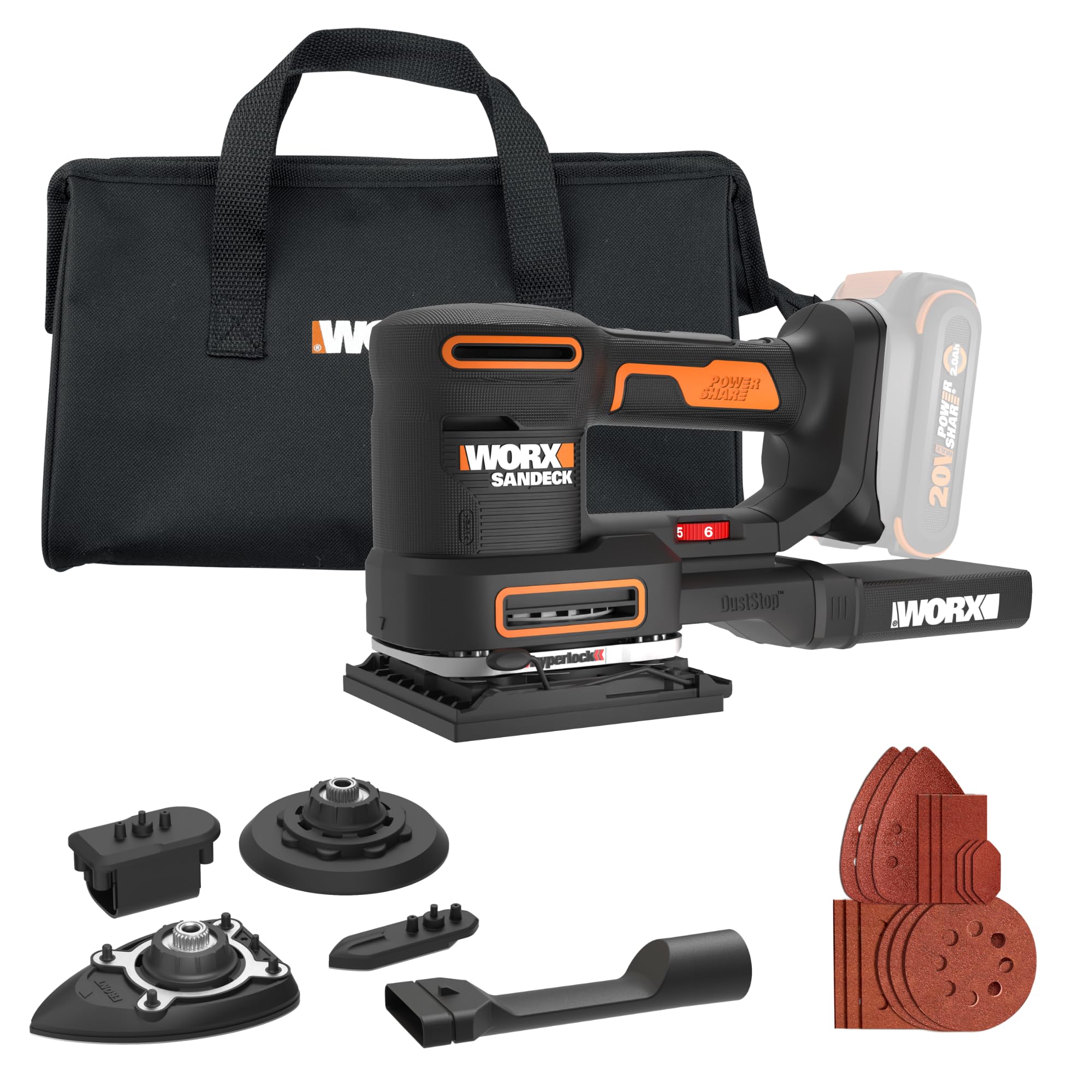
The WORX WX820L.9 is the category’s shape-shifter, offering five sanding configurations — random orbit, finish, detail, contour, and finger sanding — via a tool-less pad change system. Press the lock button, twist the lever, and swap pads in seconds without needing a hex key or Allen wrench. The Hyperlock clamping system applies one ton of force to keep the pad secure during operation, so there is no wobble even during aggressive orbital motion. The 10,000 OPM fixed speed is a trade-off for the modular design, but it lands in the sweet spot for general-purpose work.
The kit includes five different sanding pads, fifteen sanding sheets, a dust bag, a dust extraction adapter, a hole punch, and a carry bag. The finger sander attachment is particularly useful for slatted furniture or between balusters, where standard orbital sanders cannot reach. The dust collection is adequate for DIY projects but not as efficient as dedicated orbital sanders — expect to wipe down the workpiece between grit changes. The WORX PowerShare battery system lets you combine 20V batteries for use across 40V and 80V tools, which is convenient if you already own WORX yard equipment.
Runtime on the included 2.0Ah battery is sufficient for small to medium jobs; users recommend stepping up to a 4–6Ah pack for extended sessions. The tool is noticeably light even with a battery attached, making it ideal for overhead sanding or one-handed detail work. If your projects span multiple sanding shapes and you value quick pad changes over raw orbital speed, the WORX is the most flexible battery powered sander on this list.
Why it’s great
- Tool-less pad change covers five sanding shapes
- Hyperlock clamping secures pads with 1 ton force
- Finger sander attachment reaches narrow gaps
Good to know
- Fixed 10,000 OPM, not variable speed
- Dust collection is decent but not vac-level
6. CRAFTSMAN 20V MAX Cordless Detail Sander (CMCW221B)

The CRAFTSMAN CMCW221B is a variable-speed detail sander that brings versatility to a form factor often stuck with fixed OPM. The 9,000 to 12,000 OPM range lets you slow down for delicate trim or speed up for material removal on small panels. The D-handle grip is a standout ergonomic feature — it shifts the center of gravity rearward, reducing the tendency to tip forward during vertical sanding. The dust-sealed switch and dust bag plus 1-1/4-inch vacuum connection give you two collection options in a tool that weighs under 2.6 pounds.
Users with hand weakness or arthritis specifically praise this model for its lightweight maneuverability and low-vibration operation. The triangular detail pad reaches into corners that random orbital sanders cannot touch, making it a natural companion for cabinet door frames, window casings, and furniture repair. Battery compatibility with the full CRAFTSMAN V20 lineup means you can share packs with your drill, saw, and trimmer — a major cost saving if you already own that ecosystem.
The trade-off is that detail sanders remove material more slowly than 5-inch random orbital models, and the smaller pad means you cannot tackle large flat surfaces efficiently. This is purpose-built for detail work, not deck sanding. Available as tool-only, it is an affordable entry point for users who need precise control in tight spaces rather than raw stock removal speed.
Why it’s great
- Variable-speed detail sander with 9k–12k OPM range
- D-handle grip improves vertical control
- Lightweight design ideal for users with hand fatigue
Good to know
- Detail pad shape is slow for large flat surfaces
- Tool only — battery and charger sold separately
7. BLACK+DECKER 20V MAX Mouse Sander (BDCMS20B)

The BLACK+DECKER BDCMS20B is the quintessential compact mouse sander, designed from the ground up for tight-corner accessibility. The interchangeable finger attachment extends the sanding surface into narrow slots, between slats, and behind radiators where even a detail sander struggles. The ergonomic body is balanced well with a standard 20V MAX battery attached, and the hook-and-loop system makes paper changes quick without tools. At 2.1 pounds, it is one of the lightest cordless sanders available — ideal for extended overhead work.
Dust collection is handled by an included bag that fills quickly — users report emptying it every 5–10 minutes during continuous use. The bag works well with wood dust but is not recommended for metal sanding. For longer sessions, the vacuum port accepts standard hoses, though it uses a 12-hole sanding pad pattern that requires specific sheets; generic 8-hole pads will block suction. B&D-branded pads are pricey, but third-party options from brands like Lot Fancy fit the 12-hole pattern and cost significantly less per 50-pack.
Battery life runs 30–40 minutes on a full 20V MAX pack, which is reasonable for a compact sander tackling trim, baseboards, and furniture touch-ups. The variable speed is fixed — you get one speed, and it is set for general-purpose sanding. This is not a tool for heavy stock removal or large surface areas. For DIYers who need a cordless sander that fits in a drawer and reaches into the tightest spots, the BDCMS20B delivers exactly what the mouse form factor promises.
Why it’s great
- Mouse shape and finger attachment access tight spaces
- Very lightweight at 2.1 pounds
- Hook-and-loop pad for quick sandpaper changes
Good to know
- Dust bag fills rapidly, needs frequent emptying
- Uses 12-hole pad pattern, not standard 8-hole
FAQ
Can a cordless sander match a corded sander for power?
Why does my battery powered sander stop spinning under pressure?
What grit sequence should I use for a smooth finish on wood?
Final Thoughts: The Verdict
For most users, the Best Battery Powered Sander winner is the DEWALT DCW210B because it balances brushless power, variable 8,000–12,000 OPM range, and effective dust collection in a package that feels balanced and lasts through multiple battery swaps. If you want pro-grade ergonomics and the smoothest finish, grab the Bosch GEX18V-5B15 kit. And for maximum versatility with tool-less pad changes across five sanding shapes, nothing beats the WORX WX820L.9.