
Running a sprinkler line to that far flower bed or a drip system to a raised vegetable garden usually means a shovel, a trench, and a trip through the breaker panel. A battery powered sprinkler controller cuts that entire process out — it mounts directly on the valve or the hose spigot, runs on standard batteries, and puts a full watering schedule exactly where AC power has never reached.
I’m Min — the co-founder and writer behind Gadgets Feed. I’ve spent hundreds of hours cross-referencing solenoid draw, valve compatibility, and wireless protocols for this category to separate controllers that actually survive a wet season from those that leave plants dry.
Whether you are expanding an in-ground system, automating a rain barrel setup, or simply want to stop dragging a hose around after work, this guide to the best battery powered sprinkler controller ranks every relevant option by real-world durability and scheduling flexibility.
How To Choose The Best Battery Powered Sprinkler Controller
Buying the wrong controller usually means one of two outcomes: dead batteries in the middle of a heatwave, or a valve that never opens because the solenoid isn’t compatible. The specs that matter are narrow, and narrowing them correctly is the entire game.
Valve Type and Solenoid Compatibility
Most in-ground irrigation valves (Orbit, Hunter, Rain Bird) use a 24V AC solenoid that requires a transformer. Battery powered controllers use a DC-latching solenoid — a completely different mechanism that fires a pulse to open and another to close, then draws zero power in between. If you are replacing an existing valve, check that the controller includes its own solenoid or matches your valve’s latching specs. Hose-end timers (like the RAINPOINT models) are self-contained and connect directly to a spigot, so solenoid compatibility is not a concern — the trade-off is that they control only one zone per unit.
Battery Life and Power Management
A controller that chews through batteries every three weeks is useless for vacation watering or remote garden beds. Look for units that advertise a full season on two AA or 9V alkaline cells. The secret is the solenoid’s latching current: the lower the pulse milliamps, the longer the batteries last. Rain delay features also matter — they let the controller skip cycles during wet weather, saving water and preserving battery cycles. Keep an eye on LCD screen brightness, too; a backlit screen that stays on too long can drain cells faster than the valve operation itself.
Wireless Connectivity and Range
Battery powered controllers fall into three connectivity tiers: fully manual (set at the dial), Bluetooth (requires proximity), and cloud-based (Wi-Fi or Zigbee). If your valve box is inside a metal enclosure or buried under a concrete walkway, standard 2.4 GHz Wi-Fi may struggle. The LinkTap G1S uses Zigbee, which penetrates walls and moisture better than Wi-Fi and sips power for a two-year battery claim. For hose-end timers, Bluetooth models like the RAINPOINT WiFi timer let you adjust schedules from inside the house, but you generally need the gateway close enough to reach the valve.
Quick Comparison
On smaller screens, swipe sideways to see the full table.
| Model | Category | Best For | Key Spec | Amazon |
|---|---|---|---|---|
| RAINPOINT (Brass) | Hose-End | Simple no-smart scheduling | Brass inlet/outlet, 116 PSI | Amazon |
| RAINPOINT WiFi | Hose-End | App & voice control | 2.4 GHz WiFi + Bluetooth | Amazon |
| Orbit 57860 | In-Ground Valve | Multi-zone in-ground | 1″ FPT jar-top valve | Amazon |
| Hunter X2 4-Zone | In-Ground Panel | Smart-ready wired system | 4 zones, Wi-Fi module option | Amazon |
| LinkTap G1S | Hose-End | Long-range wireless | Zigbee, 2-yr battery life | Amazon |
| Rain Bird ARC8 | In-Ground Panel | 8-zone smart system | 8 stations, Wi-Fi, Alexa | Amazon |
| Hunter Node 100 | In-Ground Valve | Remote valve control | IP68, 1-2 9V batteries | Amazon |
In‑Depth Reviews
1. Hunter Node 100 Battery Operated Sprinkler Timer

The Hunter Node 100 is the benchmark for battery powered zone controllers. It ships with a pre-wired DC-latching solenoid that mates directly to most standard irrigation valves, so there is no guesswork about compatibility. The IP68 rating means it can sit inside a flooded valve box or be buried directly in soil without the electronics failing — an important distinction for controllers installed in low-lying areas that pool water after a storm.
Programming supports three independent schedules with four start times each and run durations up to six hours. The seasonal adjustment function scales watering percentages up or down without rebuilding every program, and the suspend mode pauses irrigation for up to 99 days. Battery life depends heavily on the brand of 9V cells used — two alkaline batteries typically last a full growing season, but neglecting to replace them annually can lead to corrosion that damages the battery contacts.
This unit is designed for professionals and DIYers who need reliable, unconnected operation. There is no Wi-Fi, no app, and no cloud dependency. The trade-off is that schedule changes require walking to the valve box and pressing buttons on the LCD interface. For remote zones, off-grid drip systems, or secondary areas where trenching a wire is impractical, the Node 100 is the most durable solution on the market.
Why it’s great
- Genuinely waterproof (IP68) for direct burial in mud and rain
- Pre-wired DC-latching solenoid simplifies installation to under 10 minutes
- Seasonal adjustment and 99-day suspend mode for winterizing
Good to know
- No wireless connectivity — all programming done at the device LCD
- Battery contacts can corrode if alkaline cells are left in past their lifespan
2. RAINPOINT Sprinkler Timer with Brass Inlet & Outlet

The RAINPOINT hose-end timer is the most straightforward entry on this list. Its defining feature is the pure brass inlet and outlet threads, which resist cross-threading and corrosion far better than the plastic nipples found on budget timers. The body uses UV-resistant materials, and the internal filter gasket catches sediment before it reaches the solenoid — a real benefit for well water or rain barrel setups.
Programming is handled by a physical dial and button interface with a large LCD. You set start time, watering duration (1 minute to 3 hours 59 minutes), and frequency (every hour up to every 7 days). The rain delay pauses the schedule for 24, 48, or 72 hours and resumes automatically. Manual mode lets you run the valve for a custom time without interrupting your saved program.
User reports consistently note that batteries last around two months with regular daily watering, which is reasonable for a non-latching AC solenoid design. The unit does not support Wi-Fi or Bluetooth, so everything is controlled at the spigot. For a gardener who wants a simple, leak-free timer for a single hose zone and does not need remote access, this is the most reliable budget-friendly option available.
Why it’s great
- Full brass inlet and outlet threads resist leaks and corrosion
- Large LCD screen is easy to read in direct sunlight
- Rain delay and manual mode operate independently of scheduled programs
Good to know
- No wireless app control — must walk to the spigot to make changes
- LCD screen may appear blank in direct sun until the viewing angle shifts
3. RAINPOINT WiFi Water Timer
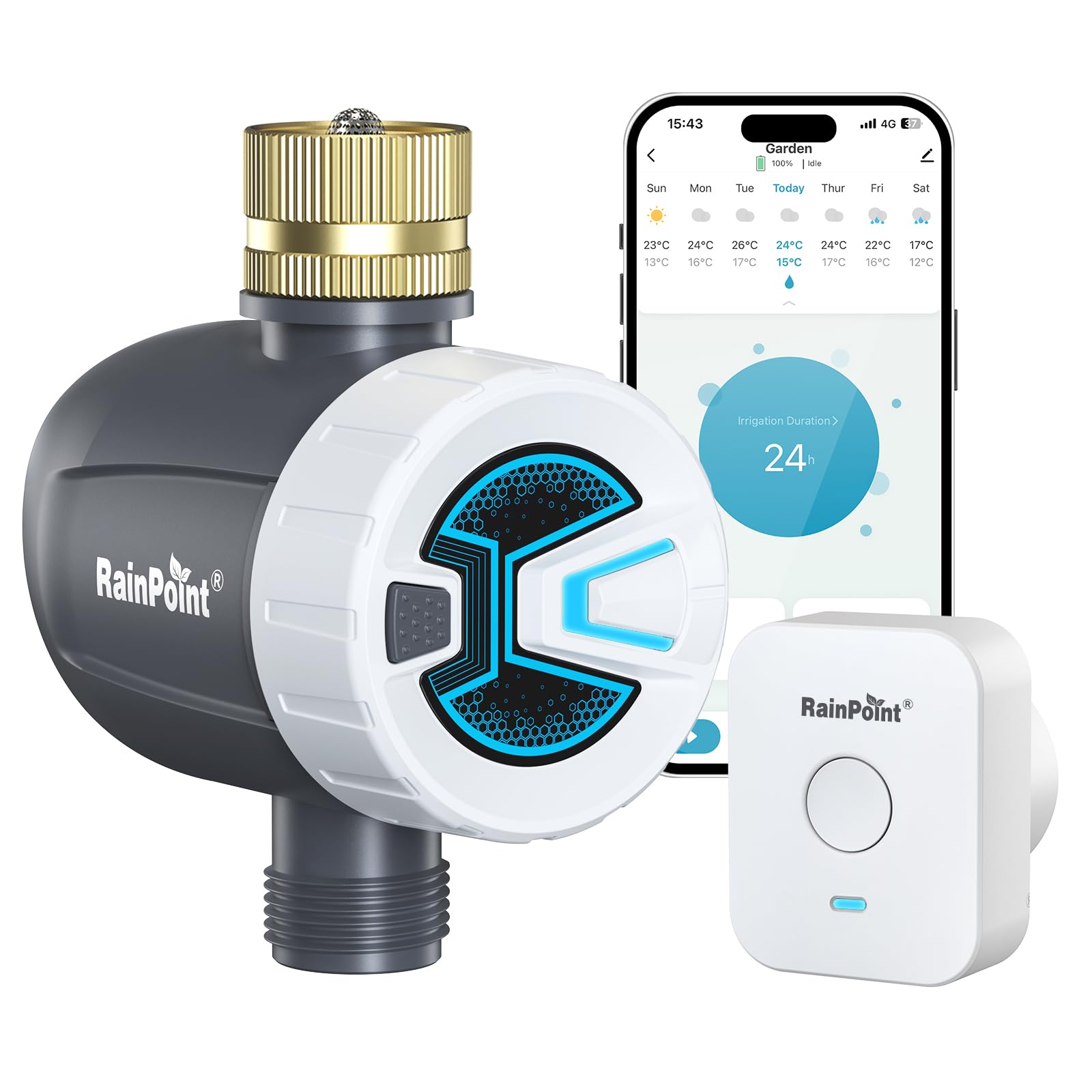
The RAINPOINT WiFi timer brings remote control to the hose-end format without jumping to the premium price tier. It connects through the TUYA smart platform via 2.4 GHz Wi-Fi and a separate Bluetooth path for initial pairing. The hub supports up to four timers, making it feasible to cover multiple hose outlets from a single app interface. Alexa and Google Assistant integration is baked in, so you can start or stop watering by voice.
The reinforced 360-degree brass swivel inlet is the standout mechanical feature. It rotates to align the timer vertically with the hose without straining the connection, and the metal thread is far less likely to crack during temperature swings than all-plastic housings. Watering modes include manual (1 minute to 24 hours), rain delay (24/48/72 hours), and a recurring schedule that repeats from every minute up to every 7 days.
Several buyers noted that the setup process requires the phone to be on a 2.4 GHz network, which can be tricky on dual-band mesh routers that force devices onto 5 GHz. Once connected, reliability is high, and the app provides clear status updates on battery level and next watering time. If you want app control for a hose bib without spending over , this is the sweet spot in the category.
Why it’s great
- Full Wi-Fi remote control plus Alexa/Google Assistant voice integration
- 360-degree brass swivel prevents hose kinks and connection stress
- Expandable hub supports up to four timers for multi-zone coverage
Good to know
- 2.4 GHz only — dual-band mesh routers may require temporary band separation
- WiFi module housing adds bulk compared to a simple hose timer
4. LinkTap G1S Wireless Water Timer & Gateway

The LinkTap G1S solves the fundamental tension between battery life and wireless connectivity. It uses a proprietary Zigbee protocol — not standard Wi-Fi — which sips power so aggressively that LinkTap advertises a two-year battery life on two AA cells. The included gateway connects to your router via Ethernet and creates a dedicated mesh network to the timer, achieving reliable coverage at distances over 70 feet through walls and around obstructions.
The valve inlet is made from an aerospace-grade fiber composite that LinkTap claims rivals metal in strength while being 100 percent lead-free and rust-proof. The self-adaptive threads are designed to create a leak-free seal without Teflon tape, and the UV-resistant IP66 housing protects the electronics from direct sun and rain. The app supports up to 100 watering cycles per day with durations as short as 3 seconds, making this the only timer on this list capable of running a propagation misting system.
The anti-freeze protection is a rare feature — it opens the valve when temperatures near freezing to prevent ice damage in the pipe. Weather-based rain skip adjusts schedules based on local conditions pulled through the gateway. The trade-off is that the gateway requires a wired Ethernet connection, so your router must be within cable range. For buyers who prioritize absolute battery longevity and reliable remote control, this is the category leader.
Why it’s great
- Two-year battery life on Zigbee protocol far exceeds Wi-Fi competitors
- 3-second minimum run time enables misting/seedling schedules
- Composite inlet with self-adaptive threads seals without tape or plumber’s putty
Good to know
- Gateway requires wired Ethernet — not compatible with Wi-Fi-only networks
- Does not support LinkTap flow meters
5. Orbit 57860 Battery-Powered Sprinkler Timer

The Orbit 57860 is the only in-ground valve controller on this list that comes as a complete kit — the timer module pre-attached to a 1-inch FPT jar-top valve. This makes it a direct replacement for a manual valve in an existing PVC line without buying additional components. The timer supports up to four valves (you wire additional standard 24V AC solenoids to the output terminals) and can stack runtimes so multiple zones never activate simultaneously.
Programming follows the familiar Orbit interface: dial-select for program, start time, duration, and frequency. Cycle and soak settings break longer run times into shorter pulses to prevent runoff on slopes or compacted clay. The rain delay pauses the entire schedule, and the manual mode lets you run a single zone or all zones for testing or heavy watering days.
The plastic housing is not fully waterproof — the controller detaches from the valve for indoor storage during freezing months. User feedback notes that leaving the unit exposed to winter weather can allow moisture into the switch compartment, causing erratic operation. In a shaded or covered valve box during the growing season, the Orbit 57860 is a capable multi-zone solution for properties where trenching power is not feasible.
Why it’s great
- Complete kit with 1″ jar-top valve eliminates separate valve purchase
- Cycle and soak prevents water waste on slopes and heavy soil
- Supports up to four zones with simple field wiring
Good to know
- Housing is not winter-proof — controller should be removed before frost
- Extra zones require separate 24V AC solenoids, not included
6. Hunter X2 4-Zone Sprinkler Controller

The Hunter X2 is a wired-in-ground controller that occupies a unique middle ground: it operates as a standalone unit out of the box but accepts an optional WAND module (sold separately) to unlock Hydrawise cloud control. This makes it a flexible pick for someone who wants a conventional panel now without forfeiting the option of app-based scheduling later.
Out of the box, the X2 supports three custom programs with four start times per program and run times up to six hours. The automatic seasonal adjustment scales watering based on the time of year and local climate data stored in the unit. Cycle and soak prevents runoff, and the suspend mode pauses all watering for up to 99 days during the off-season. The backlit LCD screen and QuickCheck diagnostics make installation and troubleshooting straightforward.
The catch is cost: adding the Wi-Fi module increases the total investment significantly, and some users rightfully note that a controller at this tier should include built-in Wi-Fi rather than requiring an add-on. The X2 runs on standard 24V AC power, so a transformer and nearby outlet are required — it is not a battery-powered unit in the strictest sense, but it earns its place here as the most affordable path to a professional-grade smart system if you have existing valve wiring in place.
Why it’s great
- Seasonal adjustment automatically reduces water during cooler months
- Easy Retrieve memory backs up your full schedule in case of power loss
- QuickCheck diagnostic feature identifies wiring faults before they damage solenoids
Good to know
- Wi-Fi module is a costly separate purchase, not integrated
- Requires 120V AC power — not suitable for remote valve boxes without electricity
7. Rain Bird ARC8 Smart WiFi Irrigation Timer

The Rain Bird ARC8 is the only eight-station controller on this list, making it the default choice for properties with more than four irrigation zones. It mounts indoors or outdoors (the electronics are weather-resistant but not submersible) and connects via built-in Wi-Fi to the Rain Bird mobile app. The app allows full schedule management from anywhere, manual watering, rain delay activation, and local weather forecast monitoring.
The ARC8 carries EPA WaterSense certification, meaning it automatically adjusts daily watering based on local weather data and historic averages for your postal code. Users report saving up to 30 percent on outdoor water use after switching from a basic timer. Compatibility with Alexa and Google Assistant adds the convenience of voice commands for manual zone activation.
Setup time is generally under 30 minutes for the hardware and app pairing combined. Some users have experienced intermittent Wi-Fi disconnections that cause missed watering cycles, particularly on networks with frequent channel changes. The ARC8 runs on standard 120V AC power, so it requires a nearby outlet or a weatherproof extension cord. For homeowners with a large in-ground system who want app control and weather-based optimization in a single package, this is the most capable option by zone count.
Why it’s great
- Eight zones cover larger properties without multiple controllers
- EPA WaterSense certification with weather-based automatic adjustments
- Alexa and Google Assistant voice commands work reliably
Good to know
- Requires 120V AC outlet — not a true battery powered unit
- Wi-Fi disconnections have been reported on unstable networks
FAQ
Can a battery powered sprinkler controller operate a standard in-ground irrigation valve?
Why do some battery controllers advertise a two-year battery life while others last only two months?
Can I use a battery powered hose timer on a rain barrel or low-pressure system?
Final Thoughts: The Verdict
For most users, the best battery powered sprinkler controller winner is the LinkTap G1S because its Zigbee protocol delivers two years of battery life and reliable remote control through obstructions — a combination no Wi-Fi unit on this list can match. If you want a fully utilitarian, no-app controller for a single remote valve, grab the Hunter Node 100. And for a budget-conscious hose-end upgrade with brass fittings, nothing beats the RAINPOINT brass timer.