
Hotel WiFi seems convenient, but it can also be a gateway for snoopers. A battery powered WiFi router lets you clone that public signal into your own private fortress, but only if you pick one that balances real battery endurance with the connectivity you actually need—be it 4G backup or fast Wi-Fi 7 speeds.
I’m Min — the co-founder and writer behind Gadgets Feed. To build this guide, I sifted through technical specs, battery capacities, and real user accounts on Amazon to find which portable routers actually deliver on their promise of secure, mobile internet.
A great battery powered wifi router must offer long runtimes and strong security without forcing you to rethink how you connect your devices on the road.
How To Choose The Best Battery Powered WiFi Router
The pivot point on any portable router is its battery. A unit with a 3000 mAh cell might last an afternoon, but a 7000 mAh pack can power through an entire workday and a movie night without plugging in. That runtime, combined with your internet source (SIM card vs. tethering), defines what you can realistically do away from home base.
Battery Life Vs. Throughput
A high-speed Wi-Fi 7 chipset draws more power than a simple 4G LTE radio. Models like the ASUS RT-BE58 Go deliver cutting-edge speeds but rely on USB-C pass-through power for extended use. If you need full-day untethered operation, a unit with a dedicated multi-amp-hour battery and a power-saving mode—like the GL.iNet Mudi with its 7000 mAh pack—is the smarter pick.
SIM Card Or Tether-Only
Not all battery powered routers include a cellular modem. Some, like the TP-Link Roam series, rely on an external source—phone tethering, hotel WiFi, or an Ethernet cable. Others, like the EIOTCLUB hotspot or the NETGEAR Nighthawk M7 Pro, have a built-in SIM slot so your network is independent of any surrounding infrastructure. Your choice here determines whether you can get online in a field or only inside a building with WiFi.
Device Capacity And Security
Simultaneous device limits range from 10 to 120 devices. A router connecting an entire RV family requires a higher ceiling. Security also varies—look for models supporting VPN clients (WireGuard or OpenVPN) and WPA3 encryption. The TP-Link and GL.iNet models are particularly strong here, with one-tap captive portal authentication and full VPN passthrough.
Quick Comparison
On smaller screens, swipe sideways to see the full table.
| Model | Category | Best For | Key Spec | Amazon |
|---|---|---|---|---|
| GL.iNet Mudi (E750V2) | Mid-Range | Long runtime with 4G | 7000 mAh battery | Amazon |
| ASUS RT-BE58 Go | Premium | Future-proof Wi-Fi 7 travel | Wi-Fi 7, 3600 Mbps | Amazon |
| GL.iNet Beryl 7 | Mid-Range | Custom OpenWrt setups | OpenWrt, 512MB storage | Amazon |
| TP-Link Roam 7 | Mid-Range | Public WiFi VPN security | Wi-Fi 7, BE3600 | Amazon |
| TP-Link Roam 6 | Budget | Affordable travel security | Wi-Fi 6, USB-C power | Amazon |
| EIOTCLUB 4G Hotspot | Budget | Easy plug-and-play hotspot | 3000 mAh, 12 hrs runtime | Amazon |
| NETGEAR Nighthawk M7 Pro | Premium | Top-tier 5G performance | 5G mmWave, Wi-Fi 7 | Amazon |
In‑Depth Reviews
1. GL.iNet GL-E750V2 (Mudi) 4G LTE Portable Wi-Fi Hotspot

The Mudi is the rare true hybrid: a battery powered WiFi router with a 7000 mAh cell that can power itself for up to 8 hours while simultaneously acting as a 4G LTE hotspot. Its Cat6 module supports global bands, and you can pop in a local SIM anywhere to create an independent internet bubble. The dual-band WiFi (2.4 GHz at 300 Mbps, 5 GHz at 433 Mbps) is modest by Wi-Fi 6 standards but perfectly adequate for video calls, streaming, and remote work on the go.
Running OpenWrt under the hood, the Mudi gives you WireGuard and OpenVPN server/client capability right out of the box—so your whole network is encrypted without any per-device app. The physical touchscreen makes checking signal strength and data usage simple, and the USB-C port replicator even allows a wired Ethernet out. Users consistently praise its reliable VPN speeds (up to 50 Mbps over WireGuard) and Google Fi SIM compatibility with a simple APN tweak.
The device runs noticeably warmer than a typical smartphone hotspot, and its 285g weight is heavier than a bare-bones travel router. Still, the combination of a true internal battery, cellular modem, and full VPN tunnel support makes it the most complete portable solution on this list. For anyone who needs offline independence with robust security, this is the pick.
Why it’s great
- 7000 mAh battery delivers all-day untethered use
- Global Cat6 4G LTE with replaceable SIM slot
- Full WireGuard and OpenVPN client/server support
Good to know
- Runs warm under sustained load
- WiFi speeds are limited to Wi-Fi 5 class (433 Mbps on 5 GHz)
- Heavier than tether-only travel routers
2. ASUS RT-BE58 Go Portable Mini Travel Router
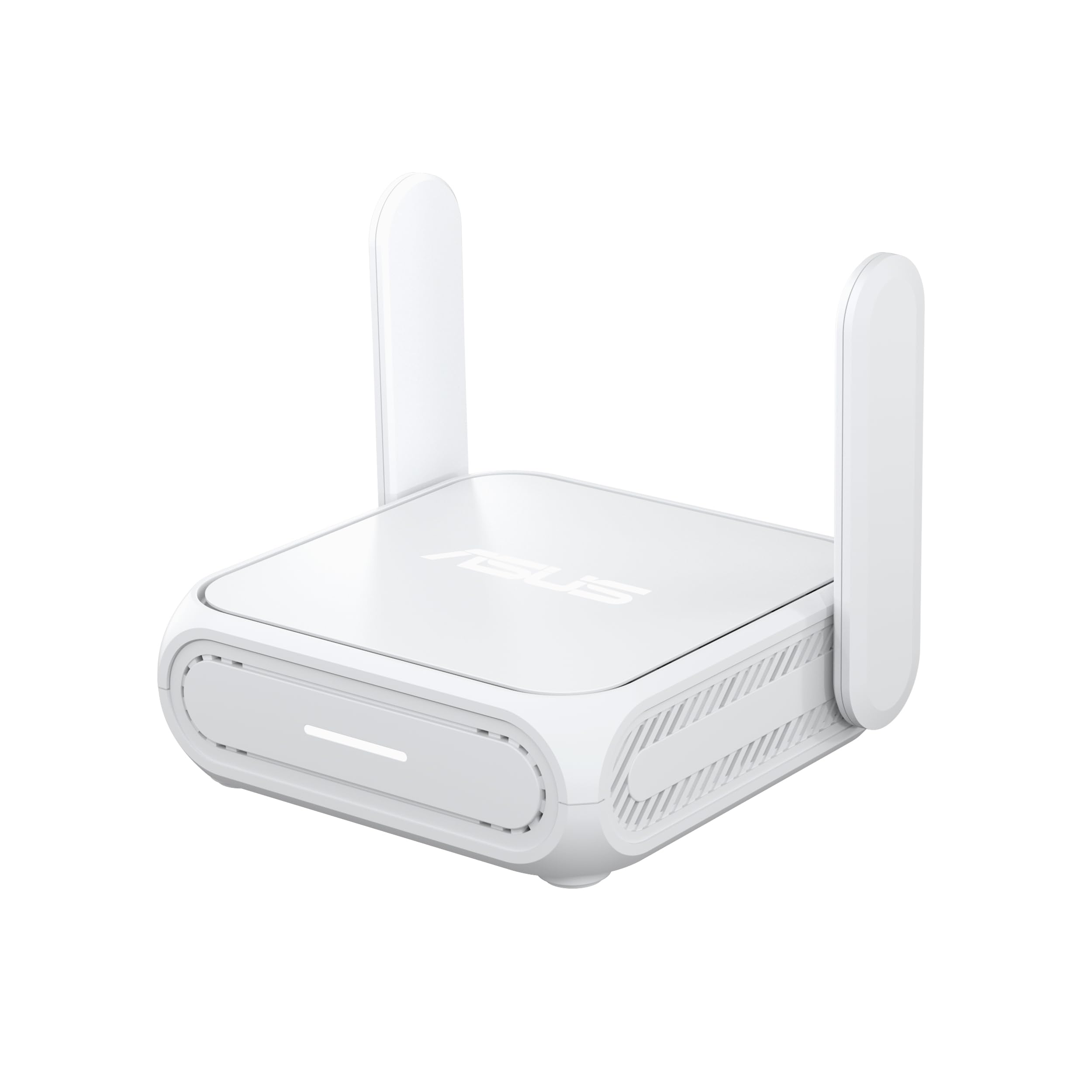
The ASUS RT-BE58 Go is the vanguard of portable Wi-Fi 7 routers—dual-band, up to 3600 Mbps aggregate, with Multi-Link Operation and 4K-QAM for low-latency streaming and gaming. Unlike the GL.iNet Mudi, this unit has no internal battery; it relies on USB-C Power Delivery at 18W, meaning you can run it off a laptop charger or a power bank. If your travel power supply is plentiful, you get a tremendous throughput advantage over any 4G-based competitor.
WISP mode is its killer feature for public WiFi: one tap clones a hotel or cruise ship network into a private, encrypted hotspot protected by the full suite of ASUS AiProtection. The toggle switch instantly enables VPN passthrough (OpenVPN and WireGuard), and the 2.5 Gbps WAN port ensures your wired backhaul doesn’t bottleneck even the fastest external connection. With AiMesh compatibility, you can later integrate it into a mesh network at home.
The main trade-off is the missing internal battery. Without a power bank, you lose connectivity the moment you unplug. Also, a few users report the captive portal authentication can be finicky on some hotel networks, requiring a manual MAC address spoofing workaround. If you carry a power bank already, this router delivers the highest raw speed and security among travel routers.
Why it’s great
- Wi-Fi 7 dual-band with up to 3600 Mbps throughput
- One-tap WISP mode securely clones public WiFi
- 2.5 Gbps WAN port handles multi-gig tethering
Good to know
- No internal battery — requires USB-C power bank
- Captive portal login can be unreliable in some hotels
- Single LAN port is 1 Gbps only
3. GL.iNet GL-MT3600BE (Beryl 7) Portable Travel Router
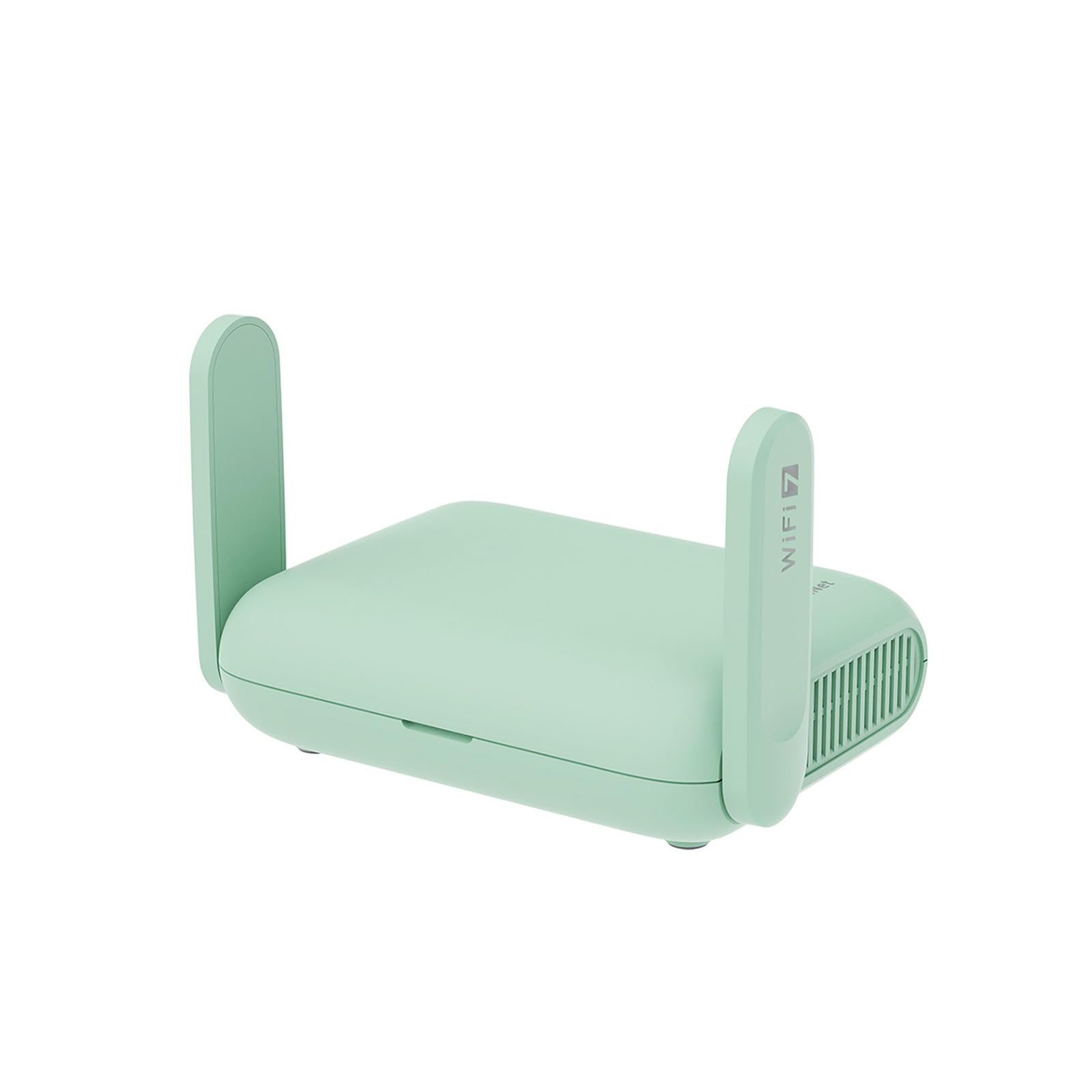
The Beryl 7 runs the full OpenWrt 21.02 firmware, giving you root-level control and the ability to install custom packages like AdGuard Home and advanced VPN profiles. Its dual-band Wi-Fi 7 delivers 688 Mbps (2.4 GHz) and 2882 Mbps (5 GHz), and the two 2.5 Gbps Ethernet ports make it viable as a wired gateway as well. There is no cellular modem here—connection comes from tethering, Ethernet, or public WiFi—but the hardware toggle switch lets you instantly enable your chosen VPN or ad-blocking service without diving into menus.
GL.iNet supports over 30 VPN providers, and the Beryl 7 can run a VPN server and client simultaneously (VPN cascading), allowing remote access to your home network while protecting outbound traffic. With IPv6 and DNS over TLS support, your data is shielded at every layer. Users consistently report rock-solid connection stability and zero dropouts during week-long hotel stays, with the unit powered via its included adapter or a USB-C power bank.
The main drawback is that the built‑in signal can occasionally be weaker than expected in crowded environments like cruise ships, where many competing networks exist. The physical toggle switch requires manual configuration in the admin panel before it does anything useful. For power users who want to run custom scripts and control every packet, however, the Beryl 7 offers the deepest customization.
Why it’s great
- OpenWrt with 512 MB storage for custom plugins
- Physical toggle for instant VPN/AdGuard activation
- Dual 2.5 Gbps Ethernet ports
Good to know
- No internal battery — needs constant USB-C power
- WiFi range can be average in high-density areas
- Toggle switch is non-functional until manually mapped
4. TP-Link Roam 7 BE3600 Wi-Fi 7 Portable Travel Router

The Roam 7 is TP-Link’s Wi‑Fi 7 travel workhorse—BE3600 speeds via dual-band, with a 2.5 Gbps WAN and a 1 Gbps LAN port. Like the ASUS model, it lacks an internal battery and must be powered via its USB-C port from a power bank or wall adapter. Where it stands out is in its public WiFi handling: the Tether app’s one-step captive portal authentication means you log in once on your phone and the Roam 7 automatically authenticates every device behind it.
OpenVPN and WireGuard are built in, so your traffic is encrypted from the moment it leaves any connected device. TP-Link signed the CISA Secure-by-Design pledge, and the router supports PPTP and L2TP VPN protocols as well. With the ability to handle up to 90 devices, it’s overkill for a solo traveler but perfect for a family or group trip. The USB 3.0 and microSD slot also allow networked file sharing from a drive.
Some users note that the device can run hot under sustained load, and the plastic chassis feels less premium than aluminum alternatives. A few also found the captive portal process occasionally failed, requiring manual MAC address cloning. For a nearly‑full‑featured router in a pocket‑sized package, the Roam 7 is a strong choice.
Why it’s great
- One-step captive portal authentication via Tether app
- Built-in OpenVPN and WireGuard client/server
- Supports up to 90 simultaneous devices
Good to know
- No internal battery
- Plastic casing can get very warm
- Captive portal may require manual intervention on some networks
5. TP-Link Roam 6 AX3000 Dual-Band Wi-Fi 6 Travel Router

The Roam 6 is the entry point into secure portable WiFi without sacrificing modern connectivity. Its AX3000 speeds (2402 Mbps at 5 GHz, 574 Mbps at 2.4 GHz) cover streaming and remote work well, and like the higher‑end Roam 7, it lacks an internal battery and runs off any USB‑C power source. This means it can be powered by a power bank that you already carry, reducing the number of devices you need to plug in at a coffee shop or hotel room.
VPN support includes OpenVPN and WireGuard, and the one‑step captive portal login in the Tether app works exactly as on the Roam 7. The router supports Router, Hotspot, and AP/RE modes, making it flexible whether you’re tethering your phone, connecting to hotel WiFi, or extending an existing network. You also get a USB 3.0 port for sharing a thumb drive and a microSD slot for expandable storage—features often missing at this tier.
Because the Roam 6 tops out at Wi‑Fi 6 rather than Wi‑Fi 7, it won’t push past 3 Gbps, and there’s no 6 GHz band. A few user reviews note that the captive portal can fail on certain hotel networks, forcing you to manually spoof the MAC address. For a reliable, mid‑range travel router that doesn’t break the bank, the Roam 6 delivers excellent security and solid performance.
Why it’s great
- Wi‑Fi 6 AX3000 for smooth streaming and calls
- One‑step captive portal via Tether app
- USB 3.0 and microSD slot for file sharing
Good to know
- No internal battery
- No cellular modem; requires external internet source
- Captive portal can be inconsistent on some networks
6. EIOTCLUB 4G LTE Portable WiFi Hotspot
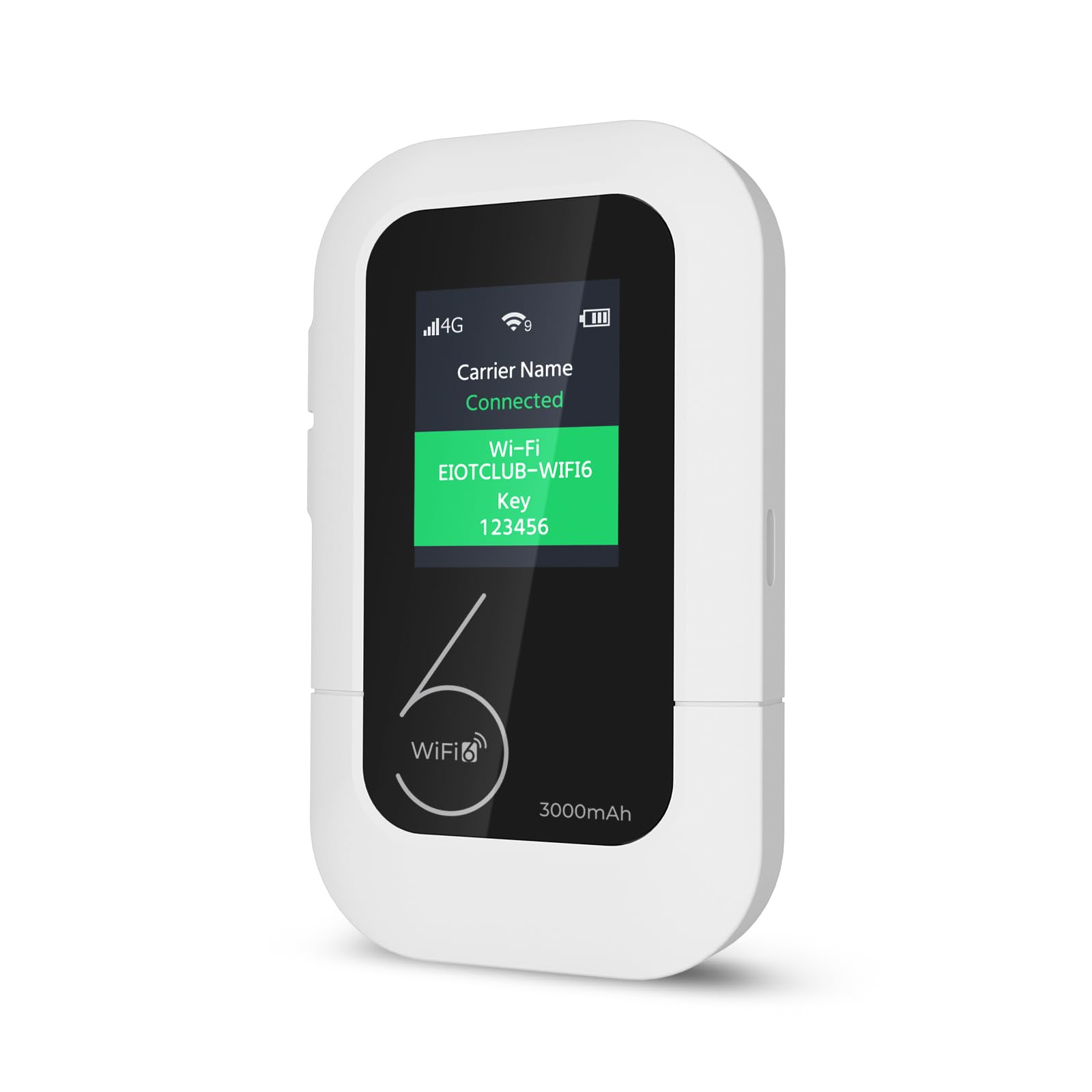
If you simply want internet on the go without any configuration, the EIOTCLUB hotspot is the most accessible entry point. It ships with a pre-installed SIM and 1 GB of free trial data—just power it on, scan the QR code, and you are online. The 3000 mAh battery is rated for up to 12 hours of continuous use, with a smart sleep mode that wakes on button press to conserve power when idle. The 1.7-inch LCD screen shows carrier name, data usage, and recharge QR codes, making top‑ups hassle‑free.
This is a single‑band 2.4 GHz Wi‑Fi 4 device, so maximum throughput is capped around 150 Mbps—enough for browsing, email, and standard video streaming, but not for multi‑device 4K streaming or large file transfers. It supports up to 10 devices at once, and the SIM is locked to optimize US coverage (AT&T and T‑Mobile). Averages from user reports show reliable speeds for work conferences and road trips, especially when the local venue WiFi is weak.
The biggest limitation is the lack of 5 GHz or any advanced security features like a built‑in VPN. To encrypt your traffic, you would need a VPN client on each device. The data plans work on a time‑plus‑data usage model, so monitor your consumption to avoid automatic recharges. For a turnkey, no‑hassle hotspot, this delivers the most straightforward experience.
Why it’s great
- Built‑in SIM with 1 GB free trial, zero setup
- 3000 mAh battery for up to 12 hours runtime
- Clear LCD shows data status and recharge QR
Good to know
- 2.4 GHz only — capped at Wi‑Fi 4 speeds
- No built‑in VPN support
- Data plans use a time/data limit model
7. NETGEAR Nighthawk M7 Pro Mobile Hotspot 5G mmWave (Renewed)

The Nighthawk M7 Pro is in a class of its own: a true 5G mmWave mobile hotspot with Wi‑Fi 7, a 6 GHz band, and speeds up to 5.8 Gbps. It can connect up to 64 devices and cover up to 2,000 square feet, making it a viable primary internet source for a small RV or temporary office. The integrated battery means you can take it to a park or campsite without any external power or wiring—just a SIM card is needed.
This renewed unit supports AT&T and Verizon 5G out of the box, and user reports confirm it works on T‑Mobile as well. The LCD passcode screen and URL filtering give you basic network management without needing a separate app. For heavy users who need gaming‑grade latency and multi‑gigabit downlink, the M7 Pro performs at a level no other portable router on this list can match.
The catch is the renewed status: some units arrive SIM‑locked to AT&T despite being advertised as unlocked, requiring a call to unlock. The price point is also the highest on this list, and the battery life under constant 5G mmWave load is significantly shorter than the 4G‑class EIOTCLUB or Mudi. For power users who demand the absolute fastest cellular internet in a portable package, the M7 Pro is the endgame.
Why it’s great
- True 5G mmWave with 5.8 Gbps peak speed
- Wi‑Fi 7 with exclusive 6 GHz band
- 2000 sq. ft. coverage, 64 device capacity
Good to know
- Renewed unit may arrive carrier-locked
- Battery life short under heavy 5G load
- Highest cost in this guide
FAQ
Can a battery powered WiFi router charge my phone via USB?
Do I need a separate SIM card for a battery powered WiFi router?
Can I use a battery powered WiFi router with a VPN service?
How many devices can a portable hotspot support at once?
Final Thoughts: The Verdict
For most users, the battery powered wifi router winner is the GL.iNet Mudi because it packs a massive 7000 mAh battery, a 4G LTE modem, and full VPN support into a compact travel companion. If you want the fastest wireless speeds and don’t mind tethering to a power bank, grab the ASUS RT-BE58 Go. And for zero‑configuration cellular internet at a budget price, nothing beats the EIOTCLUB 4G Hotspot.