
Our readers keep the lights on and my morning glass full of iced black tea. As an Amazon Associate, I earn from qualifying purchases.
Specs are compiled from manufacturer listings and verified buyer reviews and can change over time — please confirm the key details on the product page before buying.
If your wall has no C-wire, you still have options. That thin “common” wire is what normally feeds power to a smart thermostat, and plenty of older homes simply do not have one. All four thermostats below run on batteries and connect over Wi-Fi, so no C-wire is needed. The catch is Wi-Fi reliability: connection dropouts are the most common complaint across these four models.
I’m Min — the founder and writer behind Gadgets Feed. This guide is built by comparing the manufacturers’ published specifications and the patterns across verified customer reviews, so you get each pick’s real strengths and trade-offs instead of marketing spin.
Battery power removes the wiring job, but not the setup quirks. What separates them is app reliability, C-wire exceptions, and Wi-Fi signal strength. Below is a plain-English look at the battery powered wifi thermostat options worth your money.
Quick Picks
- Braeburn 7205 Digital Programmable Wi-Fi — Best Overall
- Nest Thermostat E Programmable Smart Thermostat — Best for Multi-Zone
- Google Nest Thermostat – Smart Thermostat — Top Performer
- Lux Products GEO-BL Wi-Fi Thermostat, Black — Most Flexible Mounting
How To Choose The Best Battery Powered WiFi Thermostat
Choosing a battery-powered Wi-Fi thermostat depends on phone control without an electrician and without dropouts. The features that matter most are battery power, C-wire-free operation, and the reliability of the app and Wi-Fi connection.
The C-Wire Question Comes First
A C-wire, short for “common wire,” is the wire that carries continuous low-voltage power to a thermostat. Most battery-powered thermostats are built to run without it, so no rewiring is needed just to get the device powered up. But some systems still demand the wire to enable Wi-Fi. That is the catch to check before you buy.
Heating-only setups, cooling-only setups, zone-controlled systems, and heat pump systems often need a C-wire even on a battery thermostat. The Nest Thermostat, for example, is designed to work without a C-wire in most homes but specifically lists those systems as exceptions. Check your own wiring first, then match the thermostat to it.
Wi-Fi Reliability Beats Fancy Features
Every thermostat here connects over Wi-Fi, and every one of them has some customer feedback about connection hiccups. A thermostat whose Wi-Fi drops is just an expensive wall clock. The battery models that keep owners happiest are the ones whose Wi-Fi stays connected and whose app stays logged in.
App Support And Voice Control
App control is the reason to pay more than a basic programmable unit. Some units work with Amazon Alexa and Google Assistant, others do not. The Braeburn 7205, for instance, is not compatible with Alexa or Google Home, while the Google and Lux units both offer voice control. If hands-free control matters to you, that is a deciding factor.
Battery Power And Everyday Convenience
Battery operation means no line voltage, so in most cases it is a direct swap for your old thermostat. It also means the thermostat keeps running during a power cut. The trade-off is that batteries eventually need replacing, and a unit that ships with a dead battery is a frustrating first impression.
Quick Comparison
| Model | Best For | Power | Wi-Fi | Voice Control | Amazon |
|---|---|---|---|---|---|
| Braeburn 7205 | Existing Braeburn owners | Battery, no C-wire needed | Wi-Fi | None | Amazon |
| Nest Thermostat E | Multi-zone homes | Battery | Wi-Fi | Alexa and Google Assistant | Amazon |
| Google Nest Thermostat | Most homes, most systems | Battery, no C-wire in most homes | Wi-Fi | Alexa and Google Assistant | Amazon |
| Lux GEO-BL | Geofencing and Echo users | Battery, mini USB, or AC24V | Wi-Fi | Amazon Alexa | Amazon |
In‑Depth Reviews
1. Braeburn 7205 Digital Programmable Wi-Fi Thermostat, White
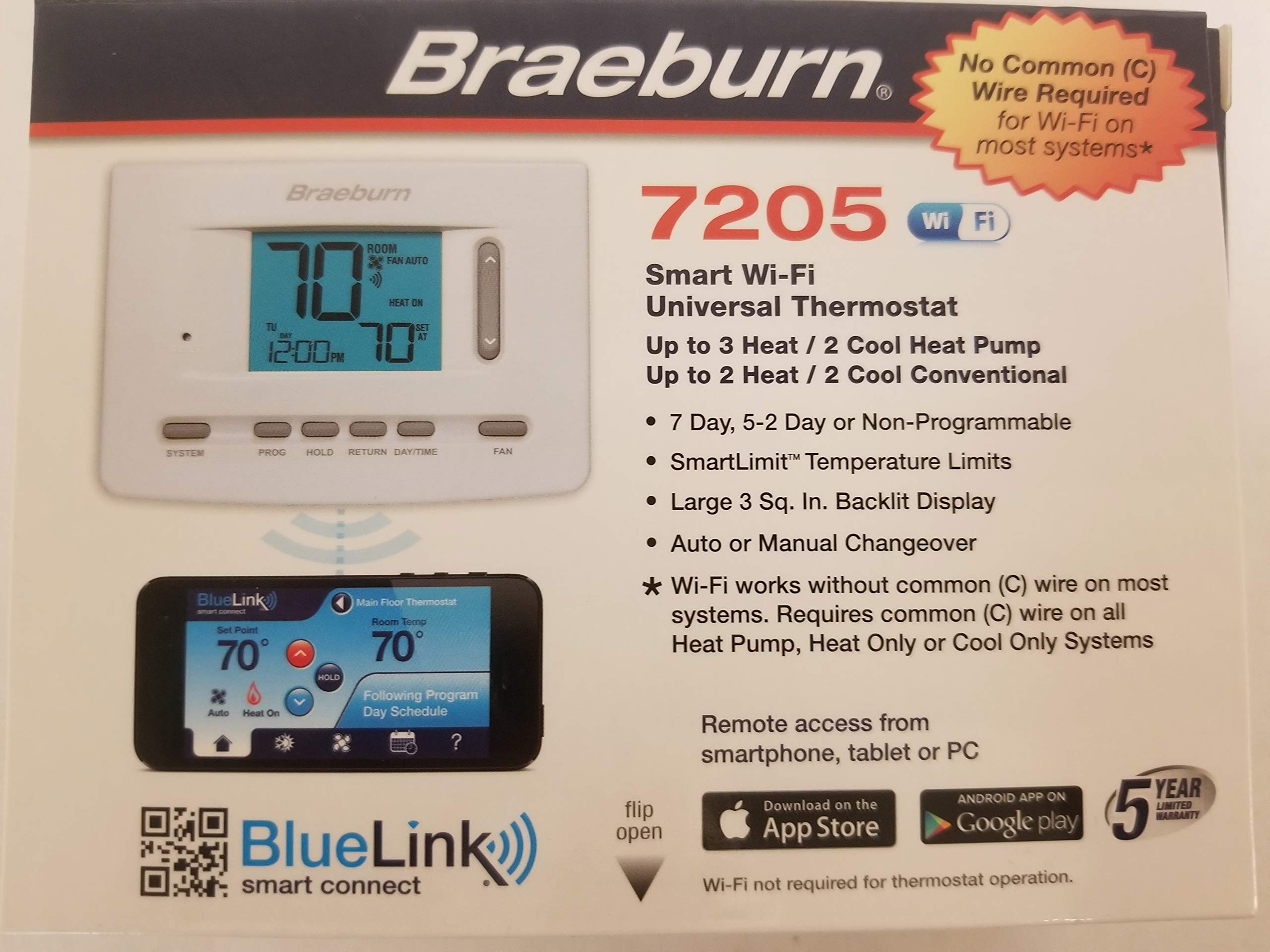
The wiring-light pick for anyone who already runs Braeburn gear and wants app control without a common wire.
The headline here is the C-wire-free design. This thermostat runs Wi-Fi on conventional HVAC equipment without a common wire, so you can push your system to your phone without opening up the wall. Stick with a matched brand and the install is close to painless — owners coming from an older Braeburn swap units and are done almost immediately, and repeat buyers keep praising how easy the whole thing goes in.
What wins people over is how the day-to-day function holds up. It clearly handles the basics well, from an affordable all-in approach to matching an existing upstairs unit for unified app control, and it lets you shut the system down remotely while you are away. The BlueLink app is described as pretty basic, so do not expect a rich interface. At 15.2 ounces it is no featherweight on the wall either — noticeably heavier than the sleek Google unit above it.
The honest catch is the wireless link itself. Wi-Fi is where this one draws its complaints, with difficulty connecting and an app that is not compatible with Alexa or Google Home. Buyers report: “This one didn’t need the common wire either to get the wifi function to work but wifi connection is not reliable.” Programming also takes patience — the instructions are not the friendliest, though customer service earns steady praise for walking people through it. If you value a rock-solid connection above all, weigh that against the smooth install.
What Buyers Rave About
- Runs Wi-Fi on conventional HVAC without a common wire
- Straightforward install, especially as a same-brand replacement
- Remote system shutdown while you are away
Where It Falls Short
- Wi-Fi connection is not reliable and cuts out sometimes
- No Alexa or Google Home compatibility
- Programming instructions are hard to follow
Pick this if: you want a no-fuss battery Wi-Fi swap and already run the Braeburn system.
Think twice if: you need dependable always-on Wi-Fi or voice control through Alexa or Google.
2. Nest Thermostat E Programmable Smart Thermostat for Home (T4002ES)

A lightweight, voice-ready unit that shines in homes with several zones to juggle.
For a house with multiple floors, the appeal is remote monitoring and scheduling. Owners running three zones on separate floors find the app makes programming simple and love checking the heat while away in winter. The unit weighs 12 ounces, which is 3.2 ounces lighter than the 15.2-ounce Braeburn above — a small thing, but it tells you how compact the body is. Installation is pitched at 60 minutes or less, and it works with most 24V heating and cooling systems, from gas and electric to heat pump, radiant, oil, hot water, solar, and geothermal.
The box is generous on features: auto-scheduling, remote access, energy usage tracking, and hands-free control through Alexa and Google Assistant. It blends in on light-colored walls and offers a manual spin dial on the front for quick adjustments without your phone.
Here is the trade-off to weigh before you buy. The battery life is the weak spot — several units arrive with a dead battery that needs charging before install, and one buyer hit a three-hour troubleshooting wall trying to add the device to a new account. There is also a real C-wire caveat: once installed, some find it will only run properly with a speciality wire. Owners mention: “Purchased these because it was advertised that it can run without a specialty wire. This is not true in any way.” If your system is simple and your wiring is knowable, it is a strong value; if you are unsure, verify before ordering.
The value read: voice control, auto-scheduling, and wide 24V system support for less than the Google unit — a fair buy when your setup is uncomplicated.
The honest limit: battery reliability and the specialty-wire demand are the things that send this one back for some owners.
Reach for this if: you run several zones and want voice control without paying flagship money.
Look elsewhere if: your system needs a C-wire you would rather not add.
3. Google Nest Thermostat – Smart Thermostat for Home – Snow

The crowd favorite — 4.1 stars across 29,000+ owners — and the one built to dodge the C-wire in most homes.
Google’s mainstream thermostat earns its spot on battery power alone. It is designed to work without a C-wire in most homes, so the majority of buyers can install it without running a wire. It is also ENERGY STAR certified, which is a recognized mark for lower energy use. The headline trick is occupancy awareness: it turns itself down when you leave so you are not heating an empty house, and it works with Matter-certified voice assistants plus Alexa and Google Assistant for hands-free changes.
Set-up experience splits two ways. Plenty of owners find the phone setup quick and love changing temperature from an iPhone, while others find it tricky and end up on YouTube chasing the fix. The temperature side is mostly dialed in, though a handful report readings running about 15 degrees above the actual figure at first. HVAC monitoring watches your heating and cooling system and pings you if something looks off, and Savings Finder suggests schedule tweaks to trim waste.
Two caveats deserve a plain mention. First, that no-C-wire convenience has limits — heating-only, cooling-only, zone-controlled, and heat pump systems still need a C-wire or a compatible power accessory, so check your system on Google’s compatibility checker before buying. Second, and easier to miss, this model runs on the Google Home app, not the Nest app — and if you already own other Nest thermostats on the Nest app, this one will not join them. Owners who did not know that upfront find it an annoyance. Get past those two and you get the most polished mix of battery power, smart scheduling, and voice control in this group.
Why It Wins People Over
- Works without a C-wire in most homes
- ENERGY STAR certified and saves energy by sensing when you leave
- Alexa, Google Assistant, and Matter-certified voice control
- HVAC monitoring plus Savings Finder schedule suggestions
Worth Knowing
- Heating-only, cooling-only, zone, and heat pump systems still need a C-wire
- Runs on the Google Home app, not the Nest app
- Set-up is easy for some, frustrating for others
Best for the widest range of homes: if your system is conventional, this is the one that most buyers land on.
Not for you if: you run a heat pump or zone system, or you are committed to the Nest app.
4. Lux Products GEO-BL Wi-Fi Thermostat, Black

A battery-only unit with geofencing and Echo control, aimed squarely at hands-off comfort.
This is the most flexible of the four on the wall. It mounts horizontally or vertically, runs on batteries with no C-wire, and can also be powered by mini USB or AC24V if you prefer. Geofencing uses proximity awareness to keep the space comfortable when you are home and efficient when you are away, and the free iOS or Android app delivers control from anywhere. It works with Amazon Alexa over Wi-Fi, so voice changes are on the table.
Physically it draws compliments. The black, brushed finish and retro screen read as stylish, and the large numbers plus simple knob control suit anyone who wants to eyeball the temperature without opening an app. Owners like the MAC address tucked under the Device ID for added router security, the backlight that runs up to 15 seconds or stays always on, and the auto-away mode that kicks in the moment you leave. At 14.4 ounces, it sits between the featherweight Google unit and the heavier Braeburn.
The caveat is the software, and it is worth taking seriously. The app is where this one loses people — long-sync delays, dropouts after updates, and repeated logouts. The recurring gripe is the app not holding a connection and the Wi-Fi being fussy to set up in the first place. An occasional unit also arrives without plastic wrap on the batteries, which is more of a packaging nit than a defect. If you can live with a stubborn app and want a battery-powered unit that mounts your way and answers Alexa, this is a solid pick; if the app is your whole reason for buying, look at the Google unit above.
The standout feature: geofencing plus Alexa and dual-direction mounting give you more ways to run it than anything else here.
The honest limit: the app is the weak link — expect connection stumbles and the occasional logout.
Suits you if: you want battery-only operation, geofencing, and an Alexa voice command without a C-wire.
Move on if: a rock-solid phone app is the feature you care about most.
Understanding the Specs
Battery Power and the C-Wire
A battery-powered thermostat runs on batteries, so it does not draw power from your home’s wiring the way a hardwired unit does. That is what lets many of these install without a C-wire, the continuous low-voltage wire that normally powers a smart thermostat. Check your system type first though, because heating-only, cooling-only, zone-controlled, and heat pump systems often still need a C-wire to enable Wi-Fi even when the unit runs on batteries.
Wi-Fi Connectivity and App Control
Wi-Fi is what turns a wall thermostat into something you can reach from anywhere. The connection quality varies a lot between units, and a weak link usually shows up as dropouts or an app that logs you out. App support matters too, since some units control through their own app while others integrate with Alexa, Google Assistant, or Matter-certified platforms. Match the app and voice platform to the one you already use at home.
System Compatibility
Compatibility decides whether a thermostat will even work in your house. Most units here support common 24V heating and cooling systems, but the details differ. Some handle gas, electric, forced air, heat pump, radiant, oil, hot water, solar, and geothermal, while others are built for conventional equipment only. Verify your system type against the manufacturer’s compatibility list before you buy to avoid a return.
Geofencing and Energy Saving
Geofencing uses your phone’s location to know when you are home, so the thermostat holds comfort while you are there and eases off when you leave. It pairs with occupancy learning and scheduling to cut waste from heating or cooling an empty house. If saving energy automatically matters to you, look for geofencing, occupancy sensing, or a recognized energy certification on the unit.
FAQ
Do I need a C-wire for a battery powered WiFi thermostat?
Will a battery powered thermostat keep working during a power cut?
How do I know if my HVAC system is compatible?
Why does my Wi-Fi thermostat keep disconnecting?
Does a battery powered WiFi thermostat work with Alexa and Google Home?
How long does the battery last in a Wi-Fi thermostat?
Can a battery powered thermostat control more than one zone?
Is geofencing worth having on a thermostat?
What smart home app will my thermostat use?
Final Thoughts: The Verdict
For most homes, the battery powered wifi thermostat winner is the Google Nest Thermostat because it is designed to work without a C-wire in most homes, carries ENERGY STAR certification, and covers more systems than anything else here — the crowd favorite by a wide margin. If you already run the Braeburn system and want the simplest no-C-wire swap, grab the Braeburn 7205. And for geofencing with Alexa in a unit that mounts your way, the Lux GEO-BL is the one to reach for. One nudge: start with your system type, since that single check decides which of these will actually control your heat and air.
How We Picked
We do not accept paid placement. Every pick is matched to a real buyer and a real use-case; we do not hands-on test units.
Sources & Methodology
Specifications: manufacturer listings and product documentation. Review insights: verified customer reviews, as of September 2026. Pricing: not shown on this page (it changes often); check the current price via the retailer link.
As an Amazon Associate, Gadgets Feed earns from qualifying purchases. This does not affect which products we feature.