
Our readers keep the lights on and my morning glass full of iced black tea. As an Amazon Associate, I earn from qualifying purchases.
Specs are compiled from manufacturer listings and verified buyer reviews and can change over time — please confirm the key details on the product page before buying.
Old batteries in a drawer or trash can leak chemicals and start fires. You need a safe, clear spot to collect dead cells until you recycle them. The battery recycling bin worth buying for most homes is the QHAND Battery Recycling Container — it has a clear 1.32-gallon bin and a built-in tester (a small device that checks if a battery still has charge) so you never toss a good battery by mistake. This guide compares the specs and real buyer feedback for four top bins, covering safety, capacity, and what each one is actually good for.
I’m Min — the founder and writer behind Gadgets Feed. This guide is built by comparing the manufacturers’ published specifications and the patterns across verified customer reviews, so you get each pick’s real strengths and trade-offs instead of marketing spin.
The right battery recycling bin keeps your home safer by making proper disposal simple. A bin prevents fires from shorted terminals and keeps toxic chemicals out of landfills.
Quick Picks
- QHAND Battery Recycling Container — Best Value + Tester
- PIG Battery Disposal Container — High-Volume Pick
- Winkee Volt Vault Battery Box — Desk-Ready Design
- EZ on the Earth Dry Cell Battery Recycling Kit — Complete Mail-Back Kit
How To Choose The Best Battery Recycling Bin
Choosing the right bin depends on your collection volume, disposal method, and placement location. A tiny container in a workshop is very different from a clear bin for a busy office kitchen. You need a container that seals safely, is clearly labeled, and fits your space perfectly so dead batteries do not become a forgotten hazard.
Capacity and Footprint
The most important decision is size. A one-gallon bin holds a surprising number of household batteries — around 13 pounds worth, according to some kit specs. But a 2-gallon bin gives you twice the storage space, meaning fewer trips to the recycling center. Measure the spot you plan to put it: a small 3.74-inch wide bin fits on a slim shelf, while a larger 10-inch cube might live on a garage bench. Choose the smallest container that matches your collection pace so it does not become a permanent monument to dead cells.
Lid and Seal Safety
A tight lid is the main safety feature. A sealable lid keeps moisture out and prevents spills if the bin tips over. Clear containers let you see the fill level without opening the bin. Some models even use a resealable lid that meets universal waste regulations (government rules for storing common hazardous household items), which is important if your local recycling center requires closed containers.
Quick Comparison
| Model | Best For | Capacity | Dimensions | Material | Amazon |
|---|---|---|---|---|---|
| QHAND Battery Recycling Container | Households needing a tester included | 1.32 gallons | 7.87″ x 7.87″ x 7.09″ | Plastic | Amazon |
| PIG Battery Disposal Container | High-volume offices and workshops | 2 gallons | 9.75″ x 7.75″ x 9.63″ | HDPE / PP | Amazon |
| Winkee Volt Vault Battery Box | Desk decor and light collection | 1.6 liters | 3.74″ x 3.74″ x 7.28″ | Stainless Steel | Amazon |
| EZ on the Earth Dry Cell Recycling Kit | All-in-one recycling with mail-back | 1 gallon | 10″ x 10″ x 10″ | High Density Polyethylene | Amazon |
In-Depth Reviews
1. QHAND Battery Recycling Container

This bin stops you from tossing a still-good battery too soon — its tester checks charge before you drop cells in.
You get a transparent container with a sealable lid and a small battery tester that checks AA, AAA, C, D, 9V, and 1.5V button cells (small round watch batteries). This is a real time-saver when you are not sure which batteries are dead. The bin holds about 1.32 gallons (dimensions: 7.87 x 7.87 x 7.09 inches). Buyers report the size is “perfect” — big enough to hold many batteries but not so large it becomes un-storable. The total height with the lid is about 8.3 inches, so it tucks neatly onto a shelf or desk corner.
Compared to the PIG container below, which has a 2-gallon capacity versus this QHAND bin’s 1.32 gallons, this QHAND bin is better for a single household that collects gradually. The tester is the standout addition: it takes seconds to confirm a battery is truly dead before you drop it in, which prevents waste. The lid seals securely, which helps prevent accidental spillage in busy settings like a kitchen drawer.
One buyer started a collection program at their office, calling it the “perfect size container” that holds enough yet is still easy to carry. Another mentioned the tester has proven “very handy” and easy to use on all battery sizes. For most homes, this is the one to beat.
Two handy features in one: The included battery tester saves you from tossing good cells, and the 1.32-gallon clear bin with sealable lid is just the right size for steady household collection.
Not a shipping container: This bin is for storage only — you will need your own recycling drop-off route.
Reach for this if: you want the most practical household kit — a clear bin with a tester, a secure lid, and a size that is large enough to collect for months without dominating your counter.
Look elsewhere if: you need a massive container for a high-traffic office or a complete mail-back recycling service.
2. PIG Battery Disposal Container

A clear 2-gallon bin designed for busy offices and workshops where dead batteries pile up fast.
This PIG container holds a full 2 gallons of used dry-cell batteries versus the QHAND bin’s 1.32 gallons. The dimensions are 9.75″ x 7.75″ x 9.63″, so it has a larger footprint but still fits on a counter or a garage shelf. The clear polyethylene body (a tough, chemical-resistant plastic) lets you see exactly how full it is at a glance, so you never open it to check and risk a spill.
The lid is resealable and designed to meet universal waste regulations — that means your local recycling center will accept it as a closed container, which eliminates the hassle of open bins. The bottom is HDPE (high-density polyethylene) and the lid is polypropylene, both tough materials that resist corrosion. The brand explicitly says it is for “used battery storage only” and not a shipping container, so you still need to take it to a drop-off point. Its 9.25″ x 7.25″ opening is wide enough to drop even larger C and D cells without forcing them.
For an office that goes through batteries quickly or a multi-person workshop, the extra capacity saves trips. It is a straightforward workhorse — no tester, no decor — just a large, regulation-friendly bin that does exactly one job well.
Why it wins
- 2-gallon capacity is the largest here (2 gallons versus the 1-gallon EZ on the Earth kit)
- Clear body shows fill level instantly
- Resealable lid meets universal waste rules
The trade-off
- No battery tester included — you must test separately
- Not a mail-back recycling kit — you need to bring it to a drop-off center
Best for high-traffic spots: a 2-gallon clear bin that meets waste regulations, making it ideal for offices, garages, and workshops where dead batteries pile up fast.
skip it if: you want a mail-back service or need the convenience of a built-in battery tester.
3. Winkee Volt Vault Battery Box
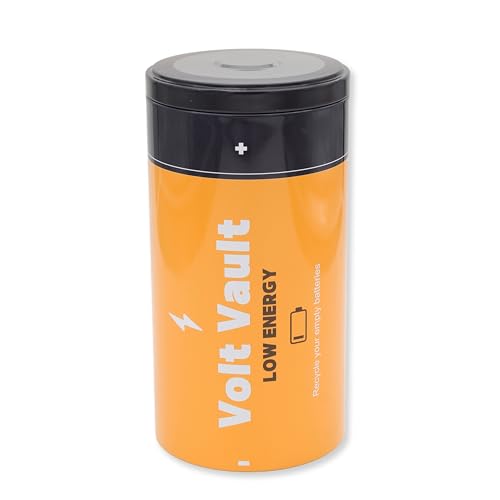
A stainless steel bin shaped like a giant battery — it fights the urge to toss cells in the trash.
This is the most compact option at just 3.74 inches wide and 7.28 inches tall, so it fits in a pencil cup slot on a desk. The hook is obvious design: it looks like a giant battery, so you never forget where to put dead ones. It holds 1.6 liters, which is about a third of a gallon (roughly 0.42 gallons), so it is best for a single person or a light-collecting desk spot. The stainless steel body is rustproof and polished, making it durable for everyday use.
Compared to the QHAND and PIG bins, which are plastic and larger, and the EZ on the Earth kit at 10 inches wide versus this bin’s 3.74 inches, the Volt Vault is much more of a decorative piece. It is not translucent, so you cannot see the fill level at a glance. It also has no lid seal in the traditional sense — it uses a pull-out opening mechanism. The brand markets it as a universal storage bucket, also suggesting it can collect charging cables or small items, which is a clue that its primary role is as a stylish reminder rather than a high-capacity safety container.
For the eco-conscious worker who wants a conversation starter on their desk, this is a clever choice.
Design-first, function-second: The iconic battery shape and stainless steel build make it a lasting desk piece, but its 1.6-liter capacity and pull-out opening are best for light, personal use.
Not for high volume: You will outgrow this quickly if you collect batteries for a household or office — it is purely a personal desk accessory.
Reach for this if: you need a compact, durable, and visually fun reminder on your desk that fits a slim space and collects dead cells from personal devices like remotes and keyboards.
Look elsewhere if: you need a sealed, see-through container with enough capacity for family or office battery collection.
4. EZ on the Earth Dry Cell Battery Recycling Kit

The all-in-one solution: a UN-approved container (meets United Nations safety standards for shipping) with a pre-paid return label so you just fill, seal, and mail.
This is the only kit on this list that includes a pre-paid mail-back label, so you do not have to find a local drop-off — you simply fill the container, attach the label, and send it for recycling. The container holds 1 gallon and measures 10 x 10 x 10 inches, a large cube that is best for a garage or workshop floor. The official capacity is up to 13.2 lbs of batteries. It is made from High Density Polyethylene (HDPE), a chemical-resistant plastic, and is UN-approved for shipping dry cell batteries.
A key detail: the manufacturer asks you to return the filled kit within 12 months of purchase to ensure proper processing. The kit accepts a very wide range of battery chemistries: alkaline, NiCad (nickel-cadmium), zinc-carbon, rechargeable lithium-ion, nickel-metal hydride, mercury, and silver-oxide — basically any common household dry cell (a non-spillable battery used in devices like remotes, toys, and clocks). The “EZ on the Earth” brand states they are certified recycling experts, so the ecological chain is closed. This is the most expensive pick, but it includes the recycling service itself, not just the box.
If you do not have a convenient recycling drop-off, this removes the biggest barrier to proper battery disposal.
Why it stands out
- Pre-paid return label eliminates the need to find a recycling center
- UN-approved container accepts nearly all dry-cell chemistries
- Holds up to 13.2 lbs of batteries
The catch
- Must be returned within 12 months of purchase
- 1-gallon capacity versus the PIG bin’s 2 gallons, and it is not translucent
Best for low-maintenance recycling: the complete mail-back kit for anyone who lacks easy center access — fill, attach the free return label, and your batteries are responsibly recycled.
pass on it if: you already have a reliable drop-off point and just need a larger storage bin for the interim.
Understanding the Specs
Capacity (Gallons vs. Liters)
Capacity tells you how many batteries your bin can hold before you need to empty it. A 1-gallon bin is fine for a single household collecting over several months, while a 2-gallon bin is better for an office or workshop where dead cells pile up faster. Some bins list liters instead of gallons — 1.6 liters equals about 0.42 gallons. Choose the largest container your space and collection pace allows, so you are not running to the recycling center every few weeks.
Lid Type and Safety
A sealable lid prevents moisture ingress and battery spills if the bin falls over. Some bins use a simple snap-on lid, while others have a resealable tab that meets universal waste regulations. Clear plastic lids let you see the fill level without opening the bin, reducing leak or overflow risk. A sealed lid is often required for drop-off at recycling centers.
FAQ
What batteries can I put in a battery recycling bin?
How long can I store dead batteries in a bin before recycling?
Can I put rechargeable batteries in a regular battery recycling bin?
Is it safe to store dead batteries in a plastic container?
What is a mail-back recycling kit?
How much does a battery recycling bin typically hold?
Can I use a battery recycling bin for other trash?
What happens if I put the wrong batteries in a mail-back kit?
Where do I take a full battery recycling bin if it is not a mail-back kit?
Is a battery recycling bin better than a ziplock bag for storage?
Final Thoughts: The Verdict
For most people, the battery recycling bin winner is the QHAND Battery Recycling Container because it combines a practical 1.32-gallon clear bin with a useful battery tester at a great value. If you collect batteries in a busy office or workshop, grab the PIG Battery Disposal Container for its large 2-gallon capacity and regulation-ready seal. And for the ultimate low-maintenance experience, the EZ on the Earth Dry Cell Recycling Kit includes a pre-paid return label so you never have to find a drop-off center again.
How We Picked
We do not accept paid placement. Every pick is matched to a real buyer and a real use-case; we do not hands-on test units.
Sources & Methodology
Specifications: manufacturer listings and product documentation. Review insights: verified customer reviews, as of July 2026. Pricing: not shown on this page (it changes often); check the current price via the retailer link.
As an Amazon Associate, Gadgets Feed earns from qualifying purchases. This does not affect which products we feature.
Product prices and availability are accurate as of the date/time indicated and are subject to change. Any price and availability information displayed on Amazon at the time of purchase will apply to the purchase of this product. As an Amazon Associate I earn from qualifying purchases.
CERTAIN CONTENT THAT APPEARS ON THIS SITE COMES FROM AMAZON. THIS CONTENT IS PROVIDED "AS IS" AND IS SUBJECT TO CHANGE OR REMOVAL AT ANY TIME.
Amazon and the Amazon logo are trademarks of Amazon.com, Inc. or its affiliates.