
Our readers keep the lights on and my morning glass full of iced black tea. As an Amazon Associate, I earn from qualifying purchases.
Specs are compiled from manufacturer listings and verified buyer reviews and can change over time — please confirm the key details on the product page before buying.
A home power outage can turn your life upside down in seconds — the fridge goes quiet, the lights flicker, and you start worrying about the food and the sump pump. A battery solar generator solves that by storing electricity in a big rechargeable battery pack that runs your essential appliances for hours, then refills from solar panels or a wall outlet when the grid is back. This guide cuts through the noise to find the best battery solar generator for your actual home, your camping trip, or your emergency plan.
I’m Min — the founder and writer behind Gadgets Feed. This guide is built by comparing the manufacturers’ published specifications and the patterns across verified customer reviews, so you get each pick’s real strengths and trade-offs instead of marketing spin.
You need a power station that will genuinely keep your fridge cold, your router on, and your family safe — and I have matched eleven top contenders against real-world owner feedback to help you pick the right one. Welcome to my complete guide to the battery solar generator.
Our Picks at a Glance

How To Choose The Best Battery Solar Generator
Picking a battery solar generator is less about brand loyalty and more about matching numbers to your real life. You need to know how much power your stuff draws, how long you want it to last, and how you plan to recharge it. Here are the three specs that matter most.
Watt-Hours (Wh): The Size of Your Fuel Tank
A watt-hour is a unit of energy storage — think of it like the size of your gas tank. A 2048Wh station can run a 200W refrigerator for roughly 10 hours, while a 640Wh station might give you 3 hours with the same fridge. If you are powering critical gear through a long outage, you want more Wh. If you are just keeping phones and a laptop charged at a campsite, a smaller number is fine.
AC Output Watts: What You Can Run at Once
This number tells you the maximum power the generator can deliver at any moment. A standard fridge needs about 600W to start. A microwave pulls 1000W-1500W. A window air conditioner can hit 1200W. If your generator’s continuous output is too low, it will shut down or trip when you try to run more than one big appliance. High-output models also have a peak or surge rating — a short burst of extra power to help motors and compressors start up without kicking the unit into overload protection.
Solar Input Watts: How Fast It Refills from the Sun
This spec determines how many watts of solar panels you can plug in at once. A station with a 1200W solar input limit can fully recharge from a single sunny day using a couple of good panels. A station limited to 400W input will take much longer. If you are going off-grid, a higher solar input number is a huge advantage. Compatibility with standard MC4 connectors (the plug type most solar panels use) also matters.
Quick Comparison
| Model | Best For | Capacity (Wh) | AC Output (W) | Solar Input (W) | Amazon |
|---|---|---|---|---|---|
| BLUETTI AC200L★ Best Overall | Whole-Home Backup | 2048 | 2400 | 1200 | Amazon |
| LIBRIDS C600Best Value | Budget CPAP/Camping | 640 | 600 | 1200 | Amazon |
| BLUETTI Elite 100 V2Top Performer | Compact Portable Power | 1024 | 1800 | 1000 | Amazon |
| EF ECOFLOW Delta 3 Classic | Smart Home Integration | 1024 | 1800 | 500 | Amazon |
| AFERIY Nomad1800-A | Feature-Rich Mid-Range | 1024 | 1800 | — | Amazon |
| DABBSSON 2000L | Semi-Solid Tech Value | 2048 | 2200 | 800 | Amazon |
| AFERIY P210 | High Output Budget Alternative | 2048 | 2400 | — | Amazon |
| Anker SOLIX S2000 | Lightest 2kWh for Home | 2010 | 1500 | 400 | Amazon |
| Jackery Explorer 2000 v2 | Brand-Trust Ultralight | 2042 | 2200 | 400 | Amazon |
| EF ECOFLOW Delta 3 Max | Premium Whole-Home Power | 2048 | 3400 | — | Amazon |
| Anker SOLIX C2000 Gen 2 | Fastest Recharge & RV | 2048 | 2400 | — | Amazon |
In-Depth Reviews
1. BLUETTI AC200L Portable Power Station
Our pick — over 4.5★ from 450+ verified ratings; the strongest balance of quality and price.
The powerhouse that keeps a whole house running for ten hours straight.
This station delivers a massive 2048Wh capacity and a 2400W AC output, and with Power Lifting it can surge to 3600W for starting heavy motors. That means you can run a refrigerator, a 64-inch OLED TV, security cameras, a modem, and lamps — all at once. Owners with an RV report it starts a roof air conditioner without a hiccup, and the built-in 30 amp RV port feeds power directly to your camper’s panel.
The battery uses LiFePO4 (lithium iron phosphate) cells rated for 3000+ cycles, so you get roughly a decade of regular use before it degrades. A 2400W AC input charges 0-80% in just 45 minutes, and a 1200W solar input means a full sun-day refills it in under 2.2 hours. The crowd favorite across nearly 500 reviews, it is the definition of a buy-it-for-life backup.
high capacity anchor
- 2048Wh expandable up to 8192Wh with extra battery packs — enough to run an entire home’s essentials
- 2400W AC output with 3600W Power Lifting handles almost any appliance or power tool
- 11 ports including a 30A RV outlet and a 100W USB-C PD port
- 45-minute 0-80% fast recharge and a <10ms UPS switchover for sensitive electronics
heavy investment
- At 61.4 pounds, you are not throwing this in a backpack — it lives near the breaker panel or in the RV bay
- The proprietary AC cord is a weak point; failure means waiting for a replacement from Bluetti
your best bet: If you want one generator to handle a multi-day outage, power a travel trailer, or run critical home gear, this is the undisputed anchor.
look elsewhere: If you need something to carry daily in a car or van, the 61-pound weight makes it a stationary unit, not a grab-and-go one.
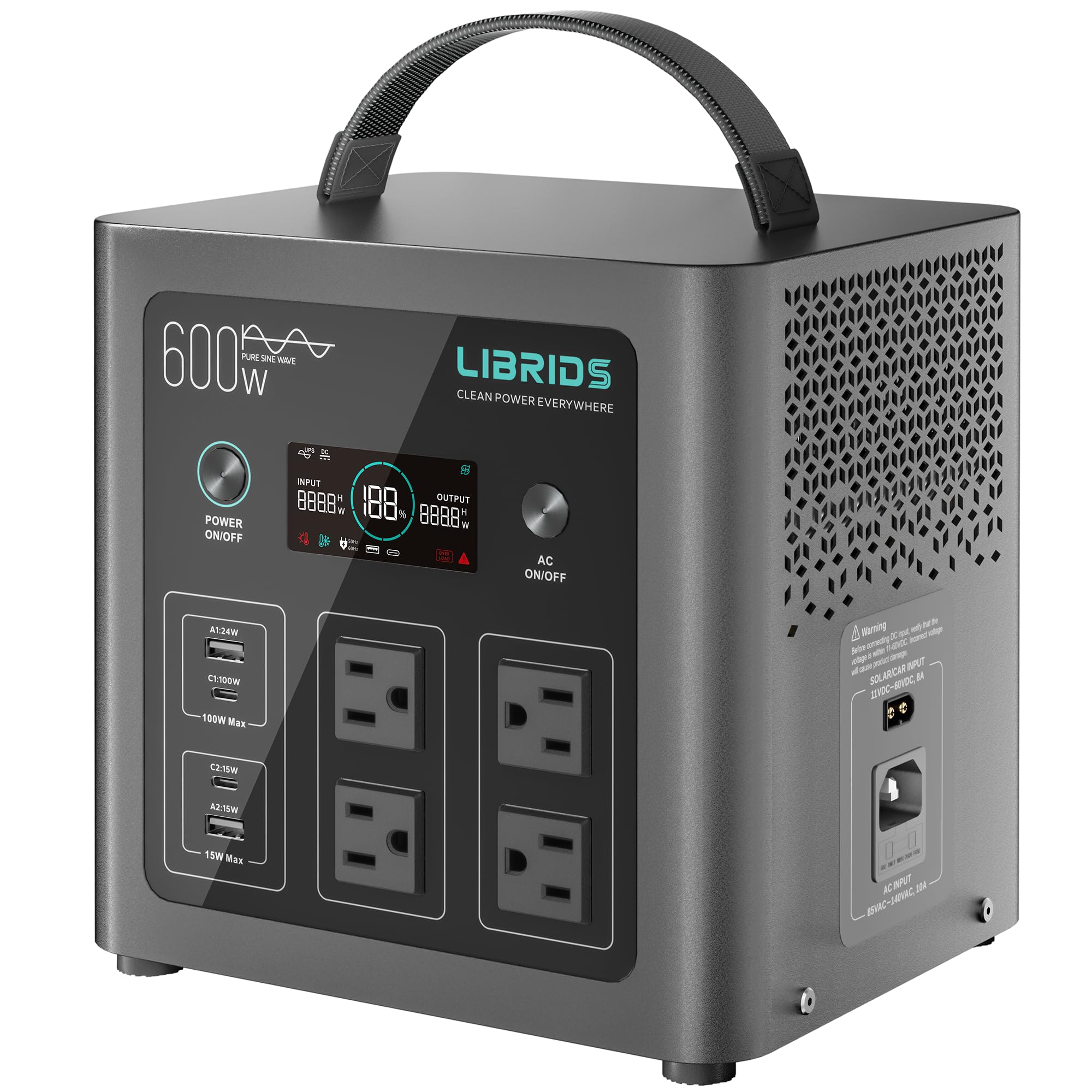
2. LIBRIDS C600 Portable Power Station
A tiny metal box that outperforms its price tag on every metric.
The LIBRIDS C600 packs a 640Wh LiFePO4 battery and a 600W pure sine wave inverter (1200W surge) into a compact 8.3-inch long steel case that weighs very little. Buyers report using it as a reliable 600W pure sine wave backup for saltwater aquarium pumps, and one owner ran a ResMed Airsense 11 CPAP for seven hours using just 24% of the battery. That kind of efficiency is rare at this tier.
Its 4000+ cycle rating means it will outlast many premium units. A 1.5-hour AC recharge and a surprisingly high 1200W solar input make it a phenomenal value for anyone who just needs a few essentials — router, CPAP, phone chargers — to stay running. The metal enclosure handles heat better than plastic rivals, and the 10ms UPS (uninterruptible power supply) keeps gear online during flickers.
The catch is simple: 640Wh is not enough for a full refrigerator for a whole day, and at 600W continuous, it will not run a large microwave or a space heater. But for its price, it is the best entry-level buy money can get.
reach for this if: You need a dependable backup for a CPAP machine, a router, lights, and phone charging during short outages or camping — at the lowest possible cost.
not meant for: Running a refrigerator for 12+ hours or powering multiple high-wattage appliances at once — you will hit the capacity ceiling quickly.
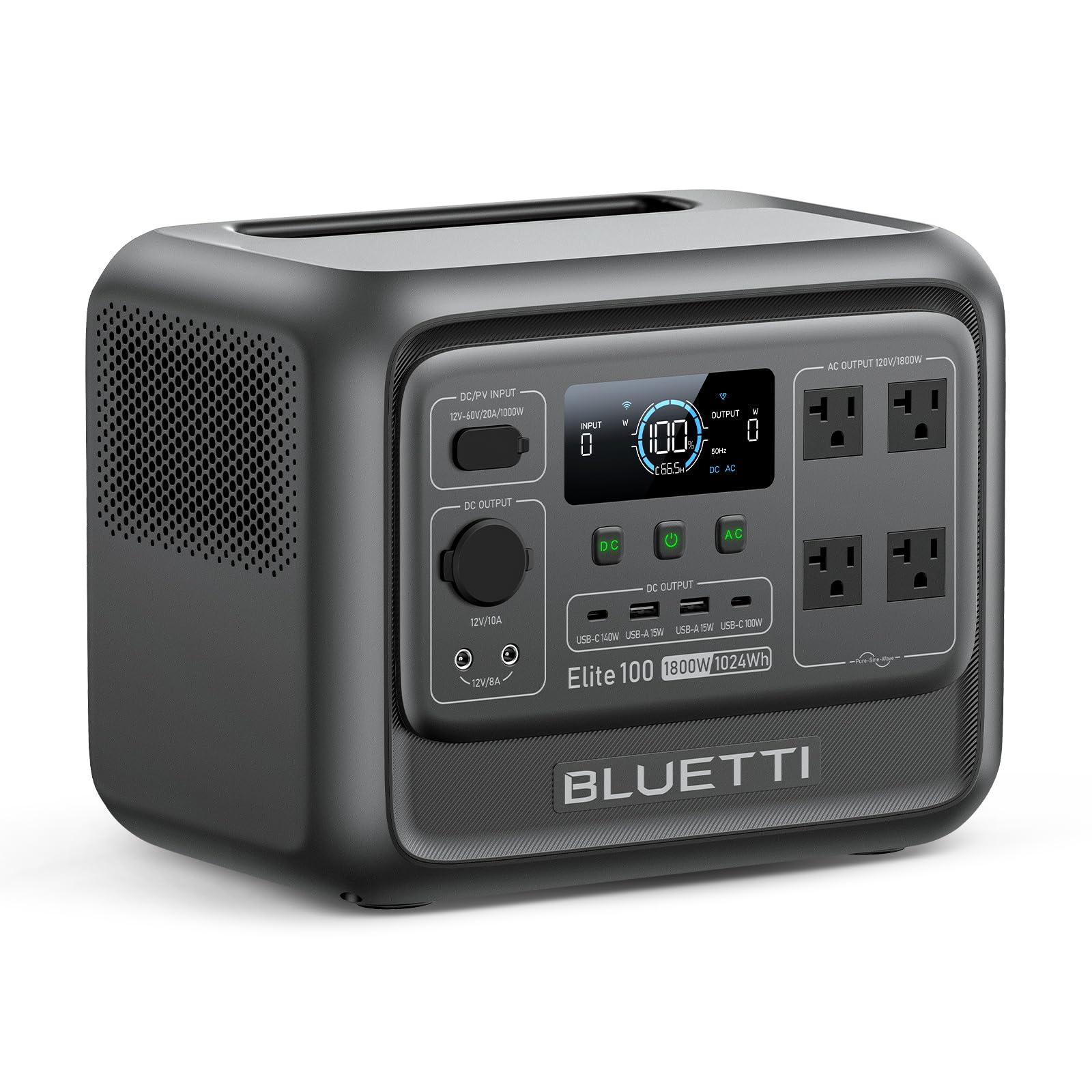
3. BLUETTI Elite 100 V2
A 25-pound 1kWh station that recharges in little over an hour.
The Elite 100 V2 is 35% smaller and 30% lighter than the previous generation at the same capacity — 25 pounds and a compact 12.6 x 8.5 x 9.8-inch package. You get a 1024Wh LiFePO4 battery, 1800W AC output (2700W Power Lifting surge), and an impressive 1000W solar input. The station recharges fully in about 70 minutes on a wall outlet, and in silent mode it runs at just 30dB — quiet enough for a bedroom.
Owners appreciate the 4000+ cycle lifespan and the built-in 10ms UPS (uninterruptible power supply) that keeps PCs and routers online during a flicker. The 11-port panel includes a 100W USB-C PD port for laptops. It is noticeably lighter than the 42+ pound 2kWh units, making it a better fit for car camping or mobile work. The mixed feedback on reliability (the most-discussed aspect) means a small batch of defective units has appeared, but BLUETTI’s customer service has a strong track record of replacing them without hassle.
grab this for: A great balance of capacity and portability — enough for a fridge, lights, and a laptop for a few hours, but still light enough to carry one-handed.
think twice if: You need 2kWh+ of capacity for multi-day home backup, or you want zero risk of receiving a defective unit — check the return policy before buying.
4. EF ECOFLOW Delta 3 Classic
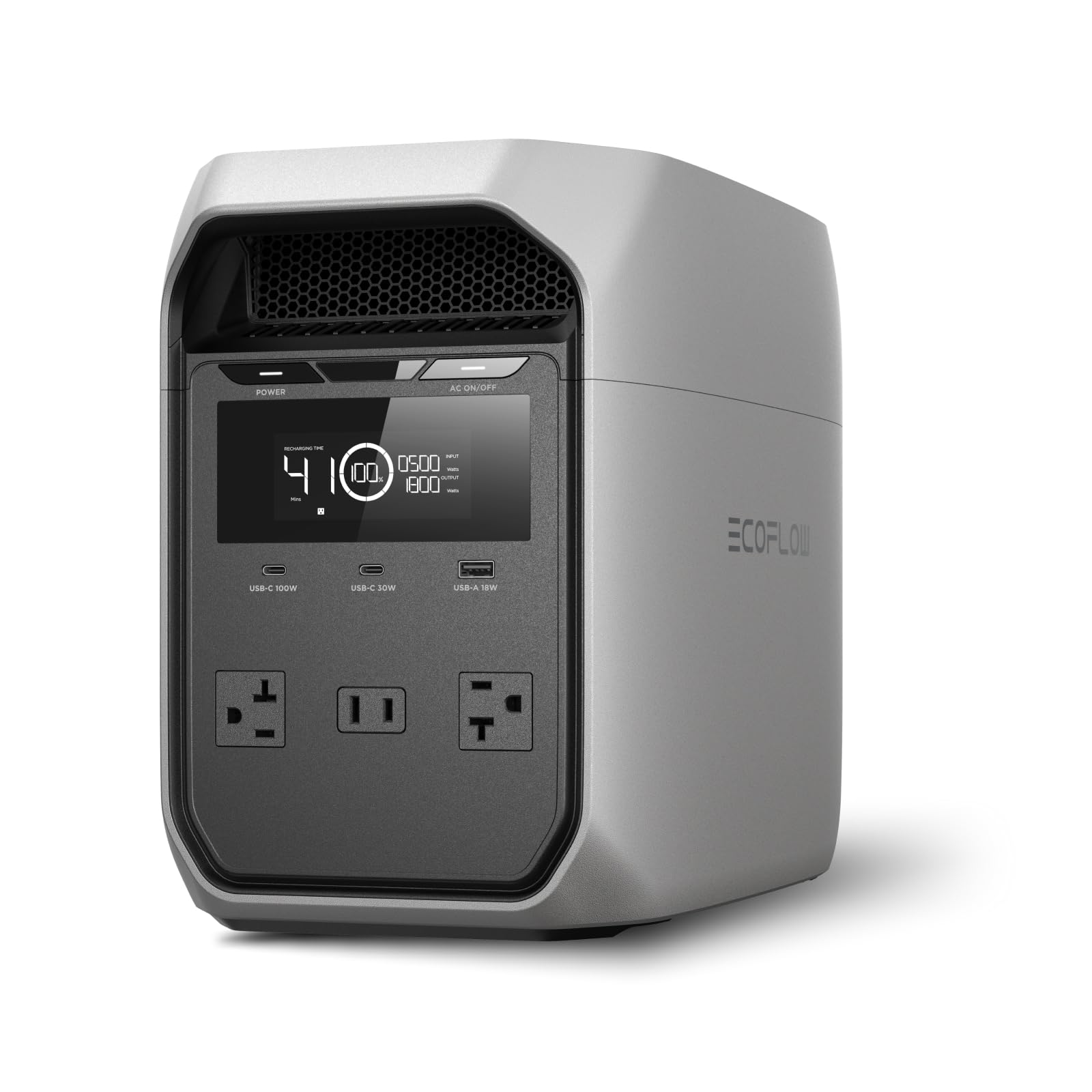
An app-controlled powerhouse with a smooth UPS that protects your PC.
The Delta 3 Classic keeps your desktop computer or medical device running without a glitch during an outage, thanks to its <10ms UPS switchover (the time it takes to swap from grid power to battery power — faster than a blink). It pairs a 1024Wh capacity (enough to run a fridge for several hours) with 1800W output (3600W surge via X-Boost technology, which briefly boosts power for starting motors or compressors). Owners call it “essential” for areas with frequent power cuts, and one buyer reports it powers their Starlink system without issues.
X-Stream AC charging takes it from 0-80% in 45 minutes, and a 500W solar panel refills it in 2.5 hours. The EcoFlow app adds Storm Alert and Self-Powered Mode, automatically charging up before bad weather hits and discharging during peak rate hours to save on electricity bills. The LiFePO4 (lithium iron phosphate) battery is rated for 10+ years of daily use. The majority of owners praise its reliability and build quality, making it a very safe buy.
ideal for: Anyone who wants a smart, connected backup that fits in a car trunk for camping and can also protect a home office server or PC setup from power flickers.
keep in mind: It is not expandable with Delta 2 or Delta 3 series extra batteries — you get the 1024Wh and that is it, so it is best as a standalone unit.
5. AFERIY Portable Power Station Nomad1800-A
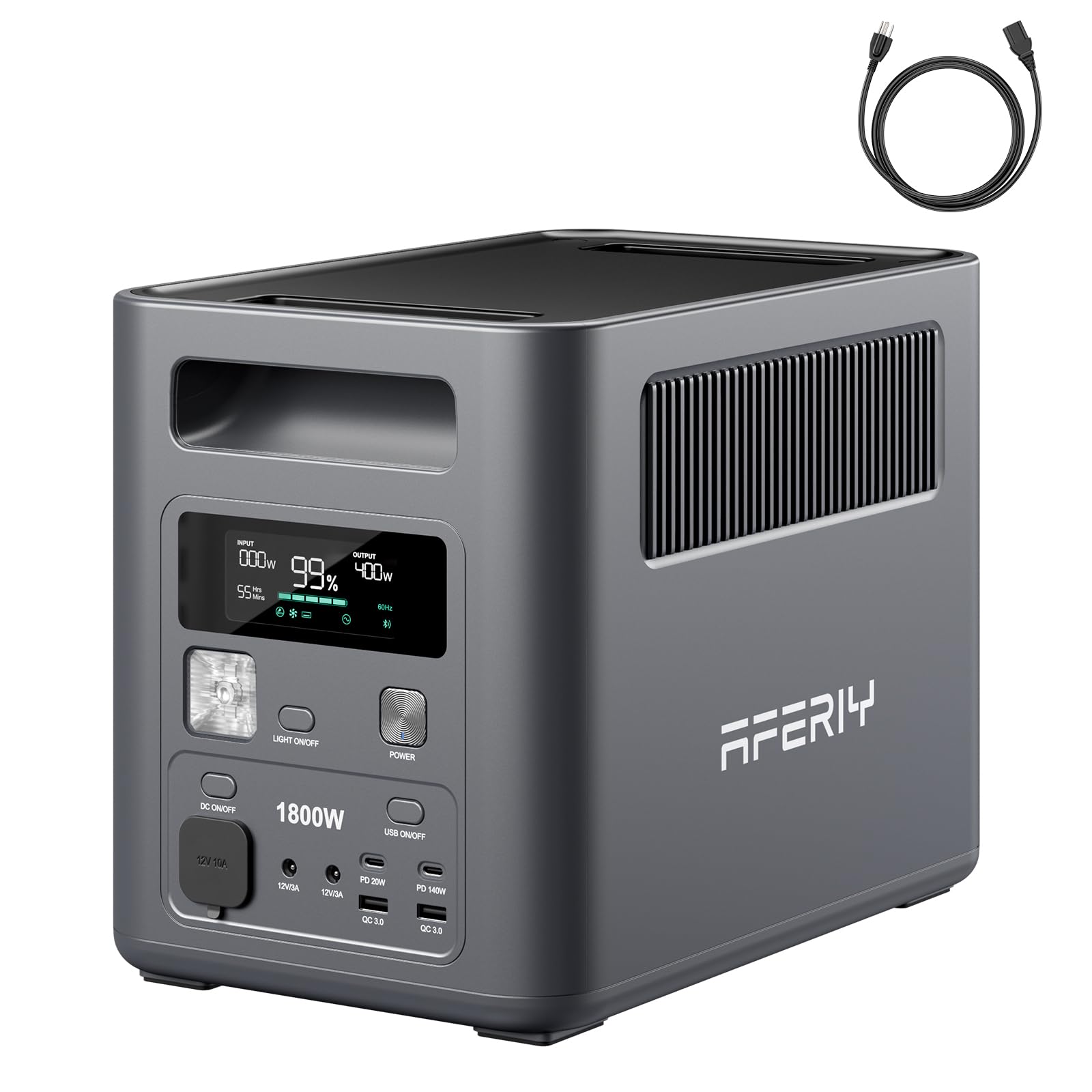
A feature-packed 1kWh generator that is 16% smaller than most rivals.
This station measures 13.77 x 8.66 x 10.35 inches and weighs 25.6 pounds — about 16% more compact and 25% lighter than similar 1024Wh models. The 1800W inverter (3600W peak) and four AC outlets handle fridges, coffee makers, and tools. A 140W PD USB-C port fast-charges a MacBook Pro, and two QC3.0 USB-A ports handle phones and tablets simultaneously.
The built-in LED offers three modes: Steady Light, SOS, and Strobe Flash — a rare extra that campers love. Owners mention the unit runs a fridge, coffee maker, and tools without complaint, and the fan runs below 30dB during normal use. The 4000+ cycle LiFePO4 battery carries a 7-year support period. The UPS switchover is under 10ms, and smart app control lets you monitor and schedule from your phone. A buyer who cooked hamburgers on a griddle at a campsite says it “runs quiet and has amazing charge time.”
best for: Campers and road-trippers who want a compact, quiet station with fast laptop charging, a built-in camp light, and the ability to power a portable griddle or mini fridge.
keep in perspective: The 1024Wh capacity is ideal for overnight or day-trip use but will not run a household for multiple days like the 2kWh+ stations above.
6. DABBSSON Portable Power Station 2000L
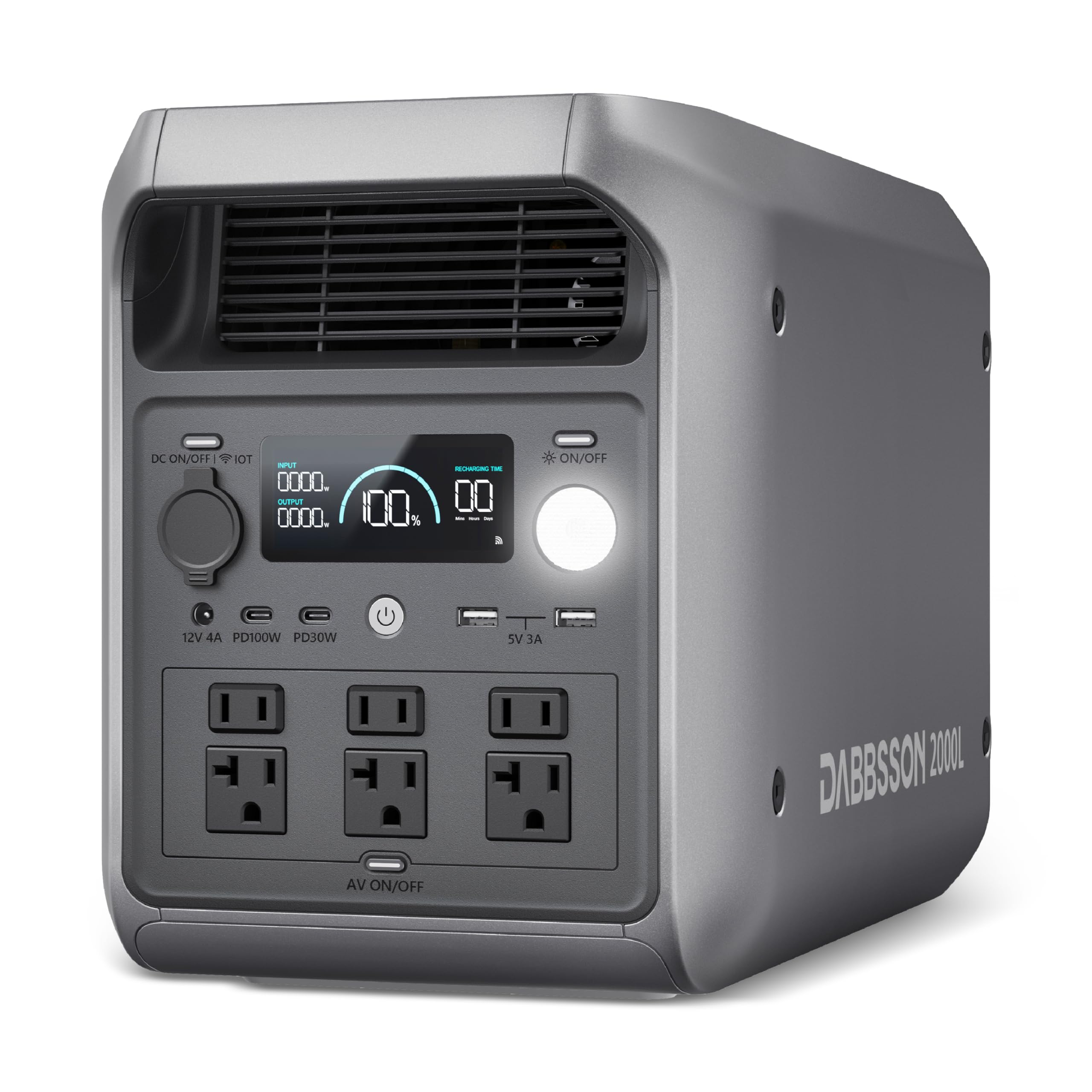
Semi-solid state battery tech at a price that undercuts the competition.
The DABBSSON 2000L uses advanced semi-solid LiFePO4 cells that deliver about 13 hours of fridge runtime and a 4000+ cycle lifespan. It packs 2048Wh capacity with 2200W continuous output and 3300W surge, and it runs a Keurig at 1400W, an air fryer at 1670W, or two freezers plus two fridges for 7.5 hours — all confirmed by buyers. The six AC outlets mean you can plug in multiple heavy devices at once without an external power strip.
Despite its 41-pound weight, it is compact for a 2kWh station at 11.2 x 18.3 x 8.9 inches. A 1-hour AC recharge and an 800W solar input (MPPT) make it practical for off-grid use. The <10ms EPS (emergency power supply) switch and the Dabbsson App with Wi-Fi/Bluetooth control add polish you normally find on units costing significantly more. Buyers consistently mention the value as the primary reason to choose it.
go for this if: You want 2kWh-class capacity and semi-solid battery safety without paying a premium — a strong choice for budget-conscious buyers who refuse to sacrifice runtime.
consider the trade-off: The brand does not have the same long service history as BLUETTI or Jackery, though it backs the unit with a 5-year warranty.
7. AFERIY P210 Portable Power Station

A 2400W continuous inverter that runs your portable air conditioner for hours.
This 54-pound station delivers 2048Wh of LiFePO4 power through a 2400W pure sine wave inverter (4800W surge), and it runs an LG portable AC for 3.5 hours — an owner verified this with a full test. The 6 AC ports and a 25A XT60 DC output make it a credible home backup for a fridge, lights, internet, and a TV all at once. Charging from 27% to 100% takes about 90 minutes, and you can adjust the line charging rate to avoid tripping breakers in older homes.
The battery is rated for 3500+ cycles with a 7-year extended warranty (the manufacturer backs it for 7 years, which is longer than most standard coverage). Owners comment on the clear display and the quiet fan that is barely audible from a few feet away. The honest trade-off: one buyer reports a UPS mode limitation that restricts live power draw to about 1200W when plugged into the wall, which may frustrate users expecting full 2400W pass-through.
choose this for: Running a portable AC, a well pump, or power tools that need a 2400W continuous inverter without paying premium-brand prices — backed by a strong 7-year support window.
watch for: The UPS mode limits pass-through wattage to about 1200W on a wall circuit, so if you need full 2400W while charging and discharging simultaneously, this is not the right unit.
8. Anker SOLIX S2000 Portable Power Station
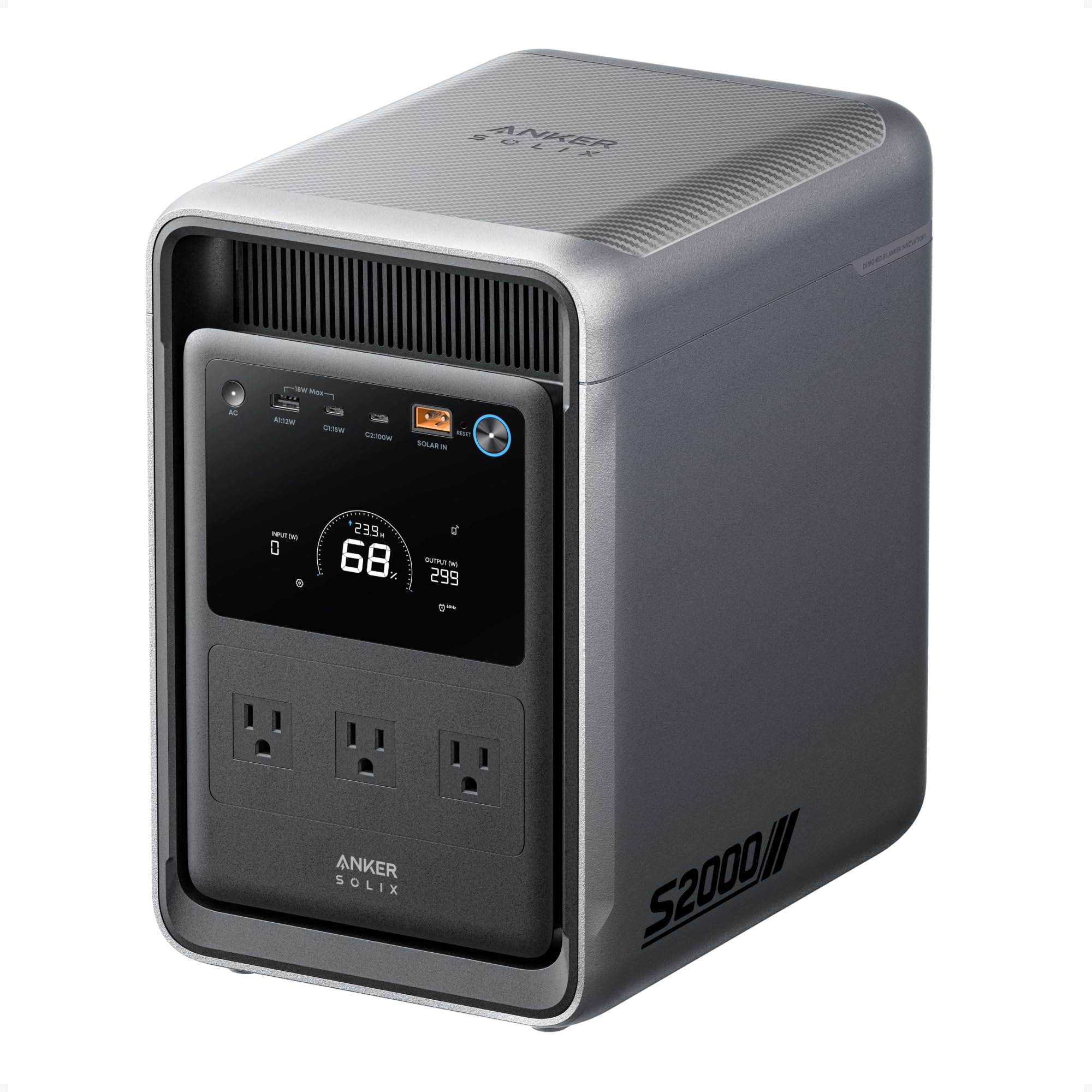
A 2kWh fridge-backup box that weighs a feasible 35.7 pounds.
The S2000 is 30% smaller and 25% lighter than the average 2kWh station — just 8.2 x 11.1 x 12.7 inches and 35.7 pounds. It uses 314Ah prismatic LFP (lithium iron phosphate) cells rated for a remarkable 10,000 cycles, which translates to a 15-year lifespan. Customers note it keeps a fridge running for up to 35 hours, and the 6W idle power draw means it wastes almost no energy waiting for an outage.
The 1500W continuous output (3000W peak) covers 99% of home essentials like a fridge, lights, a router, and a fan. Charging from 33% to 100% takes about 1.5 hours at 1200W, and the WiFi app allows UPS mode, time-of-use scheduling, and charge/discharge limits. The fan is quiet during normal use, though some owners note it gets noticeable at high charging speeds. The Anker brand reputation for reliability and customer service is a major factor in this pick.
reach for this if: Portability matters most — you need a true 2kWh capacity you can carry from the garage to the house without a dolly, plus a decade-plus lifespan from the best battery cycle rating on this list.
be aware: The 1500W continuous output is lower than some competitors, so it will not run a high-draw space heater or a large microwave alongside a fridge — prioritize it for low-to-moderate backup loads.
9. Jackery Explorer 2000 v2

The ultralight 2kWh champion — only 39.5 pounds.
At 39.5 pounds, the Jackery Explorer 2000 v2 is a compact station. It uses CTB (Cell-to-Body) technology derived from EV battery packs, which improves structural rigidity and allows the compact form. With 2042Wh capacity and 2200W AC output, it powers a fridge for 21.3 hours — a number confirmed by owners who use it in off-grid situations in Belize and Cuba. The clear display and multiple ports (3 AC, 2 USB-C, 1 USB-A, DC car outlet, and a flashlight with SOS) make it a very practical travel companion.
AC fast charging hits 0-80% in 66 minutes, and a silent charging mode operates at 30dB. The 20ms UPS switchover is UL1778 certified, meaning it meets Underwriters Laboratories standards for uninterruptible power systems. The app provides remote monitoring and control. Owners consistently call the build quality and charging speed the standout features — the most-mentioned positive by a wide margin.
perfect for: Off-grid living, van life, and long road trips where every pound matters — the lightest 2kWh station here by a solid margin, with Jackery’s reliable ecosystem behind it.
one thing to note: The solar barrel ports on the unit have been noted by owners to flex inward slightly when inserting plugs, so handle the connection with care to avoid damaging the terminals.
10. EF ECOFLOW Delta 3 Max
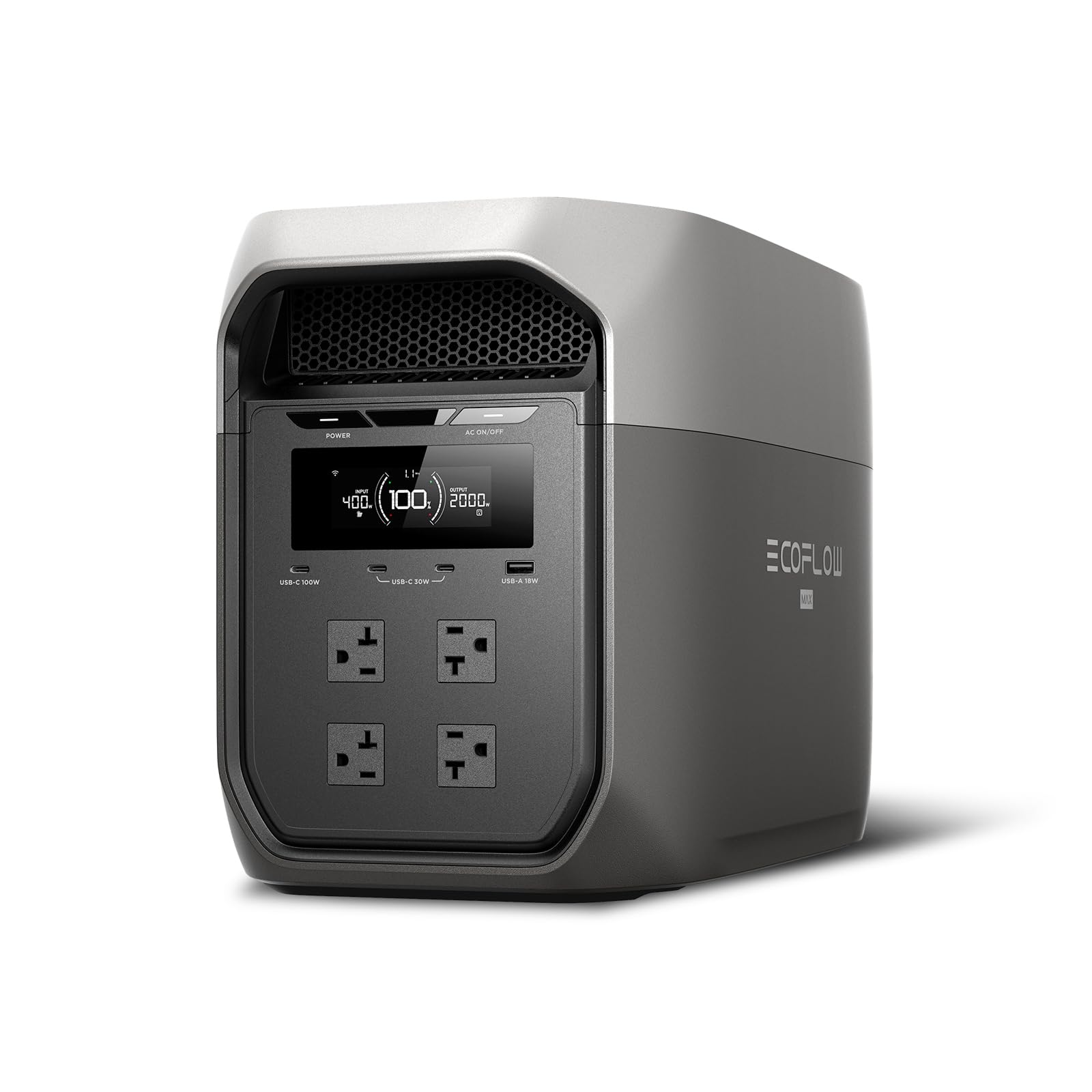
A 3.4kW X-Boost monster that powers 99% of your home appliances.
The Delta 3 Max delivers 3400W of continuous power via X-Boost technology, which is enough to run a refrigerator, microwave, sump pump, and power tools all at once. Its 2048Wh LiFePO4 battery recharges from 0-80% in just 1.13 hours, making it one of the fastest-respinning 2kWh stations available. The <10ms UPS transfer keeps sensitive electronics — computers, medical devices, network gear — safe during outages.
Owners highlight the Storm Guard feature in the EcoFlow app, which automatically charges the battery to full before bad weather hits. The unit is built with a durable aluminum and plastic chassis with dual handles for easier carrying, despite its size (9.4 x 12 x 19.44 inches). The fan stays quiet even at 1700W load, and the XT60i solar input cable enables faster charging than standard XT60 ports. EcoFlow backs it with a 5-year service period. A buyer who uses it in Cuba during frequent blackouts calls it “an investment that is really worth it.”
pick this if: You want the highest continuous output in this comparison — 3400W through X-Boost means you can run nearly any appliance in your home without worrying about overload.
consider the size: At 19.44 inches tall and relatively heavy, it needs dedicated floor space; it is not a slide-under-the-bed unit.
11. Anker SOLIX C2000 Gen 2
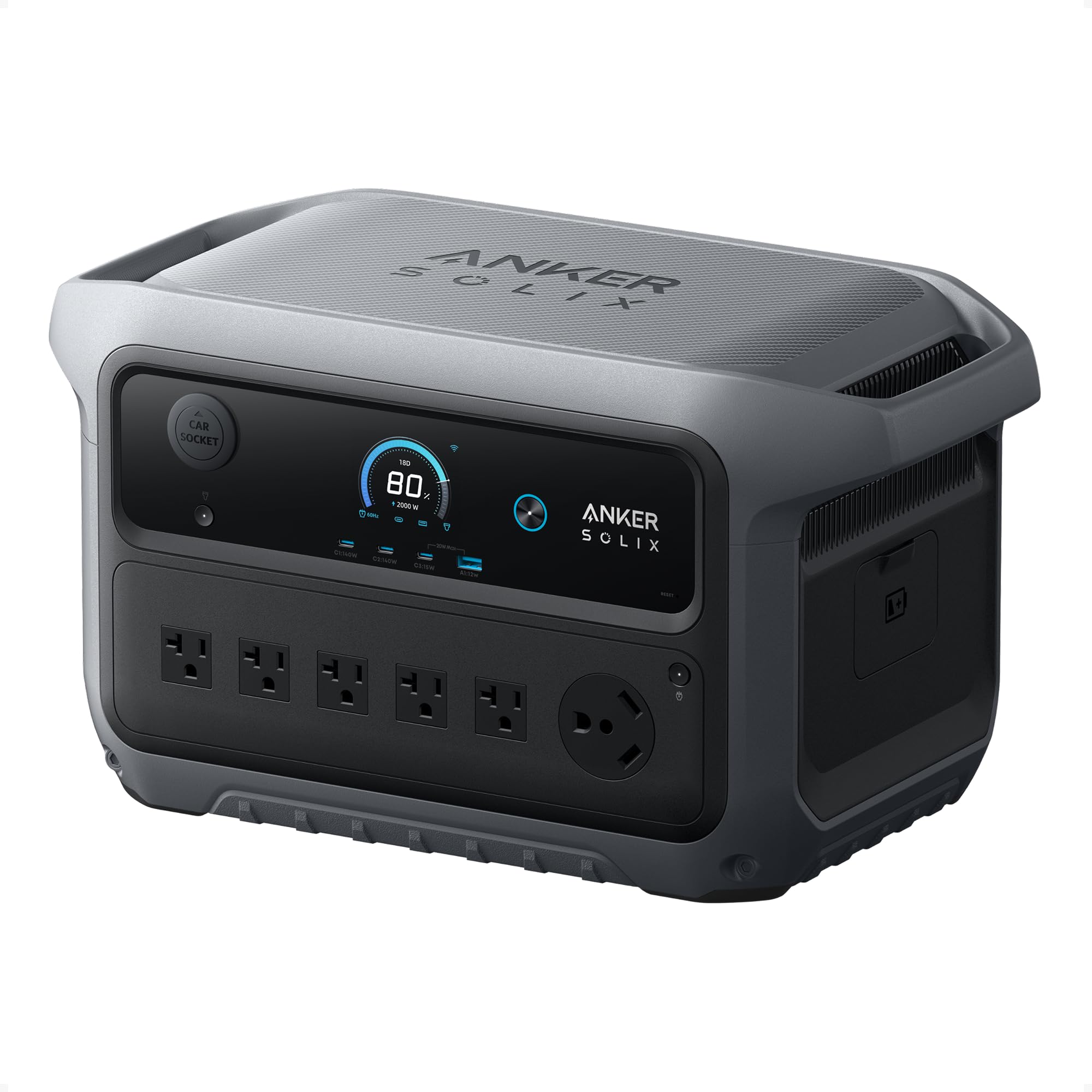
A 58-minute full recharge — the fastest top-up in the 2kWh class.
The C2000 Gen 2 recharges to 100% in just 58 minutes using AC and solar simultaneously, and it delivers 2400W rated output with a 4000W peak — enough to handle most window and RV air conditioners. Its 2048Wh LiFePO4 battery can be expanded to 4kWh with an add-on battery pack, which doubles the fridge runtime to up to 64 hours. The 9W standby draw is impressively low.
Weighing 41.7 pounds and measuring 18.1 x 9.8 x 10.1 inches, it is a compact 2kWh unit. An 800W alternator charging port lets you top it up from your car in about 3 hours Owners confirm it runs a 30A travel trailer overnight, powers a coffee maker and microwave, and handles a 13,500 BTU RV air conditioner for about 90 minutes. The fan is quiet during use but noticeable when charging. Anker’s reputation and the crowd of 400+ positive reviews make this a high-confidence pick.
best for: RV owners and anyone who needs the fastest turnaround between uses — a full charge in under an hour is a standout when the grid comes back on for a short window.
one limitation: When charging from AC, the input power limits the output capacity to about 1800W, so running the A/C while simultaneously recharging can trip the unit — plan your charging vs. using schedule.
Understanding the Specs
Watt-Hours (Wh) — Your Energy Tank
This is the total amount of electricity the battery can hold. Think of it like the fuel tank on a generator. A 2048Wh station can run a 200W refrigerator for about 10 hours (2048 ÷ 200 = 10.2). Higher is always better for backup use, but it also adds weight. For camping and short outages, 500-1000Wh is enough. For whole-home backup, aim for 2000Wh or more.
AC Output Watts — What You Can Run at Once
This is the maximum power the inverter can deliver in one instant. A 600W station can run a laptop and a few lights, but not a microwave (which pulls 1000-1500W). A 2400W station can run a fridge, a microwave, and a few more devices simultaneously. Most stations also list a surge/peak rating — a short burst of extra power (typically 1-2 seconds) that helps start motors in fridges, ACs, and pumps.
Solar Input Watts — How Fast You Recharge from the Sun
This spec tells you the maximum wattage of solar panels the generator can accept. If a station supports 1200W solar input, you can plug in 1200W worth of panels and fully recharge that 2048Wh battery in about 2 sunny hours. If it is limited to 400W, it will take much longer. Always match your solar panel wattage to your generator’s max input — over-paneling is fine (the generator just takes what it needs), but under-paneling means slow charging.
LiFePO4 Battery & Cycle Life — How Long It Lasts
LiFePO4 (lithium iron phosphate) is the safest and longest-lasting lithium chemistry for home backup. A 3000-cycle rating means the battery will still hold 80% of its original capacity after 3000 full charge/discharge cycles — roughly 8-10 years of daily use. Older lithium-ion (NMC) batteries typically last 500-1000 cycles before degrading. All the generators in this guide use LiFePO4, which is a major upgrade from the previous generation.
FAQ
How long will a battery solar generator run my refrigerator?
Can I leave a battery solar generator plugged in all the time?
What is the difference between a solar generator and a gas generator?
Can I charge a battery solar generator while it’s also powering devices?
How long does a LiFePO4 battery last before needing replacement?
What size solar panels do I need to charge these generators?
What appliances can I run on a 600W solar generator?
What is a UPS and why does it matter in a solar generator?
Final Thoughts: The Verdict
The crowd favorite — with near-unanimous praise across hundreds of owners — is the battery solar generator from BLUETTI AC200L, and for good reason: 2048Wh expandable to 8192Wh, a 2400W inverter, and a <10ms UPS that makes it a true home backup anchor. If portability and a decade-plus lifespan matter most, the Anker SOLIX S2000 at just 35.7 pounds with 10,000-cycle LFP cells is the smartest grab-and-go choice. And for the budget-minded buyer who still wants a 2kWh station, the DABBSSON 2000L delivers semi-solid battery tech and a 2200W output at a price that leaves room for a solar panel or two — making it the value king of the 2kWh class. No matter which station you pick, you are getting a reliable, quiet, and fume-free backup that keeps your fridge cold, your router online, and your family comfortable when the grid drops out.
How We Picked
We do not accept paid placement. Every pick is matched to a real buyer and a real use-case; we do not hands-on test units.
Sources & Methodology
Specifications: manufacturer listings and product documentation. Review insights: verified customer reviews, as of July 2026. Pricing: not shown on this page (it changes often); check the current price via the retailer link.
As an Amazon Associate, Gadgets Feed earns from qualifying purchases. This does not affect which products we feature.