
Our readers keep the lights on and my morning glass full of iced black tea. As an Amazon Associate, I earn from qualifying purchases.
Specs are compiled from manufacturer listings and verified buyer reviews and can change over time — please confirm the key details on the product page before buying.
Your battery dies because of the controller, not the sun. A weak controller can overcharge, fry, or refuse to charge a battery below a certain voltage. The best units here use Maximum Power Point Tracking (MPPT, a smart controller that constantly adjusts to squeeze the most power from the sun) or a reliable Pulse Width Modulation (PWM) controller (a simpler, budget-friendly regulator) to keep your 12V battery topped off without you lifting a finger.
I’m Min — the founder and writer behind Gadgets Feed. This guide is built by comparing the manufacturers’ published specifications and the patterns across verified customer reviews, so you get each pick’s real strengths and trade-offs instead of marketing spin.
To protect a car, boat, RV, or tractor battery from draining, the right battery solar panel charger delivers consistent, maintenance-free power to keep your vehicle ready to start.
Our Picks at a Glance


How To Choose The Best Battery Solar Panel Charger
Before you buy, focus on three things: the controller type, the panel’s wattage, and how you plan to mount it. These three decisions will determine whether your battery stays healthy or slowly drains.
MPPT vs. PWM Controllers
The controller is the brain of the setup. MPPT (Maximum Power Point Tracking) is more advanced, constantly adjusting to get up to 20-30% more power from the panel, especially on cloudy days. PWM (Pulse Width Modulation) is simpler and cheaper, but less efficient. If you have limited sun exposure or a larger battery, MPPT is worth the premium.
Match Wattage to Your Battery
For simply maintaining a battery that’s already charged, a 15W or 20W panel is usually plenty. If you need to recover a significantly drained battery, or you live in a cloudy area, step up to a 25W or 30W panel. The right wattage ensures you’re not underpowered or overpaying.
Mounting and Durability
Think about where you’ll place the panel. Suction cups work great on windshields, while corner holes or adjustable brackets are better for permanent roof or wall mounting. Also check the waterproof rating — an IP67 rating means the panel and controller are fully sealed against dust and water.
Quick Comparison
| Model | Best For | Max Power | Controller | Weight | Amazon |
|---|---|---|---|---|---|
| SUNER POWER 30W★ Best Overall | Overall performance | 30 watts | MPPT | 1.81 kg | Amazon |
| Sun Energise 25WProven Performer | Proven reliability | 25 watts | MPPT | 2.53 kg | Amazon |
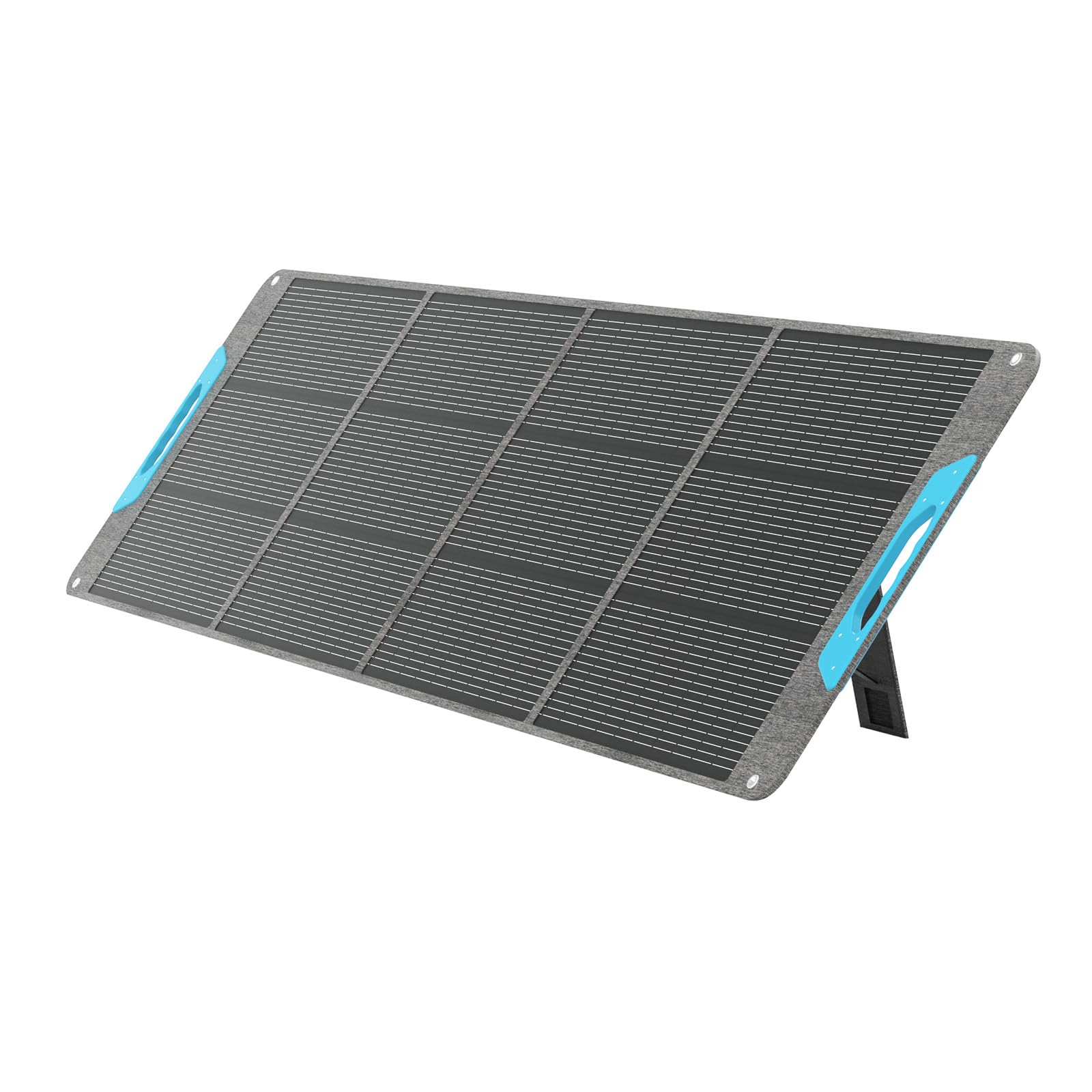
| Renogy 200WHigh-Output Power | High-output portable power | 200 watts | — | 13.9 lbs | Amazon |
| SOLPERK 30W | Versatile mounting | 30 watts | MPPT | 2.04 kg | Amazon |
| SUNER POWER 20W | Smaller SUNER option | 20 watts | MPPT | 1.38 kg | Amazon |
| FlexSolar 100W | Foldable portability | 100 watts | — | 1.85 kg | Amazon |
| ECO-WORTHY 25W | Rigid budget value | 25 watts | PWM | 2.34 kg | Amazon |
| SUNAPEX 20W | Flexible windshield mounting | 20 watts | — | 1.06 kg | Amazon |
| POWOXI 15W | Entry-level maintenance | 15 watts | MPPT | — | Amazon |
In‑Depth Reviews
1. SUNER POWER 30W
Our pick — over 4.5★ from 300+ verified ratings; the strongest balance of quality and price.
The smart-charging workhorse that adapts to three battery chemistries
You get 30 watts plus an UltraSmart MPPT controller that tracks the sun’s power with up to 99% tracking efficiency and 98% peak conversion. In plain terms, it pulls noticeably more usable power from the same sunlight than a basic controller. A week of full sun can recover an old 660CCA battery to 13.8V, per owner reports. Three selectable modes (12V, 12V AGM, and 12V Lithium) let you safely match it to flooded, gel, AGM, or LiFePO4 batteries.
At 1.81 kg, it’s heavier than the compact SUNAPEX 20W, but that heft comes with a bigger 30-watt output and a more sophisticated three-stage charging algorithm (Bulk, Absorption, Float) that protects your battery’s lifespan. Charging level indicators at 25%-50%-75%-100% let you see the progress at a glance, and the included suction cups plus plug-and-play SAE cables make setup genuinely tool-free.
The feedback on physical stability is split — some find it sturdy while others say the panel warps easily. One owner warns it gets very hot in direct sunlight and melted dashboard coating, so keep it out of the cockpit. For a camper, boat, or trailer, this is the set-and-forget companion.
Why It Wins
- High-efficiency MPPT controller squeezes more power from weak sun
- Three charging modes cover most 12V battery types
- Visual charge level indicators remove guesswork
Watch Out For
- Skinny 0.15-inch frame can warp under stress
- Runs hot on a dashboard — avoid direct placement there
Grab it for: a versatile, high-tech maintainer that can handle boats, RVs, and dump trailers with different battery types.
Think twice if: you need a rigid panel to permanently mount on a roof — the flexible design prefers flatter surfaces.
2. Sun Energise 25W
The heavy-duty panel that anchors down and keeps charging day after day
If your battery sits in a long-term storage vehicle, this 25W MPPT unit is the dependable choice. With a 2.53 kg frame and pre-designed mounting holes, it’s built to be bolted to a wall or roof, and the tempered glass plus corrosion-resistant ABS frame shrugs off UV, hail, and sandstorms. It held a Ford Transit’s chassis battery at 12.6V over eight days and kept a 2019 OEM battery at 12.6V for three years, per owners.
It delivers 25 watts with a 2A current rating and smart three-stage charging (Bulk, Absorption, Float) that cuts off when full and resumes when drained. This is a slow charger meant for maintaining, not reviving a dead battery — several owners note it’s not for depleted batteries. It’s a “top-off” specialist, and it excels at that job.
The catch, as buyers report, is the cable length; you’ll likely want an extension cord to reach from a roof mount down to the battery. Also, keep the glass face clean with a non-abrasive cleaner to keep it efficient. For a lawnmower, RV, or tractor parked for months, this is a strong, sturdy pick.
Built to Last: The solid frame and wall-mounting design make it feel like permanent equipment, not a temporary gadget.
A Note: It’s a maintainer, so expect slow charging — you’ll want a separate charger for a fully dead battery.
3. Renogy 200W
The serious off-grid panel that charges whole power stations, not just batteries
This is a different beast entirely — a 200-watt foldable panel built for running CPAP machines, laptops, and charging portable power stations, not just trickle-charging a car battery. It uses 16BB N-Type cell technology to hit 25% efficiency, which means more power from the same sunlight than standard panels. It charges three devices at once (1 USB-C PD 45W, 2 USB-A ports) and has MC4 output to connect to your power station or 12V battery system.
At 13.89 lbs, it’s the lightest in its class for this output, folding down to a backpack-friendly size with a magnetic closure. The quadfold design includes four kickstands with a 3-angle adjustment (40°/50°/60°) to angle it perfectly at the sun. Owners mention up to 185W in good conditions, with output varying between 60-130W based on cloud cover and angle.
For large energy needs — think 4×4 overlanding, van life, or emergency backup — this is the powerhouse. Its efficiency is impressive, but it’s overkill (and heavier) if you just need to maintain a single 12V battery. It’s also IP65-rated against dust and splashes, not fully submersible like some smaller options.
Powerhouse Potential: With 200 watts, this is for serious off-grid use, capable of recovering a moderate battery drain in hours, not days.
Keep in Mind: You’re paying for high output and portability; for simple maintenance duty, a smaller fixed panel is easier to manage.
4. SOLPERK 30W
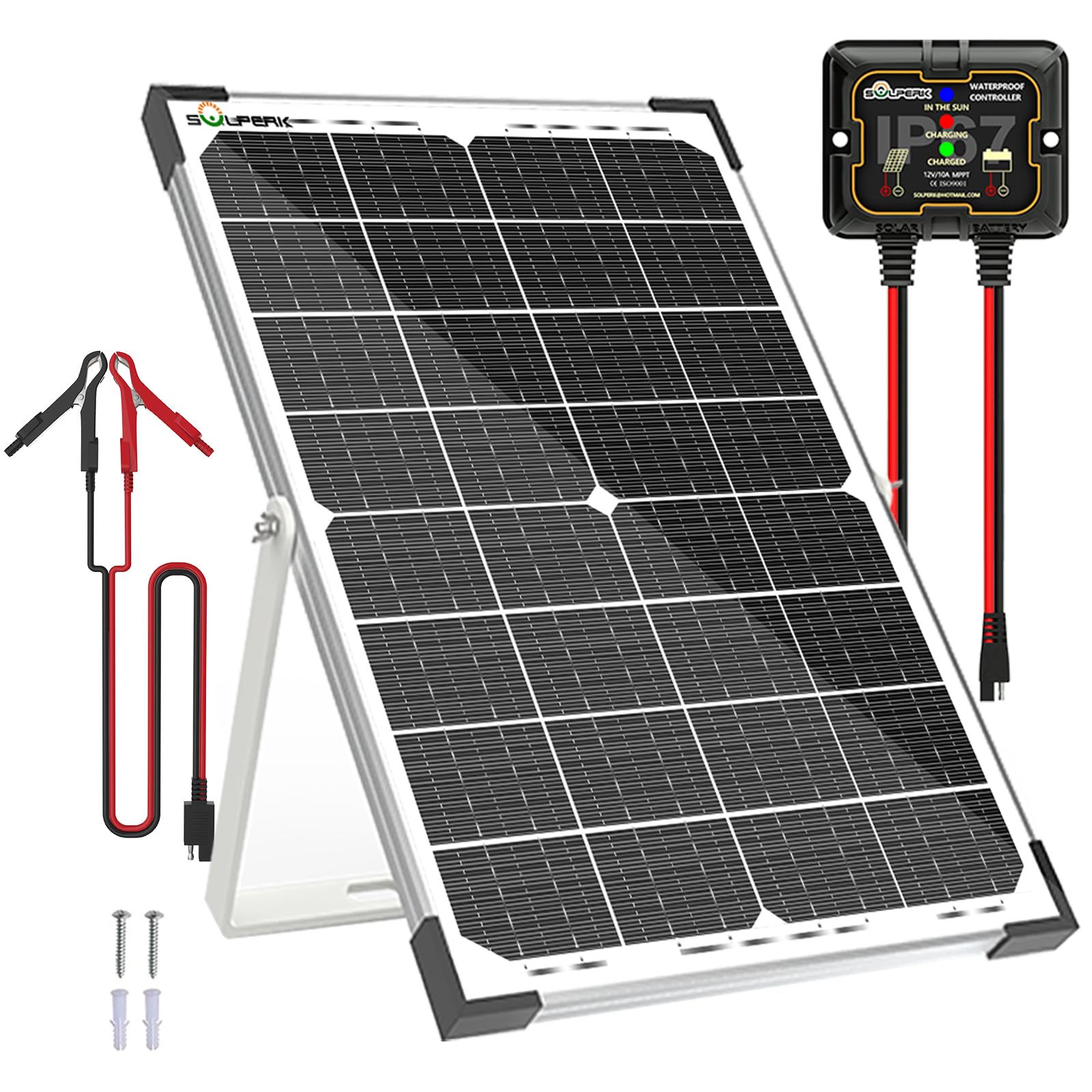
A 30W charger with a fully adjustable bracket for hitting the perfect sun angle
This 30W kit from SOLPERK sets itself apart with a 360° adjustable bracket and a controller that can be completely submerged in water. That means you can angle the panel perfectly toward the sun, no matter where you mount it — on the ground, wall, or roof. It’s a smart choice for a dump trailer or a boat where the sun’s path changes and you want to boost every ray.
With an MPPT controller delivering 30% more power than standard controllers, it pushes a 30-watt monocrystalline panel with A+ cells at 30% efficiency. It charged a trolling motor battery from 60% to 100% in 3-4 days of full sun, per owner tests. It includes three LED indicators (blue for connected, red for charging, green for full).
The recurring complaint is the cable length — the wires between the controller and battery clips are only about 20 inches, which was far too short for a tractor connection. If your battery sits far from the mounting point, budget for an extension. It’s a capable charger with excellent angle flexibility for a stationary setup.
Best For: Situations where you can afford to angle the panel daily or need to mount it on a roof where the bracket design shines.
Cable Caution: Check your mounting distance; the short 20-inch lead may require an aftermarket extension cable.
5. SUNER POWER 20W

The ultra-thin panel that slips onto windshields and keeps AGM batteries topped off
This is the 20W little sibling to the Best Overall SUNER POWER, and it inherits the same UltraSmart MPPT technology in a slimmer, lighter package — only 1.38 kg and about 1/8-inch thick. It’s the right size for a car or a smaller boat where a 30W panel is overkill. Owners praise it for maintaining an old AGM battery in a 4Runner, with the AGM setting persisting between uses.
It features the same three selectable modes (12V, 12V AGM, 12V Lithium) and visual charge indicators. One owner measured a 75% Group 27 deep cycle battery reaching 100% in about 22 daylight hours. For a truck used only for hunting or fishing trips, this panel keeps the battery ready, unplugs before you start the engine, and lives happily on the windshield via suction cups.
Feedback confirms it’s ideal for boats and long-idle vehicles, though the thin panel needs a stiffer surface to prevent flexing. One owner’s only gripe was the limited suction-cup-only mounting, which held up through a winter regardless. It’s a compact, reliable choice for straightforward maintenance.
Sleek & Smart: Same clever MPPT brain as the 30W flagship, but in a package that suits cars and smaller batteries perfectly.
Flexible Frame: The thin design is part of its charm, but it may require a stiff backing to prevent warping.
6. FlexSolar 100W
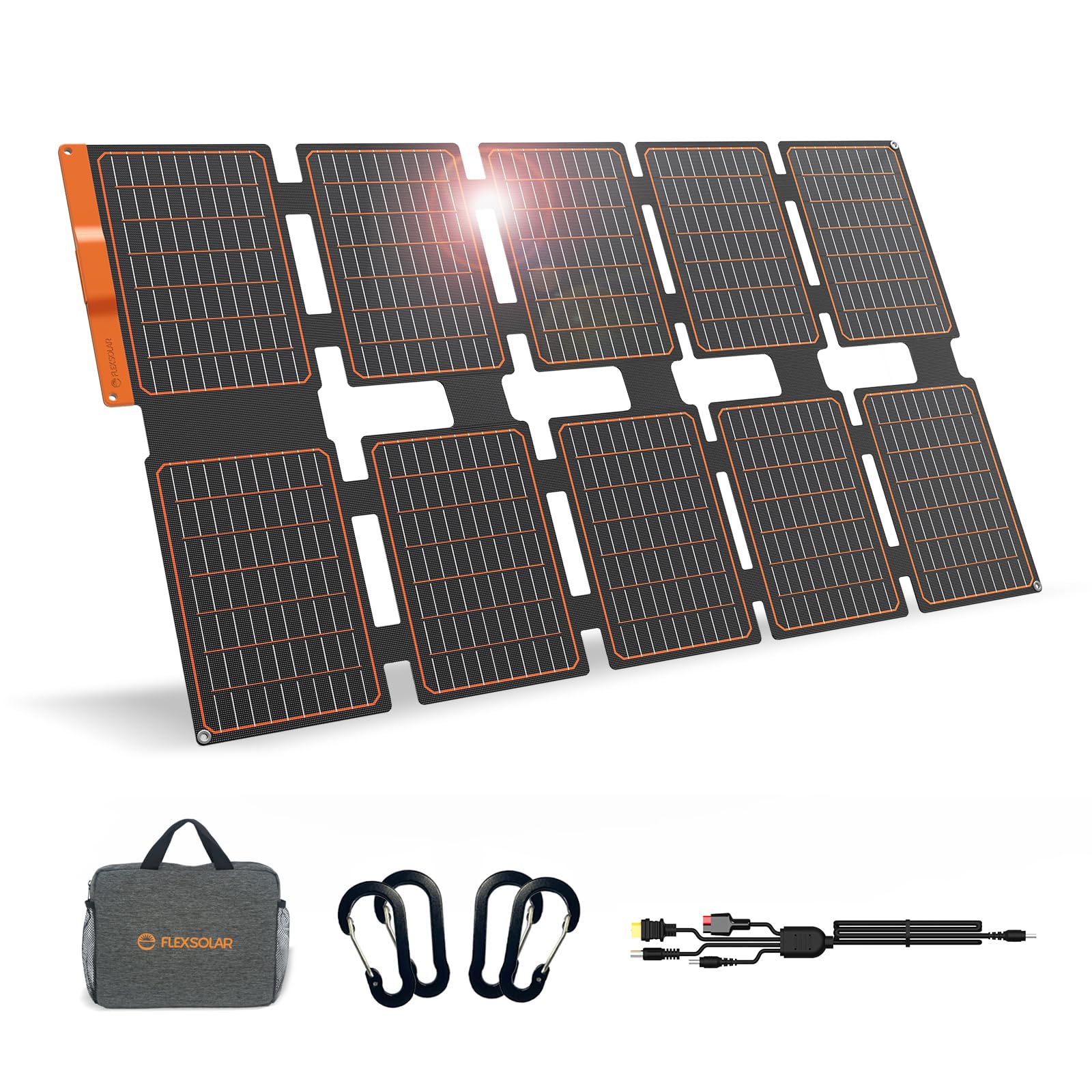
A foldable 100W panel with fast USB-C output for phones, laptops, and power stations
Weighing just 4.1 lbs (1.85 kg) and folding down to 12.99 x 10.43 inches, this 100W panel is a hiking and camping powerhouse. It offers a 3-in-1 output: a 45W USB-C PD port, an 18W USB-A port, and a 100W DC output, letting you charge a laptop, phone, and power station simultaneously. The included 4-in-1 cable (DC5521, DC7909, Anderson, XT60) covers most portable power stations.
With 23%+ conversion efficiency and IP67 waterproofing, it’s built for all-weather use — fully protected against rain, dust, and sand. It matched rigid 100W panels, delivering ~70W horizontally in Maine summer and charging an iPad from 9% to 95% in ~7 hours via USB-C.
The trade-off is connector compatibility: it lacks an MC4 connector, which means it’s not an out-of-the-box fit for all 12V battery systems — you’ll need the right adapter. Also, owners note the DC/USB circuitry can get hot at 60W+. For backpackers and emergency kits where grams matter, this is a fantastic, packable energy source.
Electronics First: If your goal is charging devices directly (not just maintaining a battery), this is the tool for the job.
Check Connectors: For a direct 12V battery hookup, verify your adapter setup since it skips MC4 connectors.
7. ECO-WORTHY 25W
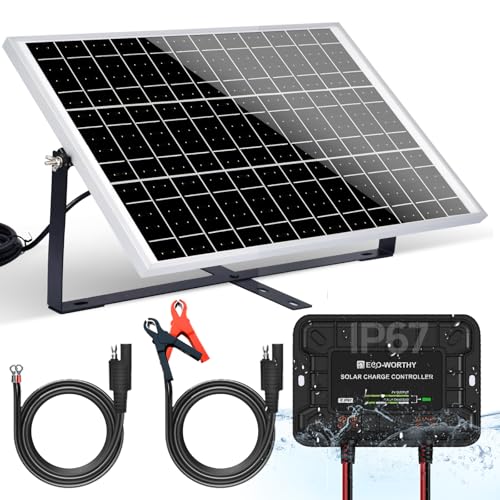
A rigid, no-nonsense 25W panel with a solid aluminum frame for permanent mounting
If you want a traditional rigid solar panel rather than a flexible one, this ECO-WORTHY kit is a straightforward value play. The 25W panel uses premium A+ monocrystalline cells with up to 23% efficiency, generating a claimed 100Wh of daily power. It features a low-iron tempered glass surface and a corrosion-resistant aluminum frame, making it 100% waterproof and rustproof while handling wind loads up to 2400 Pa and snow loads up to 5400 Pa.
It’s designed to charge and maintain 12V batteries (LiFePO₄, AGM, SLA, Lithium Ion, GEL) and even power small off-grid devices like water pumps. The included waterproof 4A PWM controller has battery temperature compensation and status indicator lights. It charged a motorcycle battery from 11.9V and lifted a battery from 12.2V to 13.4V on one overcast day, per owner reports.
There’s a slight nuance: one owner called the PWM controller “mostly a toy” and warned it can be overloaded by a panel larger than about 18V, so don’t upgrade to a bigger panel without a new controller. The build quality is split — while some call it solid, others report units falling apart on first use. For the price, it’s a capable entry into rigid solar panels.
Solid Entry: A great first rigid panel with a proper tempered glass top and aluminum frame.
Controller Limits: Keep it to a 12V charge setup; this PWM controller isn’t rated for larger panels.
8. SUNAPEX 20W
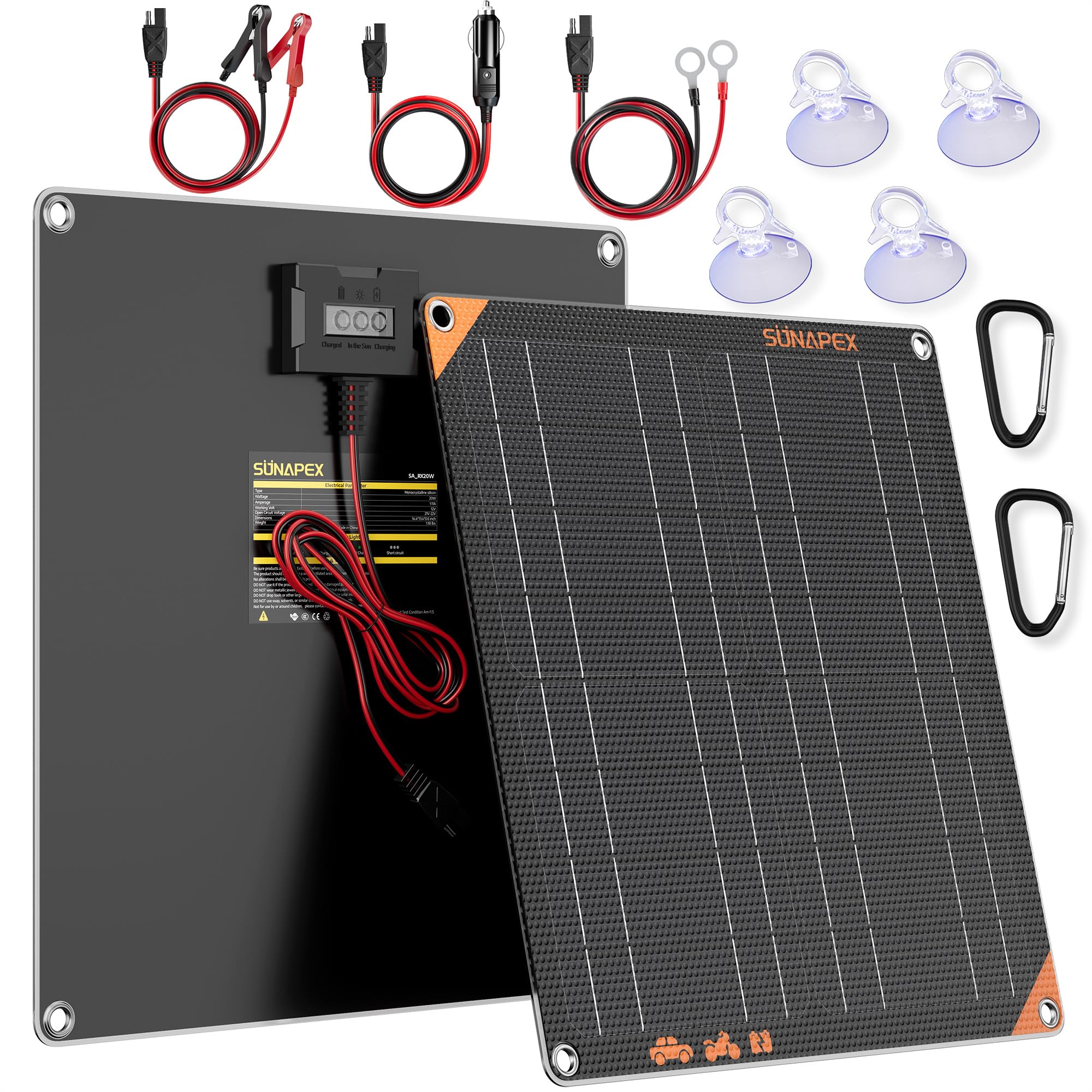
The featherweight windshield panel that keeps your RV chassis battery alive off-grid
At just 1.06 kg, this is the lightest panel in the comparison — a full 71% lighter than the 1.81 kg SUNER POWER 30W — and it makes windshield mounting easy. Customers note it keeps a Travato chassis battery topped off when parked for 24-48+ hours, attaching securely with 4 suction cups. It’s a favorite for RVs stored in lots without electricity; one buyer’s report sums it up: “It keeps our RV batteries charged well.”
This 20-watt panel delivers a 1.11A trickle output using high-efficiency monocrystalline cells, with a built-in controller offering three LED indicators (blue for sunlight, red for charging, green for full). The ETFE material is ultra-lightweight and flexible, rated IP67 waterproof to withstand rain, snow, and extreme temperatures. It’s designed for cars, boats, RVs, lawnmowers, and even off-grid devices like gate openers.
There are limitations. Unlike the SUNER POWER 20W, this model doesn’t list a selectable AGM/Lithium mode, just a general 12V charge algorithm. Also, it won’t charge a battery that’s below a certain voltage threshold — it’s strictly a maintainer for topped-off batteries, not a recovery charger. For a simple, featherlight way to prevent seasonal battery drain, it’s an excellent choice.
Stick It On: Perfect for a windshield where weight and suction-cup hold are the deciding factors.
Maintain Only: Don’t expect to revive a deeply drained battery; this panel’s job is prevention, not cure.
9. POWOXI 15W
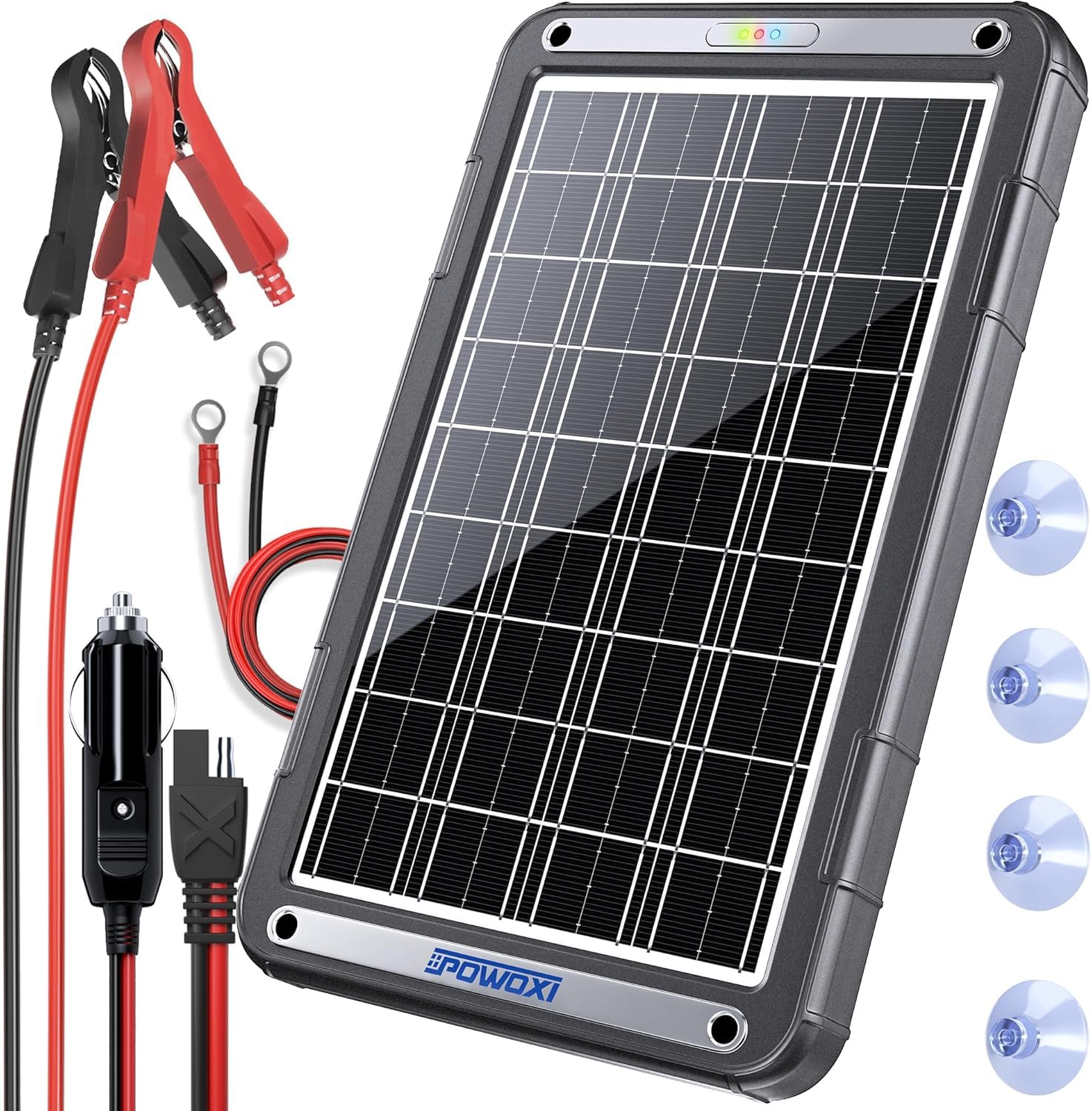
The smart little 15W panel that brings MPPT tech to the entry-level price point
Most budget panels use a cheap PWM controller, but this POWOXI 15W squeezes in an MPPT controller with up to 99% conversion, dynamically adjusting to sunlight intensity for better performance on cloudy days. It’s a smart pick if your budget is tight but you don’t want to sacrifice battery health. Owners found it kept a generator battery fully charged and prevented a car battery from draining over five weeks.
Despite its MPPT smarts, it’s still a 15-watt panel — the lowest wattage in this list — with a 1.02A output. It’s built with a PC+ABS frame plus tempered glass, rated IP65 waterproof and able to withstand -40 to 137°C, so it handles heavy rain without fuss. The frame is stronger than flexible panels and won’t damage car paint like aluminum frames, which is a nice touch for paint-sensitive owners.
However, power output feedback is mixed — some find it powerful, others note low output. There’s also a rare but real quality-control concern: a few units arrived with reversed red/black wiring and incorrect polarity causing all indicator lights to flash. The LED indicator also gets negative feedback. For a small, smart maintainer for a lawnmower or compact car, it’s a solid value, but inspect the wiring on arrival.
Smart & Small: An affordable way to get MPPT benefits without paying for a large panel.
Check It Over: Given occasional wiring defects, verify the clamp polarity matches your battery before connecting.
Understanding the Specs
MPPT vs. PWM Controllers
MPPT (Maximum Power Point Tracking) is the premium controller technology. It constantly adjusts the electrical load to find the balance where the panel produces the most power. This can boost efficiency by 20-30% compared to PWM (Pulse Width Modulation), especially in cloudy conditions or when the battery is low. PWM is simpler and cheaper, but it wastes some of the panel’s potential, particularly in cold weather.
Watts and Amps
Wattage (W) is the total power output of the panel — higher watts mean more charging power. Amperage (A) is the charging current. For a 12V battery, a 1A output (like the 15W or 20W panels) is ideal for maintenance, slowly topping off a battery that’s already charged. A 2A or higher output (from a 30W+ panel) can recover a more significantly drained battery, but it’s still a slow, safe trickle — not a fast charger.
FAQ
Will a solar panel charger work in cloudy or winter weather?
Can I charge a completely dead battery with a solar trickle charger?
What is the difference between MPPT and PWM charge controllers?
How do I know which battery type my charger supports?
How long does it take to charge a car battery with a 30W solar panel?
Is it safe to leave a solar charger connected to a battery all the time?
Can I use a foldable solar panel like the FlexSolar 100W to charge a 12V car battery?
What does the IP67 waterproof rating actually mean for outdoor use?
Are the flexible solar panels as good as the rigid ones?
Final Thoughts: The Verdict
For the majority of shoppers, the winner for the battery solar panel charger category is the SUNER POWER 30W because it pairs the highest wattage in the trickle-charger class with a smart MPPT controller and battery-type selectors. If you want a rock-solid, wall-mountable panel for long-term storage, the Sun Energise 25W is the one to reach for. And for serious off-grid power to run devices and charge power stations, the Renogy 200W handles it all.
How We Picked
We do not accept paid placement. Every pick is matched to a real buyer and a real use-case; we do not hands-on test units.
Sources & Methodology
Specifications: manufacturer listings and product documentation. Review insights: verified customer reviews, as of August 2026. Pricing: not shown on this page (it changes often); check the current price via the retailer link.
As an Amazon Associate, Gadgets Feed earns from qualifying purchases. This does not affect which products we feature.