
Our readers keep the lights on and my morning glass full of iced black tea. As an Amazon Associate, I earn from qualifying purchases.
Specs are compiled from manufacturer listings and verified buyer reviews and can change over time — please confirm the key details on the product page before buying.
When the lights go out or you head off-grid, the real question isn’t just solar panels — it’s the battery that holds the sun’s energy for when you actually need it. A Battery Solar Panel Kit pairs solar panels with a rechargeable power station so you can run your fridge, CPAP machine, or charge your laptop well after sunset. The true measure of a great kit is the battery’s capacity in watt-hours.
I’m Min — the founder and writer behind Gadgets Feed. This guide is built by comparing the manufacturers’ published specifications and the patterns across verified customer reviews, so you get each pick’s real strengths and trade-offs instead of marketing spin.
Ignore the hype about panel wattage alone — a kit with a solid battery matters more for backup. battery solar panel kit choices like these deliver dependable power when you need it most, straight from the sun.
Our Picks at a Glance

How To Choose The Best Battery Solar Panel Kit
Choosing between these kits starts with matching the battery’s watt-hours (Wh) to what you need to keep running. Watt-hours measure total stored energy — a 1024Wh battery can deliver 200 watts for about 5 hours, for example.
Match Capacity To Your Real Load
List what you must power during an outage — a fridge draws maybe 150W, a CPAP around 30W, lights and phones another 50W. A 1000Wh class kit handles these essentials.
Prioritize LiFePO4 Chemistry
Lithium iron phosphate cells deliver thousands of charge cycles and 10+ year lifespans — a major upgrade over older lead-acid batteries.
Size The Solar Input
Solar panel wattage dictates recharge speed — more panel watts means more sun captured per hour, so your kit tops up faster even on partly cloudy days.
Quick Comparison
| Model | Best For | Battery Capacity | AC Output | Solar Panel | Amazon |
|---|---|---|---|---|---|
| Anker SOLIX C200 DC★ Best Overall | Laptops and Starlink camping | 192Wh | — | 60W | Amazon |
| EF ECOFLOW Delta 3 ClassicTop Performer | Fridge and home backup | 1024Wh | 1800W | 220W | Amazon |
| BLAVOR S1600Smart Design | All-in-one with built-in panel | 1024Wh | 1600W | 40W built-in | Amazon |
| ECO-Worthy 1.6KWH Complete Kit | RV off-grid full systems | 2x 12V 100Ah | 2000W | 4x 100W | Amazon |
| Jackery Explorer 2000 v2 | Balanced home and travel | 2042Wh | 2200W | 2x 200W | Amazon |
| EF ECOFLOW DELTA 2 Max | Whole-home essentials | 2048Wh | 2400W | 400W | Amazon |
| ALLWEI PPS2400-3 | Expandable RV backup | 2048Wh + 2048Wh | 2400W | 400W | Amazon |
| Jackery HomePower 3000 | Heavy home backup | 3072Wh | 3600W | 2x 200W | Amazon |
| EF ECOFLOW Delta Pro | Serious off-grid power | 3.6KWh | 3600W | 400W | Amazon |
In-Depth Reviews
1. Anker SOLIX C200 DC Portable Power Station and 60W Solar Panel
Our pick — over 4.5★ from 200+ verified ratings; the strongest balance of quality and price.
The compact camp setup that keeps your Starlink running from dawn to dusk.
What wins people over is the battery stamina — a 192Wh pack that buyers report keeps a Starlink mini drawing 22-25W topped to 100% all day with its 54W solar input. Unlike the bigger power stations in this list, this one is made for DC devices, not fridges, but it excels at keeping phones, laptops, and drones charged for about 5-6 hours of off-grid work. Being compact is a big part of its charm.
Charging flexibility is a bright spot — hit 80% in 50 minutes from a wall outlet, or about 4 hours from the 60W panel in full sun. The built-in LiFePO4 battery chemistry earns a 3-year warranty from Anker. Owners mention it feels “well worth it” as an emergency backup.
One trade-off owners note is that the DC fast-charging depends on using the OEM cable with certain gear like a Starlink mini. The solar panel folds neatly into its own case for travel, and the five ports (including a 140W USB-C) give you room to power multiple devices.
Why Campers Love It
- 192Wh battery with 140W two-way USB-C fast charging
- 39% smaller than similar power stations
- Charges to 80% in 50 minutes from a wall outlet
- Solar recharge in about 4 hours
Watch For
- No AC outlet — DC-only output
- Not compatible with PS30, PS200, or PS400 panels
- Fails with non-OEM DC-to-USB-C adapters
Reach for it: if you need a lightweight solar companion for truck camping, road trips, and keeping your Starlink mini humming.
Look elsewhere: if you need to power AC appliances — for that, a 1000W+ station is the better fit.
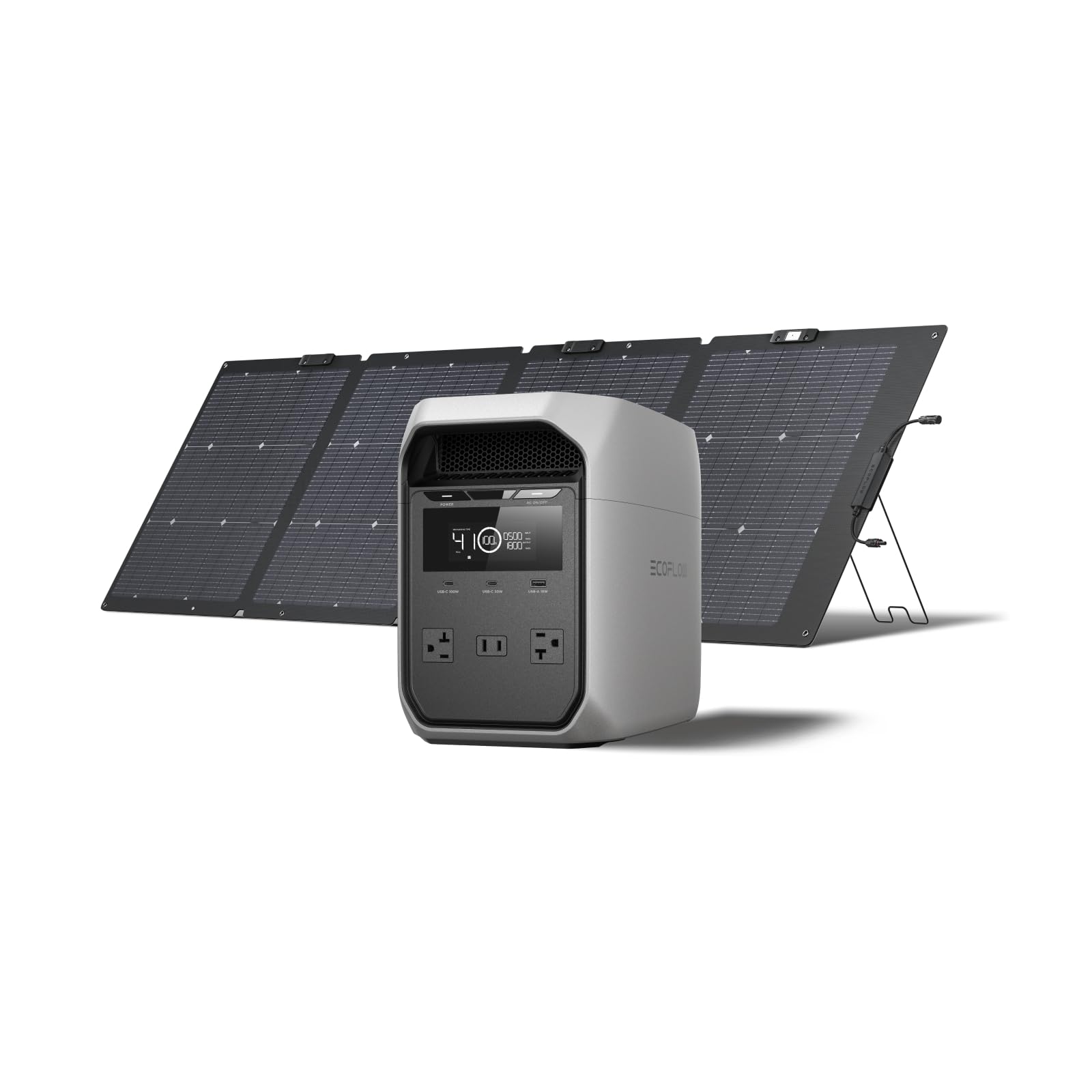
2. EF ECOFLOW Solar Generator Delta 3 Classic with 220W Solar Panel
Serious home backup with a 1800W punch that reloads in under an hour.
The Delta 3 Classic delivers where it counts — 1024Wh capacity with 1800W pure sine wave output (3600W surge) that customers note ran a CPAP and a fan all night with power to spare. This is the kit for home emergencies and camping trips where you need to push real watts through a fridge or microwave. The crowd responds to its premium feel, which is the thing everyone raves about.
Rapid refilling is the spec that changes your day — go from 0-80% in 45 minutes via X-Stream AC charging, or 5.8 hours from the included 220W solar panel. The 220W bifacial panel caught buyers off guard by delivering 190-200W even in shade, with a conversion rate of up to 25%. Its <10ms UPS switching protects sensitive electronics like a PC from an outage flicker.
The trade-off is weight — it’s notice-able but manageable, and owners call the build rock solid. A 5-year warranty backs the LiFePO4 cells rated for 10+ years of daily use, and the app adds WiFi control over the 1400W AC/solar charging. One owner ran slow cookers and a coffee pot for 3.5 hours with no power loss, and carried it a quarter-mile to a picnic spot.
Powerhouse Pick: A reviewers point out high praise for the quality, noting the panel’s build feels exceptional. The 1024Wh battery plus 1800W output is a winning formula for backup demands.
Get this if: you want a single unit that can power major appliances during outages and still stow in a car for camping trips.
Be aware: heavy enough that carrying it far from the vehicle becomes work — the panels and station ship in separate packages.
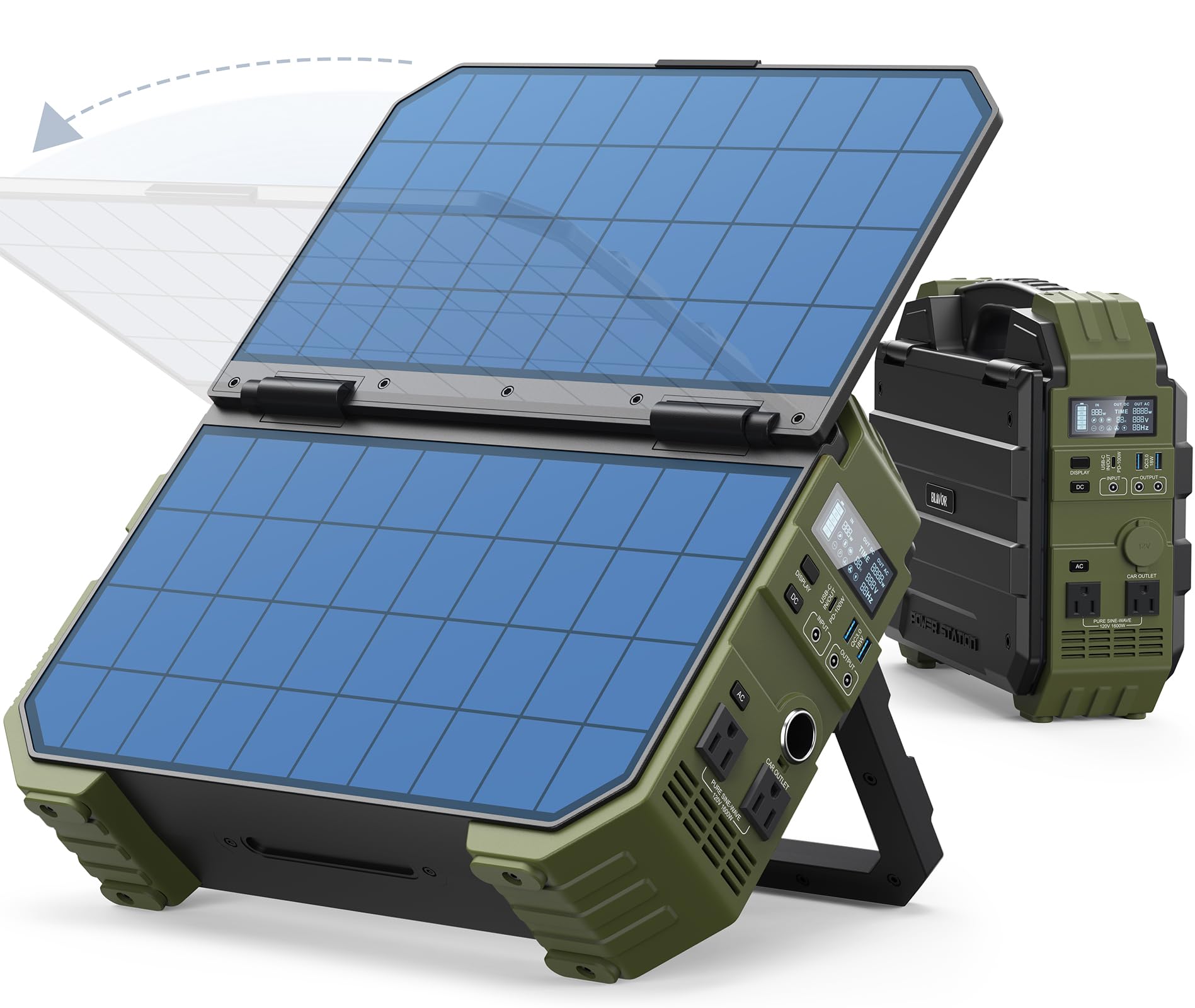
3. BLAVOR 1600W Solar Generator with Built-In 40W Panel
A rugged suitcase that unfurls its own solar panel so nothing gets left behind.
This kit solves the classic problem of forgetting the panel at home — the BLAVOR folds out a built-in 40W solar panel right from its suitcase shell. It’s the kit owners praise most for reliability in emergencies, with a 1024Wh battery and 1600W rated output (3200W peak) that handles a fridge, coffee maker, or CPAP. The 4,000+ cycle LiFePO4 battery quietly powers through years of daily use.
Recharging covers four paths — wall, car socket, its built-in 40W panel, or an external panel for up to 200W solar input. The built-in panel is more of a slow trickle (~30W in December), so buyers suggest grabbing an external 200-260W panel if you want meaningful sun recharging. A bidirectional 100W USB-C port fast-charges a laptop while the LCD shows input, output, and remaining battery.
The recurring gripe is the port labels hard to read against the orange background. Eight output ports include AC, USB-A, USB-C, and DC for running satellite TV for hours or a 26 cu ft fridge for about 5 hours.
All-In-One Advantages
- 1024Wh battery with built-in 40W solar panel
- 1600W rated output (3200W peak)
- 4,000+ cycle LiFePO4 battery
- 8 output ports with 100W USB-C
Consider
- Heavy 26-pound case
- Built-in panel charges slowly (~30W)
- Port labels tough to read
Choose this for: a go-bag power station where carrying one item means you always have solar capability.
Keep in mind: pairing it with a 200W+ external panel makes sun recharging actually practical.
4. ECO-Worthy 1.6KWH Complete Solar Panel Kit
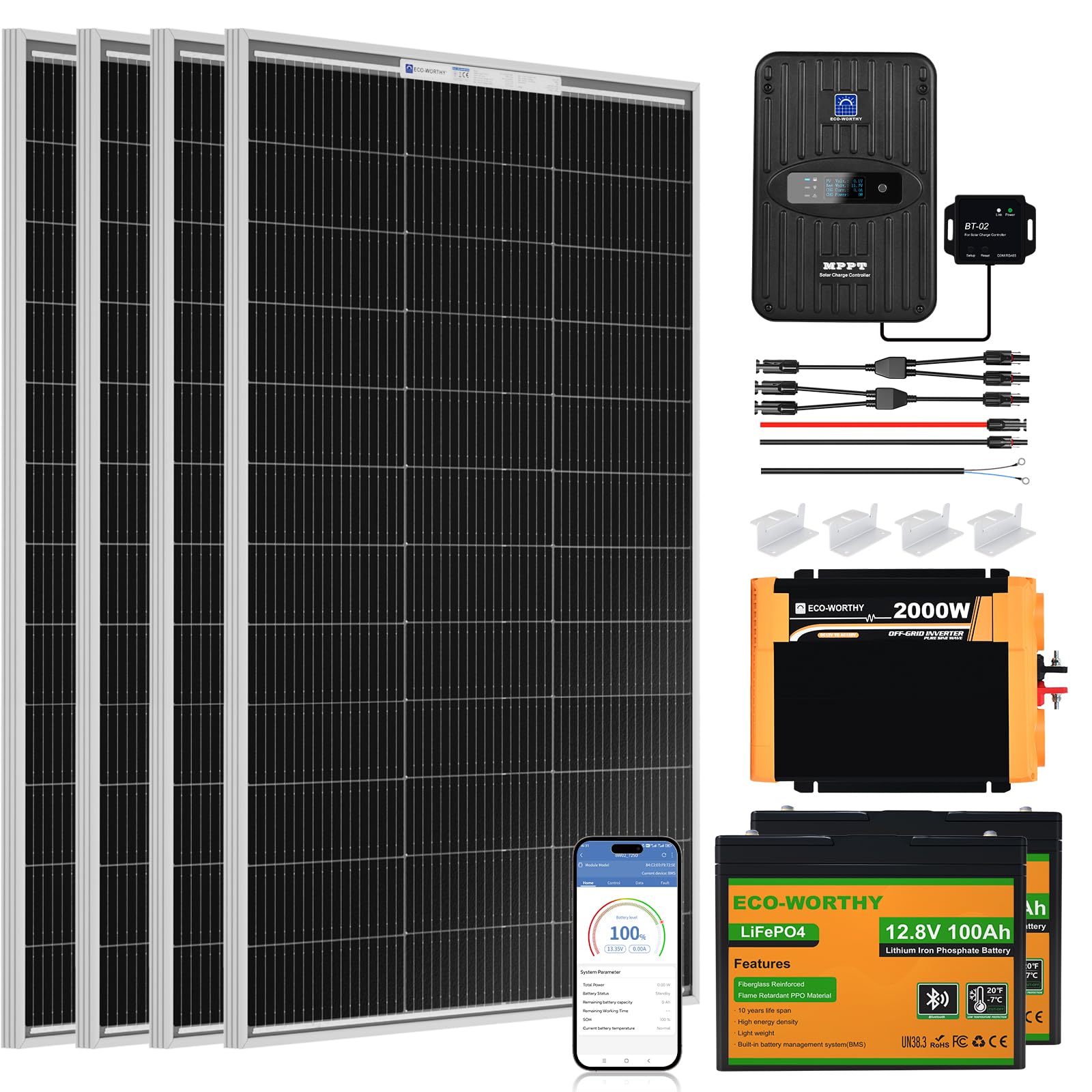
A true component kit for RVs that wires panels, controller, inverter, and batteries together.
Unlike most picks here that are sealed portable stations, the ECO-Worthy kit is a modular system — 4x100W bifacial solar panels wired into a 40A MPPT controller, a 2000W pure sine wave inverter, and 2x12V 100Ah lithium batteries. It’s built for a fixed install on an RV roof or cabin shed rather than being carried around, aiming for 1.6KWH daily output under 4 hours of sunlight.
Owners were surprised how well the 400W solar performs once installed, but honest fit matters here — shoppers say the system really only charges in direct sunlight, and high-drain items drain it fast. One reviewer noted two extra batteries to make it work as a primary source. The setup is rated easy; parts arrive in separate shipments, so checking all boxes on arrival is recommended.
This is a different skill tier than the plug-and-play stations — a buyer must wire the panels and understand 12V systems. The batteries promise more than 3,000 deep cycles versus lead-acid, and the Bluetooth Module 5.0 adds monitoring. For an RV fridge and lights, it fits; as a whole-house primary, plan to expand the battery bank.
For the DIY-Minded: Quality of components nets praise, yet the full-picture warning is the performance — which owners find mixed. Some systems shut down under higher draw, making expansion key.
Best fits: an RV owner comfortable with wiring who wants a fixed rooftop system with room to grow.
Think twice if: you want a carry-it-anywhere station in one box — a portable unit serves that better.
5. Jackery Explorer 2000 v2 with 2x200W Solar Panels
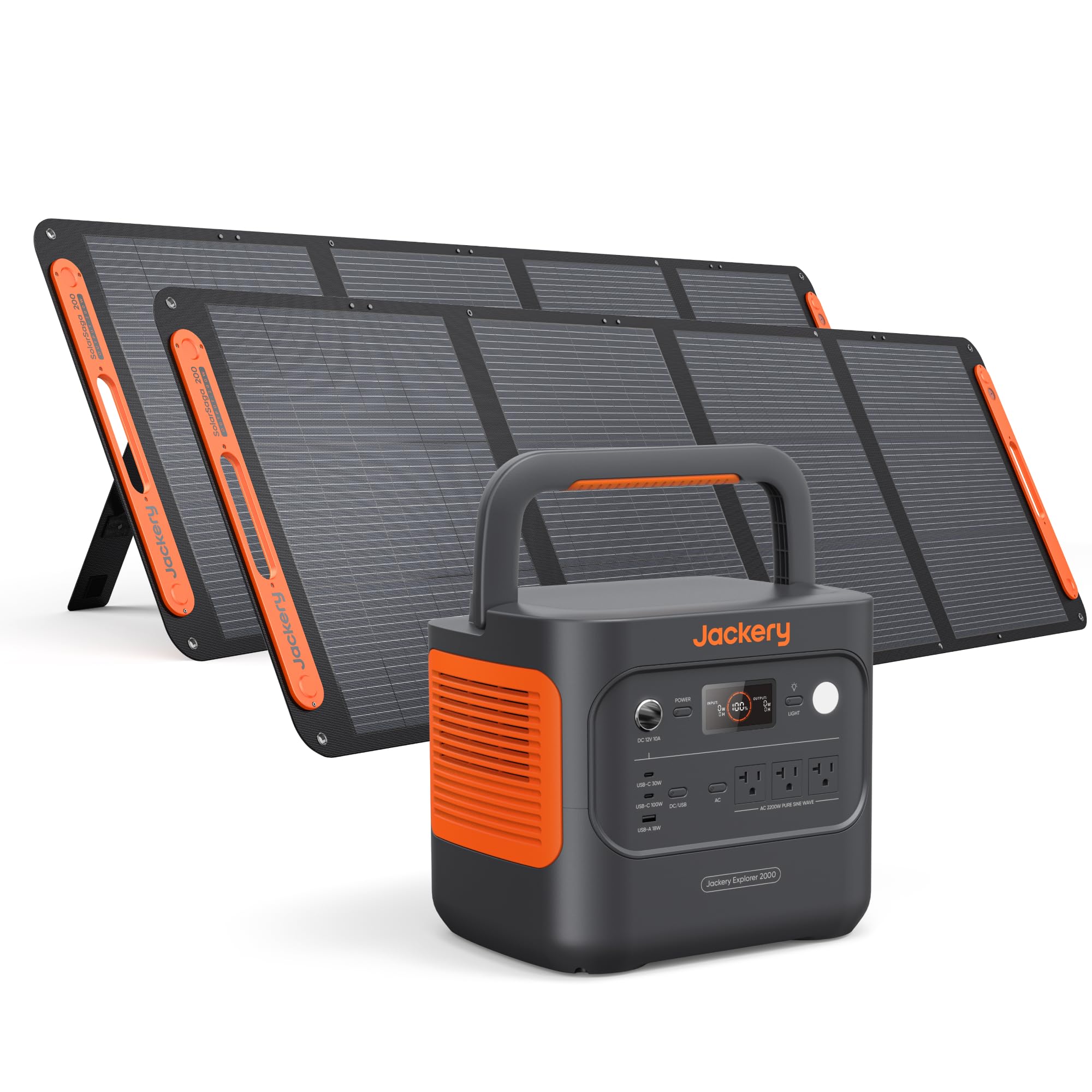
The 2kWh station that drops 41% of the weight from its rivals.
At 39.5 lbs, Jackery’s Explorer 2000 v2 is 41% lighter than conventional 2kWh LiFePO4 stations — a figure that matters when lugging emergency power from garage to living room. It delivers 2042Wh capacity through 3 AC ports at 2200W, with a USB-C PD 100W port for fast device charging. This is the gold-standard balance between heavy home backup and weekend portability.
The thing that wins owners over is the charging speed — hit 80% in 66 minutes from AC, or a full charge in 102 minutes using app-activated Emergency Super Charging. Solar recharging takes 6 hours with the 400W of included panels, and Silent Charging tops it up at just 30dB so it won’t disturb sleep. The LiFePO4 battery is rated for up to 10 years of reliable performance.
Buyers report that panels can scorch grass after a few hours, so placement matters, and the correct DC cable connection is essential. For real-world proof, one owner ran a window AC for 3.5 hours from 100% to 45% and got a 60% solar charge in 1.5 hours. The 20ms UPS switching keeps electronics running through grid disruptions without skipping a beat.
Everyday Wins
- 2042Wh capacity at just 39.5 lbs
- 80% charge in 66 minutes via AC
- 20ms UPS smooth switching
- USB-C PD 100W fast charging
Small Print
- Panels can yellow grass quickly
- Cable must be inserted correctly for solar
- Weight is lighter, but still 39.5 lbs
Reach for this if: you want 2kWh of serious backup without a hernia-inducing haul to the campsite.
Trade-off: recommend pairing with the app to open up super-fast charging mode.
6. EF ECOFLOW DELTA 2 Max Solar Generator 2048Wh

A 2048Wh station that doubles as a mini home grid with 15 outlets.
The DELTA 2 Max runs 99% of home appliances with a 2400W output, and its expandable design grows from 2kWh to 6kWh as your needs climb. It comes with a single 400W solar panel that tops it up in 5.1 hours; add a second 400W and that drops to 2.6 hours. The 2048Wh LiFePO4 battery is rated for 3,000 full charge cycles before degrading to 80% capacity.
Performance gets the loudest applause from owners — hurricane survivors report surviving 4 days of 90°F heat by managing a fridge, fan, and TV on 220W while solar input peaked over 300W. Charging flexibility leads with combined solar and AC input of 2400W, hitting 80% in just 43 minutes. The 400W panel itself is IP68 waterproof and folds down to a compact 35.3 lb package with its own case.
Owners note the solar case stand feels flimsy (some DIY a PVC fix) and that heavy loads need extra Y/extension cables to connect more panels. Battery life feedback runs mixed — some see 24 hours of power, others find the main unit drains before extra batteries. For outage scale, one owner cut their electric bill by over 50% using it as a daily inverter.
Grid-Scale Effort: With 15 outlets and up to 2400W, it powers a kitchen and laundry with room to spare. Expandable to 6kWh capacity for whole-home ambitions.
Pick this for: homeowners who want one station that can run a fridge all day and still grow with future add-on batteries.
Watch out: it weighs around 50 lbs, so wheel it rather than carry it.
7. ALLWEI 2400W Power Station with 400W Solar Panel & B200 PRO Battery
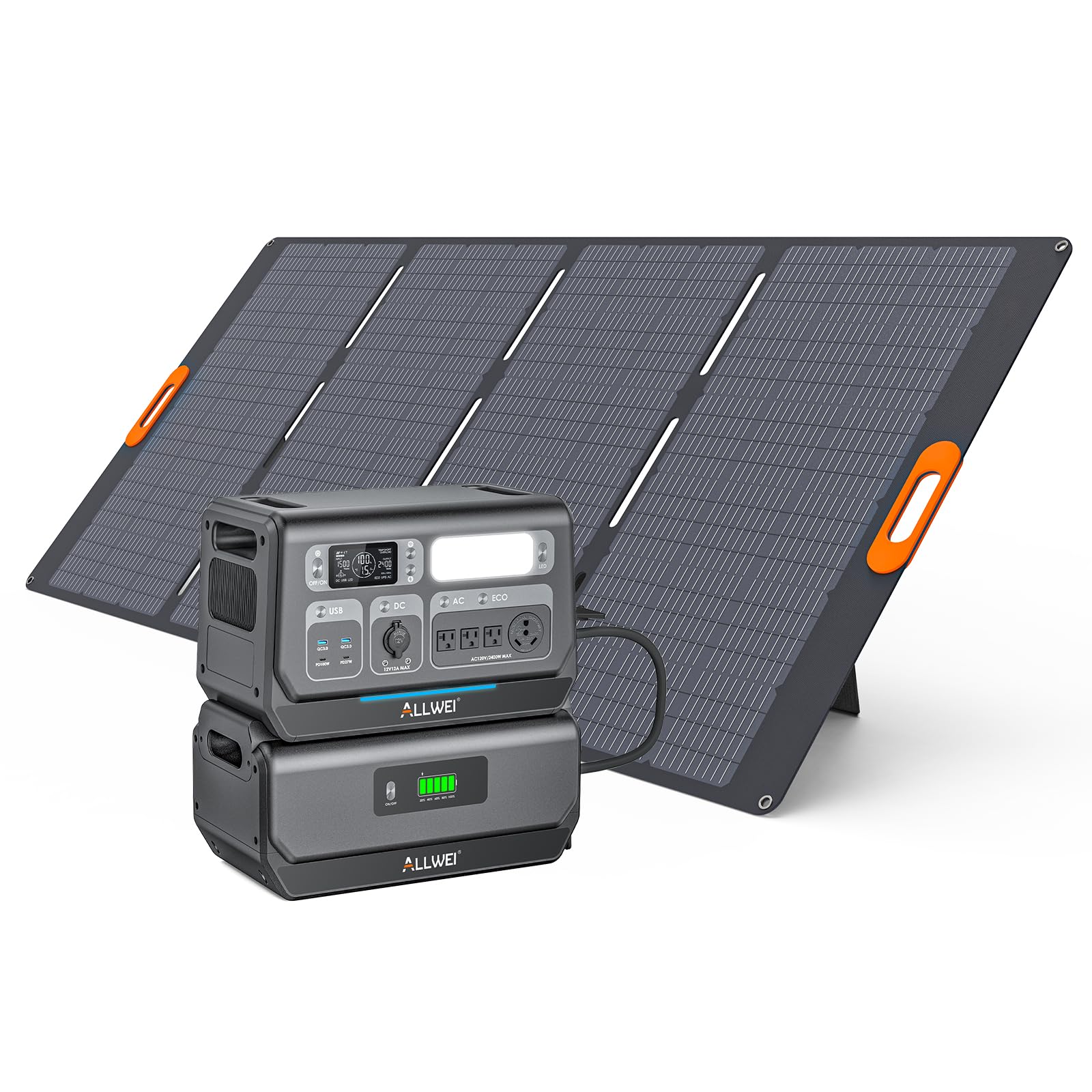
Two battery packs in the box give this kit nearly double the runtime of its peers.
The ALLWEI ships with a 2400W power station AND a 2048Wh expansion battery, stacking to a 4096Wh total before you buy anything extra — nearly double the capacity of a single 2042Wh station. It delivers up to 1200W fast solar recharging, with the ability to fully power in just 1.5 hours from an AC socket in Q Mode. The 400W solar panel feeds it full in 6-8 hours of sun.
Performance and charging speed are what owners praise loudest. Owners mention it charges from zero to 99% in just a few hours and provides power for many hours afterward. It handles phones, tablets, tool batteries, and even runs a router and modem as a clean, quiet UPS alternative to a beeping surge protector. The LiFePO4 batteries are rated for over 3,500 cycles across a 10-year lifespan.
This kit’s standout is expandability — it supports up to 4 additional battery packs, jumping from 2048Wh to a massive 10240Wh. Connected AC outputs count 4 along with a 30A RV outlet and 4800W surge capacity. The 10ms UPS switching protects essentials during outages. At 51 lbs per station plus the 35 lb panel, this is no travel companion — it’s a stationary home or RV powerhouse.
Capacity King
- 4096Wh total with power station + expansion battery
- 4,800W surge and 4 AC outputs
- 30A RV outlet built in
- Smart App control via Landbook
Heavy Reality
- Station alone weighs 51 lbs
- Solar panel adds another 35 lbs
- Thin handle not trusted for hanging
Biggest bang for the buck: if you need double the storage of most 2kWh rivals without buying a second unit.
skip it if: you need to move your power around often — this one stays put.
8. Jackery HomePower 3000 with 2x200W Solar Panels
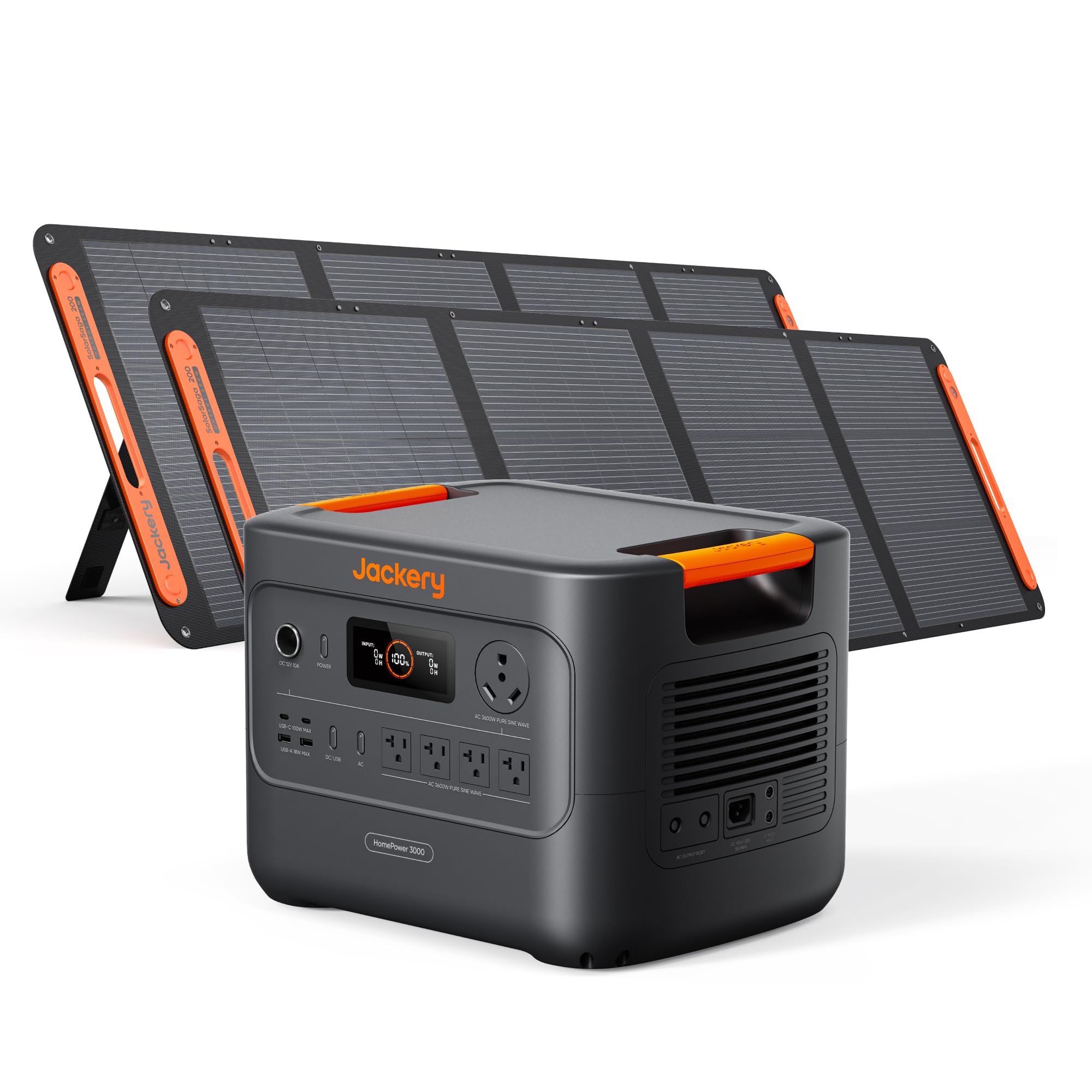
A 3kWh home grid that keeps three fridges cold through a four-hour outage.
When an outage hits, the HomePower 3000 carries a 3072Wh capacity with 3600W output (7200W surge) that one owner found ran three refrigerators and a freezer through a 4.5-hour blackout. It powers a household for up to 15 hours and keeps a refrigerator running for 1-2 days. The quality build and functionality earn the loudest praise from owners.
You can top up the battery in as little as 1.7 hours when you plug into both AC and DC power, or 2.2 hours using AC alone. If you rely on its two 200W solar panels, you will reach 80% charge in about 9 hours. Two USB-C ports each deliver 100W of Power Delivery (a fast-charging standard), so you can juice up your phone or drone quickly. A TT-30 port (the standard outlet found on most RVs) lets you power a camper directly. The built-in UPS (uninterruptible power supply) switches in under 20 milliseconds and is UL-certified, so your security cameras and medical refrigerator keep running without a hiccup during a storm.
Its CTB design makes it 47% smaller and 43% lighter than comparable 3kWh models, yet at 59.5 lbs it still needs wheels or strong arms. The LiFePO4 batteries offer 4,000 cycles while retaining 70% of their original capacity. Charging speed draws mixed notes — some owners find it fast, others report issues where it won’t charge at all. Buyers advise reading carefully since this unit is nonreturnable.
Outage Armor
- 3072Wh for 15 hours of household power
- 3600W output with 7200W surge
- TT-30 RV port for campers
- Dual 100W PD fast charging
Before You Buy
- 59.5 lbs heavy
- Charging speed varies by unit
- Nonreturnable
- No battery expansion option
Designed for: whole-home essentials — fridge, router, lights — through multi-day outages or full RV off-grid use.
Not for: those who want expandable capacity or a lighter carry-anywhere station.
9. EF ECOFLOW Solar Generator 3.6KWh DELTA Pro with 400W Panel

A wheeled 3.6KWh fortress with fifteen ports for serious off-grid living.
The DELTA Pro is the big rig of this list — a 3.6KWh capacity station with 3600W output that customers note powered 20 hours of daily use in Cuba. With 15 outputs including 5 AC outlets, 4 USB-A, 2 USB-C, 2 DC ports, a car port, and an Anderson port, it can run an induction cooker, fridge, or power tools. The 400W foldable panel, rated IP68 waterproof, charges it fully in 11 hours.
Owners prize its extreme quiet and easy setup, but power capacity draws mixed feedback — some find it enough for 3 days while others report getting 56% of the advertised capacity. This is a kit for serious disaster prep or semi-permanent off-grid use, not a tailgate accessory. Its 99 lb weight comes with wheels and a pull handle to compensate, though the handle is awkwardly placed.
Recharging 3x400W panels cuts full charge time to 3.5 hours. The 22.4% panel conversion rate boost efficiency in rain or shine. The app controls everything from charge levels to temperature monitoring. A buyer running a 1500W heater got only about 2 hours of runtime — shorter than expected. Storage requires a top-up every 90 days to protect the battery.
The Serious Tool: Accuracy of its reported specs earns top marks from owners. Consider pairing with an inverter generator for sensitive electronics, and use surge protectors.
Get this if: you need real, sustained power for an off-grid cabin, frequent long outages, or heavy duty appliances.
Think twice if: you need lightweight portability or only occasional backup — this is an investment in staying powered; note the 90-day storage maintenance.
Understanding the Specs
Watt-Hours (Wh)
This measures the total energy your battery can store. A 1024Wh unit runs a 100W fridge for roughly 10 hours; a 3072Wh unit extends that to 30 hours. Match watt-hours to the load and duration you need.
AC Output in Watts (W)
The continuous watts a station can supply at once via standard wall outlets. Smaller DC-only units like Anker’s SOLIX C200 have no AC outlet and can’t run a fridge. A 2000W+ unit powers most appliances simultaneously.
LiFePO4 Battery Chemistry
Lithium iron phosphate cells last far longer than older lead-acid batteries, often rated for 4,000+ charge cycles and a 10-year lifespan. They maintain capacity over daily use, making them ideal for permanent installation.
Solar Input Wattage
The max solar panel wattage a station accepts determines recharge speed. A 60W panel suits laptops, while a 400W panel refills a large battery in 5-8 hours of full sun. More panel watts mean faster reloads.
FAQ
What size battery solar panel kit do I need for my home?
Can a battery solar panel kit run a refrigerator?
How long does a 1024Wh battery last?
What is the difference between LiFePO4 and lead-acid batteries?
Can I expand the capacity later?
What size solar panel do I need to recharge quickly?
What does UPS mean on these power stations?
How heavy are these solar generator kits?
Final Thoughts: The Verdict
If you want a battery solar panel kit that is easy to live with, the Anker SOLIX C200 is the one to buy: it combines a LiFePO4 battery (a long-lasting lithium chemistry) with a solar panel that actually works, all in a compact size. Need real AC power for home backup? The EcoFlow Delta 3 Classic delivers 1800W from its 1024Wh battery, enough to run appliances during an outage. For a whole home or off-grid cabin, the EcoFlow Delta Pro stores 3.6KWh of solar energy you can draw on day or night. The consistent quality across Anker and EcoFlow models means any of these will serve you well.
How We Picked
We do not accept paid placement. Every pick is matched to a real buyer and a real use-case; we do not hands-on test units.
Sources & Methodology
Specifications: manufacturer listings and product documentation. Review insights: verified customer reviews, as of September 2026. Pricing: not shown on this page (it changes often); check the current price via the retailer link.
As an Amazon Associate, Gadgets Feed earns from qualifying purchases. This does not affect which products we feature.