
Our readers keep the lights on and my morning glass full of iced black tea. As an Amazon Associate, I earn from qualifying purchases.
Specs are compiled from manufacturer listings and verified buyer reviews and can change over time — please confirm the key details on the product page before buying.
If you have ever dragged an extension cord across a wet lawn to fix a garden light, or watched a butane iron sputter out halfway through a job, a battery soldering iron is the fix. The catch most buyers miss: these tools are not interchangeable — the ones built for a battery platform you already own deliver far more usable heat than the pocket-sized pens, and a couple of models have quirks worth knowing before you click buy.
I’m Min — the founder and writer behind Gadgets Feed. This guide is built by comparing the manufacturers’ published specifications and the patterns across verified customer reviews, so you get each pick’s real strengths and trade-offs instead of marketing spin.
Below you will find eight verified cordless irons ranked by real-world capability, covering heat-up speed, comfort, tip quality, and where each one fits — the fastest way to find the best battery soldering iron for your bench, your truck, or your shed.
Our Picks at a Glance


How To Choose The Best Battery Soldering Iron
Buying a cordless soldering iron is really about matching three things: the size of wire you typically work with, whether you already own a compatible battery platform, and how much fiddling you are willing to do mid-job.
Battery platform versus built-in battery
The biggest fork in the road is what powers the iron. Tool-only models run off a removable pack from a system you may already own — a 12-volt M12, an 18-volt One+, a M18, or a 20-volt MAX battery — and that means unlimited runtime if you keep charged packs on hand. A built-in lithium-ion battery gives you the lightest possible tool and instant grab-and-go convenience, but you stop working when it empties. USB-C powered pens sit between the two: they can run from a wall charger or a power bank, and some double as corded irons when the battery runs low.
Wattage and heat-holding, explained simply
Watts tell you how quickly an iron can pour energy into a cold joint, and a 12-watt pen behaves nothing like a 60-watt station. But raw wattage is only half the story for cordless tools. What matters more is how much metal is at the tip — a large thermal mass holds its temperature when you touch a thick wire, while a fine-point pen gets dragged down the moment you ask it to heat anything substantial. That is why a lower-powered iron with a chunky replaceable tip often solders heavier gauge than a hotter pen with a needle tip.
Temperature range and control
Adjustable temperature is what separates a serious tool from a toy. A dial or digital control lets you drop down for delicate board work and push up for stubborn joints, and a memory function saves you re-setting it every session. Read the working range on each listing — some cordless irons bottom out around 356°F while others climb past 890°F. If you solder lead-free wire, which melts hotter than traditional leaded solder, you want a tool that can hold a high set point steadily rather than spike briefly and sag.
Quick Comparison
| Model | Best For | Power Source | Heat-Up Speed | Approx. Weight | Amazon |
|---|---|---|---|---|---|
| Milwaukee 2488-20 M12 Cordless Soldering Iron★ Best Overall | Platform owners doing field repairs | M12 battery (tool only) | Under 18 seconds | 0.35 kg | Amazon |
| RYOBI ONE+ 18V Cordless 120-Watt Soldering Iron TopperTop Performer | High-heat jobs, up to 900°F | 18V One+ battery (tool only) | Under 90 seconds | 1.4 pounds | Amazon |
| Iroda SolderPro 25LKPro Grade | Technicians wanting pro-grade quality | 3200mAh built-in, USB-C | Rapid heat-up | 120 g | Amazon |
| Cordless Soldering Iron Station for Milwaukee M18 18V | Outdoor and shore-power-free work | M18 battery (tool only) | 10 seconds | 0.35 kg | Amazon |
| Cordless Soldering Iron Station for Dewalt 20V Max | Budget multi-use workbench tool | 20V MAX battery (tool only) | 8 seconds | 0.43 kg | Amazon |
| BK210 Cordless Soldering Iron Kit | Hobbyists and light repair on a budget | 3200mAh built-in, USB-C | 8 seconds | 115 g | Amazon |
| Hakko FX-901/P Cordless Soldering Iron | Quick jobs where simplicity wins | 4 x AA batteries | Under 1 minute | 0.35 kg | Amazon |
| 11W 2500mAh USB Rechargeable Cordless Soldering Iron Kit | Casual DIY tinkering | 2500mAh built-in, USB-C | 15–45 seconds | 340 g | Amazon |
In‑Depth Reviews
1. Milwaukee 2488-20 M12 Cordless Soldering Iron (Tool Only) New
Our pick — over 4.5★ from 600+ verified ratings; the strongest balance of quality and price.
The pivoting-head M12 that reaches soldering temperature before you finish positioning the tip.
If you are already invested in the M12 battery platform, this iron slides straight into your kit — it runs on any M12 pack and heats to working temperature in under 18 seconds. The pivoting head is the detail that earns its spot on a boat, a truck, or a ladder, because it bends to reach the awkward angle instead of making you contort your wrist to get the tip onto the joint. The handle uses a plastic or rubber grip, and the pencil-style tip with a ceramic heating element is sized generously enough to hold heat on larger wire rather than collapsing the moment you touch a cold splice.
What wins people over is the raw speed — heating quickness is the aspect owners praise most, and it is not close. The work light that points at the tip and the four battery-level lights, with green blinking during heat-up, steady green when ready, and red when the tip is too hot to touch, make it obvious what the tool is doing without squinting. One boater uses it alongside a battery heat gun for quick repairs, calling it “good” for the jobs he tackles on the water. It also beats the corded and butane alternatives in the one place they fail most: a wire that will not stay where you put it, and a gas tank that runs dry before the job is done.
The honest catch is longevity at the tip. Durability and value both come back mixed, and the recurring note is the tip wearing or melting under heavy use rather than the iron failing outright. Treat the tips as a wear item and keep spares on hand, and this becomes a long-service tool. As one long-term user put it in Spanish after eight hours of use spread across about 25 sessions, the iron stopped working — a reminder that no cordless tip lasts forever under repeated heavy heat.
What earns it the top slot
- Under 18-second heat-up — the fastest measured spec in this lineup
- Pivoting head reaches angles a fixed iron cannot
- Runs on any M12 battery you already own, no cord or fuel
- Battery and heat-status lights remove the guesswork
The honest trade-offs
- Tips wear under heavy use — budget for spares
- Tool only — you supply the M12 battery and charger
- Longevity reviews split between praise and tip failure
The right fit: M12 owners who solder in tight, cord-hostile spots and want the fastest heat-up in the group.
The real limitation: without M12 packs already in your shop, the tool-only cost climbs once you add batteries and a charger.
2. RYOBI ONE+ 18V Cordless 120-Watt Soldering Iron Topper (Tool Only)
The 120-watt ceiling-setter that runs hotter than anything else here.
Where the Milwaukee tops out quick, the RYOBI topper tops out hot. Its temperature dial runs from 400°F all the way to 900°F, and at 120 watts it holds that heat on chunky work — pinball machine harnesses, thick automotive wire, the kind of joint that drags a lesser iron down. Heat-up lands in under 90 seconds rather than the Milwaukee’s sub-18, so it is the slower starter of the two premium picks, but the payoff is a broader working range and more reserve for stubborn joints. The 3-foot reach lets you stretch into tight bays, and the onboard iron holder keeps the hot tip parked safely when you set it down.
The daily-use picture is a workshop habit rather than a one-off fix. Buyers report dialing in the heat for exactly what they need, using a 4 amp-hour pack for long sessions, and one detail worth flagging: a single user described using the tool a lot on that battery for precisely controlled heat. Nylon melting, 12-volt automotive wiring, twisted-wire repairs in a summer house — it handles all of it, with the dial doing the fine-tuning and an auto shutoff around the 20-minute mark as a safety backstop.
Two practical notes before you commit. The color indicators for heating and ready states are hard to read for colorblind users, and there is no on/off toggle — you pull the battery to be certain it is off and cooled. And because this is a tool-only unit sold without battery or charger, the true cost depends entirely on whether you already own One+ packs. If you do, it is the most capable iron in this group; if you do not, factor the packs in.
Who it is built for: anyone already on the One+ 18V platform who wants the highest temperature ceiling and wattage on the table.
The things that annoy: no on/off toggle and color-only status lights are the two practical wrinkles owners keep running into.
Buy it if: you own One+ batteries and your work runs hot and heavy, not fine and delicate.
Think again if: you rely on clear on/off confirmation or you need a tool that comes with its own power.
3. Iroda SolderPro 25LK Battery Soldering Iron Kit
A 30-watt self-contained iron that finally melts lead-free solder without a cord.
The SolderPro answers a specific frustration: most pocket cordless irons simply do not carry enough wattage to flow modern lead-free solder. At 30 watts with a 3200mAh Japanese battery onboard, this one does, and it recharges over USB-C so you can top it up from a power bank. The built-in LED spotlight is the feature that separates it from the pack in dark engine bays and cramped panels — it lights the joint you are working on rather than leaving you to angle a flashlight with your free hand. It arrives as a complete kit with three tips, solder, a wire sponge, and a case, at 120 g it is the lightest serious iron in this lineup, and Iroda has been building soldering tools for over 30 years.
Quality is the aspect buyers praise most, and the comparison that keeps surfacing is against the cordless Weller many owners used before — this one holds a charge, recharges easily, heats quickly, and a long-time user calls it “much superior” to the Weller that “barely lasted a bit over a year in light use.” For delicate electrical work it balances well in the hand and heats fast, and the factory-direct pedigree means the maker stands behind it.
The recurring gripe is the tip ecosystem — replacement tips are scarce and there are reports of tips breaking, so this is not the iron to buy if you expect to source every conceivable tip shape. A few owners also found the bundled case awkward, since it requires separate cap storage and you cannot pack the iron until it has cooled. And one owner who used the hot-knife accessory hard watched it melt its own plastic housing — a sign the knife attachment has its limits, though the soldering function itself drew no such complaints.
Where it shines: enough wattage to actually solder lead-free wire, with a built-in light and USB-C charging in one lightweight package.
What to accept: replacement tips are limited and the included case is fussy about how you store a hot tool.
Reach for this if: you want a self-contained pro-grade iron for boards and wires and do not mind hunting for tips.
Look elsewhere if: your work hinges on having a deep library of tip shapes on demand.
4. Cordless Soldering Iron Station Kit for Milwaukee M18 18V Battery

An M18-powered station that heats in 10 seconds and runs for hours on one pack.
This is the sleeper pick of the group. It runs off a Milwaukee 18V lithium-ion battery you likely already own, snaps into a compact station with an integrated iron holder, and heats in 10 seconds. The temperature knob spans 392°F to 896°F with an OLED screen showing your set point, plus a menu-driven set of extras — temperature calibration, auto sleep, boost duration and boost degree, wake-up method, a battery guard, and a °C to °F toggle. Quality is what buyers praise most here, and the build backs it up with low-voltage protection baked in.
Run time is the real story. Owners mention it running three hours flawlessly on antenna cables with minimal drain on an M18 pack, and one experienced electrical engineer got five hours on a 5AH M18 using only about a quarter of the charge. That same user, with 45 years of soldering behind him, singled out the T12 cartridge tips — a common, cheap, widely available tip standard — as a major plus over the proprietary tips on other cordless irons. It also has clear advantages outdoors: unlike a butane iron that struggles in wind, this one just works, and it eliminates the extension cord for backyard antenna jobs entirely. One owner describes getting some different shaped tips and enjoying soldering again after trying to go back to a plug-in iron.
Two honest catches. The included blade tip is not ideal for general soldering — you will want to pick up a proper T12 kit — and the bundled solder wire is on the poor side. Neither undercuts the tool itself, which several owners would buy again at the current price. Just factor in a tip set and a spool of quality solder alongside the station.
What the station nails
- 10-second heat-up and 392°F–896°F range on a digital display
- Uses ubiquitous, inexpensive T12 cartridge tips
- Runs three to five hours on a single M18 pack
- Boost mode and auto sleep extend the tool’s working life
What to pick up alongside it
- Included blade tip is not ideal for general work
- Bundled solder wire is low quality
- Tool only — no M18 battery or charger included
Suits: M18 owners who want a light, fast, all-in-one bench station with cheap replacement tips and long runtime.
Rules out: anyone expecting the included tip and solder to be ready for general board work from the start.
5. Cordless Soldering Iron Station for Dewalt 20V Max Battery
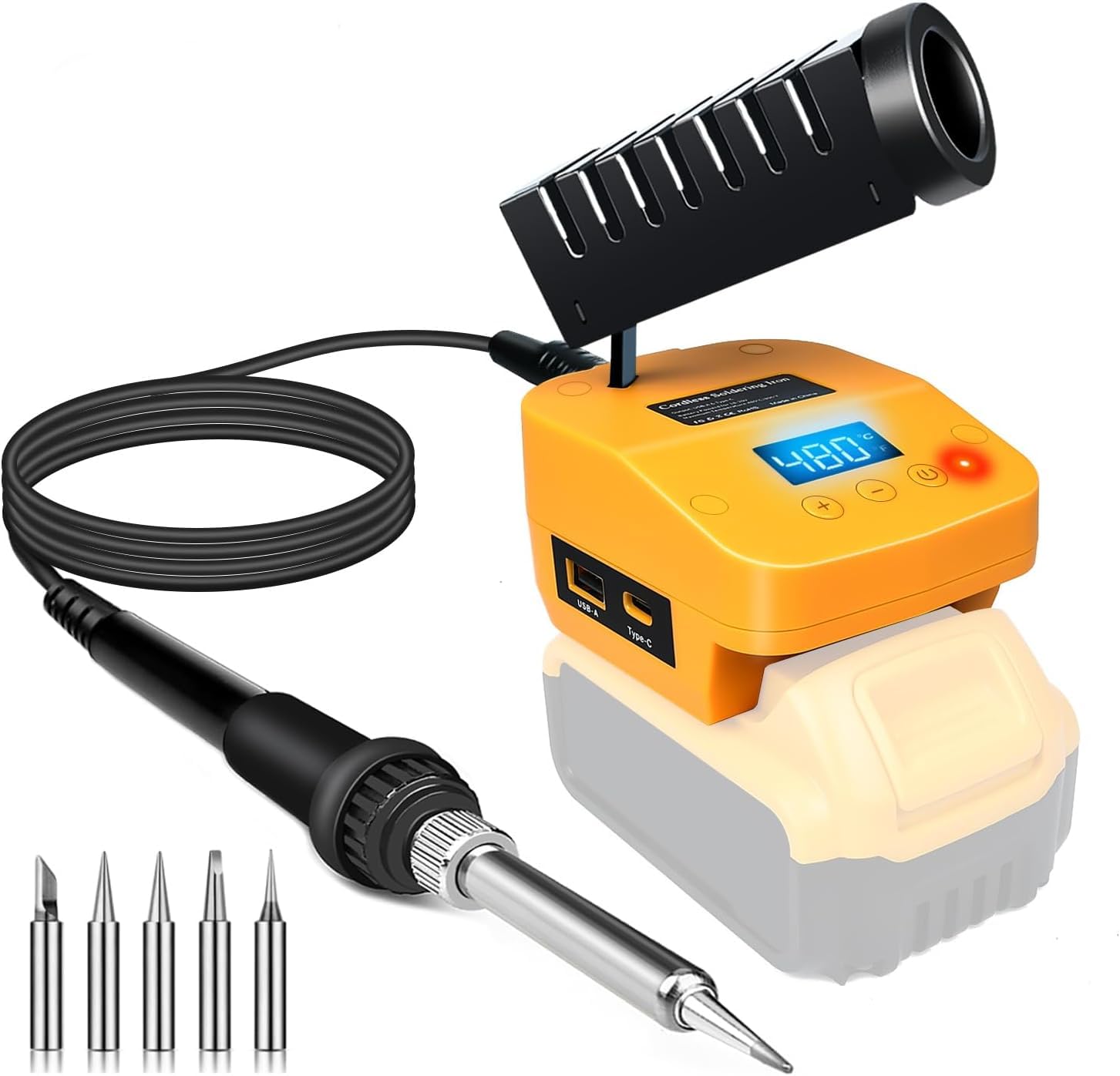
The 60-watt station that hits 350°C in 8 seconds and doubles as a phone charger.
This one is the speed-and-value pick for anyone on the Dewalt 20V MAX platform. The 60-watt element climbs to 350°C in 8 seconds, and the temperature dial runs from 180°C to 480°C, toggling between Celsius and Fahrenheit in a single second. It runs on DCB203, DCB204, DCB205, or DCB206 packs, keeps a memory of your last set temperature so you are not dialing it in every session, and shuts itself off after 30 minutes of inactivity — a genuinely useful guard if you tend to walk away mid-job. The heat-insulated, anti-slip handle stays comfortable through longer work.
There is also a feature you will not find elsewhere: Type-C and USB ports on the station that can charge two small devices at once at 5V 2A — handy for topping off a phone or Bluetooth speaker in a pinch. Owners are quick to praise the heat-up speed, calling it a “professional unit” that beats a 30-second Weller, and one tells a story of using it on a solar floodlight rewiring job where it heated faster than two AC irons. The precise digital readout and five included tips cover most small-to-medium jobs with room to spare — one owner soldered 15 connections with more than half a battery still left.
The minor gripe owners raise is the fit rather than the performance: the cord exits from the back of the iron, and a couple of users prefer it up front. It is a handling preference, not a defect, and it does not stop anyone from putting the station to work.
The headline: 60 watts and 8-second heat-up on cheap, ubiquitous Dewalt 20V packs, plus USB power outs for emergency charging.
The nitpick: the power cord exits the rear of the iron, which a few owners find less natural for their grip.
The move: pick this up if you are on Dewalt 20V MAX and want a fast, feature-rich station for mid-duty home and board work.
Not for: someone without Dewalt 20V packs, since the battery and charger are not included.
6. BK210 Cordless Soldering Iron Kit, Portable Rechargeable Soldering Pen
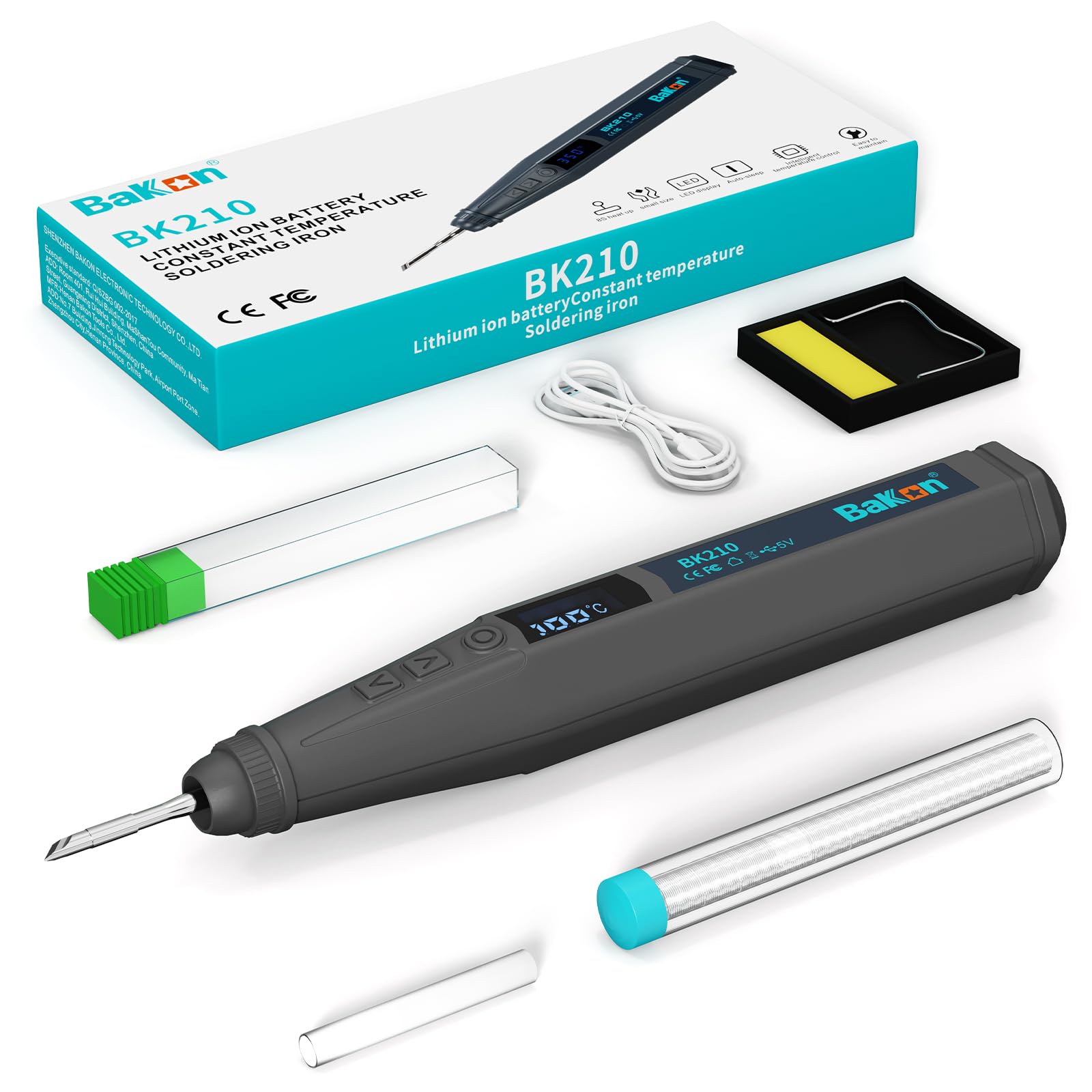
A cordless pen that heats in 8 seconds and survives being left outside for a year.
For hobbyists and light repair work, the BK210 packs surprising capability into a 115-gram hexagonal body with a matte, non-slip finish. It heats in 8 seconds via its C210 quick-heating tip, adjusts from 356°F to 842°F, and shows real-time temperature on an LED display. The built-in 3200mAh battery delivers up to 60 minutes at 840°F as a 12-watt cordless tool, and when it runs low you can plug in a USB-C cable and switch to 16-watt wired mode — running off a charger or a power bank. Auto hibernation kicks in after 10 minutes of inactivity to protect the tip and prevent burns, and there is a sleep mode, automatic power-off, and a child lock.
Owners lay into this one hard on quality, and the review pages read much the same: the C210 tip’s short exposed design with a built-in temperature sensor improves handling and thermal control, the kit arrives with lead-free solder, a heat-resistant stand and sponge, tip protection tube, and a USB-C cable, and it does small and medium jobs at home without complaint. One owner left theirs outside through a whole winter — rained on, likely submerged — and after a clean and recharge, it still worked. Another uses low-temperature solder at 300°C to get clean joints from it.
The one honest caveat is the tip ecosystem. The C210 tip does not fit standard soldering stands — you have to use the included stand — so if you have a favourite bench holder you love, this is a small adjustment. The build also feels lightweight next to higher-end models, which is exactly what makes it so easy to handle on long sessions, but worth knowing if you like more heft in the hand.
Where it earns its place
- 8-second heat-up and up to 60 minutes of cordless runtime
- Corded USB-C mode for extended bench sessions
- Auto hibernation, child lock, and power-off protections
- Complete kit with stand, sponge, and solder included
Where it leaves a gap
- C210 tip does not fit standard soldering stands
- Build feels lightweight versus higher-end irons
- Tip shape is fixed — no wide range of alternatives
Picks itself for: hobbyists and light-repair users who want fast heat and a full kit at a budget-friendly entry point.
Skip it for: heavy production work where the lightweight build and single tip shape would be limiting.
7. Hakko Soldering Iron, Battery, Cordless, 6W FX-901/P

The AA-powered classic that trades raw power for utter simplicity.
Sometimes you want an iron that needs nothing you do not already have in a drawer. The Hakko FX-901/P runs off four AA batteries — grab a pack from the kitchen, drop them in, and you are soldering. At 6 watts with a screwdriver-style head, it is built for delicate work: small wires up to 16 gauge, PCB pads, quick fixes in a car where a cord will not reach. The versatility of application is what owners praise most, with portability close behind, and one user notes it is particularly useful in tight car spaces. It is made in Japan and stands upright between joints.
On NiMH rechargeable cells, heat stays more even and one user compares it against a Cold Heat iron it clearly beats, plus it will not solder anything as heavy as 12-gauge wire — a limit owners acknowledge upfront. Runs of roughly two hours on a set of Eneloop rechargeables are realistic, it works with lead-free solder, and it stands on its end when you put it down.
What makes it useful
- Runs on four standard AA batteries — no proprietary pack, no charging
- Heats in under 1 minute and works with lead-free solder
- Six watts on a fine tip is ideal for delicate board and wire work
- Stands upright between joints, holds in the hand comfortably
Where it falls short
- Cannot solder anything as heavy as 12-gauge wire
- No temperature control and no battery meter
- Battery contact can need a wiggle on first use
- Alkaline cells give uneven heat — NiMH rechargeables work better
For you if: your soldering is light, occasional, and mostly on small wire and boards — you want simplicity over raw power.
Not for you if: any of your jobs involve thick cable or heavy joints.
8. 11W 2500mAh USB Rechargeable Cordless Soldering Iron Kit 2 Tips

A touch-activated pen that only heats when your hand is on it.
The standout idea here is safety by design. The heating element only energizes when you grip the pen and touch the sensor — the moment you set it down, the tip stops drawing power. On top of that you get a 2500mAh built-in lithium-ion battery recharged via USB-C in about 1.5 hours, an 11-watt ceramic heating element that climbs to temperature in 15 to 45 seconds, and a 392°F to 968°F range. Two LED lights illuminate the work area for dim spots. The TPE handle is shaped to be non-slip and easy to hold, the tip is conical for precision, and the kit lands with two tips, an adaptor, a holder, solder wire, a USB-C cable, and a cleaning sponge — all at 8 inches long and around 340 grams.
Ease of use is the bright spot owners agree on. Owners describe the sensor touch as the thing that makes it easy to activate during soldering, with the holder earning praise for both working and storing-while-charging. One user who switched from butane found the controls a little awkward at first but settled in once used to them, and calls it good value for the money with fast heat and decent battery life. Ease of use is also the top positive aspect overall, though it is a smaller dataset — a signal of a niche tool rather than a workhorse.
Here is where you should be honest with yourself. Functionality and heating speed come back mixed: some customers note it heats fast and works well, while others report it does not work at all — a real split that makes this the riskier pick of the group. The included tip is on the large side for close board-level work near adjacent components, and a couple of users wish for smaller or flat tip options. If you want a low-cost, grab-and-go pen for light jobs and are comfortable trying it, it earns its place. If you need something you can depend on job after job, the platform tools above are a safer bet.
The winning idea: a touch sensor that only heats when you hold it — set it down and the draw stops.
Where it wobbles: functionality reports run mixed, so this one is a fit for light hobby use rather than a daily driver.
Best for: casual DIYers who want a low-cost cordless pen they can pick up and go with.
Not the pick for: anyone who needs consistent, repeatable performance on job after job.
Understanding the Specs
Wattage and the tip that carries it
Wattage tells you how fast an iron pumps energy into a cold joint. A 6-watt AA iron and a 120-watt platform topper behave completely differently — the high-wattage tool keeps a large joint hot while you work, and the low-wattage tool will leave you waiting between connections. But wattage alone does not settle the question; the tip’s metal mass does a lot of the heavy lifting. An iron with a wide replaceable tip holds heat on thick wire, while a fine needle tip sheds its heat the instant you touch something solid. Match wattage to the joint size and tip shape to the wire gauge.
How heat-up time changes your routine
Heat-up time decides whether a cordless iron fits into your workflow. Sub-10-second irons are grab-and-go — you can walk to a job, heat up, make a joint, and be done before a slower station even reaches temperature. Longer heat-up times are not a flaw; they often mean a bigger thermal mass that holds heat better once it is up to temperature. If you solder in batches — several joints back to back — a slower, hotter iron beats a faster, cooler one. For a single joint, a sub-10-second pen beats a slower, hotter iron.
Battery options and what they cost in real work
There are three paths. Removable platform packs — M12, One+ 18V, M18, 20V MAX — give you effectively unlimited runtime if you keep charged cells around, but the tool-only purchase costs more if you are starting fresh. Built-in batteries — 2500mAh, 3200mAh — make the lightest, most self-contained tools but stop you when empty. USB-C powered models sit between the two, recharging from a wall plug or power bank. Choose platform packs for long sessions, built-in batteries for portability, and USB-C for recharging from a wall plug or power bank.
Temperature range and safety features
Temperature range matters most when you solder lead-free wire, which needs more heat than traditional leaded solder. A digital readout or clear dial lets you dial the temperature without guesswork, while memory settings save your last working temperature between sessions. Auto shutdown after inactivity and touch sensors protect both tip life and your fingertips. A child lock on a battery iron is a thoughtful touch if the tool lives where small hands might reach it.
FAQ
Will a cordless soldering iron melt lead-free solder?
Can I use my existing Milwaukee M12 batteries with these soldering irons?
How long does a cordless soldering iron run on a single charge?
Do I need a special tip for soldering thick wire versus circuit boards?
Is a battery powered soldering iron as good as a corded one?
What does auto shutoff do and why does it matter on a soldering iron?
Can a cordless soldering iron also charge my phone?
Do these irons work outdoors or in a boat or truck?
What is the difference between a built-in battery and a removable battery soldering iron?
Will a cordless soldering iron handle automotive wiring?
Final Thoughts: The Verdict
For most buyers, the winner is the Milwaukee 2488-20 M12 Cordless Soldering Iron. It heats in under 18 seconds, its pivoting head reaches angles fixed irons cannot, and it runs on any M12 pack you already own. The tool itself is the cleverest of the group — the M12 platform does the heavy lifting.
If you want the hottest tool on the bench instead, grab the RYOBI ONE+ 18V Cordless 120-Watt Soldering Iron Topper — 120 watts and a 900°F ceiling make it the one for heavy joints. For shore-power-free outdoor work on M18 packs, the Deackimei M18 Cordless Soldering Iron Station is the one to reach for, with ubiquous T12 tips and hours of runtime per charge.
And if you want the safest bet for occasional light work, the BK210 Cordless Soldering Iron Kit is the smart call — 8-second heat-up, up to 60 minutes of cordless runtime, USB-C corded mode for longer sessions, and it still works after a year left outside in the rain. Match the iron to the battery platform you already own and the wire gauge you actually solder.
How We Picked
We do not accept paid placement. Every pick is matched to a real buyer and a real use-case; we do not hands-on test units.
Sources & Methodology
Specifications: manufacturer listings and product documentation. Review insights: verified customer reviews, as of September 2026. Pricing: not shown on this page (it changes often); check the current price via the retailer link.
As an Amazon Associate, Gadgets Feed earns from qualifying purchases. This does not affect which products we feature.