
A power outage used to mean digging out a gas generator, dealing with fumes, and listening to a loud engine run all night. Home battery storage changes that completely. These silent, zero-emission power stations store enough energy to run a refrigerator, lights, internet, and even a well pump for days — recharging from solar panels or a standard wall outlet when the grid comes back.
I’m Min — the co-founder and writer behind Gadgets Feed. I study the latest battery chemistries, inverter topologies, and charging speeds to separate real performance from marketing claims in this fast-moving category.
After analyzing over 80 hours of spec sheets, customer feedback, and real-world runtime tests, I narrowed the field to the 11 best models that deliver reliable power for home backup. This guide to the best battery storage for home covers everything from budget-friendly entry points to whole-house systems capable of running a 5-ton AC unit.
How To Choose The Best Battery Storage For Home
Home battery storage is a long-term investment, and buying the wrong capacity or chemistry can leave you without power when you need it most. Focus on these three factors to make the right call.
Battery Capacity and Chemistry
Capacity is measured in watt-hours (Wh). A 3,072Wh unit can run a standard refrigerator (150W average) for about 20 hours. For a full day of critical loads — fridge, lights, internet, a few device charges — look for at least 3,800Wh. Expandable models let you start smaller and add battery packs later. Almost every modern home station uses LiFePO4 chemistry, which lasts 3,000 to 6,000 charge cycles versus 500 cycles for older NMC batteries. That translates to 10+ years of daily use before capacity drops to 80%.
Inverter Power and Surge Rating
Continuous wattage tells you what the unit can sustain (running a fridge, furnace fan, or TV). Surge wattage covers the startup spike that motors and compressors need — a fridge might draw 600W running but 2,000W for the first second. Look for a continuous output at least 2,000W for essential circuits and 3,600W+ if you plan to run a well pump, window AC, or power tools. Units with split-phase 120V/240V output can also feed a dryer or EV charger.
Recharge Speed and Solar Input
Fast AC recharge turns a drained battery into a full one in under 3 hours — critical during multi-day outages when the grid flickers back briefly. Solar input is measured in watts (e.g., 1,000W max). Higher solar input means you can use larger panels and recharge faster when the sun is out. MPPT charge controllers (standard on all premium units) convert solar energy at over 97% efficiency compared to cheaper PWM controllers that lose 20-30% of the panel’s potential.
Quick Comparison
On smaller screens, swipe sideways to see the full table.
| Model | Category | Best For | Key Spec | Amazon |
|---|---|---|---|---|
| EF ECOFLOW DELTA Pro Ultra | Premium | Whole-house backup | 6144Wh / 7200W output | Amazon |
| Anker SOLIX F3800 | Premium | EV charging + home backup | 3840Wh / 6000W output | Amazon |
| Jackery Solar Generator 5000 Plus | Premium | Extended outage coverage | 5040Wh / 7200W output | Amazon |
| Jackery HomePower 3600 Plus | Premium | Lightweight 3.6kWh system | 3584Wh / 3600W output | Amazon |
| ECO-WORTHY Home Power Station 5120Wh | Mid-Range | Rack-mount solar system | 5120Wh / 5000W hybrid inverter | Amazon |
| OSCAL PowerMax 6000 + 3×400W Solar | Mid-Range | All-in-one kit with panels | 3600Wh / 6000W output | Amazon |
| BLUETTI Elite 400 | Mid-Range | Budget-friendly large capacity | 3840Wh / 2600W output | Amazon |
| AFERIY 3840Wh Power Station | Mid-Range | Fast charging expandable unit | 3840Wh / 3600W output | Amazon |
| ABOK Ark3600 | Mid-Range | Wheeled portable for RVs | 3840Wh / 3600W output | Amazon |
| Segway Cube 2000 | Mid-Range | Compact modular system | 2048Wh / 2200W output | Amazon |
| PECRON F3000LFP | Budget-Friendly | Entry-level 3kWh backup | 3072Wh / 3600W output | Amazon |
In‑Depth Reviews
1. EF ECOFLOW DELTA Pro Ultra

The DELTA Pro Ultra is the only unit on this list that truly replaces a whole-house gas generator. It comes with 6,144Wh of LiFePO4 storage and a 7,200W inverter that delivers both 120V and 240V split-phase output. That means it can run a 3-ton central AC, a dryer, an EV charger, or a well pump — all from a single stackable system. Three inverters can be paralleled for 21.6kW of continuous power and up to 90kWh of battery capacity, which covers a standard home for over 30 days.
Charging is equally impressive. A single battery reaches full charge in 2 hours from a wall outlet, and it supports charging via an EV pile, solar panels, or a gas generator. The online UPS feature offers a true 0-ms transfer time, meaning computers and servers never blink during a grid failure. Fans stay off for the first 30 minutes of light loads, keeping the unit silent during evening use.
The main drawback is weight — each battery and inverter module is heavy, and the total system at 186 pounds requires planning for placement. Some users report inconsistent customer service responses, and the lack of a printed manual in the box (for a premium product) frustrates initial setup. But for power density and scalability, nothing else here matches it.
Why it’s great
- True 240V split-phase for whole-house backup
- Scalable to 90kWh with parallel batteries
- 0-ms UPS transfer for sensitive electronics
Good to know
- Very heavy — requires permanent or near-permanent placement
- Customer support experiences are mixed
- No printed manual included
2. Anker SOLIX F3800

The Anker SOLIX F3800 stands out for its dual-voltage capability in a single unit. With 3,840Wh of capacity and 6,000W of AC output (120V/240V split-phase), it can power a clothes dryer, RV air conditioner, or even charge an EV via its NEMA 14-50 port without any extra equipment. The 240V output is rare among portable stations and makes the F3800 a direct competitor to installed systems like the Tesla Powerwall — without requiring an electrician for installation.
Scalability is strong too. You can add up to six expansion batteries for a total of 26.9kWh, or stack two F3800 units for 12,000W of peak output. The Anker app offers Wi-Fi and Bluetooth monitoring, and InfiniPower technology promises a 10-year lifespan with daily use. Solar input accepts up to 2,400W, though hitting that maximum requires careful panel matching.
On the downside, the unit requires a firmware update out of the box (via Wi-Fi) to enable simultaneous AC and solar charging. Battery management limits charging speed below 50°F, slowing recharge in winter. A few users report slow customer support responses, and the app lacks detailed energy tracking over time. Still, the 240V split-phase in a portable package is a unique advantage.
Why it’s great
- 240V split-phase output for dryers and EV charging
- Scalable to 26.9kWh with expansion batteries
- Robust Anker app control via Wi-Fi and Bluetooth
Good to know
- Firmware update needed for simultaneous AC+DC charging
- Charging speed limited below 50°F
- App lacks detailed energy tracking history
3. Jackery Solar Generator 5000 Plus
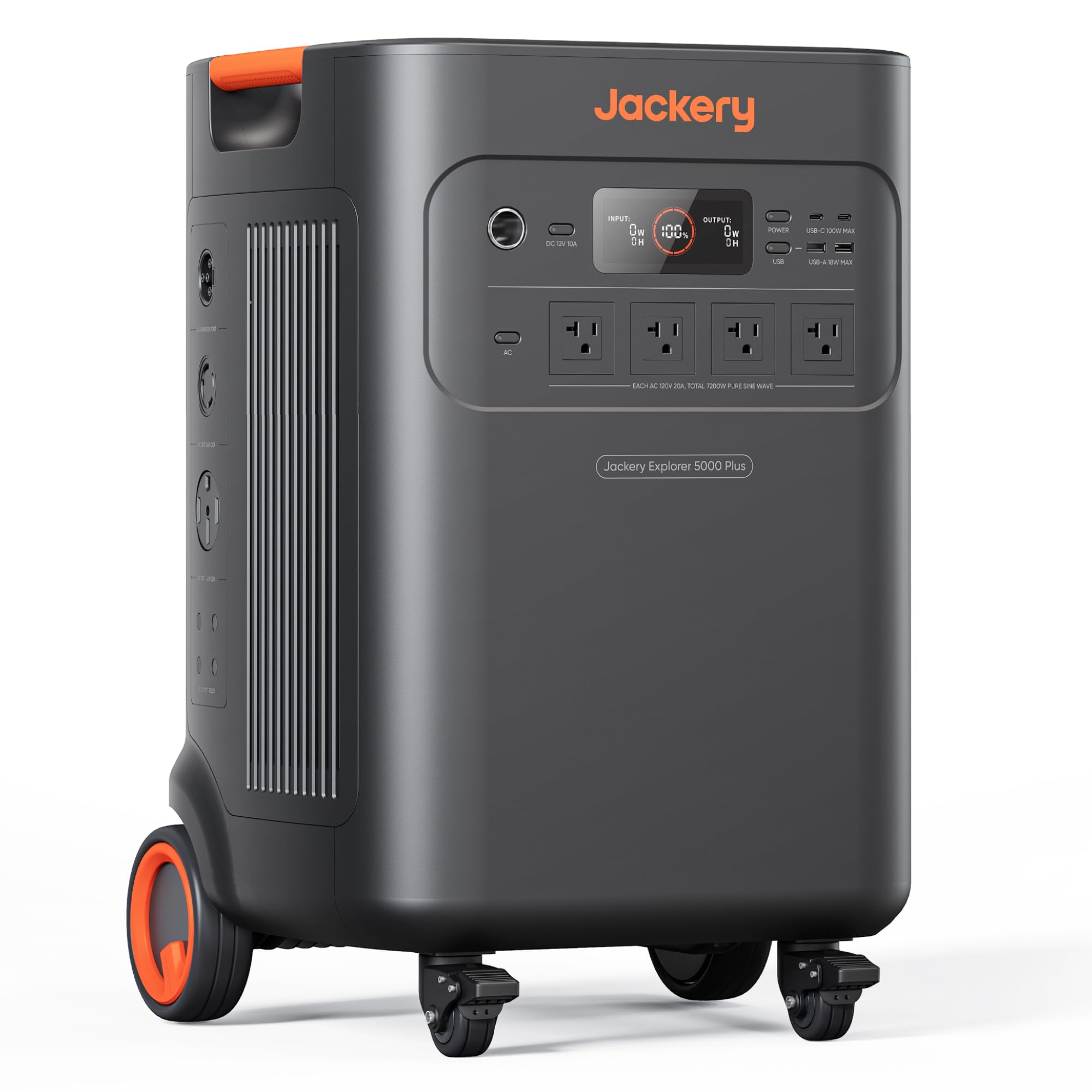
The Jackery Solar Generator 5000 Plus packs 5,040Wh of LiFePO4 storage and delivers 7,200W of rated power (14,400W surge) across both 120V and 240V outputs. That is enough to run a 5-ton central AC, a water heater, or even a small EV charger. Capacity expands up to 60kWh by adding extra battery packs, making it viable for multi-week outages. Jackery rates the battery cells for 6,000 cycles, which translates to roughly 11 years of daily use with ChargeShield 2.0 technology.
Solar input accepts up to 4,000W, which can fully recharge the unit in about 2 hours under strong sun. The 60A Smart Transfer Switch pairs with the station to automatically power 12 circuits at 120V or 6 circuits at 240V, seamlessly switching when the grid drops. The build quality is excellent, and the included luggage-style handle and wheels make the 134-pound unit reasonably movable given its capacity.
The biggest complaint revolves around software. Some units lose 30% charge per day in UPS mode due to a 50W constant draw, and the app schedules can get confused by timezone changes. A few users report error codes (6 and 4) related to overload and overcharge, though firmware updates often resolve these. Jackery’s support is generally responsive but can be slow for complex issues.
Why it’s great
- Massive 5040Wh capacity scalable to 60kWh
- Dual-voltage 7200W output for heavy appliances
- Up to 4000W solar input for fast recharge
Good to know
- UPS mode draws 50W continuously, draining battery
- Firmware updates needed for stability
- Heavy at 134 pounds
4. Jackery HomePower 3600 Plus

The Jackery HomePower 3600 Plus is the lightest 3.6kWh LiFePO4 station on the market at 77 pounds. That matters when you need to roll it from the garage to the living room during an outage. It uses a ceramic membrane battery separator that withstands 302°F, preventing thermal runaway from overcharge or heat exposure. Jackery claims 6,000 cycles and a 10-year lifespan, which is exceptional for this capacity tier.
Output is 3,600W continuous (7,200W in parallel with a second unit) and supports both 120V and 240V when two units are combined. Capacity expands to 21kWh per primary unit or up to 43kWh with multiple units. The station charges from 0-100% in 2 hours via hybrid AC+DC, 2.5 hours from a wall outlet, or 4 hours with 1,600W of solar panels. The integrated telescoping handle and wheels make it genuinely portable — not just “movable.”
Parallel operation requires buying two units, which doubles the cost quickly. The app is functional but basic — no time-of-use scheduling or detailed energy tracking. Some owners wish the 240V output came standard in a single unit rather than requiring parallel mode. If you need a powerful yet physically manageable backup station, this is the best balance on the list.
Why it’s great
- Lightest 3.6kWh unit at 77 pounds with wheels
- 6,000-cycle LiFePO4 with ceramic separator
- Fast 2-hour hybrid charging
Good to know
- 240V output requires two units in parallel
- App lacks advanced scheduling features
- Expensive to scale with parallel units
5. ECO-WORTHY Home Power Station 5120Wh
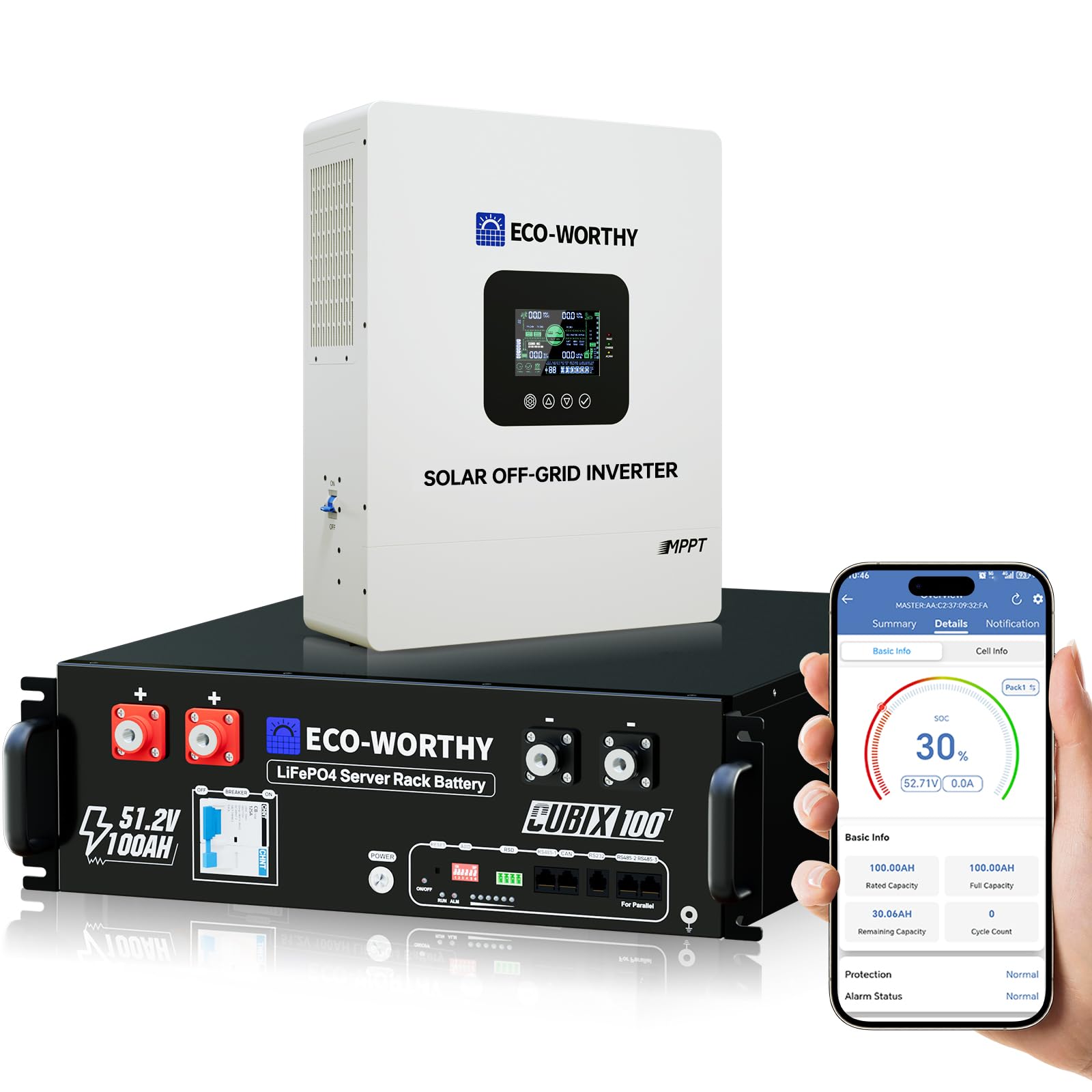
The ECO-WORTHY kit is a different approach than the all-in-one portable stations above — it ships as separate components: a 51.2V 100Ah (5,120Wh) LiFePO4 rack battery and a 5,000W hybrid inverter with a built-in 100A MPPT charge controller and 100A battery charger. This setup is ideal for users who want a more permanent solar system without hiring an electrician. The battery and inverter are UL1973 and UL1741 tested by Intertek, meeting North American safety standards and California Energy Commission requirements.
The inverter outputs 5,000W continuous (10,000W peak) at 120V and accepts solar panel input from 120V to 500V DC. Up to 6 inverters can parallel for 30kW output, and up to 32 batteries can stack for 163.84kWh total storage — true whole-house scale. Closed-loop communication (CAN/RS485) lets the battery talk directly to leading solar inverters for optimized charging. Bluetooth and WiFi monitoring are built into the battery.
The trade-off is complexity. This is not plug-and-play — you need to wire the inverter to a breaker panel or transfer switch. The manual has contradictions, and some units ship with quality-control glitches (fan errors, configuration bugs). ECO-WORTHY support is responsive but delays can happen. If you want a permanent system with expandability, this is the most cost-effective path; if you want a simple emergency backup, a portable all-in-one is easier.
Why it’s great
- UL1973/UL1741 certified for permanent installation
- 5000W hybrid inverter with 100A MPPT
- Scalable to 30kW output and 164kWh storage
Good to know
- Requires wiring — not a plug-and-play system
- Manual has some contradictions
- Quality control can be inconsistent
6. OSCAL PowerMax 6000 + 3×400W Solar Panels
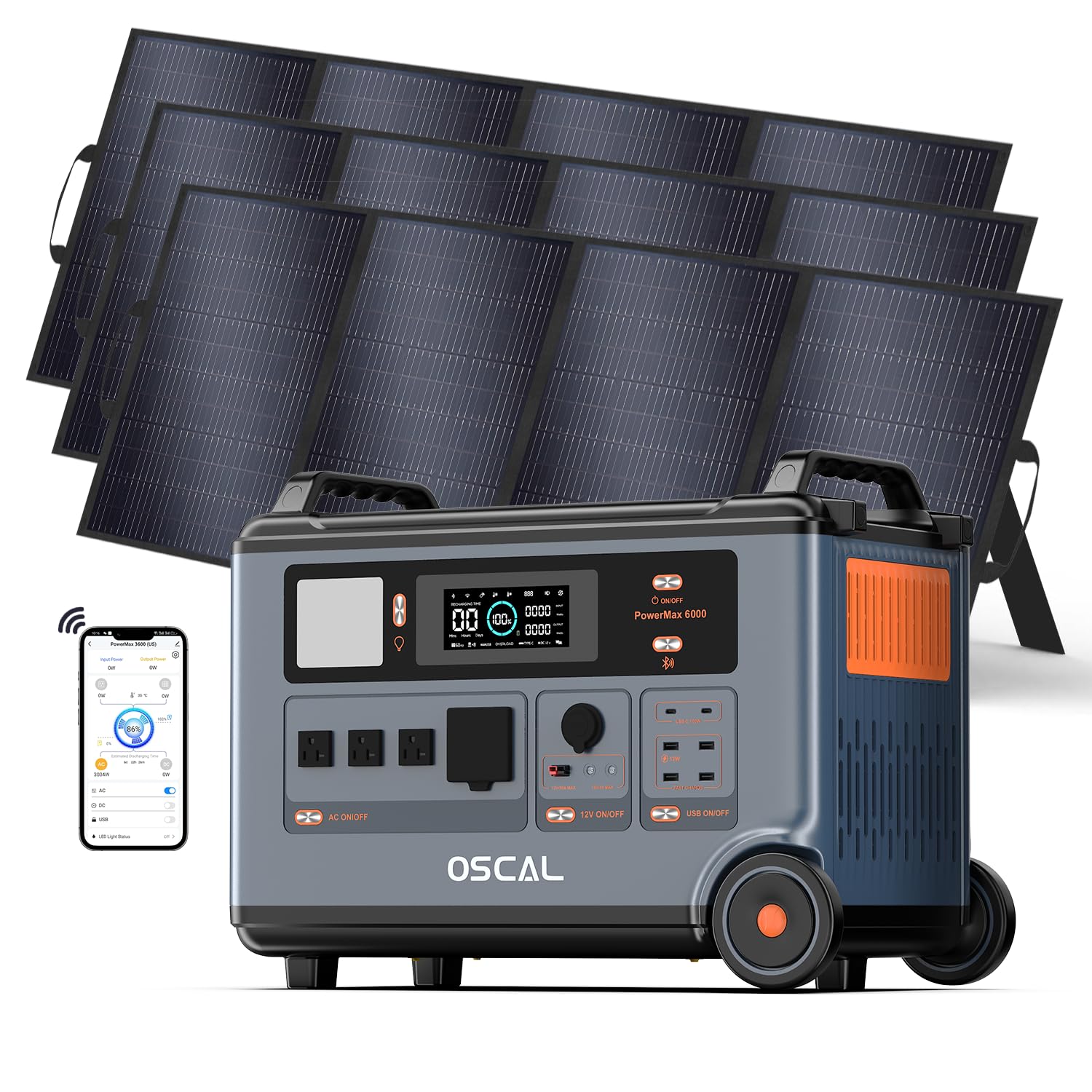
The OSCAL PowerMax 6000 is one of the few complete kits that includes three 400W solar panels in the box, making it solar-ready out of the gate. The station itself has 3,600Wh of LiFePO4 capacity with a 6,000W AC output (9,000W surge) and supports 120V/240V split-phase. Charging from the wall is fast — 0-100% in about 1.44 hours using the 2,200W bi-directional inverter. Solar charging maxes out at 2,400W, which means the included panels can fully recharge the unit in around 4-5 hours of peak sun.
The EPS (emergency power supply) switchover is rated at 5-8 ms, fast enough to keep computers and network equipment running seamlessly. The app allows remote monitoring and control, and the eight-layer BMS protects against overcharge, over-discharge, short circuits, and temperature extremes. The panels use MC4 connectors, so expanding the array is straightforward.
The main issue is that some units show significant standby power loss — one verified review reported 100% to 85% in 2 hours with only an LED bulb connected, which suggests the inverter idle draw is higher than expected. The 6,000W continuous rating is also difficult to achieve in practice with the included solar panels alone (they provide only 1,200W total). If you need a turnkey solar+storage kit, this is a convenient package; if you prioritize low standby power, look elsewhere.
Why it’s great
- Includes 3×400W solar panels for immediate solar use
- Fast 1.44-hour wall recharge
- 120V/240V split-phase output
Good to know
- High standby power draw reported
- 6000W output requires external panels beyond included kit
- Panels add significant shipping weight
7. BLUETTI Elite 400
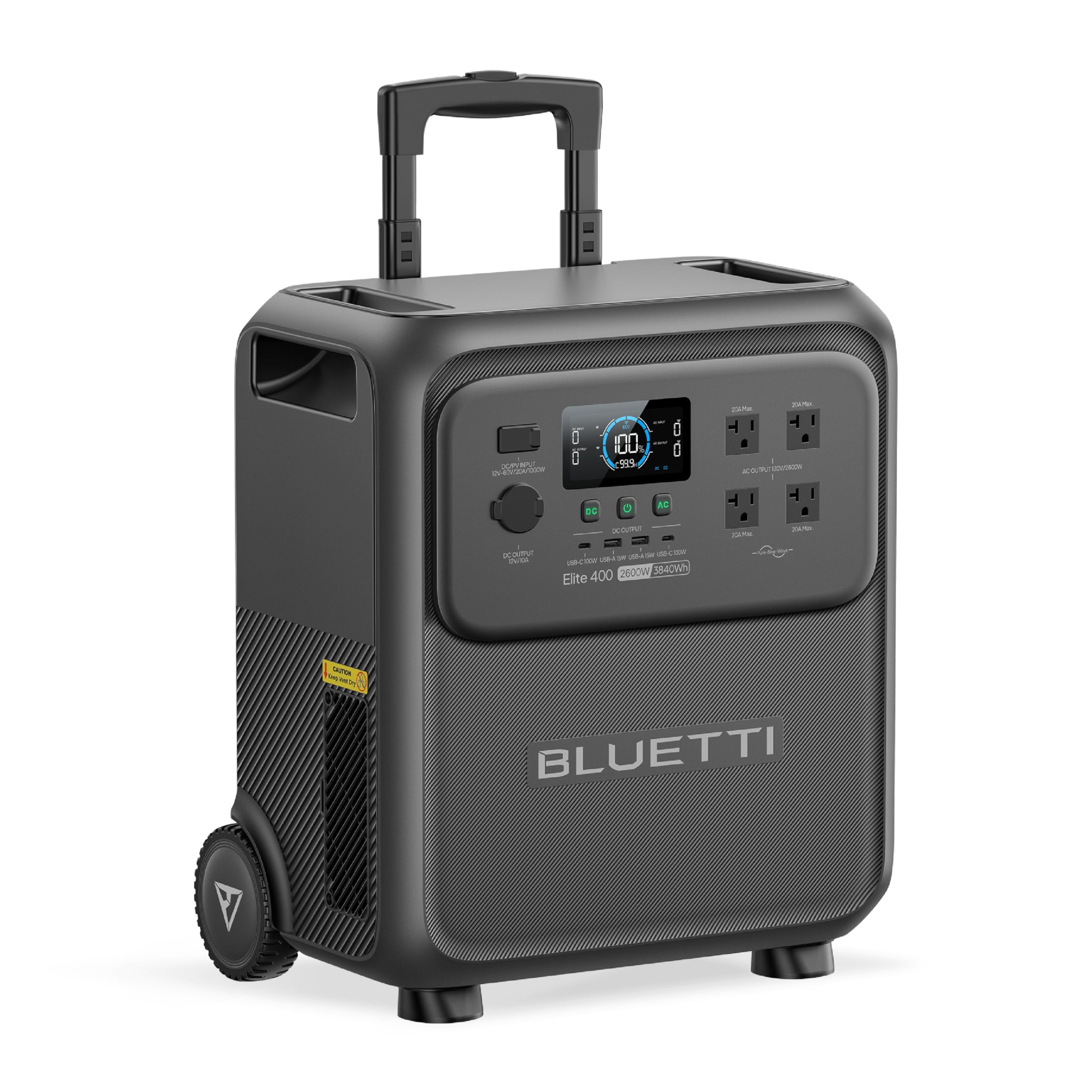
BLUETTI’s Elite 400 delivers a full 3,840Wh of LiFePO4 storage at a price point that undercuts most competitors by a wide margin. The 2,600W inverter (3,900W surge) is enough for a refrigerator, sump pump, furnace fan, and lights, though it won’t handle a central AC or well pump. The unit comes with a trolley system with wheels, making the 86-pound station easy to move from storage to the living room during an outage.
Charging speed is a highlight — 0-80% in just 70 minutes using a 2,800W AC+Solar combo input. A standard wall outlet charges it fully in 2.5 hours, and solar input accepts up to 1,000W. The UPS switchover is rated at 15ms, which is fast enough for most electronics (though slightly slower than the 10ms or sub-10ms units). Nine output ports cover all the basics: AC, USB-C, USB-A, and a car outlet.
The 2,600W output limit is restrictive if you want to run multiple heavy appliances at once. There is no 240V output and no expandability — you cannot add extra battery packs. A few owners mentioned the app is basic and lacks historical data. For a budget-conscious buyer who needs 3.8kWh of reliable backup for essential circuits, this is the best value in the category.
Why it’s great
- Best price-per-Wh in the 3.8kWh tier
- Fast 70-minute charge to 80%
- Integrated wheels and trolley handle
Good to know
- Limited to 2600W output — no heavy appliances
- Not expandable — fixed capacity
- No 240V split-phase support
8. AFERIY 3840Wh Power Station

The AFERIY 3840Wh station delivers a solid combination of capacity and output for the price. With 3,840Wh of LiFePO4 storage and a 3,600W inverter (7,200W peak), it can run a refrigerator, lights, and a microwave simultaneously. The unit supports expansion battery packs to scale from 3.8kWh up to 11.5kWh, giving you room to grow. The UPS switchover is rated at under 10ms, which is fast enough for sensitive electronics.
One of its strongest features is charging speed — 0-100% in just 1.5 hours via AC input, one of the fastest times in this tier. It also offers adjustable charging speed levels, letting you prioritize either speed or quietness. The 15 output ports include five AC outlets, USB-A, USB-C (PD 3.0), DC outlets, and a 12V car socket. The app allows monitoring and remote control of charging schedules and light modes.
The main downside is noise — the fan is noticeably louder than competitors like the BLUETTI or Jackery units when charging at high speed. The 80-pound weight (without wheels) makes it harder to move around than some wheeled competitors. UL listing is mentioned but not fully detailed in customer documentation. For buyers who prioritize recharge speed above all else, this is a strong contender.
Why it’s great
- Fastest AC recharge at 1.5 hours to 100%
- Expandable to 11.5kWh with battery packs
- 15 output ports for extensive device support
Good to know
- Fan noise is louder than competitors
- No wheels — 80 pounds manual carry
- UL listing details are sparse in documentation
9. ABOK Ark3600
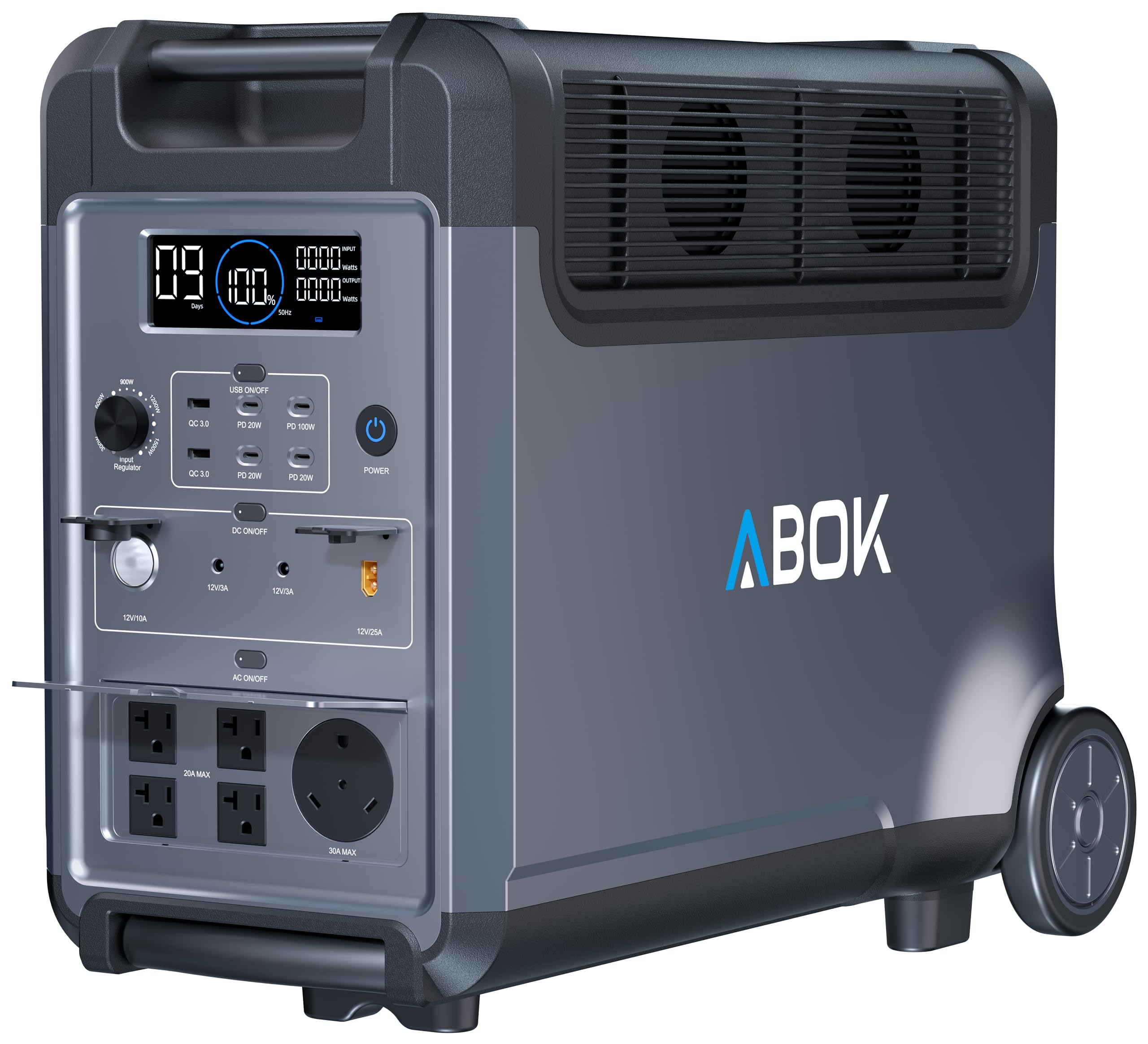
The ABOK Ark3600 packs 3,840Wh of LiFePO4 capacity and a 3,600W inverter (4,500W peak) into a wheeled chassis with a telescoping handle, making it one of the more maneuverable large-capacity stations. Capacity expands to 11,520Wh with extra battery packs, and the EV-grade cells are rated for over 4,000 cycles (roughly 10 years). The 15 output ports include a 30A AC outlet and a 100W USB-C PD port for fast laptop charging.
Charging is versatile: 1,500W from AC, 2,000W from solar, or a combined 3,500W via AC+Solar for a full charge in around 1.5 hours. The Bluetooth app provides remote monitoring and control, and the UPS transfer is rated at under 10ms. The unit can charge from solar panels down to 32°F, though charging below freezing may delay start by 30 minutes to 2 hours.
Some users note the app documentation is poor and there is no 240V output for heavy appliances. The unit is heavy at 92 pounds (though the wheels help). A few early units required warranty service for exceeding the solar voltage limit, but ABOK support resolved those cases quickly. For a well-built, mobile power station with solid customer service, the Ark3600 is a reliable choice.
Why it’s great
- Wheeled chassis with telescoping handle for easy mobility
- Expandable to 11520Wh capacity
- Fast combined AC+Solar charging at 3500W
Good to know
- No 240V split-phase output
- App documentation is sparse
- Heavy at 92 pounds despite wheels
10. Segway Cube 2000
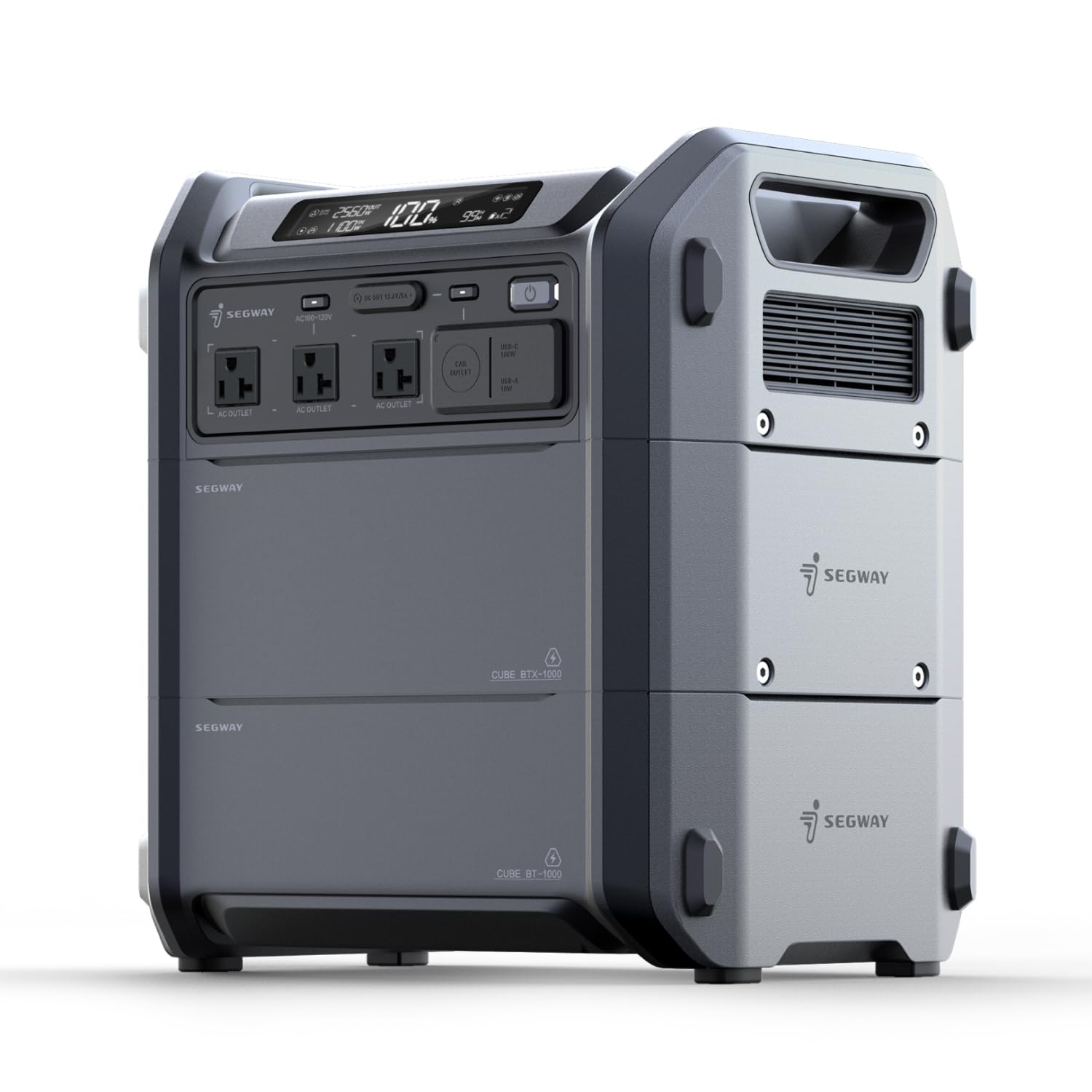
The Segway Cube 2000 is a compact modular system that starts at 2,048Wh and 2,200W output (4,400W surge with R-drive), expandable to 5kWh by stacking up to three BTX-1000 expansion batteries. The modular design means you can start with a smaller, lighter unit and add capacity only when needed. The LiFePO4 battery is rated for over 4,000 cycles, and the IP56 rating means it’s protected against water jets and dust — rare in this category.
Charging is notably fast — 0-100% in about 1.8 hours via AC input. MPPT solar charging efficiency is rated at 97%, and the stackable batteries connect cordlessly, keeping the system tidy. Output ports include dual 100W USB-C, multiple AC outlets, and a car battery detection feature. The app is required for initial activation and some settings, but it provides clear power monitoring.
The 2,200W output is lower than many competitors — it won’t run a well pump or large window AC. A few users report the unit not holding a charge in storage (dropping to 0% over 3 months), which is unusual for LiFePO4 and may indicate a BMS calibration issue. The expansion battery packs are sold separately and are not cheap. For a compact, expandable system with IP56 durability, this is a solid middle-ground option.
Why it’s great
- Compact modular design expandable to 5kWh
- IP56 water and dust resistance
- Fast 1.8-hour full recharge
Good to know
- 2200W output limits appliance compatibility
- Some units lose charge in long-term storage
- Expansion batteries sold separately at premium price
11. PECRON F3000LFP
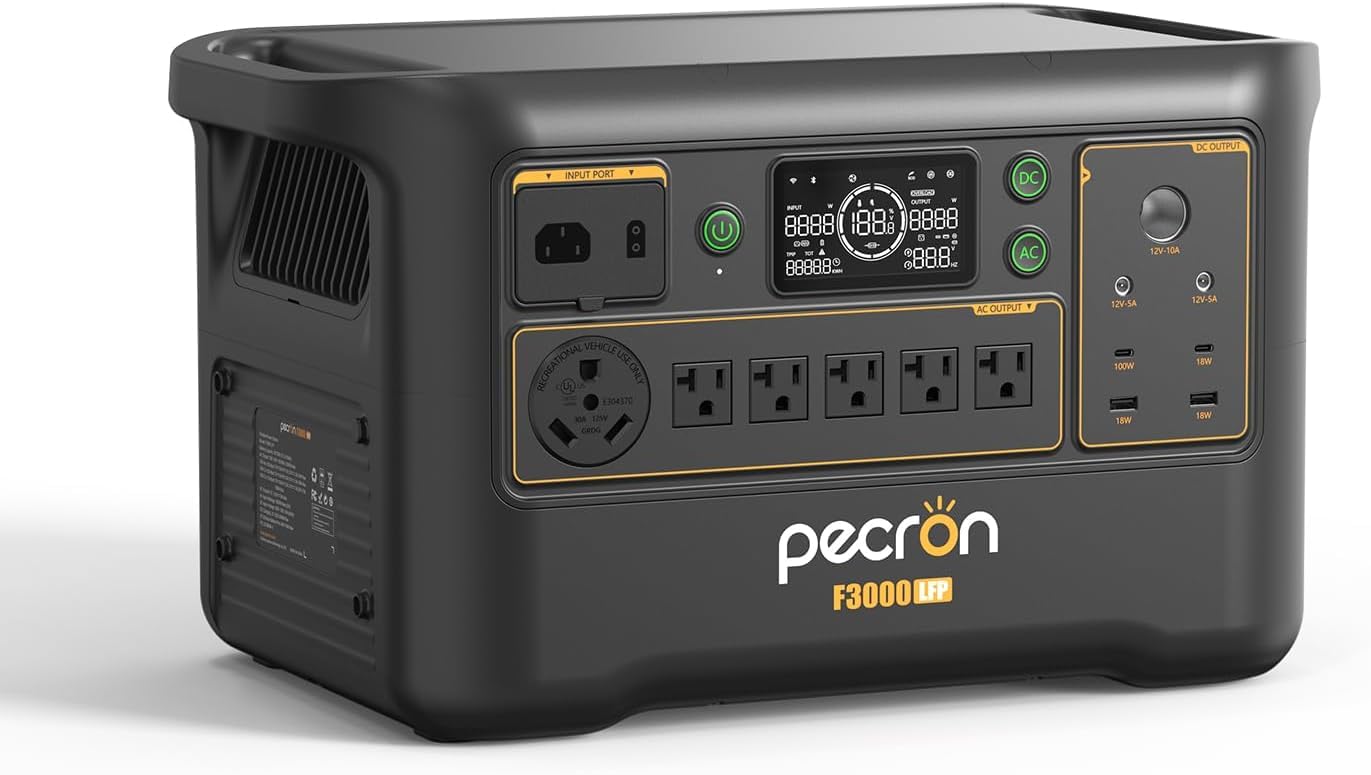
The PECRON F3000LFP is the most accessible entry point for home battery storage, offering 3,072Wh of LiFePO4 capacity and a 3,600W pure sine wave inverter at a budget-friendly price point. Despite the lower cost, it delivers solid performance — it can power a refrigerator, air conditioner, and power tools simultaneously across 13 output ports (six AC outlets, two 100W USB-C, two USB-A, a car port, and two DC outlets).
Charging is fast at 1,800W AC input, reaching full in about 2 hours. Solar input accepts up to 1,600W with a 25-120V input range, and the UPS switchover is rated at 8-20ms — fast enough for most electronics. Capacity can be expanded to 10,752Wh by adding an external battery (sold separately). The app provides real-time power monitoring and control, and the 2+3 year warranty covers 5 total years.
The biggest trade-off is build quality and longevity. Some users note the fan runs loudly during charging, and the inverter overhead is higher than competitors (one review measured a 1200Wh consumption for a fridge that typically uses 500Wh). The expandable battery requires a special XT120-M cascade cable sold separately. For a first-time buyer wanting a capable starter unit without a large investment, this is a solid foundation.
Why it’s great
- Most affordable entry point for 3kWh+ home backup
- 3600W inverter handles most household appliances
- Expandable to 10752Wh capacity
Good to know
- Fan noise is noticeable during charging
- Inverter overhead higher than premium competitors
- Expansion cable sold separately
FAQ
How many watt-hours do I need for a typical home outage?
Can I charge my home battery from solar panels during an outage?
What is the difference between UPS mode and standard backup mode?
How long do LiFePO4 batteries last before needing replacement?
Final Thoughts: The Verdict
For most users, the best battery storage for home winner is the Anker SOLIX F3800 because it combines 240V split-phase output, 6,000W of clean power, and reliable Anker build quality in a single portable unit — no electrician required for basic backup. If you want the absolute highest capacity and scalability for whole-house protection, grab the EF ECOFLOW DELTA Pro Ultra. And for the best entry-level value that still delivers 3,800Wh of usable storage, nothing beats the BLUETTI Elite 400.