
Our readers keep the lights on and my morning glass full of iced black tea. As an Amazon Associate, I earn from qualifying purchases.
Specs are compiled from manufacturer listings and verified buyer reviews and can change over time — please confirm the key details on the product page before buying.
A loose or corroded battery terminal adapter is the quickest way to go from a full battery to a no-start situation, especially when you are trying to power auxiliary lights, a winch, or an audio system off the same post. The right adapter keeps every connection tight and corrosion-free, so you do not end up stranded with a truck that cranks but will not fire.
I’m Min — the founder and writer behind Gadgets Feed. This guide is built by comparing the manufacturers’ published specifications and the patterns across verified customer reviews, so you get each pick’s real strengths and trade-offs instead of marketing spin.
Whether you are adding a second battery to a diesel pickup or cleaning up the rats nest of wires under the hood of a classic car, the battery terminal adapter you choose determines whether your electrical system is a secure, conductive hub or a future corrosion problem waiting to strand you.
Quick Picks
- Recoil BTO Solid Brass Positive Negative — Premium Brass Build
- BetyBedy 12-Way Battery Terminal Connectors — Best Overall
- Ampper 3/8″-16 Thread Female Lead Top Post — Value Convert
- Kaas Colored Anode Top Post Battery Terminal — Clean & Capable
How To Choose The Best Battery Terminal Adapter
Choosing the right terminal adapter is about matching the material, number of ports, and post type to your specific vehicle and the electrical load you plan to run. A mismatch here can mean a connection that loosens over time or corrodes within months.
Material: The Foundation of Conductivity and Durability
The material of the terminal block determines how well it conducts electricity and how long it resists the corrosive environment inside an engine bay. Solid brass is the premium choice for the best power transfer and long-term corrosion resistance, as seen in the Recoil BTO. High-grade aluminum alloys, like 6061-T6, offer a strong and lightweight alternative that also resists corrosion, especially when the surface is anodized or treated. Avoid cheap zinc alloys, as they can corrode quickly and create resistance that robs your electrical system of power.
Connection Count: Matching Your Ports to Your Needs
Count the number of devices you need to connect to the battery post. A simple setup with just the factory cables and a single accessory might only need a 2-way or 4-way adapter. A serious build with a winch, off-road lights, amplifiers, and a secondary battery charger—like many 12-way adapters support—needs a distribution block with 6 to 12 connection points. Buying an adapter with more ports than you need now gives you room to add accessories later without having to stack adapters.
Post Fitment: SAE, DIN, or EN
Your battery’s terminal posts come in a few standard shapes, and your adapter must match. The most common on American vehicles is the SAE standard tapered post. Many high-end cars and trucks use DIN or EN posts, which have a slightly different taper and size. Always check whether the adapter explicitly lists compatibility with your battery’s post type. A JIS (Japanese Industrial Standard) post is a different, smaller pencil-style post that most standard adapters will not fit.
Quick Comparison
| Model | Best For | Material | Connection Points | Weight | Amazon |
|---|---|---|---|---|---|
| Ampper 3/8″ Female Lead | Simple Post Conversion | Lead | 2 (1 pair) | 10.8 oz | Amazon |
| BetyBedy 12-Way | Heavy Multi-Cable Systems | 6061 Aluminum | 12 | 1.65 lbs | Amazon |
| Recoil BTO Solid Brass | OEM Integration & High Power | Brass | 4 | — | Amazon |
| Kaas 12-Way Colored Anode | Versatile Clean Install | 6061-T6 Aluminum | 12 | 1.17 lbs | Amazon |
In‑Depth Reviews
1. Recoil BTO Solid Brass Positive Negative Battery Terminals

The brass bullet that keeps your factory connections intact while adding serious power outputs.
This adapter is built from forged and machined brass, which you want for the best power transfer possible and superior corrosion resistance — far better than cheap zinc terminals. It is designed with adaptor collars and top-mounted or side-mounted posts so you can keep your OEM battery clamp without cutting, which is a big deal if you want your vehicle’s wiring to stay intact. The unit splits into one 0/2/4 gauge output and one 4/8 gauge output, plus a ring terminal provision, giving you four flexible connection paths. It comes with red and black silicone covers for insulation and protection from the elements.
Buyers report the adapters failed to secure the OEM clamp on a ’13 Lexus GS, so they simply wired directly via the top bolt and it worked fine. Another owner on a ’99 Jeep XJ reported zero issues installing it, stating it works great. One reviewer noted it takes some torque to secure everything and that the included Allen keys can risk shorting against engine bay metal if you are not careful — always disconnect the negative first. It is a heavier, more premium setup compared to the lightweight aluminum Kaas adapter, which weighs 1.17 lbs versus an unknown for this brass unit, offering a denser feel.
The design gives you flexibility for future expansion: you have two separate gauge outputs plus a ring terminal spot, so running a winch and lights is straightforward. However, a reviewer noted that the removable post felt slightly thin-walled compared to the main clamp body, which may matter if you are torquing it down hard.
Why This Terminal Works
- Solid brass construction for the best conductivity and corrosion resistance — unlike cheap zinc.
- Adaptor collars let you keep your factory clamp, perfect for OEM integration without cutting.
- Silicone covers protect top and side connections from short circuits.
Where It Can Fumble
- Adaptor collars may not grip every OEM clamp tightly — one Lexus owner had to bypass them.
- Included Allen key can short against metal if you are not careful during installation.
- Removable post feels lighter than the main body, raising torque concerns.
The high-power integration: This pick is for the owner who wants to keep the factory wiring intact while adding serious aftermarket output, especially for winches or off-road gear in a Jeep or truck.
Worth knowing: The adaptor collars are a clever feature but can lose their grip on certain OEM clamps — plan to use the top bolt as a backup connection point.
2. BetyBedy 12-Way Battery Terminal Connectors

The heavy-duty hub that turns one battery post into twelve clean connection points.
If you are running a diesel truck with aftermarket accessories — think a winch, lights, and a second battery charger — this terminal adapter lifts the strain off a single post. It is machined from 6061 aluminum for good toughness and corrosion protection, offering 12 connection points: 6 hole-holders for wire lugs and 6 threaded studs for ring terminals. That is the same number of connection points as the Kaas terminal, but the BetyBedy comes in at 1.65 pounds, which is 0.48 pounds heavier than the Kaas at 1.17 pounds, making it feel more substantial. It fits SAE, DIN, and EN tapered top posts, but not JIS pencil posts, so check your battery type.
Owners mention it works best with soldered or terminal-ended cables; large cables like 0/1 AWG can fray under the screws. One owner installed it on a 1995 F250 diesel to replace a broken positive connector, adding a 0/1 CCA cable to the starter and a secondary battery, and it improved starting instantly. The kit includes a 4mm and 6mm hex wrench, fiber washers, copper wire lugs, and heat shrink tubing to get you started. It supports battery voltages of 6, 12, 24, 36, and 48V, so it works across a huge range of vehicles from motorcycles and pickups to forklifts and cranes.
The main trade-off is that the aluminum clamps are thick but can be brittle — one buyer mentioned theirs broke on an AGM battery because the post was a tight fit, so go slowly when tightening. The included hex wrench is serviceable, but you may want a better one for the final torque to avoid stripping.
Why This Hub Works
- 12 connection points give you room for a starter, winch, lights, audio, and a secondary battery on one terminal.
- Machined from 6061 aluminum for durability and corrosion protection, with included hardware for setup.
- Wide voltage and vehicle range: works on 6V to 48V systems for cars, trucks, RVs, and machinery.
Where It Can Fumble
- Thick aluminum can crack if over-tightened on a tight battery post — go slow and do not force it.
- Large cables (0/1 AWG+) may fray under the screw terminals unless you use a soldered or terminal end.
- At 1.65 lbs, it is noticeably heavier than the comparable Kaas terminal, which is a consideration for weight-conscious builds.
Reach for this if: You run a diesel pickup, off-road rig, or work truck with multiple high-draw accessories and need a single distribution point that can handle 0/1 AWG cables and a secondary battery.
Look elsewhere if: You are installing on an AGM battery with a tight post fitment, as the thick aluminum can crack under pressure.
3. Ampper 3/8″-16 Thread Female Lead Top Post to Side Post Terminal Adapters
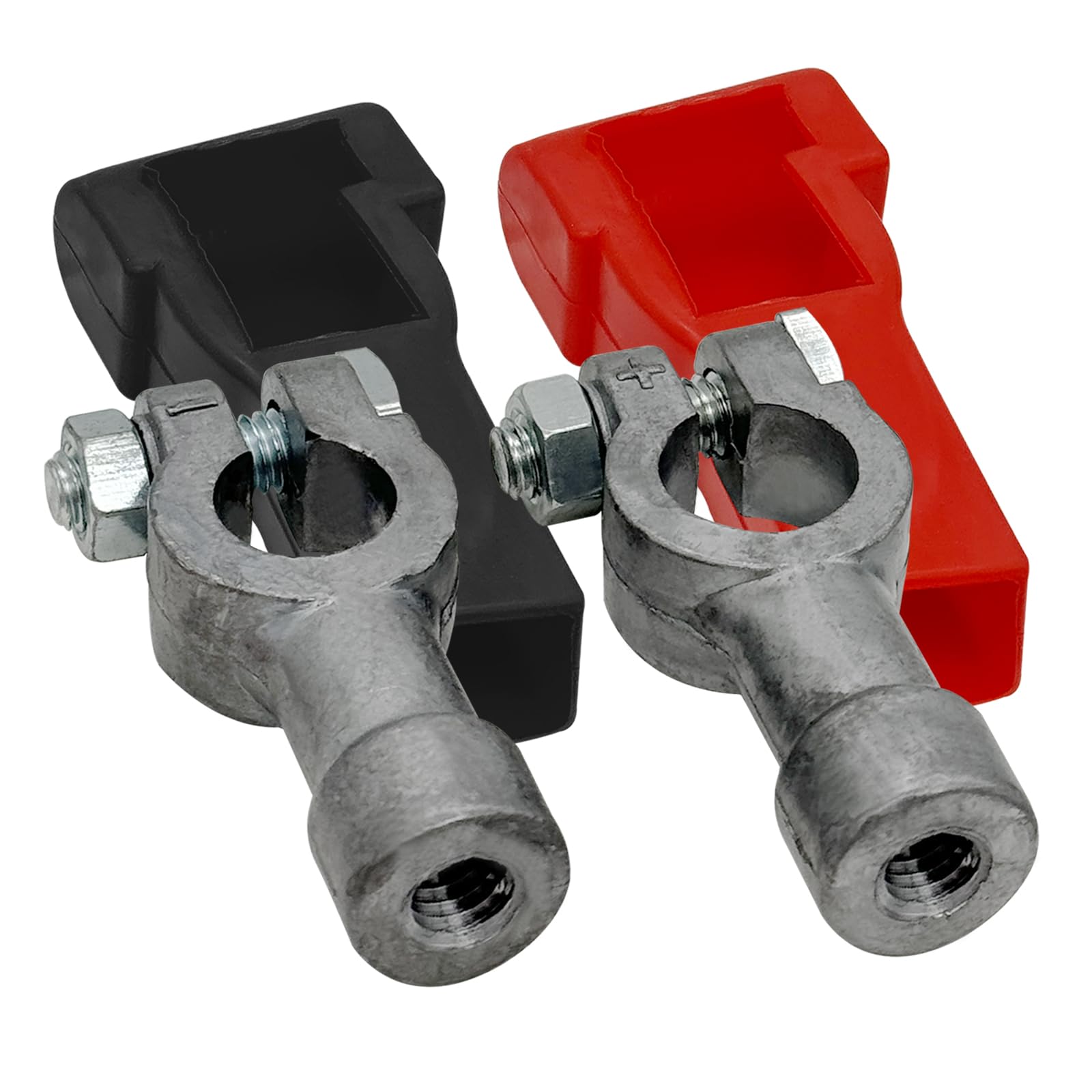
The simplest solution for turning a top-post battery into a side-post connection, no cutting needed.
This adapter does one thing and does it well: it converts a standard top-post battery (19mm positive cone and 17mm negative cone) into a standard 3/8″-16 SAE side post. It is made from lead, which is a good conductive material that naturally offers some corrosion resistance. The design is straightforward — a direct fit with no modifications — making it faster to install than a universal block. Buyers describe them as “solid good quality terminals” with no issues with clamping force or the threaded side. It is much smaller than a 12-way hub; at 5.5 x 0.7 x 3.5 inches, it is heavier per volume due to the lead material.
This is a budget-friendly entry-level choice for someone who simply needs to connect a side-post cable to a top-post battery, like on an older vehicle or a deep cycle marine battery. One owner reported that the silicone covers are a bit cheap and probably will not last long, but they work for now. It comes as a pair (one for positive, one for negative) so you can convert both posts.
The catch is obvious: you only get two connections per adapter, so this is not for anyone planning to add multiple accessories. It is a pure conversion tool, not a distribution block. If your vehicle is an ’89 truck with a side-mount starter cable and you have a top-post battery, this is exactly what you need.
Why This Converter Works
- Direct fit with no modifications — clamps onto the standard top post and gives you a 3/8″ side thread.
- Lead construction provides good conductivity and natural corrosion resistance.
- Works great on deep cycle and classic car batteries where you need to switch post types.
Where It Can Fumble
- Only two connection points — cannot add multiple accessories like a 12-way block.
- Included silicone covers are cheap and may not hold up over time in the engine bay.
- Lead material is softer than brass or aluminum, so be careful with over-torquing the side thread.
Best for classic and marine builds: Grab this if you are adapting an old truck or a deep cycle battery to a side-post cable and want a no-fuss, bolt-on solution that just works.
Not for heavy expansion: If you need more than one or two connections, look at a multi-port block instead — this is a pure converter.
4. Kaas Colored Anode Top Post Battery Terminal, 12-Way

The light, color-coded hub that separates power cables from clutter with a machine-sharp finish.
This terminal is made from heat-treated 6061-T6 aluminum alloy and precision CNC machined for a perfect fit on SAE, DIN, and EN tapered posts. It offers 12 connection points — the same capacity as the BetyBedy above — but it is lighter at 1.17 pounds versus 1.65 pounds, making it easier to handle during installation. The unique color anodization (red for positive, blue for negative) is not just for looks: the anodic layer is removed at the contact zone where the battery post and power cable connect, ensuring a conductive surface without sacrificing the corrosion resistance of the rest of the body. It includes an easy-to-tighten head design with an anti-loosening screw to keep your connections secure.
Customers note it is a great fit for a 2004 F350 King Ranch, where it was used to add a lift to the truck bed and a welder cable to the rear, with plenty of room for additions. Another owner on a 2003 Excursion noted it seems very durable and has enough versatility to adjust screws for different gauge wires. Like the BetyBedy, it supports cable gauges from 8 AWG up to 4/0 (00) AWG, so it handles heavy charging and starter cables without issue. It is specifically designed for lead-acid batteries including AGM, GEL, WET, and MF types, not JIS pencil posts.
The one thing to note: lithium battery users may need an additional stud-to-post adapter to get a secure fit, so this is not a direct bolt-on for lithium packs from the start. Also, while the anodized finish looks great, you must take care not to scratch the conductive zone during installation.
Why This Hub Shines
- 12-way distribution in a lighter package (1.17 lbs vs 1.65 lbs for the BetyBedy) — easier to mount and handle.
- Color anodization with a removed conductive zone ensures corrosion resistance where it matters and conductivity where it needs to.
- Anti-loosening screw design helps keep connections from vibrating loose on rough roads.
Where It Can Fumble
- Lithium battery users will need an extra adapter — not a direct fit for non-lead-acid batteries.
- The anodized finish is protective but can be scratched, potentially compromising the corrosion barrier.
- At a higher price point, this is a premium pick for the clean aesthetic and lighter weight, not the budget option.
Reach for this if: You need a 12-way hub for a truck or SUV build and want the lighter weight, corrosion-resistant anodized finish, and anti-loosening screw for rough terrain.
Look elsewhere if: You are working with a lithium battery or need a simple two-post converter — this is a full distribution block for lead-acid systems.
Understanding the Specs
Material and Conductivity
The material of the terminal adapter directly determines how efficiently power flows from your battery to your cables. Solid brass is the gold standard for high-power applications because it offers the best conductivity and is naturally resistant to corrosion, which is why the Recoil BTO uses it. High-grade aluminum alloys like 6061 and 6061-T6 are excellent alternatives — they are lighter and very strong, but you must ensure the contact area is not anodized, as the Kaas terminal manages, because anodizing acts as an insulator. Cheap zinc or unplated steel adapters should be avoided as they corrode quickly, increasing resistance and causing voltage drops that can leave your starter struggling.
Connection Count and Cable Range
Connection points are listed as “12-way” or “2-way” and refer to how many separate cables you can attach to the block. A 12-way terminal gives you 6 hole-holders for wire lugs and 6 threaded studs for ring terminals, which is ideal for a fully accessorized truck. The supported cable gauge range (e.g., 8 AWG to 4/0 AWG) tells you the thickness of wire the block can physically accept. A 4/0 (00) AWG cable is extremely thick, used for high-current starter and alternator cables. If you are running 0 or 00 gauge welding cable to a winch, ensure the adapter explicitly lists that size, as not all blocks have set screws large enough to clamp that thick a cable.
FAQ
Will a battery terminal adapter fit my car’s battery post?
How many wires can I connect to a 12-way battery terminal?
Can a battery terminal adapter handle the current for a winch or audio amplifier?
Is solid brass better than aluminum for a battery terminal?
How do I prevent a battery terminal adapter from breaking during installation?
Does a battery terminal adapter work with lithium batteries?
What does SAE, DIN, and EN mean on a battery terminal?
How do I secure a battery terminal adapter so it does not come loose?
Can I use a top-post to side-post adapter on a marine battery?
What is the difference between a battery terminal adapter and a battery distribution block?
Final Thoughts: The Verdict
Across the board, the battery terminal adapter winner is the BetyBedy 12-Way because it gives you the most connection points and the heaviest feel in a durable 6061 aluminum body, providing a solid foundation for any truck or off-road build. If you want premium materials and OEM integration, the Recoil BTO solid brass terminals are the pick. And for a clean, lighter 12-way system with corrosion-resistant anodizing, the Kaas Colored Anode is the best bet for a tidy engine bay.
How We Picked
We do not accept paid placement. Every pick is matched to a real buyer and a real use-case; we do not hands-on test units.
Sources & Methodology
Specifications: manufacturer listings and product documentation. Review insights: verified customer reviews, as of July 2026. Pricing: not shown on this page (it changes often); check the current price via the retailer link.
As an Amazon Associate, Gadgets Feed earns from qualifying purchases. This does not affect which products we feature.