
A battery terminal that’s fused to the post with years of corrosion turns a simple swap into a frustrating struggle. Prying with a screwdriver risks cracking the lead post or shorting against the chassis, while rocking the clamp by hand often does nothing. A dedicated puller applies controlled, straight lifting force to break that bond cleanly, saving time and preventing damage to the battery case or the expensive electronic modules that modern cars rely on.
I’m Min — the co-founder and writer behind Gadgets Feed. I’ve analyzed the jaw geometry, thread pitch, and material hardness across dozens of battery terminal pullers to identify which designs truly deliver consistent removal force without slipping or bending on corroded posts.
This guide focuses exclusively on pullers built to separate cable clamps from battery posts without hammering or prying. Whether you’re maintaining a single vehicle or working a shop bay, the right best battery terminal puller transforms a ten-minute headache into a thirty-second task.
How To Choose The Best Battery Terminal Puller
A battery terminal puller is a simple machine: a frame, two jaws, and a center screw. But small differences in jaw shape, thread quality, and material make the difference between a tool that pops a clamp off in three turns and one that cams out or bends on the first stubborn terminal. Focus on these three factors to find a puller that works every time.
Jaw Opening and Reach
The jaws must fit under the clamp without contacting the battery post itself. Minimum opening around 6 mm suits tight side-post clamps, while a maximum of 30 mm handles thick top-post cable ends. Equally important is the reach — how far the jaws extend under the clamp. Shorter jaws work in cramped battery trays, but longer jaws provide better leverage on deeply recessed terminals.
Center Screw Thread Pitch and Tip
A fine-thread center screw multiplies hand force more effectively than a coarse thread, allowing you to apply steady pressure without needing a breaker bar. The tip that contacts the battery post should be flat or slightly concave to center itself and avoid digging into the lead. A hardened steel tip resists mushrooming over repeated use on corroded posts.
Material and Corrosion Resistance
Battery acid fumes are aggressive. A puller made from carbon steel with a black oxide or phosphate coating resists surface rust far longer than bare or painted steel. Forged or heat-treated jaws maintain their shape under heavy loads, while cast or stamped jaws can spread open, losing grip on the clamp.
Quick Comparison
On smaller screens, swipe sideways to see the full table.
| Model | Category | Best For | Key Spec | Amazon |
|---|---|---|---|---|
| OTC 4611 | Premium Puller | Quick, one-hand clamp removal | Spring-loaded sharp jaws | Amazon |
| Lang Tools 202 | Classic Screw Puller | Heavy corrosion on top posts | 1/4″ to 1-1/8″ jaw range | Amazon |
| FIRSTINFO F3393 | Patented Dual-Hook | Wiper arms and stubborn terminals | Wrenchable center bolt | Amazon |
| EWK 8-30mm | Adjustable Multi-Use | Tight engine bays and small bearings | 8–30 mm opening range | Amazon |
| OEMTOOLS 25316 | Carrier-Style Lifter | Lifting and transporting batteries | 5″–7″ adjustable width | Amazon |
| KZINO 2-Piece Set | Budget 2-in-1 Kit | Wiper arm and small bearing removal | 6–28 mm jaw opening | Amazon |
| NOCO NCP2 M401 | Cleaning & Protection Kit | Terminal cleaning and corrosion prevention | Spray-on cleaner & brush | Amazon |
In‑Depth Reviews
1. OTC 4611 Battery Terminal Puller

The OTC 4611 uses spring-loaded sharp jaws that dig under the cable clamp and hold it securely while the center screw pushes down on the battery post. This design lets you operate it with one hand, which is a real advantage in tight battery trays where you cannot get a second tool in for counter-pressure. The jaws automatically close around the clamp as you turn the screw, so there is no fiddling with adjustment knobs.
At just over five inches tall, it fits under hoods with limited vertical clearance. The sharp jaw edges are hardened to bite into corrosion without slipping. Users have reported pulling off terminals that would not budge with a hammer and screwdriver, often in under four turns of the screw. The tool cleans up easily with a rag and light oil after exposure to battery acid fumes.
Some users note the handle could be thicker for more comfortable high-torque turning, and the base pad is narrow, which can sink into soft lead posts. But for a dedicated battery terminal puller that lives in your toolbox and works on both top-post and some side-post clamps, the OTC 4611 sets the standard for speed and reliability.
Why it’s great
- Spring-loaded jaws grab the clamp automatically
- Compact size fits cramped engine bays
- Hardened steel jaws resist wear on corroded terminals
Good to know
- Handle could be thicker for heavy torque
- Narrow base pad may press into soft lead posts
2. Lang Tools 202 Battery Terminal Puller
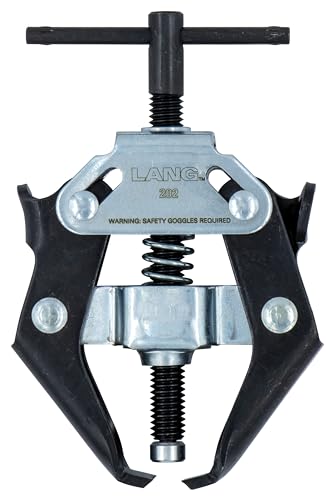
The Lang Tools 202 is a traditional screw-type puller with a jaw opening range from 1/4 inch to 1-1/8 inches, covering nearly all automotive battery terminal sizes. The forks slide under the cable clamp, and turning the center T-handle pushes directly down on the battery post to lift the clamp straight up. This straight-line force is exactly what you need to break a corrosion bond without tilting the clamp and damaging the post.
The tool is built from alloy steel and feels substantial in the hand. Several users report it pulled off terminals that a hammer and screwdriver could not budge in four turns. It is also heavy enough to apply consistent downward force without the user having to brace the tool body. The large T-handle provides good leverage for the final turns when the clamp is highest.
One buyer noted that the tool no longer carries a “Made in USA” mark as some older units did, and the manufacturer confirmed the production shift. The quality remains good, but it is no longer priced as a domestic tool. For a straightforward, no-nonsense puller that handles the most stubborn top-post terminals, the Lang 202 is a proven workhorse.
Why it’s great
- Wide jaw range fits most battery terminals
- Alloy steel body handles high torque without flexing
- T-handle provides comfortable leverage
Good to know
- No longer made in the USA
- Heavier than compact puller designs
3. FIRSTINFO Patented Windshield Wiper Arm Puller F3393

The FIRSTINFO F3393 is a heavy-duty puller designed with a dual-radius hook system that adapts to different clamp geometries, including battery terminals and wiper arms. What sets it apart is the center bolt that accepts a 1/2-inch wrench or ratchet, allowing you to apply far more torque than a hand-turned T-handle can generate. For a battery terminal fused by years of corrosion, this wrench-driven force is often the difference between success and frustration.
The tool is made from special heat-treated steel and carries a black oxide coating that resists acid fumes. Users consistently describe it as extremely solid and commercial-grade. One reviewer noted it removed a rusted splined wiper arm in seconds, and multiple users reported it handled seized battery terminals without any sign of flex or damage. The wing nuts that secure the hook arms are easy to adjust but could be tighter near the center rod.
At 1.58 pounds, it is heavier than most dedicated battery pullers, but that weight translates directly into durability and stability under load. If you work on multiple vehicles and want one tool that handles both battery terminals and wiper arms without breaking a sweat, the FIRSTINFO F3393 is a premium investment that pays off on the first hard pull.
Why it’s great
- Wrench-driven center bolt for high torque
- Dual-radius hooks fit multiple clamp sizes
- Black oxide coating resists battery acid
Good to know
- Heavier than dedicated terminal pullers
- Wing nuts can loosen near center bolt
4. EWK 8-30mm Battery Terminal and Wiper Arm Removal Tool
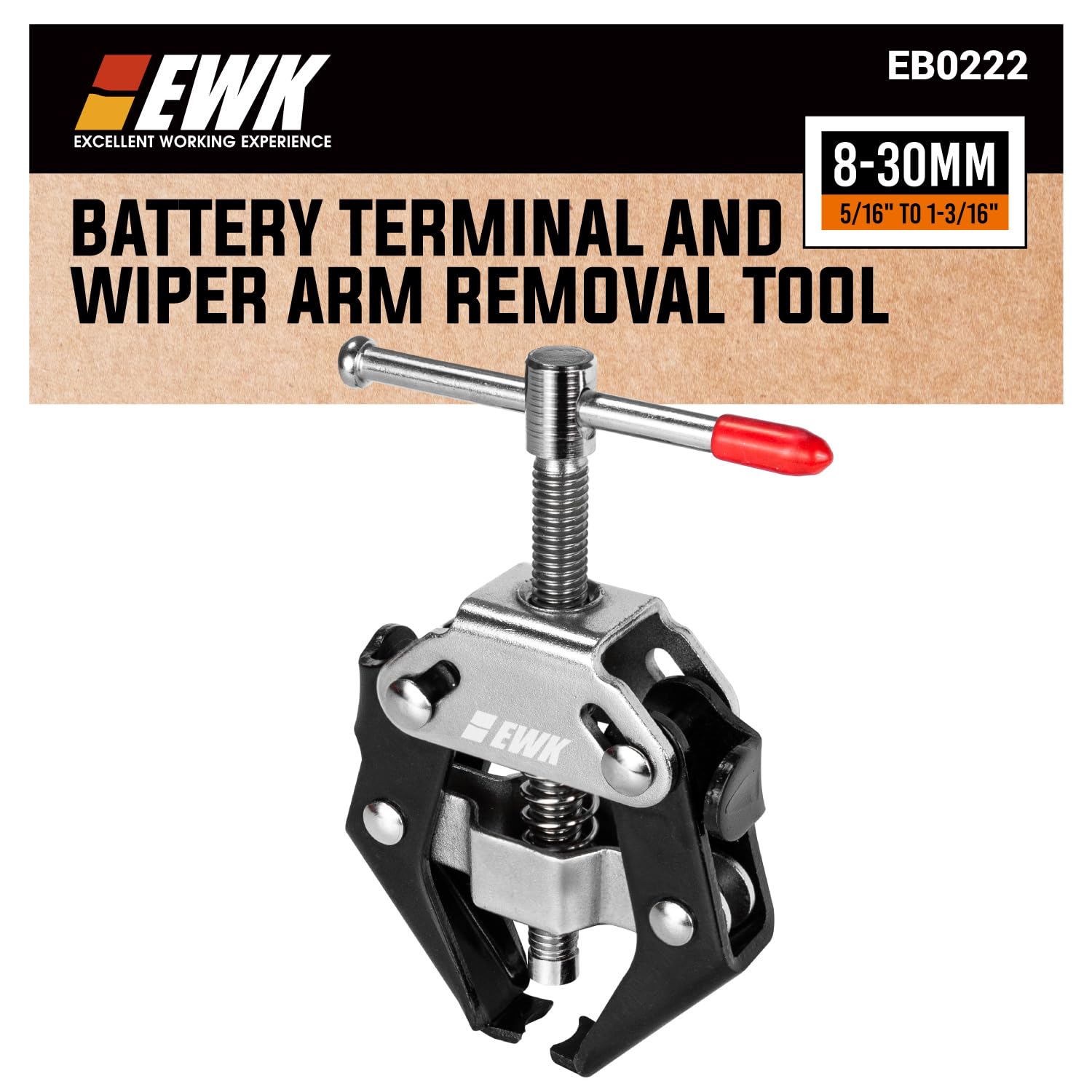
The EWK puller covers an 8 mm to 30 mm jaw opening with a self-centering T-handle design that applies even pressure around the clamp. This is particularly important on battery terminals where uneven force can cause the clamp to tilt and bind halfway up the post. The carbon steel construction and corrosion-resistant finish make it suitable for regular shop use in environments where battery acid is present.
Users praise it for removing wiper arms that had been stuck for years, and several noted it worked on battery terminals without pre-cleaning. The adjustable opening allows it to handle small side-post terminals as well as larger top-post clamps, reducing the need for multiple tools. The compact dimensions (4.72 x 3.54 x 1.38 inches) make it easy to store in a tool bag or drawer.
Some users found that the tool has a bit of play in the adjustment mechanism, requiring a steady hand during initial positioning. Once engaged, however, it provides consistent lifting force. For a mid-range puller that covers a wide size range and works in tight engine bays, the EWK is a strong value pick.
Why it’s great
- Self-centering design prevents clamp tilting
- 8–30 mm range covers side and top posts
- Compact and easy to store
Good to know
- Some play in adjustment mechanism
- Best with careful initial positioning
5. OEMTOOLS 25316 Adjustable Battery Carrier

The OEMTOOLS 25316 is a different approach: instead of prying the clamp off the post, it acts as a carrier that grabs the entire battery body so you can lift and transport it safely. The adjustable tongs open from 5 inches to 7 inches, fitting most group sizes, and the rubber pads provide a secure grip without scratching the battery case. This is ideal for removing a battery after the terminal clamps are already loose.
Made from lightweight aluminum, it weighs only 1.4 pounds but feels sturdy. Users report it makes removing lawnmower and ATV batteries much easier, especially when the battery is recessed in a tight compartment. One reviewer noted it allowed their son, who has use of only one arm, to independently remove the battery from their riding mower — something impossible with a strap or by hand.
This tool does not function as a terminal puller — you still need a separate tool to break the clamp free from the post. But for the lifting and carrying phase of the job, it is ergonomically superior to gripping the battery case edges or using a strap. If you frequently swap batteries in tight locations, the OEMTOOLS carrier saves your back and fingers.
Why it’s great
- Adjustable width fits most battery sizes
- Rubber pads prevent slipping and scratching
- Lightweight aluminum construction
Good to know
- Does not remove stuck clamps from posts
- Not for use while battery terminals are live
6. KZINO Wiper Arm and Battery Terminal Puller Set

The KZINO set includes two pullers: an adjustable jaw puller with a 6–28 mm opening and a smaller fixed-size puller for tight spots. The adjustable tool is made from 45# carbon steel with a heat-treated finish that provides good hardness for the price point. The center screw pad is designed to sit on top of the battery post or spline, keeping the force centered.
Buyers have used it successfully on stuck rear wiper arms and small bearings, noting that the adjustable puller feels sturdy enough for the task. The set covers both battery terminal and wiper arm removal, making it a versatile addition to a basic tool kit. The compact size fits in a glove box or small tool pouch.
The smaller fixed puller may bend under extreme force on a heavily seized part, so it is best suited for moderate corrosion jobs. For the price, this two-piece set offers good value if you need occasional terminal pulling and wiper arm service without investing in a pro-grade single tool.
Why it’s great
- Two pullers included for different jobs
- Heat-treated carbon steel for durability
- Very affordable entry-level option
Good to know
- Small puller may bend on seized parts
- Not for heavy daily professional use
7. NOCO NCP2 M401 Battery Terminal Cleaning Kit

The NOCO NCP2 M401 is not a puller — it is a complete cleaning and protection system that prevents the need for a puller in the first place. The kit includes a spray-on battery cleaner that neutralizes and dissolves corrosion, a two-sided cleaning brush with stainless steel bristles, a corrosion preventative spray that creates a barrier against acid fumes, and anti-corrosion felt washers.
Using the cleaner and brush removes the white and blue crust that fuses clamps to posts. After cleaning, the preventative spray coats the terminal and clamp with an oil-based film that resists new corrosion. Users report improved starting performance after cleaning, and the preventative lasts for months. The brush is precisely engineered to reach between post and clamp without damaging the lead.
This kit is best used proactively. If you clean and protect your battery terminals every 6–12 months, you will rarely need a puller at all. It is a smart complement to any puller tool on this list, ensuring the next time you need to disconnect, the clamp comes off by hand or with minimal persuasion.
Why it’s great
- Complete cleaning and protection in one kit
- Neutralizes existing corrosion instantly
- Preventative spray lasts for months
Good to know
- Not a removal tool — does not pull clamps
- Spray can loses pressure before empty
FAQ
Can a battery terminal puller damage my battery post?
Will one puller work on both side-post and top-post batteries?
How do I prevent battery terminal corrosion from forming?
Final Thoughts: The Verdict
For most users, the best battery terminal puller winner is the OTC 4611 because its spring-loaded jaws make clamp removal a one-handed operation that works on the first try, even in tight engine bays. If you want a traditional screw-type puller with a proven track record for breaking heavy corrosion, grab the Lang Tools 202. And for a do-it-all tool that handles battery terminals and wiper arms with wrench-driven torque, nothing beats the FIRSTINFO F3393.