
A car that cranks slowly, headlights that dim at idle, or an unexplained parasitic drain can often be traced back to one weak point: the battery terminal connection. Corroded, cracked, or ill-fitting terminals create resistance that starves your electrical system of the current it demands. A dedicated repair kit replaces cheap stamped aluminum or zinc castings with properly sized copper lugs, corrosion barriers, and secure fasteners—transforming a high-resistance fault into a low-impedance circuit.
I’m Min — the co-founder and writer behind Gadgets Feed. I’ve spent hundreds of hours cross-referencing lug metallurgy, stud sizing, gauge compatibility, and shrink-tube adhesive ratings to find the kits that actually deliver a lasting, high-conductivity repair rather than a band-aid that fails three months later.
Whether you are restoring classic car wiring, upgrading a marine dual-battery setup, or eliminating a voltage drop in your truck’s auxiliary system, this guide to the battery terminal repair kit category separates the heavy-duty copper solutions from the brittle alloy impostors that waste your time and tools.
How To Choose The Best Battery Terminal Repair Kit
Selecting the right repair kit is about matching lug material, stud diameter, and wire gauge to your specific cable and battery post. A mismatch here introduces the exact resistance you are trying to eliminate.
Understand Stud Size and Hole Diameter
The most common stud sizes for battery terminals and distribution blocks are 3/8-inch and 5/16-inch. Your lug’s hole must slide over the stud without slop—too loose and the connection arcs and corrodes; too tight and you risk stripping threads during installation. Premium kits often include both sizes or indicate the stud diameter clearly on the barrel.
Check the AWG Rating
Your cable’s gauge determines the lug barrel size. A 2 AWG lug crushes 4 AWG strands, leaving gaps that trap moisture. Measure your cable’s cross-section—most car battery cables are 4 or 2 AWG, while inverter and marine setups often use 1/0 or 4/0. Kits that cover multiple gauges in one box give flexibility without buying separate packs.
Evaluate Corrosion Protection
The enemy is galvanic corrosion between dissimilar metals. Look for tin-plated or pure copper lugs rather than aluminum or unplated brass. Heat shrink tubing with an adhesive inner liner creates a water-tight seal at the cable jacket, while anti-corrosion washers or felt pads placed under the terminal block prevent acid wicking from the battery post.
Quick Comparison
On smaller screens, swipe sideways to see the full table.
| Model | Category | Best For | Key Spec | Amazon |
|---|---|---|---|---|
| Kaas Lead Acid Terminal Clamps | Premium | Distribution & aesthetics | 6061-T6 aluminum, 4-way connectors | Amazon |
| Vgate 12-Way AGM Post Terminal | Premium | Multi-accessory setups | 4x 8mm + 8x 5mm studs | Amazon |
| SELTERM 10pcs 4/0 AWG Lugs | Premium | High-current 4/0 cable | UL listed, 600V rated | Amazon |
| Deka East Penn 08864 Splice | Mid-Range | Quick cable repair | 4-gauge top-post splice | Amazon |
| Filluck 40pc Battery Cable Ends | Mid-Range | Golf cart & solar systems | Includes 1/0, 2, 4 AWG lugs | Amazon |
| Nilight 150pc Wire Lugs Kit | Budget-Friendly | Variety & multi-project | 5 AWG sizes, 10 stud sizes | Amazon |
| Bateria Power Terminal Kit | Budget-Friendly | Direct terminal replacement | Copper terminals + anti-corrosion washers | Amazon |
In‑Depth Reviews
1. Kaas Lead Acid Battery Terminal Clamps

CNC-machined from heat-treated 6061-T6 aluminum alloy, the Kaas terminal clamps deliver a precise fit on SAE/DIN/EN tapered top posts. Each clamp has four hole-holders—two spaced for 2/0 AWG and two for 1/0 AWG—plus a top-mounted post adapter that preserves the original OEM clamp for accessories. The anodized exterior resists corrosion, and a machined conductive zone at the contact surfaces removes the anodic layer for zero added resistance.
Installation requires no cutting of factory cables; the included OEM post adapter lets you add auxiliary wires without modifying the existing harness. The anti-loosening screw design uses a broad head that grips a standard wrench securely, preventing the detachment issues common with die-cast terminals. Reviewers consistently report zero voltage drop even on long 17-foot runs using 6 AWG secondary cables.
At 11.4 ounces per pair, these clamps are noticeably denser than stamped aluminum alternatives. The only limitation is compatibility: they are designed specifically for lead-acid AGM, GEL, and WET batteries with tapered top posts—JIS pencil posts are not supported. For lithium batteries, a separate stud-to-post adapter is required.
Why it’s great
- CNC-machined 6061-T6 aluminum with conductive zone for low resistance
- Includes OEM top-post adapter for accessory wiring without cutting factory cables
- Four connector ports support up to 2/0 AWG cables
Good to know
- Does not fit JIS pencil posts or lithium batteries without adapter
- Anodized finish requires conductive-zone contact for electrical performance
2. Vgate 12-Way AGM Post Terminal Ends

Vgate’s AF12 terminal ends are a distribution block fused directly onto a battery clamp. The unit features four 8mm threaded studs and eight 5mm threaded studs, giving you twelve separate attachment points for everything from a main starter cable to auxiliary fuse blocks, winch solenoids, and amplifier power leads. The clamp body is solid aluminum with a machined pocket that locks onto the battery post lip, preventing rotation during tightening.
The design accommodates SAE, DIN, and EN tapered top posts, making it compatible with most lead-acid batteries in cars, RVs, boats, and trucks. Metric hardware (13mm nuts, 5mm Allen key) provides consistent torque application. A plastic insulator sits between the positive and negative halves to prevent accidental shorting during wiring changes. Reviewers on a 2015 Tacoma 27F battery confirmed a perfect fit with no shimming required.
At , this is a premium option, but the cost is justified by the sheer connection density. The downside is that the stud pattern may require custom-length ring terminals for tight engine bays, and the clamp cannot accept JIS pencil posts. Some users noted that the threads can gall if overtightened with a power tool—hand-torque to spec is recommended.
Why it’s great
- Twelve studs (4x 8mm, 8x 5mm) for complex multi-accessory systems
- Machined pocket prevents clamp rotation on the battery post
- Insulated halves eliminate accidental short circuits
Good to know
- Metric hardware requires separate tools from SAE wrenches
- Not suitable for JIS pencil-post batteries
3. SELTERM 10pcs 4/0 AWG Lugs Kit
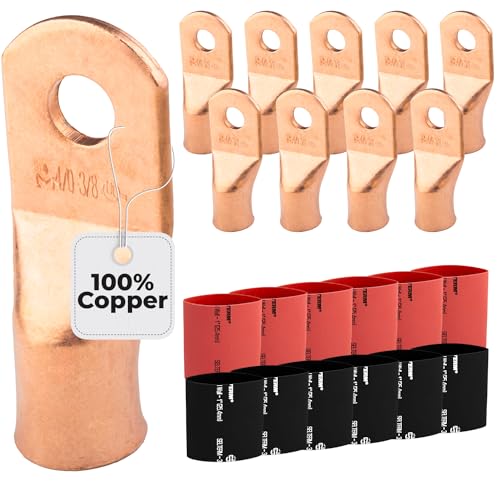
When your system demands 4/0 AWG cable—inverters, high-power amplifiers, or marine windlass circuits—the SELTERM 3630 kit delivers ten pure copper lugs with a 3/8-inch stud hole. Each lug is UL listed under File Number E254847 and tested to S.A.E. conductivity standards J163 and J1811, rated for 600V DC when properly installed with the included 3:1 adhesive-lined heat shrink tubing.
The barrel features a flared, rounded entrance to ease cable insertion and avoid cutting individual strands. The transition slope from barrel to pad is minimized to ensure the cable seats as deeply as possible. Twelve pieces of black and red 3:1 heat shrink come in the kit, each with hot-melt adhesive that oozes from the edges when shrunk, creating a moisture-proof seal.
At for ten lugs, the per-piece cost is higher than multi-gauge assortments, but the commitment to a single heavy gauge means no wasted lugs and no undersized barrels. The heat shrink quality is notably better than generic tubing—it shrinks at a lower temperature and the adhesive flows before the tube distorts. Some users wish more than twelve pieces of tubing were included for longer cable runs requiring multiple seals.
Why it’s great
- UL listed and meets S.A.E. conductivity standards for 4/0 AWG
- Adhesive-lined 3:1 heat shrink included for water-tight terminations
- Pure copper construction with tinned surface for corrosion resistance
Good to know
- Only 4/0 AWG size—no smaller gauges for auxiliary wires
- Heat shrink count (12) may be insufficient for longer cable assemblies
4. Deka East Penn 08864 Quick Connect Splice

The Deka East Penn 08864 is not a kit of loose lugs—it is a pre-assembled cable repair harness with a top-post dual cable splice. This makes it ideal for restoring a corroded or cut positive battery cable without removing the entire wiring loom. The 4-gauge pigtail connects to the battery clamp on one end and splices into your existing cable on the other, using a sealed barrel connector.
Installation is straightforward: cut the damaged section of cable, strip 3/8-inch of insulation, insert into the splice barrel, and crimp. The entire assembly is wrapped in a heavy-duty heat shrink sleeve from the factory. Multiple five-star reviews report it fixed theft-cut cables and restored 20-year-old starter wiring in under 30 minutes. The unit weighs 0.66 pounds and measures 9.63 inches in length.
At , this is a specialized solution rather than a general-purpose kit. The 4-gauge rating matches most stock battery cables, but it will not accommodate aftermarket 1/0 or 2/0 wiring upgrades. One reviewer noted that severe corrosion caused the terminal clip to deform and the bolt to seize; regular inspection of the splice area is recommended in harsh environments.
Why it’s great
- Pre-assembled harness for fast cable repair without re-wiring
- 4-gauge rating matches standard automotive battery cables
- Factory heat shrink sleeve protects the splice joint
Good to know
- Only available as a single positive or negative cable—not a pair
- Not suitable for oversized aftermarket cable gauges
5. Filluck 40pc Battery Cable Ends Kit
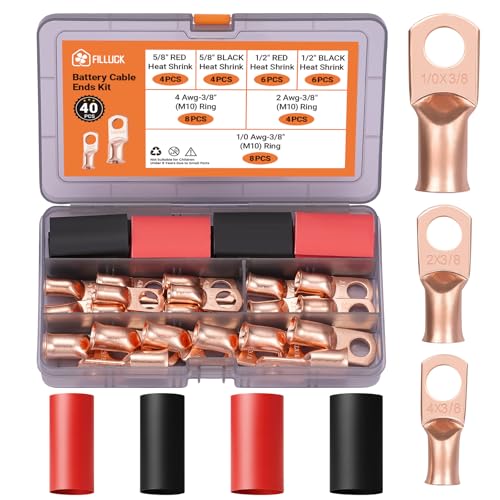
The Filluck F1-TE19 kit packs twenty pure copper ring terminals (eight 4 AWG, four 2 AWG, eight 1/0 AWG, all with 3/8-inch stud holes) plus twenty adhesive-lined 3:1 heat shrink tubes into a sturdy plastic organizer box. Each lug has an engraved model number on the pad for quick identification, and the barrel features a rounded, flared entrance that makes cable insertion effortless—critical when working with stiff 1/0 welding cable.
Reviewers specifically praise these lugs for re-wiring golf carts and building home solar arrays, noting that the heat shrink shrinks significantly and the glue visibly seals around the wire jacket. The storage bin is thicker than typical organizer cases, with a flexible plastic that withstands shop floor abuse. The kit supports both crimping and soldering, though the lugs are optimized for a standard six-ton hydraulic crimper.
At , the per-lug cost is economical, but the trade-off is that the 4 AWG count is highest while 2 AWG is lowest—four pieces may not complete a full vehicle rewire. Audio and non-standard copper-stranded cables may not seat fully in the barrel; verifying wire diameter before ordering avoids loose crimps.
Why it’s great
- Covers three common gauges (4, 2, 1/0 AWG) in one organized kit
- Rounded barrel entrance prevents strand damage during insertion
- Adhesive-lined heat shrink included for each lug
Good to know
- Only four pieces of 2 AWG included—may need a separate pack for full rewiring
- Non-standard audio cable may not fit the barrel correctly
6. Nilight 150pc Wire Lugs and Heat Shrink Kit

Nilight’s 50075B assortment includes seventy copper lugs spanning five AWG sizes (2, 4, 6, 8, 10) and ten stud diameters, plus eighty pieces of 3:1 color-coded heat shrink tubing. Every lug is stamped with its wire gauge and stud size on the face, eliminating guesswork when you are reaching into the box with greasy hands. The tinned copper surface provides basic corrosion protection for low-stress environments like car audio installs or grounding wires.
The strength of this kit is breadth: you can terminate a 10 AWG ground wire, an 8 AWG speaker cable, and a 2 AWG main power cable from the same box. This makes it a capable companion for multiple small projects rather than a single heavy-duty repair. Polyolefin heat shrink tubing offers basic waterproofing without the adhesive liner found in premium kits.
At , the value per terminal is extremely high, but the lug wall thickness is noticeably thinner than pure heavy-duty kits. Multiple reviews note that 2 AWG lugs can be bent with moderate finger pressure, which raises concerns under continuous high-current loads in marine or off-road applications. For light-duty automotive and DIY use, this is a solid entry-level choice.
Why it’s great
- Massive variety: 5 wire gauges and 10 stud sizes in one box
- Engraved gauge and stud markings for fast identification
- Tinned surface offers basic corrosion resistance
Good to know
- Thinner lug walls—2 AWG lugs can bend under finger pressure
- Heat shrink lacks adhesive liner, reducing moisture seal quality
7. Bateria Power Terminal Connectors Kit
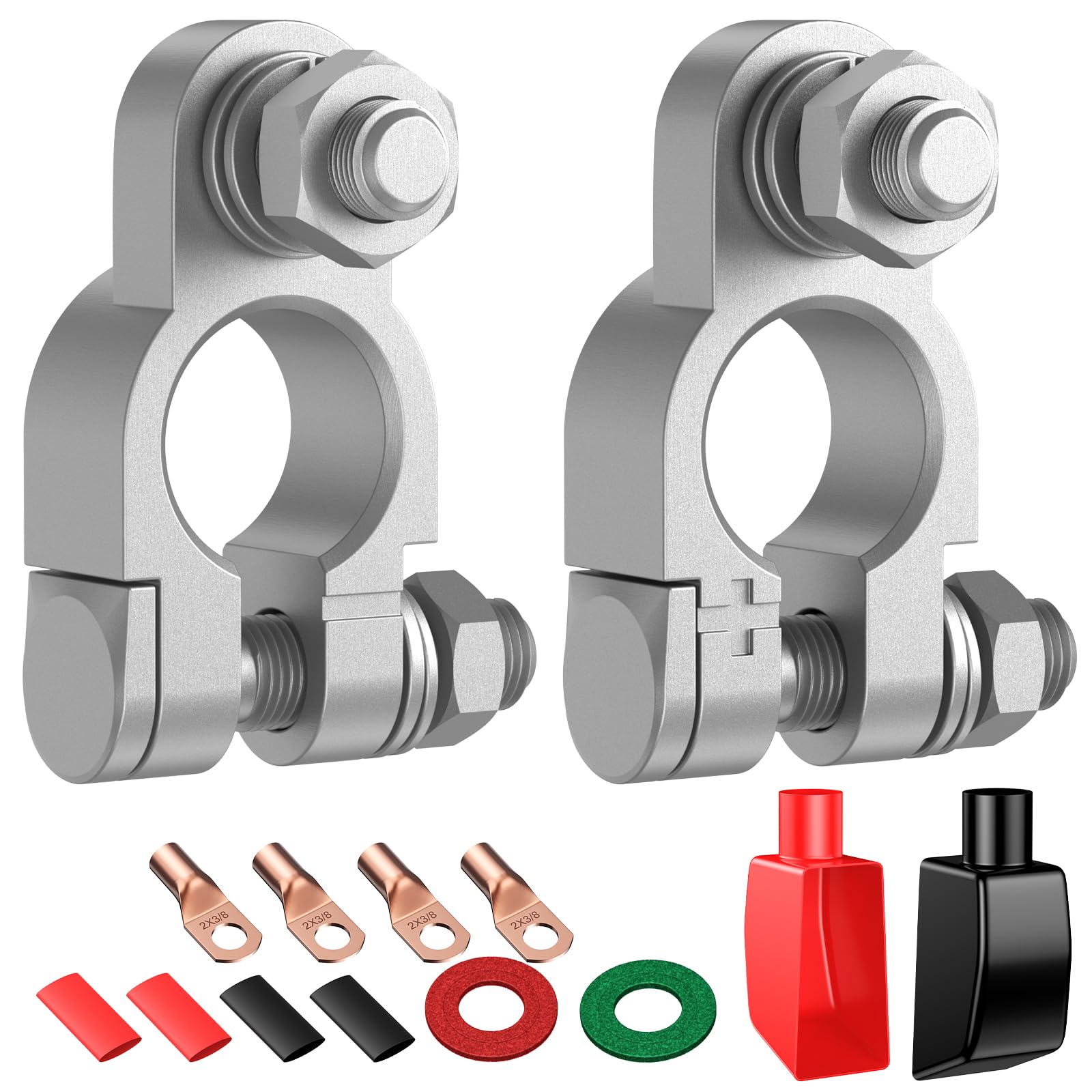
This entry-level kit from Bateria Power includes two heavy-duty copper battery terminals (positive and negative), two protective covers, two anti-corrosion washers, four 2-gauge 3/8-inch copper lugs, and four heat shrink tubes. The terminals are tin-plated for better corrosion resistance than raw brass, and the anti-corrosion washers sit under the terminal base to block acid creep from the battery post. The included covers snap over the finished connection, adding a layer of insulation against accidental shorting.
Installation is beginner-friendly: the bolts are pre-assembled, and the lugs accept 2 AWG cable. Reviewers consistently mention the tight, wobble-free fit on standard SAE top posts, with no need for shims or adapters. The positive terminal is visibly larger than the negative, reducing the risk of reverse polarity during installation.
At the entry-level price point, the copper lugs are functional but not as thick as premium alternatives. The kit does not include a crimp tool, nor does it support gauges smaller than 2 AWG. For a direct terminal swap on a standard car battery with minor cable repair needs, this is a reliable and affordable solution that gets the job done without fuss.
Why it’s great
- Complete terminal swap kit with covers, washers, and lugs
- Tin-plated copper terminals improve corrosion resistance
- Positive and negative terminals are clearly differentiated in size and color
Good to know
- Only supports 2 AWG cable—no smaller gauge options provided
- Lug thickness is moderate compared to heavy-duty professional kits
FAQ
Can I use aluminum lugs instead of copper for a battery terminal repair?
How do I know if my battery terminal needs a full repair kit versus just a cleaning?
Do I need a hydraulic crimper for 1/0 and 4/0 AWG lugs?
Can I solder battery lugs instead of crimping them?
Final Thoughts: The Verdict
For most users, the battery terminal repair kit winner is the Kaas Lead Acid Terminal Clamps because they combine aerospace-grade 6061-T6 aluminum construction with a conductive-zone contact design that delivers zero added resistance, plus the OEM adapter keeps your factory wiring intact. If you need twelve connection points for a heavily accessorized vehicle, grab the Vgate 12-Way Terminal Ends. And for a high-current 4/0 AWG repair with certified safety ratings, nothing beats the SELTERM Lugs Kit.